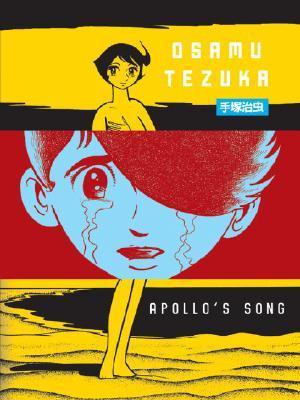
The gods with their poetic justice, can be unrelenting. Just ask the young cynic Shogo, who sinned against love. Electroshock therapy was only meant to bring him face to face with his own violent misdeeds, but instead landed him in the court of a stern goddess.
If the encounter was a hallucination, then it's a hallucination that starts to encroach on reality in this unforgettable tale penned by manga-god Osamu Tezuka and inspired by Greek myths of divine unforgiving. Sharing with his longer work Phoenix the themes of recurrence and retribution as well as the spirit of high invention, Apollo's Song explores the meaning of love and the consequences of its absence.
Shogo's mother is a bar hostess, his father could be any one of a dozen of her regular patrons. Growing up, he learns nothing of genuine love and tenderness, and when he witnesses his mother in the nearest approximation of which she's capable--lustful embrace--he receives a merciless beating soon afterwards. Shogo comes to hate the very notion of love. But goddesses, who are neither the Buddha nor Christ, do not excuse misfortunes of upbringing.
Apollo's Song reaches Olympian heights of tragedy as the story proceeds from a boxcar bound for a Nazi concentration camp to a dystopian future where human beings are persecuted by an ascendant race of their own clones. Will Shogo ever attain redemption, or, like the human race itself, will he have to relearn the lessons of love forever? Is it better to have loved and lost if the heartbreak must recur eternally?
Love, propagation, nature, war, death--Tezuka holds his trademark cornucopia of concerns together with striking characterizations, an unfailing sense of pacing, and of course, stunning imagery.
Though marked by a salty pessimism, this unique masterpiece from Tezuka's transitional period is also unabashedly romantic--and, at times, profoundly erotic. Combining a classic tale of thwarted love with cognitive ambiguities reminiscent of the work of Philip K. Dick, Apollo's Song is guaranteed to plumb new depths of the human heart with each rereading.
Dr. Osamu Tezuka (手塚治虫) was a Japanese manga artist, animator, producer and medical doctor, although he never practiced medicine. Born in Osaka Prefecture, he is best known as the creator of Astro Boy and Kimba the White Lion. He is often credited as the "Father of Anime", and is often considered the Japanese equivalent to Walt Disney, who served as a major inspiration during his formative years. His prolific output, pioneering techniques, and innovative redefinitions of genres earned him such titles as "the father of manga" and "the God of Manga."
Osamu Tezuka truly is the god of manga. The attention to detail is simply staggering, and he produced his hundreds of thousands of pages of manga over the decades the long, hard way. Sometimes, when reading his work, one simply must stop and marvel at the art, even during the most engrossing of tales.
Apollo's Song, given to me by a friend, is quite epic, whether examined alone or alongside Tezuka's other works. It features, of course, Tezuka's unmistakable comic drawing style, combined with a dark, deep story about eternal punishment. The contrast in the story and its presentation is itself something truly amazing, and it must be seen to be fully appreciated.
What happens to a man who hates the very concept of love? What must he endure in order to open up to the idea that even a troubled, abused fellow such as he can learn to truly love someone? What happens to our tortured anti-hero is nothing short of brutal, and never-ending. How he wound up being the sort of person he became can't truly be blamed on him, yet he receives retribution everlasting for rejecting love itself.
Shogo's journey is at times sweet, at times violent, and at times even peppered with hope, but is always a struggle. This story is a tragedy on a truly epic scale, stretching from the past well into the future, with the only constants being his name, his appearance, his punishment... and the face of one specific woman. The remaining details all change, yet his travels are very much a spiral, leading him downward into the bottomless.
This manga was made during a time when sex education was no longer taboo in Japan, and is not hesitant to take advantage of the new freedom this allowed the medium. This isn't one of Tezuka's family-friendly works. There's blood, there's nudity and enough else you don't want the young 'uns seeing. It's filled with plenty of immensely unlikeable characters supporting two very flawed, but ultimately likable people whose sad story has backdrops as brutal as the Holocaust.
Apollo's Song isn't for everybody. But for those who like solid story and the inimitable crafting and style of Osamu Tezuka, it's a must-read.
It was hard trying to rate this book. I quite enjoyed some of the vignettes, some ideas were interesting, and the art was good with some really impressive moments. But that was outweighed by a thoroughly unlikeable protagonist, a lot of heteronormativity and other uncomfortableness, and it not actually having much to say about love.
Un tomo representativo de la época "oscura" de Tezuka. Se trata de una serie de historias de amor trágicas y violentas ambientadas en distintas épocas unidas por un mismo personaje. Como otras obras de este período no llama precisamente al optimismo pero se deja leer.
Dated, melodramatic, and rather toxic gender and relationship tropes made this novel a flop for me. A young man who hates all expressions of love--to the point of killing animals and attacking couples--is cursed to fall in love with the same woman in successive lives, only for death to separate them before their love can be consummated. There follows a string of experiences where he basically forces his attentions on others, or occasionally other people force their attentions on him, and in most cases these persistent unwanted advances lead to something the author calls love (?!? NO !!!). In a few places some of the chapters feel very like stiff, awkward rapey porn ("If you really cared about curing me, you'd French me!" "Oh, your a**hole behaviour and coerced intimacy make my little heart go all aflutter!" / "You hu-manz will now demonstrate the act of love or I will torture you, mwa ha haaa!"). The author was trying to wax poetic about the ennobling nature of love, but shoots himself in the foot by concentrating only on sexual and/or reproductive aspects and using blatantly unhealthy relationship patterns as his examples of glorious romance, with a protagonist who pretty much stays a jerk despite the supposedly redemptive power of this 'love'.
This book was…different. The story centers on a teenage boy who, abused by his floozy of a mother, develops a pathological hated of love, or, more appropriately, sex. He has begun to act out his rage by slaughtering animal couples, and it is this behavior that sends him to the asylum in which our story begins.
First, the good. I appreciated that the storyline treats animal cruelty and killing for the pathology it is, and the act of harming animals is always taken seriously. There’s no talk of “sport” or “boys being boys” here. In the best vignette, Shogo dreams of visiting a mysterious island in which all animals live harmoniously. After Shogo thoughtlessly kills a rabbit, the animals take their revenge until the boy promises not to kill another land animal. Shogo still fishes for food, so it’s clear the author wasn’t “all the way there.” Nevertheless, I think he was definitely on the right track—especially when one considers the date this book was published.
However, although I liked the author’s stance on animal welfare, I did not like the overarching theme of the book. The artist’s near-obsession with the breeding process as being central to “love” stigmatizes the childfree as well as the asexual. All of the talk of love as expressed by the heterosexual pairing also conspicuously ostracizes gay individuals. And of course, we also have all of the fun stereotypical gender roles. All of that really bothers me.
A strange, but enthralling piece of work that tells the story of a cursed soul. The protagonist, Shogo, is a man so unable to understand love that Athena curses him to live countless lives where he will learn to love only to lose it at its apogee. What follows is various tales of love found and lost, teaching Shogo that love is an eternal cycle of bliss and pain.
It is a strange piece of fiction and to some extent twisted. Its greatest flaw is that Tezuka spends sometimes too little time in each period which tends to make the love between the protagonist and his true love a bit forced.
It is otherwise a thought provoking piece that depicts the eternal conflict that is the love between people. Whether it is past, present, or future.
This isn't MW cruel but it's not that far off. Our protagonist, having received no love from his parents growing up becomes a cruel psychopath whenever he witnesses couples express love towards each other. Eventually he is cursed to fall in love and lose his love for the rest of eternity. There's an very interesting character arc here and it made for some captivating reading, I devoured the book but at the end, I was hoping for something better, something closer to closure. Obviously the art was astounding as well.
Astro Boy or Apollo -- we all love, need to love, to be loved, and I loved this book! enjoy.
It's a graphic novel for adults, with an hysterical opener reminiscent of Woody Allen. If you enjoy odysseys of the heart, and are curious about Manga, you'll definitely enjoy this title from one of the masters of the genre.
Not one of Tezuka's greatest, but it is ambitious and contains many of his fixations: what it means to be human, respect for nature and the environment... It is overlong and a bit repetitive, but still an interesting read... It is clear why Tezuka is considered the god of Manga, even his weakest work has interest...
A psychologically damaged delinquent named Shogo is cursed to perpetual nightmares of tragic romance.
This is more of a parable or allegory than it is a fleshed out story. The characters lack depth or a robust set of traits and their actions are poorly motivated. The plot is simple and cyclical. Shogo meets a woman, starts a romance, then one or both die horribly in a disaster. Repeat ad nauseam. It’s a passive setup where forces act upon Shogo more than Shogo takes action. He’s violent, angry, and impulsive, incapable of forming and pursuing a rational goal.
In an attempt at variety, each scenario has a different, wacky setting, but each is so superficially constructed and poorly thought out that it does little to garner interest. A bunch of goofy twists come and go out of nowhere, none of them with any purpose other than filling pages.
The story touches on a host of emotionally fraught topics — suffering, death, torture, love, lust, infidelity, jealousy, abuse, rape, mental illness, the Holocaust etc. Grave themes alone can’t give a book gravitas, however. Apollo’s Song offers only the cheap manipulation of emotion and shock value. Such as animals smashed by rocks.
The author is trying and failing to say something about the power of love. Perhaps that love perpetuates suffering, but also redeems it. It’s hard to tell through all the random violence.
The art is quite bad, with little detail and poorly drawn characters. The anatomy, expression, and construction are on a basic level that is almost insulting. The linework is crude and ugly. No thought or care is evident; the goal seems to have been producing as many pages as possible.
The storytelling is very well done. I think this is why Tezuka is the “god of manga.” It flows smoothly and reads clearly with a good variety of camera angles and framing, and plenty of space to breathe, including many panels that are used to show reactions, clarify action, or set mood. This somewhat cinematic approach to panel layout is far beyond what was practiced in the west at the time, with western comics using static, flat camera angles, repetitive framing, and dense, crowded pages. In fact western comics didn’t broadly employ the more sophisticated manga storytelling techniques until after the turn of the millennium.
Apollo’s Song juxtaposes a simple cartoon style with brutal, troubling content that touches directly on real world tragedies and fears. This combination, perhaps a bit counterintuitive, is actually effective at creating drama and has been used in other books such as Maus and Persepolis.
The nature of the cartoon is to simplify — to reduce something to its essence, distilling what is important and thereby emphasizing or exaggerating it. Thus people can read their own lives and experiences into the cartoon symbols, filling in their own details as it were. More realistic art when dealing with these themes almost inevitably comes off as melodramatic — think of Neal Adams’ or Alex Ross’ weeping characters for instance.
It was a bit convoluted at times. For a bit I thought he was still in the psych center and having a dream about escaping. Some of the short “lives” seemed almost filler or inconsequential to the larger narrative.
But I actually liked how disturbed the character was up front. I didn’t care enough about him to worry about his redemption, but some of those early parts of the story were unsettling, especially with the cutesy manga art. I was drawn in by how horrific it was when it started.
I was hoping for an exploration of love or hatred and murder, but ultimately the themes were only superficially explored.
But I liked the art. And it was a fun read. Not great but not terrible.
Perfection. The main theme. The characters. The narrative style.The art style. I thoroughly enjoyed this manga. I knew it was going to be amazing when I read the blurb and remembered who the author was. Some years ago I read his Buddha series and was overawed. I've had the same feeling again with this book. I'm in awe of Osamu Tezuka's gift for narrating. Read this and see for yourself! I strongly recommend.
Apollo’s Song is a manga epic about a young man who does not believe in the concept of love. He goes on an epic journey of different universes where he encounters the same woman in each universe. There’s love, hate, violence.
A lot of the gender politics in this have not aged well.
The art and scope of this book, though, is still impressive.
In all honesty the psychology in this is so embarrassingly bad and the story so repetitive that it’s realistically a 2/5, but Tezuka at least attempts something bold and that alone is so rare in this broken medium that you have to appreciate the existence of something so different. The same cannot be said for film, so please don’t quote me on that; directors need more editing lol.
Osamu Tezaku is the unmistaken giant of Manga and Anime, but I cannot say I like 'Apollo's Song'. There much to say against it: it's overlong, it's all over the place, it has an immature obsession with sex, it's badly composed, it has a very unsympathetic protagonist, it's all too melodramatic and it's inconsistent in both mood and style. The book is neither melodrama, nor erotic novel, nor comedy, but contains elements of all to fall into a gap between. The overall idea of Shogo falling in love again with the same woman every incarnation is badly worked out, and leads to nowhere. Tezaku can't even focus on his protagonist, suddenly shifting to Hiromi and her story on page 262. It seems that Tezaku composed his tale as it came along. I wish he had dared to make more choices. For example, the future episode in itself contains some interesting ideas. In all, 'Apollo's Song' is a missed opportunity. Tezuka certainly could do better.
Apollo's Song was one of the first non-AstroBoy Tezuka works I'd seen and it is definitely one of my favorites. Shogo has a complex where he can't stand LOVE. That's any outward expression of love or caring-- it puts him in a homicidal rage. He's admitted to the psychiatric hospital when he's caught murdering a dove, and experiences a vision during electroshock therapy. He experiences several other 'dreams' during the manga (usually after a falling down a ravine or exhaustion) where he is fated to learn what'love' is and how he can accept it and that he can love/be loved. Things get a little twisty at the end but it's still great.
Love comes in many forms and isn't easily explainable-- but Tezuka presents what he thinks it is, and the biological side of the matter too. It's sorta cute with the personified sperm too. :)
I couldn't put this book down. Tezuka's works are so pure, so violent. "Apollo's Song" puts Tezuka's darkest, most depraved thoughts on the center stage in this stunningly illustrated manga. The themes explored in this work must certainly have been ambitious at the time, considering Japan's general stigmas against mental health. Unraveling the awful complexities of Shojo's violent disdain for love is deeply disturbing, and we're only endeared to him via Tezuka's skill at cultivating empathy through his innocently drawn characters. If I had to pick my favourite aesthetic in comics and graphic novels, it's cutsey, innocent-looking characters cast against ruthless, gritty worlds. "Apollo's Song" delivers just that in spades, with all the violence, rape, murders, incest, and most often beatiful scenes to prop up another Tezuka masterpiece.
A boy who hates love (his mama was neglectful, and a prostitute) is cursed to continually find his true love, only to have either her or himself die shortly after realizing their true feelings.
Tezuka fits three variations on this theme into 530-odd pages, and some readers might not like the "life sucks, and then just when you think it's gonna get good, it gets 1000x worse" theme of it, but Tezuka does a great job assembling the story, finding different twists on the lead characters and keeping everything engaged. And he really draws out some of the sequences, so you can't expect the final death as readily as you'd expect to.
Tezuka's art is expressive and animated, and the storytelling is very strong. He works in medical aspects, sci-fi, war and deserted island themes to keep things fresh, and all of the characters are believable. Not a cheerful book, but a good one.
Who said Manga (comics) cannot be serious and meaningful? A standing ovation to Apollo's song by Osamu Tezuka. Derived from the myth of Apollo's unrequited love for Daphne who in her eternal evasion turned into a laurel tree, Apollo's song told of an eternal cycles of human struggle for love and union. An interesting and entertaining book. I enjoyed the whole story greatly (Don't get hung up about the part that the characters seem to mix up sexual union with love, and yes, "procreational heterosexual love" - as it was so viewed by non-human characters). Beautiful drawing, intriguing plot, rich storyline - a master piece.
Tezuka's place in the history of modern pop culture is hard to overstate (both in Japan and abroad, given the reach Astro Boy had), which is what led me to Apollo's Song. Unfortunately, I couldn't really get into it. Tezuka had stated that Apollo's Song was a response to/reflection of changing societal moods in Japan in the 70s, so I'm not surprised that it didn't land as well with four decades later and half a world away. The variety of vignettes is nice, but I didn't find myself connecting to any of them emotionally. In a manga entirely about the meaning and experience of love, that was a significant roadblock.
Tezuka is rightfully a legend in manga and I’ve enjoyed much of his works but this was a bit of a disappointment. Obviously it’s easy to look dismissively at the gender politics negatively fifty years later but definitely problematic through most of it. Despite seemingly being redeemed a few times through the book, there isn’t really much to celebrate here in our very flawed protagonist.
The art is classic Tezuka, as you would expect which also unfortunately means that there is only one body type for all the women with an hourglass figure and gravity-defying breasts. Fine for completionists but ultimately skippable despite some interesting ideas.
This is a strange graphic novel. But how could I resist reading a book by the grand-papa of Japanese manga that also weaves in characters from Greco-Roman mythology? While my head spins at the extreme heteronormativity of the piece--which basically apotheosizes heterosexuality--I'm intrigued by Tezuka's use of the story of Apollo and Daphne as a foundational myth of desire. I think that Ovid uses the story of Apollo and Daphne in the Metamorphoses to a similar end, but Tezuka has re-worked Ovid's version in significant ways to make it fit his own vision of human desire.
This entire review has been hidden because of spoilers.
4 & 1/2 stars. a minor masterpiece, this one. a long discursion on the subject of love: where it comes from, what it's made of, what it leads to. the characters change utterly across time, yet at every point we can understand them. the Greek myth of Apollo and Daphne figures into one segment of the story, while another sequence centers around an alien race in the far future, but all the segments are tightly woven into the larger story. the treatment of voice is also remarkable: its romantic tendencies nicely tempered with a salty streak of raw realism. a beautiful edition from Vertical, too.
So GOOD. Mythic, gorgeous, and well paced. The godfather of manga creates whole worlds in the span of a page or two...There's an island ruled by peaceful animals (it reminded me of LOST, what can I say), and a future where the world is run by robots and there are stadiums full of the graves of humans... Artistically amazing, and the story doesn't suck either. And I say this as someone who has no real interest in manga as a genre...so..it must be true?
As a time capsule, this one was really interesting. Unfortunately, Apollo's Song stood too proudly on the soapbox for me, even for a morality tale, I think. Churned the stomach a little bit. But Tezuka also wrote something that I haven't seen in any other comics before, for japanese, american, or anywhere else, for that matter. There are over 500 pages to this one, so expect an investment of a couple hours. Not sure if it was worth the time, to be honest.