

What do you think?
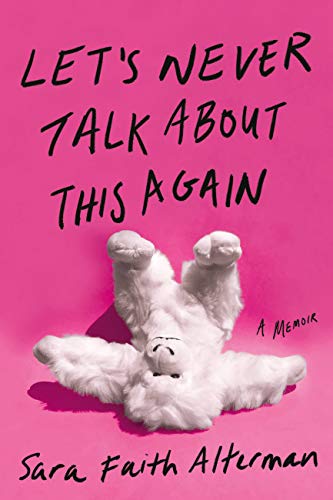
Let's Never Talk About This Again: A Memoir
Samantha Irby meets Bettyville in this darkly funny and poignant memoir about love, loss, Alzheimer's, and reviving her father's pornographic writing career from Mortified writer and producer Sara Faith Alterman.
12-year-old Sara enjoyed an G-rated existence in suburban New England, filled with over-the-top birthday cakes, Revolutionary War reenactments, and nerdy word games invented by her prudish father, Ira. But Sara's world changed for the icky, when she discovered that Ira had been shielding her from the truth; that he was a campy sex writer who'd sold millions of books in multiple languages, including the wildly popular 'Games You Can Play with Your Pussy.' Which was, to the naive Sara's horror, not a book about cats. For decades the books remained an unspoken family secret, until Ira developed early onset Alzheimer's disease...and announced he'd be reviving his writing career. With Sara's help.
In this cringeworthy, hilarious, and moving memoir, Sara shares the profound experience of discovering new facets of her father; once as a child, and again as an adult. 'Let's Never Talk About This Again' is a must-read confessional from a woman who spent years trying to find humor in the perverse and optimism in the darkness, and succeeded.
12-year-old Sara enjoyed an G-rated existence in suburban New England, filled with over-the-top birthday cakes, Revolutionary War reenactments, and nerdy word games invented by her prudish father, Ira. But Sara's world changed for the icky, when she discovered that Ira had been shielding her from the truth; that he was a campy sex writer who'd sold millions of books in multiple languages, including the wildly popular 'Games You Can Play with Your Pussy.' Which was, to the naive Sara's horror, not a book about cats. For decades the books remained an unspoken family secret, until Ira developed early onset Alzheimer's disease...and announced he'd be reviving his writing career. With Sara's help.
In this cringeworthy, hilarious, and moving memoir, Sara shares the profound experience of discovering new facets of her father; once as a child, and again as an adult. 'Let's Never Talk About This Again' is a must-read confessional from a woman who spent years trying to find humor in the perverse and optimism in the darkness, and succeeded.
273 pages, Kindle Edition
First published July 28, 2020
Ratings & Reviews
Friends & Following
Create a free account to discover what your friends think of this book!
Community Reviews
Displaying 1 - 30 of 131 reviews

August 18, 2020
Such a great and poignant memoir. Made me laugh and cry.

January 7, 2021
This is really well loved by most but it didn't do much for me and parts left me somewhat bothered. This is supposed to be a memoir about Alterman's father and her relationship with him, but she makes it about herself for most of the book. I don't know why we needed so many details about things like her first boyfriend, the crappy guy who used her for sex, her planned c-section, how much she was afraid she wouldn't like her baby, her bad camping trip with the guy she married, etc.
Why so much information about her sex life as a teenager and how her boyfriend left her for another girl? Why so little on why she loved her father? She presents him as an uptight and controlling jerk for most of her childhood even though she says several times at the end that he was funny and admirable. She doesn't show that. She gives lots of examples of him being prudish and kind of an ass, and then she basically makes fun of him for losing his memory, becoming fixated on reviving his sex books, telling the same stories, and becoming a "crazy old man."
Then she gives heartbreaking details like the scene of him lying on the floor of the nursing home in nothing but an adult diaper and moaning, with the staff having to use a crane to get him back into bed. What loving daughter puts that in a memoir of a man she claims to love and admire? This is how most of the world will come to know this man. That breaks my heart.
It is so hard to balance giving painful facts with protecting a person's dignity. If Alterman had done more to show us what a funny, loving, wonderful man her father might have been, I would forgive the mocking tone of most of this book. But she never does. She never really seems to care about anybody in her life other than herself and how everything affects her. I know she must, but she writes all about how her father's terrible illness affected HER and occasionally her poor mother, but she's the major victim of Alzheimer's in her story.
I rarely found the book funny and I didn't find it touching. I kept thinking how horrified her proud father would have been to have this be his legacy. She was dumbfounded that her father would want to write his comedy sex books with her once he was old and she was grown, instead of realizing that parents do eventually see their grown children as friends and peers and that it was a sign that he just saw her as a competent person who could have helped him with something that he was actually very proud of and hopeful about.
Alterman made her title very similar to Jenny Lawson's "Let's Pretend This Never Happened," which seemed a little strategic to me. I see that Lawson wrote a glowing review of this book and wonder if they're friends. Alterman does seem to emulate Lawson but she lacks Lawson's raw vulnerability and emotional honesty. She just comes across as cold and self centered to me.
Alzheimer's is such a terrible disease. The people it strikes deserve to be treated with sensitivity and respect. This story could have been told to balance the humor and tragedy, keeping Ira's dignity yet still telling the truth. Ultimately though, it didn't.
I read a digital ARC of this book for review.
Why so much information about her sex life as a teenager and how her boyfriend left her for another girl? Why so little on why she loved her father? She presents him as an uptight and controlling jerk for most of her childhood even though she says several times at the end that he was funny and admirable. She doesn't show that. She gives lots of examples of him being prudish and kind of an ass, and then she basically makes fun of him for losing his memory, becoming fixated on reviving his sex books, telling the same stories, and becoming a "crazy old man."
Then she gives heartbreaking details like the scene of him lying on the floor of the nursing home in nothing but an adult diaper and moaning, with the staff having to use a crane to get him back into bed. What loving daughter puts that in a memoir of a man she claims to love and admire? This is how most of the world will come to know this man. That breaks my heart.
It is so hard to balance giving painful facts with protecting a person's dignity. If Alterman had done more to show us what a funny, loving, wonderful man her father might have been, I would forgive the mocking tone of most of this book. But she never does. She never really seems to care about anybody in her life other than herself and how everything affects her. I know she must, but she writes all about how her father's terrible illness affected HER and occasionally her poor mother, but she's the major victim of Alzheimer's in her story.
I rarely found the book funny and I didn't find it touching. I kept thinking how horrified her proud father would have been to have this be his legacy. She was dumbfounded that her father would want to write his comedy sex books with her once he was old and she was grown, instead of realizing that parents do eventually see their grown children as friends and peers and that it was a sign that he just saw her as a competent person who could have helped him with something that he was actually very proud of and hopeful about.
Alterman made her title very similar to Jenny Lawson's "Let's Pretend This Never Happened," which seemed a little strategic to me. I see that Lawson wrote a glowing review of this book and wonder if they're friends. Alterman does seem to emulate Lawson but she lacks Lawson's raw vulnerability and emotional honesty. She just comes across as cold and self centered to me.
Alzheimer's is such a terrible disease. The people it strikes deserve to be treated with sensitivity and respect. This story could have been told to balance the humor and tragedy, keeping Ira's dignity yet still telling the truth. Ultimately though, it didn't.
I read a digital ARC of this book for review.

August 4, 2020
In this hilarious and loving tribute to her father, Alterman writes about realizing your parents are fallible humans with lives of their own. In the case of Alterman’s dad it’s a secret life writing punny sex books and suffering from Alzheimer’s. Full of 80s and 90s nostalgia from her childhood and surprisingly vulnerable moments of becoming a parent herself while caring for her father. A funny and touching read.

June 5, 2021
Alterman touches on her childhood focusing largely on her father Ira’s surprising, hidden career, but the real takeaway is the later experience of his Alzheimer’s disease. The early stages are so hard. And denial is a beast. If you’ve ever experienced this with a loved one, then you know. You begin to mourn while they’re living. It’s fucking unbearable. Alterman is funny, honest, and thoughtful. This hit home.

November 12, 2020
I loved the premise of this book and while I found parts of this book witty, heart wrenching and charming, a lot of it was frustrating. I understand that the author had a lot to be frustrated about while dealing with her fathers illness, however I also feel there were some other emotions that could’ve shone through that didn’t.
I just don’t really think this book was for me 🤷🏼♀️.
I just don’t really think this book was for me 🤷🏼♀️.
April 7, 2021
I expected this book to be funny and sad, and didn't really find it to be enough of either. The author writes with an emotional detachment and lack of empathy for her father, coupled with an extraordinarily self-absorbed story that should have been more about her father and the family as a whole as they dealt with everything Alzheimer's does to everyone involved. I was prepared for dark humor but I didn't really find any. Some scenes may have seemed funny to the author but they struck me as more tragic. I did feel great sadness, but I felt it despite the author's recollection of the events, not with her. How sad for this man that the world will know him from the embarrassing, pitiable actions of his final years and his frantic desire to fix all that was so terribly unraveling. While many of us can relate to what it's like to lose a loved one to Alzheimer's like this (and to worry about succumbing to it ourselves), I don't think this is the book to bond over, sadly. I do hope that it helped the author in her healing and processing of all that happened, though.

April 26, 2022
Sad with a lot of unnecessary details about the author's teen years, it's the interesting story of her relationship with her father. There's no sugar coating the tragedy of Alzheimer's but Alterman's honesty in sharing her less-than-perfect handling of her father's decline is refreshing. Her voice is friendly and humble. The underlying story about her dad's writing of porno books isn't the main focus though that seems to be how it's marketed. For those who've suffered the loss of a parent, the emotions are all here - with some heartbreaking realities and a little bit of snarky humor.
Favorite quotes:
"Your parents aren't supposed to be old; your parents are supposed to be infallible".
"The internet is a trend. It's stupid. People want human connection".
Favorite quotes:
"Your parents aren't supposed to be old; your parents are supposed to be infallible".
"The internet is a trend. It's stupid. People want human connection".

August 18, 2020
I find myself wanting to apologise for not liking this book. It's a sweet sad story but not much goes on. The main character offers no development, no passions, it felt more like a verbal account of her relationship with her dad.

November 9, 2020
LET'S NEVER TALK ABOU THIS AGAIN: A MEMOIR is a remembrance of the author, Sara Alterman's father, Ira. I enjoyed the book and it brought me to tears a couple of times as the story and the emotion is quite close to that of my own father, although he didn't write sex books, he did write a book. I loved how Ms. Alterman's account was truthful about the feelings of children as their parents begin to fail. I don't think it matters that the child is an adult and the parent is old... when a child idolizes their parent, the fall is even harder to watch.
The book was quite funny in a dark way, sort of gallows humor of impending death. But it was a pretty good read and I did enjoy it.
4 stars
Happy Reading!
The book was quite funny in a dark way, sort of gallows humor of impending death. But it was a pretty good read and I did enjoy it.
4 stars
Happy Reading!

December 17, 2020
4 stars! This book was hilarious, dark and at times wildly uncomfortable. Alterman does a lovely job making the reader smile during some of her hardest times. A laugh-cry memoir that’s worth the read!

December 17, 2020
Genuine, affecting, and compassionate!
Let’s Never Talk About This Again is a touching, tender memoir that delves into the special relationship between Sara and her family members, as well as the complex dynamic shift that occurs between her father, Ira, and herself as he ages, reveals secret writings, seeks employment in a technology-fueled world, and eventually suffers the debilitating and devastating effects of early-onset Alzheimer’s.
The prose is heartfelt and warm. And the novel is an often funny, sincere tale of one woman’s personal experience supporting and caring for her parents in the best way possible while living across the country and planning for a family of her own.
Overall, Let’s Never Talk About This Again is an honest, entertaining, lovely tale by Alterman that reminds us that the most important things in life are loving large, sharing moments, and remembering all the special times.
Thank you to Grand Central Publishing for providing me with a copy in exchange for an honest review.
Let’s Never Talk About This Again is a touching, tender memoir that delves into the special relationship between Sara and her family members, as well as the complex dynamic shift that occurs between her father, Ira, and herself as he ages, reveals secret writings, seeks employment in a technology-fueled world, and eventually suffers the debilitating and devastating effects of early-onset Alzheimer’s.
The prose is heartfelt and warm. And the novel is an often funny, sincere tale of one woman’s personal experience supporting and caring for her parents in the best way possible while living across the country and planning for a family of her own.
Overall, Let’s Never Talk About This Again is an honest, entertaining, lovely tale by Alterman that reminds us that the most important things in life are loving large, sharing moments, and remembering all the special times.
Thank you to Grand Central Publishing for providing me with a copy in exchange for an honest review.
January 18, 2021
In her memoir, Let’s Never Talk About This Again, Sara Alterman deploys an uneasy mix of humor and sorrow to detail her father’s sharp decline in the face of Alzheimer’s Disease. Parts of her story were laugh-out-loud hilarious. Parts were absolutely cringe inducing. Mostly though, her story was sad in a bittersweet sort of way.

May 2, 2021
The first half of the book was funny and light and fast. The second half of the book where she focuses on her father’s Alzheimer’s spoke to my heart. Lots of tears as I read about her experience which was so similar to my own experience with my mom. Definite five stars for the second half.

October 20, 2020
From the premise and cover, I expected this to be a humor-type memoir, and it IS funny, but the heartwarming love outshines the laughy bits. Lovely story of an imperfect family trying to love each other, imperfectly. Definitely recommend.

August 26, 2020
Such a good memoir. It makes you go through multiple emotions

March 8, 2022
I won this book, so I went into it not knowing what to expect. I loved it; I laughed, I cried (a lot, and continue to as I type) and didn't want to put it down.

April 22, 2022
really liked this book until i didn’t

April 14, 2024
This book really put in perspective to appreciate my parents as they age. Like everyone this made me cry. I thought it was an easy read and shared a heartfelt story. Although the sexual references felt unnecessary. I would recommend.

January 31, 2021
Not at all what I was expecting. Very engaging, and a bit heart wrenching.
December 31, 2020
I enjoyed this poignant memoir by Sara Alterman about her relationship with her father who died from Alzheimer’s disease at the age of 70. Growing up in a close-knit family of four, Sara, her parents, and brother enjoyed word play, puns, jokes and pranks, family car trips and their life in a small Massachusetts town in the Boston suburbs. When Sara is in middle school, she begins to look at her father differently after she finds some pornographic books written by him before she was born. Sara is mortified and cannot believe that her prudish father who never mentions the word sex would have written these volumes. She vows never to talk about this again. It is only when her father’s Alzheimer’s begins to reveal a hidden side of his personality that she learns the truth about his earlier writings.
Sara writes honestly with humor and compassion about her father’s decline and its effect on her and her family. Plenty of laughs and tears while reading this memoir. Highly recommended.
Sara writes honestly with humor and compassion about her father’s decline and its effect on her and her family. Plenty of laughs and tears while reading this memoir. Highly recommended.

November 11, 2020
I’m going to be honest, this one was really personal for me. My family is no stranger to Alzheimers disease. My nana was diagnosed with it when she was 76 years old and passed away a shell of herself 4 years later. Her son, my dad, is 76 now and currently going through his own Alzheimers testing. It’s scary. Seeing him confused is scary. We don’t know what the future holds but I’m choosing to remain both optimistic AND realistic.
Although I’m holding onto hope that he’s not going to get the diagnosis we fear, I’m still choosing to prepare myself just in case. When I’m fearful of something I hide in research. I want to know every what if. The good and the bad. I don’t want sugar coating, I want it straight. So when Grand Central offered to send this book my way I jumped on it. And I’m so glad I did.
Sara’s father, Ira, reminds me so much of my dad, less the hiding of everything perverse. My dad was the opposite. He let me watch It when I was 8 and Pulp Fiction when I was 9. He shared all his young 70s free love and party stories with me when I was probably too young to hear them. But in so many other ways Ira reminded of my dad. From his fiery temper followed by a quick apology (never in words, always in actions) to his sense of humor. And unfortunately the things that Sara experienced before his diagnosis are the same sorts of things we’re experiencing now. This book hit really close to home for me. It was hard to read but very cathartic. It was like therapy for all the fears I’m holding. And this book is funny! I recounted some scenes to my husband in bed one evening and we laughed together. I wept deeply at the end and released a lot of the emotions I’ve been burying inside. This book is also a love letter from a daughter to her father and it’s beautiful.
This is why books are so important. They can prepare us for things and give us a new perspective. They promote empathy.
I will treasure this book and if you are going through something similar I highly recommend picking it up.
Although I’m holding onto hope that he’s not going to get the diagnosis we fear, I’m still choosing to prepare myself just in case. When I’m fearful of something I hide in research. I want to know every what if. The good and the bad. I don’t want sugar coating, I want it straight. So when Grand Central offered to send this book my way I jumped on it. And I’m so glad I did.
Sara’s father, Ira, reminds me so much of my dad, less the hiding of everything perverse. My dad was the opposite. He let me watch It when I was 8 and Pulp Fiction when I was 9. He shared all his young 70s free love and party stories with me when I was probably too young to hear them. But in so many other ways Ira reminded of my dad. From his fiery temper followed by a quick apology (never in words, always in actions) to his sense of humor. And unfortunately the things that Sara experienced before his diagnosis are the same sorts of things we’re experiencing now. This book hit really close to home for me. It was hard to read but very cathartic. It was like therapy for all the fears I’m holding. And this book is funny! I recounted some scenes to my husband in bed one evening and we laughed together. I wept deeply at the end and released a lot of the emotions I’ve been burying inside. This book is also a love letter from a daughter to her father and it’s beautiful.
This is why books are so important. They can prepare us for things and give us a new perspective. They promote empathy.
I will treasure this book and if you are going through something similar I highly recommend picking it up.

Read
March 19, 2022 The advanced billing for this book was certainly most worthy, as LET’S NEVER TALK ABOUT THIS AGAIN, lived up to expectations. It is a warm and moving memoir about one daughter’s relationship with her father, along with a most telling family secret.
While the secret is the crux of the book, what her father said, impacted her more than what he wrote. The story revolves around books Sara found accidentally in a bedroom closet. There was a treasure trove of adult books hidden there, all written by her father. A curious young girl managed to find them, even though they were craftily concealed.
Adult in nature, they were very tame compared to what is available today. She never mentioned to her father or brother that she stumbled upon them. She harbored this secret in the back of her mind as she grew older. But the big deal was the fact that her father had written so many of the books in that secret stash.
For someone who had made a career of writing about sex for a living, her father was very strict about Sara’s dating habits and boyfriends. It was an odd juxtaposition of sorts. The book details this and then gets more interesting when Sara relates how her father when nearing age sixty-five lost his job and wanted to revive that lucrative porn career.
He was showing signs of Alzheimer’s, so it became Sara’s duty of sorts to help him with his latest efforts. She had no objection or problems editing and giving her father purpose in life even as the disease threatened to take away his independence.
The book may be about sex, but it is also about secrets and a daughter’s love, looking past what someone had done, but rather acknowledging who they were.
While the secret is the crux of the book, what her father said, impacted her more than what he wrote. The story revolves around books Sara found accidentally in a bedroom closet. There was a treasure trove of adult books hidden there, all written by her father. A curious young girl managed to find them, even though they were craftily concealed.
Adult in nature, they were very tame compared to what is available today. She never mentioned to her father or brother that she stumbled upon them. She harbored this secret in the back of her mind as she grew older. But the big deal was the fact that her father had written so many of the books in that secret stash.
For someone who had made a career of writing about sex for a living, her father was very strict about Sara’s dating habits and boyfriends. It was an odd juxtaposition of sorts. The book details this and then gets more interesting when Sara relates how her father when nearing age sixty-five lost his job and wanted to revive that lucrative porn career.
He was showing signs of Alzheimer’s, so it became Sara’s duty of sorts to help him with his latest efforts. She had no objection or problems editing and giving her father purpose in life even as the disease threatened to take away his independence.
The book may be about sex, but it is also about secrets and a daughter’s love, looking past what someone had done, but rather acknowledging who they were.

Read
March 10, 2022This was messy, which I love in a memoir. There were funny parts, sad parts, relatable parts. I love memoirs like this.
It has enough substance to be interesting without the author taking herself too seriously or trying too hard to push a certain message.
Like can you imagine your super prudish father wrote really weird sex books? And then as his dementia progresses he loses his filter and wants your help writing another sex book? I could feel the author cringe reading those parts.
I think this book can come across a little more emotionally detached than you’d expect for a memoir about something so devastating. But as a person who doesn’t talk or think about feelings, I get it.
All in all, a very quick and fun memoir, with depth. It would be a great beach or pool read. The chapters are short enough to read in between your kids yelling “mommy watch this!” Before they do another jump spin.
It has enough substance to be interesting without the author taking herself too seriously or trying too hard to push a certain message.
Like can you imagine your super prudish father wrote really weird sex books? And then as his dementia progresses he loses his filter and wants your help writing another sex book? I could feel the author cringe reading those parts.
I think this book can come across a little more emotionally detached than you’d expect for a memoir about something so devastating. But as a person who doesn’t talk or think about feelings, I get it.
All in all, a very quick and fun memoir, with depth. It would be a great beach or pool read. The chapters are short enough to read in between your kids yelling “mommy watch this!” Before they do another jump spin.

September 27, 2020
Raised in a very strict household where her parents wanted their kids to learn no cuss words, hear anything about the concept of sex, or listen to up-to-date music, the author was poking around one day and found something interesting. A bunch of "sex" books, many with illustrations, that were written by her father. She spent her childhood sneak reading the books but never asking about them. When her father develops Alzheimer's, and money problems, he tries to get her to co-author another crop of these books. This memoir has its very funny moments and the author does a great job narrating her own book but I didn't find it compelling enough to recommend widely.
October 30, 2020
It’s really a book about Alzheimer’s, seeing your parents as people, and that time in life when the child starts taking care of the parents. It’s also about the struggle between what you should want or do, what you actually do, and the guilt and forgiveness that results. It’s a quick read, but one that really struck a chord for me.

December 18, 2022
This one was really eye opening! I enjoyed the writing and the humour in it! I enjoyed the explanations of her life, and everything she has been through!
It was so inspiring, and I loved every inch of it! All young adults need to read this one!
It was so inspiring, and I loved every inch of it! All young adults need to read this one!

December 25, 2020
Lots of inappropriateness combined with the sad memoir of a daughter's experience with her father as he succumbs to Alzheimer's disease.

August 3, 2020
Sara Faith Alterman grew up in the 1980s in the kind of family that never swore or made rude jokes. Her father, Ira, would leap out of the chair to turn off the television if anything even close to a sex scene cropped up, and the closest they ever came to “the talk” was when a teenaged Sara had an ovarian cyst and he had to explain the diagnosis to her. He loved terrible puns, wordplay of all sorts and doing the crossword puzzle. So imagine Sara’s surprise when, as a relatively young girl, she discovered a cache of humorous sex books --- written by her father, with bawdy cartoon illustrations by one of his best friends.
When Sara first found the books, she was too young to really understand their double entendres. As she entered adolescence, however, she used them as how-to manuals for her relationship with her own first boyfriend. Years passed, and Sara never discussed the books with Ira, or with anyone else in her family --- until her father, now in his early 60s, lost his job in executive education.
Sara --- who by this time was living with her husband in San Francisco, across the country from her parents’ Massachusetts home --- wanted to help and was drawn into her father’s increasingly frustrating job search. As she helped him navigate Monster.com and improve his LinkedIn profile, she gradually began to suspect that there was something a little off about him, more than could be explained by depression or advancing age. He seemed confused by computers and by the internet in particular, incapable of performing simple search functions that once would have been easy for him.
And then, when Ira decided to revive his writing and publishing business as a way to earn some money, Sara knew something was off-kilter for sure. Why would her dad, who had never even joked about sex in front of her before, be sending her manuscript pages from his latest work, Sex After 40, for her to edit? As Sara and the rest of her family began to suspect that Ira suffered from dementia caused by Alzheimer’s, Sara realized that offering to help him --- no matter how uncomfortable it might make her --- could be a last opportunity for them to work together and to understand one another as fellow adults, not just as parent and child.
Alterman, who is one of the producers of the podcast and live show “Mortified,” excels at telling cringeworthy stories of her youth and young adulthood --- stories that don’t flinch even as they touch on deeply uncomfortable topics and themes. She also, courageously, acknowledges her own failings in dealing with her father during his rapid decline and eventual death, and her regrets over how she failed to support her mother in her own grief.
I don’t read many memoirs, but when I do, I’m looking for ones like Alterman’s: a true story that offers hilarious anecdotes and insights but also addresses difficult topics with the same honesty and candor. Alterman’s voice is funny, irreverent and full of love for her father, and readers are unlikely to come away without a deep fondness for them and their entire family.
Reviewed by Norah Piehl
When Sara first found the books, she was too young to really understand their double entendres. As she entered adolescence, however, she used them as how-to manuals for her relationship with her own first boyfriend. Years passed, and Sara never discussed the books with Ira, or with anyone else in her family --- until her father, now in his early 60s, lost his job in executive education.
Sara --- who by this time was living with her husband in San Francisco, across the country from her parents’ Massachusetts home --- wanted to help and was drawn into her father’s increasingly frustrating job search. As she helped him navigate Monster.com and improve his LinkedIn profile, she gradually began to suspect that there was something a little off about him, more than could be explained by depression or advancing age. He seemed confused by computers and by the internet in particular, incapable of performing simple search functions that once would have been easy for him.
And then, when Ira decided to revive his writing and publishing business as a way to earn some money, Sara knew something was off-kilter for sure. Why would her dad, who had never even joked about sex in front of her before, be sending her manuscript pages from his latest work, Sex After 40, for her to edit? As Sara and the rest of her family began to suspect that Ira suffered from dementia caused by Alzheimer’s, Sara realized that offering to help him --- no matter how uncomfortable it might make her --- could be a last opportunity for them to work together and to understand one another as fellow adults, not just as parent and child.
Alterman, who is one of the producers of the podcast and live show “Mortified,” excels at telling cringeworthy stories of her youth and young adulthood --- stories that don’t flinch even as they touch on deeply uncomfortable topics and themes. She also, courageously, acknowledges her own failings in dealing with her father during his rapid decline and eventual death, and her regrets over how she failed to support her mother in her own grief.
I don’t read many memoirs, but when I do, I’m looking for ones like Alterman’s: a true story that offers hilarious anecdotes and insights but also addresses difficult topics with the same honesty and candor. Alterman’s voice is funny, irreverent and full of love for her father, and readers are unlikely to come away without a deep fondness for them and their entire family.
Reviewed by Norah Piehl

March 11, 2021
This book took me back, (and not in a fun way) to the memory of what it felt like to get bullied in high school, then onto the memories of my grandmother fading into dementia after a series of strokes. It was a touching story, if a little thin. It had a lot of extra stuff thrown in, as what felt like filler.
Did we really need to know all that about her high school boyfriend, (including their flirty classroom notes transcribed!) or how they’d kept in sporadic touch, having sex post break-up? As for the sections where her father started to fade, it didn’t feel like she had done any extra research, or had any great insight, or agonized particularly hard over it. The main sentiment she seems to keep expressing is irritation. Valid, but gosh, a lot of us have gone through this, go a little deeper please. I felt like I understood the disease better than she did.
Toward the end, when her father is battling dementia and MRSA, and kept getting worse because he’d pull his IVs out, I wondered why they couldn’t restrain him, the way they do suicidal patients, who might hurt themselves. Yes, he would likely be upset, but if he could have a family member there to reassure him, or could he be sedated for a time to allow the medications to work? That would have been my first question. At that point it seemed like they had all just given up and wanted him to die. Again, I think this is due to the author’s lack of providing us much detail about his care, except to repeat again and again about the male Nurse Steve.
There was also the matter that her father behaved when she was a child, in a way that I would call emotionally abusive. She describes a scene where he discovered her reading a book he didn’t approve of, so he threw all her books out of her bookcase and then ordered her to pick them all up and put them back on the shelf. She describes how he would apologize later and buy her affection back after his tantrum. Wow, how about we discuss that a bit more deeply? Huge red flag there.
I also wondered about Ira’s missing brother, in the obituary she inserts into the book she mentions a brother Alan and a brother Jay. Jay appears in the narrative, but Alan is never mentioned again. Is he dead? Estranged. What happened there?
Then there is the little matter of the ice cream shop mystery. Did her father work in this particular ice cream shop in his youth? She thought it was the dementia talking, but it appears he was telling the truth. She transcribes her email to the company and their very bland email back, which confirmed what she’d already established, that they weren’t in business in the 60s. Logic would dictate that there was another ice cream shop with a similar name where he worked. Did she research that at all? Don’t know. All we have is her email exchange. Interesting to her, but didn’t mean much to me.
Did we really need to know all that about her high school boyfriend, (including their flirty classroom notes transcribed!) or how they’d kept in sporadic touch, having sex post break-up? As for the sections where her father started to fade, it didn’t feel like she had done any extra research, or had any great insight, or agonized particularly hard over it. The main sentiment she seems to keep expressing is irritation. Valid, but gosh, a lot of us have gone through this, go a little deeper please. I felt like I understood the disease better than she did.
Toward the end, when her father is battling dementia and MRSA, and kept getting worse because he’d pull his IVs out, I wondered why they couldn’t restrain him, the way they do suicidal patients, who might hurt themselves. Yes, he would likely be upset, but if he could have a family member there to reassure him, or could he be sedated for a time to allow the medications to work? That would have been my first question. At that point it seemed like they had all just given up and wanted him to die. Again, I think this is due to the author’s lack of providing us much detail about his care, except to repeat again and again about the male Nurse Steve.
There was also the matter that her father behaved when she was a child, in a way that I would call emotionally abusive. She describes a scene where he discovered her reading a book he didn’t approve of, so he threw all her books out of her bookcase and then ordered her to pick them all up and put them back on the shelf. She describes how he would apologize later and buy her affection back after his tantrum. Wow, how about we discuss that a bit more deeply? Huge red flag there.
I also wondered about Ira’s missing brother, in the obituary she inserts into the book she mentions a brother Alan and a brother Jay. Jay appears in the narrative, but Alan is never mentioned again. Is he dead? Estranged. What happened there?
Then there is the little matter of the ice cream shop mystery. Did her father work in this particular ice cream shop in his youth? She thought it was the dementia talking, but it appears he was telling the truth. She transcribes her email to the company and their very bland email back, which confirmed what she’d already established, that they weren’t in business in the 60s. Logic would dictate that there was another ice cream shop with a similar name where he worked. Did she research that at all? Don’t know. All we have is her email exchange. Interesting to her, but didn’t mean much to me.
This entire review has been hidden because of spoilers.

November 12, 2025
“DADDY’S LITTLE GIRL”
‘Let’s Never Talk About This Again’ is written in a breezy manner. Ms. Alterman begins by reminiscing about her childhood in a Boston suburb. The author’s parents were up tight about their two kids being exposed to inappropriate age-related material. They were not prudes as much as gung-ho about following parenting guidelines, despite most other parents allowing their kids to be exposed to such material. It was not based upon a religious mindset. Her dad was an atheist. Ms. Alterman was raised during the 1980s and 90s. The memoir was published in 2020. It is her third book. I have not read anything by her before picking up ‘Let’s Never Talk About This Again.’
The author’s parents appear very strait-laced, but dad had published books that were blue humor. Both parents were uncomfortable talking about anything remotely involving sex and profanity was frowned upon. Ms. Alterman talks about such topics as her first kiss, her first crush, her first boyfriend, middle school bullies, trying to fit in with the other kids, and losing her virginity. Her adult adventures are mined for humor as she writes about dating, marrying, and having two kids. She even mines laughs from her C-section. While humor is a staple of the memoir, it takes a sad turn as her dad is diagnosed with Alzheimer’s at 68 years old, its struggles and his death.
Ms. Alterman’s sarcastic outlook permeates her memoir. It does include a bit of profanity and the sex scene where she gives her first boyfriend a blowjob is told in an amusing manner with the use of cute euphemisms. ‘Let’s Never Talk About This Again’ is primarily her relationship with her dad. She has a younger brother, but he’s rarely mentioned in the book. Mom gets a little bit of attention.
The memoir is not about her living some hellish abusive existence. She had loving parents. Ms. Alterman’s book is an honest portrayal. She lays it on pretty thick about her nagging, nitpicking, and self-imposed guilt trips. The memoir concludes on a sweet note. I enjoyed ‘Let’s Never Talk About This Again.’
‘Let’s Never Talk About This Again’ is written in a breezy manner. Ms. Alterman begins by reminiscing about her childhood in a Boston suburb. The author’s parents were up tight about their two kids being exposed to inappropriate age-related material. They were not prudes as much as gung-ho about following parenting guidelines, despite most other parents allowing their kids to be exposed to such material. It was not based upon a religious mindset. Her dad was an atheist. Ms. Alterman was raised during the 1980s and 90s. The memoir was published in 2020. It is her third book. I have not read anything by her before picking up ‘Let’s Never Talk About This Again.’
The author’s parents appear very strait-laced, but dad had published books that were blue humor. Both parents were uncomfortable talking about anything remotely involving sex and profanity was frowned upon. Ms. Alterman talks about such topics as her first kiss, her first crush, her first boyfriend, middle school bullies, trying to fit in with the other kids, and losing her virginity. Her adult adventures are mined for humor as she writes about dating, marrying, and having two kids. She even mines laughs from her C-section. While humor is a staple of the memoir, it takes a sad turn as her dad is diagnosed with Alzheimer’s at 68 years old, its struggles and his death.
Ms. Alterman’s sarcastic outlook permeates her memoir. It does include a bit of profanity and the sex scene where she gives her first boyfriend a blowjob is told in an amusing manner with the use of cute euphemisms. ‘Let’s Never Talk About This Again’ is primarily her relationship with her dad. She has a younger brother, but he’s rarely mentioned in the book. Mom gets a little bit of attention.
The memoir is not about her living some hellish abusive existence. She had loving parents. Ms. Alterman’s book is an honest portrayal. She lays it on pretty thick about her nagging, nitpicking, and self-imposed guilt trips. The memoir concludes on a sweet note. I enjoyed ‘Let’s Never Talk About This Again.’
Displaying 1 - 30 of 131 reviews