Jump to ratings and reviews
Rate this book

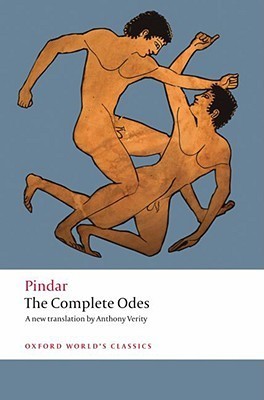
The Complete Odes

Rate this book
The Greek poet Pindar (c. 518-428 BC) composed victory odes for winners in the ancient Games, including the Olympics. He celebrated the victories of athletes competing in foot races, horse races, boxing, wrestling, all-in fighting and the pentathlon, and his Odes are fascinating not only for their poetic qualities, but for what they tell us about the Games. Pindar praises the victor by comparing him to mythical heroes and the gods, but also reminds the athlete of his human limitations. The Odes contain versions of some of the best known Greek myths, such as Jason and the Argonauts, and Perseus and Medusa, and are a valuable source for insights on Greek religion and ethics. Pindar's startling use of language, including striking metaphors, bold syntax, and enigmatic expressions, makes reading his poetry a uniquely rewarding experience.

Anthony Verity's lucid translations stay as close as they can to the original Greek, without sacrificing readability. The text is complemented by a succinct introduction by Stephen Instone outlining the essential nature of Pindar's Odes as well as explaining the nature of the Games, the events, and the participants. Explanatory notes help the reader to navigate Pindar's sometimes compressed and allusive expressive technique.

About the For over 100 years Oxford World's Classics has made available the broadest spectrum of literature from around the globe. Each affordable volume reflects Oxford's commitment to scholarship, providing the most accurate text plus a wealth of other valuable features, including expert introductions by leading authorities, voluminous notes to clarify the text, up-to-date bibliographies for further study, and much more.

186 pages, Paperback

First published January 1, 447

Loading...
Loading...

About the author

Pindar

726 books101 followers
also know as Pindare.

People remember Greek lyric poet Pindar (522 BC-443 BC) especially for his odes, celebrating victorious athletes.

https://en.wikipedia.org/wiki/Pindar

Ratings & Reviews

What do you think?
Rate this book

Friends & Following

Create a free account to discover what your friends think of this book!

Community Reviews

5 stars
558 (33%)
4 stars
508 (30%)
3 stars
436 (26%)
2 stars
120 (7%)
1 star
34 (2%)
Displaying 1 - 30 of 112 reviews
Profile Image for Luís.
2,443 reviews1,532 followers
November 30, 2025
It's the most difficult Greek poet to translate, the most aphoristic, the most rhetorical, and the most pompous of all Hellenic literature.
That's the only bad memory of my dear classical studies. But you have to hate a little to love a lot.
Profile Image for Erick.
264 reviews236 followers
September 29, 2019
I became interested in Pindar mainly because he is cited as an influence on Plato by various scholars. He is also a source for Greek mythology. It seemed to be an appropriate time to read him given that I am studying the latter right now and had already gone through Plato a number of times in the past.

That Pindar was an influence on Plato seems entirely plausible. It seems that Pindar had been influenced by Pythagoreanism. The odes indicate that it was the belief in an afterlife and a divine judgment on one's deeds that show the greatest Pythagorean influence and the most likely influence on Plato. Plato, of course, could have picked this up straight from Pythagorean sources, but that Pindar was the medium in which he found certain ideas (e.g. Rhadamanthus' role as judge) seems very plausible.

Most of these odes were composed for victors in various contests. Pindar has a tendency to recount mythological tales when he is lauding some victor. In some cases, it's in order to warn against hubris and pride. Some of Pindar's comments almost seem to echo biblical ideas. Whether that was simply an intentional attempt by the translator to make the Greek conform to such, or whether the ideas were inherent to Pindar's thought, is difficult to gauge. It is interesting though regardless.

Very interesting work; both as a possible influence on Plato and as a source for Greek myth. Obviously, if one is interested in such topics, this would qualify as an essential source.
Profile Image for Cymru Roberts.
Author 3 books106 followers
December 29, 2017
Five, ten, fifteen stars I give the Odes of this most melifluous of Greek poets save Homer, Pindar, mouthpiece of the Muses.

I started reading this book maybe in 2012 or '13, and it took me till now to finish it, mostly because after reciting one Ode, especially one as overflowing with amazement as Nemea 11, or Isthmia 3 & 4, I had to set the slim volume of copious counsel down and let it simmer, let the violet-shade of the Graces linger a little.

For background on the episodes of Greek lore (which is the main content of the Odes, not merely panegyrics), this is as good as it gets, once again save Homer. Sure, we may not know or care about the athletes the songs were commissioned for -- but honestly tell me you can't imagine some modern day prize fighter, or garlanded Quarterback, that wouldn't suit perfectly as analog and stand-in. The sheer joy that comes when wise counsel urging humility combines with the ecstasy of athletic victory is so abundant in these Odes, they may be my favorite poems ever.

Richmond Lattimore, true blessed recipient of the Muses' cadence, renders the Odes in perfect measure; he is still pre-eminent among Greek translators. This edition is definitive and vital.
Profile Image for Daniel Chaikin.
594 reviews73 followers
Read
December 21, 2016
Oh dear... Pindar is tough. I used two translations to try to get through this, but apparently Pindar is tough on translators too. Not only were their poetics different, but the meaning was often wildly different (that is, when I understood the meaning).

Pindar of Thebes wrote numerous books, about 18 of which were known to have existed, and all but four are now lost. Those four consist of his poems in honor of the winner of various events at ancient olympic games. The poems are rife with mythological references, some particularly insightful (and early). They are also full of aspects of this world where where athletes were given a lengthy poem in song as a treat, and at some cost. (the music is lost).

I respect Pindar, but I'm afraid I can't recommend him to anyone not obsessed or really needing to know all the mythological elements preserved within. Pindar's main interest to me was that he wrote mainly before the great playwrights, making is mythologies some of the oldest preserved and influential versions.

In Pindar's defense, there is a great deal going on in his poems, and, when you can follow, things seem to come from everywhere. There is energy. The more I read, the more I got used to his (translated) quirks and techniques and the more I could follow.

As for the two translations, Lattimore is the more poetic of the two. He uses few notes, only the bare essentials (not enough!), but has some insightful comments. Swanson is the more analytical. His book includes a lengthy introduction, extensive and quite wonderful notes (including a summary of each mythological story), and even, which I thought a treat, has an appendix of several classic English poems influenced by Pindar. His poetics had the occasional jarring fail. Both were so different as to, in sum, actually compliment each other.

Overall this was an interesting and hopefully useful but odd exercise.

------------------------------------------

75. The Odes of Pindar, Second Edition translated by Richmond Lattimore - this book
translation 1947/1976
format: 178 page hardcover
acquired: library
read: Dec 11-18

76. Pindar's Odes translated by Roy Arthur Swanson
translation 1974
format: 358 page hardcover
acquired: library
read: Dec 10-20

composed: 498-439 bce
rating: ??
Profile Image for Alp Turgut.
430 reviews142 followers
May 19, 2018
Ve sonunda geldik 2015'in son kitabına. Antik çağın 9 büyük lirik şairinden biri olan Pindar / Pindaros'un (MÖ 518-438) tüm şiirlerini okuyucuya sunan "The Odes / Bütün Zafer Şarkıları", olimpiyat oyunlarında zafer kazananları övmek ve ödüllendirmek amaçlı yazılmış şiirleri barındırıyor. Sappho ve Hipponaks'ın aksine mitolojiye daha fazla önem veren Pindaros'un metaforik dilini anlamak gerçekten çok zor. Fazlasıyla sabır gerektiren bir eser olmasından dolayı eserin açıkçası bir yerden sonra gerçek bir işkenceye dönme ihtimali var. Bu yüzden Antik Yunan edebiyatına ilgisi olanların bile iki kere düşünüp okumaya karar vermesi gerekiyor. Buna rağmen hem dili hem de yazış biçimi olsun şiirlerin oldukça ilginç olduğunu söylemek gerek.

31.12.2015
İstanbul, Türkiye

Alp Turgut

http://www.filmdoktoru.com/kitap-labo...
234 reviews183 followers
April 11, 2020
ἄριστον μὲν ὕδωρ
[Water is best]
__________
The ancient brilliance sleeps,
and mortals are unaware of all that does not reach
poetry’s finest flower, yoked to the splendid streams of verse.

He is bathed in the brightness of the violet-haired Muses . . .
__________
. . . stream of nectar,
gift of the Muses and sweet fruit of my mind.

__________
Pindar not only praises various victors in the Panhellenic festivals in his Odes, but he manages to infuse them with some truly poetically beautiful turns of phrase, as well as tempering these honey-sweet words with stoic statements and reminders of both our mortality, and the madness of trying to reach the Olympian heights of the gods.

A beautiful translation by Mr. Verity.
__________
Truly, two things only shepherd life to its sweetest perfection:
if a man is blessed with flourishing prosperity,
and if he enjoys a noble reputation.
Do not seek to become Zeus;
if a share of these blessings comes to you, you possess everything.
Mortal ways suit mortal men. (I5.12-17)

. . . chooses for himself the finest fruits
of every kind of excellence. (O1.12-13)

If a man hopes his deeds will escape the gods’ notice
he is mistaken. (O1.64-65)

For the rest of his days . . . enjoys honey-sweet tranquility . . . (O1.97)

For good men the nights and sunny days
are in perpetual equal balance. (O2.61-62)

There flowers of gold shine like flame . . . (O2.72)

If a man waters a healthy prosperity
and is content with a sufficiency of possessions,
and adds to this good repute,
he should not strive to become a god. (O5.24-27)

with the gold and purple radiance of violets. (O6.56)

and swell to fruition the pleasing flower of my songs. (O6.105)

Even a wise man can be led astray by derangement of the mind. (O7.33)

Nothing will ever please all men equally. (O8.53)

To speak ill of the gods is a depraved art . . . (O9.35)

Praise wine that is old . . . (O9.48)

Some roads reach further than others . . . (O9.106)

Joy,
which is a radiance in men's lives beyond all deeds. (O10.22-22)

Men's hopes are tossed up and down
as they voyage through waves of empty lies. (O12.5-6)

Inborn character cannot be concealed. (O13.13)

Accomplished what no mortal man has reached before. (O13.31)

I am a private passenger on a public voyage. (O13.50)

Illicit sexual passions hurl men into utter ruin . . . (P2.36)

You have learnt what kind of a person you are: now become that man. (P2.71)

There is among mankind a very foolish breed, who disdain familiar things
and look with longing at what is out of reach . . . (P3.22-24)

Do not, my soul, long for an immortal life,
but make the most of what you can realistically achieve. (P3.61-62)

If you can understand the true meaning of sayings,
you will have learnt this lesson from men of old:
that for every blessing the immortals hand men a double grief.
Fools cannot wear this with dignity but good men can,
by turning the better side outward. (P3.80-84)

If a man holds to the path of truth in his mind
he must be content with whatever the blessed gods send him.
Gusts of soaring winds blow now this way, now that;
lasting prosperity does not visit men for long,
even when it has attended them with all its weight.
I shall be small when times are small, and great when they are great.
Whatever fortune comes my way I shall respect it with my mind and nurture it according to my powers.
If a god should hold out luxurious wealth to me
I hope I shall use it to acquire glory in time to come. (P3.103-111)

The daughter of Epaphus will plant a root
from which cities revered by men will spring. (P4.15-16)

The flower of your youth now swells in bloom . . . (P4.158)

. . . whose heart was already aflame. (P4.219)

The fleece which flattens with its fringe of gold. (P4.232)

The cruellest thing, they say, is to know the good,
but to be forced to stand apart from it. (P4.288-289)

And many times pledge his heart to the pleasures of youth. (P4.297)

sprinkled with soft dew and accompanied by waves of revel song,
bringing them happiness for themselves . . . (P5.100)

Cultivates a mind and eloquence beyond his years . . . (P5.110)

He is wise in handling his wealth, and does not cull the flower of youth
with injustice or insolent excess, but chooses wisdom
in the secret garden of the Pierian Muses. (P6.47-49)

His sweet spirit exceeds the honeycombed labour of bees. (P6.53)

Yet this, they say, is how the world goes:
happiness that thrives and stays with a man
brings with it now good things, now bad. (P7.20-22)

Take wings by means of my art. (P8.34)

Is it permitted to lay my illustrious hand on her
and reap the honey-sweet flower of her bed? (P9.38-39)

Her beauty was marvellous,
and they wished to cull the blossoming fruit of her gold-crowned youth. (P9.109-110)

Of all the glories which our mortal race may reach,
his voyage takes him to the farthest region. (P10.27-28)

. . . an object of desire for young unmarried girls. (P10.59)

My friends, though I followed a straight path at first
I have become bewildered at the place where the road forks;
or did some wind blow me off my course, like a boat at sea? (P11.38-40)

Conceived, as our tale goes, from a liquid stream of gold. (P12.16)

No stranger to the golden leaves of Olympic olive. (N1.16)

It is not best for a man to give in to yearnings for exotic themes. (N3.30)

Those who achieve must expect to suffer as well. (N4.32)

. . . though the deep salt sea grips you by the waist (N4.36)

There is one race of men, and one of gods,
though from one mother we both draw our breath. (N6.1-2)

The mass of mankind is blind in heart. (N7.25)

even honey
and Aphrodite's flowers of pleasure can cause satiety. (N7.54-55)

Each one of us differs by nature in the life that is allotted him. (N7.56)

The Muse binds gold and white ivory together
with the lily-like flower she steals from under the dew of the sea. (N7.78-79)

Aphrodite's ambrosial tenderness . . . (N8.1)

The flowers of white smoke. (N9.24)

The gods have allotted him amazing happiness. (N9.46)

You may live half your life under the earth
and half in the golden palaces of heaven. (N10.87-88)

Let him remember that his limbs' clothing is mortal,
and earth is the very last garment he will put on. (N11.17-18)

In matters of gain, one should hunt out due measure;
the madness of inaccessible desires is too sharp to bear. (N11.47-48)

What is passed over in silence often brings greater happiness. (I1.63)

Stifles restless excess in his heart . . . (I3.3)

Life, as the days roll past, changes now in this way and now in that,
and only the sons of gods steer clear of wounds. (I3.19-20)

Yet now in its turn, after the darkness of winter’s months,
it is as if the variegated earth has by the god’s design
flowered with red roses. (I4.17-19)

. . . enjoying supreme happiness, and is honoured as the gods’ friend. (I4.59)

For them at sunset a flame leaps up and burns all night,
kicking the heavens with its savoury smoke. (i4.65-66)

All men reckon gold to be powerful beyond other things. (I5.2)

. . . accompanied by the honeyed pleasure of song. (i5.54)

Mix a second bowl of the Muses’ song. (I6.2)

He drops his anchor at the furthest limits of happiness . . . (I6.13)

At midnight in a snowstorm of gold. (I7.6)

. . . at the limit of their hopes. (I7.36)

I shall sing,
binding garlands in my hair . . . (I7.38-39)

May the immortals envy
not bring about disorder because I pursue the pleasure of the day
and walk quietly towards old age and my fated span of life. (I7.39-41)

A most bitter end awaits the sweetness of unlawful joys. (I7.48)
Profile Image for John.
767 reviews2 followers
January 27, 2020
Whew! I finally finished this book of poems. Pindar is considered on of the greatest Greek poets; this translation has failed to persuade me.

Richmond Lattimore was a respected translator of ancient Greek. He was known for his fidelity to the text. In this instance, he was too faithful to matters such as Greek word order at the expense of clarity. But if you reading (struggling) through the Odes in the original Greek, I suspect this translation would be a good aid to understanding.

Pindar is a worthwhile poet. But if you can't read the original Greek I would look elsewhere for a translation that is easier to comprehend and contains more interpretive materials such a a good introduction and notes.
Profile Image for Eadweard.
606 reviews518 followers
December 28, 2015
These were... sort of tough to get through. You better know your greek mythology to make any sense out of them, if not, be ready to read the footnotes every 15 seconds.
Profile Image for Marc Lamot.
3,541 reviews2,093 followers
Read
May 15, 2026
While reading works on ancient Greek history, I noticed that the 5th-century poet Pindar was frequently quoted. He is also occasionally referred to outside the context of those historical works. And yet, I read in introductions to the poet himself that he is read remarkably little. A closer acquaintance with his work made it clear to me why.
In the first place, these are occasional works—poems concretely linked to a specific, usually joyous, event. And within the ancient Greek context, there is nothing more joyous than a victory in one of the prestigious games. Pindar apparently made it his unique selling proposition to celebrate the winners of those games, which immediately earned him a substantial reward from the patrons of those athletes. For the contemporary reader, this link usually complicates the ability to appreciate those poems: we lack both background information and an emotional connection to the event. And the absence of a plot or intrigue is not conducive to appreciation either.
Second complicating factor: the accumulation of mythical references. Other ancient Greek writers (Homer, to name just one) also abound in references to stories about gods and heroes, but Pindar seems to surpass them. Here, too, a problem arises, for our knowledge of those myths is usually limited, and the two or three pages of footnotes accompanying most of Pindar’s poems do not exactly encourage a smooth read. Experts assure me that, once that background knowledge is applied, the poems do indeed come to life, revealing that Pindar placed his references very thoughtfully and ingeniously.
Third complicating factor: Pindar appears to play masterfully with poetic meter and the use of a specific idiom. I read among experts that reading his texts is quite a task, even for those who are fluent in Ancient Greek. And that is without even mentioning the problems involved in translating that into another, modern language. It is not without reason that most translations of Pindar are in prose.
Suffice it to say: enjoying Pindar’s work requires considerable effort. I have ventured into a number of his odes, and granted, with some digging, it is possible to see the special value of his work. After all, a proper understanding of the work of the tragedians (Aeschyles, Sophocles, and Euripides) is not easy either (the choral parts in their works often approach the level of difficulty of Pindar).
Perhaps, then, we should just stick to assessing the historical value of Pindar’s work. For that, see the review in my History account on Goodreads: https://www.goodreads.com/review/show...
Profile Image for sologdin.
1,871 reviews922 followers
July 25, 2024
Pindar's wonderful. This edition is perfectly serviceable. I find myself however needing a facing page edition, so I guess it's the Loeb. Also, this one is missing the fragments, which, I get it, kinda tail wagging the dog, but sometimes you really need that one cryptic reference to Selene from three lines of surviving paean.
Profile Image for Steven Latour.
Author 5 books6 followers
February 8, 2023
An interesting collection of odes to various athletes at the Olympic, Pythian, Nemean, and Isthmic games in Ancient Greece. Although the athletes themselves are obscure for the most part, there are a lot of excellent references and details of various Greek myths. I can only imagine how beautiful these would be in the original language.
Profile Image for James Carrigy.
316 reviews1 follower
January 25, 2026
7/10

Favourite Poems: Nemean V, Isthmian VII, Isthmian VIII, Olympian IX, Pythian II, Pythian IV, Pythian IX.

Reckon we should get someone to compose one of these on the spot for a Wimbledon champion or something.
6 reviews
May 4, 2026
Heavy shit. Zelfs de parafrase van de vertaling is enorm compact. Maar ik durf Pindaros niet te bekritiseren.
Profile Image for Mike.
1,469 reviews56 followers
April 11, 2018
3.5 stars. Pindar’s odes have a heroic quality that celebrate athletes, politicians, and gods on several levels: in terms of genetics, the family unit, regional history, and national pride. Here we find not only the beginnings of lyric poetry (if not the earliest extant Greek examples, then certainly the most extensive and complete), but also the roots of athletics as part hero-worship and part nationalism. Pindar celebrates the athlete as mythic warrior, always connected to the past deeds of gods, but ever mindful that too much success might lead to hubris and one’s eventual downfall.

The odes have a basic structure: an introductory portion that gives a nod to the gods most closely associated with the victor and/or his family, the retelling of a mythic tale that relates in some way to the athlete’s success, praise of the athlete and his family, a line or two connecting the poet with the victor in some way (Pindar’s way of tooting his own horn...or perhaps I should say tooting his own aulos?), and concluding with a gentle warning not to let success go to one’s head. Although this structure can get a little stale through 150 pages, Pindar sometimes gives pieces of wisdom both beautiful and aphoristic. This elegance in weaving myth and human achievement offsets the constant unsettling reminder that Pindar is being paid by super rich people -- often tyrants -- to compose these glowing odes to their egos. But this is really no different than Renaissance masters painting their patrons into Biblical scenes and such, so it’s not too distracting.

On a final note, one would be wise to get a critical edition of these odes -- the Oxford is great -- for footnotes on the history behind each ode, as well as references to the countless gods, myths, and locations name-checked by Pindar. One can equally enjoy studying each footnote, or just reading the odes straight through to appreciate the language.
Profile Image for Jackson Cyril.
836 reviews93 followers
November 4, 2017
I read Pindar in Italian translation, hoping that the musical qualities of the language would better capture the subtle cadences of the Greek than modern English-- I'm not sure I succeeded. At the end of the day, however, Pindar in translation is hardly the equal of Pindar in the Greek. One hears, hidden beneath the layers of translation, a majestic voice with an almost Miltonic power struggling to make itself heard.
Profile Image for Illiterate.
2,910 reviews58 followers
May 24, 2023
Athletes as heroes favored by the Gods.
Profile Image for Monty Milne.
1,068 reviews80 followers
September 1, 2022
This is a review of the translation by Sir John Sandys in the Loeb Classical Library.

I enjoyed this and I am glad I made the effort which it undoubtedly requires, although I can also understand why Pindar isn’t much read nowadays. His style is deliberately archaic: according to Dionysus of Halicarnassus, it evokes the “rugged…severe beauty of the distant past.” According to the introduction, the dialect Pindar used did not correspond to any language that was actually spoken in the Hellenic world, but is a literary construct, based on ancient Dorian. This helped me to feel not so bad that the Greek text was often beyond my limited abilities – if even Pindar’s contemporaries struggled with it, what chance have I got? It also made me feel that the deliberately archaic English translation was perhaps not such a bad choice (though occasionally it lapses into absurdity with phrases such as “grievous eld”).

Most of the odes are brief and specific to victors at the games. They are not overly sycophantic. One man is, rather startlingly, commended for his skill as a charioteer in spite of his short stature. A boy victor is not praised for his beauty – as others are – but instead for his filial piety (presumably he was therefore ugly). This kind of thing makes me think that Pindar’s praise always had some basis in reality.

My attempts to wrestle with the Greek text made me realise, however, that even if my Greek was a great deal better than it is, there is so much here that it is almost impossible to recover. The Odes were originally set to music and dance, and words, dance steps and melody were all combined into an artistic whole which it is impossible for us to recover. (If you want the closest we can probably get, look for Amand D’Angour on Youtube – he has put up some videos of the odes performed in the original language with authentically reconstructed musical accompaniment – but even here, there is no dance, and we are left saddened by how much is lost forever).

At his best, Pindar gives us a glimpse into the nature of human existence, expressed with a poetic beauty which still has the power to move after two and a half thousand years. So Pythian Ode VIII, perhaps the most famous example, whose most poignant line is rendered thus by Sandys:

“Creatures of a day, what is any one? What is he not? Man is but a dream of a shadow; but, when a gleam of sunshine cometh as a gift of heaven, a radiant life resteth on men, aye and a gentle life.”
Profile Image for Sense of History.
666 reviews973 followers
Read
May 15, 2026
The historical value of the work of Pindar (c. 518–c. 438 BCE) can be viewed in various ways. There is, of course, the information contained within it regarding the winners of one of the Hellenic Games, and the group or man supporting them. However, this is usually only brief. Although Pindar's (surviving) poems are mostly occasional works, the poet evidently intended to do much more than merely commemorate a remarkable achievement. In most cases, he explicitly links the victory to specific values such as virtue and wisdom, a sense of moderation, order and harmony, hospitality, and respect for the gods.

In a sense, this links him to classical wisdom literature and to tragedians of the first generation such as Aeschyles, who was, not coincidentally, a contemporary. In other words, Pindar is an advocate of rather conservative, traditional values. And that may well have to do with the enormous changes the Greek community underwent during his lifetime: the transition from tyranny to more democratic forms of government, the struggle and victory against the powerful Persian neighbor, the expansion of the Athenian pseudo-empire and the accompanying wealth, prosperity, and cultural flourishing (for some).

In that sense, Pindar is simultaneously an illustration and a promotor of the formation of an even closer Hellenic community. While his poems celebrate the sporting victories of specific cities, he addresses the entire Greek world (including that in the outlying regions). Whereas tragedians sometimes go very far in their Athenian patriotism, Pindar refuses to bind himself to a single city or region (this undoubtedly has to do with his own biography, which is related to Thebes, Athens, Aegina, and finally Sicily). In that sense, he is already a forerunner of the much later Hellenism, and at the time a decisive factor in the further development of the shared Hellenic heritage. That, too, is the historical value of this poet. For other aspects: see my review in my general Goodreads account: https://www.goodreads.com/review/show....
Profile Image for Daniel.
78 reviews1 follower
April 14, 2025
Pindar is notoriously hard, now I know what is meant by this.
The reason why he is so hard is because his poetry is so distant from us in every sense (who's writing victory songs today?), not intuitive at all, shows at first glance no structure and is deeply religious. Before starting Pindar one should at least read a good introduction and maybe get a commentary - without this one will get hopelessly lost (my edition would have needed far more notes). If you put in the effort you will be rewarded with beautiful poetry and one of the most sublime images of humankind there is; Pindar really can shine. I definitely have to reread him soon.
The translation seemed quite good, at least from what I could understand from the original (Pindar's Greek is illegaly hard).

Pindar is a tough sell and intimidating. Hard to recommend.
Profile Image for no.stache.nietzsche.
124 reviews36 followers
November 4, 2023
Wonderfully enunciated reading of some epic passages. Reading Pindar for us is mostly names and places for which we have little context, but simply getting into the flow and feeling the vibe of this distant time and place is enough for us to enjoy. The passage detailing Jason and the Argonauts was especially fun!
Profile Image for Andreea.
22 reviews1 follower
May 16, 2024

Ode to Andreea of Râșcani, victor of the idgaf race

Whose grace transcends mortal bounds, a goddess' trace.
From Râșcani's shores, a beauty unmatched,
By gods' decree, her virtues hatched.

Oh, Andreea of Râșcani, noble and true,
To your triumph, we raise our voices anew.
In the annals of time, your legend shall soar,
A testament to virtues, forevermore.

Thank you Pindar for this dedication
Profile Image for Arthur Sperry.
381 reviews12 followers
November 4, 2017
As a Latin and Greek Major as an Undergrad, I love reading the classics as much as I can. Pindar has some great lines and beautiful turns of phrase.
Profile Image for Christopher.
409 reviews5 followers
October 6, 2021
Pindar’s odes in praise of winners of Panhellenic games in early fifth century BCE—a vivid look at Classical Greek culture, reflecting the glory and honor earned by the victors, giving them undying fame.
Profile Image for jona.
1 review
March 4, 2026
"Nevertheless, though the deep salt sea
Holds you by the waist, strain against its stratagems.
When we come to the struggle in the light of day
We shall be seen far to outdo our enemies;"
Profile Image for Jerry Horak.
17 reviews
January 7, 2025
This was an excruciating exercise in endurance disguised as poetry. Pindar’s odes are a labyrinth of archaic references, convoluted syntax, and relentless allusions that demand an encyclopedic knowledge of mythology, history, and culture just to make sense of half a stanza. Even with the scholarly commentary and provided formulas, the text remains impenetrable, its ornate style suffocating any emotional resonance or clarity. Pindar’s insistence on weaving together mythological digressions and abstract moralizing feels like an elaborate riddle to confuse even the most studied individuals. I understand that it's a cornerstone of lyric poetry (as far as being extant) - but its significance doesn’t change the fact that it’s a slog. I even tried singing them to myself to no avail. I realize this was likely not the case for spectators 2500 hundred years ago. I’ll begrudgingly give it 3 stars out of respect for its importance, but as a modern reader, I can confidently say this was a deeply unpleasant esoteric experience. Maybe one day I’ll return to it with a better grasp of Greek mythology and the patience of a saint.
Displaying 1 - 30 of 112 reviews