This work has been selected by scholars as being culturally important, and is part of the knowledge base of civilization as we know it. This work was reproduced from the original artifact, and remains as true to the original work as possible. Therefore, you will see the original copyright references, library stamps (as most of these works have been housed in our most important libraries around the world), and other notations in the work.
This work is in the public domain in the United States of America, and possibly other nations. Within the United States, you may freely copy and distribute this work, as no entity (individual or corporate) has a copyright on the body of the work.
As a reproduction of a historical artifact, this work may contain missing or blurred pages, poor pictures, errant marks, etc. Scholars believe, and we concur, that this work is important enough to be preserved, reproduced, and made generally available to the public. We appreciate your support of the preservation process, and thank you for being an important part of keeping this knowledge alive and relevant.
Books can be attributed to "Anonymous" for several reasons:
* They are officially published under that name * They are traditional stories not attributed to a specific author * They are religious texts not generally attributed to a specific author
Books whose authorship is merely uncertain should be attributed to Unknown.
I'm finally finished with 2 Samuel. Talking about this one is a bit difficult since I've been reading this book, 1 Chronicles, and Psalms all at once (in chronological order) because they happen during King David's rule. I do have to say, that I found it strange that 2 Samuel and 1 Chronicles are nearly identical. I read the same story twice multiple times, nearly word for word. Both books do occasionally offer different perspectives or slightly different variations of the same story, but I don't think I ever realized how similar these two books are.
Didn't mean to mark this as finished yet and I can't undo it lol. Oh well. RTC.
Very epic, personally I liked 1 Samuel a tad better but then again, they were originally one book if I recall correctly, so it seems silly to compare them like that.
Some problematic reasoning and morality, as usual. All round a good continuation though. Don't know if I liked David. Sometimes he was good and surprisingly compassionate but then sometimes he totally wasn't. Joab for some reason stuck out to me. He was brutal but kind of cool.
Obviously I’ve been trucking through 2 Samuel most of the summer, but wrapped it up before summer FULLY comes to an end. Things to note: despite the title, this book would more efficiently be titled David since Samuel died before any of the history this book shares came to fruition BUT his faithfulness in 1 Samuel shows the fruits of his labor in 2 Samuel, so there’s that. David is author of most of the Psalms, but honestly before these past few months I only knew some highlighted info on the guy, and seriously it’s worth diving into 2 Samuel to get more of his full story. This book helps us see the settings in which many psalms were penned as well as help tie some of the minutia of 1 Chronicles into focus!
Consider this both 1 and 2 Samuel (couldn't find the right edition of 1 Samuel on GR).
Reading about King David is interesting. Perhaps his story is proof that a person "after God's own heart" is never entirely perfect, but is constantly striving for a more perfect union with Him.
2 Samuel is an account of David's live, and different things that happened during his reign. Interesting ... though some things are a bit hard to understand.
Not nearly as happy-ish as 1 Samuel, but still very interesting.
It honestly reads like an epic fantasy novel with all the insane royal family drama, some mystical elements here and there, and VIOLENCE. I could 100% see some author using this as a source to write something really cool, and I kinda want to be the person to do it 😂
Some closing thoughts:
David was doing so good (kinda) until Bathsheba showed up T-T
Ammon was a literal perv with Tamar what on EARTH
Absolom was also a perv but not nearly as bad as Ammon
I don't know why but I really liked Joab. He was absolutely bloodthirsty and heartless at times but he got stuff DONE
Anyways GJ to me for reading some Bible, and now it's time to move on to 1 & 2 Kings where things get even MORE messed up :D
Blaikie's commentary was probably my second most referenced commentary on 2 Samuel, but not necessarily the second most helpful, although I would be hard pressed to identify what commentary that would be. All of the other commentaries that I referenced, and the number was considerable, fall into the category of "also ran." What kept me coming back to Blaikie is the age of the writing. Not of single line of postmodern thinking spoils its pages, which is far more dangerous to the modern preacher than anything he might feel is "dated" in this volume. Additionally, there is much insight into the biblical text to be gleaned from Blaikie's commentary. I would definitely recommend that any preacher who intends to preach through 2 Samuel to have this volume available to him.
It is so cool to be able to read a book like 2 Samuel with the knowledge our generation has about Jesus! The Lord established his covenant with David, a covenant which states that a kingdom that will endure forever will come through the line of David. Despite the sin of David and his sons, we see that it can not put a wrinkle in God’s ultimate redemptive plan! He is merciful and sovereign.
Sách dài và nhiều nhân vật quá. Đọc đọc sau mà quên mất đoạn đầu. Đọc xong toàn bộ sách chỉ lờ mờ hiểu được rằng ai hạ mình xuống sẽ được tôn lên. Điểm cộng ở sách là tác giả (không rõ là ai) viết vô cùng ngắn gọn, rành mạch, rõ ràng.
This is part of a series where I am reading the Bible in chronological order. I am not doing this for reasons of faith, as I am agnostic, but because of my interest in mythology, ancient literature, and history. I chose the NRSV because I used to be Catholic and still have sympathies there. More importantly, this version seeks a balance between an accurate translation and the literary qualities of the King James Bible. So it seems you get the best of two worlds.
This is the tale of David usurping the throne (God is always conveniently on the side of the winner in these struggles) and his troubled personal relationships which undermine his rule, even as he stays on the throne. I did not find it as compelling as 1 Samuel and one should know Samuel does not even appear here. There are good moments to be sure, but I guess the tragedy of Saul, a complicated figure, is a better tale than the glories of David. Indeed, if not for the Bathsheba tale, David is nearly perfect. That tale alone makes this book solid, if inferior to 1 Samuel. More a 3.5 but I will round up.
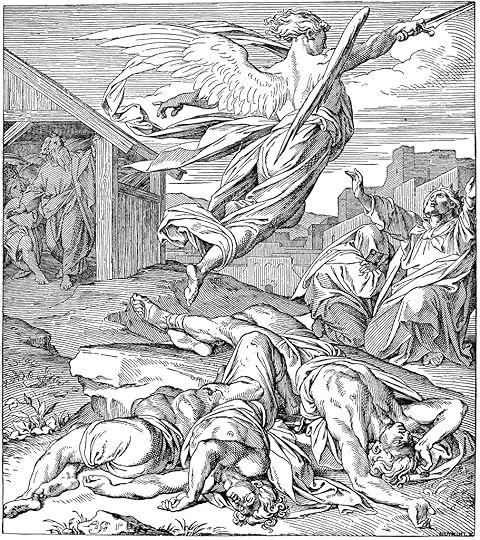
How the mighty have fallen, and the weapons of war perished!
2 Samuel follows David’s consolidation of Israel after Saul’s death. Judah secedes from Saul’s kingdom and chooses David as their new king. Ish-bosheth— Saul’s last remaining son—allies with Saul’s top general, Abner, in a civil war against the south. David wins, unites Israel, and selects Jerusalem as its capital and location for the Ark. (Our hero debates building a temple complex for Yehweh; God promises him a long and successful dynasty if he does.) He then defeats some testy neighbors, has his infamous affair with Bathsheba, repents, and is ostensibly adored by everyone. Well, not quite everyone, as David is later forced to brutally squash two revolts, one of which is tragically led by his own son, Absalom. The book ends with some miscellaneous narratives, celebratory battle-poems, and David’s last words.
David is generally viewed as the closest thing to a messiah in the Hebrew bible, and 2 Samuel may reflect Israel’s zenith (according to the biblical authors, that is). A consolidated promised land feared by its enemies, with Yahweh’s cult in the driver’s seat: it doesn’t get better than this. But this designation is odd given how much more geopolitically powerful and promising the country is under David’s successor, Solomon. As we’ll explore later, while Solomon deviates too far from God’s wishes, David is the perfect shepherd for the chosen sheep. In fact he may even be a little too perfect. As with 1 Samuel, this book goes to tortuous lengths absolving David of responsibility for many of the story’s murders and genocides, even as he blatantly benefited from them.
This is exemplified in the Bathsheba narrative, where a naughty David is shown to be imperfectly (and understandably) human. While meant to add a little dirt to his pristine character, making him more identifiable and “complex”, the real motivation was simply to have David display an idealized repentance (a precedent that the Bible will never tire of abusing). The book seems to care little for Uriah, let alone Bathsheba. The disgusting irony is that their tragedy is exploited for David’s benefit: converting his sin into a virtue. It’s without a doubt one of the most morally perverse narratives in the Bible.
The truth is that David is just another successful Hebrew warlord that honored Yahweh above all other gods, earning him a thumbs-up from the biblical authors. While I understand that these were vicious times with many tribes all vying for power, and that states in the ancient world were the creation of hegemonic conquest, I simply fail to see the higher complexity or interest of David compared to, say, Joshua or Saul. I enjoy that this is one of the most robust biographies of a king in ancient literature, and for all his barbarism David seems to be more cultured and politically adept than the other conquerors I named. But I wish these humans had any sign of, well, humanity (that isn’t insultingly ham-fisted in a story about murder, rape, and faux-repentance).
If I’m hard on 2 Samuel it’s because it’s such a celebrated book of the Hebrew Bible. Samuel taken together with Kings culminates in a masterpiece; I’ll be the first to admit. But David’s military exploits are too similar to Joshua to stand out; much more interesting is the gritty nation-building that Judges and Kings elaborate. Yet, for a warlord, we could do worse. Having 2 Samuel deny genocide rather than celebrate it; support a king that weeps for his enemies instead of reveling in their death; require that our hero be cultured and refined in addition to being powerful: these are welcome improvements and a harbinger for more tender books to come.
Second Samuel is about the fourth or so book in a series that ends after Second Kings that make up a history of the rulership of the tribes of Israel. It was a fairly compelling book (and extra nice that it didn't end like Exodus did, with endless description), although not any less morally objectionable than previous installments.
As I go through these, I'm starting to kind of laugh at them in certain ways. For example, here a guy complains that his wife (or one of them) has been taken by Saul's people. His complaint isn't so much that he's lost his wife, but that he paid one hundred foreskins for her and he sees that as a loss. Even if you look at "foreskins" the way it's meant - "trophies proving I killed my enemies" - it still comes across as very callous. I got the image of a 1940's film actor saying in that Humphrey Bogart voice, "I paid a hundred foreskins for that dame and I aim to keep 'er!" But really it's pretty messed up to own women as chattel and to pay for them with your kill trophies.
The story mostly concerns the feud between David and Saul. Plot twist: everyone kills everyone else. Not a big surprise by now. That's... pretty much the entirety of the Bible thus far. But at least these stories are pretty engaging. I did not take copious notes this time around. I'm beginning to see there's little point in it. The books kind of blur together.
Of note, however, is the origin of the phrase, "O how the mighty have fallen" which is in reference to folks who died in the previous book. Also, Chapter 22 has David monologuing about God as a rock that gives him strength. I think a lot of people draw on that for inspiration, although it's hard for me personally to find any value in it in the same way that I don't draw on Frodo Baggins for strength in times of trouble.
I wish I knew more about the accuracy of the book's historical claims. Isaac Asimov wrote a book investigating those, and I tried to read it a while back and found it to be extremely dry. I haven't enjoyed his sci-fi, either, so I guess there's not much point in going back to it.
Up next, after a brief break for some Halloween reading: First Kings.
Another amazing book from the Bible. This one covers David's rise as a king, from the King of Judah to the King of all Israel, his conquests of neighboring nations and his plans to build a house for God. But God doesn't permit him, because of his many wars. Instead, God said He would build him a house, a dynasty, that would reign eternally.
That's the good news. The bad news is that David screws up royally. He takes his valiant commander Uriah's wife, Bathsheba, and then when she gets pregnant, tries to cover it up. He ends up killing Uriah through battle and marries Bathsheba. Then there's one of those understatements that pop up in the Bible. "But the thing David had done displeased the Lord."
After Nathan the prophet confronts David, he repents of his sin, but suffers from the consequences for the rest of his life, that is, the rest of the book. His son Amon rapes his daughter Tamar, and then his son Absalom kills Amon. After Absalom and David are reconciled, Absalom rebels against David and leads a civil war to take over his throne. He barely escapes with his life, but his ten concubines he left behind to take care of the royal palace, Absalom rapes in public. This family would be too yucky for Jerry Springer.
In the end, Absalom is killed and David returns to Jerusalem. He passes on advice to his son Solomon and composes a psalm of praise to God and the book ends.
This narrative portrays David's struggles, moral failings, and family turmoil. It presents a very realistic picture of the most important king in the history of Judaism. David is shown as a powerful leader who in the end cannot replace God as the ultimate monarch of Israel, and as a human in need of God's assistance and protection.
#Binge Reviewing my previous Reads #The Bible Reread the Bible in-depth during Covid 19
If 1 Samuel was the prologue to monarchy—the tentative, faltering, tragic experiment—then 2 Samuel is its full-blooded epic: David’s reign in all its brilliance and shadow. Here, the shepherd-poet who once felled giants now wears the crown, and the arc of his kingship stretches from radiant triumphs to devastating failures. Yet the genius of 2 Samuel lies not in mythic perfection but in its relentless humanity. David is not polished into an icon; he is exposed as a man whose greatness and flaws are inseparable.
What struck me most while rereading this book during the pandemic was how modern its texture feels. Far from a sanitised chronicle, 2 Samuel is a narrative that lingers in ambiguity, moral paradox, and the brutal mess of politics. David ascends to power not in a vacuum but through civil war, blood feuds, and fragile alliances. The very same man who composes psalms of divine intimacy also orchestrates ruthless manoeuvres of statecraft. Power is never innocent, and scripture does not let us forget it.
If we place David alongside figures in Hindu epics, he resembles Arjuna in his inner duality: warrior and devotee, pragmatic politician and man haunted by his conscience. Just as Arjuna must wrestle with dharma in the Bhagavad Gita, David wrestles with covenant. His relationship with God is not distant; it is intensely personal, at times tender, at times agonised. Unlike Saul’s alienation, David’s crises are not born of estrangement but of intimacy—he sins, yet he also repents with piercing honesty. This paradox makes him enduringly relatable: not a saint above us, but a mirror of our own divided selves.
Postmodernly speaking, 2 Samuel destabilises the very genre of scripture. The text refuses to elevate its hero into an untouchable legend. Instead, it records his adultery, his orchestrated murder, the rebellion of his son, and the plagues and famines that scar his reign. By placing these failures at the centre of the narrative, the book undercuts the notion of seamless divine kingship. It suggests, rather, that leadership is perpetually compromised—that history itself is a palimpsest of glory and guilt.
The Bathsheba episode exemplifies this complexity. Without delving into spoilers, it is not just a personal scandal but a meditation on the abuse of power, desire, and the way private choices ripple into national catastrophe. In Hindu literature too, rulers’ private lapses often reshape cosmic balance: think of Dasaratha’s fateful boon to Kaikeyi, which exiles Rama, or the lust of kings that destabilises kingdoms. Across traditions, scripture insists that personal failings in the powerful cannot be separated from collective suffering.
What unifies these diverse voices—Hebrew Bible, Hindu epics, even Greek tragedy—is their insistence that the political is never just political. It is ethical, spiritual, and cosmic. Kings are not merely administrators; they are figures whose choices disturb or realign the order of the world. In this sense, 2 Samuel shares a profound kinship with Mahabharata’s cycles of war and reconciliation: the throne is both a seat of justice and a site of ruin.
During Covid, this aspect of 2 Samuel resonated painfully. Leaders across nations made choices that exposed the frailty of systems and the cost of hubris. David’s reign reminded me that governance is not simply a matter of efficiency or strategy—it is bound up with morality, humility, and acknowledgement of limits. When power divorces itself from accountability, consequences multiply beyond control.
Yet 2 Samuel is not only a chronicle of failure. It is also a tapestry of resilience, poetry, and the endurance of covenant. David’s psalms, many thought to be born of these turbulent years, shine with a rawness unmatched: the voice of a man broken, pleading, yet still reaching for God. In Hindu bhakti poetry—Mirabai, Tulsidas, even fragments in the Upanishads—we hear the same cadence: a soul that sins, stumbles, weeps, and yet does not sever its bond with the divine. This is the unity of religion at its most visceral: the recognition that human frailty is not the end of relationship but the ground of grace.
From a literary lens, 2 Samuel could be shelved alongside Dostoevsky or Faulkner—novels where protagonists embody both grandeur and ruin, where sin and redemption are inseparable. David is neither wholly condemned nor wholly exalted; he is written with the chiaroscuro of existence itself. That tension—the refusal of closure—is what makes the book so modern.
In the end, 2 Samuel is less a triumphalist history than a confession. It teaches us that greatness without humility collapses, that leadership carries unbearable weight, and that the line between faith and failure runs through every human heart. Read alongside Hindu scriptures, it affirms that the struggle for dharma, for covenant, for justice, is universal. No tradition claims perfection; every tradition records both the rise and the fall.
For me, rereading it during a time when human systems were cracking open, 2 Samuel felt like a warning and a comfort: a warning that power always courts corruption and comfort that even in failure, the divine presence does not abandon but transforms.
* -:}|{}|{: = THE PERFECT VOICE = 4 THE BIBLE = DAVID SUCHET = ITS NO SUPRISE IN PSLAM 47 - THE LORD HIMSELF IN FLESH = DANCED IN A MYRIAD OF REFLECTIONS OF LIGHT - THAT CLEARLY - STATES - IN THE UNDOUBTABLE CLARITY ONLY THE LOOORDDSSS PHENIMINAL - ECXSTATIC INFNITE DANCE COULD - DESCRIBE IN AN INEPHABLE - WAY - WITH THE DEAPEST OF KNOWINGS - HIS GREATEST OF AL PRECEPTS ----> THO SHALT BE SMIGHTED - IF THO LISTENS 2 ANY OTHER AUDIO-VERSION OF THE BIBLE ( OTHER THEN DAVID SUCHET ) <--- - & THO SHALT FIND ONES SELF CONDEMMED 2 ETERNAL DAMNATION - & ONES SALVATION SHALL BE FOUND IN THE - GRACE FOUND IN THE NARRATION ONES LIFE IN ITS INTIRITY READ IN 0.25 SPEED BY DAVID SUCHET= }|{}|{:- *
* -} Gestalt Psychology Simplified with Examples and Principles {- *
* -:}|{}|{: = MY SYNTHESISED ( ^ GESTALT ^ ) OF THE * -:}|{}|{:=:}|{}|{:- * ( WAY THE AUTHOR FRAMES = HIS WRITING PERSPECTIVES ) & ( POINTERS & IMPLICATIONS = the conclusion that can be drawn IMPLICITYLY from something although it is not EXPLICITLY stated ) = :}|{}|{:- *
Thy kingdom come. Let the reign of divine Truth, Life, and Love be established in me, and rule out of me all sin; and may Thy Word enrich the affections of all mankind
A mighty oak tree standing firm against the storm, As sunlight scatters the shadows of night A river nourishing the land it flows through
Again, 2 Samuel (which, as Robert Alter explains, isn't really a book - it was just too long to get the whole of Samuel on one scroll, so they cut it in the middle) is a fascinating book, and one completely different from what you remember from RE lessons. It's basically the story of David as King, written by (mostly) one author, though the last four chapters come from a totally different tradition(s), and occasionally re-edited about three hundred years later by the Deuteronomic Historian, who added some God and some condemnation of people who didn't agree with him into it. Luckily, DH only has about two chapters in the whole thing.
What is absolutely clear from this book is that David was a shitty human being and a pretty terrible King.
The morals/messages/religious import I got from this book are:
1) Polygamy is really bad, and (in David's case and I suspect most polygamists' case) inseparable from misogyny. David's forcible seduction/rape and impregnation of the married Bathsheba is presented in Sunday school classes as a moral lapse: it is clear that this was par for the course for him. The only difference is that he has her husband (one of his top soldiers) killed to cover it up. Joab, his nephew, thug and Machiavellian fixer, understands David's message clearly: he has obviously had David's sex-messes to clear up before.
Generally, the women who are NOT married to David in this book are great: wise, crafty, sympathetic, intelligent (almost none of them have names, though).
2) Hereditary monarchy is a bad idea: David's sons are generally arseholes (because they've been brought up to think they can get away with stuff, and they generally can). There is no punishment for Amnon for raping his sister; there is no punishment for Absolom for starting a revolt and raping his father's concubines; etc etc.
3) Being a guerrilla leader is very bad preparation for being King: David is great in 1 Samuel, because he is the not-King. Almost as soon as he becomes King himself, he is bloody awful. See Mugabe, Lenin, Castro, Pol Pot, Mao.
4) There should be limited terms for Kings: most of this book, David is out of touch, too busy shagging his various women to get what's going on in his country (which includes at least two brutal civil wars). He rarely leaves the tent on his roof where his harem is, unless he's running away.
The last four chapters seem to be the oldest parts of the book, the "true history" of David (or certainly closer to the time) on which the legends in the rest of the books of Samuel are based. A couple of things stand out:
a) David is certainly a believer in human sacrifice: he is happy to have the grandsons of Saul crucified to propitiate an angry YHWH and end a famine.
b) It was probably another warrior who fought and killed Goliath (Elhahan son of Jair): David merely got the credit for it long afterwards.
c) They've been shoved at the end in a higgledy-piggledy order because the editor didn't know what to do with them.
At no point in this book do we get the impression that David was a good King. A fascinating book, with very very little God in it.
It picks up where the previous book left off, but now the spotlight is fully on David, not just as a warrior or chosen successor, but as king of a united Israel.
After Saul’s death, there’s civil tension between David’s followers and the remnants of Saul’s house. But eventually, David unites the tribes, establishes Jerusalem as the capital, and brings the Ark of the Covenant into the city,
David as king tries constantly to be a just and pius man, however he commits great ofenses against God, the most imporatnt one was sending a man to his death so he could stay with his wife, Bethseba, whom he impregnated while he was away in the battlefield.
God sends the prophet, Nathan, to repremand David, and he does feel great regret that would fuel him to do right by God and his people for his coming years.
Most of the book is a war chronicle, showing us the growing pains of the kingdom. Wars waged, betrayals, assasinations and conquering. Everything David did, was always staying on God’s side, not to do as Saul did when he was king, deciding for himself and his own gain.
This book is less about military triumphs and more about the fragile, messy intersection of faith, power, and humanity. David never falls into Saul’s error of abandoning God entirely, but his flaws remind us that no human king can fully embody God’s kingdom.
It serves as a reminder on the strong inclination to sin everyone must constantly fight against, and the terrible consecuences of going against God’s wishes and breaking his law.