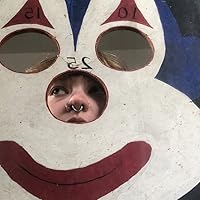
This graphic novel is Jerry Moriarty's tribute to fine artists who make their living in commercial art.
Rotart Sulli is a painter who illustrates crime fiction. In the first of two stories that comprise Visual Crime, Sulli gets a call from the publisher who gives him an assignment for Visual Crime Magazine, which comes with a peculiar requirement: Sulli is to stay at Hotel Ace in room 611 until his assignment is finished. He completes the assignment in the basement of the hotel but not without coming to blows with a janitor with a penchant for chucking toys into the furnace. In the book's second story, Sulli is once again hired to illustrate a crime story; and once again, it comes with a peculiar demand: he's told to place the finished work "in your back window — it will be seen." In between these two stories are a dozen short stories occupying a single page, all illustrated by paintings by Sulli.
Painted panel sequences alternate with Moriarty's rough-hewn, proletarian pen and ink panels amidst the luminous, Hopperesque paintings by Rotart Sulli, creating a portrait of the artist working alone in a mysterious and uncertain world, creating stunning images that transcend the melodramatic stories they illustrate.
Jerry Moriarty was a painter and cartoonist (self-described as a "paintoonist") from New York. He earned a Bachelor of Fine Arts from the Pratt institute, and his best known work in cartooning is the comic Jack Survives. He taught at the School of Visual Arts in New York City for 50 years.
I wanted to like this more. Moriary is famous for his large painted cartoons from Raw and other places. He has a distinct style, so. Here he revisits comics and
Jerry Moriarty is a "paintoonist" and got a bit of popularity for his Jack Survives strips back in the 80s. His style I'd describe as a crude Edward Hopper. Nice bold simple colors and a thick brush line.
Here unfortunately the book just feels unfinished as a lot of pages are not painted and feel like the sketch he'd do before painting. And then there's a highly rendered pencils only section with lots of text in a hard-boiled detective style.
So if you're here for Moriarty the paintoonist, you may be disappointed as only 10% of this book is rendered that way.
A pretty surreal collection of vignettes. Despite the title, the connecting theme isn't necessarily crime, it's more so based around death. Moriarty's art ranges from crude and simple to incredibly moody with deep shadows and intense line work. There's a darkly comedic undercurrent throughout the entire work that balances out the bleak nihilism.
Not quite for me, though I really liked the paintings and unrefined nature of drawings with past images still visible. Liked the main story, the shorts in the middle were hit and miss. Got me interested to read the Jack Survives series.
I really dig the format of these stories- accompanied with plain sketches or what looks like oil paintings- the dark humor, and sociological commentary . Excellent work.