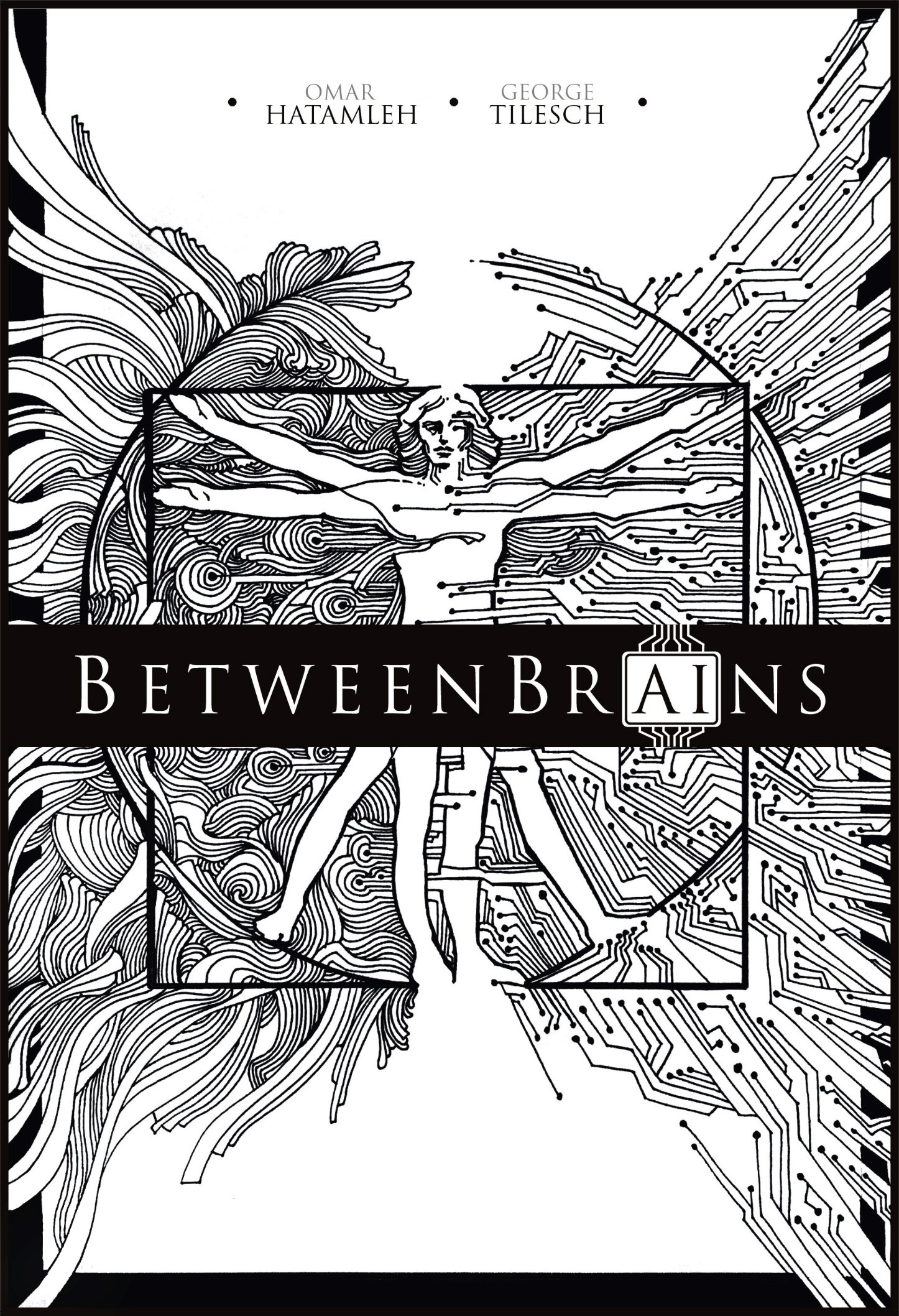
BetweenBrains - Taking Back Our Future In The AI Age
AI is a present we live at the threshold of an AI-dominated era. AI is more than a Technology wave. In the 21st century and beyond it is the very core source of power that fuels politics, business, and our minds, our work, and our homes. AI also rewrites the rules and forces us to lose no time in rethinking fundamental questions of our humanity. Our human brains will soon be required to adapt at hyper speed to a new paradigm of omnipresent machine intelligence.
We all have to deal with both its opportunities and threats in a conscious manner. Presently AI obscurity, hypotheticals, hype, and hysteria are aggravating problems of increasingly polarized and disconnected societies. However, whose image AI development will take and how the AI Age will be shaped is still in the hands of informed and clear-sighted citizens and leaders. The authors undertook the task of making sense of AI, especially its impact on the present and the near future for responsible readers worldwide.
DR. GEORGE A. TILESCH is a senior global innovation and AI expert who is a conduit and trusted advisor between the US and EU ecosystems, specializing in AI Strategy, Ethics, Impact, Policy, and Governance. Most recently, he was Chief Strategy & Innovation Officer for Global Affairs at Ipsos, a global Top 3 research firm, where he led the Digital Impact & Governance research and advisory practice and coordinated AI thought leadership. His global senior executive and strategy consulting leadership track record span decades with government leaders worldwide; Microsoft and Fortune 50 Tech corporations; international organizations and global think tanks; startups/scaleups; and global social innovation leaders. A senior consultant and frequent keynote speaker at major innovation conferences and a guest lecturer at US and EU universities, George is leading an AI Policy Working Group for Club De Madrid-World Leadership Alliance on AI, Trust & Democracy and is involved in multiple World Economic Forum Experts Groups, designing AI government strategy, and AI regulatory frameworks.
AI has been woo-woo stuff for decades, perpetually around the corner. And when it’s shown up in our lives, it’s been cute but underwhelming. It’s been a Utopian/Dystopian riff on the Boy Who Cried Wolf, and we’ve gotten used to it. “Betweenbrains” is a remarkably researched, thoughtful broadside telling us to pay attention now. The wolf is here, or is a wolf at all? It’s something big and hairy and we need to figure it out, for ourselves in our own lifetimes and for future generations who will live with your decisions. A real wakeup call.
The authors are neither utopians nor dystopians. This may work against the book’s mass popularity, since a good rant is always intriguing. Instead of a rant, they offer us a thoroughly researched, closely reasoned and remarkably comprehensive analysis of how AI will play out across the range of industries, the range of social practices and the range of social and ethical concerns.
If there was one insight that stuck to my bones it is this: We need to think, advocate and regulate as if AI were at full warp operational speed already. It’s not, quite. But by the times ideas under current discussion fully ferment, it will be much more of an AI-driven world. For good or ill. That is still our social and political choice. But we are not talking about something that will happen ‘down the road’.
The good news is that AI gives us the tools to monitor and, as needed, police AI. It is, perhaps, an infinite recursive loop, but it doesn’t have to be. Will AI development be guided purely by profits or will ethics have a major voice at the table? That is our social choice right now. Indeed, our primary one.
So where's the fifth star in my rating? I withhold it only to signal that this is a dense, closely argued book, and not always an 'easy read'. If you're looking to have AI rendered simple, this isn't for you. If you want to make the effort to think about what is certainly a core question of our times, it is.
Very interesting analysis into what AI is bringing to the table, and a great discussion of where it might be going, where it could go, and where it should go.
AI, in some limited variants, is here already, but we are not necessarily aware of to what extent it has already changed our lives or of the extent it will change them in the future. But what is coming is even more remarkable.
The authors do a fantastic job in introducing the field, as well as its potential benefits and pitfalls. Many interesting questions are posed, although many are left unanswered, but that is to be expected: this is a developing field of knowledge and we have barely started to see where it is going.
If you are looking for an interesting book to become familiar with the non-technical side of AI, to become more AI-learned, this is a great place to start.
BetweenBrains is a must-read for leaders and policymakers in the technology sector and outside of it to be able to put the so-called "AI revolution" into context. The book talks about how AI is not something that will be introduced at a later stage but how machine code is already influencing the social, political and economic structure of the world. The authors do not inflate any benefits or threats of the new world and while trying to be AI optimistic they warn how the lack of regulation in machine learning can damage society at a whole. I highly recommend the book.
In the tsunami of AI-related new books my first decision gate is always a disqualification of the nightmarish-dystopian bullshit, based on empty and misleading artificial superintelligence (ASI) considerations. The second selection step is the identification of the basic approach of the author(s) to the nature of AI itself. I only prefer the general point of views, based on substantial hybridity of man-machine systems – to be able to solve human problems, as a legacy, instead of choking because the slump scraps of optimist-pessimist binarism. Now, Between Brains is a survivor, shining on my virtual bookshelf, waiting to read from cover to cover. The quest is about its specific added value to the discourse and/or the originality of the outcomes. This book is fencing on this last traverse. Its conclusion is not to define perfect and visionary solutions for future AI-stewardship, but to build a planetary epistemic community, creating an ecosystem of ideas (with their words: collective mindspace) to find the best (ethical) frameworks, channeling and orienting the future development. I deeply agree with the authors, that we have got to have a civilizational vision at first, and we can find the role of AI within it, fertilized by our design thinking and imaginative bravery through sense-making. This is the only chance to transform the contemporary AI dominance games (detailed in a single chapter) into joint system-improving efforts. The quintessential Manifesto proposes an atypical institution, as a platform for concerted cross-disciplinary research, curation, education and dissemination activity. Its globally synchronized Foundry network could serve as a birth system of new solutions, providing alternative sustainability models, collaboration tools with dedicated support of implementation professionals. The idea is an ambitious split from the closed scientific, technology and business narratives, while opening a new, participative agora for the public, urging the creation a vital, interoperable language instead of brain-fagged technobabble, where collective co-creation is a basic norm. Minds first, shaping the AI-future thereafter. Good luck to this hopeful Renaissance, my dear allied forces.
Laszlo Z. Karvalics (PhD) information historian and information society researcher, research fellow, Institute of Advanced Studies, Kőszeg (IASK).
The book is a journey from the ancient times to our future, and also, from our expectations to reality. The authors essentially emphasise how important to understand the changing augmented business and operating models behind the technology. Likewise, the argumentation of the penetrated ecosystems and social fabrics are noticeable in the context of AI or ANI. Many thanks for the practical examples and cases, I would have read even more of this in detail. Besides that, not only the bright side of AI is discussed, but errors, biases, and ethical issues are also in the spotlight. This approach supports a balanced discussion for a “hyper perspective” (p144). In summary, the book “Between Brains” calls the audience who read about AI comprehensively for the very first time, and also, readers with deep knowledge to be rewarded with a wide perspective and reasoning.
Well-informed, thoughtful and perhaps at some points alarming summary of a subject that's extremely difficult to talk about to outsiders. If you not into the world of Machine Learning, Face recognition, Big Data etc. there is little chance anyone can give you a quick and deep general overview without getting lost in explanations and details. Yet BetweenBrains does the impossible: external look from the insiders. On one side, even seasoned professionals will find inspiring info and insights they never heard before, on the other side, finally a good read in the subject anyone will understand! This is especially important, because social awareness will be crucial in the handling of the different AI technologies, so good to know there is a book i can recommend to politicians, journalists and artists as well. Hopefully an army of similar books will appear soon, BetweenBrains is the earliest bird.
Also really cool that the authors dont fall into the trap of being either AI-optimists or AI-pessimists, funnily, it comes out as both. The future is in the making: being informed is a proper first step.
Finally got around to reading - and finished it in one sitting.
I was sometimes a bit perplexed by who is the target audience. It is sometimes too shalow for people deeper into the topic, too deep for complete laics. However, it´s overall review of the situation is sound, the thinking behind the suggestions deep and even better it manages to go against some of the more classical techooptimistic fallacies ("technology is neutral") while avoiding the botomless skepticism. Also, it´s quite short and to the point: feature not always seen in the realm of AI connected writing. Worth a read.
(also, small thing that detracted me somehow was the Harari hype, but hey, maybe I was just frustrated from the first mention of "great historian YNH...")
BetweenBrains is a welcome insight into the ethics of AI beyond everyday AI discourse. Refreshingly accessible, it discusses the political and economic forces that influence AI's development and helpfully explains why it is essential we rethink how it is developed.
I was very interested when I got this book in my hand: I was curious about what can be told about AI that has not been told already. Well...a lot. It is a deeply philosophical book about the topic, mainly focusing on the social aspect of both the now and the future AI. But not in the classic dull style... It is very readable with specks of humor.
It is hard to write about something without a spoiler. Maybe everybody sees its substance differently. To me, it is the possibilities of our future, whether AI becomes an Angel and brings us Paradise - or it will be our Devil and brings Hell onto Earth. The authors will not give us a definite answer - they entrust the reader with this final conclusion, but they do this with a lot of ammunition, facts and logical thought experiments.
What I particularly liked in the book is the bold parts where the authors are thinking about the future of centralized religions, especially Roman Catholic Church in the light of AI. As for the recommendations at the end of the book, I am skeptical about them because of what I think of human nature, but I admit they would be really helpful if they were realized. It is actually a very useful book from well-prepared authors - I enjoyed reading it.