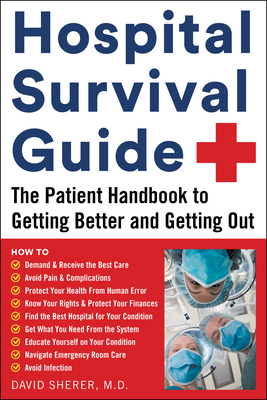
A decent reference manual in need of a bias edit. Author shines when he sticks to explaining the facts. Sherer jeopardizes readability when he inserts his own biased rhetoric or fails to present accurate (and easily verified) facts.
First, he employs inaccurate terminology without also providing the accurate corollary (“Obamacare” instead of the correct ACA) and has incorrect statistics (p. 317: “the 10 billion or so people living on our planet”); as of the book’s writing there were less than 8 billion people…author is off by a good 2 billion. Yikes.
Sherer inserts his own personal argument that universal healthcare is not a workable solution and questions citizens’ right to healthcare by using birds flying and fish swimming as analogies…or maybe it’s something about fish flying and birds swimming. Either way, we didn’t come here for this—this is in no way part of what readers are seeking in a so-called “Hospital Survival Guide”. Might be less concerning if in the same pages the doctor didn’t continue to blame patients for their own ill health: (p. 326 “Will people start taking better care of themselves? Knowing human nature […] I think not”); his speculation—and that’s all it is, speculation—is completely divorced from sociocultural reality.
No mention at all of forces that conspire against the body such as food deserts, lack of mass transit, capitalist work hours, racism, etc? Or about women who have conditions like thyroid imbalance or PCOS and struggle to maintain their weight despite intense effort? It’s always fun to go to the ER with a serious, life-threatening complaint and get a condescending lecture by a prejudiced, thinness-fetishizing doc who assumes that the patient couldn’t possibly have a real problem and squanders the visit on a diatribe about cutting out the soda. It’s even more fun when these oft-misdiagnosed patients go home to suffer unnecessarily compounded morbidity and mortality, when skinny peers who present with the same complaint actually get adequate treatment.
Sherer goes so far as to say, “Let’s be honest: Most people, if left to their own preferences, would rather sit on the couch and eat potato chips than eat and act as they know they should […] ditch the refined sugar. Work out. Lose weight.” Yes, the main reason John Q. Public is in the hospital is because he knows better but is too lazy to actually do anything. Give this doctor a Nobel Prize! Meanwhile, a Foundations in Medicine professor somewhere out there weeps.
Let me put it this way: the facile, reductive explanation of simply blaming the patient is not practicing medicine; it is practicing prejudice and its corollary, discrimination. Curious that the author feels comfortable disseminating this to a wide audience, but perhaps this doctor’s openly shared attitude can serve to inform us as to the type of doctor we *never* want to have anywhere near our bodies if we can help it. So in that, this tome is perhaps an unintentional yet embarrassing win. Three ironic stars for that.
Check out the book from the library for the hearty reference section, save the links, and continue to educate yourself with books by healthcare professionals who can either stay focused or who understand the whole system, not just the curious microcosm of the hospital.