

What do you think?

Cloris
Nachdem sie auf wundersame Weise einen Flugzeugabsturz mitten in der Wildnis der Bitterroot Mountains überlebt hat, muss sich die 72-jährige Texanerin Cloris Waldrip durch die unbarmherzige Natur im Norden der USA schlagen - ausgerüstet mit einem einzelnen Stiefel, einer Bibel und ein paar Karamellbonbons. Aber jemand scheint eine schützende Hand über Cloris zu halten. Ist sie doch nicht allein?
Rangerin Debra Lewis hat sich von ihrem Mann scheiden lassen, der in drei verschiedenen Bundesstaaten mit drei verschiedenen Frauen verheiratet war. Nun trinkt sie Merlot, um durch den Tag zu kommen. Als sie ein rätselhafter Notruf erreicht, ist Rangerin Lewis die Einzige, die an das Überleben von Mrs Waldrip glaubt. Trotz der Aussichtslosigkeit des Unterfangens macht sie sich gemeinsam mit einer Gruppe verschrobener "Friends of the Forest" auf die Suche nach dem abgestürzten Flugzeug und der vermissten Cloris. Rye Curtis' kauzige Figuren kämpfen sich in dieser ungewöhnlichen Abenteuergeschichte mit Lebensklugheit und Mut durch die Wildnis und sehen am Ende mit einem neuen Blick auf ihr altes Leben.
Rangerin Debra Lewis hat sich von ihrem Mann scheiden lassen, der in drei verschiedenen Bundesstaaten mit drei verschiedenen Frauen verheiratet war. Nun trinkt sie Merlot, um durch den Tag zu kommen. Als sie ein rätselhafter Notruf erreicht, ist Rangerin Lewis die Einzige, die an das Überleben von Mrs Waldrip glaubt. Trotz der Aussichtslosigkeit des Unterfangens macht sie sich gemeinsam mit einer Gruppe verschrobener "Friends of the Forest" auf die Suche nach dem abgestürzten Flugzeug und der vermissten Cloris. Rye Curtis' kauzige Figuren kämpfen sich in dieser ungewöhnlichen Abenteuergeschichte mit Lebensklugheit und Mut durch die Wildnis und sehen am Ende mit einem neuen Blick auf ihr altes Leben.
352 pages, Hardcover
First published January 14, 2020
Ratings & Reviews
Friends & Following
Create a free account to discover what your friends think of this book!
Community Reviews
Displaying 1 - 30 of 383 reviews

July 14, 2020
This is two novels in one. One is excellent and one is not. One of those novels, is about an older woman, Cloris who survives a plane crash and spends several months in the woods surviving with the help of a mysterious man who hides his identity for much of the novel. What works about this is that Cloris is a deeply interesting character and she is wholly believable in voice and characterization. I also liked how the book starts at the height of the climax with the plane crash, and then we start to understand Cloris and her predicament. The second novel in this novel is about Debra Lewis, who is an alcoholic with strange relationships, and is searching for Cloris. She’s the only one who does not give up on Cloris and believes the older woman to still be alive. But her chapters are incoherent and strange to the point of madness. It’s one thing to write quirky characters and it’s another thing entirely to write characters that don’t make sense and defy credulity in unproductive ways. If this novel were only Cloris‘s story it would be outstanding. I have never read anything like Cloris’s story and could read several more books in her voice. I recommend this novel for her story.

December 28, 2019
Rye Curtis's is a genre defying novel that is a gritty and moving character driven read with some pretty dark elements, and inhabited by a strange collection of characters. The elderly 72 year old Cloris Waldrip is the sole survivor of a plane crash in the Bitterroot mountains and wilderness in Montana in 1986. She has barely nothing in the form of supplies, forced to survive on whatever she can find to subsist, with the chances of her survival not looking good. Divorced local park ranger, Debra Lewis has drink issues, plagued by insecurities, with a messy personal life. It gives her life some much needed structure and purpose, when convinced that Cloris is still alive, a conviction that goes against the face of all the available evidence, she organises and leads an odd collection of individuals that form a rescue party. The quest moves into surprising directions, taxing its members as hope dwindles. Cloris finds help and rescue from an unexpected corner.
This is about the search for identity, and the spirit of human resilience in the face of the challenges that life can throw at a person. Rye excels in his characterisation, the nuanced interior lives, and the writing is beautiful, reflective, with human truths and with rich descriptions of the location. I appreciated the novel very much but it didn't sit quite right with me, and I really did not like some of the characters in the slightest. Yet there was so much about flawed humanity that resonated and that raises this novel to greater heights. I am not sure that I have got the star rating right, quite possibly I might later raise it to 4 stars as I think about this book more. Many thanks to HarperCollins 4th Estate for an ARC.
This is about the search for identity, and the spirit of human resilience in the face of the challenges that life can throw at a person. Rye excels in his characterisation, the nuanced interior lives, and the writing is beautiful, reflective, with human truths and with rich descriptions of the location. I appreciated the novel very much but it didn't sit quite right with me, and I really did not like some of the characters in the slightest. Yet there was so much about flawed humanity that resonated and that raises this novel to greater heights. I am not sure that I have got the star rating right, quite possibly I might later raise it to 4 stars as I think about this book more. Many thanks to HarperCollins 4th Estate for an ARC.

September 18, 2019
From the description, this sounds very intriguing. An elderly couple take a small airplane ride into the Montana wilderness, but the plane crashes. The woman, Cloris, survives and begins to wander around the mountains. A forest ranger, Deb Lewis, hears about the crash and begins to look for Cloris. However, the book begins to become about Deb's self-loathing (if we had a drinking game and you had to drink every time the book mentions "merlot" you would be dead) and a few other characters that are quite weird. (A search and rescue guy that puts chalk on his hands and tends to pinch Ranger Lewis - WHY?) I HATED that Lewis had to say the word "GD" in every sentence. It almost made me put the book down. I did enjoy the relationship between Cloris and her "angel" and thought that was an interesting story line; however, there seemed to be some acceptance of perversion (you are born how you are and you can't help it when you act on your impulse). I'm not sure if that was meant to be serious or tongue-in-cheek but it's enough to make me dislike the book even more.
Thank you to Netgalley for the Advanced Copy in exchange for the honest review.
Thank you to Netgalley for the Advanced Copy in exchange for the honest review.

March 31, 2021

My friend Caroline over on Instagram takes the blame for a few of my upcoming selections thanks to her namedropping the shortlist for this year’s Dylan Thomas Award. Having read both My Dark Vanessa as well as Luster and not hating either one I figured I might as well see what the library had to offer when it came to the others pictured below . . . .

(Excluding the short stories because homey don’t play that.)
Now for what I feel is a fairly amusing aside. So the “highbrow” library (a/k/a the Central – downtown library) had wait lists for all of these, but the good ‘ol pornbrary up in the ‘burbs? All three were available for immediate download. Keep only requesting smut, fellow moms, because I love instant gratification when I have FOMO for these potential award winners : )
Okay, so back on track. Kingdtomtide is told in a dual narrative. Cloris is a 72 year old woman who is on a puddle jumper from Texas to Montana for a little vacay with her husband when the plane crashes leaving her the sole survivor. Ranger Lewis is . . . well, she’s pretty much a wino . . . . who is assigned to the search and rescue for the aforementioned crash. What follows is a tale of not only survival, but of a whole gaggle of unique and quirky individuals, the resiliency of the human spirit, and a little bit of good in even a potentially evil person (as well as vice versa regarding quite a bit of bad being in one who would be considered good). The backdrop of the Montana wilderness was perfection (I’ve become sort of fascinated with all things Montana during quarantine – at first probably due to their infection rate remaining nearly nonexistent, but then more so because of its beauty).
I can’t say I looooooved this book, but once again I award stars for page turnability and uniqueness so this gets three. Fair warning, though, don’t try to take a drink every time Ranger Lewis mentions swigging some merlot or . . . .


October 7, 2020
The premise of this book sounded very interesting: a 72 year old woman, Cloris Waldrip, is on a plane that crash lands and she becomes lost in the Bitterroot Mountains; Debra Lewis is the forecast ranger in charge of that area and she is determined to find Cloris.
This book read like 2 books- the one about Cloris was reasonably interesting; the one about Deb Lewis and her wacky cohorts totally annoyed me. The author was so repetitive in constantly and I mean constantly letting us know every time Deb Lewis drank from the thermos containing Merlot. I feel he has given Merlot a bad name with its over usage and overindulgence. She was such an unlikeable mess.
We know from page 1 that Cloris survives, so it takes away any element of suspense. How she survives and learns more about herself is her story. Deb Lewis’ story is about discovering herself as well. I stopped caring about either of them and just wanted to finish this book.
This book was part of a book subscription, or I probably may have dropped this one!
Onwards to better!
This book read like 2 books- the one about Cloris was reasonably interesting; the one about Deb Lewis and her wacky cohorts totally annoyed me. The author was so repetitive in constantly and I mean constantly letting us know every time Deb Lewis drank from the thermos containing Merlot. I feel he has given Merlot a bad name with its over usage and overindulgence. She was such an unlikeable mess.
We know from page 1 that Cloris survives, so it takes away any element of suspense. How she survives and learns more about herself is her story. Deb Lewis’ story is about discovering herself as well. I stopped caring about either of them and just wanted to finish this book.
This book was part of a book subscription, or I probably may have dropped this one!
Onwards to better!

February 13, 2020
Kingdomtide
Rye Curtis’ debut novel, “Kingdomtide,” is such a special story that I loved because of the two protagonists in the story; Clovis Waldrip, the seventy-two-year-old sole survivor of a plane crash that killed her husband of 52 years, and Debra Lewis, a ranger set to find survivor Clovis in the wilderness of the Bitterroot Range in Montana.
The story is told in alternating view points with Clovis’ point of view one that is written in a compelling voice that reflects her Texan and Methodist upbringing, that is pragmatic, sometimes funny, at times dark, but always her truth with a considerable amount of self- reflection.
The book is a study in the psychological impact of shock after surviving a plane crash, the determination and perseverance of the human spirit and will to make it another day...
Rye Curtis delivered an inspiring account of two ordinary yet unforgettable characters whose strength and spirit allowed them to survive and tell this extraordinary story.
I highly recommend this book!
Rye Curtis’ debut novel, “Kingdomtide,” is such a special story that I loved because of the two protagonists in the story; Clovis Waldrip, the seventy-two-year-old sole survivor of a plane crash that killed her husband of 52 years, and Debra Lewis, a ranger set to find survivor Clovis in the wilderness of the Bitterroot Range in Montana.
The story is told in alternating view points with Clovis’ point of view one that is written in a compelling voice that reflects her Texan and Methodist upbringing, that is pragmatic, sometimes funny, at times dark, but always her truth with a considerable amount of self- reflection.
The book is a study in the psychological impact of shock after surviving a plane crash, the determination and perseverance of the human spirit and will to make it another day...
Rye Curtis delivered an inspiring account of two ordinary yet unforgettable characters whose strength and spirit allowed them to survive and tell this extraordinary story.
I highly recommend this book!

January 18, 2020
Kingdomtide is an exquisite yet quirky and highly original debut novel which charts the lives of two very different women amongst the wild, remote Bitterroot mountains in Montana in 1986. Seventy-two year old Cloris Waldrip is the sole survivor of a plane crash and is forced to survive on the slimmest of supplies. Meanwhile, park ranger and alcoholic with a turbulent personal life, Debra Lewis, decides to band together a real ragtag motley crew of rescuers to help her in her search as she is convinced there are survivors despite much evidence to the contrary. Fuelled only by bottles of merlot Debra takes the risk and moves forward with the search. This then evolves into a journey of self discovery for both of these women and follows them as they seek identity. Curtis reminds us that the human spirit is an extremely resilient part of us and even in the most adverse of circumstances we, as humans, can bounce back. This is a story written in wonderfully lyrical prose and although the main storyline is about survival, which is both gripping and intense, there is a much more profound and philosophical side to it all. It’s a fascinating and thought-provoking read but due to some of the strangeness incorporated into the storyline I feel this is a book that will be polarising.
If you are looking for something a little different from the norm and are tired of the formulaic books out there, this just might be right up your street. I thoroughly enjoyed it and loved that it was impossible to predict which direction the author was heading in. It’s dark, intriguing and genre-defying with plenty of grittiness and even some sardonic black humour interspersed throughout the narrative. This is absolutely one of those books that requests you to step into its world and engage with it and by doing so rewards you with a gem of a story full of wisdom about life, love, what it means to be human and so much more. The characters are so strongly and superbly developed they come to life on the page and although most of them are not exactly likeable I found myself admiring their courage and the fact that they had enough self-awareness to recognise their flaws as well as their strengths. I enjoyed the structure of the book as it was told in chapters alternating between Cloris and Debra and this helped to build up the tension and suspense. The rich descriptions of the desolate, lonely wilderness were so vivid I felt I was actually there experiencing all of this myself. Highly recommended. Many thanks to Fourth Estate for an ARC.
If you are looking for something a little different from the norm and are tired of the formulaic books out there, this just might be right up your street. I thoroughly enjoyed it and loved that it was impossible to predict which direction the author was heading in. It’s dark, intriguing and genre-defying with plenty of grittiness and even some sardonic black humour interspersed throughout the narrative. This is absolutely one of those books that requests you to step into its world and engage with it and by doing so rewards you with a gem of a story full of wisdom about life, love, what it means to be human and so much more. The characters are so strongly and superbly developed they come to life on the page and although most of them are not exactly likeable I found myself admiring their courage and the fact that they had enough self-awareness to recognise their flaws as well as their strengths. I enjoyed the structure of the book as it was told in chapters alternating between Cloris and Debra and this helped to build up the tension and suspense. The rich descriptions of the desolate, lonely wilderness were so vivid I felt I was actually there experiencing all of this myself. Highly recommended. Many thanks to Fourth Estate for an ARC.

February 6, 2020
I read this based on several positive reviews that I am now convinced were the work of some psilocybin-induced mass hysteria. This book was terrible. Between the merlot-soaked paragraphs and the 7,654 appearances of the word “mighty,” no story of interest emerged. The characters were the literary equivalents of stick figures, saddled with hackneyed colloquialisms, moral failings, and zero believability.
I will have a long discussion with my therapist about my inability to abandon piteous books.
I will have a long discussion with my therapist about my inability to abandon piteous books.

February 28, 2020
*3.5 stars rounded up.
August 31, 1986: Seventy-two year old Cloris Waldrip and her husband are headed to Missoula, Montana on vacation when the small plane they are flying in crashes in the mountains in the Bitterroot National Forest. Cloris is the sole survivor.
'If you are not a Methodist of a certain age likely you have not heard of Kingdomtide. It is meant to be a season of charity and unity in the Kingdom of God observed after Pentecost and before Advent. For me, it has turned out to be a season of considerable hardship and grief.'
Cloris is recounting this tale of her odyssey and survival in the wild some twenty years later from her home in assisted living in Vermont. How in the world did she survive this ordeal?
But another part of this tale is the story of the troubled park ranger, Debra Lewis, who believes Cloris somehow survived the crash and leads the rescue mission to find her, going against the advice of her boss. The only problem is that Lewis, who has been deeply disappointed in love, is quite the wino.
Interesting, deeply-flawed, all-too-human characters and a beautiful but harsh landscape make this an unforgettable read.
I received an arc of this debut novel from the publisher via netGalley in exchange for my honest opinions. One criticism: I have to admit I was fairly annoyed by the lack of quotation marks. They have been the custom for a reason, Mr Curtis!
August 31, 1986: Seventy-two year old Cloris Waldrip and her husband are headed to Missoula, Montana on vacation when the small plane they are flying in crashes in the mountains in the Bitterroot National Forest. Cloris is the sole survivor.
'If you are not a Methodist of a certain age likely you have not heard of Kingdomtide. It is meant to be a season of charity and unity in the Kingdom of God observed after Pentecost and before Advent. For me, it has turned out to be a season of considerable hardship and grief.'
Cloris is recounting this tale of her odyssey and survival in the wild some twenty years later from her home in assisted living in Vermont. How in the world did she survive this ordeal?
But another part of this tale is the story of the troubled park ranger, Debra Lewis, who believes Cloris somehow survived the crash and leads the rescue mission to find her, going against the advice of her boss. The only problem is that Lewis, who has been deeply disappointed in love, is quite the wino.
Interesting, deeply-flawed, all-too-human characters and a beautiful but harsh landscape make this an unforgettable read.
I received an arc of this debut novel from the publisher via netGalley in exchange for my honest opinions. One criticism: I have to admit I was fairly annoyed by the lack of quotation marks. They have been the custom for a reason, Mr Curtis!

May 11, 2021
My review on my website www.bookread2day.wordpress.com
Twitter @bookread2day
I loved this story so much it was completely different to anything I have ever read before. Author Rye Curtis is a very good story teller. Something at the very beginning just took off for me and I couldn’t steal myself away. I strongly recommend reading Kingdomtide for the originality and for Rye Curtis pure imagination.
72 year old Cloris waldrip and her husband were travelling on Sunday 31st August 1986 on a little twin-propeller airplane when it crashed. Cloris is the only survivor. The author made me entirely convinced that was real, that it really happened to Cloris and I couldn’t stop reading I wanted to know how Cloris was going to survive all alone without food or water.
Twitter @bookread2day
I loved this story so much it was completely different to anything I have ever read before. Author Rye Curtis is a very good story teller. Something at the very beginning just took off for me and I couldn’t steal myself away. I strongly recommend reading Kingdomtide for the originality and for Rye Curtis pure imagination.
72 year old Cloris waldrip and her husband were travelling on Sunday 31st August 1986 on a little twin-propeller airplane when it crashed. Cloris is the only survivor. The author made me entirely convinced that was real, that it really happened to Cloris and I couldn’t stop reading I wanted to know how Cloris was going to survive all alone without food or water.

November 3, 2019
I'm not sure what to say about this book. It is different from anything you might envisage from the blurb. I went through phases of liking Kingdomtide followed swiftly by being bewildered by it and wondering why I was reading it. It's fair to say it comprises equal parts quality drama mixed with wise reflection and, well, utter strangeness. I cannot recommend it, in the traditional sense, as it is simply unconventional, and likely, not palatable for those who enjoy cookie cutter stories and logic. I expect you either love Kingdomtide or loath it. I fall somewhere in the middle.
Cloris is an elderly woman who survives a small plane crash into wilderness. We shadow her and eavesdrop on her inner most reflections as she struggles to survive and find her way back to humans. What she encounters out in the wild is both thought provoking and most unusual. In parallel we meet merlot-swigging park ranger Lewis and the bazaar path the search for Cloris takes for her. The odd people she encounters on the way and her shocking ability to function whilst ingesting only merlot is staggering. I said it was strange. But, there is one shining beacon of light here. Among all the reflections is astounding wisdom and clarity of thought. Much to ponder and think through...if you can see your way through the odd bits to find the sparkling diamonds buried beneath the surface.
Cloris is an elderly woman who survives a small plane crash into wilderness. We shadow her and eavesdrop on her inner most reflections as she struggles to survive and find her way back to humans. What she encounters out in the wild is both thought provoking and most unusual. In parallel we meet merlot-swigging park ranger Lewis and the bazaar path the search for Cloris takes for her. The odd people she encounters on the way and her shocking ability to function whilst ingesting only merlot is staggering. I said it was strange. But, there is one shining beacon of light here. Among all the reflections is astounding wisdom and clarity of thought. Much to ponder and think through...if you can see your way through the odd bits to find the sparkling diamonds buried beneath the surface.

August 23, 2023
O livro alterna entre a história de Clovis, perdida nas Bitterroot, depois de um desastre de uma avioneta, e a história de Lewis, uma guarda florestal, envolvida nas buscas.
Gostei, em especial, da forma como o autor retrata a sobrevivência de Clovis, a sua reflexão sobre o passado, o possível futuro, e o humor com que o faz, sendo que o tema, a partida, não se presta a isso.
Não tive empatia com Lewis, nem com qualquer das outras personagens que a acompanham na busca, todos demasiado, não me ocorrre outra palavra, marados, mas talvez o retrato autêntico de uma América profunda.
Desde o início que se sabe que Clovis sobreviveu, mas o interesse do livro reside nas memórias e reflexões que vai fazendo ao longo dos dias em que vagueia.
Gostei, em especial, da forma como o autor retrata a sobrevivência de Clovis, a sua reflexão sobre o passado, o possível futuro, e o humor com que o faz, sendo que o tema, a partida, não se presta a isso.
Não tive empatia com Lewis, nem com qualquer das outras personagens que a acompanham na busca, todos demasiado, não me ocorrre outra palavra, marados, mas talvez o retrato autêntico de uma América profunda.
Desde o início que se sabe que Clovis sobreviveu, mas o interesse do livro reside nas memórias e reflexões que vai fazendo ao longo dos dias em que vagueia.

September 17, 2019
Wow. 72-year-old Cloris Waldrip is the sole survivor of a private plane crash and stumbles out of the wilderness of Montana's Bitterroot Mountains two and a half months later. Middle-aged alcoholic forest ranger Debra Lewis, whose husband is in prison for being married to three women at once, becomes obsessed with finding the missing woman. Hostile, mysteriously scarred 18-year-old Jill Bloor goes along as a volunteer for parts of the search. Also missing is 10-year-old Sarah Hovett. A Shoshone woman named Silk Foot Maggie occasionally decorates the parkland with crude human figures made of garbage and roadkill, and the ghost of Swedish trans woman Cornelia Akersson is believed to roam the mountains where she was raped and left to die around 1860. The men in the novel are also busted up by life and failed relationships, but completely convincing women hold center stage as the author invites the reader to consider all the ways people grasp for companionship in the face of the vast, relentless loneliness of life. In the words of Jill, "No relationship is a citadel. They're all tents."
The grittiness and stench of the struggle against nature and untamed wilderness reminds me of COLD MOUNTAIN. This is not a book to read while you eat.
I read an Advance Reading Copy of this novel, which is scheduled to go on sale January 14, 2020.
The grittiness and stench of the struggle against nature and untamed wilderness reminds me of COLD MOUNTAIN. This is not a book to read while you eat.
I read an Advance Reading Copy of this novel, which is scheduled to go on sale January 14, 2020.

December 13, 2023
3,5 ⭐
Foi livro que desisti de ler em Outubro e que tinha intenção de não terminar. Talvez pela narrativa disruptiva, um pouco non sense e porque julgo que a minha disponibilidade mental não era a ideal. Retomei-o este mês e foi a melhor coisa que fiz.
É precisamente esse lado um pouco sem sentido, como a idosa estouvada Cloris, que lhe dá o encanto. Referir, também, o facto de estar bem escrito e implicar um humor negro, muito peculiar, que adorei.
Uma lição de sobrevivência e uma grande moralidade, tal qual de uma fábula se tratasse.
A classificação deve-se, apenas, ao início menos auspicioso. Ainda bem que raramente sigo as opiniões alheias para ler ou desistir de uma obra...
Foi livro que desisti de ler em Outubro e que tinha intenção de não terminar. Talvez pela narrativa disruptiva, um pouco non sense e porque julgo que a minha disponibilidade mental não era a ideal. Retomei-o este mês e foi a melhor coisa que fiz.
É precisamente esse lado um pouco sem sentido, como a idosa estouvada Cloris, que lhe dá o encanto. Referir, também, o facto de estar bem escrito e implicar um humor negro, muito peculiar, que adorei.
Uma lição de sobrevivência e uma grande moralidade, tal qual de uma fábula se tratasse.
A classificação deve-se, apenas, ao início menos auspicioso. Ainda bem que raramente sigo as opiniões alheias para ler ou desistir de uma obra...

January 7, 2020
I was so excited when @librofm had Kingdomtide as one of the January listening choices because I listened to it in one day as I took down our Christmas decorations. Told from the perspective of two very flawed characters, this is a truly character driven novel. When a plane crashes on a mountain, the sole survivor tries to find her way back to civilization and is discovered by a masked man living in the mountain. Meanwhile, a search and rescue team just about gives up if not for Ranger Lewis and her gut instinct. Definitely one to read if you’re looking to immerse yourself in character and heart.

February 11, 2020
Very strangely written, no quotation marks when characters talk, so difficult to read!

August 20, 2019
This I must admit was not quite the book that I was expecting. It was far more profound and explored some dark and disturbing themes. For a debut novel Rye Curtis has shown he is able to produce a work that is somewhat hard to define being outside the parameters of some of the normally defined genres. Yes as I expected we do have an out in the wild story of survival which in itself is gripping and suspenseful but there is much more as the focus is on two very different women reassessing their lives as they both go through life changing experiences.
The story consists of two corresponding narratives, one is in the first person and is told by Cloris Waldrip who is looking back 20 years to 1986 when she was 72 years old and found herself lost in a deserted mountain wilderness after a plane crash which killed her husband and the pilot. Her struggle for survival will take some unexpected turns and events will certainly take a strange course.
The other narrative is in the third person and focuses on local park ranger Debra Lewis who is an alcoholic trying to come to terms with her past. Debra despite the evidence to the contrary believes Cloris is still alive and is determined to find her. The two narratives are very different in style but both contain humour that is at times ironic, droll and mordant. If you are looking for something a bit different that is nevertheless thoughtful and well written then this may be worth a try.
The story consists of two corresponding narratives, one is in the first person and is told by Cloris Waldrip who is looking back 20 years to 1986 when she was 72 years old and found herself lost in a deserted mountain wilderness after a plane crash which killed her husband and the pilot. Her struggle for survival will take some unexpected turns and events will certainly take a strange course.
The other narrative is in the third person and focuses on local park ranger Debra Lewis who is an alcoholic trying to come to terms with her past. Debra despite the evidence to the contrary believes Cloris is still alive and is determined to find her. The two narratives are very different in style but both contain humour that is at times ironic, droll and mordant. If you are looking for something a bit different that is nevertheless thoughtful and well written then this may be worth a try.

December 29, 2019
QUICK TAKE: absolutely loved the first 100 pages and the introduction of both female characters, but ultimately found myself losing interest very quickly...Curtis has a way with words and I look forward to what he does next, but this one was not for me.

February 19, 2021
Premise sound interesting, right? Well that’s not what you’re getting. Here’s what’s inside: Merlot, Cloris is not really surviving, and a ton of unnecessary pages. I admit I hate finished this book. If you read it, I urge you to keep track of how many times you read the word Merlot and then let me know.

June 13, 2020
Couldn't bring myself to finish this. If you're gonna write a book about an old woman surviving in the wild, you'd better tell us about the old woman surviving in the wild.
The opening section is really good but it quickly falls into a dull stream-of-conscious narrative that doesn't deliver.
The opening section is really good but it quickly falls into a dull stream-of-conscious narrative that doesn't deliver.

April 19, 2021
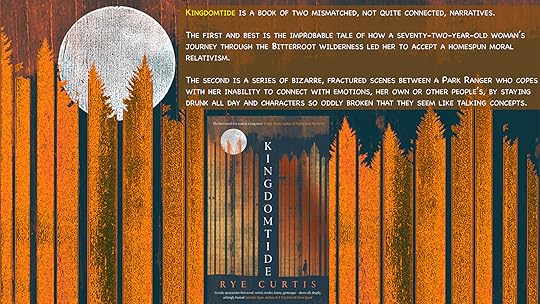
As a debut novel, 'Kingdomtide' has a lot to recommend it. It's bold and confident without being brash or slick. It experiments with form. It's brave enough to try and deal with the reality that much of the time we don't understand ourselves well enough to explain why we do what we do, that some of us find it hard to connect with, or even understand the need to connect with, other people and that our compulsion to judge others exceeds our ability to understand them.
I should be praising all the good stuff in 'Kingdomtide'. Instead, I find myself hung up on the things in 'Kingdomtide' that didn't work for me. I know that this reaction is in part due to the marketing effort behind the book - wide press coverage, a great cover, and endorsements from Roddy Doyle and Jennifer Egan that make the book sound like a literary achievement, led me to put aside the 'debut novel' label and replace it with an 'accomplished Lit Fic' label that it didn't live up to. But there's more to it than a gap between marketing and delivery. By the time I was halfway through 'Kingdomtide' I was getting impatient with it.
Most of the impatience was that based on the fact that one of the two narratives in the book doesn't work very well. The story of seventy-two-year-old Cloris Waldrip making her way off the Bitterroot mountains after surviving a plane crash that killed her husband and their pilot would make an engaging novel in its own right. Unfortunately, the other narrative reached for something that I don't think it achieved.
Here's what I wrote when I was halfway through the book:
"The parts with the old lady making her way off the mountain work well enough although her reflections are a little self-consciously of the wisdom-I've-gained-by-being-old variety.
The parts with the Park Ranger seem to be trying to be art of the cut-up-a-shark-and-put-it-in-formaldehyde kind.
I quite like the recovering-from-having-divorced-her-bigamist-husband Ranger who drinks Merlot from a thermos all day and describes 'not being a people person' as 'needing to work hard to remind myself that people continue to exist when I'm not with them'.
I could put up with the quirky the Search and Rescue guy who habitually shares too much personal information, asks probing personal questions, constantly attributes strange aphorisms to his dead wife, has a relationship with his teenage daughter that borders on inappropriate and displays sexual preferences that would be politely described as 'niched'.
What's trying my patience is the relentless use of a sentence structure like: 'Eric darted again his eyes to the girl'. It might be funny as a Yoda meets 'Twin Peaks' mash-up but I suspect the author sees it as an experiment with the relationship between syntax and semantics.
Anyway, every time we go back to the Ranger, the Search and Rescue guy and his I-see-the-world-so-differently-and-I'm-not-even-eighteen-yet daughter, I keep imagining David Lynch wanting to turn this into a mini-series with an atonal soundtrack, saturated colours and mystical mutterings about the meaning of owls."
I inured myself to the peculiar syntax and waited to see where Rye Curtis would take me.
Having completed the book, I found myself agreeing with Cloris Waldrip's statement:
'I do not entirely know what to make of it all.'
It turned out that the journeys of the two narratives shared a landscape but never intersected. I found myself dissatisfied with this. As this was clearly a thought-through part of the novel's structure I assume the failure to connect has some semantic value. Perhaps it illustrates that real-life has more failures to connect than connections. Perhaps it's supposed to counteract the tendency of narrative to impose order on a chaotic world. Whatever it was intended to do, the outcome for me was 'Why did I drag myself through these fractured incidents in the Park Ranger's journey into joyless isolation if it had nothing to do with the Cloris Waldrip narrative?' That may be shallow of me but it's how I felt.
In the end, the Cloris Waldrip story didn't work for me. It felt too much like a 'Pilgrim's Progress' designed to send me a few messages about not judging people. The journey itself was often interesting and surprising but I got tired of Cloris' 'I bet you didn't expect an old lady to have that reaction' pitch and irritated by her flowery language (is that why she's called Cloris?) and her determination to avoid contractions at all costs. The final chapters were the ones that kicked me out of the story. It seemed to me that I'd moved from narrative to lecture to ensure that I'd grasped the talking points and takeaways.
Here's the kind of thing I mean.
Firstly Cloris portions herself for an 'Aw shucks, we're all just people' pitch by describing how she arrived at her world view:
"Just by going for a little walk outside, I set new roads for the wind."
Then she declares that:
"You get to decide for yourself what you want to believe."
before launching a defence of Murbeck, a man she met on her journey who she subsequently found was being hunted by the FBI.
"But I do not allow that this man was too terribly different from the rest of us.
As far as I can tell, we sure do all cause a good deal of trouble trying to get what we want.
Yet, whatever uncommon perversion was in him he had some stroke of heroism in him too. Perilling his life for me as he did
The only thing I am certain of is that Murbeck was not evil The only authentic evil I can see in people begins with calling other people evil. Nothing quite makes the sense we would like it to. There are these who just do not fit with the way we have it set up these days."
I can see that that's one of the key messages of the book. I'd have preferred not to have it highlighted with a yellow marker pen.
On the first page of the book, Cloris opened her narrative with:
"I no longer pass judgment on any man nor woman. People are people, and I do not believe there is much more to be said on the matter."
By the end of the book, I understood that this had been a big step for Cloris. She had been raised in a culture that valued the public presentation of good behaviour and thrived on the censure of others. Nothing in her journey led me to understand why she saw totally abandoning judging others or herself as a sign of wisdom rather than weary resignation but at least she expressed herself clearly.
The Park Ranger's story got stranger and bleaker in the second half of the book.
I liked and felt I understood the Park Ranger. Her journey from trying to be a high-functioning alcoholic searching for purpose and connection to acceptance that she was inadequately equipped for joy and that purpose was self-deception seemed quite credible to me. I think a lot of us feel that at least some of the time.
What I didn't understand was the cast of characters she was interacting with. They crossed the line from quirky to WTF-land. They weren't people I believed in. It increasingly felt as if they were figments created in a nightmare. Maybe this was meant to demonstrate the Ranger's growing recognition of her alienation but I felt it undermined some of the power of the narrative.
All that being said, I'll still be on the lookout for Rye Curtis' next novel. The novel held my attention to the end, even when it was annoying me. I'm interested to hear what else he had to say,
I listened to the audiobook version of 'Kingdomtide'. Each narrative gets its own narrator and both do a good job. It seemed to me that someone had decided to mess with the sound quality of the Cloris narrative to give it a slightly tinny listen-to-that-authentic-old-timey-vinyl sound. I found this distracting but the quality of the narrative was good.

August 15, 2020
Stilistisch gescheitert und unnötig brutal
Kurzmeinung: Würde ich keinem Jugendlichen in die Hand geben.
Die Story ist schnell erzählt. Zwei Storylines. Eine 72jährige Überlebende eines Flugzeugabsturzes über dem Bitterroot National Forrest, eben „unsere Cloris Windrup“ – und eine derangierte Merlot-abhängige Rangerin Debra Lewis.
Der eine Erzählstrang ist ein bisschen bizarr, zum Beispiel wenn Cloris in allen Einzelheiten schildert, wie der schwer verletzte Pilot stirbt und vorher stundenlang ein bestimmtes Lied singt, wie ihr Mann tot im Baum hängt und wie sie Wasser aus dessen abgerissenem Stiefel trinkt, wie sie ihr Gebiss in einem Fluss verliert und ein kleines süßes Zicklein Erasmus benennt und dann umbringt und aufisst.
Aber wenn man einer leicht ironischen, überhöhten Erzählart „Drinnen war es so dunkel wie im Hintern einer Kuh“, etwas abgewinnt, ist der Part wie die alte Dame ums Überleben kämpft, lebendig, lustig, manchmal beinahe spannend. Wenn er nicht so absurd wäre. Aber sei es drum.
Der andere Part aber, der die Rangerin Debra Lewis als Mittelpunkt hat, muss man trotz allerhand skurrilem Personal und Einfällen als vollkommen misslungen betrachten. Um sich erzählstil-technisch von dem Cloris-Windrup-Teil abzugrenzen, also in bester Absicht, hat der Autor einfach zu viel getan. Als ich ungefähr zum hundertsten Mal lese, dass Rangerin Debra sich den Merlot von den Zähnen lutscht, tausendmal „gottverdammt“ nuschelt, in wirklich jedem zweiten Satz der Merlot erwähnt wird, oder sogar in jedem ? - gebe ich das Buch auf.
Ich mache mir noch einen Spaß daraus, ein wenig nachzulektorieren, und die Flüche und Merlotsätze zusammenzustreichen, aber bin ich Ryes Lektorin? Das beste Gericht schmeckt nicht, wenn man zu viel Salz hineinstreut, das beste Gemälde taugt nichts, wenn man Kerzenwachs drauf träufelt und zu viel Merlot ist eben zuviel Merlot. Von den schrägen Sexszenen muss ich da gar nicht mehr reden.
Eines noch: man hat nachgerade den Eindruck, dass der Autor, um bei der abgebrühten ? Jugend zu punkten, möglichst oft, ekelhafte und brutale Szenen einfügt, zum Beispiel, wenn er schildert, wie im strengen Winter ein Eichhörnchen sein gerade geborenes Junges auffrisst und genüßlich am aufgebrochenen Köpfchen leckt. Schocktherapie? Dafür habe ich so gar kein Verständnis!
Fazit: Der Ansatz ist gar nicht übel. Das Thema Flugzeugabsturz und Kampf ums Überleben kriegt mich immer, aber ein Mindestmaß an Stilsicherheit muss sein und unnötige Brutalitäten mag ich auch nicht.
Kategorie: Jugendbuch
C.H. Beck, 2020
Kurzmeinung: Würde ich keinem Jugendlichen in die Hand geben.
Die Story ist schnell erzählt. Zwei Storylines. Eine 72jährige Überlebende eines Flugzeugabsturzes über dem Bitterroot National Forrest, eben „unsere Cloris Windrup“ – und eine derangierte Merlot-abhängige Rangerin Debra Lewis.
Der eine Erzählstrang ist ein bisschen bizarr, zum Beispiel wenn Cloris in allen Einzelheiten schildert, wie der schwer verletzte Pilot stirbt und vorher stundenlang ein bestimmtes Lied singt, wie ihr Mann tot im Baum hängt und wie sie Wasser aus dessen abgerissenem Stiefel trinkt, wie sie ihr Gebiss in einem Fluss verliert und ein kleines süßes Zicklein Erasmus benennt und dann umbringt und aufisst.
Aber wenn man einer leicht ironischen, überhöhten Erzählart „Drinnen war es so dunkel wie im Hintern einer Kuh“, etwas abgewinnt, ist der Part wie die alte Dame ums Überleben kämpft, lebendig, lustig, manchmal beinahe spannend. Wenn er nicht so absurd wäre. Aber sei es drum.
Der andere Part aber, der die Rangerin Debra Lewis als Mittelpunkt hat, muss man trotz allerhand skurrilem Personal und Einfällen als vollkommen misslungen betrachten. Um sich erzählstil-technisch von dem Cloris-Windrup-Teil abzugrenzen, also in bester Absicht, hat der Autor einfach zu viel getan. Als ich ungefähr zum hundertsten Mal lese, dass Rangerin Debra sich den Merlot von den Zähnen lutscht, tausendmal „gottverdammt“ nuschelt, in wirklich jedem zweiten Satz der Merlot erwähnt wird, oder sogar in jedem ? - gebe ich das Buch auf.
Ich mache mir noch einen Spaß daraus, ein wenig nachzulektorieren, und die Flüche und Merlotsätze zusammenzustreichen, aber bin ich Ryes Lektorin? Das beste Gericht schmeckt nicht, wenn man zu viel Salz hineinstreut, das beste Gemälde taugt nichts, wenn man Kerzenwachs drauf träufelt und zu viel Merlot ist eben zuviel Merlot. Von den schrägen Sexszenen muss ich da gar nicht mehr reden.
Eines noch: man hat nachgerade den Eindruck, dass der Autor, um bei der abgebrühten ? Jugend zu punkten, möglichst oft, ekelhafte und brutale Szenen einfügt, zum Beispiel, wenn er schildert, wie im strengen Winter ein Eichhörnchen sein gerade geborenes Junges auffrisst und genüßlich am aufgebrochenen Köpfchen leckt. Schocktherapie? Dafür habe ich so gar kein Verständnis!
Fazit: Der Ansatz ist gar nicht übel. Das Thema Flugzeugabsturz und Kampf ums Überleben kriegt mich immer, aber ein Mindestmaß an Stilsicherheit muss sein und unnötige Brutalitäten mag ich auch nicht.
Kategorie: Jugendbuch
C.H. Beck, 2020

September 6, 2019
Wow! What a great start to a book! Rye Curtis does not hesitate: 54 years-married, Cloris and Richard Waldrip are no sooner introduced than the sound of the impact of their small plane ploughing into the Montana mountains "fractured all known sound into pieces". And so begin's Mrs Waldrip's quirky first person narrative, describing the aftermath and her determined struggle to survive in spite of her 72 years and no real hope of being found in the wilderness. And, as it transpires, providing ample opportunity for her to reflect on her life; "It does amaze me that a woman can reach the tail end of her life and find that she hardly knows herself at all."
Enter stage right, struggling divorcee Ranger Lewis displaying equal determination, this time to pursue her sixth sense that someone has survived the reported crash. Surrounded by a motley crew of disparate (and frankly odd) characters, she manages her days combining a drip-feed of black coffee and Merlot with an internal monologue of self-loathing and insecurities; "I don't figure I'm a people person, she said. Sometimes I just don't give a goddamn about anyone. I have to work at it. Remind myself everybody else still exists even when I'm not looking at them. You figure sayin somethin like that tells you somethin about me?"
Sadly, the promise of the first section of the book does not carry through into the main body of the tale. In meticulous detail, Curtis charts the daily struggle of both women - slowing the pace and losing momentum to the point that I eventually lost interest. On the eleventh time of Cloris wondering at what she may eat today or perhaps the fourteenth occasion of Lewis pouring her depressing cocktail, I had to admit defeat and so was unable to finish the tale.
Nevertheless, I am grateful to Netgalley and the publisher for sharing an advance copy with me in return for my honest opinion.
Enter stage right, struggling divorcee Ranger Lewis displaying equal determination, this time to pursue her sixth sense that someone has survived the reported crash. Surrounded by a motley crew of disparate (and frankly odd) characters, she manages her days combining a drip-feed of black coffee and Merlot with an internal monologue of self-loathing and insecurities; "I don't figure I'm a people person, she said. Sometimes I just don't give a goddamn about anyone. I have to work at it. Remind myself everybody else still exists even when I'm not looking at them. You figure sayin somethin like that tells you somethin about me?"
Sadly, the promise of the first section of the book does not carry through into the main body of the tale. In meticulous detail, Curtis charts the daily struggle of both women - slowing the pace and losing momentum to the point that I eventually lost interest. On the eleventh time of Cloris wondering at what she may eat today or perhaps the fourteenth occasion of Lewis pouring her depressing cocktail, I had to admit defeat and so was unable to finish the tale.
Nevertheless, I am grateful to Netgalley and the publisher for sharing an advance copy with me in return for my honest opinion.

Read
February 14, 2020Full review on behalf of the Sunday Times: https://bit.ly/2TvRjPJ
~I no longer pass judgement on any man nor woman. People are people, and I do not believe there is much more to be said on that matter. Twenty years ago I might have been of a different mind about that, but I was a different Cloris Waldrip back then.~
~It is not something that I easily admit, but I believe it is important: It was romantic to be naked outdoors.~
~I suppose people tell stories partly because we can tell them over and over again. You can get mighty familiar with a story and know it inside and out, front to back. But while a story has something of the true world to it, mostly it does not. You can get a handle on a story. I hold that much of what confounds young people today is that they can seldom discern the difference between a narrative and the actual events of the natural world. However, if you pay close enough attention before long in your years you come to learn that there is no retelling a life and it is by your own secret hand that you are the author of your own demise.~
~I never had any good reason to live these twenty more years after I crawled out of that little airplane. I suppose the terrible truth of it is that not an earthly creature ever has any good reason to live at all. But we do it anyhow, even when we have all the good reason in the world not to.~
~Colonel Goodnight, the father of the Texas Panhandle and inventor of the chuck wagon, once said: Old age hath its honors, but it is damned inconvenient.~
~I no longer pass judgement on any man nor woman. People are people, and I do not believe there is much more to be said on that matter. Twenty years ago I might have been of a different mind about that, but I was a different Cloris Waldrip back then.~
~It is not something that I easily admit, but I believe it is important: It was romantic to be naked outdoors.~
~I suppose people tell stories partly because we can tell them over and over again. You can get mighty familiar with a story and know it inside and out, front to back. But while a story has something of the true world to it, mostly it does not. You can get a handle on a story. I hold that much of what confounds young people today is that they can seldom discern the difference between a narrative and the actual events of the natural world. However, if you pay close enough attention before long in your years you come to learn that there is no retelling a life and it is by your own secret hand that you are the author of your own demise.~
~I never had any good reason to live these twenty more years after I crawled out of that little airplane. I suppose the terrible truth of it is that not an earthly creature ever has any good reason to live at all. But we do it anyhow, even when we have all the good reason in the world not to.~
~Colonel Goodnight, the father of the Texas Panhandle and inventor of the chuck wagon, once said: Old age hath its honors, but it is damned inconvenient.~

January 29, 2020
Two stories running parallel in the Bitterroot Mountains after a plane crashes with a single survivor, Cloris Waldrip, who begins her trek away from the wreck with little more than the dead pilot’s coat, a hatchet, and her wits. Meanwhile, two park rangers, each dealing with emotional issues and less than engaged in their jobs, are part of a less than enthusiastic search and rescue effort, with all except merlot guzzling Deb Lewis certain that the 72 year old survivor has perished in the wilderness. Clovis narrates her story of survival from a 20 year distance and what she tells is a remarkable story of transformation from the woman she was for 72 years into a woman she didn’t know she was until her plane crashed and she walked away from the wreckage. Her journey is one which uses her life in the Texas panhandle as a church going married woman in a small town as her point of reference, but you realize that she is no generic woman as she uses her experiences and observations to make practical decisions. She is not alone, and soon meets the man who leaves her food, but he is a pedophile on the run from the law, so they make quite an odd couple.The rangers’ story is a dysfunctional rambling hot mess as an odd cast of characters move in and out of their lives. This was unfortunate, as Cloris’ story was so rich and vital.

August 26, 2023
Não foi por falta de aviso.
A capa e as notas que a ilustram referem que é estranho e situam-no entre Fargo e Twin Peaks. E todos sabemos o quanto nos fascinavam.
História bem escrita com duas personagens que oscilam entre a normalidade e a bizararia. Uma velha metodista texana de seu nome Cloris Waldrip. Um misterioso mascarado que a ajuda. E uma agente sempre alcoolizada que acredita que Cloris sobreviveu ao acidente. Não é um thriller como eu o entendo mas um romance algo sórdido e um tanto intrigante que não se desenrola com a ligeireza de um thriller.
Dividido em oito partes é um livro invulgar com um desfecho interessante. Não deixa de ser um livro sobre resiliência e generosidade. Não é um livro consensual.
A capa e as notas que a ilustram referem que é estranho e situam-no entre Fargo e Twin Peaks. E todos sabemos o quanto nos fascinavam.
História bem escrita com duas personagens que oscilam entre a normalidade e a bizararia. Uma velha metodista texana de seu nome Cloris Waldrip. Um misterioso mascarado que a ajuda. E uma agente sempre alcoolizada que acredita que Cloris sobreviveu ao acidente. Não é um thriller como eu o entendo mas um romance algo sórdido e um tanto intrigante que não se desenrola com a ligeireza de um thriller.
Dividido em oito partes é um livro invulgar com um desfecho interessante. Não deixa de ser um livro sobre resiliência e generosidade. Não é um livro consensual.
January 27, 2020
I really enjoyed this first novel from Rye Curtis. The writing is wonderful and the characters are well developed. I particularly enjoyed reading Cloris Waldrop's story and the reminiscing she does on her life - Cloris is the only person who walked away from a small plane crash in the mountains, her husband and the young pilot were killed. The other main characters are Ranger Lewis (another strong female character) and a young man hiding in the mountains from the FBI. This was an unexpected, great read.

November 4, 2023
Este é um livro bizarro. Talvez o mais bizarro que li até hoje. No entanto, no meio de tanta bizarria, encontramos algumas reflexões que nos trocam as voltas e o que parecia bizarro talvez não o seja assim tanto.
"O que deixarei aqui registado é que vim a descobrir que a moralidade não constitui a âncora da virtude e que uma pessoa é demasiadas coisas para ser somente aquela que todos nós queremos que ela seja para nossa conveniência."
Na quadra do Kingdomtide (título do livro em inglês), por volta de agosto de 1986, Cloris Waldrip entra num aviãozinho pequeno com o seu marido, Mr. Waldrip, para umas pequenas férias no Montana. Despenham-se nas montanhas de Bitterroot, tendo Cloris sido a única sobrevivente. Tem 72 anos. Cloris narra a sua história a dois tempos: durante a sua provação nas montanhas em 1986 e aos 92 anos, em 2006, olhando para o passado já a viver num lar de idosos.
Temos também uma terceira perspectiva desta história, mas do ponto de vista de Debra Lewis, guarda florestal nas Bitterroot, que procura incessantemente por Cloris, mesmo contra todos os que a rodeiam. Debra Lewis é uma personagem em queda, sem esperança, o que contrasta com a tenacidade e vivacidade de Cloris.
Nas partes em que Lewis se torna a personagem principal, aparecem personagens estranhos, estranhas ligações entre eles e diálogos que nos obrigam a ler 2 ou 3 vezes, de tão descabidos que são. Mas serão assim tão descabidos?
Este livro, classificado como um thriller, mas que na minha opinião não o é, faz-nos duvidar da sanidade coletiva da humanidade. Não seremos todos bizarros, cada um à sua maneira? Convivem em nós tantos "eus" contraditórios. Será possível haver moralidade sem virtude e imoralidade com virtude?
É um livro bizarro, mas que me fez pensar e permanecerá na minha memória algum tempo. Ah, só um aviso. Tem partes nauseantes. Talvez o thriller caiba nessas partes, não sei...
"O que deixarei aqui registado é que vim a descobrir que a moralidade não constitui a âncora da virtude e que uma pessoa é demasiadas coisas para ser somente aquela que todos nós queremos que ela seja para nossa conveniência."
Na quadra do Kingdomtide (título do livro em inglês), por volta de agosto de 1986, Cloris Waldrip entra num aviãozinho pequeno com o seu marido, Mr. Waldrip, para umas pequenas férias no Montana. Despenham-se nas montanhas de Bitterroot, tendo Cloris sido a única sobrevivente. Tem 72 anos. Cloris narra a sua história a dois tempos: durante a sua provação nas montanhas em 1986 e aos 92 anos, em 2006, olhando para o passado já a viver num lar de idosos.
Temos também uma terceira perspectiva desta história, mas do ponto de vista de Debra Lewis, guarda florestal nas Bitterroot, que procura incessantemente por Cloris, mesmo contra todos os que a rodeiam. Debra Lewis é uma personagem em queda, sem esperança, o que contrasta com a tenacidade e vivacidade de Cloris.
Nas partes em que Lewis se torna a personagem principal, aparecem personagens estranhos, estranhas ligações entre eles e diálogos que nos obrigam a ler 2 ou 3 vezes, de tão descabidos que são. Mas serão assim tão descabidos?
Este livro, classificado como um thriller, mas que na minha opinião não o é, faz-nos duvidar da sanidade coletiva da humanidade. Não seremos todos bizarros, cada um à sua maneira? Convivem em nós tantos "eus" contraditórios. Será possível haver moralidade sem virtude e imoralidade com virtude?
É um livro bizarro, mas que me fez pensar e permanecerá na minha memória algum tempo. Ah, só um aviso. Tem partes nauseantes. Talvez o thriller caiba nessas partes, não sei...

January 14, 2020
This was a real slow burner of a story for me! From the initial shock impact of the plane crash that leaves 72 year old Clovis lost and alone in the wilderness, this was a book that immerses you in the plight of her and the female ranger, Debra, in charge of trying to find her. And both their journeys, both phsyically and mentally, are fascinating insights into 2 women at different stages of their lives, alone with their thoughts and demons, and the misfit characters surrounding them, and just goes to show how quickly life can change and lead you on different paths, and ultimately teaches you more about yourself than you've ever learnt before.
Clovis and her husband are in a small plane that crashes, and she's faced with horrific sights as she makes sense of what has happened to them. But her years have taught her resilience so she sets off with very little to find a way to get back to civilisation.
Debra Lewis is the Park Ranger who is heading up a small group of rescuers who have no idea where the plane went down, but have heard radio message repeating the name 'Clovis'. The forests carry their own folklore too, there's talk of ghosts roaming, and this really adds to the desperation felt by those doing the searching, and Clovis looking to be rescued.
Clovis finds herself being 'helped' by a masked man making her fires and finding food, and I really enjoyed the mystery of just who he is. The more time she spends alone, the more you think is she imagining things and the way she looks back over her life with her husband adds to the interest and helps keep her going. I was always amazed at her determination and fight to keep going, even if things did get to her at times. The more time she spent in the forests, the more she became comfortable with the routine and existence, leading her to question if she even wanted to get back to 'normality' as it all felt so far removed from the person she had become.
Debra is also another fascinating character - she chooses to spend time alone so having to deal with others is a little alien to her, and her prickly character is put to the test by some of those around her, who bring their own issues to the table.
This isn't a straightforward kind of book - there are dark turns, and the story often wanders off into places I didn't expect it too! But I think that just made it more of an intriguing prospect for me. With the rescue taking place over a longer period, it allows you to get to know more about the characters and their state of mind, and how being pushed to the edge can lead you to some extraordinary decisions. Highly recommended
Clovis and her husband are in a small plane that crashes, and she's faced with horrific sights as she makes sense of what has happened to them. But her years have taught her resilience so she sets off with very little to find a way to get back to civilisation.
Debra Lewis is the Park Ranger who is heading up a small group of rescuers who have no idea where the plane went down, but have heard radio message repeating the name 'Clovis'. The forests carry their own folklore too, there's talk of ghosts roaming, and this really adds to the desperation felt by those doing the searching, and Clovis looking to be rescued.
Clovis finds herself being 'helped' by a masked man making her fires and finding food, and I really enjoyed the mystery of just who he is. The more time she spends alone, the more you think is she imagining things and the way she looks back over her life with her husband adds to the interest and helps keep her going. I was always amazed at her determination and fight to keep going, even if things did get to her at times. The more time she spent in the forests, the more she became comfortable with the routine and existence, leading her to question if she even wanted to get back to 'normality' as it all felt so far removed from the person she had become.
Debra is also another fascinating character - she chooses to spend time alone so having to deal with others is a little alien to her, and her prickly character is put to the test by some of those around her, who bring their own issues to the table.
This isn't a straightforward kind of book - there are dark turns, and the story often wanders off into places I didn't expect it too! But I think that just made it more of an intriguing prospect for me. With the rescue taking place over a longer period, it allows you to get to know more about the characters and their state of mind, and how being pushed to the edge can lead you to some extraordinary decisions. Highly recommended

April 29, 2020
this read like a david lynch movie. it was weird & upsetting . i thought it was about the sole survivor of a plane crash & the troubled ranger whose job it was to find her. instead, it was a story about how we can't help who we desire. my feelings about this novel are complicated. i might come back to this review.

Displaying 1 - 30 of 383 reviews