

What do you think?

Dearly Beloved
As enigmatic as she is beautiful, Diana Lindsay is the most desirable and sought after woman in London, her smile worth a prince’s ransom. Yet Diana wants only one man—a haunted lord with mysterious secrets as deep as hers.
Gervase Brandelin, Viscount St. Aubyn, dedicated himself to the service of his country as a way to redeem the sins of his youth. As a spymaster, he seeks out Britain’s hidden enemies and nothing can sway him from his duty, until he meets a woman who touches his heart even more than she dazzles his senses. In Diana he finds warmth and hope, yet he is bitterly aware that she can never be his.
Then the two halves of Gervase’s life come together in a cataclysm that threatens to separate him from Diana forever. Perhaps love might bring them together, but first they must survive the assault of a deadly enemy.
Gervase Brandelin, Viscount St. Aubyn, dedicated himself to the service of his country as a way to redeem the sins of his youth. As a spymaster, he seeks out Britain’s hidden enemies and nothing can sway him from his duty, until he meets a woman who touches his heart even more than she dazzles his senses. In Diana he finds warmth and hope, yet he is bitterly aware that she can never be his.
Then the two halves of Gervase’s life come together in a cataclysm that threatens to separate him from Diana forever. Perhaps love might bring them together, but first they must survive the assault of a deadly enemy.
Audiobook
First published January 1, 1990
About the author
Mary Jo Putney
174 books2,277 followersShe writes young adult fiction as M.J. Putney.
Mary Jo Putney was born on 1946 in Upstate New York with a reading addiction, a condition for which there is no known cure. After earning degrees in English Literature and Industrial Design at Syracuse University, she did various forms of design work in California and England before inertia took over in Baltimore, Maryland, where she has lived very comfortably ever since.
While becoming a novelist was her ultimate fantasy, it never occurred to her that writing was an achievable goal until she acquired a computer for other purposes. When the realization hit that a computer was the ultimate writing tool, she charged merrily into her first book with an ignorance that illustrates the adage that fools rush in where angels fear to tread.
Fortune sometimes favors the foolish and her first book sold quickly, thereby changing her life forever, in most ways for the better. (“But why didn't anyone tell me that writing would change the way one reads?”) Like a lemming over a cliff, she gave up her freelance graphic design business to become a full-time writer as soon as possible.
Since 1987, Ms. Putney has published twenty-nine books and counting. Her stories are noted for psychological depth and unusual subject matter such as alcoholism, death and dying, and domestic abuse. She has made all of the national bestseller lists including the New York Times, Wall Street Journal, USAToday, and Publishers Weekly. Five of her books have been named among the year’s top five romances by The Library Journal. The Spiral Path and Stolen Magic were chosen as one of Top Ten romances of their years by Booklist, published by the American Library Association.
A nine-time finalist for the Romance Writers of America RITA, she has won RITAs for Dancing on the Wind and The Rake and the Reformer and is on the RWA Honor Roll for bestselling authors. She has been awarded two Romantic Times Career Achievement Awards, four NJRW Golden Leaf awards, plus the NJRW career achievement award for historical romance. Though most of her books have been historical, she has also published three contemporary romances. The Marriage Spell will be out in June 2006 in hardcover, and Stolen Magic (written as M. J. Putney) will be released in July 2006.
Ms. Putney says that not least among the blessings of a full-time writing career is that one almost never has to wear pantyhose.
Mary Jo Putney was born on 1946 in Upstate New York with a reading addiction, a condition for which there is no known cure. After earning degrees in English Literature and Industrial Design at Syracuse University, she did various forms of design work in California and England before inertia took over in Baltimore, Maryland, where she has lived very comfortably ever since.
While becoming a novelist was her ultimate fantasy, it never occurred to her that writing was an achievable goal until she acquired a computer for other purposes. When the realization hit that a computer was the ultimate writing tool, she charged merrily into her first book with an ignorance that illustrates the adage that fools rush in where angels fear to tread.
Fortune sometimes favors the foolish and her first book sold quickly, thereby changing her life forever, in most ways for the better. (“But why didn't anyone tell me that writing would change the way one reads?”) Like a lemming over a cliff, she gave up her freelance graphic design business to become a full-time writer as soon as possible.
Since 1987, Ms. Putney has published twenty-nine books and counting. Her stories are noted for psychological depth and unusual subject matter such as alcoholism, death and dying, and domestic abuse. She has made all of the national bestseller lists including the New York Times, Wall Street Journal, USAToday, and Publishers Weekly. Five of her books have been named among the year’s top five romances by The Library Journal. The Spiral Path and Stolen Magic were chosen as one of Top Ten romances of their years by Booklist, published by the American Library Association.
A nine-time finalist for the Romance Writers of America RITA, she has won RITAs for Dancing on the Wind and The Rake and the Reformer and is on the RWA Honor Roll for bestselling authors. She has been awarded two Romantic Times Career Achievement Awards, four NJRW Golden Leaf awards, plus the NJRW career achievement award for historical romance. Though most of her books have been historical, she has also published three contemporary romances. The Marriage Spell will be out in June 2006 in hardcover, and Stolen Magic (written as M. J. Putney) will be released in July 2006.
Ms. Putney says that not least among the blessings of a full-time writing career is that one almost never has to wear pantyhose.
Ratings & Reviews
Friends & Following
Create a free account to discover what your friends think of this book!
Community Reviews
Displaying 1 - 30 of 181 reviews

June 26, 2019
This is a DNF for me.
It has been reissued from 1990 I believe, but it was crass. Not giving away spoilers but this occurred in the first chapter: The hero rapes someone....in graphic detail. WHAT???? How do I get past seeing him as a rapist for the rest of the book? I realize bodice ripper romances were popular in the 90s, but rape is too much.
I very rarely give less than three stars, even when I do not like the book because I realize the effort that goes into writing a novel, but this book was not for me.
I received an ARC from Netgalley.
It has been reissued from 1990 I believe, but it was crass. Not giving away spoilers but this occurred in the first chapter: The hero rapes someone....in graphic detail. WHAT???? How do I get past seeing him as a rapist for the rest of the book? I realize bodice ripper romances were popular in the 90s, but rape is too much.
I very rarely give less than three stars, even when I do not like the book because I realize the effort that goes into writing a novel, but this book was not for me.
I received an ARC from Netgalley.

December 22, 2017
Oh man.
That's right. That is my response to this book.
I will be writing about what happens in the book. So this is your spoiler alert.
I like Mary Jo Putney's style. I just do. I like how serious her style is. I like that her characters are more stoic than others. I like that her stories are darker, her characters confronted by their own past and limits. There is nothing fluffy about Putney's stories. And I love it.
That being said, I don't know what to do with this book.
I don't love it. But appallingly I don't hate it either. Gervase, the anti-hero, was a very hard character to like. And Diana, the anti-heroine, wasn't a peach herself either. I don't like the story. I don't like the characters. I don't like how their relationship developed. There is nothing about Gervase and Diana that I like.
What I liked, was still Putney's style. Her writing and her style of building a story. Does that make sense at all? This book is like a very poor painting in a very expensive frame. Why, I want to ask Putney? Why did you write this story? You picked some mega heavyweight elements for this story, and if anyone could make it work, it would be you. Why did you go down this route?
If you are patient enough and have followed my useless review to this point, I will tell you finally what happened in this questionable story. Young Gervase opened the book for us. He was in a most unfortunate situation and was forced to marry a young girl, Mary, who he did not know. So he raped the young girl on their pathetic wedding night. Yes he did. At this point I was appalled about the fact that I did not stop reading this book right away. What the hell is wrong with me that I am willing to continue reading this book?
I read on in self-disgust.
Then we met Diana. She was easy to like in the beginning. But this gentle woman all of a sudden decided that she needed to become a courtesan. I am like why?? Because you are bored?? What the hell woman??
So the matchlessly beautiful Diana went to London. On her night out she met Gervase. And so on and so forth, you know how it goes. Creamy chest and long neck, Gervase was done for.
Now if you have read as many historical romances as I have, you know what happened. They fell in love and Gervase befriended Diana's son. They spent more time together and the boring love story continued. The emotional, superstitious Diana refused Gervase's "protection", aka becoming his mistress officially, claiming that she was looking for love and respectability (aka marriage). Gervase, as much as he lusted after Diana, could not offer her either. According to him, he could not love, nor could he marry. He did not bother to explain why.
So one fateful night Diana finally got it out of Gervase: that he was married and he abused the young girl. Diana was outraged for the girl. She told Gervase that his self-imposed punishment was for himself. He spared no thought for the girl. To appease her and his own guilt, Gervase decided to face his demon and visit Mary.
Of course Diana was Mary, Gervase's victim, the young girl raped on her wedding night. Of course Diana got pregnant that night. Her son was their son. Gervase was pissed off. Diana couldn't believe it. She was the one who was wronged. Why was Gervase angry?
At this point, I do not know who I despised more. The rapist or the woman who became a courtesan to find her rapist and wanted her rapist to love her.
There is more. The rapist had a past. Gervase's perverse mother raped him when he was 13.
Sexual abuse is a difficult topic. Having the victim face his/her abuser, and have them fall in love, I am not saying this is not possible or not ok, I am not in the position to comment on the topic at all. I can only say that it was difficult to like this story. I cannot relate to either Gervase or Diana, each had something that I find distasteful. The story itself was bland. Like I said, the only thing that was good was the frame, Putney's writing. But a fancy frame doesn't make art. Fluid writing alone does not make a good story.
The story had me at my throat in the beginning. I had guessed where the story was going, that Diana was Mary, that Gervase had his wife as his mistress. And I was hoping, even though I didn't know how one is ever to make peace with such a story, that Putney could make it work. Reconcile with the past, so to speak, forgiveness and remorse, that kind of thing. But I found the rape intolerable, Diana's fanciful wishes childish, her deceit distasteful, and Gervase's history with his mother was a poor excuse for his treatment of Diana. The spy, evil Frenchman and gay cousin elements were pitiful attempts at making the story more than a love story. They did very little for the story.
Putney is from that era which saw the rise of old-fashioned romance writers. Some of them wrote really great stories, including Putney herself. I remain a fan of her style. I hope she would somehow find new stories to showcase her writing again. I think it is brave of her to attempt to write about difficult topics, instead of writing about one duke after another duke, fairy-tale kind of romances. I hope she will continue to challenge her readers. And I hope she finds a way to give these experiences the respect they deserve.
That's right. That is my response to this book.
I will be writing about what happens in the book. So this is your spoiler alert.
I like Mary Jo Putney's style. I just do. I like how serious her style is. I like that her characters are more stoic than others. I like that her stories are darker, her characters confronted by their own past and limits. There is nothing fluffy about Putney's stories. And I love it.
That being said, I don't know what to do with this book.
I don't love it. But appallingly I don't hate it either. Gervase, the anti-hero, was a very hard character to like. And Diana, the anti-heroine, wasn't a peach herself either. I don't like the story. I don't like the characters. I don't like how their relationship developed. There is nothing about Gervase and Diana that I like.
What I liked, was still Putney's style. Her writing and her style of building a story. Does that make sense at all? This book is like a very poor painting in a very expensive frame. Why, I want to ask Putney? Why did you write this story? You picked some mega heavyweight elements for this story, and if anyone could make it work, it would be you. Why did you go down this route?
If you are patient enough and have followed my useless review to this point, I will tell you finally what happened in this questionable story. Young Gervase opened the book for us. He was in a most unfortunate situation and was forced to marry a young girl, Mary, who he did not know. So he raped the young girl on their pathetic wedding night. Yes he did. At this point I was appalled about the fact that I did not stop reading this book right away. What the hell is wrong with me that I am willing to continue reading this book?
I read on in self-disgust.
Then we met Diana. She was easy to like in the beginning. But this gentle woman all of a sudden decided that she needed to become a courtesan. I am like why?? Because you are bored?? What the hell woman??
So the matchlessly beautiful Diana went to London. On her night out she met Gervase. And so on and so forth, you know how it goes. Creamy chest and long neck, Gervase was done for.
Now if you have read as many historical romances as I have, you know what happened. They fell in love and Gervase befriended Diana's son. They spent more time together and the boring love story continued. The emotional, superstitious Diana refused Gervase's "protection", aka becoming his mistress officially, claiming that she was looking for love and respectability (aka marriage). Gervase, as much as he lusted after Diana, could not offer her either. According to him, he could not love, nor could he marry. He did not bother to explain why.
So one fateful night Diana finally got it out of Gervase: that he was married and he abused the young girl. Diana was outraged for the girl. She told Gervase that his self-imposed punishment was for himself. He spared no thought for the girl. To appease her and his own guilt, Gervase decided to face his demon and visit Mary.
Of course Diana was Mary, Gervase's victim, the young girl raped on her wedding night. Of course Diana got pregnant that night. Her son was their son. Gervase was pissed off. Diana couldn't believe it. She was the one who was wronged. Why was Gervase angry?
At this point, I do not know who I despised more. The rapist or the woman who became a courtesan to find her rapist and wanted her rapist to love her.
There is more. The rapist had a past. Gervase's perverse mother raped him when he was 13.
Sexual abuse is a difficult topic. Having the victim face his/her abuser, and have them fall in love, I am not saying this is not possible or not ok, I am not in the position to comment on the topic at all. I can only say that it was difficult to like this story. I cannot relate to either Gervase or Diana, each had something that I find distasteful. The story itself was bland. Like I said, the only thing that was good was the frame, Putney's writing. But a fancy frame doesn't make art. Fluid writing alone does not make a good story.
The story had me at my throat in the beginning. I had guessed where the story was going, that Diana was Mary, that Gervase had his wife as his mistress. And I was hoping, even though I didn't know how one is ever to make peace with such a story, that Putney could make it work. Reconcile with the past, so to speak, forgiveness and remorse, that kind of thing. But I found the rape intolerable, Diana's fanciful wishes childish, her deceit distasteful, and Gervase's history with his mother was a poor excuse for his treatment of Diana. The spy, evil Frenchman and gay cousin elements were pitiful attempts at making the story more than a love story. They did very little for the story.
Putney is from that era which saw the rise of old-fashioned romance writers. Some of them wrote really great stories, including Putney herself. I remain a fan of her style. I hope she would somehow find new stories to showcase her writing again. I think it is brave of her to attempt to write about difficult topics, instead of writing about one duke after another duke, fairy-tale kind of romances. I hope she will continue to challenge her readers. And I hope she finds a way to give these experiences the respect they deserve.

March 27, 2023
1.5 stars
This book is, for me, a rare misstep from an author I usually enjoy a lot. The prologue was horrifying and mystifying. Then we are supposed to believe that a young mother, after giving refuge to a former courtesan, decides that the very thing she needs for herself and her son is to head to London to become a courtesan. In order to find love. I kid you not. That her training for prostitution involves parsnips should be all you need to know about that. I could go on and on, but the biggest problem with this book, in a veritable lake of problems, is that the author doesn’t share the backstories that might illuminate the motivations behind the characters’ actions with the reader, resulting in plot twists that seem mind-bogglingly and incomprehensibly stupid at the time, but that actually make a little sense once the reader knows the history and thought process of the characters.
I don’t know for sure, but suspect this might be an earlier work of Mary Jo Putney. The writing talent and imagination are very evident, and kept me turning the page but, frankly, this is an unpleasant mess.
This book is, for me, a rare misstep from an author I usually enjoy a lot. The prologue was horrifying and mystifying. Then we are supposed to believe that a young mother, after giving refuge to a former courtesan, decides that the very thing she needs for herself and her son is to head to London to become a courtesan. In order to find love. I kid you not. That her training for prostitution involves parsnips should be all you need to know about that. I could go on and on, but the biggest problem with this book, in a veritable lake of problems, is that the author doesn’t share the backstories that might illuminate the motivations behind the characters’ actions with the reader, resulting in plot twists that seem mind-bogglingly and incomprehensibly stupid at the time, but that actually make a little sense once the reader knows the history and thought process of the characters.
I don’t know for sure, but suspect this might be an earlier work of Mary Jo Putney. The writing talent and imagination are very evident, and kept me turning the page but, frankly, this is an unpleasant mess.

October 28, 2010
The only reason I read this book through to the end was to see exactly how the heroine would finally reveal her big secret to the hero. (I had guessed what the secret was at some point between the introduction of the heroine and the big revelation.) This secret just happens to be the most important fact in the story and the heroine's character, so it makes no sense to keep the reader in the dark about it until 80% of the book is finished. Getting that reveal so late in the book effectively nullifies every action of the heroine up to that point in the story and totally negates every scene in the book that is told from the heroine's POV up to that point.
Because of this, I felt cheated out of most of the story, and I couldn't relate to how the heroine's feelings for the hero changed from loathing to love. Also, there was no explanation for why the heroine didn't tell the hero about his son a long time ago, which would have been the right thing to do for so many reasons (her loathing the boy's father is not an acceptable reason for not telling him - it's just childish, IMHO).
The author has the heroine decide to become a fabulously successful courtesan after living most of her life in an isolated village in Yorkshire with a decent income and security in her life. I don't know - maybe the author felt this would make the heroine glamorous and attractive to the reader. But really - this is a "career choice" that most women of the time would only have made if they felt they had no other option or they were forced into it, and 99% of the time it was pure degradation. So besides not making any sense at all, the author's decision is totally insulting to the women who had to prostitute themselves simply in order to live.
The spy aspect of the story was pretty lame, and the bad guy was just a 1-dimensional caricature of a really eeeevilllll villain. The melodrama of the last part of the book felt completely contrived.
So - not a keeper and not enjoyable for me.
Because of this, I felt cheated out of most of the story, and I couldn't relate to how the heroine's feelings for the hero changed from loathing to love. Also, there was no explanation for why the heroine didn't tell the hero about his son a long time ago, which would have been the right thing to do for so many reasons (her loathing the boy's father is not an acceptable reason for not telling him - it's just childish, IMHO).
The author has the heroine decide to become a fabulously successful courtesan after living most of her life in an isolated village in Yorkshire with a decent income and security in her life. I don't know - maybe the author felt this would make the heroine glamorous and attractive to the reader. But really - this is a "career choice" that most women of the time would only have made if they felt they had no other option or they were forced into it, and 99% of the time it was pure degradation. So besides not making any sense at all, the author's decision is totally insulting to the women who had to prostitute themselves simply in order to live.
The spy aspect of the story was pretty lame, and the bad guy was just a 1-dimensional caricature of a really eeeevilllll villain. The melodrama of the last part of the book felt completely contrived.
So - not a keeper and not enjoyable for me.

February 1, 2022
I first read this book back in 2012, at the beginning of my romance journey. I've read a lot of romance novels since then, but this book remains the worst romance novel that I've ever read. One of the few romances where the HEA should've been the heroine taking her son and drop kicking the POS "hero" into a ditch.
This is a SUPER delayed review but a friend of mine asked me what was the worst historical romance that I ever read and the rage that I felt after reading this book came rushing back!
This is a SUPER delayed review but a friend of mine asked me what was the worst historical romance that I ever read and the rage that I felt after reading this book came rushing back!

December 22, 2017
This was my first buddy read ever and no surprise that it was with Zoe (celebratory cheers-hopefully many more to come).
Because of my background and the prejudice I have faced in my life...I have acquired this uncanny ability to really experience other peoples' perspective and understand their motivations and think about the context of their behavior better than anyone I know. A combination of this ability and MJP's writing prowess is what made this reading experience more meaningful for me.
I know these are only fictional characters and I have a tendency to overanalyze everything but I am going to give you my thoughts uncensored and I hope that it will give my fellow GR readers something to ponder about.
I think there are no transgressions committed by humans that are unforgivable unless done in a cold blood calculated way with malicious intent. I am saying this because I have first hand experience of the horrors human beings are capable of...and most of them were committed by flawed but redeemable human beings.
You see we do not grow up in a vacuum...instead we are inundated from the moment we are born with influencing and shaping behaviors. So when we are judging someone for their behavior we have to understand not only their story, societal influences, and moral and ethical understanding, but also our own biases that may cause us to have knee jerk reactions.
Let me use the hero of this story for an example. The story begins with him getting drunk out of his mind and arranging an assignation with the tavern girl and the chapter ends with him raping a young girl. Just based on this first chapter he is a pedophile and a rapist for having non-consensual sex with a 16 year old (unforgivable and irrevocably beyond redemption0n).
*But I guess if we put the story into context...during this era marrying a 15 or 16 year old was the norm and unless we want to call every person in that society a child molester by act or association....we have to allow our hero to be redeemable for having sex with a 16 year old (not forgive him just allow him to repent and change his ways).
**Then comes the rape part-this is a huge dilemma and poses many challenges to this story.
Let's first examine the hero's background-he was a victim of rape himself (an act committed by his own mother)...and although it is counterintuitive psychologically it makes sense that he is perpetuating the same destructive behavior (i.e. the son of a domestic abuser is one himself). It also makes sense that he sees women as treacherous and evil beings as the most influential role model of this gender in his life, his mother, was one. Then we look at his moral and ethical understanding and we find a void in that area too because of his lack of maternal/paternal guidance and the strongest thing guiding him there is his conscience (human conscience is dubious at best). Lastly, we look at his lack of sobriety and command of his mental faculties...but even here we have to go back and understand his decision to drink himself to that state (why and how and what)...and so as you can see this analysis can go on and on and on. Although all of this doesn't make his crime less hideous...but it helps me understand the reasons behind his action...and what makes him redeemable? What would I have done if I was in the same exact position? Would I be a morally superior person with ability to make rational and just decisions despite all these things....I don't think so...none of us could....because as I said we are not raised in a vacuum and we are not born with innate good/evil personalities (which are again subjective and something to ponder about). Besides the main issue here is consent and if we believe a 16 year is incapable to giving one then the whole argument is mute.....not to forget again the norms (however wrong) of the time period for women to have no legal and social identity.
When it comes to the heroine and her motivation for her behavior...it was a lot easier for me to understand because she grew up in a highly patriarchal and misogynist society....and although the whole decision to become a courtesan didn't make sense to a lot of people.. .it made sense to me because she lived an extremely isolated and sheltered life and the only example of escape she had personally known was the story of her friend who was a courtesan. Finally although still angry, her forgiveness of her rape also made sense because again during that era consent of a wife was not required for the act legally, I mean c'mon if the guiding societal roles especially laws are so lacking, how can we expect people to behave differently?
All of the above made both the hero and heroine in my opinion redeemable. However, here is the kick....MJP failed to redeem either of them...especially the hero.....instead she perpetuated the anti-qualities in both of them....and although in the last few chapters I could at least tolerate the heroine....the hero's very last thought when the heroine was in mortal danger was....she must be meeting with a lover...i.e. jealousy...but look even all of this makes sense because in some ways Newton's first law applies to human behavior too....it will continue in the same direction with the same speed unless an outside influence acts on it.....which we call therapy in the modern era that was not available during that time....but I guess coming close to losing someone is therapeutic in itself hence the change of behavior in our hero.
My only hope with this review is that you get more than just a headache by reading my circular and disjointed thoughts lol if you made it all the way to the end :).
Leaving you with this quote
"While nothing is easier than to denounce the evildoer, nothing is more difficult than to understand him."
Because of my background and the prejudice I have faced in my life...I have acquired this uncanny ability to really experience other peoples' perspective and understand their motivations and think about the context of their behavior better than anyone I know. A combination of this ability and MJP's writing prowess is what made this reading experience more meaningful for me.
I know these are only fictional characters and I have a tendency to overanalyze everything but I am going to give you my thoughts uncensored and I hope that it will give my fellow GR readers something to ponder about.
I think there are no transgressions committed by humans that are unforgivable unless done in a cold blood calculated way with malicious intent. I am saying this because I have first hand experience of the horrors human beings are capable of...and most of them were committed by flawed but redeemable human beings.
You see we do not grow up in a vacuum...instead we are inundated from the moment we are born with influencing and shaping behaviors. So when we are judging someone for their behavior we have to understand not only their story, societal influences, and moral and ethical understanding, but also our own biases that may cause us to have knee jerk reactions.
Let me use the hero of this story for an example. The story begins with him getting drunk out of his mind and arranging an assignation with the tavern girl and the chapter ends with him raping a young girl. Just based on this first chapter he is a pedophile and a rapist for having non-consensual sex with a 16 year old (unforgivable and irrevocably beyond redemption0n).
*But I guess if we put the story into context...during this era marrying a 15 or 16 year old was the norm and unless we want to call every person in that society a child molester by act or association....we have to allow our hero to be redeemable for having sex with a 16 year old (not forgive him just allow him to repent and change his ways).
**Then comes the rape part-this is a huge dilemma and poses many challenges to this story.
Let's first examine the hero's background-he was a victim of rape himself (an act committed by his own mother)...and although it is counterintuitive psychologically it makes sense that he is perpetuating the same destructive behavior (i.e. the son of a domestic abuser is one himself). It also makes sense that he sees women as treacherous and evil beings as the most influential role model of this gender in his life, his mother, was one. Then we look at his moral and ethical understanding and we find a void in that area too because of his lack of maternal/paternal guidance and the strongest thing guiding him there is his conscience (human conscience is dubious at best). Lastly, we look at his lack of sobriety and command of his mental faculties...but even here we have to go back and understand his decision to drink himself to that state (why and how and what)...and so as you can see this analysis can go on and on and on. Although all of this doesn't make his crime less hideous...but it helps me understand the reasons behind his action...and what makes him redeemable? What would I have done if I was in the same exact position? Would I be a morally superior person with ability to make rational and just decisions despite all these things....I don't think so...none of us could....because as I said we are not raised in a vacuum and we are not born with innate good/evil personalities (which are again subjective and something to ponder about). Besides the main issue here is consent and if we believe a 16 year is incapable to giving one then the whole argument is mute.....not to forget again the norms (however wrong) of the time period for women to have no legal and social identity.
When it comes to the heroine and her motivation for her behavior...it was a lot easier for me to understand because she grew up in a highly patriarchal and misogynist society....and although the whole decision to become a courtesan didn't make sense to a lot of people.. .it made sense to me because she lived an extremely isolated and sheltered life and the only example of escape she had personally known was the story of her friend who was a courtesan. Finally although still angry, her forgiveness of her rape also made sense because again during that era consent of a wife was not required for the act legally, I mean c'mon if the guiding societal roles especially laws are so lacking, how can we expect people to behave differently?
All of the above made both the hero and heroine in my opinion redeemable. However, here is the kick....MJP failed to redeem either of them...especially the hero.....instead she perpetuated the anti-qualities in both of them....and although in the last few chapters I could at least tolerate the heroine....the hero's very last thought when the heroine was in mortal danger was....she must be meeting with a lover...i.e. jealousy...but look even all of this makes sense because in some ways Newton's first law applies to human behavior too....it will continue in the same direction with the same speed unless an outside influence acts on it.....which we call therapy in the modern era that was not available during that time....but I guess coming close to losing someone is therapeutic in itself hence the change of behavior in our hero.
My only hope with this review is that you get more than just a headache by reading my circular and disjointed thoughts lol if you made it all the way to the end :).
Leaving you with this quote
"While nothing is easier than to denounce the evildoer, nothing is more difficult than to understand him."

August 21, 2019
Someone decided it would be a good idea to re-release Mary Jo Putney’s debut novel, Dearly Beloved. They were wrong. It was not a good idea. This book should be put in the archives and only brought out as a bad example. I received this ARC from NetGalley in exchange for an honest review. This review is dark and full of spoilers.
Content warning – rape, sexual assault, internalized misogyny, verbal and emotional abuse
Here is the plot, with spoilers. Gervase Brandelin, Viscount St. Aubyn is at an inn in Scotland. He drinks too much. He thinks he is going to an assignation with a bar maid (who had invited him) but ends up in bed with a young woman named Mary. Mary’s father bursts in on them and forces them to get married. Gervase then rapes his new wife, who is terrified. He decides she is probably a simpleton rather than a whore, but abandons her anyway, leaving her with directions to apply to his banker for an annual income and a threat that if she ever comes to London or tries to contact him, he will rescind his financial support. He feels bad about the whole thing, so he runs away to India. Years later, the most beautiful, innocent looking woman in the whole of England, Diana Lindsey, is raising her son out in the country. She decided to go to London to be a courtesan, because she is bored and wants her son to be around more people. Her friend the retired courtesan introduces her to the courtesan scene. On Diana’s first night out, she meets Gervase and they are instantly attracted to one another despite the fact that his face is the one she sees in her nightmares, and he thinks she’s a whore. Diana is Mary, her father had drugged her and she had no idea what was happening that night at the inn. Diana enters into a sexual relationship with her husband/rapist/father of her child without telling him that he is any of those things. He is randomly sneering and suspicious of her because he thinks she is a whore and distrusts all women. When he finds out that she is his wife/victim/mother of his secret child, it confirms that she was the deceitful whore he had always suspected. They have more than one altercation in which no matter what Diana does or says, Gervase is angry and verbally abusive. Another man tries to rape and murder Diana and Gervase suddenly realizes he does trust and love her after all. Diana’s love was so pure it fixed everything.
Gervase Brandelin is emotionally and verbally abusive. The normalization of his behavior is awful. The message that the Diana’s love and gentleness could overcome Gervase’s scorn for women and turn him into a gentle and trusting partner is gross and dangerous. Gervase thinks of, or calls, Diana a whore a lot. I didn’t count, but it happened A LOT. He lashes out at Diana at the merest hint that she is untrustworthy. Why does he lash out? Because he is in pain – his mother sexually abused him, and he carries terrible burden of guilt he feels for raping his teenaged wife. Over and over again, his pain is used to excuse his behavior. When Diana gets angry at him, as any normal human would, not only does Gervase use her anger as a weapon against her, she views her anger as evidence that she herself is not perfect. Everything Gervase does should be considered a red flag and a deal breaker.
This is one of the books people who don’t read romance are talking about when they are surprised by consent in romance. Dearly Beloved was originally published in 1990. I read it sometime between 1990 – 1992, when I was in college. It was not my favorite book, and I wasn’t a fan of rape as a plot device, but I don’t think I recognized how deeply problematic it is. The idea that a woman would fall in love with and cure a man who was so deeply wounded that he lashed out in anger seemed normal to me. It seemed reasonable to believe that if you just loved them enough and never gave them reason to distrust you, it would fix their emotional hole and they would return your love and trust. A lot of women believe this. A lot of women find this story-line romantic. The book is full of so much angst and pain, but we also see how happy they can be together if Gervase would just accept that Diana truly is a paragon.
This book is founded on the idea that Gervase is a good person despite that little spot of rape and abandonment and all the emotional and verbal abuse. Diana (and the author) accept as true that Diana’s deception and the anger that she has held on to, are comparable to Gervase raping her, abandoning her, attempting to control her, and his constant jealousy and suspicion. The rotten cherry on top of this fetid sundae is the reason that Diana forgave Gervase – her pregnancy cured her anger.
All kinds of women have found themselves pregnant after being raped, and I’m sure they have felt many different ways about the resulting pregnancy and child. But this, this is bad. So far this book has made the abusive hero a forgivable rapist, conflated protecting one’s boundaries with violently violating another person’s boundaries, conveyed the innocence of an infant to it’s father. None of these messages are ok. None of them.
Romance is a part of pop culture, and pop culture will always reflect who we are – good and bad. Dearly Beloved won a RITA for best debut novel, and it is on many people’s classics of the genre list. Even in 1990, this book should not have won an award, nor should it have been well regarded. It was and it will probably be loved and defended by people who read it now. I am grateful that I have evolved and no longer find misogyny romantic. The genre has evolved and I am so grateful that I have so many options when it comes to romance without rapist heroes or abusive heroes.
Content warning – rape, sexual assault, internalized misogyny, verbal and emotional abuse
Here is the plot, with spoilers. Gervase Brandelin, Viscount St. Aubyn is at an inn in Scotland. He drinks too much. He thinks he is going to an assignation with a bar maid (who had invited him) but ends up in bed with a young woman named Mary. Mary’s father bursts in on them and forces them to get married. Gervase then rapes his new wife, who is terrified. He decides she is probably a simpleton rather than a whore, but abandons her anyway, leaving her with directions to apply to his banker for an annual income and a threat that if she ever comes to London or tries to contact him, he will rescind his financial support. He feels bad about the whole thing, so he runs away to India. Years later, the most beautiful, innocent looking woman in the whole of England, Diana Lindsey, is raising her son out in the country. She decided to go to London to be a courtesan, because she is bored and wants her son to be around more people. Her friend the retired courtesan introduces her to the courtesan scene. On Diana’s first night out, she meets Gervase and they are instantly attracted to one another despite the fact that his face is the one she sees in her nightmares, and he thinks she’s a whore. Diana is Mary, her father had drugged her and she had no idea what was happening that night at the inn. Diana enters into a sexual relationship with her husband/rapist/father of her child without telling him that he is any of those things. He is randomly sneering and suspicious of her because he thinks she is a whore and distrusts all women. When he finds out that she is his wife/victim/mother of his secret child, it confirms that she was the deceitful whore he had always suspected. They have more than one altercation in which no matter what Diana does or says, Gervase is angry and verbally abusive. Another man tries to rape and murder Diana and Gervase suddenly realizes he does trust and love her after all. Diana’s love was so pure it fixed everything.
Gervase Brandelin is emotionally and verbally abusive. The normalization of his behavior is awful. The message that the Diana’s love and gentleness could overcome Gervase’s scorn for women and turn him into a gentle and trusting partner is gross and dangerous. Gervase thinks of, or calls, Diana a whore a lot. I didn’t count, but it happened A LOT. He lashes out at Diana at the merest hint that she is untrustworthy. Why does he lash out? Because he is in pain – his mother sexually abused him, and he carries terrible burden of guilt he feels for raping his teenaged wife. Over and over again, his pain is used to excuse his behavior. When Diana gets angry at him, as any normal human would, not only does Gervase use her anger as a weapon against her, she views her anger as evidence that she herself is not perfect. Everything Gervase does should be considered a red flag and a deal breaker.
This is one of the books people who don’t read romance are talking about when they are surprised by consent in romance. Dearly Beloved was originally published in 1990. I read it sometime between 1990 – 1992, when I was in college. It was not my favorite book, and I wasn’t a fan of rape as a plot device, but I don’t think I recognized how deeply problematic it is. The idea that a woman would fall in love with and cure a man who was so deeply wounded that he lashed out in anger seemed normal to me. It seemed reasonable to believe that if you just loved them enough and never gave them reason to distrust you, it would fix their emotional hole and they would return your love and trust. A lot of women believe this. A lot of women find this story-line romantic. The book is full of so much angst and pain, but we also see how happy they can be together if Gervase would just accept that Diana truly is a paragon.
This book is founded on the idea that Gervase is a good person despite that little spot of rape and abandonment and all the emotional and verbal abuse. Diana (and the author) accept as true that Diana’s deception and the anger that she has held on to, are comparable to Gervase raping her, abandoning her, attempting to control her, and his constant jealousy and suspicion. The rotten cherry on top of this fetid sundae is the reason that Diana forgave Gervase – her pregnancy cured her anger.
I hated you until I began to feel my child move inside me. It was such a wondrous thing that there was no more room for hatred.”
She opened her eyes. “And to hold my son in my arms . . . it was a miracle. I decided then that any man who could father so sweet a baby couldn’t be all bad. Yes, you’d behaved wickedly, but that didn’t make you a wicked man.”
All kinds of women have found themselves pregnant after being raped, and I’m sure they have felt many different ways about the resulting pregnancy and child. But this, this is bad. So far this book has made the abusive hero a forgivable rapist, conflated protecting one’s boundaries with violently violating another person’s boundaries, conveyed the innocence of an infant to it’s father. None of these messages are ok. None of them.
Romance is a part of pop culture, and pop culture will always reflect who we are – good and bad. Dearly Beloved won a RITA for best debut novel, and it is on many people’s classics of the genre list. Even in 1990, this book should not have won an award, nor should it have been well regarded. It was and it will probably be loved and defended by people who read it now. I am grateful that I have evolved and no longer find misogyny romantic. The genre has evolved and I am so grateful that I have so many options when it comes to romance without rapist heroes or abusive heroes.

November 3, 2011

Dearly Beloved is one of a handful of my all-time favorite historical romances. This probably has something to do with the fact that it was one of the first historicals I ever read and it really sucked me into the genre.
Our main female character is Diana Lindsey. Diana and her son live in Yorkshire, a county in England. During a winter storm, she discovers a woman out in the elements freezing on her property. She rescues the woman and nurses her back to health. The woman it turns out is a famous courtesan from London coming home due to a terminal health condition. The woman tells her life story to Diana. Diana then decides that since she has no other options, she too would become a courtesan.
Gervase Brandelin is the Viscount St. Aubyn. He is also a spymaster for British Intelligence and works at the Foreign Office. He is a hard, cold and calculating man. He is man that can ill afford to be ruled by emotion. And after his last mistress left, he finds himself in the need of another’s services. It is this that brings Diana and Gervase together.
Due to Gervase being a spymaster, there is a subplot that harbors the quintessential bad guy intent on killing. So, this story also has some definite action to it.

Dearly Beloved is a little bit of a controversial book in that most either love it or hate it. The reason for the censure is mainly due to the beginning of the story where there is a relatively graphic rape scene by our leading male character. Grumblings further range from the story being unrealistic to salacious to boring. But on the whole, we have according to some, a rather unlikeable main male character with no redeeming value whatsoever. I happen to very strongly disagree.
Dearly Beloved is a story of redemption. Bad things must be done in order to have this type of storyline. It is here that MJP takes the offensive action and makes it personal to the reader. It is raw. It is in your face. It is impossible to deny that our hero of the story did that horrible act, that maybe he was just misunderstood. That perhaps there could be a reason for the act and we the reader could somehow justify and downgrade it to a less offensive transgression. But nope. The hero of Dearly Beloved rapes a teenage girl. No excuse can justify it. He feels remorse. He hates himself for it. But it isn’t enough. And thus begins the journey towards redemption. Some people can handle this psychological stripping of characters and some people cannot. Neither is this good nor bad. It’s just a matter of perceptions.
On the whole, Dearly Beloved is a regency romance filled with secrets and lies, danger and mystery, betrayal and redemption, and a love to mend all wounds.
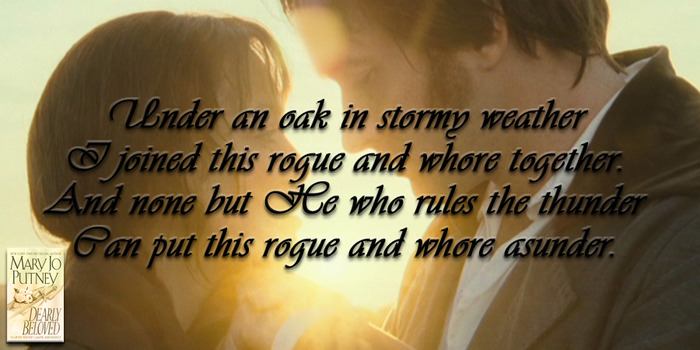
If you read Dearly Beloved and enjoy it, I would also recommend Silk and Shadows by MJP. Another edgy and gripping tale dealing in dark subject matter. This story is about revenge. Highly recommend.
Happy Reading!
♥ Lisa

October 28, 2013
Author: Mary Jo Putney
First published: 1990
Length: 6422 locations (finishes at 90%)
Setting: London and Yorkshire, 1799 to 1820s.
Sex: Reasonably frequent but often fade-to-black. Some explicit scenes. Rape of h by H and threatened rape of h by BadGuy.
Hero: Spymaster. Lord. Soldier. Neglectful parents.
Heroine: Only daughter of reasonably well-off parents. Father was a vicar. Went mad. Mother committed suicide. Raped by H at 16 and promptly married and deserted. Mother of a young son (product of the rape). Sets herself up as a High Class Courtesan.
Triggers: Rape. Incest.
Includes: excerpts from Thunder & Roses and Silk and Shadows by Putney.
Okay, so the book opens on the drunken rape of h by H because he thinks her a whore and she's been drugged to not say otherwise.
She's 16.
With a mad/abusive father.
H promptly marries her and then abandons her.
... 7 years later ...
She's living a quiet, isolated life with a housekeeper/friend and young son. Geoffrey is the product of the rape. And Diana is considering her future.
Along comes Maddy who presents another opportunity.
... Now 24 years old ...
Diana sets herself up as a High Class Courtesan but the first man she meets is... Gervase, her rapist, her husband, and her H.
I kept getting this far and DNF. Eventually I persevered to finish it.
I loved the beginning of this book. It's powerful and emotional. Diana is so strong.
But I kept getting really, really angry with Gervase.
He's supposed to be this brilliant spymaster but constantly jumps to conclusions. Never tests his theories. Assumes the worst with no proof. Doesn't even check out his new mistress to determine her background?
He's such an idiot.
Why the heck does he blame her for every little thing? She becomes such a doormat.
I seriously dislike the middle of this book.
I dislike Gervase.
So we get past that and we reach the culmination of the story.
A powerful ending where secrets are revealed, frought with emotion and angst.
And some really stupid moves by Gervase.
No grovelling.
No apologies.
No understanding of her pov.
I loved the beginning. I liked most of the ending. I hated the middle.
And I don't believe in their HEA.
Diana will always be his doormat. He won't trust her. And certainly doesn't respect her.
*cranky*
References:
Author's website: http://www.maryjoputney.com/
-CR-
First published: 1990
Length: 6422 locations (finishes at 90%)
Setting: London and Yorkshire, 1799 to 1820s.
Sex: Reasonably frequent but often fade-to-black. Some explicit scenes. Rape of h by H and threatened rape of h by BadGuy.
Hero: Spymaster. Lord. Soldier. Neglectful parents.
Heroine: Only daughter of reasonably well-off parents. Father was a vicar. Went mad. Mother committed suicide. Raped by H at 16 and promptly married and deserted. Mother of a young son (product of the rape). Sets herself up as a High Class Courtesan.
Triggers: Rape. Incest.
Includes: excerpts from Thunder & Roses and Silk and Shadows by Putney.
Okay, so the book opens on the drunken rape of h by H because he thinks her a whore and she's been drugged to not say otherwise.
She's 16.
With a mad/abusive father.
H promptly marries her and then abandons her.
... 7 years later ...
She's living a quiet, isolated life with a housekeeper/friend and young son. Geoffrey is the product of the rape. And Diana is considering her future.
Along comes Maddy who presents another opportunity.
... Now 24 years old ...
Diana sets herself up as a High Class Courtesan but the first man she meets is... Gervase, her rapist, her husband, and her H.
I kept getting this far and DNF. Eventually I persevered to finish it.
I loved the beginning of this book. It's powerful and emotional. Diana is so strong.
But I kept getting really, really angry with Gervase.
He's supposed to be this brilliant spymaster but constantly jumps to conclusions. Never tests his theories. Assumes the worst with no proof. Doesn't even check out his new mistress to determine her background?
He's such an idiot.
Why the heck does he blame her for every little thing? She becomes such a doormat.
I seriously dislike the middle of this book.
I dislike Gervase.
So we get past that and we reach the culmination of the story.
A powerful ending where secrets are revealed, frought with emotion and angst.
And some really stupid moves by Gervase.
No grovelling.
No apologies.
No understanding of her pov.
I loved the beginning. I liked most of the ending. I hated the middle.
And I don't believe in their HEA.
Diana will always be his doormat. He won't trust her. And certainly doesn't respect her.
*cranky*
References:
Author's website: http://www.maryjoputney.com/
-CR-

March 6, 2011
I like very much almost every book written by this author, but that was awful. Not because of the topic, but because it was simply boring. I read many books about rapes, sexual abuses and such matters, but that was nearly the worst. How could it happened? I have no idea. Putney Mary Jo is a very good writer. Her books are smart and she's not afraid of writing about problematic and controversial issues. I think that this title is just accident at work. There's no other explanation.

September 10, 2020
The following review contains many spoilers, but I do not apologise for not hiding them.
Many blame the inherent issues with the book on the era it was written in and the period in which it was set. I beg to differ. Lack of logical thinking and stupidity are timeless.
The drunken hero (no capital letter, he doesn’t deserve it) manages to gain access by wiggling his key in the old fashioned lock to what he thinks is his room where he expects to find a willing, buxom waitress awaiting. He commences to have sex with the inert body in the bed, even though surely this woman is a lot skinnier than he remembered. Heroine (capitalised only because it is the start of sentence) gradually realises something is happening and screams. Father rushes in and because it is Scotland, he is a Religious Minister and the proprietors of the Inn can act as witnesses promptly insists they get married.....
Turns out the female in question is around 15, has an emotionally unstable father who perhaps lusts after her but blames her for tempting him. He regularly locks her in her room and doses her with laudanum. Not sure why.
After the bedside “ceremony”, the hero decides to still have sex with her, thinking she was part of a fiendish plot to ensnare him, rapes her, realises she is a virgin and gives her a towel to hold between her legs to soak up the blood.
He tells her he never wants to see her again. Promises he will make sure she has money. Forbids her from ever coming to a London, calls for his servant to pack his gear and departs. End of prologue.
Now this guy is apparently deep down a nice bloke and intelligent, but when drunk conveniently forgets that if he hadn’t consummated the marriage it could have been annulled. He also conveniently ignores or never becomes aware that he was in the wrong room.
He tells everyone he has a mad wife locked up in Scotland. Why mad? Oh, well at some stage when we was assaulting her he mistook the fact that her dazed expression from being drugged meant she was simple....
She of course never knows anything about his motives, only that this drunk forced his way into her bed, married her then raped her. Mind you get the order of the last two right, as in those days married men had the right to do that.
Anyway she discovers she is pregnant.
The timeline bothered me a bit here as I don’t think they had those dipsticks back then. She must have stayed at the Inn, because the nice Inn lady eventually takes her to the wilds of Yorkshire to live with her sister.
Don’t forget she is still only 15. Dad is no longer on the scene and she is pregnant. But we never get to hear how she coped through all this.
So she has the kid and they stay in this quaint little cottage in the wilds of Yorkshire for 8 years.
She grows into the most beautiful woman who ever lived (apart from her hands which are a little rough from doing the milking.)
Somehow she seems to have been able to collect and live off all the money her hubbie put into the bank for her. Perhaps they had an ATM in the closest village!
She is good and kind, caring for her son (who has Juvenile epilepsy just like his dear, old Dad). Then along comes a very rich Courtesan who at one minute seemed to be dying of cancer then goes into Remission (who needs chemo or radiation? Good country air will fix it, no probs).
Mind you, no mention is made of her past once the Prologue is finished. In fact she has a different name! And only the most astute Romance Reader will have any inkling that this paragon of perfection is the skinny, simple waif we met in the Prologue. Duh!
So when she and the Courtesan, and her poor son and the Inn Keeper’s sister arrive in London and she meets the cause of all her problems again, he doesn’t recognise her.
Now this is where the story falls apart.
From here on in, there is only the slightest suggestion she knows who he is. She never thinks about that night, nor bears any resentment for the way he treated her. When she hears he refers to her as his mad wife, she seems more bemused than anything.
Apparently she has decided he must be a lovely person deep down because her son is..
What?
Wait?
The daughter of a crazy religious fanatic with repressed incestuous tendencies decides that nature is more important than nurture! Then later we discover his mother had raped him?!?!
See this is where the whole story falls apart. Her motivations for forgiving him do not make sense.
Perhaps if she had shared some of her changing attitude over time, it might have been understandable, but because we as readers “didn’t know who she was either” her willingness to forgive him seems forced.
Of course they both fall madly and passionately in love with each other. She is especially virtuous because she has only ever had sex with one man. He of course is supremely jealous at every stage, doesn’t believe her when the truth comes out, but everything needs to be excused because he has an Important Job as spymaster and there is a side plot about espionage which I won’t even bother to go into.
I have to admit I gave up reading half way through. Flipped through to find the big reveal and no one’s motivations made any sense. So I gave up.
Apparently it was the author’s first book and was re-released recently. Perhaps it shouldn’t have been.
Perhaps if the heroine hadn’t been so perfect. Perhaps if we got some idea of how she coped with the birth then bringing up her son we might have cared, but that’s all glossed over. Perhaps if she had thoughts about her reactions to seeing him again, then it might have worked, but keeping those thoughts away from the reader just made her seem weak and stupid. She was sorry for him....
Many blame the inherent issues with the book on the era it was written in and the period in which it was set. I beg to differ. Lack of logical thinking and stupidity are timeless.
The drunken hero (no capital letter, he doesn’t deserve it) manages to gain access by wiggling his key in the old fashioned lock to what he thinks is his room where he expects to find a willing, buxom waitress awaiting. He commences to have sex with the inert body in the bed, even though surely this woman is a lot skinnier than he remembered. Heroine (capitalised only because it is the start of sentence) gradually realises something is happening and screams. Father rushes in and because it is Scotland, he is a Religious Minister and the proprietors of the Inn can act as witnesses promptly insists they get married.....
Turns out the female in question is around 15, has an emotionally unstable father who perhaps lusts after her but blames her for tempting him. He regularly locks her in her room and doses her with laudanum. Not sure why.
After the bedside “ceremony”, the hero decides to still have sex with her, thinking she was part of a fiendish plot to ensnare him, rapes her, realises she is a virgin and gives her a towel to hold between her legs to soak up the blood.
He tells her he never wants to see her again. Promises he will make sure she has money. Forbids her from ever coming to a London, calls for his servant to pack his gear and departs. End of prologue.
Now this guy is apparently deep down a nice bloke and intelligent, but when drunk conveniently forgets that if he hadn’t consummated the marriage it could have been annulled. He also conveniently ignores or never becomes aware that he was in the wrong room.
He tells everyone he has a mad wife locked up in Scotland. Why mad? Oh, well at some stage when we was assaulting her he mistook the fact that her dazed expression from being drugged meant she was simple....
She of course never knows anything about his motives, only that this drunk forced his way into her bed, married her then raped her. Mind you get the order of the last two right, as in those days married men had the right to do that.
Anyway she discovers she is pregnant.
The timeline bothered me a bit here as I don’t think they had those dipsticks back then. She must have stayed at the Inn, because the nice Inn lady eventually takes her to the wilds of Yorkshire to live with her sister.
Don’t forget she is still only 15. Dad is no longer on the scene and she is pregnant. But we never get to hear how she coped through all this.
So she has the kid and they stay in this quaint little cottage in the wilds of Yorkshire for 8 years.
She grows into the most beautiful woman who ever lived (apart from her hands which are a little rough from doing the milking.)
Somehow she seems to have been able to collect and live off all the money her hubbie put into the bank for her. Perhaps they had an ATM in the closest village!
She is good and kind, caring for her son (who has Juvenile epilepsy just like his dear, old Dad). Then along comes a very rich Courtesan who at one minute seemed to be dying of cancer then goes into Remission (who needs chemo or radiation? Good country air will fix it, no probs).
Mind you, no mention is made of her past once the Prologue is finished. In fact she has a different name! And only the most astute Romance Reader will have any inkling that this paragon of perfection is the skinny, simple waif we met in the Prologue. Duh!
So when she and the Courtesan, and her poor son and the Inn Keeper’s sister arrive in London and she meets the cause of all her problems again, he doesn’t recognise her.
Now this is where the story falls apart.
From here on in, there is only the slightest suggestion she knows who he is. She never thinks about that night, nor bears any resentment for the way he treated her. When she hears he refers to her as his mad wife, she seems more bemused than anything.
Apparently she has decided he must be a lovely person deep down because her son is..
What?
Wait?
The daughter of a crazy religious fanatic with repressed incestuous tendencies decides that nature is more important than nurture! Then later we discover his mother had raped him?!?!
See this is where the whole story falls apart. Her motivations for forgiving him do not make sense.
Perhaps if she had shared some of her changing attitude over time, it might have been understandable, but because we as readers “didn’t know who she was either” her willingness to forgive him seems forced.
Of course they both fall madly and passionately in love with each other. She is especially virtuous because she has only ever had sex with one man. He of course is supremely jealous at every stage, doesn’t believe her when the truth comes out, but everything needs to be excused because he has an Important Job as spymaster and there is a side plot about espionage which I won’t even bother to go into.
I have to admit I gave up reading half way through. Flipped through to find the big reveal and no one’s motivations made any sense. So I gave up.
Apparently it was the author’s first book and was re-released recently. Perhaps it shouldn’t have been.
Perhaps if the heroine hadn’t been so perfect. Perhaps if we got some idea of how she coped with the birth then bringing up her son we might have cared, but that’s all glossed over. Perhaps if she had thoughts about her reactions to seeing him again, then it might have worked, but keeping those thoughts away from the reader just made her seem weak and stupid. She was sorry for him....

June 6, 2019
I purchased first this book as I was a new release from an author I knew I had to read.
Then I was graced an advance review by Netgalley and the publisher Kensington Books.
It is only when I checked in Goodreads, I learned it was a reedition of a long time ago edition, from the 90s, when I first read Kathleen E. Woodiwiss novels.
The rape trope in Mrs Putney book was immediately reported by the earlier reviewers so I questioned myself if I would be able to read this book. Then I remembered the first book I read by Mrs Woodiwiss, about a young woman abducted on a boat mistaken for a prostitute, I do not remember if she had a lot of saying about what she wanted.
(After some research, I found which book it was “The Flame and The Flower”) and there was another about a young lady having her home invaded and being rape too by the hero, the soldier behind the attack.
So I decided to read it with an open mind about how it was in this time as not so long ago I read a medieval romance about a marriage of convenience and the husband had quite a dislike for his wife as he was compiled to oblige his family and when he claimed his marital’s rights, he just did it, not a moment did he tried to be kind to his wife, worth he hurt her on their first night until their relationship evolved to a love match.
So will the hero be redeemable?
So yes, it is rape from our modern point of view but in his drunken stupor and his angry haze, he saw his now-wife as a scheming whore and decided to claim what had become his by law, the girl never uttered a word. He claimed his hudband’s rights as a revenge for tricking him in this joke of a marriage. He only understood after what he did, and himself named it as a rape while this time period accorded no says to the brides, they changed hands from father to husband like any chattel and were to do what their owners decided them to.
And even if I might shock many, I do loved this book.
As my first read by Mrs Putney and despite the triggers, I was sucked by the fluidity of the story, it was clever and witty with the right amount of anger. I was not appalled by the story passed the initial stage of distaste after the prologue. Sure, I’m no psychiatrist and it probably more than borders the Stockholm syndrome but Gervase has his flaws and he committed sins but it does not make him an evil or monster as Diana rose herself from a victim to a woman who curbs her life in the way she wants it to.
Diana, I loved her from the beginning. Sure the blurb was quite shocking about her wish to become a courtesan. The first reason is the secret she harbours, then her hope at a second chance in life and maybe find love without the heavy cost she had to pay the first time.
« it wasn’t men that she wanted. It was one man, one who would love and protect her in spite of her past, one who could initiate her into the profane, earthly delights that Madeline had described. At the thought, Diana smiled wryly, knowing what a romantic fool she was. It was a sign of how much she had healed that she dared to dream again. »
Gervase, he was not a bad man to me, wrong circumstances and bad timing plus his past wounds drove him to believe the worst of his unfortunate baby-wife, it does not absolve him for the harm done but behind his wicked action there is his own pain and blameworthiness.
« Like her, Gervase had been gravely wounded by life, and he had done less healing than she had. Until she understood the origins and depths of his pain, there could be no worthwhile future for them. »
Sure the author took time to reveal what I did know from the beginning by she also distilled but of informations this or there. But the story progressed at its right pace, nothing was hurried, all perfectly timed and the side characters were incredible to like or dislike.
Madeline is really an awesome character.
I usually am not very attracted with stories about destitute women but she is a magnificent person whom has gained more from her life than it had cost her, she never lost her soul. Gervase’s cousin, Francis was also a kind and sweet allie to Diana and Geoffrey, Diana’s son was a breath of fresh air and never he was depicted as overacted.
Then the bigger threat is not the vilain but themselves and the guilt and anger they bear in their inner core that make them doubt the other and could cost them everything if they can’t overcome their pain.
« She and Gervase each carried dark scars on their souls, scars only love could heal. In the language of the heart she must be the teacher, for she knew something about giving and receiving love, while Gervase could scarcely bring himself to say the word aloud. If they were to have a future together, she must fight him; she must compel him to explore his own heart, and to let her in. »
I know rape is a trigger for many persons, so I can comprehend if readers choose to avoid this story, but I was glad I did read this book.
Then I was graced an advance review by Netgalley and the publisher Kensington Books.
It is only when I checked in Goodreads, I learned it was a reedition of a long time ago edition, from the 90s, when I first read Kathleen E. Woodiwiss novels.
The rape trope in Mrs Putney book was immediately reported by the earlier reviewers so I questioned myself if I would be able to read this book. Then I remembered the first book I read by Mrs Woodiwiss, about a young woman abducted on a boat mistaken for a prostitute, I do not remember if she had a lot of saying about what she wanted.
(After some research, I found which book it was “The Flame and The Flower”) and there was another about a young lady having her home invaded and being rape too by the hero, the soldier behind the attack.
So I decided to read it with an open mind about how it was in this time as not so long ago I read a medieval romance about a marriage of convenience and the husband had quite a dislike for his wife as he was compiled to oblige his family and when he claimed his marital’s rights, he just did it, not a moment did he tried to be kind to his wife, worth he hurt her on their first night until their relationship evolved to a love match.
So will the hero be redeemable?
So yes, it is rape from our modern point of view but in his drunken stupor and his angry haze, he saw his now-wife as a scheming whore and decided to claim what had become his by law, the girl never uttered a word. He claimed his hudband’s rights as a revenge for tricking him in this joke of a marriage. He only understood after what he did, and himself named it as a rape while this time period accorded no says to the brides, they changed hands from father to husband like any chattel and were to do what their owners decided them to.
And even if I might shock many, I do loved this book.
As my first read by Mrs Putney and despite the triggers, I was sucked by the fluidity of the story, it was clever and witty with the right amount of anger. I was not appalled by the story passed the initial stage of distaste after the prologue. Sure, I’m no psychiatrist and it probably more than borders the Stockholm syndrome but Gervase has his flaws and he committed sins but it does not make him an evil or monster as Diana rose herself from a victim to a woman who curbs her life in the way she wants it to.
Diana, I loved her from the beginning. Sure the blurb was quite shocking about her wish to become a courtesan. The first reason is the secret she harbours, then her hope at a second chance in life and maybe find love without the heavy cost she had to pay the first time.
« it wasn’t men that she wanted. It was one man, one who would love and protect her in spite of her past, one who could initiate her into the profane, earthly delights that Madeline had described. At the thought, Diana smiled wryly, knowing what a romantic fool she was. It was a sign of how much she had healed that she dared to dream again. »
Gervase, he was not a bad man to me, wrong circumstances and bad timing plus his past wounds drove him to believe the worst of his unfortunate baby-wife, it does not absolve him for the harm done but behind his wicked action there is his own pain and blameworthiness.
« Like her, Gervase had been gravely wounded by life, and he had done less healing than she had. Until she understood the origins and depths of his pain, there could be no worthwhile future for them. »
Sure the author took time to reveal what I did know from the beginning by she also distilled but of informations this or there. But the story progressed at its right pace, nothing was hurried, all perfectly timed and the side characters were incredible to like or dislike.
Madeline is really an awesome character.
I usually am not very attracted with stories about destitute women but she is a magnificent person whom has gained more from her life than it had cost her, she never lost her soul. Gervase’s cousin, Francis was also a kind and sweet allie to Diana and Geoffrey, Diana’s son was a breath of fresh air and never he was depicted as overacted.
Then the bigger threat is not the vilain but themselves and the guilt and anger they bear in their inner core that make them doubt the other and could cost them everything if they can’t overcome their pain.
« She and Gervase each carried dark scars on their souls, scars only love could heal. In the language of the heart she must be the teacher, for she knew something about giving and receiving love, while Gervase could scarcely bring himself to say the word aloud. If they were to have a future together, she must fight him; she must compel him to explore his own heart, and to let her in. »
I know rape is a trigger for many persons, so I can comprehend if readers choose to avoid this story, but I was glad I did read this book.

June 28, 2019
Dearly Beloved
by Mary Jo Putney
What an amazing story! I LOVED the angst of it, the emotions and heartache. Through no fault of her own Diana Lindsay was woken, her innocence brutally taken and forcefully married by her crazed preacher father., to Gervase Brandelin who was incoherent at the time, but soon realized his grave error!
This is a compelling gripping read that is not for the faint at heart or with trigger issues. Yes it’s dark and Ms. Putney is a professional at her craft, the storyline needs the darkness so the light can shine through. The road is a difficult one but there is remorse and a happy ending thankfully!
I highly recommend! I received a complimentary copy from the publisher via NetGalley. This is my unbiased opinion.
by Mary Jo Putney
What an amazing story! I LOVED the angst of it, the emotions and heartache. Through no fault of her own Diana Lindsay was woken, her innocence brutally taken and forcefully married by her crazed preacher father., to Gervase Brandelin who was incoherent at the time, but soon realized his grave error!
This is a compelling gripping read that is not for the faint at heart or with trigger issues. Yes it’s dark and Ms. Putney is a professional at her craft, the storyline needs the darkness so the light can shine through. The road is a difficult one but there is remorse and a happy ending thankfully!
I highly recommend! I received a complimentary copy from the publisher via NetGalley. This is my unbiased opinion.

October 8, 2014
For fans of unrealistic Polyanna fairytales...
Even the most dimwitted reader would have figured out the relationship between heroine and hero straight from the beginning of this book. So it was rather boring and long-winded to get to the revelation of the "big" mystery so late into the story. And what about the heroine's POVs up to this point? In light of the fact that the protagonists weren't strangers per se they made no sense whatsoever: she felt like having a split personality.
The prose was too flowery for my liking, the vilain rather lame...
I'll try to forget that I read this.
Even the most dimwitted reader would have figured out the relationship between heroine and hero straight from the beginning of this book. So it was rather boring and long-winded to get to the revelation of the "big" mystery so late into the story. And what about the heroine's POVs up to this point? In light of the fact that the protagonists weren't strangers per se they made no sense whatsoever: she felt like having a split personality.
The prose was too flowery for my liking, the vilain rather lame...
I'll try to forget that I read this.

March 24, 2020
"The first woman i ever lay with was my mother"
Wow, I have been reading this book of large print since August 2019. I chose the book because the cover got my attention, 672 pages of history, alcohol, abuse, love, hate, crime, sexual abuse, gay men, whores, family and with all that it's a true love story.
In the 18th century all of the above was going on within the main two characters life but with hope, love, understanding and forgiveness they were married and and proceeded to live a good life.
I am so glad I challenged myself to read this book and I definitely recommend it to Romance Readers!!
Wow, I have been reading this book of large print since August 2019. I chose the book because the cover got my attention, 672 pages of history, alcohol, abuse, love, hate, crime, sexual abuse, gay men, whores, family and with all that it's a true love story.
In the 18th century all of the above was going on within the main two characters life but with hope, love, understanding and forgiveness they were married and and proceeded to live a good life.
I am so glad I challenged myself to read this book and I definitely recommend it to Romance Readers!!

June 18, 2019
Wow, I feel like I've just been put through a wringer washer! This was such an intense yet fascinating story, with one shock after another, especially at the end. From the very first chapter, you are brought into a situation that leaves you reeling.
All Diana Lindsay wants is to find a man who will love her and make her dreams come true and if she needs to become a courtesan to do so, then so be it. She also has a young son that needs a father! When she comes face to face with Gervase Brandelin, the Viscount St. Aubyn, it's immediate attraction and she soon becomes his mistress.
Both have dark secrets that can destroy what they have and once they come out in the open, it almost seems impossible that they will be able to overcome it all....but love and passion are very strong emotions and forgiveness is another one.
This is not a lighthearted story but one of deep, dark emotions and filled with angst. One must also realize that these things happen quite often and we can't keep our heads buried in the sand and pretend that it doesn't happen.
I received an ARC of this book via NetGalley and am voluntarily leaving an honest review.
All Diana Lindsay wants is to find a man who will love her and make her dreams come true and if she needs to become a courtesan to do so, then so be it. She also has a young son that needs a father! When she comes face to face with Gervase Brandelin, the Viscount St. Aubyn, it's immediate attraction and she soon becomes his mistress.
Both have dark secrets that can destroy what they have and once they come out in the open, it almost seems impossible that they will be able to overcome it all....but love and passion are very strong emotions and forgiveness is another one.
This is not a lighthearted story but one of deep, dark emotions and filled with angst. One must also realize that these things happen quite often and we can't keep our heads buried in the sand and pretend that it doesn't happen.
I received an ARC of this book via NetGalley and am voluntarily leaving an honest review.
March 27, 2013
Finished this last night, and have to say I loved this book! The author said at the beginning that although she loved writing Regencies, she wanted to do something with more depth, stronger emotions....well she definitely hit the bull's eye with this one! I loved the heroine, her strengths and resolution. The hero made me so angry sometimes I wanted to choke him, but his character was wonderful, even though he was strongly flawed. I was glued to the book from start to finish! There's everything in here for the historical romance fan...mystery, suspense, romance...I would definitely recommend this to anyone who loves a good story in the historical romance theme! Will definitely read more of M J Putney!!

January 20, 2010
I attempted to read this years ago because it was receiving rave upon rave on romance listservs all over the internet. So I was quite surprised when I found it impossible to get through. Not due to the writing, which is good, but the subject matter which I found horribly offensive. I couldn't get past it and still can't all these years later. I traded this book because just looking at it gave me the heebie jeebies.

December 17, 2019
Good book about two emotionally wounded people. It opens with a young Gervase who, in a moment of drunken idiocy, compromises a young woman. He retains enough of his gentleman's code to marry the girl but also takes revenge for what he sees as entrapment. Devastated when he realizes the truth, he takes steps to care for the girl, yet also to avoid ever having to see her again.
I will say that Gervase did not endear himself to me in these opening pages. He was selfish, thoughtless, and cruel. I wasn't sure that he was at all redeemable. He is rightfully haunted by what he did, which drives him to find ways to ease his conscience. When the story resumes eight years later, Gervase is back in England after inheriting the title and continuing his service to England. He is emotionally closed off, allowing no one past the walls around his heart. So he is surprised and dismayed by the strength of his attraction to London's newest courtesan.
When we first meet Diana, she and her son and a friend live in a cottage in Yorkshire. It is the middle of winter, and during a vicious snowstorm, she rescues a woman who was a former courtesan. After nursing Maddy back to health, they become friends. Diana discovers that the stories Maddy tells appeal to the restlessness she feels. Something tells her that if she takes up that life, maybe she will find the love that she craves. But the man she is most drawn to is the least likely to give her what she needs.
The development of the relationship between Diana and Gervase is a rollercoaster of emotions. Both are wary of the strength of their attraction and the depth of the connection they feel. Gervase is a man whose trust in women was destroyed long ago in a most devastating way. He is determined to protect himself and uses that distrust like a shield. Though part of him wants to believe in Diana's goodness and the happiness he feels when he is with her, his skepticism is never far away. Diana is frequently overwhelmed by the strength of her feelings for Gervase, but also fears that giving in to those feelings without an equal return will cause her to lose sight of her own needs.
This is not a fast-paced romance. Instead, Gervase and Diana spend time together over many months, both in bed and out of it. I liked seeing Gervase slowly begin to exhibit his emotions. I especially enjoyed his connection with Diana's son. There were some pretty sweet scenes between them. However, Gervase's demons still made frequent appearances, most notably in his outbursts of jealousy. Diana is not free of her own issues. There are parts of her past that she needs to share with him, but she's afraid that it will drive him away. The longer she puts it off, the harder it becomes. When matters come to the points where both reveal their pasts, it is just as bad as she feared. Both of them frustrated me because of their attitudes. Diana made some excellent points about Gervase's actions, and I liked that he accepted the truth of them and sought to make changes. But she wasn't free of guilt herself, and the way she revealed her past only made things worse. Everything she said ran up against Gervase's fears and beliefs, causing him to believe the worst of her. I wondered how they could ever get past the things that were said and done.
Gervase did his usual shove everything he didn't want to think of behind a locked door in his mind and tried to lose himself in work. On the other hand, Diana still didn't give up hope that they could overcome it all and have that future she dreamed of. I enjoyed her arrival at the house party, and the after-dinner scene was marvelous. I loved how she handled herself and turned things her way. I still wanted to shake Gervase for his blindness and loved seeing his cousin tear into him. But it took nearly losing her for Gervase to finally let down his walls and allow Diana into his heart.
Running through the book was also an element of suspense. As a spymaster, Gervase actively works to help Britain in its efforts to bring down Napoleon. There is one particular French spy that he is determined to stop if he could only get the proof needed. This particular spy also has an unhealthy interest in Diana. The depth of his depravity and his determination to have Diana are another element of tension throughout the book. The final confrontation with him was a nail-biter and I genuinely feared for the safety of both Diana and Gervase. The way the spy was brought down was poetic justice and extremely satisfying.
I will say that Gervase did not endear himself to me in these opening pages. He was selfish, thoughtless, and cruel. I wasn't sure that he was at all redeemable. He is rightfully haunted by what he did, which drives him to find ways to ease his conscience. When the story resumes eight years later, Gervase is back in England after inheriting the title and continuing his service to England. He is emotionally closed off, allowing no one past the walls around his heart. So he is surprised and dismayed by the strength of his attraction to London's newest courtesan.
When we first meet Diana, she and her son and a friend live in a cottage in Yorkshire. It is the middle of winter, and during a vicious snowstorm, she rescues a woman who was a former courtesan. After nursing Maddy back to health, they become friends. Diana discovers that the stories Maddy tells appeal to the restlessness she feels. Something tells her that if she takes up that life, maybe she will find the love that she craves. But the man she is most drawn to is the least likely to give her what she needs.
The development of the relationship between Diana and Gervase is a rollercoaster of emotions. Both are wary of the strength of their attraction and the depth of the connection they feel. Gervase is a man whose trust in women was destroyed long ago in a most devastating way. He is determined to protect himself and uses that distrust like a shield. Though part of him wants to believe in Diana's goodness and the happiness he feels when he is with her, his skepticism is never far away. Diana is frequently overwhelmed by the strength of her feelings for Gervase, but also fears that giving in to those feelings without an equal return will cause her to lose sight of her own needs.
This is not a fast-paced romance. Instead, Gervase and Diana spend time together over many months, both in bed and out of it. I liked seeing Gervase slowly begin to exhibit his emotions. I especially enjoyed his connection with Diana's son. There were some pretty sweet scenes between them. However, Gervase's demons still made frequent appearances, most notably in his outbursts of jealousy. Diana is not free of her own issues. There are parts of her past that she needs to share with him, but she's afraid that it will drive him away. The longer she puts it off, the harder it becomes. When matters come to the points where both reveal their pasts, it is just as bad as she feared. Both of them frustrated me because of their attitudes. Diana made some excellent points about Gervase's actions, and I liked that he accepted the truth of them and sought to make changes. But she wasn't free of guilt herself, and the way she revealed her past only made things worse. Everything she said ran up against Gervase's fears and beliefs, causing him to believe the worst of her. I wondered how they could ever get past the things that were said and done.
Gervase did his usual shove everything he didn't want to think of behind a locked door in his mind and tried to lose himself in work. On the other hand, Diana still didn't give up hope that they could overcome it all and have that future she dreamed of. I enjoyed her arrival at the house party, and the after-dinner scene was marvelous. I loved how she handled herself and turned things her way. I still wanted to shake Gervase for his blindness and loved seeing his cousin tear into him. But it took nearly losing her for Gervase to finally let down his walls and allow Diana into his heart.
Running through the book was also an element of suspense. As a spymaster, Gervase actively works to help Britain in its efforts to bring down Napoleon. There is one particular French spy that he is determined to stop if he could only get the proof needed. This particular spy also has an unhealthy interest in Diana. The depth of his depravity and his determination to have Diana are another element of tension throughout the book. The final confrontation with him was a nail-biter and I genuinely feared for the safety of both Diana and Gervase. The way the spy was brought down was poetic justice and extremely satisfying.

August 19, 2019
Solely giving Mary Jo Putney's Dearly Beloved 4-stars because when things got spicy, boy did it get spicy. Despite a doubtful beginning full of unearned sentiment, there is a pay-off if you like to read dark stories about darker H+H's. It all depends on how much you want to work for it.
Dearly Beloved is so extra, which I love, but like in all the ways, which I didn't quite so love. Not just Southern Gothic a la V.C. Andrews but in a way that I can only say reminds me of Sabrina or Buffy. There's this 1990s woo-woo undercurrent of the Occult. Housekeepers read tea leaves. Heroines know how to throw knives to kill, and they are on a destiny to find Love. There's a lot being asked on the reader in terms of suspending their disbelief and it could have been written with more nuance. Essentially, consider Diana Belle from Beauty and the Beast. Diana wants more than this provincial life. Oh and she also throws knives.
The simplicity of Diana and Gervase's relationship is patronizing to the reader. I was aggressively skimming up until 60% through the Kindle because I never believed Diana was a courtesan. It seemed more like she got a makeover and went to a party than she was now a bird of paradise, selling herself. I also didn't care about Gervase's inability to love because of his mommy issues. That being said, I was changing my tune more than halfway through the story. Because it got dark fast. It was quite impressive. And it got dramatic. Putney really saved her writing talent for that fun climax. I only wish the lead-up was half as entertaining.
Dearly Beloved is so extra, which I love, but like in all the ways, which I didn't quite so love. Not just Southern Gothic a la V.C. Andrews but in a way that I can only say reminds me of Sabrina or Buffy. There's this 1990s woo-woo undercurrent of the Occult. Housekeepers read tea leaves. Heroines know how to throw knives to kill, and they are on a destiny to find Love. There's a lot being asked on the reader in terms of suspending their disbelief and it could have been written with more nuance. Essentially, consider Diana Belle from Beauty and the Beast. Diana wants more than this provincial life. Oh and she also throws knives.
The simplicity of Diana and Gervase's relationship is patronizing to the reader. I was aggressively skimming up until 60% through the Kindle because I never believed Diana was a courtesan. It seemed more like she got a makeover and went to a party than she was now a bird of paradise, selling herself. I also didn't care about Gervase's inability to love because of his mommy issues. That being said, I was changing my tune more than halfway through the story. Because it got dark fast. It was quite impressive. And it got dramatic. Putney really saved her writing talent for that fun climax. I only wish the lead-up was half as entertaining.
June 6, 2019
I purchased first this book as I was a new release from an author I knew I had to read.
Then I was graced an advance review by Netgalley and the publisher Kensington Books.
It is only when I checked in Goodreads, I learned it was a reedition of a long time ago edition, from the 90s, when I first read Kathleen E. Woodiwiss novels.
The rape trope in Mrs Putney book was immediately reported by the earlier reviewers so I questioned myself if I would be able to read this book. Then I remembered the first book I read by Mrs Woodiwiss, about a young woman abducted on a boat mistaken for a prostitute, I do not remember if she had a lot of saying about what she wanted.
(After some research, I found which book it was “The Flame and The Flower”) and there was another about a young lady having her home invaded and being rape too by the hero, the soldier behind the attack.
So I decided to read it with an open mind about how it was in this time as not so long ago I read a medieval romance about a marriage of convenience and the husband had quite a dislike for his wife as he was compiled to oblige his family and when he claimed his marital’s rights, he just did it, not a moment did he tried to be kind to his wife, worth he hurt her on their first night until their relationship evolved to a love match.
So will the hero be redeemable?
So yes, it is rape from our modern point of view but in his drunken stupor and his angry haze, he saw his now-wife as a scheming whore and decided to claim what had become his by law, the girl never uttered a word. He claimed his hudband’s rights as a revenge for tricking him in this joke of a marriage. He only understood after what he did, and himself named it as a rape while this time period accorded no says to the brides, they changed hands from father to husband like any chattel and were to do what their owners decided them to.
And even if I might shock many, I do loved this book.
As my first read by Mrs Putney and despite the triggers, I was sucked by the fluidity of the story, it was clever and witty with the right amount of anger. I was not appalled by the story passed the initial stage of distaste after the prologue. Sure, I’m no psychiatrist and it probably more than borders the Stockholm syndrome but Gervase has his flaws and he committed sins but it does not make him an evil or monster as Diana rose herself from a victim to a woman who curbs her life in the way she wants it to.
Diana, I loved her from the beginning. Sure the blurb was quite shocking about her wish to become a courtesan. The first reason is the secret she harbours, then her hope at a second chance in life and maybe find love without the heavy cost she had to pay the first time.
« it wasn’t men that she wanted. It was one man, one who would love and protect her in spite of her past, one who could initiate her into the profane, earthly delights that Madeline had described. At the thought, Diana smiled wryly, knowing what a romantic fool she was. It was a sign of how much she had healed that she dared to dream again. »
Gervase, he was not a bad man to me, wrong circumstances and bad timing plus his past wounds drove him to believe the worst of his unfortunate baby-wife, it does not absolve him for the harm done but behind his wicked action there is his own pain and blameworthiness.
« Like her, Gervase had been gravely wounded by life, and he had done less healing than she had. Until she understood the origins and depths of his pain, there could be no worthwhile future for them. »
Sure the author took time to reveal what I did know from the beginning by she also distilled but of informations this or there. But the story progressed at its right pace, nothing was hurried, all perfectly timed and the side characters were incredible to like or dislike.
Madeline is really an awesome character.
I usually am not very attracted with stories about destitute women but she is a magnificent person whom has gained more from her life than it had cost her, she never lost her soul. Gervase’s cousin, Francis was also a kind and sweet allie to Diana and Geoffrey, Diana’s son was a breath of fresh air and never he was depicted as overacted.
Then the bigger threat is not the vilain but themselves and the guilt and anger they bear in their inner core that make them doubt the other and could cost them everything if they can’t overcome their pain.
« She and Gervase each carried dark scars on their souls, scars only love could heal. In the language of the heart she must be the teacher, for she knew something about giving and receiving love, while Gervase could scarcely bring himself to say the word aloud. If they were to have a future together, she must fight him; she must compel him to explore his own heart, and to let her in. »
I know rape is a trigger for many persons, so I can comprehend if readers choose to avoid this story, but I was glad I did read this book.
Then I was graced an advance review by Netgalley and the publisher Kensington Books.
It is only when I checked in Goodreads, I learned it was a reedition of a long time ago edition, from the 90s, when I first read Kathleen E. Woodiwiss novels.
The rape trope in Mrs Putney book was immediately reported by the earlier reviewers so I questioned myself if I would be able to read this book. Then I remembered the first book I read by Mrs Woodiwiss, about a young woman abducted on a boat mistaken for a prostitute, I do not remember if she had a lot of saying about what she wanted.
(After some research, I found which book it was “The Flame and The Flower”) and there was another about a young lady having her home invaded and being rape too by the hero, the soldier behind the attack.
So I decided to read it with an open mind about how it was in this time as not so long ago I read a medieval romance about a marriage of convenience and the husband had quite a dislike for his wife as he was compiled to oblige his family and when he claimed his marital’s rights, he just did it, not a moment did he tried to be kind to his wife, worth he hurt her on their first night until their relationship evolved to a love match.
So will the hero be redeemable?
So yes, it is rape from our modern point of view but in his drunken stupor and his angry haze, he saw his now-wife as a scheming whore and decided to claim what had become his by law, the girl never uttered a word. He claimed his hudband’s rights as a revenge for tricking him in this joke of a marriage. He only understood after what he did, and himself named it as a rape while this time period accorded no says to the brides, they changed hands from father to husband like any chattel and were to do what their owners decided them to.
And even if I might shock many, I do loved this book.
As my first read by Mrs Putney and despite the triggers, I was sucked by the fluidity of the story, it was clever and witty with the right amount of anger. I was not appalled by the story passed the initial stage of distaste after the prologue. Sure, I’m no psychiatrist and it probably more than borders the Stockholm syndrome but Gervase has his flaws and he committed sins but it does not make him an evil or monster as Diana rose herself from a victim to a woman who curbs her life in the way she wants it to.
Diana, I loved her from the beginning. Sure the blurb was quite shocking about her wish to become a courtesan. The first reason is the secret she harbours, then her hope at a second chance in life and maybe find love without the heavy cost she had to pay the first time.
« it wasn’t men that she wanted. It was one man, one who would love and protect her in spite of her past, one who could initiate her into the profane, earthly delights that Madeline had described. At the thought, Diana smiled wryly, knowing what a romantic fool she was. It was a sign of how much she had healed that she dared to dream again. »
Gervase, he was not a bad man to me, wrong circumstances and bad timing plus his past wounds drove him to believe the worst of his unfortunate baby-wife, it does not absolve him for the harm done but behind his wicked action there is his own pain and blameworthiness.
« Like her, Gervase had been gravely wounded by life, and he had done less healing than she had. Until she understood the origins and depths of his pain, there could be no worthwhile future for them. »
Sure the author took time to reveal what I did know from the beginning by she also distilled but of informations this or there. But the story progressed at its right pace, nothing was hurried, all perfectly timed and the side characters were incredible to like or dislike.
Madeline is really an awesome character.
I usually am not very attracted with stories about destitute women but she is a magnificent person whom has gained more from her life than it had cost her, she never lost her soul. Gervase’s cousin, Francis was also a kind and sweet allie to Diana and Geoffrey, Diana’s son was a breath of fresh air and never he was depicted as overacted.
Then the bigger threat is not the vilain but themselves and the guilt and anger they bear in their inner core that make them doubt the other and could cost them everything if they can’t overcome their pain.
« She and Gervase each carried dark scars on their souls, scars only love could heal. In the language of the heart she must be the teacher, for she knew something about giving and receiving love, while Gervase could scarcely bring himself to say the word aloud. If they were to have a future together, she must fight him; she must compel him to explore his own heart, and to let her in. »
I know rape is a trigger for many persons, so I can comprehend if readers choose to avoid this story, but I was glad I did read this book.

March 2, 2022
This book was originally published in 1990. I read it at that time but I had very little memory of it. Really enjoyed this one. I generally have a low tolerance for historical novels where gentlewomen want to be mistresses but it made sense here. Loved both the hero and the heroine.

June 21, 2020
Review of audiobook of this Regency, redemption romance, first published in 1990
In the prologue of this novel, the romantic hero, Gervase Brandelin, is 23 years old and the sole heir of a fabulously wealthy British viscount. While in a drunken state, he is entrapped by a brutal man into marrying his 15-year-old, virginal daughter, Mary Hamilton.
In the first chapter, it is seven years after the events of the prologue. We are introduced to a woman named Diana Lindsay who is a single mother in her early 20’s living in a small village in a remote corner of Yorkshire. She owns a commodious home and is quite prosperous compared to the standard of living of everyone else in the village, but we are informed she is an outcast. Her only companions are her five-year-old, epileptic son, Geoffrey, and her friend and maidservant, Edith, a middle-aged, plainspoken and loyal woman. An additional compelling female relationship arrives in Diana’s life when she rescues a beautiful former courtesan named Madeline Gainford from freezing to death in a blizzard, and they become fast friends. It is due to this friendship that Diana decides to shake up her life completely and move with her son, Maddy, and Edith to London a year later.
It is now eight years after the events in the prologue, and Gervase is currently 31. He returned to England two years ago when he inherited the title of viscount upon his father's death. Before that, he spent six years trying to redeem himself from the disaster of his wedding night to a woman he financially supports, but whom he has not seen since, by serving his country first in the military in India, and later as a spymaster for the British government. When Gervase meets Diana, the attraction between them is immediate and mutual. But since he is married, Gervase cannot make Diana an honorable offer. Perhaps, he wonders, she might be willing to become his mistress so they can be together?
Readers who enjoy strong friendships between women in novels will greatly enjoy the warm and wonderful, BFF connection between Diana and Maddy. Maddy is a fascinating character, and there is an enjoyable secondary romance between Maddy and her former lover. The relationship between Diana and her adorable son is also very well done. Her approach to dealing with his seizures in the Regency era is fascinating and historically accurate.
There is a spy-vs-spy subplot with an evil villain who is a French spy. It feeds into and supports the trajectory of the main romance plot seamlessly, and the way that this subplot is resolved by Diana's well-foreshadowed, extremely brave actions is quite well done.
Regarding the central plot, the romance itself, this novel was written early in Ms. Putney's career, in 1990, and reflects a classic type of historical romance of that era, a "redemption plot," in which there is a "dark and dangerous" (D&D) hero who has endured a traumatic childhood. Such novels, to be successful, must have a powerful and believable growth arc for the hero, which is only possible through earning forgiveness from the one(s) he has wronged and, most importantly, forgiveness from himself, because he greatly regrets his past, destructive choices. Though this novel is not, per se, Christian fiction, it contains frequent mentions of God, and certainly, a major focus of Christianity is the concept of forgiveness and redemption through repentance and reparation. However, these principled ideals are not limited to Christianity and exist as universal, ethical themes among honorable people everywhere. As such, they are a crucial factor in the way that all historical-romance redemption plots play out, including this one.
I first read this book many years ago in the form of a mass market paperback. A year ago, in June, 2019, I read a re-release of it in Kindle format. This week, in June, 2020, I had a chance to experience it as a recently released audiobook. The narrator is Christine Rendel, a British voice talent who does an excellent job. Her voice is melodious, and she convincingly portrays both genders, all ages, and many different national and regional accents.
I rate this book as follows:
Heroine: 5 stars
Hero: 4 stars
Subcharacters: 5 stars
Redemption Romance Plot: 4 stars
Spy Plot: 4 stars
Writing: 5 stars
Audiobook Narration: 5 stars
Overall: 4.5 stars rounded to 5 stars
In the prologue of this novel, the romantic hero, Gervase Brandelin, is 23 years old and the sole heir of a fabulously wealthy British viscount. While in a drunken state, he is entrapped by a brutal man into marrying his 15-year-old, virginal daughter, Mary Hamilton.
In the first chapter, it is seven years after the events of the prologue. We are introduced to a woman named Diana Lindsay who is a single mother in her early 20’s living in a small village in a remote corner of Yorkshire. She owns a commodious home and is quite prosperous compared to the standard of living of everyone else in the village, but we are informed she is an outcast. Her only companions are her five-year-old, epileptic son, Geoffrey, and her friend and maidservant, Edith, a middle-aged, plainspoken and loyal woman. An additional compelling female relationship arrives in Diana’s life when she rescues a beautiful former courtesan named Madeline Gainford from freezing to death in a blizzard, and they become fast friends. It is due to this friendship that Diana decides to shake up her life completely and move with her son, Maddy, and Edith to London a year later.
It is now eight years after the events in the prologue, and Gervase is currently 31. He returned to England two years ago when he inherited the title of viscount upon his father's death. Before that, he spent six years trying to redeem himself from the disaster of his wedding night to a woman he financially supports, but whom he has not seen since, by serving his country first in the military in India, and later as a spymaster for the British government. When Gervase meets Diana, the attraction between them is immediate and mutual. But since he is married, Gervase cannot make Diana an honorable offer. Perhaps, he wonders, she might be willing to become his mistress so they can be together?
Readers who enjoy strong friendships between women in novels will greatly enjoy the warm and wonderful, BFF connection between Diana and Maddy. Maddy is a fascinating character, and there is an enjoyable secondary romance between Maddy and her former lover. The relationship between Diana and her adorable son is also very well done. Her approach to dealing with his seizures in the Regency era is fascinating and historically accurate.
There is a spy-vs-spy subplot with an evil villain who is a French spy. It feeds into and supports the trajectory of the main romance plot seamlessly, and the way that this subplot is resolved by Diana's well-foreshadowed, extremely brave actions is quite well done.
Regarding the central plot, the romance itself, this novel was written early in Ms. Putney's career, in 1990, and reflects a classic type of historical romance of that era, a "redemption plot," in which there is a "dark and dangerous" (D&D) hero who has endured a traumatic childhood. Such novels, to be successful, must have a powerful and believable growth arc for the hero, which is only possible through earning forgiveness from the one(s) he has wronged and, most importantly, forgiveness from himself, because he greatly regrets his past, destructive choices. Though this novel is not, per se, Christian fiction, it contains frequent mentions of God, and certainly, a major focus of Christianity is the concept of forgiveness and redemption through repentance and reparation. However, these principled ideals are not limited to Christianity and exist as universal, ethical themes among honorable people everywhere. As such, they are a crucial factor in the way that all historical-romance redemption plots play out, including this one.
I first read this book many years ago in the form of a mass market paperback. A year ago, in June, 2019, I read a re-release of it in Kindle format. This week, in June, 2020, I had a chance to experience it as a recently released audiobook. The narrator is Christine Rendel, a British voice talent who does an excellent job. Her voice is melodious, and she convincingly portrays both genders, all ages, and many different national and regional accents.
I rate this book as follows:
Heroine: 5 stars
Hero: 4 stars
Subcharacters: 5 stars
Redemption Romance Plot: 4 stars
Spy Plot: 4 stars
Writing: 5 stars
Audiobook Narration: 5 stars
Overall: 4.5 stars rounded to 5 stars

May 14, 2019
This book is bad. Really bad. I almost never one star books. The lowest I usually give is three stars. But this book has issues from start to where I stopped reading. The book starts from the point of view of a man who somehow was the male protagonist. I will not use his name A) because I can't remember how to spell it and B) because he is awful. It starts with him getting drunk, which is manageable, but then he goes and rapes a young woman. And he's somehow able to become the protagonist? Also, there's no content warning before this that the book contains a graphic rape scene. At that point, the only reason I kept reading was because I assumed the main character was the victim and I hoped the book might be about her recovering. But the book goes on and that is clearly not the case. She decides to upend her nice life in Yorkshire because she wants to become a courtesan, which women generally didn't do unless necessary. Once I found out that she was going to try to get back with rape dude, this book was a big fat no. Do not recommend, do not read.
Another thing I want to mention. Something I've noticed reading romance novels is the varying levels of consent involved, often on the part of the women. Contemporary books (from what I've read) don't tend to have too much of an issue save for when characters are drunk. But in historical, I've found many books that are sorely lacking. Consent is enthusiastic, ongoing, and freely given. Books are often missing one or more of these, especially early in relationships with the main couple. There's also a trend of the male characters sleeping with courtesans, etc before meeting the heroine. While that was common at the time, there is still some consent missing (freely given), and that has rubbed me the wrong way. I've been thinking about it for a while, and decided to add it to this review, since it was so problematic in this nature.
Another thing I want to mention. Something I've noticed reading romance novels is the varying levels of consent involved, often on the part of the women. Contemporary books (from what I've read) don't tend to have too much of an issue save for when characters are drunk. But in historical, I've found many books that are sorely lacking. Consent is enthusiastic, ongoing, and freely given. Books are often missing one or more of these, especially early in relationships with the main couple. There's also a trend of the male characters sleeping with courtesans, etc before meeting the heroine. While that was common at the time, there is still some consent missing (freely given), and that has rubbed me the wrong way. I've been thinking about it for a while, and decided to add it to this review, since it was so problematic in this nature.

December 5, 2017
Gervase and Diana
A discussion in my book club caused me to revisit this book. Sufficient time had passed that allowed me to read with fresh eyes. I had forgotten the particulars, but remembered that I enjoyed this book on my first read.
Gervase is a man with a closed heart. Early in life his world was rocked by a devastating betrayal that colored his every interaction. His coldness was well known to society and people tread a wide path around him.
Diana is a woman who is not only beautiful and desired by all, but also a woman of deep feeling. Gervase is inexplicably drawn to her and enters into an arrangement with her. He is constantly thwarted by her refusal to commit to an exclusive relationship with him although she professes to have developed deep feelings for him.
This story features themes that in the hands of an inferior writer would leave the reader devastated. None but a writer of Mary Jo Putney's caliber could pull this off. Her writing style is smooth and flawless. When touching upon taboo subject matter, she writes with an economy of words that delivers the message but does not belabor the point to ad nauseum.
The secondary characters were fully fleshed out and their story resolutions were satisfactory. The antagonists were detestable and shadowed the protagonists interactions throughout their lives.
I enjoyed my second reading as much as I did the first reading. I highly recommend this book, it is a page turner.
A discussion in my book club caused me to revisit this book. Sufficient time had passed that allowed me to read with fresh eyes. I had forgotten the particulars, but remembered that I enjoyed this book on my first read.
Gervase is a man with a closed heart. Early in life his world was rocked by a devastating betrayal that colored his every interaction. His coldness was well known to society and people tread a wide path around him.
Diana is a woman who is not only beautiful and desired by all, but also a woman of deep feeling. Gervase is inexplicably drawn to her and enters into an arrangement with her. He is constantly thwarted by her refusal to commit to an exclusive relationship with him although she professes to have developed deep feelings for him.
This story features themes that in the hands of an inferior writer would leave the reader devastated. None but a writer of Mary Jo Putney's caliber could pull this off. Her writing style is smooth and flawless. When touching upon taboo subject matter, she writes with an economy of words that delivers the message but does not belabor the point to ad nauseum.
The secondary characters were fully fleshed out and their story resolutions were satisfactory. The antagonists were detestable and shadowed the protagonists interactions throughout their lives.
I enjoyed my second reading as much as I did the first reading. I highly recommend this book, it is a page turner.

June 14, 2010
I was reluctant to read this book... I'd heard it was a good book, but that the relationship between heroine and hero was tempestuous.. That would be the word. The book starts out with Gervase, future Viscount St. Aubyn, drunkenly stumbling into a wrong room belonging to a clergyman's daughter, Not a joyful beginning!
Fast forwards seven years, and Diana Lindsey decides she wants love, so, in a logical decision (lol), decides to become a courtesan, and ends up with St. Aubyn... Lies, misunderstandings, jealous rages and French spies mess up their relationship, till the requisite HEA...
I enjoyed the book, and wanted to know how it would all end up.. But I have to say it was not one of the most fun books I've enjoyed.. More along the lines of Whitney, My Love (not quite that tortured, true) than Julia Quinn.. I usually prefer more humor in my romance!
4* for me:-)
Fast forwards seven years, and Diana Lindsey decides she wants love, so, in a logical decision (lol), decides to become a courtesan, and ends up with St. Aubyn... Lies, misunderstandings, jealous rages and French spies mess up their relationship, till the requisite HEA...
I enjoyed the book, and wanted to know how it would all end up.. But I have to say it was not one of the most fun books I've enjoyed.. More along the lines of Whitney, My Love (not quite that tortured, true) than Julia Quinn.. I usually prefer more humor in my romance!
4* for me:-)

March 11, 2011
*** "Dearly Beloved" may refer to the words of the marriage ceremony, because of the unusual way the couple enact the wedded state. Mary Jo Putney has passion, espionage, flying knives, and an epileptic child. British spymaster Lord Gervase needs unmask an evil count supporting Napoleon. Eight years before, Gervase was tricked into wedding a child, and left instructions for financial care, on condition that she never contact him. Elegant, spirited Diana feels drawn by destiny to London in search of a protector. Why she denies to promise him the exclusivity she accords in action, neither I nor Gervase understand, and I skipped pages until the clear motivation: adult has trouble believing in love if unloved as child.

June 17, 2019
I'm sorry to inform you dear reader that this book was .... infuriating.
On the surface you see a young woman forced by circumstance to become a courtesan to support herself and her young son, then this dashing spy master comes along and adventure happens, cut to their happily ever after.
That is NOT this book. Originally published in 1990, the book seems to ignore the tone of 2019, this is the #MeToo era. A book about a woman who is forced to marry her rapist, have her rapists' child, and then become a prostitute to support themselves because they were abandoned by said rapist, AND THEN "fall in love" with her "reformed" rapist- who treats her like untrustworthy garbage- is not just tone deaf, but insulting.
On the surface you see a young woman forced by circumstance to become a courtesan to support herself and her young son, then this dashing spy master comes along and adventure happens, cut to their happily ever after.
That is NOT this book. Originally published in 1990, the book seems to ignore the tone of 2019, this is the #MeToo era. A book about a woman who is forced to marry her rapist, have her rapists' child, and then become a prostitute to support themselves because they were abandoned by said rapist, AND THEN "fall in love" with her "reformed" rapist- who treats her like untrustworthy garbage- is not just tone deaf, but insulting.

July 30, 2015
Drama, angst, tormented pasts, character insight, development and growth, an evil spy/villain, anger, jealousy, revenge, secrets, love and redemption. I read this once years ago. While reading reviews, I realized I had forgotten the details and decided to read again. I'm glad I did. An entertaining read. 4 stars.
May 30, 2011
Regency historical romance with a classic redemption plot, first published 1990, reissued 2004 and 2019
The prologue of this Regency romance novel occurs in a small, country inn located in Scotland. A wild-eyed, pistol-wielding cleric, named Hamilton, catches intoxicated, 23-year-old Gervase Brandelin, who is sole heir to a fabulously wealthy British viscount, in the midst of compromising the cleric's 15-year-old daughter, Mary Hamilton. When Hamilton melodramatically discovers Gervase in Mary’s room, which Gervase has drunkenly mistaken for his own room and Mary for a lusty barmaid with whom he has made an assignation, Mr. Hamilton rouses the entire inn with his bellowed accusation that Gervase has seduced his daughter. It is not only the man's pistol, but the code of honor Gervase has been raised in that prompts him to surrender to the cleric's demand that Gervase marry his daughter: "A clergyman was by definition a gentleman, and the nubile daughters of the upper classes were sacrosanct." The cleric marries them on the spot since marriage could be instantly achieved in Scotland at that time, unlike in England. Because Gervase is both mentally impaired due to being drunk and filled with righteous fury at what he decides is a heinous extortion plot of Mr. Hamilton that he believes Mary has colluded in, as well as the fact that her own father calls her a "slut," Gervase viciously accuses her of being a whore. He then proceeds to, as a self-admitted revenge on Mary, "claim a husband's rights." When he realizes in the process that she is a virgin, guilt and self-disgust sober up Gervase fast, and he mentally defines the angry consummation of his marriage as rape, though he does not admit that out loud to the sobbing Mary. Gervase also links in his mind the rape of his wife to another, unnamed traumatic event in his life that occurred in 10 years ago, which he also clearly blames himself for, even though he was a child of 13 at the time. He considers both events unforgivable transgressions on his part, making him beyond redemption. In a state of rage and betrayal, toward himself as much as his unwanted wife, Gervase tells Mary to contact his lawyer, whom Gervase says he will order to support her amply the rest of her life. However, Gervase proclaims, he never wants to see her again. Since he has already taken a commission to serve in the British army, Gervase immediately abandons his presumably despicable, and possibly simple-minded, young wife and sails to India to join his regiment.
The main story begins around seven years later. We are introduced to the heroine of this novel, 23-year-old Diana Lindsay. She is living as a "Mrs." in a small village in a remote corner of Yorkshire, at her commodious home, High Tor Cottage, near the village of Cleveden, but no mention is made as to whether her husband is dead or alive--or if she has never been married at all and is faking the "Mrs." because she has a child. A pivotal and compelling female relationship is established when Diana rescues a beautiful woman named Madeline Gainford from a blinding blizzard. Though Madeline is only in her early 30's, she has come home to Cleveden, the village of her birth, to die from an "alien growth" in the form of a lump in one of her breasts which she assumes is terminal cancer. Her sister, who lives in Cleveden, has refused to take her in, and Madeline has nowhere else to go to die with dignity. But even so, Madeline confesses to Diana, with great bravery and honesty, that she has been a renowned courtesan in London for many years, so that Diana can deny Madeline hospitality if that sordid fact repels her. Madeline is therefore extremely grateful when Diana, clearly understanding the threat to her own reputation of taking in a prostitute, willingly offers friendship and shelter to Maddy anyway. She mentions as her example Jesus’ acceptance of Mary Magdalene and further states, "We are all outcasts here," referring to herself, her five-year-old, epileptic son, Geoffrey, and her friend and maidservant, Edith, a middle-aged, plainspoken and loyal countrywoman.
Diana and Maddy soon become close friends, and due to Diana's assiduous care and affection, Maddy completely recovers her health. Over time, Maddy confides in Diana all the colorful details of Maddy's life as a courtesan. At first Diana is somewhat shocked, then later grows accepting, and finally, intrigued. To the point that, in spite of living a quiet, safe and prosperous life, which is in her son's best interest, Diana makes a huge decision to drastically alter her circumstances, follow in Maddy’s footsteps and become a courtesan herself. This massive turnaround is due to the promptings of her very strong intuition. She states to Maddy, "I am all emotion and instinct, and they are what rule my life." She explains that she does not know why there are some things she *must* do any more than she knows why the wind blows. For that reason, she is compelled to follow the promptings of her intuition which insists that "her only hope for a complete, happy life" is to be found "in London, pursing the life of a fallen woman." Maddy informs Diana that she certainly has the stunning beauty, sweet nature and high intelligence to qualify her for a massively successful career as a highly paid, top-level courtesan. And though Diana is currently almost 24, a bit old to launch a courtesan career, fortunately she only looks about 17. Diana learns from Maddy that a big benefit of being a courtesan is that she will not solely be valued for her beauty. Unlike the poorly educated matrons of the aristocracy, whose husbands treat them as if they are mindless fools, aristocratic men actually talk politics with their courtesan mistresses, and Diana will be encouraged to educate herself and use her mind to the fullest.
Diana is attracted to that part of the courtesan lifestyle, but she also fully understands the massive social stigma attached to becoming a prostitute, even if a sophisticated, elegant, and very highly compensated one. Her son Geoffrey will be an outcast even more than he already is due to being epileptic if his mother becomes a woman of easy virtue. Diana's intuition blares far louder, however, than pragmatic logic, and she doggedly persists in pursuing her eccentric goal. Over the course of six months, Maddy carefully and completely trains Diana in everything she needs to know to be a successful courtesan, including self defense with a knife.
A year after Diana and Maddy meet, they arrive in London to launch Diana as a courtesan. They live, along with Geoffrey and Edith, in a beautiful mansion gifted to Maddy by her most recent lover, whom she abandoned when she assumed she was going to die, and Diana enrolls Geoffrey in a private day school.
It is eight years after the events in the prologue and Gervase is now 31. He returned to England two years ago when he inherited the title of viscount upon his father's death. In India, he tried to "expiate his sins" by fulfilling his duty to his country with diligent, honorable service, first in the military and then as a spymaster for the British government. He has avoided thinking about his disastrous, legally binding marriage, but the cause of it has strongly affected his behavior. He has avoided ever again losing control over himself by refusing to drink to excess and closing himself off from all strong emotion, other than physical passion with a long-time, complacent mistress in India. He does periodically check in with his lawyer, and has learned through him that his wife is currently alive and well. The mysterious, traumatic event which occurred when he was 13 years old continues to prey on his mind, though no details about it are yet given as to what it was.
At a party held at the home of a famous courtesan whom Maddy knows, Diana encounters Gervase. She recognizes him immediately, but the reader does not learn through her thoughts how or why (though there have been enough strong hints so far, that the author clearly assumes readers will figure out how she knows Gervase). Gervase does not recognize her. He only sees a gorgeous, charismatic woman, and the attraction between them is immediate and intense. Gervase impetuously asks her to become his mistress, even though he had not been in the market for a mistress before encountering her, but Diana refuses to instantly agree, even though she informs Maddy that the same intuition that led her to London to become a courtesan is now announcing that Gervase is her "fate." She is determined that Gervase must court her before she gives in to him, and if they form a relationship, he must be an attentive, respectful and considerate lover.
Readers who enjoy strong friendships between women in novels will greatly enjoy the warm and wonderful, BFF connection between Diana and Maddy. Maddy is a fascinating character, and there is an enjoyable secondary romance between Maddy and her former lover. The relationship between Diana and her adorable son is also very well done. The approach to dealing with his seizures in the Regency era is fascinating and historically accurate.
There is a spy-vs-spy subplot with an evil villain who is a French spy. It feeds into and supports the trajectory of the main romance plot seamlessly, and the way that this subplot is resolved by Diana's well-foreshadowed, extremely brave actions is quite well done.
Diana's choice of a career as a courtesan is very much out of keeping with expected behavior for a lady of her station who is not in desperate financial straits and, as such, is an unusual plot choice for a Regency romance that some readers may find a refreshing change within this genre. In addition, the intuition that prompts Diana’s extraordinary choice provides a slight paranormal twist to the story that is a unique motivator for her actions.
Regarding the central plot, the romance itself, this novel was written early in Ms. Putney's career, in 1990, and reflects a classic type of historical romance of that era, a "redemption plot" in which there is a "dark and dangerous" (D&D) hero with a traumatic childhood. Such novels, to be successful, must have a powerful and believable growth arc for the hero, which is only possible through earning forgiveness from the one(s) he has wronged and, most importantly, forgiveness from himself. Though this novel is not, per se, Christian fiction, it contains frequent mentions of God, and certainly, a major focus of Christianity is the concept of forgiveness and redemption through repentance and reparation. However, these principled ideals are not limited to Christianity and exist as universal, ethical themes among honorable people everywhere. As such, they are a crucial factor in the way that all historical-romance redemption plots play out, including this one.
It is, of course, quite anachronistic for Gervase to instantly recognize and admit to himself after raping his wife that nonconsensual, forced consummation of his marriage is rape. Rape is not mentioned in the 10 Commandments, and I find it hard to imagine that a man like Gervase, at that point in history, would have defined the nonconsensual consummation of marriage as rape, because there was no such thing as married rape. The marital rape exemption was not abolished in England and Wales until 1991, and it was not until 1993 that marital rape became a crime in all 50 states in the USA. However, the genre of historical romance has been, since its inception in the early 1970's, filled with anachronistic, modern sensibilities in the attitudes of its heroes and heroines, and true fans of the genre, therefore, have never considered this to interfere with a "willing suspension of disbelief" which allows them to fully enjoy the relationship between the romantic protagonists. For that reason, I have no quarrel with Gervase having a very modern conscience. In fact, for a plot like this to work, that type of conscience is essential to the first step of redemption, admission of guilt.
Another issue with a romance-novel, redemption plot, in general, is that romance readers tend to either love it or hate it. They are rarely lukewarm toward redemption. This is because, in order to create a redemption plot, the hero (or in much rarer cases, the heroine) has to commit a major sin to admit, repent, and make restitution for. One is not redeemed from a peccadillo. It must be a huge, moral infraction. Unfortunately for the success of a particular redemption romance, some romance readers consider two major sins of heroes to be unforgivable: striking the heroine or raping her. Many of these same readers also cannot accept as sympathetic, believable or admirable a heroine who, over the course of a redemption novel, forgives the hero for his "unforgivable" sin of either striking or raping her. Such readers will therefore probably not enjoy or approve of this book and may grade it down in their reviews for being the very thing it is. On the other hand, readers who approve of redemption plots, especially if the author writes a particular redemption plot convincingly and with great artistry, as does the very talented Ms. Putney with this story, will very likely greatly enjoy this book. My approach to this review is to rate this novel based on the principle that redemption plots are a viable and acceptable trope in the historical romance genre, and I am grading this book's success based on how well the author has created this specific redemption romance.
I rate this book as follows:
Heroine: 5 stars
Hero: 4 stars
Subcharacters: 5 stars
Redemption Romance Plot: 4 stars
Spy Plot: 4 stars
Writing: 5 stars
Overall: 4.5 stars rounded to 5 stars
The prologue of this Regency romance novel occurs in a small, country inn located in Scotland. A wild-eyed, pistol-wielding cleric, named Hamilton, catches intoxicated, 23-year-old Gervase Brandelin, who is sole heir to a fabulously wealthy British viscount, in the midst of compromising the cleric's 15-year-old daughter, Mary Hamilton. When Hamilton melodramatically discovers Gervase in Mary’s room, which Gervase has drunkenly mistaken for his own room and Mary for a lusty barmaid with whom he has made an assignation, Mr. Hamilton rouses the entire inn with his bellowed accusation that Gervase has seduced his daughter. It is not only the man's pistol, but the code of honor Gervase has been raised in that prompts him to surrender to the cleric's demand that Gervase marry his daughter: "A clergyman was by definition a gentleman, and the nubile daughters of the upper classes were sacrosanct." The cleric marries them on the spot since marriage could be instantly achieved in Scotland at that time, unlike in England. Because Gervase is both mentally impaired due to being drunk and filled with righteous fury at what he decides is a heinous extortion plot of Mr. Hamilton that he believes Mary has colluded in, as well as the fact that her own father calls her a "slut," Gervase viciously accuses her of being a whore. He then proceeds to, as a self-admitted revenge on Mary, "claim a husband's rights." When he realizes in the process that she is a virgin, guilt and self-disgust sober up Gervase fast, and he mentally defines the angry consummation of his marriage as rape, though he does not admit that out loud to the sobbing Mary. Gervase also links in his mind the rape of his wife to another, unnamed traumatic event in his life that occurred in 10 years ago, which he also clearly blames himself for, even though he was a child of 13 at the time. He considers both events unforgivable transgressions on his part, making him beyond redemption. In a state of rage and betrayal, toward himself as much as his unwanted wife, Gervase tells Mary to contact his lawyer, whom Gervase says he will order to support her amply the rest of her life. However, Gervase proclaims, he never wants to see her again. Since he has already taken a commission to serve in the British army, Gervase immediately abandons his presumably despicable, and possibly simple-minded, young wife and sails to India to join his regiment.
The main story begins around seven years later. We are introduced to the heroine of this novel, 23-year-old Diana Lindsay. She is living as a "Mrs." in a small village in a remote corner of Yorkshire, at her commodious home, High Tor Cottage, near the village of Cleveden, but no mention is made as to whether her husband is dead or alive--or if she has never been married at all and is faking the "Mrs." because she has a child. A pivotal and compelling female relationship is established when Diana rescues a beautiful woman named Madeline Gainford from a blinding blizzard. Though Madeline is only in her early 30's, she has come home to Cleveden, the village of her birth, to die from an "alien growth" in the form of a lump in one of her breasts which she assumes is terminal cancer. Her sister, who lives in Cleveden, has refused to take her in, and Madeline has nowhere else to go to die with dignity. But even so, Madeline confesses to Diana, with great bravery and honesty, that she has been a renowned courtesan in London for many years, so that Diana can deny Madeline hospitality if that sordid fact repels her. Madeline is therefore extremely grateful when Diana, clearly understanding the threat to her own reputation of taking in a prostitute, willingly offers friendship and shelter to Maddy anyway. She mentions as her example Jesus’ acceptance of Mary Magdalene and further states, "We are all outcasts here," referring to herself, her five-year-old, epileptic son, Geoffrey, and her friend and maidservant, Edith, a middle-aged, plainspoken and loyal countrywoman.
Diana and Maddy soon become close friends, and due to Diana's assiduous care and affection, Maddy completely recovers her health. Over time, Maddy confides in Diana all the colorful details of Maddy's life as a courtesan. At first Diana is somewhat shocked, then later grows accepting, and finally, intrigued. To the point that, in spite of living a quiet, safe and prosperous life, which is in her son's best interest, Diana makes a huge decision to drastically alter her circumstances, follow in Maddy’s footsteps and become a courtesan herself. This massive turnaround is due to the promptings of her very strong intuition. She states to Maddy, "I am all emotion and instinct, and they are what rule my life." She explains that she does not know why there are some things she *must* do any more than she knows why the wind blows. For that reason, she is compelled to follow the promptings of her intuition which insists that "her only hope for a complete, happy life" is to be found "in London, pursing the life of a fallen woman." Maddy informs Diana that she certainly has the stunning beauty, sweet nature and high intelligence to qualify her for a massively successful career as a highly paid, top-level courtesan. And though Diana is currently almost 24, a bit old to launch a courtesan career, fortunately she only looks about 17. Diana learns from Maddy that a big benefit of being a courtesan is that she will not solely be valued for her beauty. Unlike the poorly educated matrons of the aristocracy, whose husbands treat them as if they are mindless fools, aristocratic men actually talk politics with their courtesan mistresses, and Diana will be encouraged to educate herself and use her mind to the fullest.
Diana is attracted to that part of the courtesan lifestyle, but she also fully understands the massive social stigma attached to becoming a prostitute, even if a sophisticated, elegant, and very highly compensated one. Her son Geoffrey will be an outcast even more than he already is due to being epileptic if his mother becomes a woman of easy virtue. Diana's intuition blares far louder, however, than pragmatic logic, and she doggedly persists in pursuing her eccentric goal. Over the course of six months, Maddy carefully and completely trains Diana in everything she needs to know to be a successful courtesan, including self defense with a knife.
A year after Diana and Maddy meet, they arrive in London to launch Diana as a courtesan. They live, along with Geoffrey and Edith, in a beautiful mansion gifted to Maddy by her most recent lover, whom she abandoned when she assumed she was going to die, and Diana enrolls Geoffrey in a private day school.
It is eight years after the events in the prologue and Gervase is now 31. He returned to England two years ago when he inherited the title of viscount upon his father's death. In India, he tried to "expiate his sins" by fulfilling his duty to his country with diligent, honorable service, first in the military and then as a spymaster for the British government. He has avoided thinking about his disastrous, legally binding marriage, but the cause of it has strongly affected his behavior. He has avoided ever again losing control over himself by refusing to drink to excess and closing himself off from all strong emotion, other than physical passion with a long-time, complacent mistress in India. He does periodically check in with his lawyer, and has learned through him that his wife is currently alive and well. The mysterious, traumatic event which occurred when he was 13 years old continues to prey on his mind, though no details about it are yet given as to what it was.
At a party held at the home of a famous courtesan whom Maddy knows, Diana encounters Gervase. She recognizes him immediately, but the reader does not learn through her thoughts how or why (though there have been enough strong hints so far, that the author clearly assumes readers will figure out how she knows Gervase). Gervase does not recognize her. He only sees a gorgeous, charismatic woman, and the attraction between them is immediate and intense. Gervase impetuously asks her to become his mistress, even though he had not been in the market for a mistress before encountering her, but Diana refuses to instantly agree, even though she informs Maddy that the same intuition that led her to London to become a courtesan is now announcing that Gervase is her "fate." She is determined that Gervase must court her before she gives in to him, and if they form a relationship, he must be an attentive, respectful and considerate lover.
Readers who enjoy strong friendships between women in novels will greatly enjoy the warm and wonderful, BFF connection between Diana and Maddy. Maddy is a fascinating character, and there is an enjoyable secondary romance between Maddy and her former lover. The relationship between Diana and her adorable son is also very well done. The approach to dealing with his seizures in the Regency era is fascinating and historically accurate.
There is a spy-vs-spy subplot with an evil villain who is a French spy. It feeds into and supports the trajectory of the main romance plot seamlessly, and the way that this subplot is resolved by Diana's well-foreshadowed, extremely brave actions is quite well done.
Diana's choice of a career as a courtesan is very much out of keeping with expected behavior for a lady of her station who is not in desperate financial straits and, as such, is an unusual plot choice for a Regency romance that some readers may find a refreshing change within this genre. In addition, the intuition that prompts Diana’s extraordinary choice provides a slight paranormal twist to the story that is a unique motivator for her actions.
Regarding the central plot, the romance itself, this novel was written early in Ms. Putney's career, in 1990, and reflects a classic type of historical romance of that era, a "redemption plot" in which there is a "dark and dangerous" (D&D) hero with a traumatic childhood. Such novels, to be successful, must have a powerful and believable growth arc for the hero, which is only possible through earning forgiveness from the one(s) he has wronged and, most importantly, forgiveness from himself. Though this novel is not, per se, Christian fiction, it contains frequent mentions of God, and certainly, a major focus of Christianity is the concept of forgiveness and redemption through repentance and reparation. However, these principled ideals are not limited to Christianity and exist as universal, ethical themes among honorable people everywhere. As such, they are a crucial factor in the way that all historical-romance redemption plots play out, including this one.
It is, of course, quite anachronistic for Gervase to instantly recognize and admit to himself after raping his wife that nonconsensual, forced consummation of his marriage is rape. Rape is not mentioned in the 10 Commandments, and I find it hard to imagine that a man like Gervase, at that point in history, would have defined the nonconsensual consummation of marriage as rape, because there was no such thing as married rape. The marital rape exemption was not abolished in England and Wales until 1991, and it was not until 1993 that marital rape became a crime in all 50 states in the USA. However, the genre of historical romance has been, since its inception in the early 1970's, filled with anachronistic, modern sensibilities in the attitudes of its heroes and heroines, and true fans of the genre, therefore, have never considered this to interfere with a "willing suspension of disbelief" which allows them to fully enjoy the relationship between the romantic protagonists. For that reason, I have no quarrel with Gervase having a very modern conscience. In fact, for a plot like this to work, that type of conscience is essential to the first step of redemption, admission of guilt.
Another issue with a romance-novel, redemption plot, in general, is that romance readers tend to either love it or hate it. They are rarely lukewarm toward redemption. This is because, in order to create a redemption plot, the hero (or in much rarer cases, the heroine) has to commit a major sin to admit, repent, and make restitution for. One is not redeemed from a peccadillo. It must be a huge, moral infraction. Unfortunately for the success of a particular redemption romance, some romance readers consider two major sins of heroes to be unforgivable: striking the heroine or raping her. Many of these same readers also cannot accept as sympathetic, believable or admirable a heroine who, over the course of a redemption novel, forgives the hero for his "unforgivable" sin of either striking or raping her. Such readers will therefore probably not enjoy or approve of this book and may grade it down in their reviews for being the very thing it is. On the other hand, readers who approve of redemption plots, especially if the author writes a particular redemption plot convincingly and with great artistry, as does the very talented Ms. Putney with this story, will very likely greatly enjoy this book. My approach to this review is to rate this novel based on the principle that redemption plots are a viable and acceptable trope in the historical romance genre, and I am grading this book's success based on how well the author has created this specific redemption romance.
I rate this book as follows:
Heroine: 5 stars
Hero: 4 stars
Subcharacters: 5 stars
Redemption Romance Plot: 4 stars
Spy Plot: 4 stars
Writing: 5 stars
Overall: 4.5 stars rounded to 5 stars
Displaying 1 - 30 of 181 reviews