

What do you think?
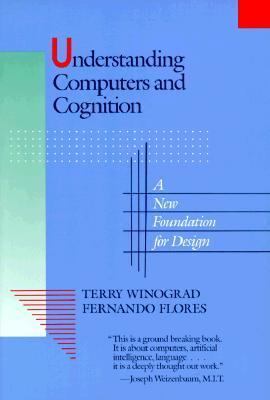
Understanding Computers and Cognition: A New Foundation for Design
This volume is a theoretical and practical approach to the design of computer technology.
207 pages, Paperback
First published May 1, 1986
Ratings & Reviews
Friends & Following
Create a free account to discover what your friends think of this book!
Community Reviews
Displaying 1 - 17 of 17 reviews

June 7, 2011
So far this is an absolutely fascinating study... The authors -concerned with current theories for determing artificial intelligence- begin by identifying our "traditional approach" to science and scholarship based on rational inquiry, particularly the idea that we humans build and maintain cognitive maps of reality and then attempt to harmonize those maps with the world around them. They follow a Chilean neurobiologist named Humberto R. Maturana who sees the behavior of humans in terms of our "mechanistic structure-determined systems." (which strongly de-emphasizes rationality)
They support their perspectives by way of Hans-Georg Gadamer and Martin Heidegger, and do so quite compellingly.
So far (I'm currently on p.51) the chapter on "Cognition as a Biological Phenomenon" has been the most exciting. I happened to have a chance to mention this work to Dr. John Samples -a specialist in Glaucoma- while my wife was having her blindness documented (for her citizenship paperwork) and he pointed me to an article in the May 2011 issue of Scientific American; "The Hidden Organ in our Eyes" by Ignacio Provencio. This article highlights new research indicating that our eyes not only "take in" information via the rods & cones but also from the ganglion cells... and that even the blind will often be aware of the circadian rhythms (night & day). This seems to show a biological system that completely by-passes cognitive thought.
more when I finish...
They support their perspectives by way of Hans-Georg Gadamer and Martin Heidegger, and do so quite compellingly.
So far (I'm currently on p.51) the chapter on "Cognition as a Biological Phenomenon" has been the most exciting. I happened to have a chance to mention this work to Dr. John Samples -a specialist in Glaucoma- while my wife was having her blindness documented (for her citizenship paperwork) and he pointed me to an article in the May 2011 issue of Scientific American; "The Hidden Organ in our Eyes" by Ignacio Provencio. This article highlights new research indicating that our eyes not only "take in" information via the rods & cones but also from the ganglion cells... and that even the blind will often be aware of the circadian rhythms (night & day). This seems to show a biological system that completely by-passes cognitive thought.
more when I finish...

July 20, 2018
The books theory is based on phenomenology (Heidegger, Gadamer). Artificial intelligence and design are discussed based on the philosophy’s implications. The introduced concepts of Heidegger’s ready-to-hand and breakdown. It also discusses tacit assumptions in our use of language, showing that the truth of a statement is dependent on these assumptions and that the assumptions themselves are constantly (re)created in our use of language and actions.
There are references to Wittgenstein (who is relevant for his “Sprachspiele” in this context) and Garfinkel (who is relevant for his discussion of “Accountability”), however, they are less extensive than I expected in a book discussing language and social commitments extensively.
The non-philosophical parts were interesting, but very short. The implications for design are discussed explicitly only in the last chapter (although greatly interweaving the theoretical ideas as well as actual products illustrating the ideas). The sections on Artificial Intelligence are still interesting, however, the book is dated and the systems discussed use different paradigms than the ones today.
Related for their criticism of rationalist ideas: Supersizing the mind (Clark), The Reflective Practitioner (Schön), Plans and Situated actions (Suchman)
There are references to Wittgenstein (who is relevant for his “Sprachspiele” in this context) and Garfinkel (who is relevant for his discussion of “Accountability”), however, they are less extensive than I expected in a book discussing language and social commitments extensively.
The non-philosophical parts were interesting, but very short. The implications for design are discussed explicitly only in the last chapter (although greatly interweaving the theoretical ideas as well as actual products illustrating the ideas). The sections on Artificial Intelligence are still interesting, however, the book is dated and the systems discussed use different paradigms than the ones today.
Related for their criticism of rationalist ideas: Supersizing the mind (Clark), The Reflective Practitioner (Schön), Plans and Situated actions (Suchman)

November 5, 2007
Es un trabajo imprescindible para comprender que la tecnología informática es un modo de vivir comunicados y conectados que forma parte de nuestra vida cotidiana. No se trata de máquinas de cálculo ni de administración de información, sino de invenciones de posibilidades en conversaciones, que -ahora con la red- son masivas globales. Es destacable que 21 años después esta obra siga siendo destacada entre los estudiosos del fenómeno de la era digital y las redes.

October 12, 2012
A train wreck of amateur philosophy.
July 10, 2013
This is a great book! I will definitely read it again in the future. This book gives readers a brief overview of how scientists have been trying to understand the way people understand and learn, and why the theories and models they proposed might not be enough for explaining known human behaviors. The authors mention several theoretical standpoints that have been affecting how people design computing system for decades. I especially enjoy the discussion about what is communication and how languages have been co-evolved with our world.

December 6, 2013
Even when the book came out, I thought to myself, "It doesn't really say anything".
I can imagine a writer for a magazine could make use of the book to think of topics for tech pieces about the "future".
A friend of mine gave me the book because he knew the authors, and wanted my take on it (as an A.I. developer).
I wrote a quick program to spew out sentences that were similar to those in the book.
I can imagine a writer for a magazine could make use of the book to think of topics for tech pieces about the "future".
A friend of mine gave me the book because he knew the authors, and wanted my take on it (as an A.I. developer).
I wrote a quick program to spew out sentences that were similar to those in the book.
January 10, 2015
The central messages of this classic seem obvious in 2015. But, then, the sections on Maturana and Heidegger are perhaps as essential to today's techie's as ever.

March 8, 2026
It's been more than 30 years since I read this in the German translation ("Erkenntnis - Maschinen - Verstehen"). I was impressed then as today by the sheer scope and erudition that is compressed in so few pages. The authors are writing a critique of artificial intelligence and computer design more generally. This critique is build on philosophical insights from phenomenology (Heidegger, Gadamer) and biological and cybernetical findings from Maturana and Varela. The concepts of "blindness", "breakdown" and "commitment" of language and linguistic acts, and their application on computer technology (incl. programming) is highly instructive. Even if some of the examples sound strange today (this was written before the internet boom, and during what was later called an AI "winter"), the key thoughts are highly relevant to the discourse around AI, "AGI" and LLMs today, and I hope that many of the protagonists of today's debates around AI existential threats would read this superb book by two outstanding thinkers.
November 3, 2017
Book was given to me by one of my most important teachers Dr.Guim . Presents perspectives on what it is to be a robot as opposed a human in a world where robotics is well poised to replace humans in my areas of life . The state of intellect within which the spadework of the understanding of computer technology takes place. Its of a wider readership than just those curious about AI and computer design. Important and controversial new approach to understanding what computers do and how their functioning is related to human language, thought, and action. This boo is important as a person in this day and age to have a well rounded perspective on how humans and machines are developing each other.
This entire review has been hidden because of spoilers.

September 16, 2024
Very cool book. Opens my eyes up to what's possible in CS.
I think it misses the mark on some things, and I'm not sure it really makes an argument (I imagine it was more revolutionary back in the day), but it is a wonderful exercise in thought marrying philosophy and computation.
I think it misses the mark on some things, and I'm not sure it really makes an argument (I imagine it was more revolutionary back in the day), but it is a wonderful exercise in thought marrying philosophy and computation.
January 17, 2019
HCI Classic

April 9, 2007
This book has a big influence on how I think about cognition, though it took a long time to seep in. This book, in critiquing old fashioned, human-simulating AI, liberated me from aspiring to NLP AI and made it okay to do HCI. Copout by critique? Maybe. I prefer to think it's just not wasting your time on a fundamentally flawed approach. Thank you, Terry!

October 3, 2011
A classic that merits reading despite its age. Winograd and Flores bring together philosophy, linguistics, and biology in order to illuminate the endeavor of computer science. This little book is dense but somehow manages to remain clear and readable by students of many different disciplines.

January 11, 2010
A very interesting book that is frequently recommended by Hjørland in his writings.

September 28, 2015
This is now dated, but I give it 5 stars from a 1986 context.

Want to Read
February 6, 2010Recommended by paolo zanardi
January 23, 2012
It's been so long I've forgotten what I loved about this book, I am rereading it.
Displaying 1 - 17 of 17 reviews