

What do you think?

Sir Henry Merrivale #1
The Plague Court Murders
Plague Court is old and crumbling, long neglected after its lord, hangman’s assistant Louis Playge, fell victim to the black death hundreds of years before. Famously haunted by Playge’s ghost, the property finally has a new owner and banishing the spirit is the first order of business. And when the medium employed with this task is found stabbed to death in a locked stone hut on the grounds, surrounded by an untouched circle of mud, the other guests at Plague Court have every reason to fear an act of supernatural violence—for who among them would be diabolical and calculating enough to orchestrate such an impossible execution?
Enter Sir Henry Merrivale, an amateur sleuth of many talents with deductive powers strong enough to unspool even the most baffling crimes. But in the creepy, atmospheric setting of Plague Court, where every indication suggests intervention from the afterlife, he encounters a seemingly-illogical murder scene unlike anything he’s ever encountered before...
Reissued for the first time in thirty years, The Plague Court Murders is the first novel in the Sir Henry Merrivale series. Originally published under the name Carter Dickson, it is a masterful example of the “impossible crime” novel for which John Dickson Carr is known.
Enter Sir Henry Merrivale, an amateur sleuth of many talents with deductive powers strong enough to unspool even the most baffling crimes. But in the creepy, atmospheric setting of Plague Court, where every indication suggests intervention from the afterlife, he encounters a seemingly-illogical murder scene unlike anything he’s ever encountered before...
Reissued for the first time in thirty years, The Plague Court Murders is the first novel in the Sir Henry Merrivale series. Originally published under the name Carter Dickson, it is a masterful example of the “impossible crime” novel for which John Dickson Carr is known.
416 pages, Paperback
First published January 1, 1934
About the author
John Dickson Carr
444 books534 followersAKA Carter Dickson, Carr Dickson and Roger Fairbairn.
John Dickson Carr was born in Uniontown, Pennsylvania, in 1906. It Walks by Night, his first published detective novel, featuring the Frenchman Henri Bencolin, was published in 1930. Apart from Dr Fell, whose first appearance was in Hag's Nook in 1933, Carr's other series detectives (published under the nom de plume of Carter Dickson) were the barrister Sir Henry Merrivale, who debuted in The Plague Court Murders (1934).
John Dickson Carr was born in Uniontown, Pennsylvania, in 1906. It Walks by Night, his first published detective novel, featuring the Frenchman Henri Bencolin, was published in 1930. Apart from Dr Fell, whose first appearance was in Hag's Nook in 1933, Carr's other series detectives (published under the nom de plume of Carter Dickson) were the barrister Sir Henry Merrivale, who debuted in The Plague Court Murders (1934).
Ratings & Reviews
Friends & Following
Create a free account to discover what your friends think of this book!
Community Reviews
Displaying 1 - 30 of 157 reviews

September 5, 2026
This is a typical locked-room whodunit. It is slow and confusing at the beginning and I didn't know where the plot was headed. Was it a robbery, a ghost story...?
But after the murder was committed, it became much more interesting and although the all-knowing H.M comes up with with a far-fetched solution at the end, I had an enjoyable time reading and guessing.
But after the murder was committed, it became much more interesting and although the all-knowing H.M comes up with with a far-fetched solution at the end, I had an enjoyable time reading and guessing.

February 18, 2024
It is a mixture of a locked room and closed circle mysteries. The story is good and the descriptions of the characters are brilliant. I can reccommend it if you are not afraid of getting lost among long boring explanations of the circumstances and numerous (unnecessary) confusing details.
January 18, 2024
A Paranormal Locked Room
Review of the American Mystery Classics paperback (February 2, 2021) of the William Morrow & Company hardcover original (1934)
Despite an intriguing start, this started dragging for me quite early. I even resorted to mementoizing* it, although that attempt proved to be so confusing that I had to go back and persevere in chronological order. The first 40% just felt like an overextended prelude where the investigators (but not the main one), the suspects and the victim are introduced. Then it did start to get more interesting as the actual suspect interviews begin. Finally at the 60% point, Sir Henry Merrivale (the series lead) is introduced and the gradual solution to the case begins to coalesce.
Plague Court is the ancestral home of the Playge family, one of whom was an assistant executioner during the years of the Great Plague in 17th Century London, England. Now in 1930's London, the house is reputed to be haunted, but a spiritualist vows that he will exorcise the ghost. Various witnesses and authorities (including Ken Blake, the "Watson" of the case) appear on the scene to view the event. The spiritualist is instead found dead from several stab wounds (apparently from Playge's own awl-like knife which had been stolen from a museum shortly before) inside a locked and bolted stone building inside the courtyard of Plague Court. Though the yard is wet and muddy no footsteps to or from the building can be found.
That introduction overstayed its welcome, but the case starts to have some momentum when the eccentric Sir Henry Merrivale is brought in to consult on the matter. Merrivale was a Chief of Intelligence in the World War (1914-1918) and still maintains an office in Whitehall. He brings the case to a dramatic conclusion and the investigators adjourn for punch back at his office where he explains it all. As it is for all locked room mysteries, the solution is pretty far-fetched.
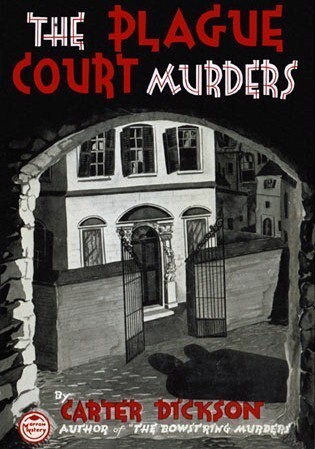
The front cover of the original 1934 William Morrow & Company hardcover when the book was first issued under the penname of Carter Dickson. Image sourced from Goodreads.
On Berengaria's Ease of Solving Scale® I would rate this as a 10 out of 10, i.e. "impossible to solve." In hindsight one might say that clues were provided, but the culprit was hidden from view for so long that it all came out as a twist in the end which was impossible to foresee.
Footnote
Trivia and Links
John Dickson Carr (1906-1977) is one of the 99 authors listed in The Book of Forgotten Authors (2017) by Christopher Fowler. He is No. 20 in the alphabetical listing which you can see towards the bottom of my review here.
This edition of The Plague Court Murders is part of the Otto Penzler American Mystery Classics series (2018-ongoing). There is a related Goodreads Listopia here with 55 books listed as of early January 2024. There are currently 68 titles listed at the Mysterious Press online bookshop. The official website for the series at Penzler Publishers seems to show only the most recent and upcoming titles.
Review of the American Mystery Classics paperback (February 2, 2021) of the William Morrow & Company hardcover original (1934)
“Wait Blake. Wait a bit. Before I tell you about it, let me ask you whether you’re willing to give me a hand in what you’ll probably call an idiotic business. I want you to …”
“Go on.”
“To spend the night in a haunted house,” said Halliday.
“What’s idiotic about that?” I asked, trying to conceal the fact that my boredom had begun to disappear; I felt an anticipatory pleasure, and my companion seemed to notice it.
Despite an intriguing start, this started dragging for me quite early. I even resorted to mementoizing* it, although that attempt proved to be so confusing that I had to go back and persevere in chronological order. The first 40% just felt like an overextended prelude where the investigators (but not the main one), the suspects and the victim are introduced. Then it did start to get more interesting as the actual suspect interviews begin. Finally at the 60% point, Sir Henry Merrivale (the series lead) is introduced and the gradual solution to the case begins to coalesce.
Plague Court is the ancestral home of the Playge family, one of whom was an assistant executioner during the years of the Great Plague in 17th Century London, England. Now in 1930's London, the house is reputed to be haunted, but a spiritualist vows that he will exorcise the ghost. Various witnesses and authorities (including Ken Blake, the "Watson" of the case) appear on the scene to view the event. The spiritualist is instead found dead from several stab wounds (apparently from Playge's own awl-like knife which had been stolen from a museum shortly before) inside a locked and bolted stone building inside the courtyard of Plague Court. Though the yard is wet and muddy no footsteps to or from the building can be found.
That introduction overstayed its welcome, but the case starts to have some momentum when the eccentric Sir Henry Merrivale is brought in to consult on the matter. Merrivale was a Chief of Intelligence in the World War (1914-1918) and still maintains an office in Whitehall. He brings the case to a dramatic conclusion and the investigators adjourn for punch back at his office where he explains it all. As it is for all locked room mysteries, the solution is pretty far-fetched.
The front cover of the original 1934 William Morrow & Company hardcover when the book was first issued under the penname of Carter Dickson. Image sourced from Goodreads.
On Berengaria's Ease of Solving Scale® I would rate this as a 10 out of 10, i.e. "impossible to solve." In hindsight one might say that clues were provided, but the culprit was hidden from view for so long that it all came out as a twist in the end which was impossible to foresee.
Footnote
*mementoize
məˈmenˌtōˈīz/
verb / neologism
Definitions:
• 1. to tell a story in reverse order, as in the film Memento (2000) by director Christopher Nolan.
“Christopher Nolan didn’t invent reverse chronology story telling, but his film title Memento is the easiest to make into a verb: mementoize."
• 2. to read a book in reverse order to finish it, especially when reading it in forward order is not very interesting or compelling.
“The book was so dull I had to mementoize it in order to get through it."
• 3. a fictitious word invented for use in book reviews by The Lone Librarian™.
Trivia and Links
John Dickson Carr (1906-1977) is one of the 99 authors listed in The Book of Forgotten Authors (2017) by Christopher Fowler. He is No. 20 in the alphabetical listing which you can see towards the bottom of my review here.
This edition of The Plague Court Murders is part of the Otto Penzler American Mystery Classics series (2018-ongoing). There is a related Goodreads Listopia here with 55 books listed as of early January 2024. There are currently 68 titles listed at the Mysterious Press online bookshop. The official website for the series at Penzler Publishers seems to show only the most recent and upcoming titles.

November 2, 2009
The Plague Court Murders is the first in a series featuring Sir Henry Merrivale, noted expert on crime, barrister, physician and all around smart guy when it comes to solving the unsolvable. Carter Dickson is one of the pseudonyms of Golden-Age mystery writer John Dickson Carr, and this book definitely falls within at category. The reader is presented with an impossible crime, with several suspects and a number of red herrings. In the introduction to this edition, it is noted that Carr was a fan of the great Houdini, as well as spiritualism and haunted-house stories; he combined elements of all three in putting together this story.
As it begins, a Mr. Dean Halliday is explaining to Ken Blake that his family home, called Plague Court, is supposedly haunted, and he invites Blake and another friend, Inspector Masters, to go with him that very night to attend a seance. Masters is interested because the seance will be handled by Roger Darworth, who is a subject under surveillance by the police, along with his medium, Joseph. But during the seance something goes terribly wrong, and Darworth, who is alone, and locked in to a small stone building on the property, ends up murdered. The police are totally baffled by this impossible crime, and turn to Sir Henry Merrivale (often called "Mycroft") for help.
Like a lot of Carr's work, this one is a bit long, and the prose a bit stilted and sometimes archaic. The language may try the patience of modern mystery readers (it was written in the 1930s), and also, we don't really meet Sir Henry until late in the game. The story just kind of drags until after Darworth's murder, when it begins only then to pick up some speed. And, while the core mystery is well plotted, I wasn't overwhelmed by the solution. I will say that it was fun watching things unravel, and I was definitely wrong in my choice of murderer.
As noted, modern mystery readers may be a bit put off by the language and the slowness of the story at times, but those readers who are fans of books written during the Golden Age of Mystery will probably enjoy it.
As it begins, a Mr. Dean Halliday is explaining to Ken Blake that his family home, called Plague Court, is supposedly haunted, and he invites Blake and another friend, Inspector Masters, to go with him that very night to attend a seance. Masters is interested because the seance will be handled by Roger Darworth, who is a subject under surveillance by the police, along with his medium, Joseph. But during the seance something goes terribly wrong, and Darworth, who is alone, and locked in to a small stone building on the property, ends up murdered. The police are totally baffled by this impossible crime, and turn to Sir Henry Merrivale (often called "Mycroft") for help.
Like a lot of Carr's work, this one is a bit long, and the prose a bit stilted and sometimes archaic. The language may try the patience of modern mystery readers (it was written in the 1930s), and also, we don't really meet Sir Henry until late in the game. The story just kind of drags until after Darworth's murder, when it begins only then to pick up some speed. And, while the core mystery is well plotted, I wasn't overwhelmed by the solution. I will say that it was fun watching things unravel, and I was definitely wrong in my choice of murderer.
As noted, modern mystery readers may be a bit put off by the language and the slowness of the story at times, but those readers who are fans of books written during the Golden Age of Mystery will probably enjoy it.

August 30, 2017
Il "mio" Carr. Quello così paurosamente reale, quello che porterei sempre con me per inquietarmi, quello condito da quella particolare atmosfera fascinosa che ai miei occhi lo rende così prezioso. E unico. Già, in quanto ad atmosfera (intesa come la intendo io) qui il maestro non ci risparmia proprio nulla: abbiamo una casa misteriosa teatro di un suicidio del passato, abbiamo un gruppo di personaggi che lì si riunisce, a lume di candela, per fare una seduta spiririca, abbiamo passi furtivi, lame di coltello striscianti e un personaggio che viene ritrovato pugnalato in una stanza chiusa all'interno, un delitto che, ovviamente, nella migliore tradizione di Carr, sembra impossibile. E fuori, c'è la Londra fredda e fumosa degli anni '30 che pare aggiungere paura alla paura della storia. Insomma, un bel Carr, anche se non all'altezza di altri, forse a causa della complessità che sembra prendere l'intreccio tra l'inizio e la metà...Carr tende a "ingarbugliarsi" un po' troppo e il lettore ha l'impressione di non comprendere più nulla, ho notato che è un dei suoi (rari) difetti. Ma se si tiene duro in quelle pagine e si prosegue poi la lettura si snoda alla perfezione, e tutti i tasselli vanno al loro posto, grazie anche all'arguzia di Merrivale, che lascerà tutti a bocca aperta ancora una volta. E il colpo di scena non mancherà.

January 27, 2020
Set down in the midst of decaying brick buildings, gaunt and crooked against the dawn, with their blind windows staring into it, this yard was uncanny in its desolation. You felt that no church-bells, or street-organs, or any homely, human sound could ever penetrate it.
The Plague Court Murders (1934) by Carter Dickson [John Dickson Carr] is the first in the Sir Henry (H. M.) Merrivale mysteries by the locked room master. It is a nice little puzzle with gothic and supernatural undertones and a thoroughly unpleasant villain. Merrivale comes into the story about mid-way. We begin with Ken Blake at his club. He is approached by an old friend, Dean Halliday, with an unusual request. He wants Blake to come with him that very night and join him at a vigil at a haunted house. The house in question belongs to Halliday's family and has a history of murder and death. It is said to be haunted by the ghost of the original owner, one Louis Playge who was a hangman and died in mysterious circumstances during the years of the Plague.
Halliday's aunt, Lady Benning, and fiancee Marion Latimer are devotees of a medium/psychic and are determined to hold a vigil in the house while Roger Darworth and his medium, a young boy named Joseph, work to purge the house of its ghosts. Halliday wants Blake's assistance to prove the psychic a charlatan and they both call upon Chief Inspector Masters of the Yard (who dabbles in the art of exposing psychic fakes himself) to lend a hand. Meanwhile, the Playge Dagger--originally belonging to the hangman and donated by the Halliday family to a London Museum--has been stolen.
During the vigil, Halliday, his aunt, fiancee and her brother Ted, and Major Featherton (family friend) stay together in a room while Darworth is installed in a lonely stone building in the courtyard. The door is locked (both outside and in), the widows are closely barred, and surrounding the building is about thirty feet of smooth mud. And, yet, during the night Darworth will apparently be stabbed to death by a ghostly hand wielding the missing Playge Dagger. Masters is sure it's murder by a human hand, but can't see how the thing was done. Locked room expert, Sir Henry Merrivale is pressed into service "one more time" to show them all how it was done.
I enjoyed the atmosphere of this one--especially with all the details from the years of Louis Playge. It gave the story a nice ghost-story feel. Of course, H.M. dumps cold water on the idea that any supernatural forces are at play, but the build-up to the murders is very nicely done. The plot is not quite a smoothly polished as later Dickson novels will be, but it still a clever puzzle and Dickson manages to show you how it was done while firmly telling you that it couldn't have been done that way. Nobody says you have to believe characters implicitly when they tell you things....★★★ and 3/4.
First posted on my blog My Reader's Block. Please request permission before reposting any review content. Thanks.
The Plague Court Murders (1934) by Carter Dickson [John Dickson Carr] is the first in the Sir Henry (H. M.) Merrivale mysteries by the locked room master. It is a nice little puzzle with gothic and supernatural undertones and a thoroughly unpleasant villain. Merrivale comes into the story about mid-way. We begin with Ken Blake at his club. He is approached by an old friend, Dean Halliday, with an unusual request. He wants Blake to come with him that very night and join him at a vigil at a haunted house. The house in question belongs to Halliday's family and has a history of murder and death. It is said to be haunted by the ghost of the original owner, one Louis Playge who was a hangman and died in mysterious circumstances during the years of the Plague.
Halliday's aunt, Lady Benning, and fiancee Marion Latimer are devotees of a medium/psychic and are determined to hold a vigil in the house while Roger Darworth and his medium, a young boy named Joseph, work to purge the house of its ghosts. Halliday wants Blake's assistance to prove the psychic a charlatan and they both call upon Chief Inspector Masters of the Yard (who dabbles in the art of exposing psychic fakes himself) to lend a hand. Meanwhile, the Playge Dagger--originally belonging to the hangman and donated by the Halliday family to a London Museum--has been stolen.
During the vigil, Halliday, his aunt, fiancee and her brother Ted, and Major Featherton (family friend) stay together in a room while Darworth is installed in a lonely stone building in the courtyard. The door is locked (both outside and in), the widows are closely barred, and surrounding the building is about thirty feet of smooth mud. And, yet, during the night Darworth will apparently be stabbed to death by a ghostly hand wielding the missing Playge Dagger. Masters is sure it's murder by a human hand, but can't see how the thing was done. Locked room expert, Sir Henry Merrivale is pressed into service "one more time" to show them all how it was done.
I enjoyed the atmosphere of this one--especially with all the details from the years of Louis Playge. It gave the story a nice ghost-story feel. Of course, H.M. dumps cold water on the idea that any supernatural forces are at play, but the build-up to the murders is very nicely done. The plot is not quite a smoothly polished as later Dickson novels will be, but it still a clever puzzle and Dickson manages to show you how it was done while firmly telling you that it couldn't have been done that way. Nobody says you have to believe characters implicitly when they tell you things....★★★ and 3/4.
First posted on my blog My Reader's Block. Please request permission before reposting any review content. Thanks.

October 2, 2017
The Plague Court Murders is the first Sir Henry Merrivale mystery, by American writer John Dickson Carr, who wrote it under the name of Carter Dickson. This book says it is written by Carter Dickson, but he also used the names Carr Dickson and Roger Fairbairn. I wonder if he ever used his own or if he got confused who was writing what. He was a master of so-called locked room mystery, in which a detective solves apparently impossible crimes. The Dr. Fell mystery The Hollow Man (1935), usually considered Carr's masterpiece, was selected during 1981 as the best locked-room mystery of all time by a panel of 17 mystery authors and reviewers. He was also an author of historical mystery. Now I have to go in search of The Hollow Man, I want to read the masterpiece. I wonder what name he used for that one. I found this interesting:
"During early spring 1963, while living in Mamaroneck, New York, Carr suffered a stroke, which paralyzed his left side. He continued to write using one hand, and for several years contributed a regular column of mystery and detective book reviews, "The Jury Box", to Ellery Queen's Mystery Magazine."
If I were a writer (which I'm not) I would try writing with only one hand to see if it is hard to do, it doesn't seem like it would be, you only use one hand in the first place, although having the other one to hold the paper down would probably be welcomed. I guess I could try it even if I'm not a writer, you can still write without making a book of the thing.
I found that Carr's two major detective characters, Dr. Fell and Sir Henry Merrivale, are quite similar. Both are large, upper-class, eccentric Englishmen somewhere between middle-aged and elderly. I'll take their word on it for Dr. Fell, I never heard of the guy before, but Sir Henry Merrivale shows up in this book eventually. Henry Merrivale or "H.M.", although stout and with a majestic "corporation", is active physically and is feared for his ill-temper and noisy rages. A wealthy descendant of the "oldest baronetcy" in England, he is part of the Establishment (even though he frequently rails against it) and in the earlier novels is the director of the British Secret Service. Even though he is supposed to be such a main character, I was beginning to think that the paragraph on the back of my book was meant for something else and got on our book by accident:
"Paging Sir Henry Merrivale.....that rumbling, grumbling grand old man who has become one of the best-loved detectives in mystery fiction. When Scotland Yard is faced with the perfect murder, the insoluble problem, "impossible" clues, they know that only Old H. M. has the ingenuity and gall to put all the pieces together. In The Plague Court Murders, Sir Henry confronts one of the most chilling and dramatic crimes of his long career."
From that paragraph I expected to find the murdered person on the first page and Sir Henry arriving by the end of the first chapter. That isn't what happened though. Yes, there is a murder, more than one, but the first doesn't happen until page 50 which is chapter six, and Sir Henry has to wait quite awhile to enter the book while the police and such people try to solve the crime themselves. Finally on page 105 they all give up and go to Sir Henry, in chapter 13, this may not seem like it is that much of a surprise, after all, only 105 pages have been read and there must be hundreds more right? No, not hundreds, not a hundred, in about 50 pages we will all know who murdered who or whom, I don't know which, and all the loose ends will be tied.
But we will start with our narrator being in his club one night when an old friend of his, Dean Halliday comes in and asks our narrator whose name I can't remember at the time, if he will be willing to go spend the night in a "haunted" house. Dean begins with this:
"Listen, Blake, (oh yeah, that's his name), I could tell you the whole story, if you insist on knowing. I don't want you to walk in blindfold. But I'd rather you didn't ask anything. I want you to go with me, tonight, to a certain house in London; to tell me whether you see or hear anything; and, if you do, whether you can explain it on natural grounds. There'll be no difficulty about getting into the house. It belongs to our family, as a matter of fact...Will you go?
Yes, Blake goes. So does a detective by the name of Masters, I don't know his first name. Not only is he an inspector from Scotland Yard, but his hobby is ghosts:
"Masters makes rather a hobby of this." I smiled again, thinking of Masters the unruffled, Masters the ghost-breaker; the big, stout, urbane man who was as pleasant as a card-sharper and as cynical as Houdini. During the spiritualistic craze that took England after the war, he was a detective-sergeant whose chief business was the exposing of bogus mediums. Since then his interest had increased (apologetically) into a hobby. In the workshop of his little house at Hampstead, surrounded by his approving children, he tinkered with ingenious devices of parlor magic; and was altogether highly pleased with himself."
And of course, he goes with them. And from here lots of things happen rather fast. A dagger disappears from the London Museum, the dagger was listed as the gift of a property owned by J. G. Halliday, one of Dean's long ago relatives I suppose, and was believed to have been the property of one Louis Playge, Common Hangman during the years 1663-65. This guy had an awful and appropriate name seeing he died during the great plague of 1665. That's not a spoiler, you'll know that in a page or two. So the three men arrive at Plague Court;
"We all moved softly; I don't know why. Possibly because there seemed such an absolute hush in the desolation of the house before us. Something seemed to be impelling us to move faster; to get inside those high brick walls; something drawing us on and playing with us. The house-or what I could see of it-was made of heavy, whitish blocks of stone, now blackened with the weather. Following Halliday, we went to a weedy brick path to the carven porch over the front door. The door itself was more than ten feet high, and had a corroded knocker still hanging drunkenly from one bolt."
About this time they realize the door is open, although why anyone would want to go in this place was a mystery to me, they here somebody scream, a real person, not a ghost. So the three of them burst into a room and find Halliday's aunt, Lady Benning, and his fiancé, Marion. From what I remember dear Aunt Anne, adored Halliday's brother James. She does not seem to have the same feelings for Dean. Lady Benning is there to "find" James. She tells them not to be afraid in that room because "they" cannot come into this room". They, according to his aunt had taken possession of James and that is why he shot himself. At which time Halliday responds "Aunt Anne, are you trying to drive me mad?" I feel the same way.
But Lady Benning goes on to say:
"I loved James," said Lady Bening, and her face was suddenly pitted with wrinkles. "He was strong, but he could not stand them. So they will come for you, because you are James's brother and you are alive. James told me so, and he cannot...you see, it is to give him peace. Not you, James. And until this thing is exorcised, not you nor James will sleep."
Nice lady. And here come the rest of the group. We find that Mr. Darworth is here, but he is resting. Mr. Darworth is, well he's the guy who's been contacting James, a medium or a psychic, or some such thing. Dean tells us that Lady Benning, Marion, and her brother all know him well, and they are planning to hold a séance that night to rid the house of evil spirits, something like that. If I remember it right Mr. Darworth won't be in the room when it comes time to confront the ghosts, a young boy who goes everywhere with be will be the one who speaks to the ghosts, he has great powers, but they are receptive. Mr. Darworth is going to be on the other side of the yard in a little stone house, I can't remember why there is a little stone house in the yard, but there is. And just now Marian's brother Ted and another friend Major Featherton are in the stone house getting the fire ready for Darworth to be comfortable in while he contacts the spirits. It is now time to be locked up, Darworth that is, and that's what they do. He's locked in the stone house, bars on the windows, bars on the doors, no way in, no way out, type of thing. There's also a man by the name of McDonnell there, he's another police detective. He's looking for the dagger, remember that dagger that disappeared?
Since Darworth is locked up it is time for the séance, so everybody, almost everybody, gathers in the room with the big table, I guess there's a big table and turn the lights out, just about the time ghosts should have started showing up a bell starts ringing, and every one runs out of the room and find a dead person. Be prepared to see a spoiler, the dead person is one of the people who were not in the room with everybody else. How's that for a spoiler. Now we have to figure out how the murderer in the room with all the other people managed to sneak out of the room, murder the murderee, and get back in again without anyone noticing . As we hunt for the murderer the only way we can cross suspects off our list is because sooner or later they also get murdered.
And that's all of the plot you get from me. A rather surprising thing happened when I was reading this book. I mentioned in a different review the other day that I hate when pages fall out of a book and don't start reading it in the first place if it looks close to being in that shape. So recently I was reading a book and when the pages started falling out I threw the book away. I then moved on to "The Plague Court Murders" and everything was fine until somewhere in the middle of the book when after turning a page I found I was holding the first half of the book in my left hand and the second half in my right hand, a perfectly normal thing except there was nothing holding it together in the middle. Since the book had conveniently only split into two halves I kept going and made it to the end. By the end though it was in three pieces, maybe four. Happy reading.
"During early spring 1963, while living in Mamaroneck, New York, Carr suffered a stroke, which paralyzed his left side. He continued to write using one hand, and for several years contributed a regular column of mystery and detective book reviews, "The Jury Box", to Ellery Queen's Mystery Magazine."
If I were a writer (which I'm not) I would try writing with only one hand to see if it is hard to do, it doesn't seem like it would be, you only use one hand in the first place, although having the other one to hold the paper down would probably be welcomed. I guess I could try it even if I'm not a writer, you can still write without making a book of the thing.
I found that Carr's two major detective characters, Dr. Fell and Sir Henry Merrivale, are quite similar. Both are large, upper-class, eccentric Englishmen somewhere between middle-aged and elderly. I'll take their word on it for Dr. Fell, I never heard of the guy before, but Sir Henry Merrivale shows up in this book eventually. Henry Merrivale or "H.M.", although stout and with a majestic "corporation", is active physically and is feared for his ill-temper and noisy rages. A wealthy descendant of the "oldest baronetcy" in England, he is part of the Establishment (even though he frequently rails against it) and in the earlier novels is the director of the British Secret Service. Even though he is supposed to be such a main character, I was beginning to think that the paragraph on the back of my book was meant for something else and got on our book by accident:
"Paging Sir Henry Merrivale.....that rumbling, grumbling grand old man who has become one of the best-loved detectives in mystery fiction. When Scotland Yard is faced with the perfect murder, the insoluble problem, "impossible" clues, they know that only Old H. M. has the ingenuity and gall to put all the pieces together. In The Plague Court Murders, Sir Henry confronts one of the most chilling and dramatic crimes of his long career."
From that paragraph I expected to find the murdered person on the first page and Sir Henry arriving by the end of the first chapter. That isn't what happened though. Yes, there is a murder, more than one, but the first doesn't happen until page 50 which is chapter six, and Sir Henry has to wait quite awhile to enter the book while the police and such people try to solve the crime themselves. Finally on page 105 they all give up and go to Sir Henry, in chapter 13, this may not seem like it is that much of a surprise, after all, only 105 pages have been read and there must be hundreds more right? No, not hundreds, not a hundred, in about 50 pages we will all know who murdered who or whom, I don't know which, and all the loose ends will be tied.
But we will start with our narrator being in his club one night when an old friend of his, Dean Halliday comes in and asks our narrator whose name I can't remember at the time, if he will be willing to go spend the night in a "haunted" house. Dean begins with this:
"Listen, Blake, (oh yeah, that's his name), I could tell you the whole story, if you insist on knowing. I don't want you to walk in blindfold. But I'd rather you didn't ask anything. I want you to go with me, tonight, to a certain house in London; to tell me whether you see or hear anything; and, if you do, whether you can explain it on natural grounds. There'll be no difficulty about getting into the house. It belongs to our family, as a matter of fact...Will you go?
Yes, Blake goes. So does a detective by the name of Masters, I don't know his first name. Not only is he an inspector from Scotland Yard, but his hobby is ghosts:
"Masters makes rather a hobby of this." I smiled again, thinking of Masters the unruffled, Masters the ghost-breaker; the big, stout, urbane man who was as pleasant as a card-sharper and as cynical as Houdini. During the spiritualistic craze that took England after the war, he was a detective-sergeant whose chief business was the exposing of bogus mediums. Since then his interest had increased (apologetically) into a hobby. In the workshop of his little house at Hampstead, surrounded by his approving children, he tinkered with ingenious devices of parlor magic; and was altogether highly pleased with himself."
And of course, he goes with them. And from here lots of things happen rather fast. A dagger disappears from the London Museum, the dagger was listed as the gift of a property owned by J. G. Halliday, one of Dean's long ago relatives I suppose, and was believed to have been the property of one Louis Playge, Common Hangman during the years 1663-65. This guy had an awful and appropriate name seeing he died during the great plague of 1665. That's not a spoiler, you'll know that in a page or two. So the three men arrive at Plague Court;
"We all moved softly; I don't know why. Possibly because there seemed such an absolute hush in the desolation of the house before us. Something seemed to be impelling us to move faster; to get inside those high brick walls; something drawing us on and playing with us. The house-or what I could see of it-was made of heavy, whitish blocks of stone, now blackened with the weather. Following Halliday, we went to a weedy brick path to the carven porch over the front door. The door itself was more than ten feet high, and had a corroded knocker still hanging drunkenly from one bolt."
About this time they realize the door is open, although why anyone would want to go in this place was a mystery to me, they here somebody scream, a real person, not a ghost. So the three of them burst into a room and find Halliday's aunt, Lady Benning, and his fiancé, Marion. From what I remember dear Aunt Anne, adored Halliday's brother James. She does not seem to have the same feelings for Dean. Lady Benning is there to "find" James. She tells them not to be afraid in that room because "they" cannot come into this room". They, according to his aunt had taken possession of James and that is why he shot himself. At which time Halliday responds "Aunt Anne, are you trying to drive me mad?" I feel the same way.
But Lady Benning goes on to say:
"I loved James," said Lady Bening, and her face was suddenly pitted with wrinkles. "He was strong, but he could not stand them. So they will come for you, because you are James's brother and you are alive. James told me so, and he cannot...you see, it is to give him peace. Not you, James. And until this thing is exorcised, not you nor James will sleep."
Nice lady. And here come the rest of the group. We find that Mr. Darworth is here, but he is resting. Mr. Darworth is, well he's the guy who's been contacting James, a medium or a psychic, or some such thing. Dean tells us that Lady Benning, Marion, and her brother all know him well, and they are planning to hold a séance that night to rid the house of evil spirits, something like that. If I remember it right Mr. Darworth won't be in the room when it comes time to confront the ghosts, a young boy who goes everywhere with be will be the one who speaks to the ghosts, he has great powers, but they are receptive. Mr. Darworth is going to be on the other side of the yard in a little stone house, I can't remember why there is a little stone house in the yard, but there is. And just now Marian's brother Ted and another friend Major Featherton are in the stone house getting the fire ready for Darworth to be comfortable in while he contacts the spirits. It is now time to be locked up, Darworth that is, and that's what they do. He's locked in the stone house, bars on the windows, bars on the doors, no way in, no way out, type of thing. There's also a man by the name of McDonnell there, he's another police detective. He's looking for the dagger, remember that dagger that disappeared?
Since Darworth is locked up it is time for the séance, so everybody, almost everybody, gathers in the room with the big table, I guess there's a big table and turn the lights out, just about the time ghosts should have started showing up a bell starts ringing, and every one runs out of the room and find a dead person. Be prepared to see a spoiler, the dead person is one of the people who were not in the room with everybody else. How's that for a spoiler. Now we have to figure out how the murderer in the room with all the other people managed to sneak out of the room, murder the murderee, and get back in again without anyone noticing . As we hunt for the murderer the only way we can cross suspects off our list is because sooner or later they also get murdered.
And that's all of the plot you get from me. A rather surprising thing happened when I was reading this book. I mentioned in a different review the other day that I hate when pages fall out of a book and don't start reading it in the first place if it looks close to being in that shape. So recently I was reading a book and when the pages started falling out I threw the book away. I then moved on to "The Plague Court Murders" and everything was fine until somewhere in the middle of the book when after turning a page I found I was holding the first half of the book in my left hand and the second half in my right hand, a perfectly normal thing except there was nothing holding it together in the middle. Since the book had conveniently only split into two halves I kept going and made it to the end. By the end though it was in three pieces, maybe four. Happy reading.

November 5, 2024
I’ve read a couple of John Dickson Carr’s “British-style” mysteries and have enjoyed them. The author was American, which is revealed in general terms in his slightly twee portrayal of ‘Ye Olde England’ – and specifically when he casually mentions the likes of popcorn or that a character weighed 90 pounds (six stone, six, please!).
The Plague Court Murders is billed as the first in the Sir Henry Merrivale series – although you could be excused for thinking this is a mistake as he is absent for the first 180 pages.
I found the bulk of this book enthralling and atmospheric (indeed, more Dickensian in feel than its 1934 publication date would suggest), and it seemed set to be a simple closed-room mystery in which a bloodthirsty murder is committed within a near-impregnable stone outbuilding, locked and barred from the inside, into which the police had to break.
Baffled, the early protagonists rouse the great slumbering sleuth, the cantankerous Churchillian personage of Sir Henry Merrivale. At this juncture, in my view, a straightforward but engrossing journey now flies off the rails.
Sir Henry somehow unravels an impossibly complex web of intrigue woven by the perpetrator, requiring unlikely coincidences, and implausible feats of action – not least how the closed-room murder has been committed.
The New York Times jacket review states: “A genuine baffler, placed in an eerie, ghostly setting.”
While I agree with this, I think another quote that I found online should be considered in tandem: “Unforgivably preposterous!”
The Plague Court Murders is billed as the first in the Sir Henry Merrivale series – although you could be excused for thinking this is a mistake as he is absent for the first 180 pages.
I found the bulk of this book enthralling and atmospheric (indeed, more Dickensian in feel than its 1934 publication date would suggest), and it seemed set to be a simple closed-room mystery in which a bloodthirsty murder is committed within a near-impregnable stone outbuilding, locked and barred from the inside, into which the police had to break.
Baffled, the early protagonists rouse the great slumbering sleuth, the cantankerous Churchillian personage of Sir Henry Merrivale. At this juncture, in my view, a straightforward but engrossing journey now flies off the rails.
Sir Henry somehow unravels an impossibly complex web of intrigue woven by the perpetrator, requiring unlikely coincidences, and implausible feats of action – not least how the closed-room murder has been committed.
The New York Times jacket review states: “A genuine baffler, placed in an eerie, ghostly setting.”
While I agree with this, I think another quote that I found online should be considered in tandem: “Unforgivably preposterous!”

October 9, 2012
This is the first Sir Henry Merrivale mystery written by John Dickson Carr under his nom de plume of Carter Dickson. The recognized master of the "locked room" story. Carr doesn't cheat the reader by introducing trapdoors, hidden rooms, or other such devices to solve the mystery. Instead he illustrates how the crime could have been committed without resorting to those overworked contrivances, however far-fetched the solution. In this entry, Merrivale is called in to solve the murder of a fake psychic who, it appears, has been slashed to death inside an impregnable room. There are many suspects, all of whom were being bilked by the so-called psychic but how did the murderer get inside that room? All is not what it appears and the solution is outlandish. These stories are not for everyone and the writing style is reminiscent of turn of the 20th century detective tales......but it is rather fun!

October 26, 2021
I've long wanted to read a book by John Dickson Carr, having heard his named bandied about as one of the greats. I'm not 100% sure that I was completely blown away by the story, but I did enjoy it quite a bit. At first I felt a bit frustrated that our amateur detective was not introduced until mid-way through the story, but considering the breakneck speed that the case took upon his arrival, in retrospect, I was grateful for the slow build of tension and suspense that preceded it. I purposely read this book for the Halloween season, and it delivered on the creepy, sinister vibe of ghosts, seances, mediums, and haunted houses. Given that I generally do not try to solve the mystery, I cannot say whether or not the reader was given enough information to solve the crime before it is revealed, although it did feel as though a lot was packed in at the end. All in all, an atmospheric and enjoyable Golden Age locked room mystery.

January 7, 2024
Dar vienas "Užrakinto kambario" meistro detektyvas – kaip ir kiti šio autoriaus, gana techninis, su šykščiai psichologijos, bet malonus. Jau esu išlepinta itin elegantiškų žmogžudystės sprendimų, tai jaučiau, kad šitam kažko pritrūko, nors viskas ir logiškai susivedė. Kita vertus, labai malonus pseudo-antgamtinis build-up'as, išsitęsęs beveik per pusę knygos! Dar patiko ta 1930-ųjų kalba su visais "presently" ir "I will satisfy myself as to this...". Tebus 4 žvaigždės.

May 13, 2024
I’ve seen many say this book has an amazing first half and a slog in the middle, I have to disagree. I slogged my way through the first 40% of this but once it picked up the pace it made up for it with an amazing solution. My only difficulty with this book, and with some of Carr’s other writing, is he uses antiquated phrasing that can sometimes slow the pace. I still really enjoyed this, and look forward to reading more books with Merrivale as the detective.
November 26, 2021
2 1/2 stars. Carr is great with atmosphere and this setting is a classic. The solution is a bit crazy and complicated but that isn't unusual for locked room mysteries.

March 1, 2023
Certainly plenty of atmosphere here and a suitably baffling crime, a true "locked room" mystery, one that on the surface appears to have been impossible. Whether one will find the solution satisfactory (or even credible) is for each reader to decide. For me, the historical time frame of the story (written in 1934 and set in the mid 1920s) buys for it a bit of credibility from a forensics point of view; it wouldn't stand up today. When one sits down to read a book of this genre, it's always necessary to suspend disbelief on behalf of entertainment. The unraveling of the mystery is extremely complicated, some of the suppositions quite reasonable (e.g. not all of the characters are who they appear to be) while others (e.g.their motivations, the sequence of their actions, the risks they were prepared to take) are pretty far-fetched. As for the personalities involoved, I have to say that none of them are as fully developed as one would like. The sleuth, Sir Henry Merrivale, who doesn't appear until half way through the book, has possibilities, even though he's somewhat crude and at times insufferable; comparing him to Conan Doyle's Mycroft is an obvious choice, but not really helpful. The narrator remains obscure in spite of his continual presence, as if he were a faceless fellow peeking at the players from the wings, commenting on the play while adding little of value. An engaging Dr. Watson he is definitely not.
There followed a whole series of Henry Merrivale mysteries; I think this one will be enough for me.
There followed a whole series of Henry Merrivale mysteries; I think this one will be enough for me.

November 9, 2011
This was about 3 1/2 stars.
It took too long to wrap up. It seemed to take forever for Merrivale to explain the whole thing.
I certainly didn't get it.
Carter Dickson a/k/a John Dickson Carr is the master of the closed room murder.
It took too long to wrap up. It seemed to take forever for Merrivale to explain the whole thing.
I certainly didn't get it.
Carter Dickson a/k/a John Dickson Carr is the master of the closed room murder.

October 13, 2022
I want you to go with me, tonight, to a certain house in London; to tell me whether you see or hear; and, if you do, whether you can explain it on natural grounds.”
And when Ken Blake is approached by Dean Halliday with that request he jumps at the chance. Plague Court, is a derelict London property held by the Halliday’s, has a dark history of death. When they arrive, accompanied by Detective-Inspector Masters, they are startled to find the house already occupied. Halliday’s aunt, Lady Benning, his fiancée Marion Latimer, her brother Ted, and family friend Major Featherton have come to hold a vigil. Devotees of psychic Roger Darworth, they have brought him to Plague Court to exorcist the house of its ghosts. Before the night is over there is bloody murder as Darworth is brutally killed, alone in a small house on the grounds. Its walls are made of solid stone, the window unreachable from the ground, fitted with iron gratings, the door padlocked on the outside and bolted on the inside. Knowing that this was not the work of ghosts, but unable to explain how the murder could have been committed, they apply to Sir Henry Merrivale or help.
Am I the only person in the world who was underwhelmed by Plague Court? Okay, maybe underwhelmed is too strong of a word, because it is really a great book. But, it felt like a book of two halves. The first half felt uneven and erratic…the cadence just felt off. There were too many moving parts, and the narrative had a disjointed feeling that was distracting. It read like any other mystery, by any other good writer, and it wasn’t until Merrivale steps onto the stage that I found myself really pulled in.
But there are great things to be found in that first half. The ghost story quality that Dickson generates is remarkable. With imaginative passages, he is able to construct an intense atmosphere which is full of darkness and decay. Like the damp and fog, it bleeds into everything, and is unescapable.
…there seemed such an absolute hush in the desolation of the house before us. Something seemed to be impelling us to move faster; to get inside those high brick walls; something drawing us on and playing with us. The house—or what I could see of it—was made of heavy, whitish stones, now blackened with weather. It had almost a senile appearance, as of a brain gone, but its heavy cornices were carven with horrible gayety in Cupids and roses and grapes: a wreath on the head of an idiot.”
And while Dickson can never be accused of remarkable work regarding his characterizations, his caricatures are fabulous. Most notably here in the forms of the reptilian Lady Benning, with her cold malevolence—
…the small face, which suggested wax flowers, was unwrinkled except around the eyes, and it was highly painted. The eyes were gentle—and hard…her jeweled hands, lying limply along the arms of the chair, were twisting and upturning as though to begin a gesture.”
And the bumptious Major Featherton, the very image of a Regency fop gone to seed—
The paunchy figure tilted slightly backwards. From the brief glimpse I had had of him, of the map-veined cheeks and cadaverous eyes, I could fill out the bigness of an outworn buck and gallant of the eighties, tightened into his evening clothes like a corset.”
So once H.M. picks up the baton, he just runs away with it. All the little hints that Dickson dropped in at the time of the murder are slowly teased out by Merrivale as he goes over the evidence, prodding Masters (and the reader) to think harder about the facts. Oh, and the solution to the locked room murder itself, is so fabulous and imaginative, never even entered my mind. My solution originated in a mechanism that was found at the scene, putting me in mind of a certain honkaku work which I read earlier this year, but I was way off base. And I thought I had the murderer tagged too. But while I was close…I was of course wrong. This will be a hard one, even for the most avid of readers to figure before the reveal.
OK, so looks like I enjoyed this more than I thought. I think the quibble I really have is with Masters whose character just didn’t tweak my interest in the slightest. So, I’m just glad that Carr went with H.M. as his detective and not Masters. A great impenetrable locked room murder nestled very neatly inside a first-rate ghost story.
And when Ken Blake is approached by Dean Halliday with that request he jumps at the chance. Plague Court, is a derelict London property held by the Halliday’s, has a dark history of death. When they arrive, accompanied by Detective-Inspector Masters, they are startled to find the house already occupied. Halliday’s aunt, Lady Benning, his fiancée Marion Latimer, her brother Ted, and family friend Major Featherton have come to hold a vigil. Devotees of psychic Roger Darworth, they have brought him to Plague Court to exorcist the house of its ghosts. Before the night is over there is bloody murder as Darworth is brutally killed, alone in a small house on the grounds. Its walls are made of solid stone, the window unreachable from the ground, fitted with iron gratings, the door padlocked on the outside and bolted on the inside. Knowing that this was not the work of ghosts, but unable to explain how the murder could have been committed, they apply to Sir Henry Merrivale or help.
Am I the only person in the world who was underwhelmed by Plague Court? Okay, maybe underwhelmed is too strong of a word, because it is really a great book. But, it felt like a book of two halves. The first half felt uneven and erratic…the cadence just felt off. There were too many moving parts, and the narrative had a disjointed feeling that was distracting. It read like any other mystery, by any other good writer, and it wasn’t until Merrivale steps onto the stage that I found myself really pulled in.
But there are great things to be found in that first half. The ghost story quality that Dickson generates is remarkable. With imaginative passages, he is able to construct an intense atmosphere which is full of darkness and decay. Like the damp and fog, it bleeds into everything, and is unescapable.
…there seemed such an absolute hush in the desolation of the house before us. Something seemed to be impelling us to move faster; to get inside those high brick walls; something drawing us on and playing with us. The house—or what I could see of it—was made of heavy, whitish stones, now blackened with weather. It had almost a senile appearance, as of a brain gone, but its heavy cornices were carven with horrible gayety in Cupids and roses and grapes: a wreath on the head of an idiot.”
And while Dickson can never be accused of remarkable work regarding his characterizations, his caricatures are fabulous. Most notably here in the forms of the reptilian Lady Benning, with her cold malevolence—
…the small face, which suggested wax flowers, was unwrinkled except around the eyes, and it was highly painted. The eyes were gentle—and hard…her jeweled hands, lying limply along the arms of the chair, were twisting and upturning as though to begin a gesture.”
And the bumptious Major Featherton, the very image of a Regency fop gone to seed—
The paunchy figure tilted slightly backwards. From the brief glimpse I had had of him, of the map-veined cheeks and cadaverous eyes, I could fill out the bigness of an outworn buck and gallant of the eighties, tightened into his evening clothes like a corset.”
So once H.M. picks up the baton, he just runs away with it. All the little hints that Dickson dropped in at the time of the murder are slowly teased out by Merrivale as he goes over the evidence, prodding Masters (and the reader) to think harder about the facts. Oh, and the solution to the locked room murder itself, is so fabulous and imaginative, never even entered my mind. My solution originated in a mechanism that was found at the scene, putting me in mind of a certain honkaku work which I read earlier this year, but I was way off base. And I thought I had the murderer tagged too. But while I was close…I was of course wrong. This will be a hard one, even for the most avid of readers to figure before the reveal.
OK, so looks like I enjoyed this more than I thought. I think the quibble I really have is with Masters whose character just didn’t tweak my interest in the slightest. So, I’m just glad that Carr went with H.M. as his detective and not Masters. A great impenetrable locked room murder nestled very neatly inside a first-rate ghost story.
December 24, 2022
Golden Age mystery, with the pleasures and faults of same, featuring Carr's 2nd most popular detective, Sir Henry Merrivale. The characters are pretty much stock, though give Carr credit that as an American he wrote a pretty good British mystery, and Merrivale is less a character than an ambulatory mound of eccentricities. I think it's fair to say the revelation at the end is a bit over-complicated and relies on at least a couple of coincidences, and Carr was too fond of Merrivale's voice, but it's a decent, enjoyable light read for this time of year.

January 7, 2019
great atmospheric read. locked room mysteries are always a wild ride. the reveal at the end does have a 'ohhhh wow that's so obvious how could i have missed that??', and it's well-written to keep me hooked throughout. i enjoy sir henry merrivale's character.
quotes: the rain ran soft-footed through the house; splashing and echoing in its mysterious places.
it was a cold night; so cold that sounds acquired a new sharpness, and breath hung in smoke on the luminous air.
quotes: the rain ran soft-footed through the house; splashing and echoing in its mysterious places.
it was a cold night; so cold that sounds acquired a new sharpness, and breath hung in smoke on the luminous air.
August 17, 2021
This was my second Carr novel I read, but the first in his Sir Henry Merrivale series. Carr's writing is brilliant, his clues and misdirections are masterful, Carr does an excellent job and creating the unsolvable mystery. Perfect for mystery fans.

December 7, 2023
The detective made this book as he is a delightfully oddity. The locked room method might actually have worked and there were several twists and turns. While I only read this because I wanted to read the next in the series for Christmas, I will probably continue the series as time and availability allow. I do not expect this to be a series that needs to be read in sequence.

June 13, 2021
I was pleasantly surprised by this book, after having read and being disappointed by The Crooked Hinge. The story was convoluted, there were many "red herrings" and the actual solution was "fantastical". But it kept my interest throughout and was fun to follow. I certainly didn't come near figuring the solution.

September 1, 2021
Meh. A decent locked room mystery, but this barely qualifies as a novel - more like a fictionalized screenplay. The dialog is heavy and the characters are nonexistent. This is my first time trying this author, and while I might give him another try (perhaps in a different iteration), I can't really say I was terribly impressed with this effort.
October 12, 2021
see review other edition

October 5, 2022
One of the best "locked room" mysteries I have read; and I loved the unexpected twists at the end.

June 10, 2017
Book #32 for 2017
Follow the Clues: Trail #1, Clue #10
Mt TBR #12
Old Firehouse Books Summer Bingo Square: A Book That Is More Than 10 Years Old
Personal Challenge: A book about a haunted building
PopSugar Challenge (max. 3):
- A book that is a story within a story
- A book by an author who uses a pseudonym
- The first book in a series you haven't read before
Read Harder Challenge: A book published between 1900 & 1950
Better World Books: A book set in a place you want to visit (London)
Vintage Mystery Cover Scavenger Hunt: a bird
This was the first book in the Sir Henry Merrivale series, but it's interesting that early covers did not recognize that and instead listed Masters as the detective. Indeed, Masters does a huge amount of detecting -- and not a terrible job of it, either -- before we even meet Merrivale, who kind of swoops in and, after getting his bearings, saves the day. So you might say that the pacing of the book is a bit awkward.
I'm rather proud of myself for picking up on an important piece of the scheme (which Masters totally missed) that enabled me to stay a half-step ahead of the solution for almost the entire book. Almost. I do have to admit that the actual murder method didn't occur to me, as I am a little too accustomed to modern ideas of thoroughness in post mortem exams. Still, very clever obfuscation and another example of why John Dickson Carr was considered the master of the locked-room mystery.
I enjoyed the Gothic details sprinkled throughout for gruesome effect. Going back and forth between the 20th-century investigation and the 17th-century ghost tale was quite effective. I found it particularly interesting to look up the locations as best I could, as quite a bit of it took place in my old stamping grounds, and then it was fun to overlay the locations in The Dark Days Club to see what matched up there as well.
Despite some flaws, this story held together quite well, and I'd recommend it to any fan of locked-room puzzles or anybody looking for a Golden Age police procedural.
Follow the Clues: Trail #1, Clue #10
Mt TBR #12
Old Firehouse Books Summer Bingo Square: A Book That Is More Than 10 Years Old
Personal Challenge: A book about a haunted building
PopSugar Challenge (max. 3):
- A book that is a story within a story
- A book by an author who uses a pseudonym
- The first book in a series you haven't read before
Read Harder Challenge: A book published between 1900 & 1950
Better World Books: A book set in a place you want to visit (London)
Vintage Mystery Cover Scavenger Hunt: a bird
This was the first book in the Sir Henry Merrivale series, but it's interesting that early covers did not recognize that and instead listed Masters as the detective. Indeed, Masters does a huge amount of detecting -- and not a terrible job of it, either -- before we even meet Merrivale, who kind of swoops in and, after getting his bearings, saves the day. So you might say that the pacing of the book is a bit awkward.
I'm rather proud of myself for picking up on an important piece of the scheme (which Masters totally missed) that enabled me to stay a half-step ahead of the solution for almost the entire book. Almost. I do have to admit that the actual murder method didn't occur to me, as I am a little too accustomed to modern ideas of thoroughness in post mortem exams. Still, very clever obfuscation and another example of why John Dickson Carr was considered the master of the locked-room mystery.
I enjoyed the Gothic details sprinkled throughout for gruesome effect. Going back and forth between the 20th-century investigation and the 17th-century ghost tale was quite effective. I found it particularly interesting to look up the locations as best I could, as quite a bit of it took place in my old stamping grounds, and then it was fun to overlay the locations in The Dark Days Club to see what matched up there as well.
Despite some flaws, this story held together quite well, and I'd recommend it to any fan of locked-room puzzles or anybody looking for a Golden Age police procedural.
March 8, 2021
Described as a "Sir Henry Merrivale mystery", Sir Henry is only introduced about half way through the book. An overweight recluse who rarely leaves his office (or exerts himself physically when he does), Sir Henry has a brilliant skill at analysis of facts others gather at his direction and bring to him. Sounds like Nero Wolfe, you bet, and Sherlock Holmes, etc. Confronted with a murder seemingly impossible - in a locked from the inside out, mostly without access outbuilding, his brain does its work (but not before another murder). John Dickson Carr was noted for his impossible murder plots (what we would now call "locked room mysteries"). This book has most all the charms of Golden Age Mysteries, of which Carr was a noted practitioner. A fun, easy read and an intriguing mystery.

November 2, 2012
Like many people I often complain about the unjustifiable price of ebooks compared to paperback prices (even before factoring in the cost of the reading device). This week I came across a good article in The Verge pointing out that price isn't the only scandal. So what do publishers do to make their e-product worth the cost? Nothing it seems. The article is worth a read
The Verge
I bought a Kindle edition of The Plague Court Murders from Amazon's US store, published by Langtail Press. Now to be fair it's come down in price a lot since I paid for it and is currently only a third of the cost of the paperback – in fact it would be a bargain if the legal position wasn't that we're only leasing ebooks (despite Amazon calling it 'buying') with no right of second-hand resale, no right even to lend our purchases to a friend.
But I enjoyed the book which I read mostly beside a Portugese swimming pool. The short review I sent in to Amazon went:
Not the greatest of Carr's mysteries but essential reading for aficionados since it was the first in a masterful series. Carr was an anglophile American and so can be compared to SS Van Dine and Ellery Queen as much as the English tradition in his emphasis on the 'How done it?' as well as the 'Who done it?'.
Immensely entertaining - this is what kept people amused in the days before television. Recommended for your Kindle vacation reading.
Wow, that must have been a good vacation I was on. What I failed to point out was that the edition is a prime example of the low publishing standards covered in The Verge's article. The ebook has no cover illustration (the Goodreads entry seems inaccurate about this), no table of contents for chapter navigation, and copious examples of inadequate (or no) proofreading after the OCR conversion.
I'll stand by my recommendation that the book is worth getting for Carr's story – but don't let that stop you complaining to the publisher and to the Kindle store about the low production quality.
The Verge
I bought a Kindle edition of The Plague Court Murders from Amazon's US store, published by Langtail Press. Now to be fair it's come down in price a lot since I paid for it and is currently only a third of the cost of the paperback – in fact it would be a bargain if the legal position wasn't that we're only leasing ebooks (despite Amazon calling it 'buying') with no right of second-hand resale, no right even to lend our purchases to a friend.
But I enjoyed the book which I read mostly beside a Portugese swimming pool. The short review I sent in to Amazon went:
Not the greatest of Carr's mysteries but essential reading for aficionados since it was the first in a masterful series. Carr was an anglophile American and so can be compared to SS Van Dine and Ellery Queen as much as the English tradition in his emphasis on the 'How done it?' as well as the 'Who done it?'.
Immensely entertaining - this is what kept people amused in the days before television. Recommended for your Kindle vacation reading.
Wow, that must have been a good vacation I was on. What I failed to point out was that the edition is a prime example of the low publishing standards covered in The Verge's article. The ebook has no cover illustration (the Goodreads entry seems inaccurate about this), no table of contents for chapter navigation, and copious examples of inadequate (or no) proofreading after the OCR conversion.
I'll stand by my recommendation that the book is worth getting for Carr's story – but don't let that stop you complaining to the publisher and to the Kindle store about the low production quality.

January 12, 2021
4.5 stars
I am so excited to have read this book! I am a John Dickson Carr fan and have so far only been acquainted with Dr. Gideon Fell and Carr’s radio plays.
I am so thankful to NetGalley and Penzler Publishers for having granted me the opportunity to read and review this Sir Henry Merrivale mystery.
This book is another one of Carr’s signature suspenseful, masterfully plotted locked room mysteries. How this man could conceptualize and execute so many fresh and original locked room mysteries, I know not. Though thankful I am. In “The Plague Court Murders”, a dubious medium is stabbed during a séance he had planned, and his body found in a locked room in a atmospheric mansion with a spooky history.
I loved the ambience and characterization in this novel. All characters are very distinct and charming in their own way, clearly representation of their era. I just love the carelessness of privileged 1930’s male youth and how they talked to each other, and I feel Carr did a superb job transporting me to that mansion and the events there occurred.
Carr superpower is his ability to write, for sure. He manages to grant personality to sentences and each word and punctuation choice is careful, purposeful. You can almost hear them breathe as they jump from the page and surround you, giving you no choice but to be transported to the world Carr chooses to create.
I was worried that H.M. would be like Fell, but he wasn’t. He is just as delightful, but completely himself. He is a little cheeky, extremely smart and unapologetically himself. The book became so much better once he made his appearance. Not that Chief-Inspector Masters is much behind. This duo had me cracking up and in a great mood as I investigated the case with them.
Carr also plays extremely fair, which makes it for an enjoyable read.
I hope that Penzler Publishers continues to reprint all of Carr’s works, especially Merrivale’s stories. I want to read them all and so should everyone!
#Netgalley #theplaguecourtmurders
I am so excited to have read this book! I am a John Dickson Carr fan and have so far only been acquainted with Dr. Gideon Fell and Carr’s radio plays.
I am so thankful to NetGalley and Penzler Publishers for having granted me the opportunity to read and review this Sir Henry Merrivale mystery.
This book is another one of Carr’s signature suspenseful, masterfully plotted locked room mysteries. How this man could conceptualize and execute so many fresh and original locked room mysteries, I know not. Though thankful I am. In “The Plague Court Murders”, a dubious medium is stabbed during a séance he had planned, and his body found in a locked room in a atmospheric mansion with a spooky history.
I loved the ambience and characterization in this novel. All characters are very distinct and charming in their own way, clearly representation of their era. I just love the carelessness of privileged 1930’s male youth and how they talked to each other, and I feel Carr did a superb job transporting me to that mansion and the events there occurred.
Carr superpower is his ability to write, for sure. He manages to grant personality to sentences and each word and punctuation choice is careful, purposeful. You can almost hear them breathe as they jump from the page and surround you, giving you no choice but to be transported to the world Carr chooses to create.
I was worried that H.M. would be like Fell, but he wasn’t. He is just as delightful, but completely himself. He is a little cheeky, extremely smart and unapologetically himself. The book became so much better once he made his appearance. Not that Chief-Inspector Masters is much behind. This duo had me cracking up and in a great mood as I investigated the case with them.
Carr also plays extremely fair, which makes it for an enjoyable read.
I hope that Penzler Publishers continues to reprint all of Carr’s works, especially Merrivale’s stories. I want to read them all and so should everyone!
#Netgalley #theplaguecourtmurders

July 26, 2007
This book introduces my favorite fictional detective, "H.M.", aka Sir Henry Merrivale, aka "The Maestro," aka "Mycroft," aka "The Old Man," among other nicknames. This book is the first featuring one of Carter Dickson/ John Dickson Carr's two major detectives (the other being Gideon Fell.) H.M. is cranky, lazy, rude, and brilliant. Often he is extremely funny as well, though more so in the later books in the series. He is like a more aggressive Nero Wolfe, or a fatter and more gregarious Sherlock Holmes--and his brilliance at unraveling the complex mysteries that Carr/Dickson was so great at creating might surpass both of those.
This book sets up a very typical, and typically chilling and fascinating, Carr/ Dickson murder puzzle: a crooked creator of seances is found gruesomely murdered in a locked room, and all signs point to a ghost that is reputed to haunt the location in question. Then another associate of the murdered man dies under bizarre circumstances, and another goes missing...and much to his annoyance H.M. is the only one who stands a chance at untangling the sordid affair.
Carr/Dickson books generally combine a sinister semi-supernatural atmosphere, a complex puzzle, bawdy humor, and some romantic element, though never in quite the same way. The Plague Court Murders is unique in Dickson's output in what we ultimately learn is the central romantic relationship in the book, and the surprising yet appropriate resolution of that storyline...but to say more and risk giving away one of this fine book's many, many surprises would be criminal.
This book sets up a very typical, and typically chilling and fascinating, Carr/ Dickson murder puzzle: a crooked creator of seances is found gruesomely murdered in a locked room, and all signs point to a ghost that is reputed to haunt the location in question. Then another associate of the murdered man dies under bizarre circumstances, and another goes missing...and much to his annoyance H.M. is the only one who stands a chance at untangling the sordid affair.
Carr/Dickson books generally combine a sinister semi-supernatural atmosphere, a complex puzzle, bawdy humor, and some romantic element, though never in quite the same way. The Plague Court Murders is unique in Dickson's output in what we ultimately learn is the central romantic relationship in the book, and the surprising yet appropriate resolution of that storyline...but to say more and risk giving away one of this fine book's many, many surprises would be criminal.

November 28, 2020
"The Plague Court Murders" is a mystery set in 1934 in England. Just a warning: Sir Henry Merrivale is a rude, arrogant man who uses a lot of bad language. He's not actually the point of view character, but he's in half of the book. A con man sets up quite a show to prove that he can banish an evil spirit, but he ends up dead instead and the newspapers claim it was the evil spirit. Despite this being a locked room mystery, the police are certain that human did it. They just don't know how.
Well, from the clues given, I soon came up with a theory that would've worked. Despite the fact that Merrivale hid the critical clues, I did correctly guess some of what happened. However, I'd be seriously surprised if anyone guesses the full identity of the murderer before the reveal. With a lot of misdirection and Merrivale doing a little reveal here and a little reveal there, it was hard to keep things straight. Some things didn't even make sense to me. Like why did the victim do some things ahead of time to set the stage for an apparent fight with an evil spirit but delay a critical part that could have been done more easily and privately ahead of time until there were plenty of potential witnesses around? But then we wouldn't have a mystery. It was an interesting puzzle mystery, but I didn't really care for the characters as they never really seem to "come alive." There was some descriptive gore. There was no sex. There was some bad language.
I received an ebook review copy of this book from the publisher through NetGalley.
Well, from the clues given, I soon came up with a theory that would've worked. Despite the fact that Merrivale hid the critical clues, I did correctly guess some of what happened. However, I'd be seriously surprised if anyone guesses the full identity of the murderer before the reveal. With a lot of misdirection and Merrivale doing a little reveal here and a little reveal there, it was hard to keep things straight. Some things didn't even make sense to me. Like why did the victim do some things ahead of time to set the stage for an apparent fight with an evil spirit but delay a critical part that could have been done more easily and privately ahead of time until there were plenty of potential witnesses around? But then we wouldn't have a mystery. It was an interesting puzzle mystery, but I didn't really care for the characters as they never really seem to "come alive." There was some descriptive gore. There was no sex. There was some bad language.
I received an ebook review copy of this book from the publisher through NetGalley.
Displaying 1 - 30 of 157 reviews