

What do you think?

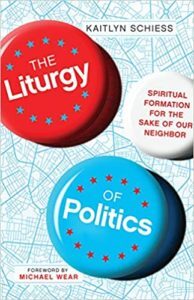
The Liturgy of Politics: Spiritual Formation for the Sake of Our Neighbor
A generation of young Christians are weary of the political legacy they've inherited and hungry for a better approach.
They're tired of seeing their faith tied to political battles they didn't start, and they're frustrated by the failures of leaders they thought they could trust. Kaitlyn Schiess grew up in this landscape, and understands it from the inside.
Spiritual formation, and particularly a focus on formative practices, are experiencing a renaissance in Christian thinking―but these ideas are not often applied to the political sphere. In The Liturgy of Politics, Schiess shows that the church's politics are shaped by its habits and practices even when it's unaware of them. Schiess insists that the way out of our political morass is first to recognize the formative power of the political forces all around us, and then to recover historic Christian practices that shape us according to the truth of the gospel.
They're tired of seeing their faith tied to political battles they didn't start, and they're frustrated by the failures of leaders they thought they could trust. Kaitlyn Schiess grew up in this landscape, and understands it from the inside.
Spiritual formation, and particularly a focus on formative practices, are experiencing a renaissance in Christian thinking―but these ideas are not often applied to the political sphere. In The Liturgy of Politics, Schiess shows that the church's politics are shaped by its habits and practices even when it's unaware of them. Schiess insists that the way out of our political morass is first to recognize the formative power of the political forces all around us, and then to recover historic Christian practices that shape us according to the truth of the gospel.
208 pages, Kindle Edition
Published September 8, 2020
Ratings & Reviews
Friends & Following
Create a free account to discover what your friends think of this book!
Community Reviews
Displaying 1 - 30 of 205 reviews

December 7, 2020
Summary: Drawing on the thought of James K. A. Smith, explores how the liturgies of our lives shape our political engagement and the gospel-shaped formative practices our Christian communities may embrace.
You don’t have to go any further than the recent elections to illustrate the messiness of our politics. Some of us are tempted to have nothing to do with it. Yet much of life is political–from the allocation of local school buildings to Supreme Court picks. Alternatively, we look for candidates who embrace “biblical” positions on what we consider vital issues and support them regardless of the character of the candidate, or stances on other issues that also have biblical implications. Furthermore, among certain Christian communities, one’s political affiliation is treated as an article of faith. I’ve seen Christians say “if you don’t support ______, you are not a Christian.”
Kaitlyn Schiess grew up in one such community and attended one of the colleges notable for its alignment with conservative politics, witnessing and experiencing everything I’ve described. She began groping for a different way to imagine political involvement as a Christian. As she read the work of James K. A. Smith she applied his thinking about how the “liturgies,” the thick formative practices of our lives, shape how we engage in our politics.
She begins by looking at the shaping liturgies of our political life, the liturgies of loyalty (“us” versus “them”), of fear (whether it is climate change or immigrants), and idolatry (political influence). These liturgies are informed by counterfeit forms of the gospel: prosperity, patriotism (American exceptionalism), security, and sadly, white supremacy. Schiess contends these are framed as compelling narratives, sometimes in our churches, more often in online media, talk radio and television.
As an alternative, Schiess begins by asking for what are we saved? Her answer is we are saved for the life of the world. The political realm is not the place where we realize the kingdom of God on earth but rather where we steward our calling to care for the creation and pursue the flourishing of other creatures created in God’s image. We our “border stalkers,” involved in our communities and formed in the polis of the church, shaped by the story of scripture heard in a community that transcends our cultural, racial, and national divisions. The church is the community that practices hospitality to the stranger, and in baptism and the Lord’s table transforms the stranger to “one of us.” We learn to shape the rhythms of our lives by the church calendar of feasting and fasting, of waiting and celebrating, of working and resting, and living out our faith in “ordinary time.” The disciplines of prayer and hospitality further shape us.
All this looks forward to the coming kingdom. Drawing on Augustine, Schiess explore life lived between the city of man and the city of God. We live in a space between lament and longing that she refers to as “confession.” We are aware of the limitations of sin as well as our longings for redemption. We live toward the vision of the new Jerusalem, bringing an anticipation and a witness of the future into the present. Yet how do we do so? Some is to listen to how communities on the margins read the story of kingdom come. As we live toward the kingdom, our resistance to earthly powers may put us there.
This is an important first work in political formation by Schiess. It addresses how we might form a Christian political imagination and engagement, something desperately needed in a Christian landscape dominated more by online and media pundits than formative Christian communities. I hope Schiess will keep writing on this subject, perhaps going deeper in describing how real communities are implementing redemptive political liturgies in their formative practices. We need narratives of Christian communities who are doing this and how this transforms their political engagements.
____________________________
Disclosure of Material Connection: I received a complimentary review copy of this book from the publisher in exchange for an honest review. The opinions I have expressed are my own.
You don’t have to go any further than the recent elections to illustrate the messiness of our politics. Some of us are tempted to have nothing to do with it. Yet much of life is political–from the allocation of local school buildings to Supreme Court picks. Alternatively, we look for candidates who embrace “biblical” positions on what we consider vital issues and support them regardless of the character of the candidate, or stances on other issues that also have biblical implications. Furthermore, among certain Christian communities, one’s political affiliation is treated as an article of faith. I’ve seen Christians say “if you don’t support ______, you are not a Christian.”
Kaitlyn Schiess grew up in one such community and attended one of the colleges notable for its alignment with conservative politics, witnessing and experiencing everything I’ve described. She began groping for a different way to imagine political involvement as a Christian. As she read the work of James K. A. Smith she applied his thinking about how the “liturgies,” the thick formative practices of our lives, shape how we engage in our politics.
She begins by looking at the shaping liturgies of our political life, the liturgies of loyalty (“us” versus “them”), of fear (whether it is climate change or immigrants), and idolatry (political influence). These liturgies are informed by counterfeit forms of the gospel: prosperity, patriotism (American exceptionalism), security, and sadly, white supremacy. Schiess contends these are framed as compelling narratives, sometimes in our churches, more often in online media, talk radio and television.
As an alternative, Schiess begins by asking for what are we saved? Her answer is we are saved for the life of the world. The political realm is not the place where we realize the kingdom of God on earth but rather where we steward our calling to care for the creation and pursue the flourishing of other creatures created in God’s image. We our “border stalkers,” involved in our communities and formed in the polis of the church, shaped by the story of scripture heard in a community that transcends our cultural, racial, and national divisions. The church is the community that practices hospitality to the stranger, and in baptism and the Lord’s table transforms the stranger to “one of us.” We learn to shape the rhythms of our lives by the church calendar of feasting and fasting, of waiting and celebrating, of working and resting, and living out our faith in “ordinary time.” The disciplines of prayer and hospitality further shape us.
All this looks forward to the coming kingdom. Drawing on Augustine, Schiess explore life lived between the city of man and the city of God. We live in a space between lament and longing that she refers to as “confession.” We are aware of the limitations of sin as well as our longings for redemption. We live toward the vision of the new Jerusalem, bringing an anticipation and a witness of the future into the present. Yet how do we do so? Some is to listen to how communities on the margins read the story of kingdom come. As we live toward the kingdom, our resistance to earthly powers may put us there.
This is an important first work in political formation by Schiess. It addresses how we might form a Christian political imagination and engagement, something desperately needed in a Christian landscape dominated more by online and media pundits than formative Christian communities. I hope Schiess will keep writing on this subject, perhaps going deeper in describing how real communities are implementing redemptive political liturgies in their formative practices. We need narratives of Christian communities who are doing this and how this transforms their political engagements.
____________________________
Disclosure of Material Connection: I received a complimentary review copy of this book from the publisher in exchange for an honest review. The opinions I have expressed are my own.
May 3, 2021
Recommended by Josh from Mercy Street
This book is just an attempt to attack conservative beliefs and say holding them is unbiblical and they should be replaced with liberal beliefs. The premise that Christians have worshiped politics but now should fix that by engaging in the right kind of politics is clunky. No to opposing abortion or strong national defense but yes to climate change regulations, racial power structures, and welcoming all immigrants without worrying about how to care for them. Schiess perpetuates the lie that only one side cares about the poor/indigent/immigrant. She ignores the many ways the very evangelical church-goers she criticizes serve these populations with compassion and sacrifice because they do see it as a role of the church and themselves as part of the solution - possibly because their political messaging is different from her preferences.
It has some good points about making your faith define your politics instead of your politics affecting your faith. But by attacking the Republican Party as the problem (not unquestioning allegiance to either party - which is a big problem), the author gives away her true purpose. She doesn’t want faith to guide politics, which would sometimes cross party lines; she wants Christians to come to her liberal point of view.
Ex: The Pledge of Allegiance is part of the patriotic gospel based on a wrong view of America as uniquely Christian that ignores American genocide of Native Americans and slavery.
Ex: Any unwillingness to live in impoverished neighborhoods is a sign of our security gospel also seen in national security concerns. The war on drugs prioritized security over building up communities. She recommends The New Jim Crow by Michelle Alexander. She wants neighborhood policing.
Ex: The gospel of white supremacy. Cites approvingly to Jemar Tisby. Our church traditions have been cultivated in white supremacy. Our discipleship towards racial fidelity starts when we grow up in segregated neighborhoods.
The last few chapters are much better, but I think it might be because she is just summarizing Surprised by Hope by N.T. Wright. She relies heavily on James K. A. Smith throughout. It might be better to read the primary sources than this book’s treatment of them.
This book is just an attempt to attack conservative beliefs and say holding them is unbiblical and they should be replaced with liberal beliefs. The premise that Christians have worshiped politics but now should fix that by engaging in the right kind of politics is clunky. No to opposing abortion or strong national defense but yes to climate change regulations, racial power structures, and welcoming all immigrants without worrying about how to care for them. Schiess perpetuates the lie that only one side cares about the poor/indigent/immigrant. She ignores the many ways the very evangelical church-goers she criticizes serve these populations with compassion and sacrifice because they do see it as a role of the church and themselves as part of the solution - possibly because their political messaging is different from her preferences.
It has some good points about making your faith define your politics instead of your politics affecting your faith. But by attacking the Republican Party as the problem (not unquestioning allegiance to either party - which is a big problem), the author gives away her true purpose. She doesn’t want faith to guide politics, which would sometimes cross party lines; she wants Christians to come to her liberal point of view.
Ex: The Pledge of Allegiance is part of the patriotic gospel based on a wrong view of America as uniquely Christian that ignores American genocide of Native Americans and slavery.
Ex: Any unwillingness to live in impoverished neighborhoods is a sign of our security gospel also seen in national security concerns. The war on drugs prioritized security over building up communities. She recommends The New Jim Crow by Michelle Alexander. She wants neighborhood policing.
Ex: The gospel of white supremacy. Cites approvingly to Jemar Tisby. Our church traditions have been cultivated in white supremacy. Our discipleship towards racial fidelity starts when we grow up in segregated neighborhoods.
The last few chapters are much better, but I think it might be because she is just summarizing Surprised by Hope by N.T. Wright. She relies heavily on James K. A. Smith throughout. It might be better to read the primary sources than this book’s treatment of them.

October 19, 2020
Kaitlyn has accomplished something quite significant in this readable yet scholarly work -- she has provided a compelling roadmap to political engagement for Christians. Personally, I was deeply challenged regarding the negative effects of my past attempts to "not be political" (confusing that with partisanship) for misplaced fear of being divisive, rather than using my energy and influence to love others.
I really hope I'm not scaring away potential readers by such statements, but rather that they prod you towards getting a copy into your hands as quickly as possible. While providing a much needed and probing critique for those having a similar background to her own (conservative American Evangelical), this book will be helpful for people of faith in other contexts toward establishing a way of living that is both spiritually AND politically shaped. This book will not attempt to tell you how to vote, but may challenge some idols around your existing party and national allegiances. Most importantly, it will expose how your loves, habits and disciplines continually orient you toward others in society, and ultimately how the present-and-coming kingdom of God reigns over all earthly kingdoms. A timely read for election years and every year in between!
I really hope I'm not scaring away potential readers by such statements, but rather that they prod you towards getting a copy into your hands as quickly as possible. While providing a much needed and probing critique for those having a similar background to her own (conservative American Evangelical), this book will be helpful for people of faith in other contexts toward establishing a way of living that is both spiritually AND politically shaped. This book will not attempt to tell you how to vote, but may challenge some idols around your existing party and national allegiances. Most importantly, it will expose how your loves, habits and disciplines continually orient you toward others in society, and ultimately how the present-and-coming kingdom of God reigns over all earthly kingdoms. A timely read for election years and every year in between!

Read
April 30, 2026I think I went into this with faulty expectations, anticipating that it would be an exploration of how Christians should seek to responsibly apply the principles of their faith to their political activity, rather than what it turned out to be: an argument for why they ought to do so. Accordingly, since I’m already on more or less the same page as Schiess on that topic, I don’t know that I was the target audience for this book.
As far as the actual argument(s) presented here, Schiess and I do differ on a few perspectives, but we share several more, and I am grateful for the work that she is doing right now.
As far as the actual argument(s) presented here, Schiess and I do differ on a few perspectives, but we share several more, and I am grateful for the work that she is doing right now.

December 18, 2024
I wish I read this book earlier. Schiess presents theology, both in thought and practice, in such an easy to understand way while holding the mainstream accountable to its misguided thoughts on the intersect of politics and theology. I’d recommend this book to anyone and everyone.

January 16, 2021
God bless Kaitlyn Schiess for writing this book--in all seriousness, I pray she reaps well from the labor she put into this book.
The Liturgy of Politics looks at two aspects of liturgy: how politics form people through liturgical practices (holidays, patriotic songs, gatherings, rituals, symbols) and how liturgical practices form Christians politically. Schiess builds on the work of James K. A. Smith, which made this book a must-read for me. Yet, Schiess attends Dallas Theological Seminary and works at a Bible church, so The Liturgy of Politics doesn't come from a high-church perspective. Instead, Schiess explores liturgy even in "non-liturgical" churches. I flashed back to a pastor I know who advocates "free styles of worship" while making minute-by-minute service plans, and has a giant digital clock at the back of the sanctuary.
Like many other Christians my age, especially those who were raised in American evangelicalism, I'm troubled by the political world my generation has entered. It's marked by extremism, hateful rhetoric, indecorous behavior, and sensationalism. Somehow the personal lives of politicians matter more in the news, and less at the polls, than more consequential stories. As a historian, I have the privilege of taking a longer view of things, but I also know that of the three American presidents who have been impeached, only one has been impeached twice, and the last time enemy combatants breached the US capitol was in the war of 1812 (you know, when Dolly Madison saved the portrait of George Washington before the White House burned--but the White House was left untouched on Epiphany 2021). Something is afoot, and Schiess writes to help us understand and do better.
Particularly, I appreciated her ideas about liturgy forming Christians politically, and the act of worship as a political statement. The sacraments are powerful statements that we, as Christians, are not at home in this world, having a higher citizenship. When these practices are reduced to individual, "spiritual" acts rather than communal, body-and-soul acts, they can be twisted to serve any old civil religion, but have particularly done so in America. Schiess references Christian slaveholding women in the South, who leveraged prayer to get more obedient slaves, pointing out how such practices can be twisted. When these acts are done properly--as acts of submission to God, rather than acts of personal power--they have political consequences. St Oscar Romero was assassinated while administering the Eucharist, because he dared stand against his corrupt government, performing the ultimate opposite of the "love feast" Paul critiqued in 1 Corinthians 11.
One issue with The Liturgy of Politics is that it raised a lot of ideas, but offered little practicalities. The chapter on spiritual disciplines and political formation poked the bear of the political consequences of fasting, feasting, Sabbath, hospitality, et c., but failed to provide a concrete way forward. Here, Schiess could have leaned on historic Christian witness (Dietrich Bonhoeffer, St Oscar Romero, and St Maximiliam Kolbe come to mind as 20th century examples), but instead she left me with a ton of questions and no method for seeking an answer. A non-historical route would be to look at ministries and movements that are doing this well. Hospitality, for example, could include the Bridge experience in Lancaster, PA, where you can sign up to attend or host a meal with refugee families. (The Amish came to America as religious refugees, and Lancaster, PA takes in 20 times more refugees per capita than anywhere else in the US.) However, I want to be clear that my complaint here is incompleteness. The book is headed in a great direction. Since the subtitle is "spiritual formation for the sake of our neighbor," it should have provided more real examples of how people today are practicing spiritual formation for their neighbors' sake.
Augustine, of course, got his own chapter, but for all the talk about the poor and marginalized, Schiess leaned mostly on white, male, Western theologians. In a few chapters she deals with the work of Jemar Tisby, Brian Bantum, and a few others, but noticeable in their absence are thinkers like James Cone. The past few centuries have provided us with a wealth of thinkers coming from marginalized groups, but Schiess doesn't lean on this tradition as heavily as she should. However, she's quick to acknowledge the church's complicity in corrupt political regimes, but she doesn't take the further step of conceding space to people from groups such regimes exploited.
Overall, I'm really excited to have found out about Schiess so early in her career, and look forward to following her career in Christian ministry and political thought. She was interviewed by Phil Vischer, the VeggieTales guy, on his podcast, so you know she's got Big Ideas.
The Liturgy of Politics looks at two aspects of liturgy: how politics form people through liturgical practices (holidays, patriotic songs, gatherings, rituals, symbols) and how liturgical practices form Christians politically. Schiess builds on the work of James K. A. Smith, which made this book a must-read for me. Yet, Schiess attends Dallas Theological Seminary and works at a Bible church, so The Liturgy of Politics doesn't come from a high-church perspective. Instead, Schiess explores liturgy even in "non-liturgical" churches. I flashed back to a pastor I know who advocates "free styles of worship" while making minute-by-minute service plans, and has a giant digital clock at the back of the sanctuary.
Like many other Christians my age, especially those who were raised in American evangelicalism, I'm troubled by the political world my generation has entered. It's marked by extremism, hateful rhetoric, indecorous behavior, and sensationalism. Somehow the personal lives of politicians matter more in the news, and less at the polls, than more consequential stories. As a historian, I have the privilege of taking a longer view of things, but I also know that of the three American presidents who have been impeached, only one has been impeached twice, and the last time enemy combatants breached the US capitol was in the war of 1812 (you know, when Dolly Madison saved the portrait of George Washington before the White House burned--but the White House was left untouched on Epiphany 2021). Something is afoot, and Schiess writes to help us understand and do better.
Particularly, I appreciated her ideas about liturgy forming Christians politically, and the act of worship as a political statement. The sacraments are powerful statements that we, as Christians, are not at home in this world, having a higher citizenship. When these practices are reduced to individual, "spiritual" acts rather than communal, body-and-soul acts, they can be twisted to serve any old civil religion, but have particularly done so in America. Schiess references Christian slaveholding women in the South, who leveraged prayer to get more obedient slaves, pointing out how such practices can be twisted. When these acts are done properly--as acts of submission to God, rather than acts of personal power--they have political consequences. St Oscar Romero was assassinated while administering the Eucharist, because he dared stand against his corrupt government, performing the ultimate opposite of the "love feast" Paul critiqued in 1 Corinthians 11.
One issue with The Liturgy of Politics is that it raised a lot of ideas, but offered little practicalities. The chapter on spiritual disciplines and political formation poked the bear of the political consequences of fasting, feasting, Sabbath, hospitality, et c., but failed to provide a concrete way forward. Here, Schiess could have leaned on historic Christian witness (Dietrich Bonhoeffer, St Oscar Romero, and St Maximiliam Kolbe come to mind as 20th century examples), but instead she left me with a ton of questions and no method for seeking an answer. A non-historical route would be to look at ministries and movements that are doing this well. Hospitality, for example, could include the Bridge experience in Lancaster, PA, where you can sign up to attend or host a meal with refugee families. (The Amish came to America as religious refugees, and Lancaster, PA takes in 20 times more refugees per capita than anywhere else in the US.) However, I want to be clear that my complaint here is incompleteness. The book is headed in a great direction. Since the subtitle is "spiritual formation for the sake of our neighbor," it should have provided more real examples of how people today are practicing spiritual formation for their neighbors' sake.
Augustine, of course, got his own chapter, but for all the talk about the poor and marginalized, Schiess leaned mostly on white, male, Western theologians. In a few chapters she deals with the work of Jemar Tisby, Brian Bantum, and a few others, but noticeable in their absence are thinkers like James Cone. The past few centuries have provided us with a wealth of thinkers coming from marginalized groups, but Schiess doesn't lean on this tradition as heavily as she should. However, she's quick to acknowledge the church's complicity in corrupt political regimes, but she doesn't take the further step of conceding space to people from groups such regimes exploited.
Overall, I'm really excited to have found out about Schiess so early in her career, and look forward to following her career in Christian ministry and political thought. She was interviewed by Phil Vischer, the VeggieTales guy, on his podcast, so you know she's got Big Ideas.

February 26, 2023
Kaitlyn Schiess is a great writer who is well researched. She draws upon a wealth of Christian thought and history to argue that Christians should view their lives as deeply political. While Schiess never fully defines what she means by political, she writes a section describing how all facets of our lives intersect with the government, their policies, and legislation (e.g., food we buy, cars we drive, who are neighbors are, educational access, refugee populations, etc.). It’s pretty easy to see how a God who champions the poor, refugee, widows, and marginalized would care about our politics.
Scheiss has some great chapters on how important the Church, the church calendar, and spiritual disciplines are in shaping our political lives. My favorite chapter though was her interaction with Augustine and his work City of God.
Here are some good quotes:
“Augustine does not determine the significance of an event based on its immediate success or failure but maintains that its significance is only found in eternity, and this same attitude is a helpful way for Christians to learn to think about politics.”
“When political work is reflecting or pointing to another, greater reality, success is not measured against an ideal - how close you can get earthly political institutions to look like the city of God - but by how faithfully the work points to a reality only God can create.”
“Political work can be right and good without being successful or permanent, so Christians are freed from attachment to any particular political structure and flexible enough to remain faithful in whatever context or circumstance they find themselves.”
There are a lot of great gems in here that I will leave for the rest of you to discover on your own. Highly engaging, thought provoking, and encouraging read for all who desire to engage politics with wisdom.
Scheiss has some great chapters on how important the Church, the church calendar, and spiritual disciplines are in shaping our political lives. My favorite chapter though was her interaction with Augustine and his work City of God.
Here are some good quotes:
“Augustine does not determine the significance of an event based on its immediate success or failure but maintains that its significance is only found in eternity, and this same attitude is a helpful way for Christians to learn to think about politics.”
“When political work is reflecting or pointing to another, greater reality, success is not measured against an ideal - how close you can get earthly political institutions to look like the city of God - but by how faithfully the work points to a reality only God can create.”
“Political work can be right and good without being successful or permanent, so Christians are freed from attachment to any particular political structure and flexible enough to remain faithful in whatever context or circumstance they find themselves.”
There are a lot of great gems in here that I will leave for the rest of you to discover on your own. Highly engaging, thought provoking, and encouraging read for all who desire to engage politics with wisdom.

July 28, 2026
A first book to be proud of. 3.5, rounded up. Schiess writes clearly and accessibly, as well as powerfully, but I found this book a little too James K.A. Smith-infused, as well as organizationally a little odd. I can forgive her perennial romanticization of High Church traditions and medieval Christianity, even when she glosses over some less admirable traits of each. I do wish chapters contained discussion questions for small group or church reflection and use, and there are a few chapters where her suggestions have some obvious limitations I wish had been parsed out more. That said, much of what she says would be of great benefit to the American church today, especially those who are waking up to the realities of the interweaving of cultural Christianity and partisan politics.

October 29, 2021
 Summary: To have our faith impact our politics and not the other way around, we have to be intentional about our spiritual formation concerning our politics.
My favorite definition of spiritual formation is from M. Robert Mulholland Jr, “Spiritual formation is a process of being formed in the image of Christ for the sake of others.” Kaitlyn Scheiss' subtitle orients this book to think about spiritual formation in politics similarly. One of the most common complaints about "Evangelical" is that it has become a political descriptor instead of a theological one. Scheiss is also concerned about how Evangelical as a term has become oriented around politics, but her approach in this book is contrary to some who are also concerned about the overtaking of the church with politics. She believes that our problem is not overthinking about politics in the church but too little about politics.
Cornel West's well-known quote, “Never forget that justice is what love looks like in public," is related to how Scheiss is connecting politics to Christianity,
"In one way or another, almost any political or moral issue is about the honor and protection of human beings. In reality, every piece of legislation is trying to legislate morality. Every policy issue is based on moral principles and has moral implications.”
There is much in The Liturgy of Politics that references other books I have read on spiritual formation. James KA Smith's work on cultural liturgies is hinted at in the title. Alexander Schmemann's "For the Life of the World," a phrase which has also been used widely by Miroslav Volf and others, is a chapter title. NT Wright's thinking on eschatology is also crucial in LItergy of Politics in orienting the reader away from inappropriate rejection of the importance of our work in this world. There is much here that I recognized from previous reading. Still, Kaitlyn Scheiss is rooting her work in political thought for the church in theological and spiritual formation thinking, not altering her theology based on her politics.
The two aspects of the book that I most appreciate are its orientation toward thinking about how spiritual practices, which we may do for other reasons, can, when we think of them in regard to politics, also help form us to love others well politically. And I appreciate how she has worked through our theological and historical blindspots within evangelicalism that has made us susceptible to the abuse of power and politics.
The Liturgy of Politics is not a book about specific political policy but about how to broadly think about and act on our politics in an appropriately Christian way. She does not assume that everyone will come to a single political position but that we can still trace through our political thinking even as we come to different policy positions while having similar theological convictions. This book would make an excellent small group discussion book and likely will be made better by discussion because we all have political and theological blindspots. Reading a book like this by ourselves can sometimes allow us to confirm our biases assuming that Scheiss would naturally agree with our preconceived positions. But the discussion with others can allow us to see other positions that we may not have readily seen for ourselves.
Kaitlyn Scheiss has been an acquaintance in my online world for a while, so I am not coming to her work without any background. She has been part of the private Facebook community that is associated with Christ and Pop Culture Magazine. And she is a great follow on Twitter. And now she is also a regular on the Holy Post podcast. She started a doctoral program at Duke Divinity School this fall, so I look forward to being impacted by her theological thinking for a long time.
The Liturgy of Politics: Spiritual Formation for the Sake of Our Neighbor by Kaitlyn Schiess Purchase Links: Paperback, Kindle Edition, Audible.com Audiobook

September 26, 2021
This is so good. I wrote all over the margins and underlined so much. So much to think about, and I’ll probably have to revisit, because I know there’s so much more to take away than I was able to this first read. Highly recommend!!

May 5, 2020
My review is from reading a pre-launch version of this book that I received from NetGalley.
The author, Kaitlyn Schiess, gives us a very good snapshot of how some evangelicals have, "solidified a particular approach to political engagement largely based in a partnership with the Republican party." Her argument is backed up by other authors who have written on this subject many of which I have read. As a result of this alliance she writes, "The idol demanded more and more of us until we abdicated our true identities for a false one."
Through her book Kaitlyn Schiess establishes the important connection between spiritual formation and politics. She does this by using James K. A. Smith's thinking regarding liturgies that form us. Until the invention of the printing press and the reduction in the cost of books much of the education of Church congregations occurred through the liturgies they developed.
She looks at ways liturgies can be used to inform us about our political lives in dangerous or biblically motivated ways. I personally was informed, moved, and validated in reading this book. The chapters that were particularly moving and informative to me were where the subject matter informed us about the need to be a part of a community of believers, the Church as a political training ground, spiritual disciplines as political formation, reading politics with Augustine, and eschatology and political formation. All of her chapters were well thought out and written, but these exposed areas in my life that are in need of growth.
I am 71 years old, attended Bible College and Seminary, and love to read, learn and grow and I am glad that she listened to her professor that told her if she waited until she was 100 percent ready, she would never write it, and to all the other people who have had an influence in her growth. To use a phrase from her Acknowledgments, "I am thankful beyond words" that she used her gifts to write this book. I will be reading it again and highly recommend it as addition to your library.
As a final note: This book has been provided courtesy of InterVarsity Press and NetGalley without requiring a positive review. All opinions offered above are mine unless otherwise stated or implied.
The author, Kaitlyn Schiess, gives us a very good snapshot of how some evangelicals have, "solidified a particular approach to political engagement largely based in a partnership with the Republican party." Her argument is backed up by other authors who have written on this subject many of which I have read. As a result of this alliance she writes, "The idol demanded more and more of us until we abdicated our true identities for a false one."
Through her book Kaitlyn Schiess establishes the important connection between spiritual formation and politics. She does this by using James K. A. Smith's thinking regarding liturgies that form us. Until the invention of the printing press and the reduction in the cost of books much of the education of Church congregations occurred through the liturgies they developed.
She looks at ways liturgies can be used to inform us about our political lives in dangerous or biblically motivated ways. I personally was informed, moved, and validated in reading this book. The chapters that were particularly moving and informative to me were where the subject matter informed us about the need to be a part of a community of believers, the Church as a political training ground, spiritual disciplines as political formation, reading politics with Augustine, and eschatology and political formation. All of her chapters were well thought out and written, but these exposed areas in my life that are in need of growth.
I am 71 years old, attended Bible College and Seminary, and love to read, learn and grow and I am glad that she listened to her professor that told her if she waited until she was 100 percent ready, she would never write it, and to all the other people who have had an influence in her growth. To use a phrase from her Acknowledgments, "I am thankful beyond words" that she used her gifts to write this book. I will be reading it again and highly recommend it as addition to your library.
As a final note: This book has been provided courtesy of InterVarsity Press and NetGalley without requiring a positive review. All opinions offered above are mine unless otherwise stated or implied.


June 25, 2020
I am so impressed by Schiess and how well this book speaks on such a difficult subject! The Liturgy of Politics provides a challenging and inspiring call to all Christians to engage our politics and faith together, not separately. Recognizing the political implications of Christianity and stewarding that influence towards justice for our neighbors is SO important.
The discussion on liturgy and how our loves are shaping us towards a certain vision of the good life borrows heavily from James K.A. Smith's You Are What You Love (which I think is fantastic!). Realizing that we are being formed by what we do repeatedly (liturgy), whether consciously or not, is a necessary step towards more thoughtful spiritual formation and political activism.
The chapter on the different gospels we believe that conflict with the Christian gospel (prosperity, patriotic, security, and supremacy) is fire. It is bold and unapologetic and so, so necessary. Schiess manages to write a book about the church and politics and faithful involvement in both while not elevating any one political party or stance. She is constantly reminding us of how our practices (and politics) are ultimately meant to bring justice, love our neighbor well, and create communities that offer glimpses into God's ultimate redemption and plan for flourishing.
This book has tons of biblical support, is well written, and is especially timely during an election year. I'd encourage every Christian to read this!
*I received an ARC from Netgalley in exchange for an honest review.*
The discussion on liturgy and how our loves are shaping us towards a certain vision of the good life borrows heavily from James K.A. Smith's You Are What You Love (which I think is fantastic!). Realizing that we are being formed by what we do repeatedly (liturgy), whether consciously or not, is a necessary step towards more thoughtful spiritual formation and political activism.
The chapter on the different gospels we believe that conflict with the Christian gospel (prosperity, patriotic, security, and supremacy) is fire. It is bold and unapologetic and so, so necessary. Schiess manages to write a book about the church and politics and faithful involvement in both while not elevating any one political party or stance. She is constantly reminding us of how our practices (and politics) are ultimately meant to bring justice, love our neighbor well, and create communities that offer glimpses into God's ultimate redemption and plan for flourishing.
This book has tons of biblical support, is well written, and is especially timely during an election year. I'd encourage every Christian to read this!
*I received an ARC from Netgalley in exchange for an honest review.*

November 2, 2020
I didn't like this as much as I wanted to, but I still thought it was worth a read, especially the first couple of chapters and the last couple. I think my main disappointment was that I wanted it to be more specific about one should actually do! But of course if she were to have said "vote this way" or "that way" I might have put the book down, because we have all seen the danger that is in that path. Since this election season is so very wearying to my spirit, I think reading even more about politics was emotionally hard, and that's another reason why I had trouble focusing on this book.
In any case, it's always refreshing to read from someone who has thought about these things so thoroughly, and isn't afraid to point out the ways both parties fall drastically short of the gospel. The author is probably also close-ish to my age and had a similar experience of disillusionment as she realized the ways that the "Christian right" had allowed itself to be sold out to the Republican Party. I learned some backstory there that was to me, and she expressed this feeling better than I have been able to, so I appreciated that as well.
In any case, it's always refreshing to read from someone who has thought about these things so thoroughly, and isn't afraid to point out the ways both parties fall drastically short of the gospel. The author is probably also close-ish to my age and had a similar experience of disillusionment as she realized the ways that the "Christian right" had allowed itself to be sold out to the Republican Party. I learned some backstory there that was to me, and she expressed this feeling better than I have been able to, so I appreciated that as well.

May 13, 2025
Overall, a terrific contribution to the church and definitely a work to consider for a small group curriculum or aid in preaching.
I had two main reactions when reading. First, sometimes there are some ubiquitous punchlines aimed at evangelicals that are over generalizing or taking the extreme. Funny enough, some of Scheiss’ final generalizations could be aimed at Christians on either side of the aisle, not just the Religious Right.
But much more frequently, a motivating “yes” to Scheiss’ core claims that the church is political as a body and in its practice. Our moral formation depends on our willingness to interrogate these practices and realize the influence the exceptional power myth in the US holds on us. Very thankful for this addition to the difficult conversations happening in the church.
I had two main reactions when reading. First, sometimes there are some ubiquitous punchlines aimed at evangelicals that are over generalizing or taking the extreme. Funny enough, some of Scheiss’ final generalizations could be aimed at Christians on either side of the aisle, not just the Religious Right.
But much more frequently, a motivating “yes” to Scheiss’ core claims that the church is political as a body and in its practice. Our moral formation depends on our willingness to interrogate these practices and realize the influence the exceptional power myth in the US holds on us. Very thankful for this addition to the difficult conversations happening in the church.
October 28, 2024
The ideas behind this book are excellent, as are the anecdotes that the author includes. She explores healthy ways that Christian communities can engage in politics for the good of our neighbors without getting sucked into the zero-sum, cutthroat world of partisanship.
The writing itself is sometimes the weakest portion of the book. Paragraphs can feel repetitive or stretched a little too thin. The book needed a few more editing passes to streamline some ideas and avoid being too academic at times, but I have no doubt the author has gotten stronger at this in the years since she wrote this book.
Maybe not the most memorable or dazzling prose, but a perfectly applicable book for Christians that is as valuable in 2024 as it was in 2020.
The writing itself is sometimes the weakest portion of the book. Paragraphs can feel repetitive or stretched a little too thin. The book needed a few more editing passes to streamline some ideas and avoid being too academic at times, but I have no doubt the author has gotten stronger at this in the years since she wrote this book.
Maybe not the most memorable or dazzling prose, but a perfectly applicable book for Christians that is as valuable in 2024 as it was in 2020.

August 28, 2024
TL;DR — you should care about politics because it affects so many people even if it’s not you. The church historically hasn’t cared but it should.

August 30, 2024
Some good bits in here, but it got distracted talking about Anglicanism a lot. Not saying there’s anything wrong with Anglicanism, but that’s a different book to write.
2.5/5.
2.5/5.

March 26, 2022
A great introduction to the concept of political theology! I think it is important to recognize that we are often shaped by our politic beliefs, and instead of shying away, we should direct it towards benefiting the kingdom of God and the world. We need to bring back a political theology that is not focused on hyper-individualism and moral panic, but one dedicated to serving the poor and the marginalized

April 13, 2024
What is forming us? "The line between our political beliefs, our moral beliefs, and our theological beliefs is blurry, if not entirely invented." To live in community is political. We are part of God's plan of redemption for all of creation. The stories we believe and everything we do forms how we treat our neighbors and the communities around us. I enjoyed how Kaitlyn really opened my eyes further to how general practices within the church (ex. church calendar, sacraments...) or spiritual disciplines (ex. hospitality, sabbath...) really should form all our social/political engagements. I easily see spiritual practices as personally transformative, which they are, but they are external in their outworking. God's plan is not simply for personal salvation; but bringing about the Kingdom of God! "We live in the tension between the future and the present, witnessing to the coming age while retaining a prophetic presence in the presence."
I love Kailyn on one of my favorite podcasts, The Holy Post. Wicked smart and I'm grateful I'll be able to listen and read her works, Lord willing, the rest of my life. Also, I think this book is a great compliment to John Mark Comer's Practice The Way.
I love Kailyn on one of my favorite podcasts, The Holy Post. Wicked smart and I'm grateful I'll be able to listen and read her works, Lord willing, the rest of my life. Also, I think this book is a great compliment to John Mark Comer's Practice The Way.

Did Not Finish
October 15, 2020From what I was hearing on social media, I expected this book to be a little more accessible and easy to understand, but like 75% of the things in this book were just flying over my head. Maybe I’ll come back to it one day, because I do think the content I understood was a good perspective on how our faith and politics mix.

August 18, 2021
Timely and important themes to wrestle with.

December 10, 2020
2.5 stars, rounded up.
Over the past few years, I have appreciated Kaitlyn Schiess's unique voice as a young, seminary-educated woman who is devoted to the essentials of an orthodox faith while also pushing back against false narratives that have hijacked evangelical American Christianity. When I learned that she was going to publish a book, I knew immediately that I wanted to read it, but unfortunately, I ended up having significant reservations about it. Based on the marketing that I had seen for this book, I expected it to speak to a popular audience, but it is very academic and dense, and even though Schiess clearly points out the ways that our spiritual beliefs shape our political engagement for good or for ill, I do not think that the people who most need to rethink their political approaches will be likely to read it.
She addresses issues related to how the American church has emphasized patriotism, prosperity, security, and supremacy at expense of the full gospel and appropriate social engagement, but she writes in a very academic tone and tends to assume that her audience already agrees with her. Many of her readers are other young evangelicals who are interested in liturgical practices and want to respond well to these recognized issues, but if she wanted to also persuade people who are unaware of the problems with these views, or who would argue in favor of them, she would have needed to approach this in a more nuanced way, instead of painting with a broad brush or assuming nefarious reasons behind someone's beliefs.
Argumentative Flaws
Schiess cites from a lot of insightful thinkers, and does a great job of summarizing James K. A. Smith's view of spiritual formation, which she builds on here with a political focus. However, she sometimes quotes someone else's opinion as evidence for one of her points without providing her own supporting information or explaining how this other writer came to their conclusion. In some cases, she never even specifies who originally made the assertion, and I would flip back to the notes section to find the source details. I found this frustrating, because even though the people who originally presented these statements may have done so with communicated logic and clarity, Schiess simply quotes their words as if they are authoritative, without producing any supporting evidence to confirm the claim.
Also, she occasionally uses straw man arguments to make her point. When she writes about the false gospel of prosperity, she points out that Christians often make moralistic judgments based on someone's financial status. I agree that Christians often wrongly judge poor people, assuming that they haven't worked hard enough or trusted God enough, but Schiess assumes that the reverse is also true, and that Christians see wealth as an inherent sign of God's blessing and someone's personal righteousness. Her critique is surely true in some cases, but this unfairly characterizes the church at large. Christians routinely talk about the problems with workaholic lifestyles, the dangers of dishonest gain, and the risk that people will prioritize earthly gain instead of their spiritual lives and relationships.
Unfair Characterization
Later, when she addresses the importance of reading Scripture within an interpretive community, she makes a more egregious straw man argument. She claims that when Christians believe that the only way to know God's word is through private study, then they are essentially saying that countless Christians throughout history did not know God's word, simply because they did not have their own Bibles. It is true that the early church experienced Paul's letters read aloud to the whole community, and this context does challenge people's blind spots, but because evangelicals have historically emphasized the importance of preaching and routinely gather for Bible studies, it is extreme and unfounded for her to claim that evangelicals think that personal study is the only way to know God's word.
Also, she never mentions what a revolutionary and extraordinary blessing it was for more recent historic Christians to be able to approach the Bible directly. In Martin Luther's era, only scholars who were trained in Latin had access to the Scriptures, and when priests read aloud from the Bible, their congregants could not understand the language. Luther undertook to translate the Bible into German so that the common people could encounter God's word directly and understand what it said, and Schiess's attempt to de-emphasize the cultural concept of the "quiet time" ends up neglecting the vital historical importance of people having direct access to the Bible.
More General Than Practical
This book is also very general and vague. Schiess is right to avoid being prescriptive, since people come from different backgrounds and contexts, but she writes constantly about social justice issues in the vaguest of terms, emphasizing privilege and marginalization in a rote and repetitive way and only rarely fleshing out what this looks like in people's real lives and church communities. This disappointed me, because at the beginning, she very clearly illustrates how financial and social privileges give people the luxury of choice and can help buffer them from public policies that they don't like. There, she is direct and practical, encouraging Christians to consider their neighbors' needs instead of only focusing on what affects them personally, but she tends to assume that privilege is the root of all problems, over-attributing church and cultural issues to homogeneity and a lack of active social involvement on behalf of the marginalized.
One particularly striking example of this appears when she writes about liturgical practices at church. She mentions that when one of her seminary classmates and his wife went to a more liturgically based church, even though he loved it, she "withered." Schiess explains that even when something seems great in theory, high ideals may not translate into reality, but she immediately jumps to attributing any weakness in a liturgical church to "characteristic malformations" in which the stated beliefs do not match up with a church's social justice. This evades the question of why different worship styles work better for some people than others, and seems to malign this particular church, assuming a particular deficiency that fits Schiess's narrative. If she knows more about this specific situation that would support her interpretation, she does not share any of those details.
Final Thoughts
One of my favorite chapters is the last one, in which Schiess writes about how Christians' views of eschatology shape their views of the earth and their mission. She clearly explains several complex themes from Revelation, and shows how a biblical view of the resurrection and the earth to come can turn people's views of the afterlife upside down, helping them engage with the world now instead of viewing heaven as an otherworldly escape from present problems. In my opinion, this chapter is much stronger than the others, and I wish that more of the book had shared its direct and practical emphasis, showing how a change of views should directly change our behavior.
I wanted to like this book, and I wish that I didn't have to write such a critical review, especially since I haven't earned a seminary degree or published a book at such a young age. Still, even though I appreciate Kaitlyn's personal maturity and contributions to the church, this book fell flat for me through its argumentative flaws, limited practical examples, and tendency to attribute every problem to privilege and marginalization without grounding these hot button concepts in clear, specific examples that set boundaries for the topic and show people how to address these issues. Other people may find this book helpful, especially if they haven't read or thought before about how spiritual practices form our lives and consciences, but this was a disappointment to me.
I received a free copy of this book from the publisher in exchange for an honest review.
Over the past few years, I have appreciated Kaitlyn Schiess's unique voice as a young, seminary-educated woman who is devoted to the essentials of an orthodox faith while also pushing back against false narratives that have hijacked evangelical American Christianity. When I learned that she was going to publish a book, I knew immediately that I wanted to read it, but unfortunately, I ended up having significant reservations about it. Based on the marketing that I had seen for this book, I expected it to speak to a popular audience, but it is very academic and dense, and even though Schiess clearly points out the ways that our spiritual beliefs shape our political engagement for good or for ill, I do not think that the people who most need to rethink their political approaches will be likely to read it.
She addresses issues related to how the American church has emphasized patriotism, prosperity, security, and supremacy at expense of the full gospel and appropriate social engagement, but she writes in a very academic tone and tends to assume that her audience already agrees with her. Many of her readers are other young evangelicals who are interested in liturgical practices and want to respond well to these recognized issues, but if she wanted to also persuade people who are unaware of the problems with these views, or who would argue in favor of them, she would have needed to approach this in a more nuanced way, instead of painting with a broad brush or assuming nefarious reasons behind someone's beliefs.
Argumentative Flaws
Schiess cites from a lot of insightful thinkers, and does a great job of summarizing James K. A. Smith's view of spiritual formation, which she builds on here with a political focus. However, she sometimes quotes someone else's opinion as evidence for one of her points without providing her own supporting information or explaining how this other writer came to their conclusion. In some cases, she never even specifies who originally made the assertion, and I would flip back to the notes section to find the source details. I found this frustrating, because even though the people who originally presented these statements may have done so with communicated logic and clarity, Schiess simply quotes their words as if they are authoritative, without producing any supporting evidence to confirm the claim.
Also, she occasionally uses straw man arguments to make her point. When she writes about the false gospel of prosperity, she points out that Christians often make moralistic judgments based on someone's financial status. I agree that Christians often wrongly judge poor people, assuming that they haven't worked hard enough or trusted God enough, but Schiess assumes that the reverse is also true, and that Christians see wealth as an inherent sign of God's blessing and someone's personal righteousness. Her critique is surely true in some cases, but this unfairly characterizes the church at large. Christians routinely talk about the problems with workaholic lifestyles, the dangers of dishonest gain, and the risk that people will prioritize earthly gain instead of their spiritual lives and relationships.
Unfair Characterization
Later, when she addresses the importance of reading Scripture within an interpretive community, she makes a more egregious straw man argument. She claims that when Christians believe that the only way to know God's word is through private study, then they are essentially saying that countless Christians throughout history did not know God's word, simply because they did not have their own Bibles. It is true that the early church experienced Paul's letters read aloud to the whole community, and this context does challenge people's blind spots, but because evangelicals have historically emphasized the importance of preaching and routinely gather for Bible studies, it is extreme and unfounded for her to claim that evangelicals think that personal study is the only way to know God's word.
Also, she never mentions what a revolutionary and extraordinary blessing it was for more recent historic Christians to be able to approach the Bible directly. In Martin Luther's era, only scholars who were trained in Latin had access to the Scriptures, and when priests read aloud from the Bible, their congregants could not understand the language. Luther undertook to translate the Bible into German so that the common people could encounter God's word directly and understand what it said, and Schiess's attempt to de-emphasize the cultural concept of the "quiet time" ends up neglecting the vital historical importance of people having direct access to the Bible.
More General Than Practical
This book is also very general and vague. Schiess is right to avoid being prescriptive, since people come from different backgrounds and contexts, but she writes constantly about social justice issues in the vaguest of terms, emphasizing privilege and marginalization in a rote and repetitive way and only rarely fleshing out what this looks like in people's real lives and church communities. This disappointed me, because at the beginning, she very clearly illustrates how financial and social privileges give people the luxury of choice and can help buffer them from public policies that they don't like. There, she is direct and practical, encouraging Christians to consider their neighbors' needs instead of only focusing on what affects them personally, but she tends to assume that privilege is the root of all problems, over-attributing church and cultural issues to homogeneity and a lack of active social involvement on behalf of the marginalized.
One particularly striking example of this appears when she writes about liturgical practices at church. She mentions that when one of her seminary classmates and his wife went to a more liturgically based church, even though he loved it, she "withered." Schiess explains that even when something seems great in theory, high ideals may not translate into reality, but she immediately jumps to attributing any weakness in a liturgical church to "characteristic malformations" in which the stated beliefs do not match up with a church's social justice. This evades the question of why different worship styles work better for some people than others, and seems to malign this particular church, assuming a particular deficiency that fits Schiess's narrative. If she knows more about this specific situation that would support her interpretation, she does not share any of those details.
Final Thoughts
One of my favorite chapters is the last one, in which Schiess writes about how Christians' views of eschatology shape their views of the earth and their mission. She clearly explains several complex themes from Revelation, and shows how a biblical view of the resurrection and the earth to come can turn people's views of the afterlife upside down, helping them engage with the world now instead of viewing heaven as an otherworldly escape from present problems. In my opinion, this chapter is much stronger than the others, and I wish that more of the book had shared its direct and practical emphasis, showing how a change of views should directly change our behavior.
I wanted to like this book, and I wish that I didn't have to write such a critical review, especially since I haven't earned a seminary degree or published a book at such a young age. Still, even though I appreciate Kaitlyn's personal maturity and contributions to the church, this book fell flat for me through its argumentative flaws, limited practical examples, and tendency to attribute every problem to privilege and marginalization without grounding these hot button concepts in clear, specific examples that set boundaries for the topic and show people how to address these issues. Other people may find this book helpful, especially if they haven't read or thought before about how spiritual practices form our lives and consciences, but this was a disappointment to me.
I received a free copy of this book from the publisher in exchange for an honest review.
October 5, 2020
This is the longest review I have written on Goodreads so far, largely because of the relevance of this book for the Evangelical Church, but more-specifically for me. Kaitlyn's theological, spiritual, and intellectual journey has mirrored my own. It was challenging and incredibly encouraging to hear her much more capable brain articulate the struggle I have found myself in.
To say that our faith is not political is to practice self-deception. I am not sure if that is a quote from the book or a message I internalized from the initial chapters. This book is surprisingly thoughtful and practical with immediate changes churches and individual Christians can make to align their political thought process more closely with the Kingdom of God (immediately: read the full chapter of 1 Corinthians 11 on communion and think about what Paul is addressing, read Augustine's City of God, engage in thoughtful conversation with Christians from other traditions).
This is a classic piece challenging the assumptions of the organization by an insider who is able to see the wider view of how and why we have arrived at our current position. The initial chapters will be a tough challenge for those with long-held conservative evangelical positions, but I appreciate that her critiques on "where we are" come fast and blunt upfront so that she can spend the bulk of her writing on "how we can move forward".
Kaitlyn Schiess focuses deeply on scripture and church tradition so that theology is forming political positions while highlighting when we are doing the opposite. This book is more theology and orthopathy than it is politics and I think that is the power she reveals. What are the priorities of the Kingdom of God? How did Jesus engage with political powers? What practices serve as safeguards to remind the church who she should be throughout millennia of political and power changes?
I do have two critiques: I believe at times she leans on several authors heavily where a diversity of influences would have further solidified her argument. I also felt at times that, coming from a conservative fundamentalist upbringing, there may be some "grass is greener" tendency in the adoption of high-church practices, such as preaching from a lectionary or the church calendar. Many church movements lost their way while practicing these methods as well and their may be some rose-colored glasses for the traditions we are not raised in when we see the sins of ours.
Having said that, finding the middle ground of church tradition in order to frame and balance our spiritual formation is close to my heart and I believe the (white) American Evangelical church needs books, sermons, and conversations like this to guide us back from where we currently find ourselves. God help us, and I believe Kaitlyn, has provided a way for us invite him to do that.
To say that our faith is not political is to practice self-deception. I am not sure if that is a quote from the book or a message I internalized from the initial chapters. This book is surprisingly thoughtful and practical with immediate changes churches and individual Christians can make to align their political thought process more closely with the Kingdom of God (immediately: read the full chapter of 1 Corinthians 11 on communion and think about what Paul is addressing, read Augustine's City of God, engage in thoughtful conversation with Christians from other traditions).
This is a classic piece challenging the assumptions of the organization by an insider who is able to see the wider view of how and why we have arrived at our current position. The initial chapters will be a tough challenge for those with long-held conservative evangelical positions, but I appreciate that her critiques on "where we are" come fast and blunt upfront so that she can spend the bulk of her writing on "how we can move forward".
Kaitlyn Schiess focuses deeply on scripture and church tradition so that theology is forming political positions while highlighting when we are doing the opposite. This book is more theology and orthopathy than it is politics and I think that is the power she reveals. What are the priorities of the Kingdom of God? How did Jesus engage with political powers? What practices serve as safeguards to remind the church who she should be throughout millennia of political and power changes?
I do have two critiques: I believe at times she leans on several authors heavily where a diversity of influences would have further solidified her argument. I also felt at times that, coming from a conservative fundamentalist upbringing, there may be some "grass is greener" tendency in the adoption of high-church practices, such as preaching from a lectionary or the church calendar. Many church movements lost their way while practicing these methods as well and their may be some rose-colored glasses for the traditions we are not raised in when we see the sins of ours.
Having said that, finding the middle ground of church tradition in order to frame and balance our spiritual formation is close to my heart and I believe the (white) American Evangelical church needs books, sermons, and conversations like this to guide us back from where we currently find ourselves. God help us, and I believe Kaitlyn, has provided a way for us invite him to do that.

January 30, 2025
3.5 stars
Astute examination of the role that politics should play in the life of the believer -from a fellow Liberty alum! Honestly at times it was a little too astute and I found myself kind of bored. But the parts I was tracking with her were, for the most part, well thought out and compelling. She argues that Christians are neither to throw in their lot completely with one political party nor to disengage from politics completely. Instead, we should carefully consider how our habits form us (thus the liturgy part) and let these habits inform how we engage politically with society. She draws heavily on James K.A. Smith in particular; in many ways this book is like his Cultural Liturgies series applied to politics.
Even though I think I align with her pretty closely on most things, I do feel like she didn't allow for much wiggle room on some of the issues she touched on. I do think that Christians can have legitimate differences in political philosophy that cause them to vote very differently from one another. That should be an alright thing as long as we agree on our ultimate aims. Christians who don't agree with her slightly-left-of-center-but-still-theologically-conservative (at least that's the vibe I got) views will probably find something to complain about, but I think this can still be a thought-provoking read no matter where you are on the political spectrum.
Astute examination of the role that politics should play in the life of the believer -from a fellow Liberty alum! Honestly at times it was a little too astute and I found myself kind of bored. But the parts I was tracking with her were, for the most part, well thought out and compelling. She argues that Christians are neither to throw in their lot completely with one political party nor to disengage from politics completely. Instead, we should carefully consider how our habits form us (thus the liturgy part) and let these habits inform how we engage politically with society. She draws heavily on James K.A. Smith in particular; in many ways this book is like his Cultural Liturgies series applied to politics.
Even though I think I align with her pretty closely on most things, I do feel like she didn't allow for much wiggle room on some of the issues she touched on. I do think that Christians can have legitimate differences in political philosophy that cause them to vote very differently from one another. That should be an alright thing as long as we agree on our ultimate aims. Christians who don't agree with her slightly-left-of-center-but-still-theologically-conservative (at least that's the vibe I got) views will probably find something to complain about, but I think this can still be a thought-provoking read no matter where you are on the political spectrum.

October 25, 2020
A well written and helpful read when thinking about politics as Christians. Here are some of my key takeaways:
1. Politics and government are not a product of sin, though they have been corrupted by sin. For this reason, it is right and good that we engage politically. We cannot expect political perfection this side of heaven, but we can strive to bring about a political and social reality that best reflects God’s kingdom. And even then, we can still point out where that best option falls short.
2. Our theology should inform our ideology, not vice versa. I wish she would’ve dug deeper into this point, but I understand a deep dive into how specific Scripture helps us make political and voting decisions was not the main point of the book. Maybe book #2? But either way, Scripture has a lot more to say about protecting the marginalized, the poor, the oppressed, the orphan, the widow, and the immigrant than about creating a strong economy.
3. Society forms us, and church forms us. Which of these should be most influential in forming our political views? She covers pretty extensively how the church should be talking about politics (in a nonpartisan way). This was probably the main point of the book overall, even if the one I could’ve done with less of.
1. Politics and government are not a product of sin, though they have been corrupted by sin. For this reason, it is right and good that we engage politically. We cannot expect political perfection this side of heaven, but we can strive to bring about a political and social reality that best reflects God’s kingdom. And even then, we can still point out where that best option falls short.
2. Our theology should inform our ideology, not vice versa. I wish she would’ve dug deeper into this point, but I understand a deep dive into how specific Scripture helps us make political and voting decisions was not the main point of the book. Maybe book #2? But either way, Scripture has a lot more to say about protecting the marginalized, the poor, the oppressed, the orphan, the widow, and the immigrant than about creating a strong economy.
3. Society forms us, and church forms us. Which of these should be most influential in forming our political views? She covers pretty extensively how the church should be talking about politics (in a nonpartisan way). This was probably the main point of the book overall, even if the one I could’ve done with less of.

September 30, 2020
“How can we have a pessimistic account of human political institutions — knowing that they are passing away and corrupted by sin — and yet still faithfully participate in politics?”
In this phenomenal book, Kaitlyn Schiess lays out the case for political engagement from Christians who have traditionally wanted to “keep politics out of it.” She makes a passionate, well-reasoned argument in favor of political involvement for the sake of our neighbors as embodiment of our faith. More than once I thought: ‘Rachel Held Evans would have loved this book.’
I learned so much from Schiess’s scholarship. A particularly interesting part is when she talks about how we are formed by the delivery (tone, emotion, etc.) of information along with the actual content and the implications that has in the midst our media-heavy, politically-charged culture. She argues that politics in the U.S. verge on a idolatry, stoked by fear and demands of loyalty.
Ultimately, Schiess says: “The line between our political beliefs, our moral beliefs, and our theological beliefs is blurry, if not entirely invented.” Her book outlines the ways that churches can be a training ground for responsible political engagement and that it is indeed our biblical duty to do so. With supporting research and clear-eyed analysis, Schiess covers the ways churches need to reconsider their programming in order to be faithful political participants and similarly how spiritual disciples can be used both positively and negatively for this formation. In a very powerful closing she says, “A theology born out of resistance to political authorities from an oppressed position cannot result in private piety and political quietism unless it is read and practiced by the privileged.”
In this phenomenal book, Kaitlyn Schiess lays out the case for political engagement from Christians who have traditionally wanted to “keep politics out of it.” She makes a passionate, well-reasoned argument in favor of political involvement for the sake of our neighbors as embodiment of our faith. More than once I thought: ‘Rachel Held Evans would have loved this book.’
I learned so much from Schiess’s scholarship. A particularly interesting part is when she talks about how we are formed by the delivery (tone, emotion, etc.) of information along with the actual content and the implications that has in the midst our media-heavy, politically-charged culture. She argues that politics in the U.S. verge on a idolatry, stoked by fear and demands of loyalty.
Ultimately, Schiess says: “The line between our political beliefs, our moral beliefs, and our theological beliefs is blurry, if not entirely invented.” Her book outlines the ways that churches can be a training ground for responsible political engagement and that it is indeed our biblical duty to do so. With supporting research and clear-eyed analysis, Schiess covers the ways churches need to reconsider their programming in order to be faithful political participants and similarly how spiritual disciples can be used both positively and negatively for this formation. In a very powerful closing she says, “A theology born out of resistance to political authorities from an oppressed position cannot result in private piety and political quietism unless it is read and practiced by the privileged.”

May 8, 2021
The providence of this book being published in 2020 is pronounced, with the onset of the COVID-19 pandemic, the murders of Black Americans and surrounding social unrest, the controversy about the nature of Evangelicalism, the swirl of the culture wars, and Donald Trump's final year as president (although he continues to stiffly resist that reality). The value of this book will only grow going forward as ongoing political and cultural polarization continues barreling ahead. The final two chapters on Augustine's Confessions and City of God and eschatology are an apt conclusion to the book and worth the price of admission. This is a book for reflection and hopefully rereading, so don't be dissuaded if it isn't a real page-turner for you.
August 28, 2022
I’m so grateful for this clear-eyed, prophetic call to the church to “spiritual formation for the sake of our neighbor.” Schiess challenges the often-individualized evangelical understanding of spiritual formation by consistently pointing us back to Scripture and the tradition’s corporate call. Not only does the modern landscape of politics form our hearts toward or away from our neighbors, but the liturgies of Christian worship form us in particular ways to engage politically for the sake of others.
Her prose is PACKED— each sentence and paragraph a feast of insight; each chapter like a prospectus for a book I want to read. I can’t wait to read more from Kaitlyn Schiess!
Her prose is PACKED— each sentence and paragraph a feast of insight; each chapter like a prospectus for a book I want to read. I can’t wait to read more from Kaitlyn Schiess!
December 6, 2022
Clear, concise, and convicting...a great first book on a topic I never dreamed I would pick up. I was introduced to Kaityln Schiess via the Holy Post podcast and have appreciated her articulate and scripture-based comments for quite awhile. Her book does a great job of helping Christians think about how politics relates (or should relate) to our personal lives as well as how we need to consider those in our communities when casting our ballots. Although Schiess is a scholar the book is accessible for those us with zero theological training and I found much to ponder. I look forward to rereading this again before our next voting cycle with a highlighter in hand.
Displaying 1 - 30 of 205 reviews