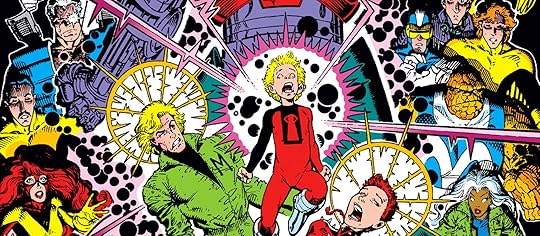
The sequel to one of the most acclaimed X-Men stories of all time... DAYS OF FUTURE PAST.
A man from the future, desperately searching for the safety of his past, returns to those he once loved to save them from a future of tyranny and death. But in doing so he may have brought with him the greatest threat of all... the mutant killer Ahab.
Reprints/Collects: Fantastic Four (1961) Annual 23 The New Mutants (1983) Annual 06 Uncanny X-Men (1963) Annual 14 X-Factor (1986) Annual 05
Chris Claremont is a writer of American comic books, best known for his 16-year (1975-1991) stint on Uncanny X-Men, during which the series became one of the comic book industry's most successful properties.
Claremont has written many stories for other publishers including the Star Trek Debt of Honor graphic novel, his creator-owned Sovereign Seven for DC Comics and Aliens vs Predator for Dark Horse Comics. He also wrote a few issues of the series WildC.A.T.s (volume 1, issues #10-13) at Image Comics, which introduced his creator-owned character, Huntsman.
Outside of comics, Claremont co-wrote the Chronicles of the Shadow War trilogy, Shadow Moon (1995), Shadow Dawn (1996), and Shadow Star (1999), with George Lucas. This trilogy continues the story of Elora Danan from the movie Willow. In the 1980s, he also wrote a science fiction trilogy about female starship pilot Nicole Shea, consisting of First Flight (1987), Grounded! (1991), and Sundowner (1994). Claremont was also a contributor to the Wild Cards anthology series.
Days of Future Present was a story that ran through the FF and X-annuals in 1990. I really like it. Future Franklin Richards from Days of Future Past returns to current time. He basically has the powers of a god and starts changing things to be like they were in his time line. Ahab, the leader of the Hounds, follows him back to the past and tries to kill all the mutants. Ahab's a cool character who makes his first appearance here. It's hinted at that he could be a future Cable. This is also where Cyclops and Jean Grey find out they are Rachel Summers parents. Art Adams draws the last annual and it looks absolutely great. I love his work from the 80's.
The sequel to X-Men: Days of Future Past sees future Franklin comes to the present subdued by Ahab, Sentinels and Hounds and sought by the Phoenix, Fantastic Four, New Mutants, X-Men and X-Factor. Storm and Gambit back! Rachel/Phoenix come clean! Extent of Franklin power revealed. Ahab's debut! Cable meets X-Men and FF! Genius! And the 'Tribute' back up stories are momentous, especially the one where a Holocaust survivor chats with Jean Grey about the identities we have to assume through our lives. 7 out of 12.
I was really hoping to like this one, because I loved Days of Future Past. Unfortunately, it was actually somewhat of a chore to get through the story. Not only was it somewhat of a boring (and slightly confusing) story line in general, it was pretty difficult sifting through all of the repetitive dialogue. This is really only something for the X-Men (and maybe FF) completest, not really for someone who's just looking to read the best stories.
Slight spoiler below.
Gave it 3/5 stars because the idea was interesting, although the story wasn't told well. Also the parts with Jean/Rachel were interesting.
Muy pocas historias de los hombres X pueden superar en mi gusto personal a X-Cutioner's song... Esta es definitivamente una de ellas!!! Brutal... Nada más de recordar el título del capítulo uno me emociono: Cuándo Franklin vuelve a casa...
Cómo mejorar una de las mejores historias de los hombres X?! Por supuesto... agregando a Los Cuatro Fantásticos...!!!
Viajes en el tiempo, realidades distópicas alternativas... poderes mutantes extremos... Alteración de la realidad... muerte y sacrificio.
This crossover is full of great ideas. We get a return to the Day of Future Past, but with things changed to reflect changes in the timeline. We get new characters like Ahab (who is hinted as a future Cable) and a totally new New Mutants. Meanwhile, there's some critical revelations, when Scott and Jean learn they're Rachel's parents, and X-Factor and the X-Men all meet. But sadly, much of the potential is wasted. The first two issues focus on the conflict when Franklin creates dream images, and the last two have random fights with Ahab, who just escapes anyway. The result is a lot of wasted potential.
Two or three awesome parts in a story told over the course of four annuals is not a win.
The first two issues (Fantastic Four and The New Mutants) straight-up suck.
The X-Factor and X-Men issues on the back side are ok with a couple great parts.
They could condense this story into the Rachel/Phoenix/Jean stuff... and that would be cool. That’s really the only interesting thing happening here.
The art is inconsistent. The only stuff that really blew me away was the Art Adams stuff in X-Men Annual. Everything else was somewhere between OK and “did this take you less than a minute?”
I recommend reading the wikipedia summary and skipping this all together.
Presented as a- not so- direct sequel to the 1980 Chris Claremont, and John Byrne classic, ‘Days of Future Present’ is a collection of four different “annuals”, in summary, ‘Fantastic Four’, ‘The New Mutants’, ‘X-Factor’, and ‘X-Men’, ultimately being told almost on par with each other, and gathering the talents of writers Walter Simonson, Louise Simonson, and Chris Claremont himself, with the likes of artists such as Jackson Guice, Terry Shoemaker, Jon Bogdanove, and Art Adams to go along the strongly ambitious project. Setting it as a sequel to ‘Days of Future Past’ allows for interesting insight of what plot these writers might come up with, and centering it around Franklin Richards does raise a fair number of questions and promise. As it was shown in the original ‘Days…’, Franklin got killed right after Kitty Pryde was sent back to the past in order to prevent the Sentinels to take over. The moment he appears out of nowhere, in present day, creates an intriguing premise to how he managed to travel back in time, and to be fair, the answer to that question, while connected to his mutant abilities, is convoluted but also quite engaging and unique, and it of course came from the annual written by Claremont. The story basically puts the character of Franklin Richards as an adult, encountering several groups of characters, being the 'Fantastic Four' the very first ones after noticing their headquarters are completely changed to how the Baxter Building used to look, which ends on the sudden appearance of another group of 'F4' doppelgangers. The same happens to 'The New Mutants', who are at this point lead by Cable, and are settle on Xavier's School for the Gifted, after the disappearance of the 'X-Men', Franklin will also reveal to them, bringing with him former and newer members of the team that'll cause a huge discrepancy for the current line-up of characters. At the same time, an antagonistic figure, known simply as 'Ahab, the Lord of the Hounds', is hunting Franklin, and is also related in some way to the possible future where the Sentinels took over North America. Now, the 'F4' alongside 'The New Mutants', 'Forge', 'Banshee', and the 'X-Factor' are looking for 'Franklin' in order to find out what his purpose in the present day is, how he got there, and most importantly, why is this 'Ahab' trying to hunt him down. In general this was a heavily entertaining reading. I was surprised at how revolting the story got, specially in 'The New Mutants', and 'X-Factor' annuals, but fortunately, Claremont's 'X-Men' one got the obvious task of solving the puzzle with huge chunks of explanation, mostly from the perspective of Franklin, and even Rachel Summers, who in the original 'Days...' is the one who sent Kitty's mind to the past, so her role in the whole deal is quite important, and I was glad that, regarding her relationship with Franklin, it came full circle, despite how shocking and tragic it felt once we've realize the truth about Franklin's presence in the present day. What I never really understood is how 'Ahab' fit in the whole deal; it is never explained whether or not he developed the new model of Sentinels, or if he's just another alternative villain, who happens to crossover in the future from which Franklin and Rachel came from. It's only explained that he's hunting mutants just for the sake of it, and that he is kind of inhabit both, present and future because of some Tesseract-technolgy that, again, is never fully fleshed out. I don't really mind ambiguity, and it seems that this villain is connected to Cable, in a way, but it makes it even more confusing, after the realization that, this is not the future Cable came from, but the one where 'Apocalypse' ruled the Earth. Aside from that, both, Franklin, and Rachel–who also posses the Phoenix Force– felt tragic, lost, and essential for this story to work, especially when both character's parents are involved; Franklin has this troublesome idea that his powers are the ones causing all the damage in the future, and Rachel is confused and misguided after realizing she's not supposed to have been born when Cyclops and Jean Grey reveal their first-born, Christopher, to be the child they had in that timeline, basically turning her in a strange sort of Paradox for both former 'X-Men'. It's all quite interesting, but it wasn't until the 'X-Men' annual when things really got into shape, although, Claremont's contribution to these four chapters felt more like an aftermath of the real battle, which happened in 'X-Factor'. Claremont's chapter is the one with the explanation, the one with the twists and turns, and the one setting up things for further stories involving this particular arc in the 'X-Men' franchise, just adding more characters to the mix, and the integration of the 'F4' since the first chapter. Besides, out of all the artists involved, Arthur Adams was the better addition; his style felt more detailed and elegant, unlike the others, which felt almost as if they were trying to mimick each other. Adams eventually will develop his pencils further on, so at certain frames his designs felt similar to Todd McFarlane's, but never reaching that level of exaggeration regarding posses, or proportions. An interesting way of viewing this could be as a contrast regarding the sudden evolution of art-style from the late 80s, to the arrival of the 90s extravagant era, mostly since the first three chapters maintain that retro-simple vibe to them, while 4 is where the real eye-candy explodes. Not to diminish the job of Guice, Shoemaker, or Bogdanove, they are good for the era, but the difference between them and Adams is quite astounding. I wouldn't say this is the best possible sequel to the original 'Days...', as a matter of fact, it feels more like a throwback to the main idea, in the likes of a 10-year anniversary it serves it's purpose of reminding us this future is still in motion, and most of the ideas are presented in such a complex matter, that it's almost worth a second reading immediately after the last chapter is checked. However, one can tell how many different writers there were, and the villain was simply a serviceable element, since it is never clarified who or what he is; is he a futuristic versión of Sebastian Shaw? Is he Robert Kelly, or Bolivar Trask but, like, with powers? I mean all these ideas were teased in the cliffhanger-ending of the original comic book, but again, they also imply he has something to do with Cable, and none of those questions are answered, which it's problematic since we're talking about a self-conclusive story told within annuals. Ultimately, hardcore fans of 'Days of Future Past' will feel half disappointed, half pleased, since this is mostly set in the present day (1990 to be precise), and there's absolute no insight or peak at the future scenario, but it does came full closure for the characters of Franklin Richards, and Rachel Summers. It is an interesting and surprisingly heavy read, but it does bring us back to this side of the Marvel Universe that is still hunting the possibilities for these character's future, and while not as iconic or as solid as it's predecessor, it surely rises the bar for further and more dangerous things to come.
It is funny how much the context of what you’ve been reading around a book can change your experience. I one-starred this previously, but I thoroughly enjoyed this four-part story that ran across the annuals of four different ongoing titles this read.
The previous read was in the midst of a greater massive X-Men read-through and this time was just a hunger for some X-Men so I jumped into this particular book.
As the title alludes, this story is a sequel of sorts to the seminal Days of Future Past: it runs through the 1990 annuals of Fantastic Four, New Mutants, X-Factor, and X-Men, but also borrows Rachel over from Excalibur.
This has the first appearance of Ahab and actually the first appearance of Gambit though it takes place after his first appearance in Uncanny—that must have been confusing back in the day. Ahab continues the line of future enemies sent back to disrupt the X-Men of the past, a la Nimrod. Given his history with Rachel, he finds immediate purchase in significance and honestly has been under-used since (which may have protected him from exhaustion).
If your are, like me, a fan of Rachel-Phoenix, this is essential reading to understand her time as a hound.
I completely forgot about the allusions to Cable’s identity here. At this stage, Cable was still very mysterious but just as mysterious to the writers as the readers. They dabble around in who he is and even what he does for a long time. There isn’t even a whisper of a chance that they thought he’d be who he turns out to be (who ironically is in this story as well).
Rachel also meets Jean for the first time and Jean and Scott find out her parentage, dealing with the ramifications.
All in all a fun little ditty. But wait till I read it next time: it might change drastically again.
The follow up to the seminal "Days of Future Past" leaves something to be desired. Between the plot that is hard to decipher and the extended dialog of early 90's comics, this sequel unfortunately feels like chore to read.
I think the biggest problem with the story is that it takes 3 out of the 4 issues to really figure out what is going on. I understand having a mystery as the main catalyst of a story, however when the story is so out there it is good to ground us a bit by at least giving us a foundation to work off of. This starts off with weirdness and keeps that weirdness amped up to a 9 or 10 with Franklin Richards showing up and conjuring things and people out of thin air, then leaving - with no apparent explanation. By the time the plot is properly locked in, we are at the 4th issue rushing towards the end.
From what I can tell, adult Franklin is from a future where mutants are almost exterminated and a villain named Ahab turns people and mutants into hounds who hunt other mutants. Franklin then goes into the past to meander about until he and Rachel Summer's come together to finally get rid of Ahab. I think that is the gist of these 4 oversized issues, and the fact that I still cant put it succinctly into words shows you how garbled the story is.
There is some good stuff regarding Cyclops, Jean, and Rachel, as well as some cool moments of the X-Men and the Fantastic Four interacting. I did enjoy the shared Marvel Universe aspect of the story.
I would recommend this to X-Men completionists only, as even fans of Marvel who are used to convoluted storylines still are left bewildered about portions of the plot.
Bueno, este tomo me gustó porque... Porque en ese entonces me gustaba todo lo que llegaba a mis manos que tuviera que ver con los X-Men, supongo. Recuerdo muy poco la trama pero sí algunas escenas sueltas, como cuando la Cosa Mujer se asombraba por que el bebé de Scott no le tuviera miedo, o que había un malo de nombre Ajab. Y no mucho más, la verdad. Supongo que en alguna futura relectura, rerreseñaré y toda la bola.
A sequel of sorts to the visionary X-Men: Days of Future Past storyline, Days of Future Present was a crossover that ran through the X-Titles and Fantastic Four Annuals in the summer of 1990. The story kicks off when an adult Franklin Richards (son of the Fantastic Four's Reed and Sue Richards) comes back in time to when he was a small child (the present day) to try and prevent some of the horrible events described in Days of Future Past from coming to pass. His misguided attempts bring him into conflict with the Fantastic Four, New Mutants, X-Factor and the X-Men, and in the process we get a glimpse of the future's New Mutants team (led by a much older Banshee) as well as the unique relationship between Franklin and Rachel Summers (who at the time was the incarnation of the Phoenix). As if that weren't enough, the mutant-hunting Master of the Hounds Ahab is hot on Franklin's trail.
The writing chores on this crossover are shared between longtime X-Men scribe (and Days of Future Past author) Chris Claremont and Walter and Louise Simonson. For the most part, they carry off this convoluted time travel story without a hitch. All three tend to write dialogue that no real person would ever say, and give each character paragraph-length thought balloons, but hey, that was what the X-titles in the 80's were all about.
The art in this volume is hit and miss. The Fantastic Four Annual was drawn by Jackson Guice, whose run on Iron Man was one of my favorites. His work here is solid as always. The New Mutants Annual (or at least the majority of it) was drawn by Terry Shoemaker, who is always consistent and never exciting. The X-Factor chapter is the collection's low point. Jon Bodganove was one of the worst artists to work on that title, and his pencils are just awful to look at. Fortunately the book's closing chapter - the Uncanny X-Men Annual - was illustrated by none other than Art Adams, one of the best X-Men artists of the 80's. His unique style and attention to detail are impeccable, and send the story out with a bang.
While not as compelling as the original Days of Future Past saga, Days of Future Present is an entertaining story with plenty of interesting twists that serious X-Men fans should enjoy. I wouldn't call it essential by any means, but it definitely has its moments.
X-Men: Days of Future Present (1989) Writer – Walter Simonson, Chris Claremont, Louise Simonson, Jackson Butch Guice Series - Fantastic Four (1961) Annual 23, The New Mutants (1983) Annual 06, Uncanny X-Men (1963) Annual 14, X-Factor (1986) Annual 05
Synopsis: Franklin Richards from the apocalyptic future as depicted in Days of Future Past, appears in the present confused and in a desperate search for peace.
Future Present is a sequel to the hit story arc Future Past, but doesn’t really connect much with the characters or the exact events of the first story. It is more of a spinoff and focusses on one of the most powerful characters of Marvel, Franklin Richards. Unlike the original story arc, there is very less to do with changing the future and more about trying to understand what is going on. This goes on for a very long time with the various factions of X-Men trying to grasp what is up with Franklin. This is easily resolved with Storm in issue #4, which just seems like a convenient wrap up. The romantic arc between Franklin and Rachel is a highlight, but it takes place here and there. Ahab as the main antagonist is good and can stand up against the various heroes and inflicts some major damage. The climatic battle felt unfulfilling and the ending is another vague end to the story arc. Franklin as the time traveller comes across as a very annoying character and the way he just comes and goes is irritating. The way he creates dream-selfves is a confusing aspect which would throw most readers off. The best issue in terms of artwork would be the final issue #4, the titular chapter. The characters look way better and standout in comparison to the first three.
Growing up, this was my least favorite comic series of all-time. I was new to comics, and loved the X-Men, thanks to the X-Men vs Fantastic Four, and liked the Fantastic Four, thanks to the weird version of the Fantastic Four with Wolverine and Ghost Rider. This book made no sense to me.
While this is definitely nigh-impenetrable if you haven't read the X-Men, X-Factor, New Mutants, and Fantastic Four that feed into this event, the whole thing wasn't helped by the fact that the comics came out out-of-order and were therefore improperly labeled, so that you were intended to read this as Part One, Part Three, Part Two, and Part Four. While I feel that all the writers on these titles were past their prime (on these titles, specifically, they should have all moved on to other titles so they could freshen up their writing, and other writers could freshen up the title), the main problem was, as often is the case: Marvel Editorial.
Reading it over thirty years later, it's ok. Not great. It's annoying at times but it's never incoherent, and it does make sense with the series that surround it. The main villain sucks, and the overall conceit is pretty unimaginative given that it's about time traveling reality benders. But I went into this thinking I was going to hate it and ended up thinking it was just mediocre.
I still can't recommend this to anyone who hasn't read pretty much all the 80s comics that led up to it. But if you're down for some convoluted X-madness, this isn't even close to the worst crossover of the 90s.
A nostalgic read for me. This mini-series sees an adult Franklin Richards comes back from a future where he's been murdered by Sentinels to try to change the past. He's a little loopy for the experience, and he doesn't seem to quite know what he wants as a result, making him extremely dangerous given his powers to rewrite reality. The Fantastic Four, X-Men, X-Factor and X-Force all get into the mix, with a featured role for Rachel Summers and a debut for evil "Master of the Hounds" Ahab.
Flowing across the annuals for four different series, the story is a bit disjointed; some issues are better than others. As callbacks to "Days of Future Past" go, though, this is one of the more successful ones, with some strong notes for Rachel Summers and a moving ending.
A really good idea with a bit of an inconsistent execution. That could describe most Marvel crossover events. This one isn’t unique.
This tells the story of the ghost-dream self of Franklin Richard’s come to the present after his death in the world of Days of Future Past alternative future. It explores how he attempts to hold on to innocence and love in the face of unspeakable tragedy. There is something really rich here.
But it gets muddled with too many writers on the New Mutants book and some crappy art all the way until you get to the closing X-Men title where Chris Claremont and Art Adams put together a strong finale.
This entire review has been hidden because of spoilers.
A fun, but silly and extremely rushed annual crossover event that feels like a decade of Uncanny X-Men continuity loose ends being squeezed through a French press. After choking down some of Rob Liefeld's worst scribbles we're treated to fabulous Art Adams artwork that feels like getting off with time served
3.5 Rounded down A hodgepodge of characters and a convoluted storyline make up the collection of annuals. All said, a decent read. The Gambit appearance was lackluster. Overall, the artwork was good, especially Art Adams.
Fantastic 4 episode - good, confusing, the inks look very dated. The other episodes were quite underwhelming if I'm honest. The inks and colourings were very unappealing by my modern eyes. 1990s X men wasn't as cool as I remembered it. But maybe I was spoiled growing up with stories like Age of Apocalypse and Onslaught saga. It was nice having a crossover of FF, X Men, X Force and the New mutants. No bishop though :(
Wirr erzählt, zum größeren Teil eine Artwork, die mich überhaupt nicht anspricht, besonders NEW MUTANTS ist außergewöhnlich schlecht. Aber auch das X-Men annual ist mt den verkehrten und verzerrten Körperrelationen ein echter Weggucker.
It takes a lot to make me dislike a story about Rachel Grey. It's not offensive just incoherent, she really deserved better. Some of the shorter stories contained in the annuals were pretty well done though, no idea if they're in the print version.
Not at all good. It’s the kind of excessively complex, pseudoscience-filled, shallow story that gave 90s comics a bad name. To think that this ran at the same time as Sandman... the art is lovely, I just wish the story was too.
Not the easiest X-Men to read, especially as it was mostly about the Fantastic Four (not a team that I know very well) and it seemed to presume a lot of knowledge of other titles too
La secuela de Días de Futuro Pasado no es tan redonda: se nota que han participado varios equipos creativos. Aún así, es imprescindible para conocer a fondo la historia de los mutantes.