The present translation of Petrarch completes the Illustrated Library series of the Italian Poets emphatically distinguished as "I Quattro Poeti Italiani." It is rather a singular fact that, while the other three Poets of this world-famed series--Dante, Ariosto, and Tasso--have each found several translators, no complete version of the fourth, and in Italy the most popular, has hitherto been presented to the English reader. This lacune becomes the more remarkable when we consider the great influence which Petrarch has undoubtedly exercised on our poetry from the time of Chaucer downwards.
Famous Italian poet, scholar, and humanist Francesco Petrarca, known in English as Petrarch, collected love lyrics in Canzoniere.
People often call Petrarch the earliest Renaissance "father of humanism". Based on Petrarch's works, and to a lesser extent those of Dante Alighieri and Giovanni Boccaccio, Pietro Bembo in the 16th century created the model for the modern Italian language, which the Accademia della Crusca later endorsed. People credit Petrarch with developing the sonnet. They admired and imitated his sonnets, a model for lyrical poems throughout Europe during the Renaissance. Petrarch called the Middle Ages the Dark Ages.
This is the sequence Petrarch gave to his book The Great Triumphs:
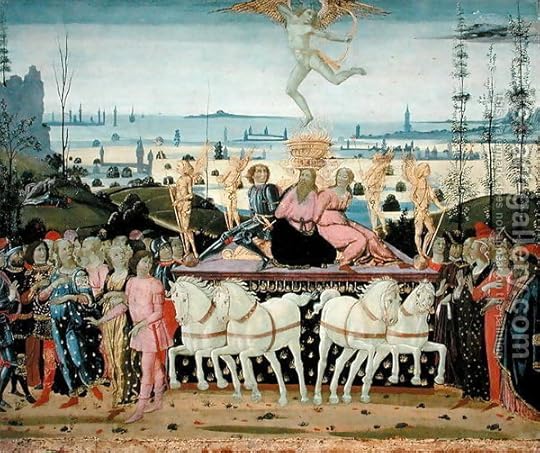
TRIUMPH OF LOVE (Jacopo Del Sellaio:Triumph of Love, inspired by Triumphs by Petrarch 1304-74)
TRIUMPH OF CHASTITY
TRIUMPH OF DEATH TRIUMPH OF FAME TRIUMPH OF TIME TRIUMPH OF ETERNITY
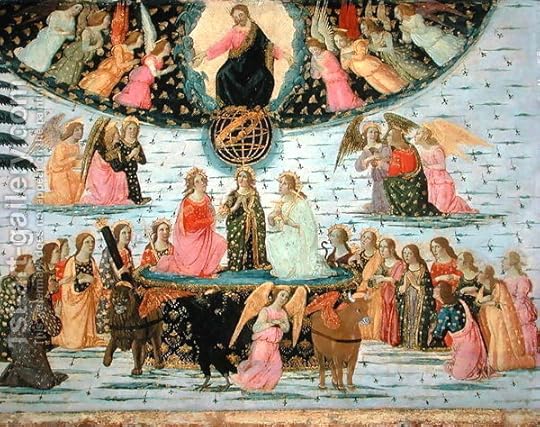
(Jacopo Del Sellaio:Triumph of Eternity, inspired by Triumphs by Petrarch 1304-74)
----
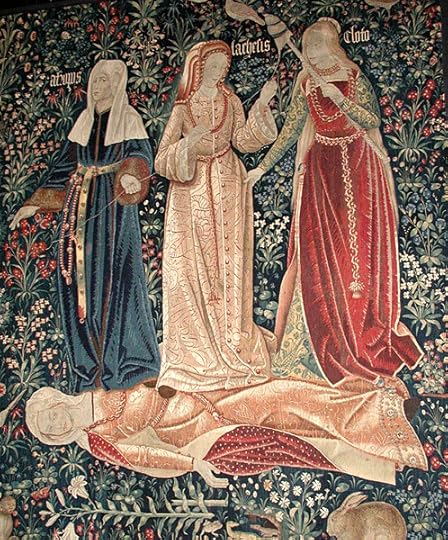
(Petrarch Fates)
Some sparse notes I collected from the thoughts of Julia Butinya* and Roxana Recio**.
JB thinks Petrarch, Dante and Boccacio form a grand trio. They shared the spirit of their time. The Triumphs’ “tercetos”; they are in form like Dante’s. But, the narrative form (allegorical) through dream marks a difference, as well as a “more humanized hell”.
RR points to the fact that there are 3 Triumphs in Barcelona, and 3 Triumphs in Paris. Roxana notices a “love for introspection” …not present in Dante. She thinks The Triumphs characters are less “bobos” (clown-like/sort of stupid), as they are in the sentimental novel. An “emancipation of feelings” has occurred. The pain suffered is worth, is virtuous. It’s the humanism: the entire human person; the creative man as center. The human emancipated from the divine.
The Catalan humanism (more political) is approached by these Spaniard scholars, it is deemed different from the Aragon court’s.
On a biographical note it’s recalled that: Petrarch was born in the 14th century, in Toscana; a time when the Aragon kingdom fought against the Naples kingdom. Petrarch’s father a notary, belonging to the Guelph party, had to leave for Avignon. So, Petrarch had studies in the humanities; developed a passion for classic literature: namely Cicero; but preserved the Christian values (Saint Francis is important). So the Triumphs are a “large, Christian, narrative poem.”
--
* L'Humanisme a la Corona d'Arago. ** Petrarca en la Península Ibérica
Sonnets to Laura, also called Il Canzoniere, were written by Francesco Petrarca (b.1304–d.1374), Italian poet and humanist, one of the great figures of Italian literature. In English we call him simply Petrarch (pron. Pe-trark). His love poems defined true emotions and described a real woman. He perfected the sonnet form and is considered by many to be the first modern poet.
There are 366 sonnets that some say were written for a year of love poetry for his Laura. But in reality, the poems were written over a period of at least 20 years, if not much of Petrarch's life, and many were written long after Laura had passed away. During that time Petrarch passed through many phases in his love for Laura and in his own life, each expressed in his sonnets.
Petrarch himself deserves five stars, of course, but some of the translations in this collection leave much to be desired. The translations in this collection are from the Victorian period and before, and I think they are inferior to some more recent translations. The language often seems stilted. Also, the final 20 pages are in Italian, which seems silly since the rest of the book is translated into English!
I love the sonnet form, and it was studying Petrarch that led me to this love. I must say I prefer the Browning and Shakespearean collections to his though! I must admit to skimming and skipping many in this collection of all his poetry, not just the sonnets. Maybe it was the translation, as some of the other reviews suggest
I fell down a rabbit hole and wanted to understand Petrarchan Love as it influenced Humanism in the Renaissance. I can appreciate the volume of his work, the importance of his work especially to Boccaccio and Shakespeare, and his endurance as a clue in crossword puzzles. It’s my understanding that this is a Victorian translation and might be something of a dud. I can confirm, I skimmed through most of these and don’t remember much of anything.
But I can state, for the record, how fucking creepy this is. He was in the clergy and thus forbidden to marry but fathered two kids by some unknown woman, all while mooning over this married woman for twenty years. He wrote her love poems after she died. His obsession caused problems in her marriage. Sir, you don’t KNOW her.
At any rate, Petrarchan Love is all about an intense, idealized, and usually unrequited love for an unattainable, often angelic lady. focusing on the lover's inner suffering, spiritual purification, self-absorption, and complex emotions (like despair, longing, and worship) rather than mutual satisfaction, with the beloved seen as a divine ideal or source of inspiration leading you to God as opposed to a real person with whom you share earthly pleasure or a life.