“One day, on tearing off some old bark, I saw two rare beetles, and seized one in each hand; then I saw a third and new kind, which I could not bear to lose, so that I popped the one which I held in my right hand into my mouth.”
At the age of 22 Charles Darwin clambered up the steps of HMS Beagle, armed with enough notepads to last him for several years and set sail on a journey of exploration that would change his life and how we view the entire world forever.
This book tells the story of Charles Darwin, and shows how his revolutionary research changed the world forever. From his fascination with the natural world which began at an early age, his love of collecting new specimens and keen eye for observation, to his groundbreaking theory of evolution, uncover the incredible life of Charles Darwin with this beautifully illustrated narrative non-fiction book.
Published to celebrate the 200th anniversary of the launch of the HMS Beagle, this is the perfect book for any child who has ever looked at the world and asked ‘why’.
Winner of the Blue Peter Book of the Year 2017, writer and journalist David Long has regularly appeared in The Times and the London Evening Standard, as well as on television and radio. He has written more than 30 books for children and adults and lives in Suffolk.
5★ “False facts are highly injurious to the progress of science.”
That is one of the many quotations and short notes which are sprinkled through the book much as we find them in today’s magazines and online articles. They are not excerpts, but additional little facts that help to break up the pages. I’ll include a few illustrations to give a feel for the book.
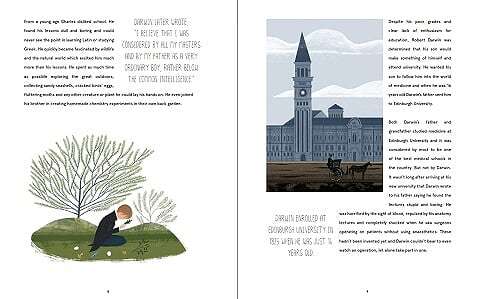
Young Charles found school boring, but he was fascinated by the natural world. Still, his father sent him to Edinburgh University at the age of 16. Charles preferred bugs to the classroom.
This book was published to celebrate the 200th anniversary of the HMS Beagle, which was built as a warship but never went to war. It launched originally in May 1820, but nothing much happened with it for several years until it was fitted out for exploration and surveys.
This history is discussed, but it’s not until its second trip in 1831 that we see Darwin aboard. He is not quite 22 and he is thrilled! Map of the voyage that took young Charles Darwin on his first voyage of exploration
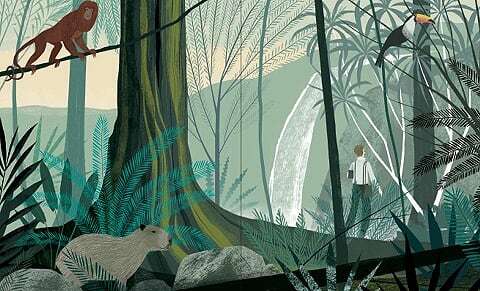
He was particularly looking forward to seeing the Brazilian rainforest for himself. Darwin, captivated by the rainforest plants and creatures
The two-year voyage had lasted five years, and Darwin was ready to take his notes and sketches home. He’d been bitten by something which made him ill, and he was distressed by the treatment of slaves in Brazil. He wanted to show his findings to other scientists and GO HOME.
“When he left England, the 22-year-old was a bright young university graduate who thought he might return from his voyage and maybe become a vicar. But by the time the Beagle returned, he was a changed man. He had survived many hair-raising adventures, had become an experienced naturalist and was considered a leading expert who was well-known in both London and Cambridge for the astonishing quality (and the sheer quantity) of the spectacular specimens he had collected and sent back to England.”
It’s pretty obvious he wasn’t going to become a vicar! What he learned on the Galapagos Islands alone was enough to change the course of his life.
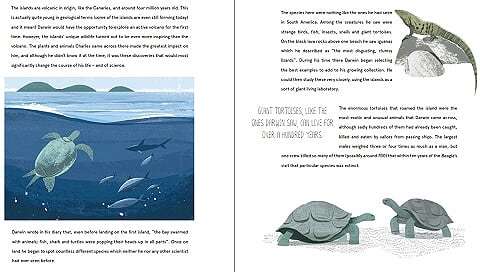
Darwin’s studies on the Galapagos Islands led to his understanding that plants and animals changed and adapted to their locations.
“Darwin would eventually use the specimens he collected from the islands to illustrate and explain an exciting new scientific theory. This theory would dramatically enhance his reputation as a scientist, and completely alter the way people looked at the world. It would also mean that, instead of being somewhere most people had never heard of, the Galápagos Islands would eventually become famous as a place of enormous scientific importance and discovery.”
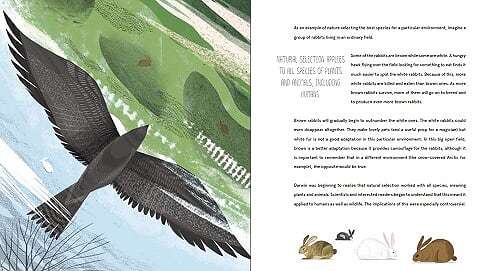
Then there’s this – an example of how adaptation and survival of the fittest, which led to controversy which continues today. There is a belief that each being was created exactly as it is by a supreme being. Evolution says that each being changes itself, over time, to adapt itself better to its circumstances.
In this example, a hawk would spot and kill highly visible white rabbits, leaving the brown ones to multiply (except in the Arctic, of course!), showing that each colour is fit for purpose in different locations.
Illustration of a hawk flying over brown rabbits and white rabbits
But, oh, didn’t his Theory of Evolution cause a stir?! It still does amongst some who have trouble reconciling science with religion, although my understanding is that most religious leaders think that it’s the supreme being who enabled evolution, so what are we arguing about?
“It took quite some time for Darwin to work out all the details, but 20 years after his momentous voyage around the world he was ready to share his ideas with the world and published his theory of natural selection in a book he called On the Origin of Species.”
This is one of the little side-notes: “Darwin’s book was an immediate bestseller. Everybody wanted to read it.”
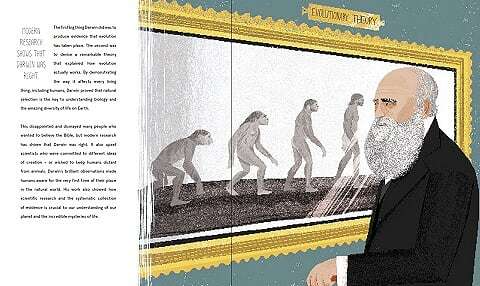
People seemed to be much more attuned to science then than now. Over the course of his life, he changed himself from a boy who disliked school to become the most famous scientist in the world!
Charles Darwin, considered the most famous scientist in the world
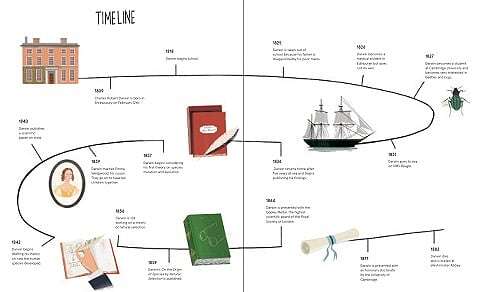
There is a handy timeline at the end as well as a page with a few of his discoveries. Timeline of Charles Darwin and his adventures
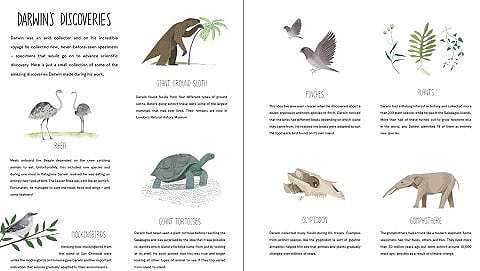
Some of Darwin’s discoveries
While the target audience of this would be primary and middle school children, it is just as enjoyable and informative for adults. There’s a lot more history I haven’t mentioned as well as snapshots of other people with whom he was involved and a glossary.
A worthy anniversary production of a book that should be in all school libraries! Thanks to NetGalley and Quarto Publishing for the preview copy.
This is a really thorough and beautifully illustrated introduction to Darwin for kids. The amount of text makes it better suited for older kids or a read-aloud over a period of time. It's a great resource that will really give kids a feel for Darwin.
I read a temporary digital ARC of this book for review.
Thanks to Netgalley for a copy of this book in exchange for a honest review.
This is a beautiful book, both in terms of content and illustrations and perfect for children who are discovering history, science and those men and women who shaped the modern world. Even for me, as an adult reader, this book was exciting, as I was able to learn a bit more about Charles Darwin, the man who introduced the concept of evolution and natural selection.
Most of us probably learned, during our high-school classes, who Darwin was and how his theory sparked debate in the early 19th century. He was the man who presented the theory of evolution, which meant that species –animals, plants and humans– have evolved during millions of years to adapt to the environment and survive. This challenged the belief that everything was created by God and no change could have been possible as all was created “according to his image and likeness”. I can only imagine the great criticism Darwin drew in his time and the great scandal he caused and still does: even when I was a child, I recall my mother, a religious woman, claiming that it was blasphemy to suggest that humans could be related to apes. But that is another story.
The thing is, perhaps what most of us know about Darwin is what we learned in school as young children and teenagers, and When Darwin Sailed the Sea is a great book that should be available for younger audiences to discover in more depth Darwin’s story and achievements. The book is very easy to read but still contains relevant information on the scientist’s life, his travels and his findings. For example, it points out that Darwin was not an outstanding student –he first tried to study medicine, then religious studies– but he failed. He was most interested in seeing the world outside and exploring nature and the environment and there was where he found his true passion. I think this message is quite important in our times –we do not have to fit certain patterns or find our way as most people do: we should listen to our interests and passions and follow where they take us.
Overall, this book is very exciting to read as it takes us with Darwin through his life, travels and discoveries and it keeps the interest of the reader. Also, the illustrations are wonderful and beautiful and truly contribute to the reading experience –it was lovely to see Darwin on his travels on the Beagle, or writing down his diary, or standing on the middle of one of the islands of the Galapagos wondering about the strange and new nature he discovered whenever he turned around.
I hope this book can soon become available for Spanish-speaking audiences as well, as it is one of those books to treasure and contributes greatly to learning among younger audiences.
When Darwin Sailed the Sea is an illustrated non-fiction book for older children by David Long. It follows Charles Darwin's early life and his time at University before his voyage of discovery. Captain Robert Fitzroy an expert sailor, surveyor and keen meteorologist needed a companion and someone who was able to put together accurate reports of countries they visited. He invited Darwin to join him aboard the HMS Beagle for its second voyage. The Beagle set sail on the 27th of December 1831 and they spent 5 years at sea discovering many new species of flora and fauna from different islands and continents. Darwin returned as an experienced naturalist and went on to publish his fascinating findings. Thanks to NetGalley and the publishers for my digital copy.
I received an advance reader copy of this book to read in exchange for an honest review via netgalley and the publishers.
This book is a fantastic biography in a child friendly format for children aged 9-14 years of age about Charles Darwin and how he became famous, the ups and downs of the start of his discovery path and what lead him onto this path and then where he went, what he discovered and how he discovered natural selection.
This book will be a fabulous addition to my classroom at school and the year 6 children will greatly benefit from this book when we do natural selection next year.
This book was very over the stop for me in terms of how you get to appreciate mother nature. Darwin sails around the world to discover new finding to increase his understanding on insects and other animals.
There is one part of the book that the gross me out was the when he ate ostrich meat and insects meat.
When Darwin Sailed the Sea: Uncover how Darwin's Revolutionary Ideas Helped Change the World, written by David Long and illustrated by Sam Kalda, is currently scheduled for release on July 1 2020. At the age of 22 Charles Darwin clambered up the steps of HMS Beagle, armed with enough notepads to last him for several years and set sail on a journey of exploration that would change his life and how we view the entire world forever. This book tells the story of Charles Darwin, and shows how his revolutionary research changed the world forever. From his fascination with the natural world which began at an early age, his love of collecting new specimens and keen eye for observation, to his groundbreaking theory of evolution, uncover the incredible life of Charles Darwin with this illustrated, narrative non-fiction book.
When Darwin Sailed the Sea is a book that offers readers a look at Darwin as a person and a scientist. The book does a good job of explaining his interests, determination, and how he collaborated with a variety of people. The information was accessible and interesting.I found the accompanying artwork to be lovely to look at while also adding meaning and detail to the text as appropriate. I learned quite a bit about Darwin, and liked the narrative tone that I think works very well in this format. I will admit that I was not expecting it to be as text heavy as it was, but the style and substance balanced that out. I am hoping some young people reading this will see how hard Darwin worked to follow his interests and be inspired. I really liked the timeline, further information on the people Darwin worked with, and additional information included in the endpages. Good use of this section always makes me happy- and this book delivered.
When Darwin Sailed the Sea would be a great addition to school, classroom, and public libraries. Some readers will want it for their personal collections as well.
Charles Darwin, 22, sailed on The Beagle with Captain Robert Fitzroy in 1831 for a five-year voyage of adventure and discovery. Collecting specimens, many of them unheard of or extinct, he returned to England to categorize and scientifically organize his many plants, animals and thoughts while writing popular books based on his journals. All the evidence he collected pointed to a new and revolutionary theory: species appear to change, or "evolve" by adapting to suit the conditions in which they lived. For example, the finches with beak variations depended on which Galapagos Island on which they lived, to better eat the seeds or insects found in that particular location. This got Darwin in trouble, as it seemed to contradict Creationism, a Biblical theory which stated the earth was made in 6 days with no changes unless caused by the Great Flood. As a scientist, he followed the evidence he gathered and deduced his theory of Natural Selection, or "survival of the fittest" to explain how animals change and adapt to their surroundings, including the human animal. Twenty years after his life-changing sea journey, he wrote his thinking down in a seminal book,"On the Origin of the Species" and infuriated many religious people in 1859. It became an instant bestseller in many languages, and was followed by "The Descent of Man." A father of 10, he died in 1882 and was honored by being buried in Westminster Abbey. His insight, meticulous research, and deep thinking continue to inspire budding scientists and highlight the conflicts between science and religion to this day. A simple glossary, timeline and plenteous illustrations make this non-fiction picture book eminently readable.
Straightforward, clear and complete account of Darwin's important life.
This isn't Horrible Histories, jokey, quizzes and disgusting facts. It's a straightforward biography of Charles Darwin, from his youth and studies to the most important part of his life - his travels and writing - and its impact on the world.
This is written in clear English, to be read by a KS2/KS3 audience and their teachers/parents, with lots of illustrations and realistic portraits of Darwin and others connected to his story.
There is a fair amount of detail about the Theory of Evolution, enough for a young audience to understand what it means and how it differs to the theories pre-Darwin, without commenting on validity and arguments. Key examples (finches) are here, that show the pertinent points that gave Darwin reason to think deeply about what he was seeing on his 5-year round-the-world voyage.
At the end are details of a number of people important to Darwin's story (both proponents and opponents), some illustrations of key species he discovered, and a glossary of scientific terms. I would have liked a list of Further Reading ideas for children who are interested to learn more - books and websites they could access. And some context for later ways in which the theory of evolution did change the world, maybe with uses in the modern era.
A good biography, attractive and easy to read for the target audience. For ages 9-14.
With thanks to Netgalley for providing a sample advance reading copy.
A brilliant introduction to the life and work of Charles Darwin. With child-friendly language and beautiful pictures, this is the perfect start for someone studying evolution and adaptation as part of science lessons. New vocabulary is clearly explained in the text and the glossary and a selection of influential people in Darwin's life are referred to in a 'who's who' style gallery at the end of the book. The main body of the text is split into short chapters spanning Darwin's life from his beginnings as a disengaged student, to his research and study of evolution when he returned from his travels. The lengthy parts of text are broken up by short snappy facts in larger print. I would highly recommend this book as a starting point for any teacher covering Darwin's work to give them and the children they teach an introduction to the man behind the science. I received an eARC of this book from the publishers via NetGalley in exchange for an honest review.
Well written biography of Charles Darwin's time on the Beagle, where he was horribly seasick. It doesn't go into depth about the five year voyage, but it does touch on the things he saw and the animal specimens he collected.
Wonderful introduction to this amazing man. I didn't know, for example, that he had to pay his own way, on the voyage, nor how long it took. He had trained to be first a doctor, then a minister, though he was never really interested in either, but coming from a well to do family, that is what you are supposed to do.
Though this book doesn't go into great detail, it give the essence of why this voyage was so important, and what sort of things he saw that helped him develop his theory of evolution. Enjoyable read. Recommended.
Thanks to Netgalley for making this book available for an honest review.
This book is a fantastic introduction to the man behind "On the Origin of Species". The story takes us from Darwin’s “average at best” time at school and university through to his time travelling the world on board the HMS Beagle and beyond. The story of how he pieced together the evidence of variations within species to generate his theory of natural selection is well-paced and beautifully illustrated throughout.
While the book is aimed at children, who will surely be inspired by the man who didn’t do well at school but still went on to achieve greatness, I also learned plenty from this book. It has enough detail to be engaging without overloading the reader on facts and figures, but there is a handy timeline and glossary at the back for readers wanting to know more.
My thanks to the author, NetGalley, and the publisher for the arc to review.
This is a wonderful book for children who are interested in scientific discovery or for a child that you would like to interest in the natural world. It tells the story of Charles Darwin in a beautifully illustrated title that was written to coincide with the 200th anniversary of the voyage of the Beagle. Adults can learn quite a bit from spending time with this title as well. I know that I did.
Readers discover that Charles lost his mother when he was young, that he did not always like school and that he did not conform to his father's expectation that he would follow as the third generation doctor in the family. Rather he became intrigued with the world of nature. This biography serves to humanize Darwin, a figure who is larger than life in the history of scientific discovery.
Many thanks to NetGalley and the publisher for this title in exchange for an honest review.
This illustration nonfiction book introduces young readers to Charles Darwin and his pioneering scientific discoveries around evolution. The book is described as narrative nonfiction, but there isn't a lot of showing through scenes or use of narrative detail. Instead, it's mostly tells readers in broad strokes about Darwin's academic career and how he wound up on the HMS Beagle. I think the book really gets interesting after he starts his voyage on the Beagle, so I would have liked a little less exposition up to that point. The author also explains how Darwin pieced together an understanding of evolution and explores the controversy around it, both in a succinct, kid-friendly way. I think this will appeal to teachers and especially kids who are interested in zoology or science in general.
(I received a digital ARC in exchange for an honest review.)
Kiddo and I really enjoyed reading this at bedtime. It's long enough to last for several nights, interesting enough to keep them listening but not too exciting so it doesn't make it hard to sleep. We read this as a follow-up to a biography of Alfred Russel Wallace, and together they provided an excellent overview and history of natural selection and evolution.
The one thing I would note is that the previous captain of the Beagle is described here as having killed himself and this should a) have a trigger warning or even better b) be omitted. It doesn't really add anything to the story (it's more of a throwaway comment) and was difficult for my child who has been struggling with suicidal ideation. (I would have skipped it if warned but by the time I realized that I should have skipped it I had already started reading it.)
A very good book for older primary schoolchildren about the life, times and works of Charles Darwin. It succeeds in being a very good biography, and of course advocate for evolution, which still to this day makes it a gallingly important book for some people to be shown. I'm not sure some of the artworks were fully necessary, and the pull-quotes that allegedly make the pages look more engaging are pointless, in that you can never tell exactly when to read them in a way that doesn't spoil the flow of the main text. Still, the story of the Beagle's voyages is very nicely presented, Darwin's ideas clearly shown (Wallace gets to carry his coffin, and a small slot in an appendix of notable people in Darwin's sphere), and the important lesson about the truth of the matter is irrefutable.
I guess I take a lot of visual cues to figure out who a book is for. I'm guessing this is middle grade. It's really interesting and I learned a lot from it. It does address religion-- talking about how Darwin trained to be a priest and how his views disagreed with the way Creationism was believed at the time (and still by some now). (Maybe I'm off base, but from my own religious life, it seems that the book shows Creationism as much more rigid than most of the people I grew up in religion with.) I think it is very respectfully done and shows religious thought, scientific thought, and people's hesitations with each belief on both sides.
I liked the illustrations and the extra information in the back matter.
While presented in a picture book format, this reads much more like a chapter book for the 8-10 year old age range. This is an excellent children's biography book focused on the life and relationships and ideas of Charles Darwin. The narrative is engaging and the paired illustrations are effective companions to the text.
I think this book does a great job presenting the full picture of Darwin's life and ideas and legacy to children. It doesn't try to show or demonstrate an entire natural history of our world, but instead focuses in on natural selection and then how Darwin's ideas were received and built upon.
***Note: I was given a review copy of this book by Quarto Kids. Opinions are my own.
A book with nice illustration about Charles Darwin and his path towards and contribution to natural science (i.e., natural selection). It was interesting to read about some of Darwin’s discoveries – Rhea, Giant Ground Sloths, Glyptodon and Gomphothere . This books made me so curious that I might end up reading The Origin of Species sooner than I thought.
I really enjoyed this read and so did my sons. Charles Darwin is such an important character in history, one that I touch on very regularly in my classroom so I know I will refer back to this book very regularly in my teaching next year. While we don't learn too much about Charles Darwins years at sea during the voyage we do learn about the new and interesting creatures that he saw and the specimens that he collected. It explored Darwins theory of evolution and provides absolutely beautiful illustrations which contribute enormously to the book. I really enjoyed this and I know I will re-read many times in the years to come.
An interesting and well-written biography of Charles Darwin, with an engaging text and lovely illustrations throughout. I especially enjoyed learning about his less than stellar academic career, which I'm sure will give struggling students some hope. I also appreciated that the controversy surrounding the publication of On the Origin of Species was covered in a fairly straightforward manner; of course the religious backlash is talked about, but it's done without being spiteful. This book gives a good overview of Darwin's life and accomplishments in an approachable way for middle grade readers, without talking down to its audience.
This was a great book to explain the biography of Charles Darwin.. The Illustrations are wonderful and the history of the Beagle, this ship Darwin sailed on was fascinating. I have not read about the Beagle before. I have read On The Origin of Species before.. This book does not shy away from the controversies of Darwin's beliefs and it explains the theory of evolution along with creationism very well. This is an excellent first biography for a child to learn about a scientist that has influenced so much of our modern world.
A wonderful little book on Darwin. A very quick read. Darwin's upbringing, his search for his path in life, his voyage on the Beagle, his discoveries, his theories, his books, and his later life. All done very succinctly, and in an easy to read and understand manner that is very enjoyable. Wonderful illustrations. Perfect for middle school to high school readers. Makes me want to go back and reread "Voyage of the Beagle". Bravo!
A really thorough review of Charles Darwin's life presented well for young readers. From his younger years in England to his travels across South America. Charles really did a lot for science. This book shows well not only his story but also how important staying true to science is. The illustrations were very lovely and aided in telling the story. I would recommend this for elementary/middle schools to have in their libraries and for young readers interested in the natural world.
While I would not be the target audience, I enjoyed reading the brief summary of Darwin's journey to becoming a famous naturalist. Finding out about his background, how he dashed the hopes of his father for him to become a clergyman, and then making all these connections with renowned scientists was very interesting.
This book is lovely, well written and well illustrated. It’s a little more in depth than many that follow a similar style, which was a good thing. Ks2 children would love this. It contains a lot of information, in a concise way that would make it ideal as a topic book.
I actually loved this book. Picked it up whole at the library with my son but sometimes a children’s book is what is best. I read “origin of the species” in college but loved learning more about Darwin’s life
Beautifully illustrated and a great introduction to Darwin’s story. Although intended as a kids book, the content is accessible to all ages. There is plenty of text throughout the book, making it more suitable for older kids to read by themselves.