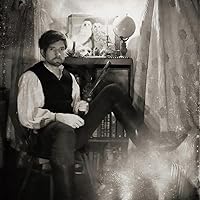
Librarian Note: There is more than one author in the Goodreads database with this name. Bruce Robinson is an English director, screenwriter, novelist and actor. He is arguably most famous for writing and directing the cult classic Withnail and I (1986), a film with comic and tragic elements set in London in the 1960s, which drew on his experiences as 'a chronic alcoholic and resting actor, living in squalor' in Camden Town. He is married to Sophie Windham, children's author and illustrator, and has contributed to some of her books. A book of interviews with Robinson, edited by Alistair Owen, is published as Smoking in Bed: Conversations with Bruce Robinson
Maurice threw another log on and a mass of brilliant sparks leapt in the air like burning confetti.
'You know what I'd like now?' he said, without taking his eyes off the fire. 'A pot of tea on top of that and a shag.'
Thomas agreed.
'Do you realize it can take up to a year of constant shagging for a girl to achieve orgasm?'
He didn't, but went along with the prognosis. After all, Maurice had had an experience in the park.
Here we examine the days and nights of young Thomas Penman as he ages from thirteen to a suave, sophisticated fifteen. Listening to the advice of Maurice is just one of his mistakes. His time is spent suffering through school, daydreaming of the delights embodied in the lovely Gwendolyn, helping his father deliver newspapers and searching tirelessly for his ailing grandfather's legendary porn collection.
This book is strange - darkly, slyly funny but with a somewhat scary miasma hanging in the air. (Not to mention the smell of feces, both canine and human.) In addition to Grandpa's grave illness, Thomas's parents' long simmering marital strife is now coming to a full boil. It's a gloomy and depressing time to be in the house. Thomas, who has always feared his father's temper, begins to worry for his own well-being.
. . . Thomas started stacking saucepans inside his bedroom door. He was worried that Rob might come in in the middle of the night and smoke him with the Beretta. Saucepans would at least give him a chance. The plan was to go straight out of the window, no hesitations; as the saucepans clattered he'd be out. And if Rob somehow navigated the precautions and got in silently to club or choke, Thomas had a back-up. He kept a permanently wired Black & Decker under the bed with a three-eighths masonry bit in the chuck. If Rob got on top of him he would drill a hole in the back of his head. There was also a three-foot wood saw in case of power-cuts. While being strangled, Thomas would attempt to saw his father's legs off.
That last line made me burst out laughing, while cringing at the same time. No child should ever have to feel this way, but Thomas's over-the-top, Wylie Coyote-ish schemes to save his own life seem hilarious and yet realistic from a youngster's point of view. Plus, I love that he has a contingency plan in case the power goes out. The boy thinks of everything!
I feel badly giving this only four stars as it was one of the better books I've read so far this year, but the unlikely romance between Thomas and Gwen annoyed me. The whole thing felt more fantastic than real and yes, . I can't help but wish that Gwen had remained an unattainable object of desire.
If you are a fan of the author's Withnail and I, you'll probably like this. The humor is similar and you're left with that weird, unsettled what-did-I-just-watch/read? feeling that is so wonderful and yet so hard to describe to others.
And remember to keep a saw under your bed . . . just in case.
This debut (and only) novel from the actor and screenwriter begins as a scatological black comedy, the titular Thomas a tortured figure unable to stay his bowels in class and relentless in pursuit of his dying grandfather’s porn stash. As the book meanders along the tone of smirking nihilism adapts to encompass Thomas’s compassion for his grandfather and acquires a bulbously implausible first-love story of unapologetic purpleness, alongside the stuff about strapping rockets to crabs and launching them at the city centre. It soon unfurls as a warped riff on David Copperfield—namedropped several times—with Thomas filling in for Bruce Robinson as David did for Dickens. So a semi-authentic künstlerroman with Dickens parallels is the flavour. Like DC, TP is raised among gits (in his case rotten slobs and violent nutters) and finds solace in his plastic-perfect lover (Gwendolyn, filling in for Little Emily), and the novel ends with almost-dramatic parentage revelations (like in almost every other Dickens novel). An uneven but smart act of homage, memory, disturbing comedy and shameless sentiment.
It's three months (gulp!) since I read this. I thought I'd made a lot of notes but the Word document "penman" turned out only to contain four lines of writing. It was reading Edward St. Aubyn's Never Mind that brought me back: both are mostly-autobiographical novels written in the 1990's by gifted male authors with past addictions, taking on their own abusive childhoods - bringing excellent writing to a subject usually left for lowbrow "misery memoirs".
Never Mind is somewhat the better literary work in its finesse and layers, but given the nature of St. Aubyn's experiences at such a young age it's almost inevitably more serious. Not that he isn't stingingly waspish at times, but The Peculiar Memories of Thomas Penman (and his red-faced raging father Rob) is fundamentally comic and optimistic.
Fundamentally perhaps being the operative word. My notes from January say: "Synopses of Thomas Penman indicate an almost John Waters level of weird and yuck. It's a semi-autobiographical novel. By someone I have a crush on. And I don't like scatological humour. But either having pets made me less disgustable than I used to be, or the writing is so good" ... and run out there. It was just funny and ridiculous, when I hadn't expected to laugh a tenth so much as I did at scenes about a kid shitting himself.
By conflating [I'm seeing double entendres everywhere just now ..."run", "flatus"...] events that happened several years apart Robinson creates a great narrative arc, but one that also loses a crucial realism in an otherwise gritty, stinking-kitchen-sink-drama world. Aged 14 or 15 at secondary school, did the prettiest girl in the year ever go out with a boy who - whilst he's turning out to be very good looking - was correctly rumoured to have poo'd his pants only months earlier? Surely not: children are merciless about such things. (Though possibly not as extreme as at my school where one year, a girl farted audibly in class - yes, one year, it was that rare - and wasn't allowed to forget it for a couple more years. Though her name probably didn't help.) But if said boy's defacatory incidents had actually happened years earlier at primary school, before he and the lissome lass had even met (as was Robinson's reality) then it's hardly going to have made a difference.
The influence of Dickens - Robinson's, and Thomas Penman's, favourite author and fellow Kentishman - is everywhere in the book's almost vaudevillian characters and heartfelt, heartbreaking sentiment. Thomas may not distinguish himself academically (having been relegated to secondary modern) but his brains are apparent through his love of books and schemes, much like Antoine Doinel in The 400 Blows, a character who would have been almost exactly the same age. In one scene Robinson appears to have written a grotesque dark parody of the final beach scene from that film - but in Smoking in Bed: Conversations with Bruce Robinson he said it really happened: his father beating him as he tried and failed to run away into the sea. (When I re-watched that film a year ago I remember thinking that a beach isn't a terribly practical place for running away: very visible, too few possible directions.)
Thomas may clean up his toilet habits much earlier on in the narrative than I assumed before reading the book, but the whole novel stinks nonetheless. A house full of dogs and dog mess, terrible boiled food (just the sort that got British cooking its bad old name), stale smoke, fusty mouldering churchyards, not wanting to bring anyone nice home ... Very very effective. These may be middle-class houses but often I remembered the days when I used to do home visits on bad estates and sometimes there would be houses where I'd have to suppress the need to retch, where on leaving I would feel that I and everything I carried was covered in a greasy smelly patina, and I counted the hours till I could go back to my flat and throw everything in the washing machine and myself in the shower.
And such the makes the all the beauty... of fresh air and wonderful views, of love, of friendship, of precious objects, of poetry, of loss, of a better future ... all the lovelier. If you are entertained by such extremes, this is rather a marvellous and all-encompassing book, despite its few faults.
Thomas Penman is a 13-year-old with "big ears and an unwholesome characteristic." who lives in a large, dilapidated house in Broadstairs, Kent, with his extended family. His grandfather, Walter, is the only one with whom Thomas has any sort of dependable relationship. Sadly, "Walter was extremely old and full of cancer".
The first chapter is an extended depiction of Thomas's rebellious nature and it also introduces us to the girl of his dreams, Gwendolin Hackett. "Gwendolin was beautiful, stone blond with sexy teeth, lips like the bit after a knot in a balloon." When love is finally consummated, Thomas knows ecstasy but it is soon followed by tragedy mirroring events his grandfather endured during WWI.
Of all the bonds that tie the family together, love is not the main one. Instead rage, guilt, anger and resentment are foremost in this dysfunctional family. There is also a dark family secret to be uncovered.When Thomas finally uncovers the truth we learn why these people seem to take such great satisfaction in annoying, ignoring and abusing one another.
Of all the characters within this book Thomas's father, Rob, is almost certainly the best, a wonderfully comic creation."In Rob's lexicon of jurisprudence capital offences were myriad: you could get hanged for almost anything...... Endless streams tramped to Rob's scaffold, Communists, trade unionists, the Labour Party -- he hanged the lot of them, and it wasn't even 7 AM."
The book is set in 1959 so memories of both World Wars are still reasonably fresh but is also an age when families struggled to speak honestly to one another about anything important, particularly to children. It is against this background that Thomas must himself come of age. He is endlessly snooping and lurking about the house trying to uncover secrets but he also has an unhealthy interest in explosives, cigarettes and pornography, something he knows that his grandfather has a vast collection of.
Robinson does not flinch from showing us the full awfulness of boys' sexual fantasies which some readers will undoubtedly find distasteful. There is even a whole chapter entirely devoted to excrement. However, running beneath all laddish humour there is a serious theme, that of a pubescent boy's attempts to make sense of his bewilderment surrounding sex and love, illness and death, without adequate parental guidance or experience.
Even as a male (admittedly one whose own teenage years are now only a distant memory) I found a lot of this book's humour made for uncomfortable reading but perhaps its greatest strength is that Robinson was able to sustain this rude and anarchic tone throughout. A piece of relatively enjoyable escapism but one I suggest will have a rather limited appeal.
I picked this up because the sleeve described a kid obsessed with gaining access to his grandpa's porn collection; I'm fascinated by personal porn collections and what happens to them so . . . perfect, there.
I'm glad I didn't stop reading it; at first I was confused and it made me kind of uncomfortable, reminding me of a British miniseries I watched on PBS late at night once when I was a kid because it had tits and ass and now all these years later I still remember a scene with a sick old man in bed haucking up a thick clot of goo from deep in his lungs and spitting it onto an old stovetop. I will never forget that shot of that yellow snot sizzling on the black griddle. The foreign-sounding (to me, as an American) choices of words and early focus on SHIT and lots of it in this book put me in that same fascinatingly gross place.
This story wound up being extremely touching (I cried), but whenever I thought it was straying too far from the roots of grossness, he'd stick the nose of a Corgi up someone's ass. Captured the obscenity of living with dogs (and confirmed my suspicion that corgis are the most obscene of all with those grotesque proportions).
Maybe more of a 4.5 or 4 for other people, but for me . . . totally a five.
What an odd book. Given it's a teenage boy's coming of age story, there's a lot of graphic writing about sex and bodily functions. Sometimes it works and ties the story together, sometimes it seems overdone and intrusive. It was an interesting novel, but not something I would read again or heartily recommend.
I knew Robinson as the director of two eccentric and wonderful British comedies, "How to Get Ahead in Advertising" and "Withnail and I." So I expected this novel to be funny. But I didn't expect it to be so deep down good and so beautifully written. I found myself copying out whole lines just for their cleverness or their music. And I laughed out loud a lot, even when I was by myself.
A beautiful oddity. A melancholy coming of age story that hangs thick with malaise in the fag-end of the Fifties — a landscape dominated by two generations emotionally stunted by being eaten up and spat out by wars. It takes the form of a series of advancing vignettes across six months at the end of the titular character’s fifteenth year, driven by his obsession with unravelling a family mystery or, alternatively, laying his hands on a cache of filth. Written with the kind of verve you would expect from the author of Withnail and I, full of rueful characters and an acerbic turn of phrase, it is chiefly a Very Funny Book. While containing a through-line of scatology and ribald humour —occasionally giving way to its preoccupation with pornography— it’s also touching and profound in dealing with its primary touchstones of mortality and regret. The romantic elements with Thomas’s sparsely written paramour are a little disappointing due to just how undervalued she is as a character, but it just about gets away with it through the hormone-fogged gaze of its protagonist. If you’d asked me after the first chapter whether I’d be moved to *actual* tears by the end, I’d probably have been so immersed in that imagery that I’d have told you that you were full of shit. But here we are.
Nobody can write like Bruce Robinson. This is one of the best pieces of writing I’ve ever read and it actually made me cry. The characters are absolutely, sometimes horribly real and utterly captivating, some of the most well-realised I’ve ever read. The storyline takes the utterly mundane life of a 50s household and sees in it the grotesque, sublime, uplifting, heartbreaking and hilarious. On one hand, it’s about a teenage boy struggling with typical teenage problems of family trauma, his grandfather dying, first love and just how to obtain pornography. On the other hand, Robinson’s sheer power of writing and observational skills can turn a steaming pile of shit (literally) into a beautiful, memorable masterpiece. He can paint an entire picture in a single line just through his often weird choice of words. I would kill for his turn of phrase. Read this book: it is brilliant.
I've given at least five copies of this book away since I first read it a decade ago. It's darkly grim and funny but also heartbreaking. I love the interplay between Thomas and his eccentric grandfather, probably the only person who understands him. I thinks Robinson nails the awkward and ugly junior high phase. One of those I re-read on occasion, though I understand it's not everyone's cup of tea.
This book is funny, sad, gross and highly atmospheric. Bruce Robinson's skillful and wickedly funny descriptions transport the reader into the world of a teenage boy growing up in a seaside town in the 1950s. I'd recommend it to anyone who likes dark comedy with a touch of toilet humour.
This is one of the most amusing, touching and disgusting books I've ever read.
Bruce Robinson's prose is effervescent and lightning-fast, complimented by an inspiring attention to detail and a dryly optimistic view of a bleak and disgusting situation.
Largely autobiographical, the book follows Bruce Thomas, an insecure, unloved fifteen year old, going through a somewhat unusual take on the classic teenage growing pains. Set in Broadstairs, Kent in 1959, the book deals with a couple of years of Thomas' life as he deals with love, death, fear and desire with a truly touching and bittersweet series of thoughts and encounters.
The awkwardness of teenage romance, burgeoning sexual desire and well-founded feelings of love and hatred are just so well written I wanted to cry with the sheer humanity of what I was reading. The comedy here comes from realism and experience. There are no jokes, just situations. There's barely even a coherent narrative arc. The only long-running themes, if there are any, would be Thomas' pursuit of two things - his grandfather's collection of vintage pornography, and Gwendolin, the prettiest girl in school.
One chapter in particular was so moving that I must have read it at least three times before I felt that I could move on. Thomas and his friend are at the beach, blowing up crabs with home-made explosives. The scene is juxtaposed with an incredibly horrific and majestic description of the front line during World War One. I feel that it would be doing Robinson a disservice by describing this scene in any more detail, but rest assured that this one chapter alone is worth the asking price ten times over.
Refreshingly unambitious yet completely enthralling, Thomas Penman is a masterpiece of modern literature from a writer who is criminally under-appreciated by many, but loved by many more. You'll laugh, you'll cry. Simultaneously one of the sweetest and ugliest novels around.
The Peculiar Memories of Thomas Penman, a very Bruce Robinson title, means nothing in and of itself but already you are starting to think who is this Thomas Penman and why are his memories so peculiar, surely they can't be any more peculiar than mine.
And that's just the thing isn't it, his memories are no more peculiar than yours or mine or anyone else for that matter they are just a simple retelling of a period in his life when he was growing up, something we all do and we all have the strange and unusual memories to prove it.
So why bother reading this book then; well there are a couple of good reasons, one, it is wrote by Bruce Robinson who wrote Withnail and I and it is with that same style and comedic use of phrase that he lays a life down on paper for you to laugh at and get frustrated at and even cry at if some of the things he tells you come a little to close to home.
The second reason you should read this is that the story is based very loosely on Bruce Robinson's own childhood and there is an element of reality in the words that even though you might not be able to put your finger on which are real and which are not, there are all in all, a collection of very peculiar memories
Most people will know Bruce Robinson from his brilliant script and direction of the film 'Withnail and I' and that is what first drew me to this book. I wasn't sure what to expect as film is so different from a novel but I needn't have worried. Robinson is a huge Dickens fan with the book set in the seaside town of Broadstairs, where Dickens wrote Bleak House, and the novel bearing many Dickensian themes, however it isn't just a homage to his favourite author. Robinson has a clear and original voice all of his own and creates an intriguing world of hidden turds, Edwardian pornography and home made explosives. I was enthralled by this bizarre, dysfunctional family and young Thomas who tries to make sense of it all. The house they live in is almost a character in its own right and is so expertly drawn by Robinson that I can still smell the dog meat boiling on the stove. I've put it as one of my top ten on my World Book Night list because it just has to be read by a wider audience. Get a copy and lose yourself in the world of Thomas Penman.
I really find it hard to express a) how much I love Bruce Robinson's writing, and b) exactly why. There's something so... BRUCE about his prose. He makes you laugh one minute, you're disgusted the next, and then suddenly you're wiping away an errant tear. Nothing is sacred - he tramples on "proper" and "PC" as if they were ingredients in garden mulch. But all to a purpose. No gratuitous stuff here, and not even very much swearing. There's a general greying dinge to all his houses, a bit of hopelessness in all his situations, which serve to showcase the brightness of the shining moment, or the lucky penny. Bruce knows how crappy people can be, and he's not afraid to point it out. But he remembers what it's like to be a little boy to whom none of the adults will tell the truth. He remembers what it's like to hide behind doors, listening. He remembers, and he conveys it like an arrow shot right into your brain. Makes you remember, too. Even if you were never a little boy. Bruce Robinson is my hero.
In the wind-blasted Broadstairs winter of 1957, Thomas goes in search of some grubby photographs and instead finds himself – or lack thereof.
This book reads like in a challenge, in which Withnail writer-director Robinson must fashion a heartrending coming-of-age novel from the most offputting material imaginable. Its 15-year-old hero – on the surface irredeemably damaged – begins the book by repeatedly soiling himself, before poring over animal porn and indulging in animal torture, while trapped in an airless house that stinks of dog shit, violence and boiling meat.
The result, somehow, is deeply and enduringly affecting, more sustained than Paul McVeigh’s The Good Son and more authentic than Joe Dunthorne’s Submarine, illuminated by Robinson’s vast, buried reserves of empathy (it has at least four great love stories at its centre), and his extraordinary facility for language. It’s also extremely funny, both in its asides and the meticulously-engineered set-pieces, the best of which has Thomas being interrogated about enemas, by a vicar.
A lot was riding on this as I am a great admirer of Bruce Robinson. Aside from writing and directing (and living) the bona fide cult classic Withnail & I, he is a fascinating raconteur and boozy eccentric whose observations on society and politics are both astute and highly amusing (as documented in the wonderful "Smoking in Bed"). I was not dissappointed with The Peculiar Memories ... I thoroughly enjoyed every page and was drawn in immediately by the hilarious first chapter and his unique turn of phrase. A wonderfully engaging read all the more touching as it is more or less based on his childhood in a violent and loveless household, not even aware the man with his mother was not his real father. Beautifully captures the confusion, difficulties and sheer joy of being a child; the pragmatic search for happiness wherever it may be and in the simplest forms. Absolutely loved this.
This entire review has been hidden because of spoilers.
This eccentric and odd-paced book seemed a bit disjointed and confusing to me at first. I stuck with it, mostly because I am a great admirer of the author's film Withnail and I. It paid off, as I enjoyed the last 2/3 of the book much more than the first third.
I didn't particularly care for some of it, but sometimes the author would write something so incredibly true and insightful about human relations, or something so beautiful or otherwise moving, that it made the book extremely worthwhile.
I found this book difficult at first, what with my idealism and American earnestness and love of the uplifting. I persevered because a) it was recommended to me by someone I love very much and b) it was well written. I am glad I did. I fell in love with Thomas and all the misunderstandings that befell him. Ultimately this is a story of the importance of love to help us survive. I feel such tenderness for Thomas and his relationship with his (initially repugnant but ultimately heroic) grandfather. So glad I carried on. This book has a place in my heart.
I started this book years ago while at college. I was reading it in the library and one line very early on in the book made me burst out laughing, very loud in a quiet library and I had to leave ("he farted in shock. It smelled like a dead chrysanthemum)" 😂😂 I never finished the book, but told my husband about it years later. He read it and loved it and spent ages pestering me to pick it back up. So glad I did. Although it was a bit of a struggle at times, there are some absolutely hilarious scenes that had me literally crying with laughter ( the scene where his friend is in bed Ill 😂😂)
Weird, funny, touching, sad, moving. This book took me on a strange ride. Thomas Penman is certainly a one-of-a-kind character. He's a teenage boy dealing with a multitude of issues that would be hard for an adult to navigate. The author did a wonderful job of describing the ups, downs, truths, hardships and life of a peculiar and lovable young man.
One of my favorite books. Filthy kid up to no good in dirty seaside 1960s England. Pipe bombs and pornography and boiling pots of meat and secret forts in the bushes for smoking cigarettes. And love. BR wrote Withnail and I and got an Oscar for The Killing Fields.
I did not enjoy the writing style. I did not care about the story nor any of the characters. I really regret picking this book up. It was dense, uninteresting, and had way too many parts that just made me feel icky. I would not recommend this book at all.