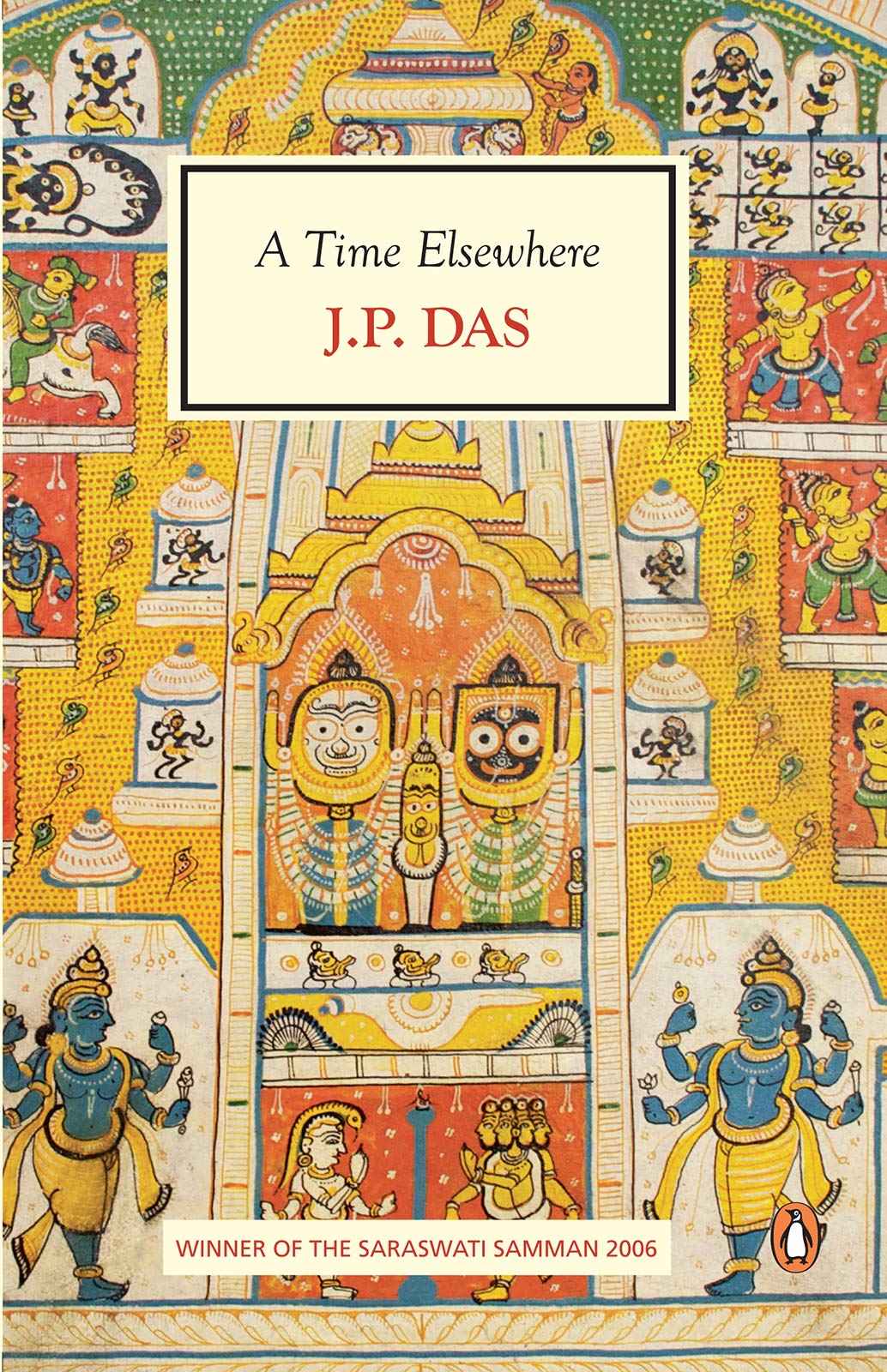
In A Time Elsewhere, fiction and history come together in a sweeping narrative spanning fifty years to create a minutely detailed portrait of nineteenth-century Orissa. The novel revolves around the fortunes of the ruling family of Puri. It traces Divyasingh Dev’s career as he inherits the throne, becomes a debauch and, ultimately, a murderer who is banished to the Andaman Islands for life. As Divyasingh spirals out of control, his mother Suryamani, the rani of Puri, emerges from behind her veil as the real ruler, shrewdly and gracefully negotiating the pressures brought to bear by the Empire.
The book is also an engaging portrayal of the great intellectual and cultural ferment that marked the clash of the east and the west as figures from Oriya history who played crucial roles in culture and politics during that tumultuous time are brought to life. Fakir Mohan Senapati and Radhanath Ray, educationists and writers, lead the charge against the hegemony of the English and Bengali languages. Gourishankar Ray, who helped set up the first Oriya printing press, publishes the Utkal Dipika, a periodical which quickly becomes the conscience keeper for Orissa, and Pyari Mohan Acharya, expelled from school for defying the British authorities, writes Orissa Itihas, a history of Orissa.
Lucidly translated from the original Oriya best-seller Desh Kaal Patra, A Time Elsewhere is a riveting account of a half century in the life of a people. It will fascinate both the student of history and the general reader.
[J.P. Das is] the quintessential raconteur with an instinctive mastery of form. —The Hindu
It is a good book covering Odisha's history of the 2nd half of the late 19th century. The book predominantly focuses on famine that struck Odisha in the 1860s, the literary history of Odisha and the progress of Odia literature, the key administrative and literary figures of Odisha, the relationship we had with the English officers and the different attitudes that these officers had towards Odisha, the naivety in our thinking, the role of the Raja of Puri and the esteem in which he was held, the importance of Lord Shri Jagannath Ji in the lives of Hindus and the state of Odisha. The book is 454 pages long, and I believe it could have been shorter by 100 pages to make it more engaging. Recommend to read it for anyone interested to understand the history of Odisha during the period.
I had bought this book 2 years back but did not get to start reading it. Having been recently back from Odisha trip visiting Sambalpur, Bhubaneshwar, Puri, Konark all driving so reading it was easy and interesting. Non-Odiya hear very little about Odisha in mainstream. But reading this book has been fascinating reading about those places I passed through, Jagannath temple and its affairs, colonial past and glimpse into Oriya Bengal rivalry. Though the book is a bit long with stories of so many characters with intricate details, it was difficult to cope up so skipped some parts. Perhaps a lighter version of the detail would entice non-Odiya readers but chronicling history to such details is also important.
A Time Elsewhere is a rather offbeat narrated history of Odisha between the 1860s and early 1900s. Focusing largely on the temple town of Puri and the administrative centre of Cuttack, with occasional forays to the hinterland, it tackles several parallel arcs - British colonial administrators dealing (or not) with a crippling famine, rulers of all bents and capabilities, emerging intellectuals trying to move out of the shadow of big brother Bengal, and the beginnings of religious and caste reform. These are all rarely written about stories that help make sense of a State that has long been considered a ‘backwater’ of sorts. The book must also be appreciated for being one of the early examples of Modern Indian history written by Indians.
However, the book’s chronological focus lacks any easily understood logic and starts as abruptly as it ends. Those unacquainted with Odia culture will also struggle to appreciate the selection of historical figures the book chooses to emphasise the most. Finally, the translation itself is patchy in more than a few spots, which makes the reading experience more uneven.