Art Renews from the Periphery
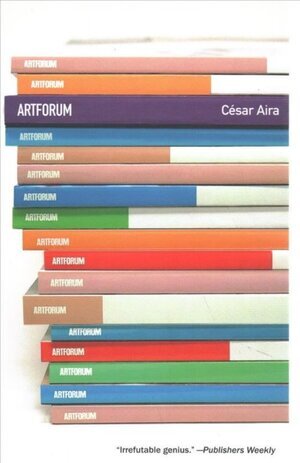
Artforum simply refers to the long standing journal of modern art, published in New York. Our narrator loves to read it and loves to find it. That is the premise. He pursues it like an idea. It may come from a newsstand, magazine rack or a used bookshop. It is necessary, less object. Our narrator reminds us that he is not a collector but something else. Artforum is not a fetish. A relationship forms between the narrator and the magazine.
Objects called books (and more so magazines) fulfilled their condition as objects twice over by being specialised carriers of information; they were superobjects because in their infinite variety and novelty they could supplant all other objects in imagination and desire.
Reading Cesar Aira is a lesson in the possibilities of the imagination. Where it can go and where it’s been. Kind of infinite. The forms he finds to explore were unknown before he chose them. Art magazines inform the consciousness, out of which new ideas become new books accompanied by forms. Even forms are up for examination.
There is an interlude on clothes pegs that becomes a discussion on forms. The pegs keep breaking. No matter what form they come in, plastic, wood, metal, how old - some are decades old, all suddenly destroyed. As are those who own Artforum, as we discover, a deceased gallery owner’s estate offers our narrator a chance to procure some more. The peso once the equivalent of the dollar, later devalues. So the 10 pesos given to a beggar, despite the rigid rule of the narrator not to give to beggars, is not the same as the 10 dollars he later sees on the ticket on the cover. The pegs he conjectures go through a kind of “form fatigue”, an invention perhaps arising out of readings from Artforum. Pegs suffer to prove that not even art forms are eternal, always subject to change, destruction and re-emergence as new forms. Or could we run out of forms?
Maybe we have lived as prisoners of something that in reality we don’t need
That Artforum is published in New York is significant. Our narrator lives in the southern hemisphere in Buenos Aires. He imagines northern light, which is winter light, coming through his apartment, something only us southern “hemispherites” appreciate on a cold winters day. And then there’s the distance between the world of ideas in New York and the narrator’s home. When our narrator serendipitously gets a credit card, he subscribes. But subscribing to receive something from New York to the southern hemisphere is full of pitfalls. You have to change your relationship with time. If your publication comes out on the first of every month, most subscribers will get it soon after depending on their relationship to the epicentre. Our narrator knows differently. He expects delays. It’s a hemisphere thing. Sometimes the anticipation is delicious. On other occasions delay is painful. To explain it requires a reformulation of time to appreciate. The southern hemispherite lives in a parallel dimension of time to the northerner. Such is my experience, too, of subscribing over the years to the New Yorker, TLS, Literary Review, LA Review of Books. I have to invent ways to accept the time that passes between issue and arrival. Always vague, inexplicable, full of possibilities. Like art and literature. So our narrator, to understand and accept all this, invents a calendar for each issue. The day of the month corresponds to how long it’s been since the issue was due. If longer than 31 days of a likely calendar, then a month can have 54 days. Or 38, or 109 days. This little theme of the distance between the centre and its periphery gave this little book an extra delight for me.
To love something means to lose something. Even subscriptions and magazines disappear, never arrive, are destroyed by the elements. The pursuit of the magazine has its dangers. The story opens with the horror of loss. Destruction from the element of rain. Art magazines too are subject to destruction. Forms renew, magazines can duplicate and emerge again, found in new places. Stories can too. From new places.
Addit 22 December 2021. Just to show how art imitates, I will run through my subscription to the Literary Review. I signed up to receive the first issue - September Issue - it arrived mid October. I waited for October for a while, which came this morning on my way to a 3-hour wait for a Covid test. On the way back, the November issue came in the mail. Not sure how it happened. So two came in a day, tw0+ and one+ months late. So you see, this is an important book that explains the world's workings so well. And yes, the wait is delicious, since I now have two issues to read through during the summer holidays. Unless December's comes early and I feel overwhelmed. Which was not explained by Cesar Aira. And possibly needs a new chapter.