

What do you think?

The Daughters of Kobani: A Story of Rebellion, Courage, and Justice
A NEW YORK TIMES BESTSELLER
The extraordinary story of the women who took on the Islamic State and won
“ The Daughters of Kobani is an unforgettable and nearly mythic tale of women's power and courage. The young women profiled in this book fought a fearsome war against brutal men in impossible circumstances — and proved in the process what girls and women can accomplish when given the chance to lead. Brilliantly researched and respectfully reported, this book is a lesson in heroism, sacrifice, and the real meaning of sisterhood. I am so grateful that this story has been told. ” — Elizabeth Gilbert, author of Big Magic and Eat, Pray, Love
“ Absolutely fascinating and brilliantly written, The Daughters of Kobani is a must-read for anyone who wants to understand both the nobility and the brutality of war. This is one of the most compelling stories in modern warfare. ” — Admiral William H. McRaven, author of Make Your Bed
In 2014, northeastern Syria might have been the last place you would expect to find a revolution centered on women's rights. But that year, an all-female militia faced off against ISIS in a little town few had ever heard Kobani. By then, the Islamic State had swept across vast swaths of the country, taking town after town and spreading terror as the civil war burned all around it. From that unlikely showdown in Kobani emerged a fighting force that would wage war against ISIS across northern Syria alongside the United States. In the process, these women would spread their own political vision, determined to make women's equality a reality by fighting—house by house, street by street, city by city—the men who bought and sold women.
Based on years of on-the-ground reporting, The Daughters of Kobani is the unforgettable story of the women of the Kurdish militia that improbably became part of the world's best hope for stopping ISIS in Syria. Drawing from hundreds of hours of interviews, bestselling author Gayle Tzemach Lemmon introduces us to the women fighting on the front lines, determined to not only extinguish the terror of ISIS but also prove that women could lead in war and must enjoy equal rights come the peace. In helping to cement the territorial defeat of ISIS, whose savagery toward women astounded the world, these women played a central role in neutralizing the threat the group posed worldwide. In the process they earned the respect—and significant military support—of U.S. Special Operations Forces.
Rigorously reported and powerfully told, The Daughters of Kobani shines a light on a group of women intent on not only defeating the Islamic State on the battlefield but also changing women's lives in their corner of the Middle East and beyond.
The extraordinary story of the women who took on the Islamic State and won
“ The Daughters of Kobani is an unforgettable and nearly mythic tale of women's power and courage. The young women profiled in this book fought a fearsome war against brutal men in impossible circumstances — and proved in the process what girls and women can accomplish when given the chance to lead. Brilliantly researched and respectfully reported, this book is a lesson in heroism, sacrifice, and the real meaning of sisterhood. I am so grateful that this story has been told. ” — Elizabeth Gilbert, author of Big Magic and Eat, Pray, Love
“ Absolutely fascinating and brilliantly written, The Daughters of Kobani is a must-read for anyone who wants to understand both the nobility and the brutality of war. This is one of the most compelling stories in modern warfare. ” — Admiral William H. McRaven, author of Make Your Bed
In 2014, northeastern Syria might have been the last place you would expect to find a revolution centered on women's rights. But that year, an all-female militia faced off against ISIS in a little town few had ever heard Kobani. By then, the Islamic State had swept across vast swaths of the country, taking town after town and spreading terror as the civil war burned all around it. From that unlikely showdown in Kobani emerged a fighting force that would wage war against ISIS across northern Syria alongside the United States. In the process, these women would spread their own political vision, determined to make women's equality a reality by fighting—house by house, street by street, city by city—the men who bought and sold women.
Based on years of on-the-ground reporting, The Daughters of Kobani is the unforgettable story of the women of the Kurdish militia that improbably became part of the world's best hope for stopping ISIS in Syria. Drawing from hundreds of hours of interviews, bestselling author Gayle Tzemach Lemmon introduces us to the women fighting on the front lines, determined to not only extinguish the terror of ISIS but also prove that women could lead in war and must enjoy equal rights come the peace. In helping to cement the territorial defeat of ISIS, whose savagery toward women astounded the world, these women played a central role in neutralizing the threat the group posed worldwide. In the process they earned the respect—and significant military support—of U.S. Special Operations Forces.
Rigorously reported and powerfully told, The Daughters of Kobani shines a light on a group of women intent on not only defeating the Islamic State on the battlefield but also changing women's lives in their corner of the Middle East and beyond.
288 pages, Hardcover
First published February 16, 2021
Ratings & Reviews
Friends & Following
Create a free account to discover what your friends think of this book!
Community Reviews
Displaying 1 - 30 of 469 reviews

June 3, 2021
This is my second book by Gayle Tzemach Lemmon and both have been well researched and very good. The Daughters of Kobani tells the stories of female fighters, YPJ, the Kurdish Women's Protection Unit. I love that her books shine light on courageous women. It is very powerful.
Kobani, a Kurdish majority city is located in northern Syria with its border to Turkey. In September 2014, ISIS seized parts of Kobani. I recall reading this in the news and wonder why didn't they just leave. Some did. As a matter of fact hundreds of thousands did cross into Turkey. Some who didn't make it out were stuck. ISIS snipers were on rooftops, and IED were hidden in the streets. People were stopped from fleeing and used as human shield against US airstrikes. Women were caged and sold at a market as brides. One woman was sold ten times after the man dies fighting she would be resold again. Innocent people were burned alive in cages. Beheaded. This were ISIS recruitment campaign. Then there are those who stayed and fought for freedom and retake their cities, including Raqqa.
The YPJ are frontline combat fighters as they have no regulation to have women serve in a particular unit. They fought for women's equality, rights and freedom. They were not going to wait until the war ended. The situation was tragic and heartbreaking, at the same time I truly admire their strength, resilience and bravery. YPJ and allies took back Kobani in January 2015.
Kobani, a Kurdish majority city is located in northern Syria with its border to Turkey. In September 2014, ISIS seized parts of Kobani. I recall reading this in the news and wonder why didn't they just leave. Some did. As a matter of fact hundreds of thousands did cross into Turkey. Some who didn't make it out were stuck. ISIS snipers were on rooftops, and IED were hidden in the streets. People were stopped from fleeing and used as human shield against US airstrikes. Women were caged and sold at a market as brides. One woman was sold ten times after the man dies fighting she would be resold again. Innocent people were burned alive in cages. Beheaded. This were ISIS recruitment campaign. Then there are those who stayed and fought for freedom and retake their cities, including Raqqa.
The YPJ are frontline combat fighters as they have no regulation to have women serve in a particular unit. They fought for women's equality, rights and freedom. They were not going to wait until the war ended. The situation was tragic and heartbreaking, at the same time I truly admire their strength, resilience and bravery. YPJ and allies took back Kobani in January 2015.

April 27, 2021
This is the story of Kurdish women who fought ISIS mainly as snipers. They did this while fighting for equal rights in Kurdish society. They are called Kurdish Women’s Protection Units (YPJ) fighters. There were outnumbered and under-equipped, but they won the battle for Kobani and later Ragga.
The book is well written and researched. The author spent many hours interviewing the women fighters in Kobani. My only complaint is I wished Lemmon had spent more time on the stories of the women fighters and less about the Syrian Civil War. I highly recommend this book.
Gayle Tzemach Lemon (1973- ) was an ABC journalist who became a best-selling author. Her first book was “The Dressmaker of Khain Khana” (2011). She then went on to earn an MBA from Harvard University.
I read this as an audiobook downloaded from Audible. The book was six hours and forty-nine minutes. Gayle Lemmon does a good job narrating her book.
The book is well written and researched. The author spent many hours interviewing the women fighters in Kobani. My only complaint is I wished Lemmon had spent more time on the stories of the women fighters and less about the Syrian Civil War. I highly recommend this book.
Gayle Tzemach Lemon (1973- ) was an ABC journalist who became a best-selling author. Her first book was “The Dressmaker of Khain Khana” (2011). She then went on to earn an MBA from Harvard University.
I read this as an audiobook downloaded from Audible. The book was six hours and forty-nine minutes. Gayle Lemmon does a good job narrating her book.

March 2, 2021
Listen to the full review at: https://bookclubbed.buzzsprout.com/
Gayle Lemmon details the efforts of the YPG--comprised of Kurdish women shirking their traditional roles and picking up guns to blast away some ISIS asshats—to secure some strip of land they can live peacefully on, fighting off waves of ISIS that no one else bothered resisting.
This is the closest we can get to a “good vs evil” story in modern times, which we love as an audience. The trope can be simple and inspiring. We can’t have good vs. evil with American soldiers anymore because we all know what they have been complicit in, so it’s refreshing to have moral clarity still exists somewhere in the world.
Unfortunately, we try to cover too much in 212 pages, including: the history of the Kurdish party, the many enemies they have, how they established themselves as a progressive group, the rise of ISIS, the backgrounds of these particular women, what inspired them, scattered battle scenes, and the negotiations and collaboration with the waffling US government.
In short, a history book, when we are supposed to be reading creative nonfiction.
Honestly, I just want to hear the stories of the female soldiers. Let them speak, Gayle. The author is clearly a journalist, not a writer. The prose is competent, but it doesn’t have the textured details, the little unimpeachable moments and scenes that transport us there. It’s a travelogue during a war.
Really, they should have skipped the book release and made it straight into a movie, as that is undoubtedly what they are aiming for anyways.
Gayle Lemmon details the efforts of the YPG--comprised of Kurdish women shirking their traditional roles and picking up guns to blast away some ISIS asshats—to secure some strip of land they can live peacefully on, fighting off waves of ISIS that no one else bothered resisting.
This is the closest we can get to a “good vs evil” story in modern times, which we love as an audience. The trope can be simple and inspiring. We can’t have good vs. evil with American soldiers anymore because we all know what they have been complicit in, so it’s refreshing to have moral clarity still exists somewhere in the world.
Unfortunately, we try to cover too much in 212 pages, including: the history of the Kurdish party, the many enemies they have, how they established themselves as a progressive group, the rise of ISIS, the backgrounds of these particular women, what inspired them, scattered battle scenes, and the negotiations and collaboration with the waffling US government.
In short, a history book, when we are supposed to be reading creative nonfiction.
Honestly, I just want to hear the stories of the female soldiers. Let them speak, Gayle. The author is clearly a journalist, not a writer. The prose is competent, but it doesn’t have the textured details, the little unimpeachable moments and scenes that transport us there. It’s a travelogue during a war.
Really, they should have skipped the book release and made it straight into a movie, as that is undoubtedly what they are aiming for anyways.
January 27, 2021
US KURDS SAY NO. A white woman making a book about us and then allowing the Clintons to make a show about it?! Profiting off the Kurdish struggle when they wouldn’t know the first thing about it! When THE CLINTON ADMINISTRATION SOLD WEAPONS TO TURKEY TO KILL KURDS AND NOW THEY WANT TO MAKE A SHOW ABOUT OUR FIGHTERS! NO, WHAT A SICK JOKE. At least allow Kurds to tell their own stories, not some white woman!

November 4, 2022
یکی دیگر از کتاب هایی که با حال و هوای این روزهای ما همخوانی دارد این کتاب است، کتابی که مبارزه دختران شجاع کوبانی با داعش را به تصویر کشیده است.
یاد عزیزانی که در این دوماه از میانمان پرکشیدند گرامی باد
یاد عزیزانی که در این دوماه از میانمان پرکشیدند گرامی باد

November 4, 2023
A remarkable account about the courageous young Kurdish women who fought and commanded forces of soldiers and were instrumental in defeating the ISIS army who had taken control of large parts of northern Syria. These young women continue to fight for women's rights in a part of the world where women have little control over their own lives. They have given hope to a new generation of women.

July 26, 2021
This book centres on the story of the YPJ or the Women’s Protection Units, the Kurdish women’s military force that was so vital in driving ISIS out of Northern Syria.
The author tells us how the YPJ came into existence and the historical/ideological basis that led to the creation of a women’s militia that played such a significant part in the fight against ISIS.
We are given a quick history of Ocalan, his influences and how he has influenced his Kurdish followers.
I remember Ocalan and the PKK from the late 1970s. Even then, while I supported their cause I was less enthusiastic about their methods. In addition, a lifelong interest in history and current affairs has taught me to be cautious about movements with a Marxist-Leninist ideology.
However, the views that Ocalan and his followers adhere to concerning the equality of women are quite stunning.
We also learn how all Kurds, adherents of Ocalan’s beliefs or not, have been oppressed and discriminated against, often violently, by Syria’s Ba’ath regime and other regimes in the region.
This book follows the women of the YPJ as they fight to regain their country from ISIS. The fighting is dangerous and difficult, sometimes progress is made inch by inch, frequently they face booby-traps and car bombs, with ISIS fighters hiding behind human shields. The description of life under the black flag of ISIS sounds like a medieval dystopia, the accounts of their actions make me feel physically sick.
Despite the dangers, particularly as women fighting ISIS, the YPJ display courage, determination and skill. They earn the respect shown them by male colleagues and stand up for their belief in women’s right to equality even when the fighting is done.
This book also reminded me of my sense of desperate futility when hearing news reports about the Yazidi trapped on Mount Sinjar, starving to death in the freezing cold while the ‘super-powers’ looked on, incapable of offering anything more than a few blankets and basic rations. It was the brave Kurds who stepped in and rescued these poor people from the ravages of the mountaintop and the savagery of ISIS.
The US security personnel on the ground recognise the strengths of this military force and how essential they are to the fight against ISIS but the governmental support is hesitant and equivocal.
It is infuriating to comprehend that the US constantly refrains from showing full support for the Kurds at Turkey’s insistence. Turkey, a country that has a problematic record for its treatment of minorities and in recent years has shown little respect for free speech and other democratic values yet are given a free hand in trying to destroy a usefully ally simply because they are a member of NATO.
The writing is clear and mostly concise. A couple of times it became bogged down in the minutiae of house to house fighting but I felt that this gave me an understanding of the frustration and stress of waging a battle in such circumstances.
I enjoyed learning about these women and found them warm, admirable and inspiring.
I recommend this book to anyone interested in the subject.
I received a copy of this book from Net Galley and Swift Press in exchange for an honest review.
The author tells us how the YPJ came into existence and the historical/ideological basis that led to the creation of a women’s militia that played such a significant part in the fight against ISIS.
We are given a quick history of Ocalan, his influences and how he has influenced his Kurdish followers.
I remember Ocalan and the PKK from the late 1970s. Even then, while I supported their cause I was less enthusiastic about their methods. In addition, a lifelong interest in history and current affairs has taught me to be cautious about movements with a Marxist-Leninist ideology.
However, the views that Ocalan and his followers adhere to concerning the equality of women are quite stunning.
We also learn how all Kurds, adherents of Ocalan’s beliefs or not, have been oppressed and discriminated against, often violently, by Syria’s Ba’ath regime and other regimes in the region.
This book follows the women of the YPJ as they fight to regain their country from ISIS. The fighting is dangerous and difficult, sometimes progress is made inch by inch, frequently they face booby-traps and car bombs, with ISIS fighters hiding behind human shields. The description of life under the black flag of ISIS sounds like a medieval dystopia, the accounts of their actions make me feel physically sick.
Despite the dangers, particularly as women fighting ISIS, the YPJ display courage, determination and skill. They earn the respect shown them by male colleagues and stand up for their belief in women’s right to equality even when the fighting is done.
This book also reminded me of my sense of desperate futility when hearing news reports about the Yazidi trapped on Mount Sinjar, starving to death in the freezing cold while the ‘super-powers’ looked on, incapable of offering anything more than a few blankets and basic rations. It was the brave Kurds who stepped in and rescued these poor people from the ravages of the mountaintop and the savagery of ISIS.
The US security personnel on the ground recognise the strengths of this military force and how essential they are to the fight against ISIS but the governmental support is hesitant and equivocal.
It is infuriating to comprehend that the US constantly refrains from showing full support for the Kurds at Turkey’s insistence. Turkey, a country that has a problematic record for its treatment of minorities and in recent years has shown little respect for free speech and other democratic values yet are given a free hand in trying to destroy a usefully ally simply because they are a member of NATO.
The writing is clear and mostly concise. A couple of times it became bogged down in the minutiae of house to house fighting but I felt that this gave me an understanding of the frustration and stress of waging a battle in such circumstances.
I enjoyed learning about these women and found them warm, admirable and inspiring.
I recommend this book to anyone interested in the subject.
I received a copy of this book from Net Galley and Swift Press in exchange for an honest review.

January 21, 2024
اولش که اومدم شروعش کردم فکر میکردم منظورش از مبارزه خانم ها به فرم ایدئولوژیک و تغییر تو ساختار و نگرش به خانم و یه جورایی فمنیست طور باشه ، ولی این آدم ها لیترالی تفنگ به دست وسط جنگ بودند.
باعث شد بفهمم یکی از چیزهایی که فکر میکردم از دنیای این طرف ما دور باشه ، زیاد هم دور نیست و رخ میده.
دمشون گرم؛ آدم های خفنی بودن.
حقیقتش کتاب این مدلی زیاد نخوندم نمیتونم بگم نویسنده مدل روایتش چطور بود، ولی من دوستش داشتم.(البته اودیوبوک گوش دادم ، و حالا خیلی هم ریز نشدم برا قسمت هاش.)
باعث شد بفهمم یکی از چیزهایی که فکر میکردم از دنیای این طرف ما دور باشه ، زیاد هم دور نیست و رخ میده.
دمشون گرم؛ آدم های خفنی بودن.
حقیقتش کتاب این مدلی زیاد نخوندم نمیتونم بگم نویسنده مدل روایتش چطور بود، ولی من دوستش داشتم.(البته اودیوبوک گوش دادم ، و حالا خیلی هم ریز نشدم برا قسمت هاش.)

October 30, 2021
Author Gayle Tzemach Lemmon tells the story of how brave women fought to drive ISIS from Kobani, their home town. As they gained sniper and military experience they were critical in driving ISIS from their headquarters in Raqqa.
Lemmon outlines the complex and precarious position of the Kurds and how the war in Iraq and the Syrian Civil War presented new challenges for this stateless ethnic group.
She shows how the writings of Abdullah Ocalan, branded a terrorist by Turkey, spoke to the Kurdish women. Ocalan wrote that to progress the Kurds needed to educate and allow participation of women along with men in all endeavors. His view was that the best situation for the Kurds is to attain autonomy within the countries where they live.
There is focus on the battles and military operations. You learn how the US became involved and how and why the US left the mission.
I appreciated the clarity this book gives to the situation of the Kurds and the role of women in the demise of ISIS but disappoints in its presentation of the women.
Lemmon outlines the complex and precarious position of the Kurds and how the war in Iraq and the Syrian Civil War presented new challenges for this stateless ethnic group.
She shows how the writings of Abdullah Ocalan, branded a terrorist by Turkey, spoke to the Kurdish women. Ocalan wrote that to progress the Kurds needed to educate and allow participation of women along with men in all endeavors. His view was that the best situation for the Kurds is to attain autonomy within the countries where they live.
There is focus on the battles and military operations. You learn how the US became involved and how and why the US left the mission.
I appreciated the clarity this book gives to the situation of the Kurds and the role of women in the demise of ISIS but disappoints in its presentation of the women.

April 1, 2021
It brings tears to your eyes to read this historically important book documents one aspect of a very tragic development In the middle east. It is a story of women’s emancipation, of contemporary politics and of the age old betrayal of people And their ideals. As all of this happened so recently one is left with unsettling thought that there should’ve been more that we should have done as these terrible things happened while we were busy following the latest self-absorbed tweets of a narcissistic president..

March 24, 2021
The women whose stories fill this book are amazing and badass and more than deserving of having their stories on record and in the annals of history. I commend Gayle Tzemach Lemmon for wanting to bring these stories to light. However, I couldn't help but feel throughout this book that I wanted less of her pov and more of the story from the perspective of the women themselves. I wanted a deeper dive into their lives and thoughts and motivations - what made Azeema, a soldier and leader twice wounded in battle, defy the life she was meant to lead beyond the love of country and people? The question, I felt, was only answered at a surface level because the women's voices were not put front and center throughout.
In many ways, I think this would have worked better as serialised magazine piece than a book.
I want these stories, but deeper and from own voices.
In many ways, I think this would have worked better as serialised magazine piece than a book.
I want these stories, but deeper and from own voices.

January 24, 2021
I'm a big fan of strong female protagonists in thriller novels, but nothing beats the real thing. The Daughters of Kobani is an impressive tale featuring incredible Kurdish women commanding and fighting alongside their male counterparts to evict ISIS from their homeland. These women warriors displayed as much bravery, courage, tenacity, cunning, intelligence and righteousness on the field of battle as anyone I've ever read about throughout the history of armed conflicts. It's one thing to support the war efforts of your people, it's quite another thing to lead from the front and dispel the myth that women aren't equal to men in the military. These amazing women challenged conventional wisdom and went against their male-dominated society to simultaneously fight an armed, determined enemy and the just cause of equal rights for women. After years of horrible war with many losses, they reigned victorious in battle and in the politics of gaining rights for women. I salute these real life heroines and recommend everyone read this book. We all have a lot to learn from these incredible women.

December 14, 2021
https://sarahsdeepdives.blogspot.com/...
I have recently become extremely frustrated by a whole lot of people having a lot of very loud opinions about stuff they don’t know anything about, and so I’ve decided to make a concentrated effort to not be like that. When an issue arises that a lot of people are yelling about, rather than shouting along with them, I go to my local library and find some books about the issue/region/people and read them. Then, I form my opinions.
Due to recent events, the Middle East has been (I think it always kind of is) a hot-button topic. I started out reading a bunch of books about Afghanistan and Al-Qaeda, but one thing leads to another and that particular rabbit hole lead to the book Black Flags, which is about Isis, which lead here, to The Daughters of Kobani.
The Daughters of Kobani is a sweeping journalistic endeavor focusing on a few brave Kurdish women in war-stricken Syria in a town called Kobani, which was near the Turkish border but fell within Isis control. In 2014, women in this town in northeastern Syria waged a war against their occupiers, fighting alongside Kurdish men.
When one considers the patriarchal society under Isis control, one realizes just how brave and determined these women must have been to stand and fight. Cornered, surrounded by misery and war on all sides, and being regarded basically sub-human under Isis, they still stood and fought. Without training, without a lot of equipment, at extreme risk to themselves, alongside men who often saw them more as a joke than a threat, they fought. If you want a story about people facing down long, impossible odds, I really don't think you can do better than reading about the Kurdish women who fought against Isis.
The book is set against a backdrop that is so dramatic, it almost doesn’t seem real. On the one hand, you have Isis, this sweeping fundamentalist group that was so radical even Al Qaeda wanted nothing to do with them. On the other hand, you have the dictator of Syria himself killing his own people, tearing his own nation apart in an effort to retain control. Civil war on the left and a fundamentalist militia on the right. The people of Kobani were stuck in a terrible situation, with no relief and no way out.
When Isis swept into Kobani, many people fled. Anyone who could, basically did. Soon, however, it became impossible and those who didn’t leave as soon as they saw trouble brewing were stuck. Isis had snipers on the rooftops, IEDs in the streets. People who were caught trying to flee were captured. Some were used as human shields against US strikes. Some details of Isis slavery are woven throughout this book, including stories of slave markets, women in cages, brides being bought and sold, sex slaves, as well as public executions and the like. The people in Isis-occupied territory faced situations I cannot even begin to imagine.
The women in this book ended up doing what they could, how they could. They were outnumbered and underequipped, but despite that, those who could, fought, not only against Isis, but eventually ended up gaining massive toeholds in the women's rights movement as well. Many of them functioned as snipers. Many of them subverted authority where and how they could when they were capable of doing so. The bravery that must have been involved in these actions is staggering, especially considering the situations encroaching from all sides. Despite the odds, however, these women ended up forming the YPJ, or the Kurdish Women’s Protection Unit, and ultimately ended up being one of the deciding factors that turned the tide of Isis, being instrumental in driving them out of Syria and breaking their control over several important cities in the region.
The Daughters of Kobani is a short book, clocking in at just under 300 pages, and perhaps this is both its greatest strength and it’s downfall. On the one hand, the length of the book makes it easy to get through. It's not overly long, so it doesn't walk that line between interest and emotional exhaustion. On the other hand, I felt like there was too much packed into these pages. The author was both trying to tell the stories of the fighters and trying to give a detailed history of the region and conflict as well. This made me feel, at times, like too much attention was being put on one thing and not enough on the other. Occasionally, I was so desperate to get back to the stories of the women, I skimmed information.
One thing I will say, is that "Kurdish" is a term that gets thrown around a lot on the news when I hear stories regarding this region, and yet I never quite understood what it meant. A nationality? A cultural group? Something else? Due to the fact that these women are Kurdish, I feel like this book informed me quite a bit about what being Kurdish actually means and how it fits into the tapestry of conflict in the region, something I truly appreciate and plan on reading more about so I can better understand.
The Daughters of Kobani is a powerful journalistic work telling the stories of the women who became a defining force in a very painful, brutal, bloody conflict. This is a book about good vs. evil, only instead of being on the silver screen, some made up action movie, this is real life. These are real living, breathing people who acted despite all their fear, and anger, and the extremely high risk to themselves. Most of these women lost absolutely everything, things I can’t even imagine losing, and still they fought.
Is the book perfect? No, but this is a story that needs to be told. The Daughters of Kobani is a sweeping narrative about the power of women. Ultimately, it’s a story about heroes.
I have recently become extremely frustrated by a whole lot of people having a lot of very loud opinions about stuff they don’t know anything about, and so I’ve decided to make a concentrated effort to not be like that. When an issue arises that a lot of people are yelling about, rather than shouting along with them, I go to my local library and find some books about the issue/region/people and read them. Then, I form my opinions.
Due to recent events, the Middle East has been (I think it always kind of is) a hot-button topic. I started out reading a bunch of books about Afghanistan and Al-Qaeda, but one thing leads to another and that particular rabbit hole lead to the book Black Flags, which is about Isis, which lead here, to The Daughters of Kobani.
The Daughters of Kobani is a sweeping journalistic endeavor focusing on a few brave Kurdish women in war-stricken Syria in a town called Kobani, which was near the Turkish border but fell within Isis control. In 2014, women in this town in northeastern Syria waged a war against their occupiers, fighting alongside Kurdish men.
When one considers the patriarchal society under Isis control, one realizes just how brave and determined these women must have been to stand and fight. Cornered, surrounded by misery and war on all sides, and being regarded basically sub-human under Isis, they still stood and fought. Without training, without a lot of equipment, at extreme risk to themselves, alongside men who often saw them more as a joke than a threat, they fought. If you want a story about people facing down long, impossible odds, I really don't think you can do better than reading about the Kurdish women who fought against Isis.
The book is set against a backdrop that is so dramatic, it almost doesn’t seem real. On the one hand, you have Isis, this sweeping fundamentalist group that was so radical even Al Qaeda wanted nothing to do with them. On the other hand, you have the dictator of Syria himself killing his own people, tearing his own nation apart in an effort to retain control. Civil war on the left and a fundamentalist militia on the right. The people of Kobani were stuck in a terrible situation, with no relief and no way out.
When Isis swept into Kobani, many people fled. Anyone who could, basically did. Soon, however, it became impossible and those who didn’t leave as soon as they saw trouble brewing were stuck. Isis had snipers on the rooftops, IEDs in the streets. People who were caught trying to flee were captured. Some were used as human shields against US strikes. Some details of Isis slavery are woven throughout this book, including stories of slave markets, women in cages, brides being bought and sold, sex slaves, as well as public executions and the like. The people in Isis-occupied territory faced situations I cannot even begin to imagine.
The women in this book ended up doing what they could, how they could. They were outnumbered and underequipped, but despite that, those who could, fought, not only against Isis, but eventually ended up gaining massive toeholds in the women's rights movement as well. Many of them functioned as snipers. Many of them subverted authority where and how they could when they were capable of doing so. The bravery that must have been involved in these actions is staggering, especially considering the situations encroaching from all sides. Despite the odds, however, these women ended up forming the YPJ, or the Kurdish Women’s Protection Unit, and ultimately ended up being one of the deciding factors that turned the tide of Isis, being instrumental in driving them out of Syria and breaking their control over several important cities in the region.
The Daughters of Kobani is a short book, clocking in at just under 300 pages, and perhaps this is both its greatest strength and it’s downfall. On the one hand, the length of the book makes it easy to get through. It's not overly long, so it doesn't walk that line between interest and emotional exhaustion. On the other hand, I felt like there was too much packed into these pages. The author was both trying to tell the stories of the fighters and trying to give a detailed history of the region and conflict as well. This made me feel, at times, like too much attention was being put on one thing and not enough on the other. Occasionally, I was so desperate to get back to the stories of the women, I skimmed information.
One thing I will say, is that "Kurdish" is a term that gets thrown around a lot on the news when I hear stories regarding this region, and yet I never quite understood what it meant. A nationality? A cultural group? Something else? Due to the fact that these women are Kurdish, I feel like this book informed me quite a bit about what being Kurdish actually means and how it fits into the tapestry of conflict in the region, something I truly appreciate and plan on reading more about so I can better understand.
The Daughters of Kobani is a powerful journalistic work telling the stories of the women who became a defining force in a very painful, brutal, bloody conflict. This is a book about good vs. evil, only instead of being on the silver screen, some made up action movie, this is real life. These are real living, breathing people who acted despite all their fear, and anger, and the extremely high risk to themselves. Most of these women lost absolutely everything, things I can’t even imagine losing, and still they fought.
Is the book perfect? No, but this is a story that needs to be told. The Daughters of Kobani is a sweeping narrative about the power of women. Ultimately, it’s a story about heroes.

February 7, 2021
I became familiar with the YPJ (the women's unit of the Kurdish People's Protection Units) a few years ago and was fascinated by the news reports and documentaries about these women fighting for their homeland and, by extent, the Kurdish culture which has so often been oppressed by majority governments. This book gives a good overview of the conflict in Syria, the various opponents, and the intervention (or lack thereof) by foreign powers.
I was expecting to hear a bit from the YPJ women themselves, but the author focuses on four characters and the chapters detailing their backgrounds and actions during the war take on a third-person narrative style. There are also extensive passages about American agents liaising with Kurdish forces that -- while part of the overall story about fighting ISIS -- were not as interesting to me as the sections about the YPJ fighters. Overall I found this book good but I was hoping for more about the lives, thoughts, and dreams of the YPJ women and material that delved deeper than the mythical Amazon mantle their stories are so often shrouded in.
I was expecting to hear a bit from the YPJ women themselves, but the author focuses on four characters and the chapters detailing their backgrounds and actions during the war take on a third-person narrative style. There are also extensive passages about American agents liaising with Kurdish forces that -- while part of the overall story about fighting ISIS -- were not as interesting to me as the sections about the YPJ fighters. Overall I found this book good but I was hoping for more about the lives, thoughts, and dreams of the YPJ women and material that delved deeper than the mythical Amazon mantle their stories are so often shrouded in.

April 19, 2021
What began as the Arab Spring in early 2010, spread to country after country, in a region known as the Middle East. What began in Syria as a minor protest, devolved into a major catastrophic war that has not ended, and has had major effects worldwide. Caught up in all of this were the Kurds, an ethnic group native to Western Asia, with many of them living in parts of Iran, Iraq, Syria and Turkey. The complex intricacies of their cultures, values, religions (groups and sub-groups)and political ideas are delineated as clearly as possible by journalist Lemmon. Theirs is a history that has numerous twists and turns, and at times is difficult to absorb. Her journalistic skills and analysis shine a light on the fact that newsworthy events and catastrophes portraying events in terms of friends and foes could not be further from reality.
Globally, modern women have been fighting to get into the fight, to be legally admitted to governmental armed forces. There is nothing new about the history of women warriors, in fact and myth, going back centuries, e.g., Queen Boudica of the Celts; the Amazons; Diana the Huntress; and women bandits and pirates. For the most part, what is significant about the women who fought in Kobani is that many of them were not clamoring to be warriors, but events, the desire for freedom and equality, the anger over the brutal savagery of ISIS proved to be decisive factors. Added to these motivating elements was the modern ideology of the imprisoned Kurdish leader, Abdullah Ocalan, who espoused that "women must be equal for society to be truly free." A fateful phone call to Lemmon called her back to a war, to witness, report and research the YPG, the Kurdish Women's Protection Units that were partners to U.S. forces in the region. These women were well-trained, highly motivated, careful and calculating fighters who led both women and men into battle. In numerous instances, the YPG women were in the lead in these battles, crossing the Euphrates River to liberate Manbij, and in the final liberation of Raqqa that was a major defeat for ISIS. Lemmon takes readers to the battlefronts with individual women who fought for territory and for ideals.
Kobani, Syria is located at the border with Turkey, and it is where the YPG hit ISIS with a major clear loss. Part of the complex history of the Kurds is that the Turks had been fighting for many years with what they deemed to be Kurdish extremists. At a decisive time during the fighting, Turkish President Recep Tayyip Erdogan was about to deny access to Turkey’s Incirlik Air Base, which was used by the US Air Force. The YPG was part of a coalition that included US forces that depended upon support from the US Air Force. What ensued were alternating and confusing decisions by both the Obama and Trump administrations, and ended with an armed expansion of forces known as the Syrian Democratic Forces. This resulted in great victories over ISIS, but tragic and unjust results for the Kurds, as President Trump withdrew US troops from the region, which gave the green light for Turkish forces to lead an offensive against Kurdish-led northeastern Syria. The women of YPG were shocked but not deterred. In 2019, when Lemmon last visited the area, the women's councils, that were part of the overall plan for justice, were still in existence and there were towns in northeastern Syria that Turkey had not captured. As one of the women stated, "It is really painful to have to fight Turkey in the same places we liberated from ISIS." These women have not given up and know, " … it is so very difficult to build something in the middle of destruction." There is nothing certain about how this will be resolved. The only certainty is that the women, who fought for justice, remain dedicated to that cause and are encouraging others to do the same.
Reviewed by Sheryn Morris, Librarian, Literature & Fiction
Globally, modern women have been fighting to get into the fight, to be legally admitted to governmental armed forces. There is nothing new about the history of women warriors, in fact and myth, going back centuries, e.g., Queen Boudica of the Celts; the Amazons; Diana the Huntress; and women bandits and pirates. For the most part, what is significant about the women who fought in Kobani is that many of them were not clamoring to be warriors, but events, the desire for freedom and equality, the anger over the brutal savagery of ISIS proved to be decisive factors. Added to these motivating elements was the modern ideology of the imprisoned Kurdish leader, Abdullah Ocalan, who espoused that "women must be equal for society to be truly free." A fateful phone call to Lemmon called her back to a war, to witness, report and research the YPG, the Kurdish Women's Protection Units that were partners to U.S. forces in the region. These women were well-trained, highly motivated, careful and calculating fighters who led both women and men into battle. In numerous instances, the YPG women were in the lead in these battles, crossing the Euphrates River to liberate Manbij, and in the final liberation of Raqqa that was a major defeat for ISIS. Lemmon takes readers to the battlefronts with individual women who fought for territory and for ideals.
Kobani, Syria is located at the border with Turkey, and it is where the YPG hit ISIS with a major clear loss. Part of the complex history of the Kurds is that the Turks had been fighting for many years with what they deemed to be Kurdish extremists. At a decisive time during the fighting, Turkish President Recep Tayyip Erdogan was about to deny access to Turkey’s Incirlik Air Base, which was used by the US Air Force. The YPG was part of a coalition that included US forces that depended upon support from the US Air Force. What ensued were alternating and confusing decisions by both the Obama and Trump administrations, and ended with an armed expansion of forces known as the Syrian Democratic Forces. This resulted in great victories over ISIS, but tragic and unjust results for the Kurds, as President Trump withdrew US troops from the region, which gave the green light for Turkish forces to lead an offensive against Kurdish-led northeastern Syria. The women of YPG were shocked but not deterred. In 2019, when Lemmon last visited the area, the women's councils, that were part of the overall plan for justice, were still in existence and there were towns in northeastern Syria that Turkey had not captured. As one of the women stated, "It is really painful to have to fight Turkey in the same places we liberated from ISIS." These women have not given up and know, " … it is so very difficult to build something in the middle of destruction." There is nothing certain about how this will be resolved. The only certainty is that the women, who fought for justice, remain dedicated to that cause and are encouraging others to do the same.
Reviewed by Sheryn Morris, Librarian, Literature & Fiction

January 24, 2022
Informative audible about women resistance fighters in Syria. The audible was narrated by the author that has ties to the region. I have a better understanding of the different factions involved in battle for Syria. Listening to individual lives impacted by oppression made the struggle more real.
This was an Honorable Mention by World Magazine for the category of Understanding the World (2021).
This was an Honorable Mention by World Magazine for the category of Understanding the World (2021).

January 25, 2021
Take one war. Combine with women's oppression. Mix with inestimable courage and bravery. The final product...the daughters of Kobani, Syria. Four major female characters are highlighted to illuminate the tenacity and heroism of the Kurdish women who became an all female militia and helped direct men in battle to take back their land against ISIS and other geopolitical forces. In a world where women are expected to be more docile, these rising warriors sacrificed much in the inhumanity of war. The author, a senior fellow at the Council on Foreign Relations, spent several years researching and traveling to Syria to explore the history of the war and to observe this group of dedicated women fighting not only for their land and tribe but also for women's rights and long term political and social change. Kobani is pressed right up against the Turkish border along with nearby Iraq ,and the people experienced minimal rights within their own country being essentially stateless, with Arab families living on the land owned by the Kurds. The author, with painfully exhaustive research becomes a guide to the history of the war while giving tribute to the women. This non fiction piece is a testimony to accomplishing a goal with grit and boldness. Hillary Clinton thought so. Along with Chelsea, they are adapting this book as a TV series. May we all be so lucky to view both.

March 25, 2021
This was a really good read which I would highly recommend to anyone interested in the middle east. This is not only a good history of the Syrian crisis and the war against Isis. But it is a good introduction to some of the major kurdish issues and the struggle of kurdish women to achieve independence and women's rights. This book had a very personal note as it followed the lives a few kurdish soldiers during the battles against Isis.
This book is very current and really does not have an ending, as these brave men and women are still fighting. Isis may be gone, but there are other forces out there that see the Kurds of North eastern Syria as a great threat.
I've read a few books on the kurdish people and find this experiment of communal democracy very interesting. This book gave a very small introduction into this project and would recommend anyways one to read about it.
If you don't know anything about the Kurds this is a good book to get an introduction.
This book is very current and really does not have an ending, as these brave men and women are still fighting. Isis may be gone, but there are other forces out there that see the Kurds of North eastern Syria as a great threat.
I've read a few books on the kurdish people and find this experiment of communal democracy very interesting. This book gave a very small introduction into this project and would recommend anyways one to read about it.
If you don't know anything about the Kurds this is a good book to get an introduction.

January 14, 2026
This is the second book by this author that I happened to read. The title and the story again is food for thought about disparities, gender equality, courage and resilience. Kobani, a small Kurdish town near the Turkish border, came under brutal siege by ISIS in 2014. The militants expected an easy victory. What they did not expect was fierce resistance led not only by men, but by young women—teachers, students, villagers,who took up arms to defend their land, dignity, and people.
These women were members of the YPJ (Women’s Protection Units), an all-female Kurdish militia. Many were in their late teens and twenties. They fought alongside male fighters of the YPG but maintained their own command structures, ideology, and identity. They were driven not only by survival, but by a deep belief in equality, inspired by Kurdish political thought that emphasized women’s rights, education, and shared leadership. ISIS viewed women as property. The sight of armed women fighters shattered their propaganda. ISIS militants believed being killed by a woman denied them martyrdom,making the YPJ psychologically powerful. Women had no equal rights or voice which I feel is very unfortunate ! Among these women Many survived, some were martyred, but their story reshaped how the world saw Muslim and Middle Eastern women—not as victims alone, but as leaders and defenders. I have a little mixed feelings about this book as about 36 years ago I recalled how the Kurds were mistreated and misplaced and some fled because of fear of prosecution and punishment. A lot had happened since then and then the ISIS came into being striking terror and forming their own rules to suit their own convenience and convictions which is not a part of Islam in anyway. My rating would be 4 stars
Dr. Javed Rasheed
These women were members of the YPJ (Women’s Protection Units), an all-female Kurdish militia. Many were in their late teens and twenties. They fought alongside male fighters of the YPG but maintained their own command structures, ideology, and identity. They were driven not only by survival, but by a deep belief in equality, inspired by Kurdish political thought that emphasized women’s rights, education, and shared leadership. ISIS viewed women as property. The sight of armed women fighters shattered their propaganda. ISIS militants believed being killed by a woman denied them martyrdom,making the YPJ psychologically powerful. Women had no equal rights or voice which I feel is very unfortunate ! Among these women Many survived, some were martyred, but their story reshaped how the world saw Muslim and Middle Eastern women—not as victims alone, but as leaders and defenders. I have a little mixed feelings about this book as about 36 years ago I recalled how the Kurds were mistreated and misplaced and some fled because of fear of prosecution and punishment. A lot had happened since then and then the ISIS came into being striking terror and forming their own rules to suit their own convenience and convictions which is not a part of Islam in anyway. My rating would be 4 stars
Dr. Javed Rasheed

February 10, 2021
"الشجاعه قدر، ومن قُدِّرت عليه الشجاعه حمل بين ضلوعه جمرة لا يطفئها إلا الموت".
الابطال الخالدون لاينسلون الا نساء حرائر
ليست اتراح انها عوده ابو صلاح
بنات جدهم صلاح الدين
تحيه الي النساء بالطبيعه الربانيه الرجال الافاضل الشجعان بمنطق الواقع والتضحيات بنات الاكراد في عين العرب كوباني
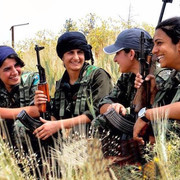
عين العرب كوباني
عندما تقاتل النساء في اروع ملحمه نسائيه في التاريخ الحديث
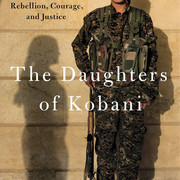
بنات كوباني هي القصة التي لا تُنسى لنساء القوات الكردية اللواتي أصبحن على الأرجح جزءًا من أفضل أمل في العالم لوقف تنظيم داعش في سوريا. فمن خلال المساعدة في ترسيخ الهزيمة الإقليمية لداعش، الذي صدمت وحشيته تجاه النساء، العالم، لعبت تلك النساء دوراً رئيساً في تحييد التهديد الذي يمثله التنظيم في جميع أنحاء العالم". وأضافت أنه "في هذه العملية، حصلت تلك النساء على احترام العالم اجمع ".
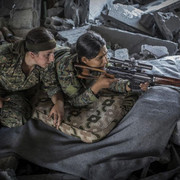
"من منزل إلى منزل وشارع إلى شارع ومدينة تلو الأخرى، أصرّت تلك النساء على جعل مساواة المرأة حقيقة واقعة بقتال الرجال الذين اشتروا وباعوا النساء. وبالاعتماد على مئات الساعات من المقابلات، تقدّم الكاتبة النساء اللواتي يقاتلن في الخطوط الأمامية، مصممات ليس فقط على إخماد إرهاب داعش ولكن أيضاً على إثبات أن المرأة يمكن أن تخوض الحرب ويجب أن تتمتع بحقوق متساوية عند السلام".
الابطال الخالدون لاينسلون الا نساء حرائر
ليست اتراح انها عوده ابو صلاح
بنات جدهم صلاح الدين
تحيه الي النساء بالطبيعه الربانيه الرجال الافاضل الشجعان بمنطق الواقع والتضحيات بنات الاكراد في عين العرب كوباني
عين العرب كوباني
عندما تقاتل النساء في اروع ملحمه نسائيه في التاريخ الحديث
بنات كوباني هي القصة التي لا تُنسى لنساء القوات الكردية اللواتي أصبحن على الأرجح جزءًا من أفضل أمل في العالم لوقف تنظيم داعش في سوريا. فمن خلال المساعدة في ترسيخ الهزيمة الإقليمية لداعش، الذي صدمت وحشيته تجاه النساء، العالم، لعبت تلك النساء دوراً رئيساً في تحييد التهديد الذي يمثله التنظيم في جميع أنحاء العالم". وأضافت أنه "في هذه العملية، حصلت تلك النساء على احترام العالم اجمع ".
"من منزل إلى منزل وشارع إلى شارع ومدينة تلو الأخرى، أصرّت تلك النساء على جعل مساواة المرأة حقيقة واقعة بقتال الرجال الذين اشتروا وباعوا النساء. وبالاعتماد على مئات الساعات من المقابلات، تقدّم الكاتبة النساء اللواتي يقاتلن في الخطوط الأمامية، مصممات ليس فقط على إخماد إرهاب داعش ولكن أيضاً على إثبات أن المرأة يمكن أن تخوض الحرب ويجب أن تتمتع بحقوق متساوية عند السلام".
June 17, 2021
I really wanted to like this book. The topic is crucially important, relevant, and fascinating. The profiles of these incredible woman would make a superb, long Atlantic article. There's probably 5-6k strong words in there, but as a book it really falls short. Lots of filler that feels ghost-written and is down-right boring. Some of my specific qualms:
- It's very 'these women knew they were different' and 'they stood up for themselves and women everywhere.' Which is great, of course! But that's about the depth of the author's intellectual dive into their feminism. I wanted to know much more.
- There's not nearly enough about the politics and feminism that define the YPJ. Ocalan is mentioned, but there's a huge gap in exploring his ideas. Basically reports that Turkey and USA think he and the PKK are terrorists (hmmmnn I wonder why?), but the USA softened up on that because the Kurds could help them fight ISIS.
-cont re politics: Murray Bookchin, the political philosopher and anarchist, who greatly influenced Ocalan, is barely mentioned. He's called 'left of Bernie Sanders.' How do you not discuss his politics in more depth?? Argubly these women wouldn't be there if it wasn't for his writings. She doesn't list Ocalan nor Bookchin's books in the further reading section. Glaring omission.
-It's super pro US military. There's possibly as many details on the army dudes as there are on the profiled women. Hundreds of words spent that basically say: US want peace, ISIS bad.
Obviously ISIS is terrible, but the level of discussion in the book would be boring for a 9th grade English class since it's so basic. Maybe from her other books army people are big fans so she wants to make them happy? Idk. I never heard of her or her books before this one.
- It's very 'these women knew they were different' and 'they stood up for themselves and women everywhere.' Which is great, of course! But that's about the depth of the author's intellectual dive into their feminism. I wanted to know much more.
- There's not nearly enough about the politics and feminism that define the YPJ. Ocalan is mentioned, but there's a huge gap in exploring his ideas. Basically reports that Turkey and USA think he and the PKK are terrorists (hmmmnn I wonder why?), but the USA softened up on that because the Kurds could help them fight ISIS.
-cont re politics: Murray Bookchin, the political philosopher and anarchist, who greatly influenced Ocalan, is barely mentioned. He's called 'left of Bernie Sanders.' How do you not discuss his politics in more depth?? Argubly these women wouldn't be there if it wasn't for his writings. She doesn't list Ocalan nor Bookchin's books in the further reading section. Glaring omission.
-It's super pro US military. There's possibly as many details on the army dudes as there are on the profiled women. Hundreds of words spent that basically say: US want peace, ISIS bad.
Obviously ISIS is terrible, but the level of discussion in the book would be boring for a 9th grade English class since it's so basic. Maybe from her other books army people are big fans so she wants to make them happy? Idk. I never heard of her or her books before this one.

April 6, 2021
I gave this book 5 stars because Goodreads says that means I thought it was "amazing," and it was. What an incredible account of women who defied their families, their traditions, and the unmitigated evil of ISIS to fight for themselves and their nationality. Truly amazing.
America's role in the conflict is elucidated in some detail, with a balanced and neutral tone. The author does a good job with the daunting task of identifying and explaining the positions of the different groups, factions, sects, and ethnic minorities that are endemic to Middle Eastern politics. I understand why she resorted to acronyms to designate the various fighting units, but as a Westerner I still found it difficult to keep everything straight. Our State Department has had the same issue for decades.
America's role in the conflict is elucidated in some detail, with a balanced and neutral tone. The author does a good job with the daunting task of identifying and explaining the positions of the different groups, factions, sects, and ethnic minorities that are endemic to Middle Eastern politics. I understand why she resorted to acronyms to designate the various fighting units, but as a Westerner I still found it difficult to keep everything straight. Our State Department has had the same issue for decades.
April 27, 2025
Wat vreemd dat er in de huidige tijd zo weinig bekend is over deze vrouwen. Koerdische vrouwen die leiding geven in het leger en die na de overwinning op gelijkwaardig niveau met mannen leiding blijven geven in de steden die zij heroverden op Isis.
Dit boek gaat over een Koerdische beweging waarbij gendergelijkheid en gezonde natuur gezien worden als de basis voor een vreedzame samenleving in een gebied waarin deze waarden werkelijk vanuit alle hoeken bedreigd worden.
Dit boek gaat over een Koerdische beweging waarbij gendergelijkheid en gezonde natuur gezien worden als de basis voor een vreedzame samenleving in een gebied waarin deze waarden werkelijk vanuit alle hoeken bedreigd worden.

March 10, 2021
When I first learned in the news that Kurdish women were instrumental in fighting ISIS in Syria, I couldn't believe it. How did women from such a patriarchal and traditional society find the courage to do this? Well, this book explains why a woman would be attracted to the life of a soldier, and rise to be a commander of large numbers of troops, both male and female -- and be instrumental in the defeat of ISIS.
The book is very well-written, and documents in great detail the lives of several Syrian Kurds who left dead-end lives and became female heroes. The author spent time behind battle lines, and knows what she's talking about. Also, her father was Kurdish, and she therefore has an understandable compassion for her subjects.
She also provides a great explanation of the political situation, especially the different factions fighting ISIS, and shows why the US and Turkey have had such baffling positions. She does not sugar-coat the situation, and is not all that supportive of Obama's or Trump's decisions. I will use this book as a reference in the future for trying to sort out the alphabet soup of Kurdish militant and political groups.
I did not enjoy reading this book. It's a war book, filled with battles and strategy, explosions and anguish. This is not the type of thing I like to spend time with. However, I considered it important to learn about these amazing women, and knew that the book would be an essential part of my library on Kurds and women's rights in general.
The book is very well-written, and documents in great detail the lives of several Syrian Kurds who left dead-end lives and became female heroes. The author spent time behind battle lines, and knows what she's talking about. Also, her father was Kurdish, and she therefore has an understandable compassion for her subjects.
She also provides a great explanation of the political situation, especially the different factions fighting ISIS, and shows why the US and Turkey have had such baffling positions. She does not sugar-coat the situation, and is not all that supportive of Obama's or Trump's decisions. I will use this book as a reference in the future for trying to sort out the alphabet soup of Kurdish militant and political groups.
I did not enjoy reading this book. It's a war book, filled with battles and strategy, explosions and anguish. This is not the type of thing I like to spend time with. However, I considered it important to learn about these amazing women, and knew that the book would be an essential part of my library on Kurds and women's rights in general.

September 1, 2021
I learned a lot with this book about Northern Syria, the Kurds and their fight against ISIS. I was embarrassed to realize how little I know about them. It is so impressive what the YPJ fighters accomplished, but what impressed me the most was their true focus on women's liberation! Their fight for equity and their ideals are a lot more progressive than many western countries'.
January 12, 2022
Around two-thirds of the way through The Daughters of Kobani, I finally had to look up who Gayle Tzemach Lemmon was. I couldn’t resist. I could no longer pick up the book and overlook the monogram, emblazoned in gold, smack in the center of the hardcover: “GTL.” Her initials were lettered in serif and bordered with a thin line, ostentatiously embossed into the cover of the book. This is weird, I kept thinking. Why would the cover design highlight the book’s author rather than something about its content? Why would she make each copy look like it had been smuggled out of her personal library? It was such an odd, patrician touch.
So I looked her up.
GTL, it turns out, is no humble writer chasing the next story about strong women, but a stone-cold member of the military industrial complex. She is a former ABC News reporter who got a Harvard MBA, “led public policy analysis” at PIMCO, is a senior fellow on the Council of Foreign Relations, and seems to be in and out of defense industry startups. Her most recent employer claims to “build AI products for the defense and security of the United States, the United Kingdom, and our allies.” Emphasis on that last part maybe? Surely our allies mean well?
This book got optioned to Hillary and Chelsea Clinton’s production company before it was published. I have no doubt it will follow nobly in the footsteps of needle-moving content like Gutsy Women and Lean In — which she went out of her way to defend from allegations of only helping well-off professional women.
None of this impugns her, necessarily, this “women can have it all” stuff. (She also wrote one of those articles.) Being a member of the elite, the political class, the World Bank, is fine. I’m glad our planet-steering ranks are filled with people who seem to align with at least some of my politics.
But once I found out that the owner of this strangely prominent monogram was, in fact, a Hillary Clinton type, the whole book made a lot more sense.
Something had felt too easy about the book. Too glazed with ESPN human-interest syrup. To be clear, the story is great. The characters are real heroes and, in these pages, we see incredible bravery. The book was good. I will remember these people for a long time, and yes, it stretched my imagination about how far women’s equality can go. Great tale to tell.
But the genuine valor of the subject matter made me that much more bothered to wonder whether, had the U.S. military come out looking negative in its interactions with these heroic women, GTL would have bothered telling the story at all.
The Daughters of Kobani is the story of the Kurdish Women’s Protection Units, or YPJ: an all-female militia that fought and beat ISIS in Northern Syria at the height of the caliphate. They rose to international fame, along with their brothers in the YPG (People’s Protection Units) as the fierce, ragtag army taking on the fight that no one in the world wanted to touch: battling ISIS toe-to-toe in cities, right in the middle of the Syrian Civil War.
Fighting for their lives, the YPG/J eventually emerged as the only viable option through which the U.S. could wage proxy war against the Islamic State. They paired up with American special forces trainers, who were endlessly impressed with how the women of the YPJ valiantly commanded male and female soldiers in battle. Supporting a Kurdish force made things awkward with Turkey, but it was the only choice at the time for U.S. politicians, who had to do something about ISIS that didn't trigger World War III in Syria.
Pour one out for the $500 million the U.S. had already spent trying to build a "moderate Syrian" army that ended up with less than 150 fighters. (117)
I’ve been sympathetic to the cause of Kurdish independence for a long time. I like that theirs is the rare nationalism with a leftist bent. But in the mid-teens, nothing prepared me for the images that started streaming in from the wire services: camouflaged women staring down their sights in the prone firing position, crouching behind walls, engaged in real-ass combat against ISIS. An all-woman militia fighting the world’s most misogynist terror group? Incredible.
GTL relies on the battle of ideologies heavily in her framing of the YPJ. She portrays the group as being made up of women who often came to military life to escape environments in which women had very little agency, if any. In the YPJ, they joined an ideology that had feminism at its core. And the group’s fight, dramatically, was against its antipode.
Even though the YPJ and YPG took on ISIS to resist territorial conquest — to survive — they could not have found a more polar opposite belief system anywhere in the world. To ISIS, according to this book, women were subhuman chattel as a matter of ideology. This was effectively a shooting war of the sexes.
Feminism was core to the YPG/J’s project thanks to Abdullah Öcalan, the freedom fighter and political theorist who in the 1970s founded the PKK (Kurdistan Workers’ Party).
“Inspired by Marxist-Leninist thought, the group called for the establishment of an independent Kurdistan, with its most urgent priority the liberation of what it called northern Kurdistan, a part of Turkey.” (7) No, ma'am, the PKK is a leftist movement, composed originally of impoverished farmers from Turkey. She doesn't spend too much time on the group's politics, of course, aside from their feminism. Quite the splice job.
When Öcalan wound up in prison in 1999, he further evolved his thinking after encountering the work of American writer Murray Brookchin. This helped him solidify the union of Kurdish self-governance and social justice.
An aside. One of the first jingoisms I noticed in this book was that GTL spent three full pages covering the life and work of Brookchin, broadly crediting him as the source of Öcalan’s latter-day thinking, and thus, the ideology of Kurdish empowerment.
This was suspect for two reasons. One, Abdullah Öcalan probably read a lot of material in prison. Why give outsized space to one American guy? Compare those three pages to the single sentence given to this story: “Not long after Öcalan fled Syria [after the U.S. designated the PKK a terrorist group at Turkey’s request] U.S. surveillance information helped Turkey arrest him as he sought safety in Kenya.” (8) Inconvenient as that U.S. antagonism towards Kurdish independence is, the text moves on quickly.
The second reason I found the focus on Brookchin odd was that Öcalan’s philosophy had sutured the rights of Kurds with the rights of women years prior. “Shatter those bonds, liberate women, let women become a flood and fall like a waterfall,” he wrote in 1992, according to this academic paper, which paints a much more realistic and complex portrait of the evolution of women’s rights in the PKK than is found in this this clearly simplified — as I said, Disney-fied — account. Brookchin’s influence, really, was to convince Öcalan that his goal was not necessarily a nation-state, but “a new set of grassroots political structures designed to support self-rule in a local, autonomous region.” (41)
GTL taking pains to make this clarification is suspect in light of the fact that later on, when the U.S. abandons the Kurds yet again, she takes even greater pains to excuse it. Don’t worry, she says, the Kurds were used to getting betrayed and they never expected the U.S. to be a partner for the long term.
Glossed over is the speed and brazenness with which the Americans did abandon their Kurdish partners. In 2019, six months after American officials hosted a star-spangled ceremony with the Kurdish fighters who defeated ISIS, the U.S. made the decision to completely leave the region and let Turkish forces overwhelm the YPG. GTL reports on this, but spares a scant few moments of introspection for what must have felt like a bitter betrayal. “Indeed, at America’s direct request, the SDF had recently destroyed all its positions built to defend against a Turkish incursion.” (207)
Reflecting on the moment in 2017 when the Trump administration took its predecessor’s advice and armed the Syrian Democratic Forces (SDF) — a construction of the U.S. military that sprinkled a few Arabs into the Kurdish fighting force to save face with Turkey — GTL paints her noble characters as pragmatists who probably weren’t that into U.S. support anyway.
Didn’t work, ladies! Turns out the U.S. wanted to expend not one more ounce of political capital than necessary to defend the Kurds once they had finished doing the world’s dirty work. To be clear, a Kurdish state was never on the table. Doing the bare minimum to protect Kurdish fighters from being attacked by Turkey, though, I have to believe, was within the realm of the possible.
Even in mentioning America’s craven realpolitik, GTL wants to turn the focus back, always back, to the uplifting part of the story: the girlbosses who won against the evil terrorists and the U.S. military characters who helped them.
No word from GTL on whether the U.S. treating the Kurds like a dirty diaper was a blow to those utopian visions. Were the Kurds really as calloused as GTL wants them to be? If they were, I am not. There’s a difference — there has to be — between weighing regional alliances and abdicating all relations with the Kurds. Yet GTL insists this abandonment was part of Kurdish forecasting. In 1991, the U.S. promised Iraqi Kurds backing if they rose up against Saddam and then promptly ghosted, letting them get massacred. This does not get more than a glancing mention in this book, and certainly not a moral judgment from the author, even though she has many for ISIS and for the brave YPJ. The purpose of bringing it up is solely to have us believe that the U.S. is a known fuckboy and no one realistically expected anything from it.
GTL’s forgiving stance towards the U.S. wouldn’t be so glaring if the “plot” of the book was not, for the most part, about the U.S.’s involvement with the YPJ. The focus is always on the women themselves, with GTL doing her best Mark Bowden impression to recreate sizzling battlefield scenes, (meh), but fundamentally, the reader is with the YPJ for about as long as the American special forces trainers are. She characterizes these operators kind of like how the CIA guy in Black Panther is portrayed: homespun, head-shaking professionals who pop in on the margins of emergencies to help the plucky gals at the last, dramatic second. American military intervention, in this story, is an unalloyed good, helping good people.
It makes for a shallow, almost insultingly tidy story. How many YPJs out there have been equally noble but ended up, unfortunately, the target of U.S.-supplied ammunition? She ridicules the imprecision of Russian air strikes (118) while portraying the Americans’ supporting air cover as a prolongation of Tom Hanks’ last moments in Saving Private Ryan. Again: not a moment to spare for the weddings we drone or the civilian casualties we kill. In this case, because the enemy is ISIS, she’s comfortable writing off all of the air strikes’ civilian casualties as being ISIS’s fault.
But the thing is, they were. ISIS is evil. The women of the YPJ are inspiring. Which brings me to the crux of my critique: I can’t help but wonder if these women would have gotten the attention of this apparatchik of the U.S. military industrial complex if the story was any more complicated. Or if the U.S. weren’t the good guys on the side of the heroines. If they didn't star in a drama that could be reported at the political depth of a USAA commercial.
We Americans have a long history of crowing, endlessly, about our military actions when they’re righteous. Beat the Nazis once and it earns you a century-plus of goodwill, erasing many ill-fated interventions after that and overshadowing untold misery visited on the world by our cavalier use of military power.
In this case, with the story of the YPJ vs. ISIS, I do agree that GTL found a good subject for a feel-good story about the U.S. fighting a proxy war. The setting and specifics are dramatic, the enemy is evil, and we fucking won. A neocon can be right twice a day. At the same time, I resent GTL for glossing over the ideology of the YPJ — an explicitly leftist force ideologically bound to the project of self-determination, a goal we did not help them with — in favor of a story she can tell to her defense contractor friends in The Wing.
This is an incredible scene. It deserves to be told outside the confines of MIC propaganda.
The sins of The Daughters of Kobani should not be borne by the heroic fighters of the YPJ. It’s not their fault that they happened to be exploited by an American, yet again — this time as the subject of facile storytelling that embodies everything wrong with the selective memories and rose-tinted glasses with which Americans interact with our military.
So I looked her up.
GTL, it turns out, is no humble writer chasing the next story about strong women, but a stone-cold member of the military industrial complex. She is a former ABC News reporter who got a Harvard MBA, “led public policy analysis” at PIMCO, is a senior fellow on the Council of Foreign Relations, and seems to be in and out of defense industry startups. Her most recent employer claims to “build AI products for the defense and security of the United States, the United Kingdom, and our allies.” Emphasis on that last part maybe? Surely our allies mean well?
This book got optioned to Hillary and Chelsea Clinton’s production company before it was published. I have no doubt it will follow nobly in the footsteps of needle-moving content like Gutsy Women and Lean In — which she went out of her way to defend from allegations of only helping well-off professional women.
None of this impugns her, necessarily, this “women can have it all” stuff. (She also wrote one of those articles.) Being a member of the elite, the political class, the World Bank, is fine. I’m glad our planet-steering ranks are filled with people who seem to align with at least some of my politics.
But once I found out that the owner of this strangely prominent monogram was, in fact, a Hillary Clinton type, the whole book made a lot more sense.
Something had felt too easy about the book. Too glazed with ESPN human-interest syrup. To be clear, the story is great. The characters are real heroes and, in these pages, we see incredible bravery. The book was good. I will remember these people for a long time, and yes, it stretched my imagination about how far women’s equality can go. Great tale to tell.
But the genuine valor of the subject matter made me that much more bothered to wonder whether, had the U.S. military come out looking negative in its interactions with these heroic women, GTL would have bothered telling the story at all.
The Daughters of Kobani is the story of the Kurdish Women’s Protection Units, or YPJ: an all-female militia that fought and beat ISIS in Northern Syria at the height of the caliphate. They rose to international fame, along with their brothers in the YPG (People’s Protection Units) as the fierce, ragtag army taking on the fight that no one in the world wanted to touch: battling ISIS toe-to-toe in cities, right in the middle of the Syrian Civil War.
Fighting for their lives, the YPG/J eventually emerged as the only viable option through which the U.S. could wage proxy war against the Islamic State. They paired up with American special forces trainers, who were endlessly impressed with how the women of the YPJ valiantly commanded male and female soldiers in battle. Supporting a Kurdish force made things awkward with Turkey, but it was the only choice at the time for U.S. politicians, who had to do something about ISIS that didn't trigger World War III in Syria.
The U.S. needed a force capable and determined enough to fight ISIS but willing to stop short of taking on Assad. America had no desire to institute a regime change in Damascus or to be responsible for the future of another nation in the Middle East. The Obama administration felt it had to defeat ISIS, saw no standing armies ready to do so, and had no intention of putting Americans on the ground. (55)
Pour one out for the $500 million the U.S. had already spent trying to build a "moderate Syrian" army that ended up with less than 150 fighters. (117)
For the United States, the YPG remained the only ground force that stood a chance of countering ISIS militarily, and the Kurds sought self-rule, not regime change… Special operations forces drew up possible plans to support this small band of fighters that seemed to be managing to do what no one else had; the YPG and the YPJ had shown they could be tactically resilient and disciplined enough to take on ISIS. Most important, they entered the fight with a will to win. (59)
I’ve been sympathetic to the cause of Kurdish independence for a long time. I like that theirs is the rare nationalism with a leftist bent. But in the mid-teens, nothing prepared me for the images that started streaming in from the wire services: camouflaged women staring down their sights in the prone firing position, crouching behind walls, engaged in real-ass combat against ISIS. An all-woman militia fighting the world’s most misogynist terror group? Incredible.
GTL relies on the battle of ideologies heavily in her framing of the YPJ. She portrays the group as being made up of women who often came to military life to escape environments in which women had very little agency, if any. In the YPJ, they joined an ideology that had feminism at its core. And the group’s fight, dramatically, was against its antipode.
Even though the YPJ and YPG took on ISIS to resist territorial conquest — to survive — they could not have found a more polar opposite belief system anywhere in the world. To ISIS, according to this book, women were subhuman chattel as a matter of ideology. This was effectively a shooting war of the sexes.
Battling ISIS had become deeply personal to Znarin. She had seen its commanders; she had seen its prisoners. She had seen the women who fought as part of the Islamic State’s forces — as Azeema’s teammates had that day in Kobani, when they spotted a female sniper — and the women the ISIS men married. She also had seen the dead bodies of ISIS fighters decaying in the street. While the world considered ISIS a movement, Znarin zaw it as far less grand than that: for her, ISIS was a group of men who brutalized women and who wanted to destroy her and her friends. (143)
Feminism was core to the YPG/J’s project thanks to Abdullah Öcalan, the freedom fighter and political theorist who in the 1970s founded the PKK (Kurdistan Workers’ Party).
“Inspired by Marxist-Leninist thought, the group called for the establishment of an independent Kurdistan, with its most urgent priority the liberation of what it called northern Kurdistan, a part of Turkey.” (7) No, ma'am, the PKK is a leftist movement, composed originally of impoverished farmers from Turkey. She doesn't spend too much time on the group's politics, of course, aside from their feminism. Quite the splice job.
When Öcalan wound up in prison in 1999, he further evolved his thinking after encountering the work of American writer Murray Brookchin. This helped him solidify the union of Kurdish self-governance and social justice.
An aside. One of the first jingoisms I noticed in this book was that GTL spent three full pages covering the life and work of Brookchin, broadly crediting him as the source of Öcalan’s latter-day thinking, and thus, the ideology of Kurdish empowerment.
This was suspect for two reasons. One, Abdullah Öcalan probably read a lot of material in prison. Why give outsized space to one American guy? Compare those three pages to the single sentence given to this story: “Not long after Öcalan fled Syria [after the U.S. designated the PKK a terrorist group at Turkey’s request] U.S. surveillance information helped Turkey arrest him as he sought safety in Kenya.” (8) Inconvenient as that U.S. antagonism towards Kurdish independence is, the text moves on quickly.
The second reason I found the focus on Brookchin odd was that Öcalan’s philosophy had sutured the rights of Kurds with the rights of women years prior. “Shatter those bonds, liberate women, let women become a flood and fall like a waterfall,” he wrote in 1992, according to this academic paper, which paints a much more realistic and complex portrait of the evolution of women’s rights in the PKK than is found in this this clearly simplified — as I said, Disney-fied — account. Brookchin’s influence, really, was to convince Öcalan that his goal was not necessarily a nation-state, but “a new set of grassroots political structures designed to support self-rule in a local, autonomous region.” (41)
GTL taking pains to make this clarification is suspect in light of the fact that later on, when the U.S. abandons the Kurds yet again, she takes even greater pains to excuse it. Don’t worry, she says, the Kurds were used to getting betrayed and they never expected the U.S. to be a partner for the long term.
Fauzia didn’t know how to think about the future. None of them did. They understood that in a given afternoon they could face Syrian government forces or a Turkish attack or a Russian offensive or an ISIS onslaught. Maybe all of those at once. They knew the Americans could abandon them the moment they judged that supporting the Kurds no longer served their interests. Whatever happened the next day would happen the next day. But for now they would stay organized, consolidate their gains, and build on them. (163)
Glossed over is the speed and brazenness with which the Americans did abandon their Kurdish partners. In 2019, six months after American officials hosted a star-spangled ceremony with the Kurdish fighters who defeated ISIS, the U.S. made the decision to completely leave the region and let Turkish forces overwhelm the YPG. GTL reports on this, but spares a scant few moments of introspection for what must have felt like a bitter betrayal. “Indeed, at America’s direct request, the SDF had recently destroyed all its positions built to defend against a Turkish incursion.” (207)
Reflecting on the moment in 2017 when the Trump administration took its predecessor’s advice and armed the Syrian Democratic Forces (SDF) — a construction of the U.S. military that sprinkled a few Arabs into the Kurdish fighting force to save face with Turkey — GTL paints her noble characters as pragmatists who probably weren’t that into U.S. support anyway.
The Americans could still sever ties with the Syrian Kurds the moment they didn’t need them, but in the meantime the U.S. had signaled publicly to the world that it had chosen the Kurdish-led forces for the highest-profile fight yet. This step toward international legitimacy mattered a lot more to the Syrian Kurds than any of the American weapons.
Now Nowruz and Rojda and the fighters serving under them sought battlefield victories resounding enough to convince the U.S. that remaining aligned with them would serve America’s counter-terrorism interests while buying time for their own political project to grow. (179)
Didn’t work, ladies! Turns out the U.S. wanted to expend not one more ounce of political capital than necessary to defend the Kurds once they had finished doing the world’s dirty work. To be clear, a Kurdish state was never on the table. Doing the bare minimum to protect Kurdish fighters from being attacked by Turkey, though, I have to believe, was within the realm of the possible.
Even in mentioning America’s craven realpolitik, GTL wants to turn the focus back, always back, to the uplifting part of the story: the girlbosses who won against the evil terrorists and the U.S. military characters who helped them.
The Americans offered the Syrian Kurds military support, but no one could say with certainty how long that would last. Given America’s history of abandoning the Kurds, she found it hard to imagine that they would be enduring allies, even if she hoped she was wrong. If circumstances forced America to choose between a few million Syrian Kurds and Turkey, a populous and powerful NATO ally, the Kurds would lose every time. All these gains they had fought for since 2011 could vanish instantly if regional powers decided to attack.
The irony of the unintended consequences of ISIS’s decision to attack Kobani was striking. By setting out to achieve its utopian vision of ideological dominance in such a splashy and barbaric way in 2013 and 2014, ISIS had inadvertently led the United States to counter with the only ground force that met its needs: the People’s Protection Units. With America’s support, the Syrian Kurds had turned Kobani into an opening that allowed their own utopian vision to come to life. (167)
No word from GTL on whether the U.S. treating the Kurds like a dirty diaper was a blow to those utopian visions. Were the Kurds really as calloused as GTL wants them to be? If they were, I am not. There’s a difference — there has to be — between weighing regional alliances and abdicating all relations with the Kurds. Yet GTL insists this abandonment was part of Kurdish forecasting. In 1991, the U.S. promised Iraqi Kurds backing if they rose up against Saddam and then promptly ghosted, letting them get massacred. This does not get more than a glancing mention in this book, and certainly not a moral judgment from the author, even though she has many for ISIS and for the brave YPJ. The purpose of bringing it up is solely to have us believe that the U.S. is a known fuckboy and no one realistically expected anything from it.
GTL’s forgiving stance towards the U.S. wouldn’t be so glaring if the “plot” of the book was not, for the most part, about the U.S.’s involvement with the YPJ. The focus is always on the women themselves, with GTL doing her best Mark Bowden impression to recreate sizzling battlefield scenes, (meh), but fundamentally, the reader is with the YPJ for about as long as the American special forces trainers are. She characterizes these operators kind of like how the CIA guy in Black Panther is portrayed: homespun, head-shaking professionals who pop in on the margins of emergencies to help the plucky gals at the last, dramatic second. American military intervention, in this story, is an unalloyed good, helping good people.
It makes for a shallow, almost insultingly tidy story. How many YPJs out there have been equally noble but ended up, unfortunately, the target of U.S.-supplied ammunition? She ridicules the imprecision of Russian air strikes (118) while portraying the Americans’ supporting air cover as a prolongation of Tom Hanks’ last moments in Saving Private Ryan. Again: not a moment to spare for the weddings we drone or the civilian casualties we kill. In this case, because the enemy is ISIS, she’s comfortable writing off all of the air strikes’ civilian casualties as being ISIS’s fault.
But the thing is, they were. ISIS is evil. The women of the YPJ are inspiring. Which brings me to the crux of my critique: I can’t help but wonder if these women would have gotten the attention of this apparatchik of the U.S. military industrial complex if the story was any more complicated. Or if the U.S. weren’t the good guys on the side of the heroines. If they didn't star in a drama that could be reported at the political depth of a USAA commercial.
We Americans have a long history of crowing, endlessly, about our military actions when they’re righteous. Beat the Nazis once and it earns you a century-plus of goodwill, erasing many ill-fated interventions after that and overshadowing untold misery visited on the world by our cavalier use of military power.
In this case, with the story of the YPJ vs. ISIS, I do agree that GTL found a good subject for a feel-good story about the U.S. fighting a proxy war. The setting and specifics are dramatic, the enemy is evil, and we fucking won. A neocon can be right twice a day. At the same time, I resent GTL for glossing over the ideology of the YPJ — an explicitly leftist force ideologically bound to the project of self-determination, a goal we did not help them with — in favor of a story she can tell to her defense contractor friends in The Wing.
The same conversation kept greeting the YPJ fighters as they made their way toward the center, clearing Manbij of ISIS. Mothers and daughters, especially, would come out into the streets. The women from Manbij would stare at them, talk with them, and sometimes hug them wordlessly, their embraces expressing more than words could about just how much they had witnessed and suffered. Znarin realized how strange it must have been for women in these villages to see female soldiers come through with braids and ponytails, carrying rifles and dressed in camouflage; it was strange enough for the Kurdish families to whom these women belonged. (147)
This is an incredible scene. It deserves to be told outside the confines of MIC propaganda.
The sins of The Daughters of Kobani should not be borne by the heroic fighters of the YPJ. It’s not their fault that they happened to be exploited by an American, yet again — this time as the subject of facile storytelling that embodies everything wrong with the selective memories and rose-tinted glasses with which Americans interact with our military.

August 21, 2025
I wish Goodreads would update their reviews to allow for .5 stars, because I would put this at a 3.5 star read. I felt myself lagging in some places, not wanting to continue because Lemmon's narrative voice is somewhat repetitive, but holy shit was this an interesting story (narrative style aside).
Like many of my white friends growing up in CA, I lived a life half-listening to the politics my parents discussed in our house. Obama's presidency lasted from the time I was six until I was fourteen, when we then watched Trump get elected for the first time. The vast majority of this book describes the years-long fight between ISIS and, namely, a female-led military group out of Northern Syria, whose ideals and convictions were inspired by Abdullah Ocalan (seems like a fascinating fellow, I'll be reading more about him for sure). Lemmon follows three female commanders as they lead the offensive against ISIS's forces, detailing the specifics of the group's creation, its rise in international legitimacy, and its current obstacles after losing US backing and thus facing Turkey's full military might.
The most striking part of the story, and something which I wish Lemmon had taken more time exploring, was the depth of emotion those women must have felt, and still feel. Many of the female fighters who joined early in the YPG's days sought an outlet for their frustration toward their respective societies; not only did they face daily threats on the basis of their ethnicity (being part of the Kurdish minority in Syria), they faced daily discrimination and oppression on the basis of being women. Joining the YPG gave them a chance to alter their own futures and the futures of women to come after them, despite the sociopolitical climate toward both Kurds and women at the time.
Azeema, a female commander, is shot during one of the last offensive pushes in the city of Kobani by an ISIS soldier--a bald man whom Azeema makes eye contact with moments before being shot in the chest. She shoots him in return, and she survives. The bullet is lodged mere inches from her heart, but she survives. Lemmon describes briefly how often Azeema thinks of that man, sees him in her dreams, and I find myself stuck on that relationship above all others in this book. These women knew how ISIS soldiers operated on an intimate level. They had to, otherwise they would have died trying to defend against an enemy they didn't understand. But Azeema recognized, in the bald man who shot her and in the other soldiers they encountered, the force of their hatred. She knew they wanted her dead because she was a woman, and she returned her rage to them tenfold. I marvel now at the fact that while I was growing up in (all things considered) my safe neighborhood in Los Angeles, these women endured war to secure the same social privileges I walked around with, completely unaware.
While I whined about Trump coming into office and sullying the good name of American politics, worked on my college applications, and tried to acknowledge the privilege of having a safe home during the pandemic, the Kurdish women in the SDF fought to retain American support against a country that wanted them eradicated, and an ideology that would not soon be erased despite facing military defeat.
Now, I look at the state of the US under Trump's second term, and I wonder if American women, specifically white women, will be able to nurture that kind of resolution within ourselves to keep each other safe and ensure that safety for generations to come. If you've read this far, know I'm considering moving this to a Substack post, lol.
Like many of my white friends growing up in CA, I lived a life half-listening to the politics my parents discussed in our house. Obama's presidency lasted from the time I was six until I was fourteen, when we then watched Trump get elected for the first time. The vast majority of this book describes the years-long fight between ISIS and, namely, a female-led military group out of Northern Syria, whose ideals and convictions were inspired by Abdullah Ocalan (seems like a fascinating fellow, I'll be reading more about him for sure). Lemmon follows three female commanders as they lead the offensive against ISIS's forces, detailing the specifics of the group's creation, its rise in international legitimacy, and its current obstacles after losing US backing and thus facing Turkey's full military might.
The most striking part of the story, and something which I wish Lemmon had taken more time exploring, was the depth of emotion those women must have felt, and still feel. Many of the female fighters who joined early in the YPG's days sought an outlet for their frustration toward their respective societies; not only did they face daily threats on the basis of their ethnicity (being part of the Kurdish minority in Syria), they faced daily discrimination and oppression on the basis of being women. Joining the YPG gave them a chance to alter their own futures and the futures of women to come after them, despite the sociopolitical climate toward both Kurds and women at the time.
Azeema, a female commander, is shot during one of the last offensive pushes in the city of Kobani by an ISIS soldier--a bald man whom Azeema makes eye contact with moments before being shot in the chest. She shoots him in return, and she survives. The bullet is lodged mere inches from her heart, but she survives. Lemmon describes briefly how often Azeema thinks of that man, sees him in her dreams, and I find myself stuck on that relationship above all others in this book. These women knew how ISIS soldiers operated on an intimate level. They had to, otherwise they would have died trying to defend against an enemy they didn't understand. But Azeema recognized, in the bald man who shot her and in the other soldiers they encountered, the force of their hatred. She knew they wanted her dead because she was a woman, and she returned her rage to them tenfold. I marvel now at the fact that while I was growing up in (all things considered) my safe neighborhood in Los Angeles, these women endured war to secure the same social privileges I walked around with, completely unaware.
While I whined about Trump coming into office and sullying the good name of American politics, worked on my college applications, and tried to acknowledge the privilege of having a safe home during the pandemic, the Kurdish women in the SDF fought to retain American support against a country that wanted them eradicated, and an ideology that would not soon be erased despite facing military defeat.
Now, I look at the state of the US under Trump's second term, and I wonder if American women, specifically white women, will be able to nurture that kind of resolution within ourselves to keep each other safe and ensure that safety for generations to come. If you've read this far, know I'm considering moving this to a Substack post, lol.

February 20, 2022
“What I know is that the young women I met across northeastern Syria, from all its communities—Arab, Kurd, Christian—want the same things from their lives as thousands of girls I have met every other place in the world, including the United States: a chance to go to school and an opportunity to forge their own future. The world has a way of telling girls and young women what they should want from their lives, and of telling them not to ask for too much.”~ Gayle Tzemach Lemmon
'The Daughters of Kobani' is the incredible story about the all-women grassroots army of Kobani, Syria that fought against ISIS trying to take over their city with the intentions of committing the same atrocities they inflicted on Sinjar. In 2014 ISIS took over the city of Sinjar in Iraq that led to the killing of over 10,000 Yazidis, mostly men and the elderly, and the enslavement and trafficking of the Yazidi girls and women. When the Kurdish town of Kobani heard that ISIS was on their way to inflict the same horrors on them, the women took action and stood their ground. The young girls and women faced great horrors once ISIS figured out they were in combat with women and stood to risk so much if they were captured as prisoners of war.
With on-the-ground reporting and interviews with the women who fought on the front lines for three years in the battle against ISIS Gayle tells the amazing story of these incredible women. These women won far more than just the battle against ISIS, they won hope for their people and the ability to create a brighter future for their city. This book is incredible, and I know I'll be thinking about the daughters of Kobani a lot.
'The Daughters of Kobani' is the incredible story about the all-women grassroots army of Kobani, Syria that fought against ISIS trying to take over their city with the intentions of committing the same atrocities they inflicted on Sinjar. In 2014 ISIS took over the city of Sinjar in Iraq that led to the killing of over 10,000 Yazidis, mostly men and the elderly, and the enslavement and trafficking of the Yazidi girls and women. When the Kurdish town of Kobani heard that ISIS was on their way to inflict the same horrors on them, the women took action and stood their ground. The young girls and women faced great horrors once ISIS figured out they were in combat with women and stood to risk so much if they were captured as prisoners of war.
With on-the-ground reporting and interviews with the women who fought on the front lines for three years in the battle against ISIS Gayle tells the amazing story of these incredible women. These women won far more than just the battle against ISIS, they won hope for their people and the ability to create a brighter future for their city. This book is incredible, and I know I'll be thinking about the daughters of Kobani a lot.
February 23, 2026
Amazing book and well written. The author goes into great detail about the Syrian civil war, this part was hard for me to wrap my head around. . . but she also describes in detail how the women - and she follows several specifically - of the YPJ contributed as armed soldiers to the defeat of ISIS in Kobani and other towns. Not only does she discuss what these brave women did to work with the YPG to take back cities and free hostages (many whom were women), she also details how ISIS was/is so much worse than Al-Quaida and what they did to the women they captured during this time.
December 28, 2022
Introduced to this book via Robert Evans podcast The Women's War by IHeartRadio.
Displaying 1 - 30 of 469 reviews