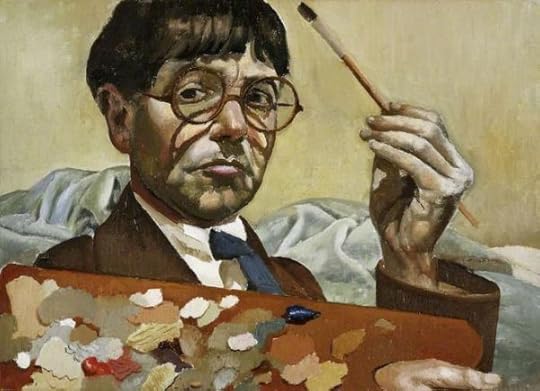
If you like poking your nose into other people’s weird sex lives, as I do, Stanley Spencer is a rare treat.
Here you have a brilliant artist who thought (like Prince and Leonard Cohen) that there was no difference between religion and sex - as he said:
A man raises a woman’s dress with the same passionate admiration and awe for the woman as the priest raises the Host at the altar
And he thought that a man ought to have two wives, and this is the ghostwritten memoir of his second wife Patricia. In the England of the 1930s this polygamy and religion stuff was fairly far out, especially since the religion he was obsessed with was one he had invented. He would routinely lift all the gospel stories and recast them as episodes in his own life. So, for instance, when he joined the British Army in 1914 he painted Christ Taking Up His Cross, and when he came back to Cookham, his earthly English village paradise, he painted Christ’s Entry into Jerusalem.
What was Stanley like?
He preferred listeners, and given the opportunity, would embark on monologues lasting several hours, speaking with animation in his curious falsetto voice, his gestures quick and sudden
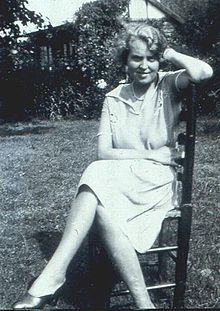
He got married to a fellow art student named Hilda and had two kids, so far so conventional. Seven years later he met a newcomer to Cookham and things took a strange turn. She was Patricia Preece,
also a painter, and had moved with her lifelong friend Dorothy Hepworth, also a painter. Patricia never went anywhere without Dorothy.
Stanley fell in love with Patricia and began buying her lots and lots of clothes.
Then he would hurry me into a shoe shop… I would have to totter up and down in innumerable pairs of bright and beastly shoes with enormous high heels as he stared at my feet and legs with fascination. The sales girls hid their titters as best they could.
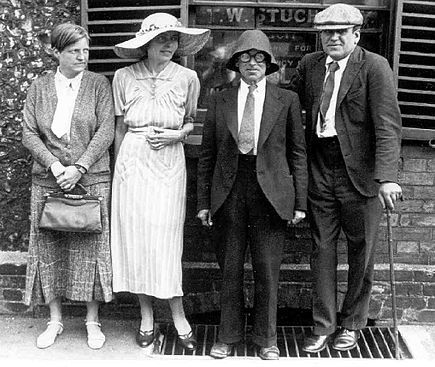
And then he got divorced from Hilda and got married to Patricia. Here is the wedding photo.
Dorothy is on the left. Patricia towers over Stanley who was the same height as the late Prince. Stanley is wearing his favourite felt hat. I have no idea what sort of spectacles or goggles those are. The other guy is the best man.
After the ceremony Patricia and Dorothy left Cookham for St Ives in Cornwall where the happy couple were to honeymoon. But Stanley stayed for a few days in Cookham. He had a cunning plan. He had invited his ex-wife to visit on the following day. He inveigled her and bamboozled her with his boyish charm and even though she was a Christian Scientist and now divorced from him, they went to bed together. This was part of his plan. She would now be wife 2 and Patricia would be wife 1. He explained that to her. She thought he was mad and left. He went to St Ives and then explained to Patricia what had happened and that she would now be wife 1 and Hilda would be wife 2.
Two wives were the very least he could do with. It might be that he would find he required more.
Patricia, like Hilda, did not take kindly to this notion and Stanley ended up with zero wives. Patricia insisted on refusing all marital relations from that point onward and continued to live with Dorothy until her death. In subsequent times, allegedly,
whenever there as nothing better to do, she would chase him down the street, shouting abuse and striking him with a tennis racket.
Stanley then went about the village – and later in the art world of London - pouring out his marital difficulties to anyone and everyone, explaining how he had married Patricia and now she would not even give him houseroom, and clearly had duped him into marriage because he was a famous artist. Lies, and more lies.
Many were to hear, and to believe, the incredible story of my vice and wickedness. How I had taken advantage of his infatuation for me to swindle him out of his house, money, pictures and other possessions. How I had run up bills in his name for clothes, jewellery and drink. How I had ended his marriage to Hilda, his only true love, and got him to marry me with the object of being supported in idleness forever.
This image of Patricia as mad harpy persisted, as Stanley prudently omitted the Two Wives stuff. Patricia continued to be his wife, they never divorced, so when he was knighted she became Lady Patricia Spencer. Stanley was poor all his life until the last 7 years because no one wanted to buy his weird religious paintings (I would have).
So the public still thought of her as a gold-digging vampire. After Stanley died in 1959 she decided that now was the time to tell the real truth and found a ghost-writer to put her story together, and this is her book. She insisted it could only be published after she died, and I understand why. She doesn’t hold back :
Patricia on Hilda
The truth was that Hilda had not the slightest idea of how to be a wife. Her strange inertia combined with a low intelligence reduced her to the state of a perpetual passenger in the world.
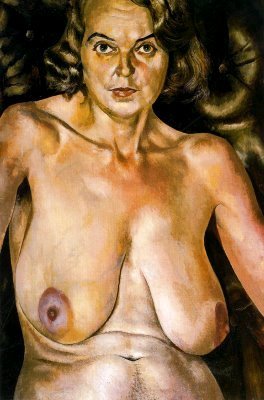
Patricia on Stanley’s nude portraits of her:
These were remarkable for their twisted sensuality and for their amazing ugliness. I think it would be difficult to find any paintings so lacking in the charms of the human person.
What an extraordinary document this book is. It tells the tale of a terrible deception by Stanley. But it never admits to a terrible deception on Stanley. It seems to me that Patricia and Dorothy were the real true lovers in all of this, but of that relationship Patricia breathes not a word. Who was fooling who?
So this book raises the interesting question (among many others) : can two unrelated people of the same sex live together for their entire adult lives and never live with anyone else and simply regard each other as their best friend and never consider that they are gay? Probably not these days, but back in the 1930s and 40s? It seems strange.