Two dramatic themes combine in this powerful a heroic figure struggling toward a destiny both glorious and tragic, and the confluence of two cultures, each with its own rich tradition and world view.
It looks/feels like an Endo’s book; truly, a historical novel in the vein of Endo,Shusako* https://www.goodreads.com/review/show... recalling old times of medieval Japan, times when other nations started arriving and brought new things in and….a new religion: Christianity.
Like Endo, Tsuji had some time of learning in France.
Tsuji’s, is a collection of letters sent by an unidentified Italian. These letters were found in southern France and translated into French. A comparison to other documents led to the conclusion that this Italian man didn’t belong to the Jesuits; he even had a critical view of the Church.
The calligraphy had been compared to the chronicles of Diego de Mesquita (1582) and the History of Japan by Luís Frois**. It seems that these letters never got to their destiny. They were written in the São Paulo seminar in Goa, India.
The author introduces the epistolary set, by saying he’s translated them because they offered a “brilliant portrait” of 16th century Japan, from a “different point of view”.
“I cannot recall exactly in what year I wrote you for the last time, I guess it was 1573, maybe a year later”….
So the Italian starts disclosing his “afflicted destiny” which started with his own (fair, he thinks) act of murder: he had killed his wife and her lover, back in Genoa. Then escaping to Lisbon…for 10 years in the sea;… till he reaches Japan in the summer of 1570.
Stationed in Goa he recalls those years in Japan, where he learned that “mellifluous” language. In Goa, while he writes down, he notices that it’s been 3 months no ships arrive, from Portugal.
He landed in Japan, in the village of Kuchinotsu, accompanied by priest Cabral and the “extraordinary” priest Organtino, whose security the Italian man has to ensure. Next, they depart to Shiki village where several Japanese friars speak Portuguese, fluently.
His first impression of the Japanese people is like this: “courteous and white-skin” people….with an “easy smile” and “extreme” personal hygiene. Yet, with a certain “disdain…”.
Meanwhile, they meet with “old and sick” priest Torres (who would die in October) who entrusts them with a mission: trying to spot and help priest Frois who had been left alone in Miyako.
So it goes the writing of this Italian midst the “eternal summer” of Goa: “here we don’t have winter nor a true spring or autumn”. In Goa’s seminar, priests get prepared to serve as missionaries ….and the Portuguese ships are “little reliable” regarding the correspondence, thinks the writer. He served as an officer in Nuova Spagna [Central America].
The book has got an introduction by Stephen Snyder***, who points the attention to the fact that, in historical novels, the text demands something else from the reader: (historical) Knowledge. Stephen mentions the case of Tolstoy and his Napoleon description. It only works (the reading) if you’ve got some prior knowledge of the French ruler.
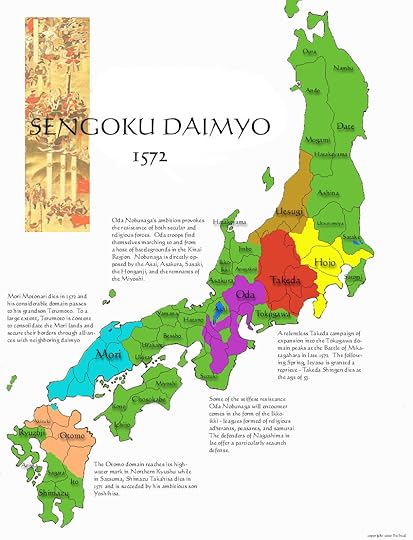
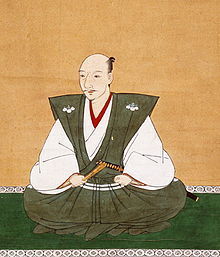
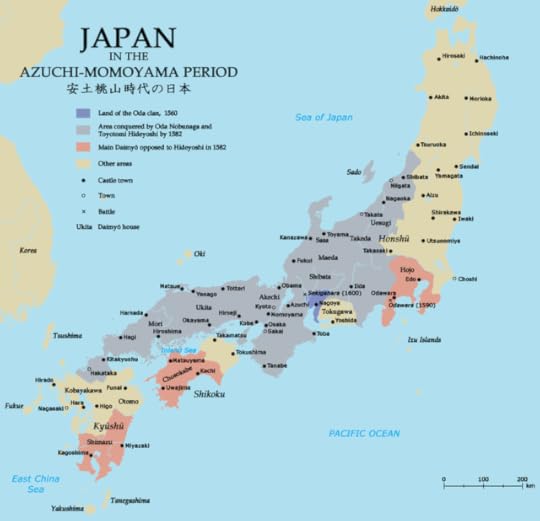
But now I was confronted with this character called The Signore (the factual ODA NOBUNAGA),I had no prior knowledge on. It appears he was responsible for the unification of Japan. A man from the Owari province, he would be involved in the fight against an army of monk-soldiers, of the Buddhist sect Ikko. That fight took 20 years (1559-1580) until nearly 20 warlords (Daímos) were subjugated by Oda.
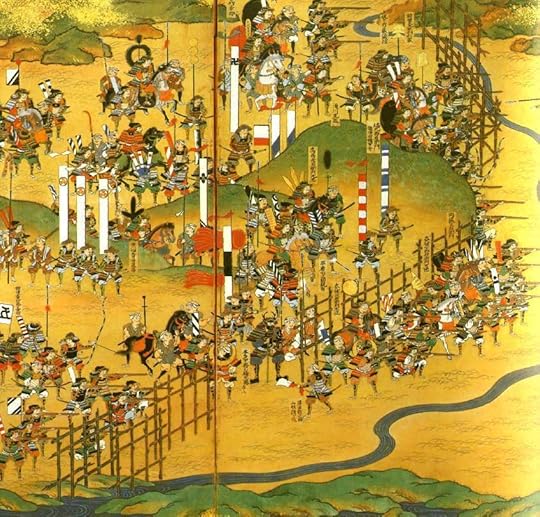
(Battle of Nagashino.June 28, 1575)
(The areas in purple show the areas controlled by the Oda in 1560, and the grey area were the territory Nobunaga controlled at the time of his death in 1582)
His successors Toyotomi Hideyoshi and Tokugawa will usher in Modern Japan. After 200 years of civil war.
The book had its English translation as “The Signore, Shogun of the warring states”. I am reading the Portuguese version, translated from the English one.
Interesting account of Nobunaga wars for the unification of Japan through the eyes of an Italian mercenary attached to the Portuguese Catholic mission in Japan, but very dry writing (or translation)