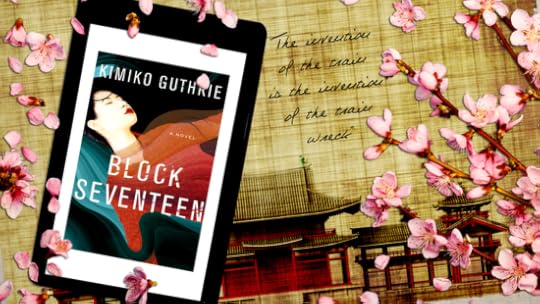
Akiko “Jane” Thompson, a half-Japanese, half-Caucasian woman in her midthirties, is attempting to forge a quietly happy life in the Bay Area with her fiancé, Shiro. But after a bizarre car accident, things begin to unravel. An intruder ransacks their apartment but takes nothing, leaving behind only cryptic traces of his or her presence. Shiro, obsessed with government surveillance, risks their security in a plot to expose the misdeeds of his employer, the TSA. Jane’s mother has seemingly disappeared, her existence only apparent online. Jane wants to ignore these worrisome disturbances until a cry from the past robs her of all peace, forcing her to uncover a long-buried family trauma. As Jane searches for her mother, she confronts her family’s fraught history in America. She learns how the incarceration of Japanese Americans fractured her family, and how persecution and fear can drive a person to commit desperate acts. In melodic and suspenseful prose, Guthrie leads the reader to and from the past, through an unreliable present, and, inescapably, toward a shocking revelation. Block Seventeen , at times playful and light, at others disturbing and disorienting, explores how fear of the “other” continues to shape our minds and distort our world.
Kimiko Guthrie is the cofounder of Dandelion Dance theater and a lecturer at Cal State East Bay. She holds an MFA in choreography from Mills College. Her work has been presented internationally and has received numerous grants and awards. Block Seventeen is her first book.
“The last thing I wanted was to fall into the bogus stereotype of the passive, voiceless Asian American woman. And yet sometimes that’s exactly how I felt”.
I really wanted to like this book. It’s always fun to read books that take place in areas where you grew up... and much of this book takes place in the San Francisco Bay Area. Plus I love the Japanese culture - so it felt like a great fit. There were times I enjoyed the dialogue— yet the book felt very disjointed.
When the book was funny is when I liked it best and yet it’s not a ha ha funny book. It was dialogue like this that I enjoyed best: “That was it— all at once I burst at the seams and out came peals of wild, hysterical laughter. I fell off my chair, rolled on the floor away from the table, arched back, doubled over; I was sure my entire meal would come projecting out of me. I don’t know when I’d last been so consumed by any emotion, let alone such full-on, unabashed hysterics like this. The outburst lasted for sometime, despite my efforts to squelch it. Finally, completely drained, side aching, I collapsed on the floor, moaning lightly. It was a wonderful release, honesty”. “Um, you okay there?” Shiro asked”. “Sorry ... I have no idea where that came from ... what were we talking about? I took several deep breaths and managed to prop myself on my knees, resting my head on my chair”. “Something hilarious, apparently—your mom’s disappearance”.
Looking back..... Rohwer, September 23, 1942 “The girl stands in the doorway, watching her sister walk the baby up and down the floor of their new home: a cramped room in a newly assembled, army-style barrack, which they are told will soon be divided into two, to share with another family”.
So although I thought the book had potential - ( a young woman finding her place in the world- while trying to empathize past trauma: her mother having once been in the Japanese camps during WWII), with some enjoyable dialogue, I had problems staying focus and connecting the books purpose - it’s authenticity with my own.
Thank you Blackstone Publishing, Netgalley, and Kimiko Guthrie
Akiko Thompson, the narrator in Kimiko Guthrie’s debut novel Block Seventeen, is the daughter of a Japanese-American mother and a white American father. Just like her mother, she is not particularly keen on her Asian heritage, so much so that in her teenage years she gave up the name “Akiko” for the plainer “Jane”. Shiro, her partner of five years and the father of the child to whom Jane is telling the story, is quite the opposite. Born to a Japanese-American family, he is obsessed with the injustice suffered by his ancestors during the Second World War in the aftermath of Pearl Harbor when, despite their patriotism and US citizenship, their fields and businesses were forcefully taken and they were sent to internment camps. Shiro, who is employed with the TSA, is convinced that the same sort of injustice is being perpetrated in present-day America. He is intent on turning whistle-blower and revealing the everyday racism of the organisation which employs him.
We learn that, through a strange coincidence (or twist of fate?) Akiko and Shiro’s families were in the same internment camp. But their approach to this painful episode in their families’ past couldn’t be more different. Akiko tends to play down these dark events by pragmatically trying to fit in. In Shiro, the collective memory spurs waves of righteous indignation. This friction starts taking its toll on their relationship.
But are painful memories so easy to suppress? In Block Seventeen the past haunts the protagonists’ present, both figuratively and literally. Jane and Shiro face a series of uncanny events, some of which can be easily explained away, others less so. These strange occurrences all seem to be prodding Jane into facing her past – not only her own, but also the “collective memory” of her family and fellow Asians.
The result is a novel which hovers playfully between psychological thriller, magical realism, ghost story and historical fiction. The mix isn’t always convincing and there are certain aspects of the story which remain frustratingly hazy. But Akiko’s endearing voice and wry sense of humour pull the novel through. I also found Japanese-American perspective very interesting, shedding light on a dark chapter in 20th Century history which I, for one, was unfamiliar with.
This just wasn’t for me, I felt like I was totally missing the point of the book. There were too many pieces that didn’t seem to fit - the boyfriend who thinks his job is spying on him, the friend whose husband has left her, the distant mother, a strange “break-in” that probably isn’t, internment camps. Maybe it all pulls together at some point, but I read the last chapter and it still seems disjointed. I received a free copy of this book from the publisher.
This was not the book, this was some fake liberal but I’m still middle class and better than you but I’m not I'm really just as stuck annoying soliloquy for 9 and a half hours of my working life.
Following the life of Jane as she manoeuvres life with her oddball boyfriend and a traumatised mum; we watch as she tries to buck the trend of social media to be hip whilst also needing therapy without wanting to go to therapy. It gets old and boring real fast.
I didn’t enjoy anything about this. Whilst it went back in time and detailed some traumatic events such as the internment camps for Asian-Americans it didn’t give any punch or any aspect to engage the reader.
A boring ass long week listening to this. Just don’t bother honestly.
Reading Block 17 sent me back to reread Murakami’s The Windup Bird Chronicles. In both of these books, there is an interpenetration of the dream world and the waking world that is so complete that trying to understand what “really” happened is no longer relevant. The conscious world is not privileged over the unconscious world. They are both real, they exist together in us and in our lives. What does it feel like to let go of the need to sort them out, the need to know which is which?
And how does a woman experience this interpenetration of conscious and unconscious? More specifically, how does a woman whose family history includes the collective trauma of internment experience it?
Guthrie’s book addresses these questions, weaving in history, family, relationship issues, culture, immigration and resistance. It addresses them by examining: how does history interact with personal experience?
Many scenes address this question. Here is one:
Shiro (Jane’s partner) shows her a tape of a PBS interview with his uncle, Pops, who was a young man in World War 2. The interview came out in the 1980’s.
During the internment, Pops was one of the “No-no Boys,” the few Japanese American young men who refused to go to war to fight for the government that had imprisoned him and his family and branded them traitors. He was sent from Camp to prison.
When the interview comes out, four decades after the war, Pops and his extended family gather for a BBQ, a family reunion, for this special occasion – for everyone to see one of their own family on TV. Pops, in the tape, is visibly shy, awkward, and self-conscious for the camera. Pops who, in his ordinary life, is usually silent, begins to talk. And as he talks, becomes more and more animated, and details the experiences of Camp. The humiliation, the indignities, the shame. “Hearts were broken” he says, and “navigational specificity became unclear.” (These puzzling phrases are themes running through Block 17.) The interview goes on for quite a long time and family members watching it have begun to lose focus and to chat with one another when Pops, in the interview, says that after the war his parents had to go back home, to Hiroshima. Everyone is suddenly are silent and people say to each other “what did he say?” His parents didn’t go back to Hiroshima. Hiroshima was destroyed. His parents never returned to Japan. The family watching the interview look at each other uncertainly. They wander off back to the grill and to the table outside. They never speak of it again.
They never speak of it again: a poignant, painful picture of the way in which trauma permeates our lives and we don’t know how to comfort and heal each other.
Then, in the story of Jane and Shiro, Pops becomes a central figure, showing up both as a memory, and as a ghost.
The book asks: Is there any hope of changing history going forward? Our personal history, our collective history? Any hope of revising our lives so that we are not forever trapped in our shared history? I think the answer it offers is that it may be possible, but only if we fully and deeply understand the past history -- not only what happened, but the conscious and unconscious experience of the people who lived it.
Do not be confused: this is not a "thriller", as I went into this book thinking. It is rather a surreal, psychological study of history and cycles of familial trauma. I usually spend the next paragraph of my reviews providing a brief summary of the book, but for this one, I don't think I can say any more than what's given in the blurb already without spoiling anything or writing in clearly enough to get anything meaningful across. So let's jump right in:
Guthrie's style is clear and concise with passing moments of beautiful prose. Her dialogue is commendable; it is incredibly natural and develops character well. The story itself was reminiscent of other modern Japanese literature (Murakami, as others have noted), but better suited for an American audience structurally. It was so close to being intelligent literary fiction -- the kind that makes you think, that makes you proud when you make accurate inferences and connections.
However, where Guthrie missed the mark is understanding her audience. I'm not sure "the masses" are going to seek this book out, so it'll likely get a niche market upon publication. The themes are complex and sophisticated, so to understand and to get anything of meaning from this book, you have to think. But the author misjudges her audience and their intellect by over-explaining and even occasionally overtly stating devices or developments that the audience will clearly understand. I'm not sure she trusted her own clarity in her writing, or perhaps an editor suggested making certain ideas clearer. But motifs, metaphors, irony will bang you over the head, and then Guthrie will tell you all about it. Just in case you missed it.
If you like Haruki Murakami's work or Toni Morrison's Beloved (because this is essentially a retelling of that novel with the same themes and everything), you'll love this one.
Block Seventeen is told through the lens of Akiko, preferably Jane, and her interactions with her mother, Sumi, and boyfriend/fiance, Shiro. Throughout the novel there is a detachment between Jane and not only these individuals, but the world around her.
Guthrie reflects on the themes such as imperialism and identity through the conversation and thought processes of the characters, and how this affects different generations of Japanese/Asian Americans. Akiko/Jane is an unreliable narrator, and with the employ of distinct, vivid imagery, the reader is asked to determine for themselves whether supernatural forces are actual at play, or if Akiko/Jane is plagued by a supposed inherited mental illness.
With this novel, Guthrie analyzes generational trauma and finding your own place in the world.
Kimiko Guthrie’s beautifully written and thoroughly intriguing novel contains profound truths, stated quietly, almost as background to her gripping modern tale. She touches poignantly on the effects of locking up Japanese-Americans during WW II, how people’s lives were damaged then and would be for generations to come. We have to take a hard look at that shameful event in our history, not unlike the ongoing mass incarceration of people of color and the cruel detention of immigrants today. But it’s dark, we say to ourselves, and besides, the entire story challenges our sense of a democratic USA. We are prone to turn our eyes away, but the artistry of Block Seventeen provides an opportunity to open eyes and see the harm of mass detention. Meanwhile we get to read a great novel. Terry A. Kupers, M.D., psychiatrist and author of Prison Madness and Solitary
This book excels in the realm of a surreal, unreliable narrator experience, but fell short for me in terms of connection and plot. It felt like the author had too much to say for one book, and so the focus became muddled and lost. I could see where the author wanted me to react, but I didn’t understand why until closer to the end, and by then I really disliked the narrator and her choices, so it all seemed pointless. There were some strong moments, like the end with the crossing of the creek and the call to come home, but beyond that, I was left confused by long narrative details that led nowhere and asking why too much for my personal taste.
Thank you to NetGalley and Blackstone Publishing for allowing me to read this book in exchange for an honest review.
'We can't trust ourselves to be objective when looking back at our own lives; we're likely only to see what we want to in the present.'
Akiko 'Jane' Thompson is the child of a Japanese mother and an American mother, and the book (addressed to a 'you', whom we learn is Jane's child) looks back over the past year of her life, and covers flashbacks to her mother Sumi and family in Block Seventeen in an internment camp in Arkansas during WW2. Jane's boyfriend/fiancé, Shiro, works for the TSA (Transport Security) and is convinced of a conspiracy and cover-up at his work. Jane's mother has gone 'missing', although she continues to have an online presence and, very occasionally, speaks to Jane on the phone. And when strange things start to happen - Jane hears a baby crying in the next apartment (which is unoccupied), and there is evidence of a break-in but nothing has been taken - Jane's life starts to unravel.
This is an accomplished debut from Kimiko Guthrie, clearly based on personal family experiences. The themes of the internment of Japanese citizens and descendants during the war, of family history, of names and inheritance and identity - all of these are present, but they all fight for attention and never get fully explored. And then there is the presence of Buddhist tradition and folklore: the Jizo, protector of children, and the importance of the ceremony of Obon, to honour the spirits of one's ancestors. These are introduced quite late on the book but shed light on much of what has come before. Again, it just felt a little like the author was throwing everything into the mix, and the result is a little bit of everything - including important questions about mental health - just being slightly under-developed.
However, this is a promising debut, very well-written, that explores some dark and troubling issues. 3.5 stars, rounded up. Well worth a read.
09-28: 'Block Seventeen' by Kimiko Guthrie is a story about a young woman named Jane who's struggling to build a life with her fiancé, Shiro, all while things seemingly grow more chaotic and discordant around them.
After a strange car accident, it's almost as if they're in the eye of a storm. Someone rifles through their apartment, taking nothing.. but leaving behind strangely stacked towers of items. Shiro's distrust of the government and his employers misdeeds continues to grow.. becoming a veritable force of its own. And to top it all off, her mother seems to have disappeared.. leaving only traces of existence through online locations.. the woman becoming increasingly more difficult to track down in the real world.
While Jane searches for her mother and struggles to manage the stressors of her environment, she delves into her family's history through the incarceration of Japanese Americans, exploring the effects.. both directly and indirectly, that have rippled ever outward from those moments of loss, fear, and humiliation in a country they called home.
As a woman with mixed Asian heritage, I really wanted to love this story.. but despite it's lofty goals, it just never reached me deeply.
Guthrie certainly has a way with words and does a lovely job telling the story of these lives as they're spiraling outwardly, but ultimately it just ends up feeling a bit pretentious. I get the impression the author is heavily inspired by Murakami. She seems to like to play with surrealism and parallel worlds.. and I did enjoy the way they appear to exist side by side for Jane, neither more important or more real than the other.
The story definitely deals with some terrible things. From the internment of our own citizens simply due to race, a distant war, and out of control paranoia.. to the breakdown of mental and emotional capacity.. to the tragic losses and decisions made in times of desperation, there are plenty of important topics covered here.
Structurally, though there's a non-linear aspect to the storytelling, the book moves fluidly and the prose is eloquent. The author does a wonderful job connecting her characters to the reader through what they're feeling even if there isn't necessarily a lot of common ground to draw upon. Jane and Shiro experience a uniquely situational journey that I think few of us could really relate to in all its sensationalism.. though I'm sure there are pieces here and there.. a bit close to our hearts.
At the end of the day though, the story feels as if ultimately it goes nowhere. We traverse the history of the family, watch as Jane explores the limits of her own ability to cope, but the end falls rather flat for me. There is no real sense of closure on any of the topics and I found myself feeling nearly as adrift as I did at the beginning.. only with a bit more understanding of those involved. I will say, I feel like this was the intention. I believe the author was writing far more about the journey itself than any destination and if that's the case, well done.. but if there's meant to be a point, it isn't clearly defined.
Despite the fact this story is intriguingly dark at points, it reads to me like someone's grand idea of what deep literature might be.. but in that sense.. it feels half-formed. Even the emotion, while likely muted to match the self-repressive nature of the main character.. comes across like fingertips skirting the edge of a wound.. never daring to dip into the center of the pain while practically telling us at every turn that she's drowning in it.
Did I enjoy it? Yes.. actually. But it's still a tale that plateaus. I think the author could have literally chosen just about any chapter to signal the end of the story and I wouldn't have felt any more uncertain that it had been told to its conclusion.
I think it's worth a risk for those interested in exploring a little taste of the effects our internal political choices as a nation can have on our own people, the way our personal life decisions can affect us long term as individuals, or for those who just enjoy sort of.. meandering writings with little sense of direction. As I said, it's pretty enough.. I just like a bit more substance if an author chooses to take on a tougher subject, than this one provides.
I... I don't know. I really don't. It was really interesting but it also didn't do it for me and I don't reeally know why?
I understood the characters and where they came from, I actually think they were really well done, but there are buts. Like, I suspected that there was a lot more going on with Jane than she herself realized from pretty early on and/but then it was mainly a long wait until it was revealed to which extent I was right. I'm also a little disappointed with Shiro's character and how his story was concluded--I felt like there was a lot of drama and complications that were never really addressed, which is a decision I totally respect but didn't particularly like. In general, there were many characters I felt like were glossed over. Beginning with Jane's mother who was made out to be one of the central points of the narrative (as far as I perceived it, so maybe that's even more my fault than the rest of my 'criticism') and then was left hanging in the void of uncertainty. Jane's friend, similarly, was pretty glossed over as soon as there was actually something going on with her, it was like she was introduced just so there would be more drama but then the actual drama was completely ignored until her drama was resolved again then she appeared again to be a little annoying and then she disappeared again and was completely dismissed.
Then there is the fact that the ambiguity of the story didn't allow it to address any potential mental-health aspects. The whole story basically concludes with a "aren't we lucky that there's so much less stigma for taking medicine against... such things". If you're going to address mental health issues and talk about how great it is for stigma to be removed, why can't you actually address any of the issues directly, why can't you name what's going on, and why is everything supposed to be resolved so easily (but then also not at all)? I'm just confused by these decisions. I understand that there is supposed to be a lot of ambiguity here but I simply wasn't into it.
So, yeah, I generally see the merit of this book, I really do. I even considered giving this a much higher rating, but as I've been formulating what was bothering me about the book I realized that I just... couldn't do it. I know that these are mostly points that simply didn't work for me, so don't let me dissuade you from reading the book, but if they didn't work for me I can't change that.
‘Block Seventeen’ is an engrossing, unique novel. The main story is told by Jane, a half-Japanese/half-white, woman in her 30s living in the Bay area with her fiancé, Shiro. There is a second timeline story set in the 1940s that details her mother’s life living in an internment camp for the Japanese in Arkansas. The trauma from her family’s past still affects Jane and her family through the present-day. This was what I found most fascinating and compelling. While reading, it is unclear what is actually happening as we hear from Jane’s perspective, and she is slowly losing grip with reality. But piece by piece, we learn what has happened to Jane present-day and to her mother in the 1940s. This was such a captivating novel that reminds us of the dark history of the United States that still affects living families.
Thank you NetGalley and Blackstone Publishing for providing this ARC.
This book to me was weird at the beginning I couldn't tell who the narrator was or whether they were reliable. But, I must say this book covers really tough topics in a way that I approve of! Our main character had to deal with mental illness, generational oppression, racism, self-hatred, and so much more. Though this book could be read in a superficial manner there are so many lessons that people can learn. I think this was excellently written and I can wait to read more from this author.
Thank you to NetGalley and Blackstone Publishing for an ARC in exchange for an honest review of Block Seventeen by Kimiko Guthrie. This is my 00:00 (Zero O’Clock) selection for the 2020 Bangtanathon. I had a lot of fun with this strange book and I’m glad that I chose to pick up this ARC because it provided the distraction I needed.
This book is about a woman named Akiko/Aki who has decided to go by Jane. She is the daughter of a Japanese woman and white American man. Her mother’s family was forced into the Japanese internment camps and from what I’ve read, the inspiration for this story is based on Kimiko Guthrie’s real life as a half-Japanese, half-white American. Jane lives with her conspiracy theorist boyfriend of five years, Shiro, in relative bliss before things start to get weird. Their shared home is broken into but no one takes anything. Soon after that, Jane’s mother goes physically missing even though she corresponds with her through the internet. Meanwhile, Shiro is trying to bring down the government as he works in TSA and uncovers some illegal dealings.
The story shifts between 2012, where Jane is writing to her and Shiro’s child and the time of the Japanese internment days where Jane’s grandmother slowly goes mad. There are links between Jane, her unborn child, and her uncle Aki who she is named after who died in infancy all those years ago. Since then, her family has pushed the memory of him to the side with the excuse that babies died a lot back then. Shiro wants to move forward with Jane but there is something mentally keeping her from being a wife and proper mother. Her family’s secrets and mistakes during that time weigh on her more than she lets on and Jane starts to realize that she pushes all unpleasant things away until they don’t exist.
This is a story about family traumas and mental illnesses. There are certain occurrences throughout this book that makes the reader wonder if it’s supernatural or something in Jane’s head. It also doesn’t help that Shiro is a conspiracy theorist who is always on edge and looking to uncover some sort of mystery. I am a fan of Japanese culture and I think that the Japanese Internment Camps is one of the many dark stains in American history that isn’t touched on as often as it should be. I’ve read many books in my lifetime but this is the first one that has gone into the inhumane parts of those camps.
As much as it makes me cringe to say, this book is very Haruki Murakami-esque with a feminine voice. I don’t think that’s a bad thing since I’m a big fan of Haruki Murakami but I think the seemingly mundane and existential lens mixed with the mixing of contemporary and past Japanese-American life feels like reading a Japanese American version of a Murakami novel. There were times when this book reminded me of The Wind-Up Bird Chronicle which happens to be one of my favorite Murakami novels.
Once transported into Jane’s world, it’s easy to get invested in the story. The way Jane’s life plays out until her lowest moments felt like a roller coaster but in the best way. My main complaint is that the ending felt kind of rushed and abrupt. A chapter before, Jane was at her lowest point but then by the end of the book she just decided to be like “I’m fine and I’m going by Akiko now” and that was it and everything was seemingly solved for the time being. It felt strange.
All in all I appreciated this book for what it is. I will be interested in reading a finalized hard copy of this.
BLOCK SEVENTEEN is a great read and I was glad I got a chance to read an ARC. A novel set in Obama-era Bay Area, it’s ultimately about how the past Japanese-American Internment still haunts America’s present with a reach that extends into many aspects of American society beyond just the Internment. The novel uses the unreliability of its narrator to explore the inherited trauma in compellingly off-centering ways through its quirky, elegant, sometimes lyrical prose.
What I loved about this novel most is its subtly post-modern approach to the trauma of the Japanese-American Internment on its descendants – instead of using the Asian-woman-as-noble-victim stereo-type, BLOCK SEVENTEEN’s female protagonist is in denial of the very trauma her psychology and circumstances are caused by and dependent on. Daughter of a Japanese-American woman who experienced deep trauma as a young girl during the Internment, the protagonist’s lack of access to her mother’s experiences feeds her own inability to articulate her own experience, further propelling the story. This is complicated stuff, and the author deftly navigates the worlds of past and present, Japanese-American and white, with effortless and deceptively simple prose that you only see in well-crafted writing. Complicated and subtle, disturbing and funny, this is a great read that will leave you thinking about it long after you think you’ve finished it.
Since I received the book from my library, I was trying to figure out exactly how I came across this novel. I’m not sure what about it got my attention whenever I did come across it. Whatever the reason was. I’m really glad that I did.
As stated above, I had no idea what the novel was about, so I went in without any expectations. I’ve come to notice that those are my favorite reads.
So, about the novel. This novel’s main topic is how familial trauma follows generation after generation unless someone in that family puts the effort into making the changes to stop it.
Jane (Aki) is talking to her child from the beginning, recounting how they both got to where they are in the very moment. In between Jane’s chapters, we get third person letters in her mothers life when she was six in the Japanese Interment camp in the 1940’s. Both POV’s take you through how the trauma was started and how it affects Jane and her child today.
It was a beautifully heart breaking story. While the author took inspiration from her actual family’s history, the events and people in this story are fictional.
I definitely recommend, but please keep in mind that this entire novel deals with trauma and what happens when you try to ignore it instead of facing it head on.
"The absence seemed to be leaking out of its tidy, assigned storage space, seeping into the complicated, mysterious landscape of the rest of me."
Jane is a young woman residing somewhere between mentally ill and generationally haunted. Alternating between the unreliability of her present-day reality and flashbacks to her mother's childhood experience surviving a Japanese interment camp, Guthrie weaves together a rich, sorrowful tale about choice, circumstance, injustice, and the ways people cope with loss.
I finished this book feeling flat and estranged. Mentally, I felt for Jane. The supernatural rumblings were compelling, the interment camp experience gut-wrenching, Jane's struggle to find her footing as an adult easy to identify with. But my heart was not in her story. Perhaps there were too many threads being pulled or I've read too many books as of late and need a reading break. It's entirely possible the problem was me but this one just didn't grab me.
‘Block Seventeen’ is an engrossing, unique novel. The main story is told by Jane, a half-Japanese/half-white, woman in her 30s living in the Bay area with her fiancé, Shiro. There is a second timeline story set in the 1940s that details her mother’s life living in an internment camp for the Japanese in Arkansas. The trauma from her family’s past still affects Jane and her family through the present-day. This was what I found most fascinating and compelling. While reading, it is unclear what is actually happening as we hear from Jane’s perspective, and she is slowly losing grip with reality. But piece by piece, we learn what has happened to Jane present-day and to her mother in the 1940s. This was such a captivating novel that reminds us of the dark history of the United States that still affects living families.
Thank you NetGalley and Blackstone Publishing for providing this ARC.
This story was sad. I'm a sucker for happy endings because I want good things to happy for others. After reading this, I was a mess. It took me a moment or two to move on and to understand how this whole story made me feel. You don't know it until later but Akiko needs help. This poor lady. I felt like she wanted her mother for comfort but could never get her. Comfort from her fiance and his paranoia. Comfort from the stress of work. Comfort from the fear from "someone" breaking in. Comfort for not having her mom around when she really needed her. I did like how Akiko started to realize that she wasn't okay and reached out to her aunt. That made me happy but overall it was all sad.
I’m not sure if this is 4 or 5. There were so many pieces about this: parents and children being separated and trying to find their way back to each other, that I found compelling and there were parts that I found challenging.
This novel comes across as a Japanese-American version of Atwood's 'The Edible Woman'. A young woman, who has less work than she needs and a fiance who is going to make an expose film that would cost him his job, deteriorates mentally over a summer.
The stress of facing up to oncoming motherhood drives Jane / Akiko inside her family memories; of a camp for interned Japanese American families, of her own mother's fear and tragic loss. Meanwhile her present-day mother leads a life on social media unrelated to her family. Isolation and lack of control over her life are shown as stressing out this young lady Jane to the point where she can't be sure what's real.
The antiheroic actions of Jane towards the end mean the tale won't suit everyone. But we are left with hope that she is finally going to be among people who will care for her and relate to her experience. I enjoyed the read and appreciate the skilful way the tale was folded, like origami. I read this ARC from Fresh Fiction. This is an unbiased review.
Was really excited for this book but despite being an interesting and unique take on recounting familial history with the Japanese Internment camps, Block Seventeen often had a confusing voice and didn't quite know what it's genre was. Akiko, who has gone by Jane since elementary school, is a little bit lost. She has trouble connecting with her mother, who had a traumatic childhood that included a few year in a Japanese Internment camp, and her boyfriend Shiro, who works as TSA and thinks his job is spying on him. She is wrestling through some sleep and mental health issues and trying to come to terms with her maternal familial history.
Kimiko Guthrie and I have the same first name and similar familial history (albeit a generation removed, it was my grandparents who were children during the Japanese Internment camps). Block Seventeen ventures into mental health - an often taboo subject for many Japanese American families - which is perhaps it's best feature. There is a generational mental health trauma that is coming out through the mothers. Aki/Jane's mother Sumiko was six when she witnessed a traumatic event with her mother and baby brother at Rohwer, a Japanese Internment camp in Arkansas. Though the party line is that the camps were like "never-ending summer camp" for children, this book truly looks at the mental impact of them on young, impressionable minds. Aki/Jane, named after her dead Uncle, is now dealing with her own sleep and anxiety issues exacerbated by her paranoid partner, missing mother (at least physically), and hospitalized grandmother. A truly (almost terrifyingly) unreliable narrator, Aki/Jane often searches for things and rearranges items in her sleep. The level of paranoia at the beginning of the novel was almost horror-esque but quickly delved into Japanese folklore, a weird Shirley Jackson meets Yangzse Choo combo.
Narrated by the ethereal Natalie Naudus, the unknown felt more eerie and confusing than I would have liked. It was almost as if I expected actual ghosts to come out of the walls but then it would take a hyperrealistic turn towards mental health. While I applaud Guthrie's attempt to tell a different story, I never truly found my footing with this novel and ended the book completely lost.
I'm struggling with what to say about this novel. I picked it up on impulse when it was on sale on Amazon Kindle for 1.99. That has led me to some real gems in the past, but this was unfortunately not one of them. The description of the book sounded right up my alley- an unsettling mystery that may be supernatural, or is it just our unreliable narrator, Jane/Akiko?
At first Jane's life sounds pretty normal- she's 30 something, lives in an apartment in San Francisco in 2012, is underemployed sewing retro dresses from home for a local clothing shop, and has a hunky boyfriend she claims to adore, Shiro, who is unhappily employed by the US government working for the TSA when he would rather be watering his plants and making artsy political videos to share online.
We're slowly introduced to the darker aspects of Jane and Shiro's lives, and her family history, especially her relationship with her mother, Sue/Sumiko, who left Jane when she was in high school and is an elusive and frustrating figure who may (or may not) have gone missing at the beginning of our story.
There were memorable and well-written individual moments, threads, and ideas in this novel, but as a whole, it was disjointed and had too much crammmed into it. It wasn't disorienting in a well-crafted way that was clearly intentionally meant to keep the reader off-kilter- I enjoy that- but in a "where was the editor?" kind of way. It's a disappointment for me as I wanted to like this book more than I did, and I feel like it just missed the mark and with a bit more work could've been much stronger than it was.
Block Seventeen is Guthrie’s debut novel and is the story of Jane, a half-Japanese, half-white woman living with her fiance in San Francisco. Jane’s mother is a second-generation Japanese-American woman who, along with her mother and siblings, was imprisoned in an internment camp in Arkansas during WWII. The novel, primarily about Jane, flashes back to her mother’s experience in the camp and explores the pain of transgenerational traumas alongside the nature of mother/daughter relationships and reality.
There is so much about this novel that I enjoyed but unfortunately, I found the dialogue really clumsy, stiff at some points and overworked at others, to the point where I almost didn’t finish this book. Conversations take longer than they should and seem to repeat themselves throughout the book, in a way that feels lazy rather than intentional. Guthrie avoids “she said,” peppering the dialogue instead with verbs such as “I grimaced,” “he answered,” “he groaned,” “I giggled,” which feels overworked and unnatural. Same with ellipsis and italics, "ums" and breaks, which are used often in a way that I think is meant to be naturalistic, but in practice weighs down the flow of the story.
Thanks to NetGalley and Blackstone Publishing for sending this e-galley in exchange for a review.
An uneven psychological not-quite-thriller about the lives of women in one family that was interned during the second World War in the Japanese camps. The narrator appears even-keeled and rational, until it's apparent she isn't at all. Her mother, whose present is a direct expression of the trauma of her time as a child in the camp, is the narrator writ large; heartbreaking scenes reveal the narrator's grandmother as a person utterly broken by the government and circumstances. This is a work in which all of the characters as mentally ill and there's no "normate"--only our own ideas of what that might be.
Unfortunately, I really struggled with this book. It had such an interesting premise, but I wasn’t a fan of the unreliable narrator trope. I also didn’t like the writing style very much; the author was very repetitive in her attempts to state the obvious. The character interactions and conversations were very strange to me – I just found them too unbelievable and forced. The plot meandered far too much to keep my interest, so even though the story had a point to it, I just couldn’t bring myself to care by the time I got to the end.
Thank you to Netgalley and the publishers for this eARC in exchange for my honest review.
I really enjoyed the first part of this book, about a woman haunted by the intergenerational trauma of the Japanese internment camps in the United States during World War II. In the end it kind of got too weird for me, though, especially the stuff about psychiatric medication.
*I was given an ARC by Netgalley in exchange for an honest review. *
I don't know what I was expecting from this book, but I was pleasantly surprised about how much I enjoyed this unique little book.
We follow Jane (whose real name is Akiko), a half Japanese/half white American woman on her quest to locate her missing mother, who seems to only exists through the internet. Of course, without giving away any spoilers, the story blossoms into much more than just a disappearance mystery, and through lyrical prose covers the complexities of Japanese history, biracial identity, and generational trauma.
Guthrie does, in my opinion, an incredible job at using the mythical elements of this book to illustrate some of the psychological torment faced by Jane and her mother. I also especially appreciated the heavy influence of Japanese-Buddhist spirituality because I learned a lot and it made me want to look into more books covering this topic.
This book also seemed to be well researched on the histories of Japanese-Americans who experienced the internment camps 1940s. I really appreciated the parallels of how Jane's mother Sumi and Jane's fiance Shiro's family remember Camp, which added to the commentary on assimilation vs. cultural preservation.
The one thing that knocked a star off this book was the discussion of technology and its control on human life. I thought this was quite an interesting topic to write into the story and actually appreciated its inclusion in this book. I thought that this conversation about false liberation (or perhaps real liberation) through technology would explain some of the actions of Jane's mother. However, in the later part of the book, Guthrie barely touched on technology, and so it felt sort of like a weird/ unnecessary addition to the story. I had no clue what was ultimately being said on technology and wished that there was a more clear connection to the main themes of the novel.
I feel that this is a book that would not be for everyone, but it happened to really work for me. If you are into intricate stories about family histories and relationships, I would definitely check this one out.