La casa Girdlestone es la primera novela larga salida de la pluma del que sería padre del rey de los detectives, Sir Arthur Conan Doyle. Aunque terminada de escribir en 1884, no se publicaría hasta 1890, cuando su autor ya había alcanzado cierta notoriedad con Estudio en escarlata en 1887, El misterio de Cloomber en 1888 y Micah Clarke en 1889. La casa Girdlestone es una novela dickensiana a la vez que una novela de aventuras con ciertas referencias autobiográficas. Los capítulos que se desarrollan en Escocia son una buena prueba de ello. Con notables influencias de obras de otro autores, como Charles Dickens, Anthony Trollope y, sobre todo de la novela de Sheridan Le Fanu, El tío Silas. Esta edición se presenta con una nueva traducción completa –la primera desde su edición alrededor de 1920 por Sopena en dos volúmenes– que, además, recupera las ilustraciones de Harry C. Edwards para la edición norteamericana de 1896.
Sir Arthur Ignatius Conan Doyle was a Scottish writer and physician. He created the character Sherlock Holmes in 1887 for A Study in Scarlet, the first of four novels and fifty-six short stories about Holmes and Dr. Watson. The Sherlock Holmes stories are milestones in the field of crime fiction.
Doyle was a prolific writer. In addition to the Holmes stories, his works include fantasy and science fiction stories about Professor Challenger, and humorous stories about the Napoleonic soldier Brigadier Gerard, as well as plays, romances, poetry, non-fiction, and historical novels. One of Doyle's early short stories, "J. Habakuk Jephson's Statement" (1884), helped to popularise the mystery of the brigantine Mary Celeste, found drifting at sea with no crew member aboard.
Feb 16, 1130pm ~~ Whew! Didn't dare quit tonight without getting to the end! Review asap.
Feb 17, 930pm ~~ If you read the wiki article about Arthur Conan Dole, you will find this sentence in the section called Other Works: "Between 1888 and 1906, Doyle wrote seven historical novels, which he and many critics regarded as his best work."
I thought it would be fun to read some of those Other Works, and I created a challenge list for myself. I've finished a few, but 2022 is the year to finish the list or at least put a bigger dent in it than I have done since 2016. (That long ago, imagine! Where does the time go?)
'The Firm Of Girdlestone' as a title does not tell you too much of what might happen in this story originally published in 1890. We learn pretty quickly that John Girdlestone built his business on the African trade: ivory, ebony, nuts, tobacco, rice, gold dust, animal skins and such. I was a little worried that maybe the firm dealt in slaves, but they were never part of the cargo, although Captain Miggs of the ship Black Eagle had a horrendously offensive attitude towards the natives he traded with.
Next I thought there would be an insurance scam, since it turned out that Girdlestone carried high premiums on his ships but refused to give them the necessary care to keep them properly sea worthy. When Captain Miggs told him flat out that the Black Eagle desperately needed refitting in a dry dock before her next voyage, Girdlestone agrees to have the work done but only if Miggs and his crew take pay cuts. This is unacceptable to the Captain, so he simply continues with a ship that should never be out on the water.
But even that did not become the focus of our story. Instead it turned out that our old man Girdlestone likes to speculate. But every certain sure investment he makes turns out badly. Son Ezra has tried to keep him under control but the senior partner of the firm naturally is able to hide things even from his son. But when bills come due and there is no money to pay them with, what can be done to protect the firm and of course everyone's reputations from scandal?
Oh, by the way, the only friend Old Girdlestone ever has in life dies in the first chapter and in his will turned his daughter Kate over to Girdlestone as ward. He had no idea the drama that would result from that simple-minded wish to have his daughter protected from the world. Poor Kate plays an important role in the Big Plan, even though she has no idea of what is going on. And neither does her cousin Tom Dimsdale. All he knows is that Kate is the most wonderful girl in the whole world and he wants to marry her. Will his dream come true?
This turned out to be a great story: lots of action (an amazing rugby game for Tom!), romance (and not only for our young sweethearts, either!) two or three wild schemes (besides the one involving our Kate) that came THIS close to being successful. I held my breath more than once, was ready to smack people upside the head a few times, cheered for Kate (she turned out to be much more tough than she seemed to be at first), and I absolutely loved the perfect justice of the ending.
I read many of the Sherlock Holmes books back in school, but I never enjoyed any of them the way I did this book and the other 'Other Works' by Arthur Conan Doyle. I am very much looking forward to the rest of my list!
A great example of Arthur Conan Doyle's 'other' writing.... I love his Sherlock Holmes stories, but have been pleasantly surprised by some of his other fiction. This one has great scope, and has a Dickensian feel to it....it's full of both good and bad characters, double dealings and adventures....very enjoyable....
Weakest book I've read by Doyle so far. Almost without the wit and unique characters I know from his other works. The plot is quite simple and I would not have minded if it didn't include an element I found frustrating. The beginning promises something of a Christmas Carol vibe, but the book never lives up to this.
Thought I fell into an unfunny Dickens. Then maybe a Trollope-who-is-getting-the-heiress's-money? But it was more a Gaboriau romp than the others. Keeps you reading. But you know the good guy is going to get the girl and her $. As to racism, the N-word predominates for people of color and antisemitism is found throughout.
Conan Doyle seems to exercise a remarkable sense of foresight in this one. He started to write it circa 1885 (Sherlock Holmes was first published 1887) and it was published finally in 1890, after he struggled many years to find someone who would pay him for it. Maybe that means something. His reason is he didn't see a future in short story writing and wanted his name to be known for a wholesome, thrilling novel, and so while this was being sent off is when he ended up writing another, known as A Study in Scarlet.
What the actual story is about is a love affair, hinged on the ruin of a trading vessel. As you no doubt know a family is going to ruin, and the only way to save it is either a wall street like diamond stock scandal (performed before the laws against diamond trading were more strict) or a scandal involving marriage and inheritance. John Girdlestone is disappointed John Harston didn't leave him any money in his will but rather just the role of a guardian over his daughter. And so, he concoct a plan to have his dark, handsome, and confident son marry Kate to increase their assets. Ezra, the son, doesn't seem so up to the plan but the work is all he has in life and so may as well comply, although pretty early on he hints he doesn't really like or respect his father that much for some foolish choices he made, especially without his consent. This portrays Ezra as a main character albeit a hotheaded one but soon enough we are introduced to others, the Dimsdales, who are Kate's closest relatives and the son Thomas is a slacker medical student considering a switch in majors, and ends up working with the Girdlestone's through their close association. Tom has already promised Kate love, which will interfere with the Girdlestones's plan.
This may all be a fairly predictable plot and reads like a plan to have it adapted to stage, which Doyle was a known underachiever in that realm. However, the story is realistic and engaging, with an ever increasing cast of characters to keep the reader happy. Above all else, though, he seems to want to address how to reconcile a romantic affair especially one mediated by manipulation. The girl, to keep her safe, is kidnapped and taken to a private resort with no chance of correspondence leaving her loved ones worried. At the last minute she refuses Ezra's hand since he is too wild. It seems she and Tom are actually destined to be. Even though Ezra is more street smart he just couldn't do this one.
They finally plan to murder Kate to get the monies but a jealous house maid (Rebecca) reads the letter inviting Kate to a harbor, misunderstands, and goes there herself to see Ezra. The guy they paid to kill her bashes Rebecca on the head instead leading to a scandal. Having had enough of this they flee, the ship wrecks, Ezra saves himself while watching his father sink to the depths below until his figure becomes a bright blur, then he climbs onto the land which was barely big enough for one.
Among other things Doyle considers this work a failure and it does seem to be little known. Who knows what his target audience was and whether they were reached or not. It's a text heavy engagement and Doyle keeps it real by dishing out just punishments and predicting what life could be like for some people, and in the near future, and the trouble they will inevitably encounter because of some fortune or good luck.
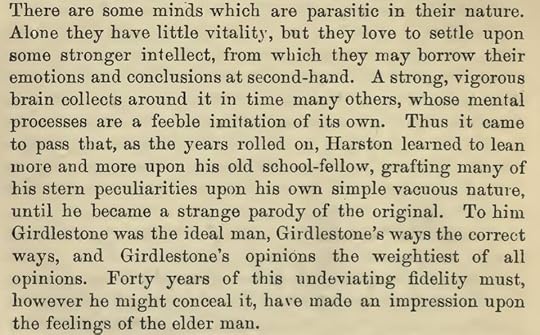
As it were Ezra is never heard from again although rumors had it he was seen around San Francisco probably gambling and most likely ended up dead there, as he wasn't seen after that. The book concludes with a wonderful marriage ceremony. I am not sure what the purpose of this book is. There are a few instances of the N word thrown in and some occasional decent passages regarding unoriginal parasitic personalities which, all sympathy and empathy aside, some people may actually have interacted with in their time and learned a thing or two about human nature, it would seem. Not sure if I'd recommend or reread this but I've heard there was an adaptation done around 1915 which could be worth checking out if you're a fan of ACD's work.
Here are a couple examples of what to expect. Check out the expert prose:
This entire review has been hidden because of spoilers.
The story is about John Girdlestone and his son, Ezra who have quite a dreadful problem. Their merchant firm is rapidly descending into financial ruin and if they don't do something to prevent it, the proud name of Girdlestone will be forever disgraced. One of their schemes to restore stability to their firm includes Kate Harston, the Girdlestone's ward after the unfortunate death of her father. On the occasion of her 21st birthday, she will inherit her father's fortune. If only there was a way for that money to come to the Girdlestones instead...
The story is filled with a fun, varied cast. Besides John, Ezra, and Kate, there's Captain Miggs, Major Tobias Clutterbuck, and the Dimsdale family. Tom Dimsdale is Kate's lovable childhood friend who isn't sure if following his father's profession as a doctor is for him. He does know, however, that Kate is the girl he wants to marry, no matter what the Girdlestones do to seperate them. Even minor characters having memorable and interesting personalities, like the unnamed sailor Tom meets who likes to collect long words, and making up ones of his own.
The plot is exciting, escalating to a tense climax, which I dare not say too much about and give away spoilers.
The writing...the writing is just charming. Though it may seem wordy and rambling compared to today's standard, each sentence creates a perfectly described picture in your mind, using every word to its fullest potential.
For an example, here's a favorite part where some of the characters are at a party.
"There was Mr. Smith, of the Gresham Insurance, rotating round with Miss Clara Timms, their faces wearing that pained and anxious expression which the British countenance naturally assumes when dancing, giving the impression that the legs have suddenly burst forth in a festive mood and have dragged the rest of the body into it very much against its will."
Обнаружила недавно этот роман в своей библиотеке. Он является первым экспериментом Конан Дойля в крупной форме – на момент его написания Шерлока Холмса ещё не существует, он только в проекте. Писатель пробует силы в так называемом «социальном романе», популярном в 19 веке. В отзывах «Торговый дом Гердлстон» часто сравнивают с диккенсовскими произведениями, но, если честно, мало читала Диккенса, чтоб это подтвердить.
Итак, викторианское время. Классовое расслоение ещё не считается пережитком. Выпасть же из собственного класса – величайший позор. Пожилой коммерсант Джон Герлдстон и его сын Эзра – владельцы торгового дома – крупного коммерческого предприятия. Герлдстон-старший – талантливый делец, поднялся с низов. Фирма и деньги – его главные идолы, которые также являются основными жизненными ценностями и его сына. Однажды старший Гердлстон обещает своему лучшему другу (хотя опора этой дружбы достаточно иллюзорна), который находится при смерти, позаботиться об его дочери. К девушке, которую забирает Герлдстон в свой дом, прилагается и состояние. В случае если торговый дом потерпит крах в результате рискованных финансовых операций, состояние девушки может стать спасением для Герлдстонов. И вот, такой день настает. В голове у героев рождается план… отец и сын не остановятся ни перед чем ради собственных интересов. В общем, кому в книге отведена роль злодеев, думаю, понятно.
Впечатления от книги🤓: ❤ Движущая сила в романе, конечно, любовь. Как водится, рядом с юной прекрасной девушкой появляется молодой человек (конечно, из хорошей семьи). Герой молод, упрям и противостоит злодеям в борьбе за свою любовь. ☝ В романе сочетается наивность и предсказуемость английского классического романа с мастерским для своего времени психологизмом. Герои очень характерные. Так, старший Герлдстон до фанатичности набожен. Он строит свои коварные планы с Библией под мышкой, которую всё время цитирует. Но даже в «темных» персонажах иногда проскакивает что-то человеческое (совесть, жалость – хоть и ненадолго), а в положительных – прорисованы неидеальные черты - вспышки гнева, элементы хулиганистости. Есть в книге интересные персонажи второго плана – бывалый майор Клаттербек, его друг мигрант-социалист фон Баумсер, а также очаровательная вдова миссис Скэлли, поселившаяся в доме напротив двух старых холостяков. 🤠 Книга частично приключенческая – поначалу, когда семейство пробует самостоятельно решить свои финансовые проблемы, младший Гердлстон уезжает в Африку. Там с ним происходит ряд событий – воры, погони, приключения – все в лучших традициях приключенческого романа. Есть даже сюжетная линия с призраком – впрочем, у Конан Дойля все подобные истории находят рациональное объяснение. 💲В широком смысле роман интересен описанием социальной ситуации своей эпохи. Простые люди не защищены от произвола владельцев компаний. Моряки плавают в Африку на полуразвалившихся суднах, каждый раз с риском для жизни. Вдовам погибшим не выплачивают в случае потери кормильца ни копейки. Такой себе «дикий капитализм» маслом.
В целом, это добротный классический английский роман, который погружает в традиционную атмосферу неспешности и ежедневных ритуалов. В противопоставлении же «доброго и злого», «хорошего и плохого» автором утверждается искренняя вера в победу первого над вторым.
This a novella that drags out filled with both good and bad characters, double dealings and the efforts to obtain an heiress's-money. The respected and successful London African trading firm of Griddletone founded and run by close to retirement John Griddlestone and son Ezra, most unlikeable, is foundering because of a series of disastrous speculations by the elder Girdlestone financially ruining the firm and they are trying to keep it from becoming public knowledge via various fraudulent and nefarious means to keep the company afloat. As their desperation grow, their efforts become more nefarious and dastardly which includes various increasingly desperate to secure the fortune Griddlestone's ward who will inherit when she reaches her majority. The goal to do whatever is necessary to save the firm from bankruptcy and the loss of their social and financial position in society.
I have always loved Holmes, but was put off ACD's other books by reading "The White Company" at school. I spotted this book a while back. Decided to buy it. My edition is a 1923 small John Murray Fiction Library one, with a very nice loose cover. The book is billed as a "A Romance if the Unromantic". Very apt. Some very well-written scenes, such as the football match (which is what we nowadays would call rugby) and the storm scenes, which made me think I was there watching. Predictable plot? Perhaps, but what does that matter with such clever story telling?
Originally published on my blog here in September 2004.
The most famous and lasting creations of Arthur Conan Doyle - Professor Challenger and, overwhelmingly, Sherlock Holmes - seem to place him firmly in the nineteenth century; these figures are an extremely important part of our iconography of Victorian England. And yet he wrote most of these stories decades after the times in which they were set, and the Sherlock Holmes stories go right up to the even of the First World War. Though these novels were among those which laid the foundations of modern popular fiction genres, they were firmly backward looking. This is also true of The Firm of Girdlestone, which reads like a product of the 1860s despite being written over twenty years later. It is traditional in themes and form, and could be seen as something of a pastiche of a writer like Anthony Trollope. Even though it looks back, though, The Firm of Girdlestone is not nostalgic. Instead, it takes the theme beloved of the writers who were Doyle's models, that of hypocrisy in outwardly pious pillars of Victorian society. It is not one of Doyle's most original or memorable creations, but it does still remain an enjoyable novel.
The central characters of this novel are not the hero and heroine, who are a rather colourless couple, notable only for their courage in adversity. The villains are far more interesting and dominate the novel: the proprietor of the firm of Girdlestone and his son. The firm itself drives the plot; run in an amoral (or as the Girdlestones would say, businesslike) way for years, the African traders are on the brink of collapse after some unwise speculation. The plot of the novel is basically a series of desperate ploys by the father and son to recoup their fortunes - over-insuring poorly maintained shipping; using rumours and false reports to try to manipulate the diamond market; and attempting to terrorise an heiress into marrying the son (the traditional method of raising money used by the nineteenth century villain). The pair represent the worst of unregulated Victorian business methods, and yet Doyle makes them exhibit different types of evil, which it would perhaps not be too fanciful to say are paradigms of the vices of their respective generations. For the father cloaks his deeds in a hypocritical veil of religious piety, while the son is brazen, vicious and brutal. The novel also charts the change from the father being the dominant partner to the son taking over this role. Though the father is the more intelligent (even if it is his speculation which has ruined the company), the important thing about Doyle's portrayal is that his hypocrisy is unconscious; he truly believes that he is a pillar of the church living a virtuous and respectable lifestyle. That is an idea which must have fascinated Doyle, and this ability to continually justify himself to himself makes him an unusual character.
The three novels that The Firm of Girdlestone is most clearly derived from are Our Mutual Friend, The Way We Live Now and Uncle Silas - all published about twenty years earlier. In particular, a lot of the plot is directly lifted from Uncle Silas. Perhaps the company of Dickens, Trollope and Le Fanu is flattering this novel somewhat, but it doesn't deserve to share the oblivion into which Doyle's minor novels seem to have fallen.
John Girdlestone owns the firm of Girdlestone. It is a very lucrative business and John Girdlestone and his son Ezra Girdlestone are respected by everyone. Both father and son are cynics and have no other thought but for their business; after giving a donation of £25 for charity, John Girdlestone remarks to himself that it is not a bad "investment", as it will make a favorable impression on the collector, who is a, member of parliament whose influence he hopes to use some day. Ezra, his son, is even more of a cynic, as the elder Girdlestone's cynicism is mitigated by his supposed religiosity. However, he manifests a great acumen for business, sometimes even surpassing his father's sharpness in business matters. A series of disastrous speculations by the elder Girdlestone financially ruins the firm. After keeping the impending bankruptcy a secret from everyone for a time, he tells his son (whom he has fooled with a dummy ledger) about it. The son is disgusted by his father's rashness.
They resort to chicanery to save the firm. They plan to send an agent to the Ural who will claim to have found diamond mines. They speculate that the resulting plunge in the prices of diamonds in England and South Africa will force the dealers to get rid of their diamonds quickly at absurdly cheap rates to avoid total financial ruin, which would eventually fall on them if diamonds from the Urals start pouring in the market. They will then step in and buy as many diamonds as their remaining money would allow them. Once their capital is exhausted, their agent will disappear and the discovery that the Ural diamond mines were a hoax would skyrocket the prices of diamonds once again, leaving them rich men.
Their plan works perfectly and the prices go down just as they had expected. Ezra Girdlestone travels to South Africa to buy from the dealers there while John Girdlestone starts buying in London. After they spend all their money on diamonds and get ready to call their agent back from the Urals, their plan collapses with the discovery of bona fide diamond mines in South Africa. As a fellow conspirator tells Ezra in South Africa: "Russia or no Russia, the prices will not go up!" He goes back to England and both of them sell their diamonds cheaply, which leaves them in an even more precarious situation than they already were in.
A very old friend of John Girdlestone had entrusted his daughter to him before dying. She was heir to £40,000 which she would inherit upon coming of age. John Girdlestone persuades his son to seduce the girl and marry her so that they could get their hands on the money. Ezra fails miserably not only because he is totally inept in romance, but because the girl is already in love with another man. Having exhausted all their means, John Girdlestone decides on a sinister plan. His friend's will provides that if the girl dies before coming of age, John Girdlestone becomes the sole heir. He plans to murder the girl. His son does not favour this plan, but his father persuades him, telling him that it will make the firm rich again.
This is a truly fascinating book. As far as I can see, it's very little known, even though ACD wrote it at about the same time that he was writing 'A Study in Scarlet', 'The Sign of Four', and 'The White Company'. I wonder how many ACD enthusiasts would, if they came to it blind, identify it as his work? (I never thought of ACD as being influenced by Thackeray, but Thackeray's influence is writ large.)
It's a long, ambitious, book, with a large cast of characters -- perhaps too long, too ambitious, and with too many characters for the plot and subject matter. I found it rather slow to begin with, but, in due course, it became quite a page-turner. There are twin plots, which become neatly meshed. On the one hand, it concerns the fortunes of a London trading company run by a corrupt, but nicely contrasted, father and son, and the love affair between the father's ward and a young man, who becomes a partner in the firm. On the other hand, it concerns a raffish, half pay Irish army officer and his German companion.
Perhaps it's patchy; the plot involves unconvincing coincidences, and some (but not all) of the its twists are visible a mile away, and the book crunches towards a highly predictable happy ending, but I especially liked the descriptive writing, and the Irish officer's dialogue -- and also the fact that the book has both a hero and an anti-hero.
In a word, this is treat for anybody who likes ACD's work.
I was a bit torn about my rating. When this book is good, it is GOOD. However, the first 100 pages really dragged for me. Being introduced to the characters at SUCH (excessive) length before their importance was known was laborious reading. I appreciate the humor around Tobias Clutterbuck and the widow Scully, which gave me some genuine laugh out loud moments. The last fifty or so pages had excellent plot twists, ambience, tension, etc. I was also thrilled to see Doyle's spin on the Gothic in this.
So, final judgment, the end is really good and there are some nice elements of humor sprinkled throughout, but it really does drag. This could have lost 150+ pages and been much more fun. I would advise you to go for it, but don't hesitate to skim the interminable exposition.
Really 3.5 rather than 3. A very workmanlike adventure story, well-plotted and nicely styled. Very much of its time, but with little of the wit and brilliance that characterises Doyle's Holmes works. Interesting that I put almost the same words into the mouth of one of my Holmes characters as ACD uses in this story, and that we both came up with a similar plot device at one point. If you're into early 20th-century pulp fiction, this is well worth downloading as a Gutenberg story. It might even pay rereading occasionally.
I enjoyed this book quite thoroughly. It had something of the gothic about it and the buildup to the ending. The villains were well crafted, though at times a bit unbelievably cruel as in the case of one of them enjoying shooting cats and maiming dogs for fun though perhaps Doyle was trying to paint a psychopathic character. The plot twist had a great buildup and though the foreshadowing gave the major twists away, the irony was beautifully done and the vast cast of characters seemed well defined. Overall an enjoyable read - the 350 pages went by surprisingly quickly.
This was such an interesting book that I had to read it aloud to my brothers (a handy excuse to re-read good books). For some reason I don't seem to care quite as much for ACD's Holmes stories as his other fiction, especially this book and Beyond the City. His sense of humour and somewhat Dickensian character-drawing are thoroughly enjoyable. I particularly enjoyed Kate's adventurous character. And a certain society to help the aborigines finish evolving. Someday I'll have to find someone else to read this aloud to!
Ah, intrigue within a Conan Doyle tale with nary a Sherlock in sight. This tale has a whole host of characters who can spin a yarn. If you like romance, quirky as well as sensible characters, intrigue, a bit of commerce and are minutely interested in seafaring, this is a story for you. Enjoy.