Jump to ratings and reviews
Rate this book

A Theater for Dreamers

Rate this book
THE UK BESTSELLER

"Sublime and immersive . . . If you wish you could disappear to a Greek island right now, I highly recommend."
—Jojo Moyes, #1 bestselling author of Me Before You


"This gorgeous, glimmering summer read is itself perfect summer: irresistible and deep, Samson's lyric sentences pulling you into unforgettable sunlight and shadow."
—Amy Bloom, New York Times bestselling author of White Houses


It’s 1960, and the world teeters on the edge of cultural, political, sexual, and artistic revolution. On the Greek island of Hydra, a proto-commune of poets, painters, and musicians revel in dreams at the feet of their unofficial leaders, the writers Charmian Clift and George Johnston, troubled queen and king of bohemia. At the center of this circle of misfit artists are the captivating and inscrutable Axel Jensen, his magnetic wife Marianne Ihlen, and a young Canadian ingenue poet named Leonard Cohen.
 
When eighteen-year-old Erica stumbles into their world, she’s fresh off the boat from London with nothing but a bundle of blank notebooks and a burning desire to leave home in the wake of her mother’s death. Among these artists, she will find an unraveling utopia where everything is tested—the nature of art, relationships, and her own innocence.
 
Intoxicating and immersive, A Theater for Dreamers is a spellbinding tour-de-force about the beauty between naïveté and cruelty, chaos and utopia, artist and muse—and about the wars waged between men and women on the battlegrounds of genius. Roiling with the heat of a Grecian summer, A Theater for Dreamers is, according to the Guardian, “a blissful piece of escapism” and “a surefire summer hit.”

336 pages, Hardcover

First published May 1, 2021

771 people are currently reading
9964 people want to read

About the author

Polly Samson

20 books191 followers
Polly Samson is the author of three novels and two collections of short stories. Her most recent novel, A Theatre for Dreamers, reached number 2 in The Sunday Times bestsellers list and she has written introductions to new editions of Charmian Clift's Mermaid Singing and Peel Me A Lotus which will be published in April 2021.


Ratings & Reviews

What do you think?
Rate this book

Friends & Following

Create a free account to discover what your friends think of this book!

Community Reviews

5 stars
981 (16%)
4 stars
1,819 (30%)
3 stars
2,063 (34%)
2 stars
831 (13%)
1 star
271 (4%)
Displaying 1 - 30 of 748 reviews
Profile Image for Paromjit.
3,080 reviews26.3k followers
August 23, 2020
I listened to the audio of Polly Samson's mesmerising coming of age story, a blend of fact and fiction, set in the idyllic Greek island of Hydra of 1960. Teen Erica is drowning in the grief of the loss of her mother in London, anchored by boyfriend, Jimmy, and her brother, Bobby, stranded in a impossible situation with her abusive and controlling father. Receiving a parcel of a book set in Hydra by her mother's close friend, the writer Charmian Clift, she decides to use her unexpected financial inheritance from her mother to leave for Hydra with a difficult and problematic Bobby and Jimmy. They find themselves living in the most basic of accommodation, but a naive Erica, living on the edges of the bohemian artistic circles coming from all round the world, painters, poets and musicians, is charmed and beguiled by this theatre of dreamers, in paradise, but a disintegrating paradise that is set to fragment and splinter apart before her very eyes.

The community includes the likes of the destructive Norwegian writer, Axel, married to the beautiful Marianne, the young Canadian Leonard Cohen, already displaying signs of being a serious writer, getting involved with Marianne, and the Australian writer married to Charmian, George Johnston. Amidst her constant daydreams of her marriage to Jimmy, Erica is obsessed about finding out her mother's secrets, a constant annoying mosquito as she pesters Charmian for information. Feeling rudderless, not hearing from her father, and Bobby being emotionally unavailable, Erica is desperate to ingratiate herself into Charmian and George's family and home. Charmian, her marriage to George revealed as a turbulent, painful and volatile affair, plays both mentor and an invaluable support, providing advice, some of which Erica does not always want to hear, such as warnings about her relationship with Jimmy.

The bohemian crowd is a source of joy and magic, dancing, celebration of festivals, revolving around Charmian and George, but begins to be interspersed with the chaos and emotional carnage, in relationships, with the almost inevitable heartbreaks, artistic rivalries and insecurities, abuse, betrayals, infidelities, deceit, cruelties, secrets and the emerging gender politics. Women are the ministering angels, muses, domestic drudges, the providers of childcare as mothers, struggling to get equal recognition as writers and artists in this supposedly progressive bohemian community amidst the atmospheric island of Hydra with its sun and sea.

Authors so often do not make the best narrators of their own books, but Polly Samson's narration is a dream, possibly because of her bone deep familiarity with the subject matter and command of her novel. She evoked the characters and Hydra in such a way that she caught my interest and immersed me into the bohemian world of real artists and writers of the time, creating an all too believable picture of their interactions. Fantastic historical fiction that many readers and listeners will adore. Many thanks to WF Howes Limited for the audio.
Profile Image for Andrew Smith.
1,252 reviews984 followers
December 18, 2023
In 1960, or soon after, Erica sets foot on the Greek island of Hydra. She’d been left some money by her mother and had decided to escape London and her grim father, dragging her boyfriend and brother along with her. Charmian, a friend of her mother’s, a writer who’d lived in the same building, had sent a package containing her latest book – the package being addressed to her late mother – it was a story set on the island and it proved to be the stimulus for an adventure, and perhaps a fresh start. Erica was still in her late teens and an aspiring writer herself and her boyfriend, Jimmy, wrote too and was also a gifted painter. Surely a Greek idyl would be the perfect place for them to take in some sun and let the surrounding beauty inspire their artful ambitions.

After a tortuous trip across Europe they arrived on the island with a few other young people they’d gathered along the way. Erica had signalled her travel plans before setting off and upon arrival they were greeted by George, Charmian’s husband. It wasn’t long before they all found themselves settled into some very basic accommodation on the island. It quickly became apparent that Hydra was full of artists from many countries who had temporarily settled there to enjoy the bohemian lifestyle and work on their projects. Charmian herself turned out to be a larger than life figure who became, in a sense, the mother figure to the group. She had three young children and spent much of her time cajoling the ailing George (yet another writer) to finish a book he’d been contracted to write. Yet, she also found time for Erica in particular and they quickly became close friends.

As Spring turned into Summer the number of characters we’re introduced to seemed to grow exponentially. The handsome Leonard, an aspiring poet, arrives and he quickly becomes the love interest for Marianne, a Norwegian beauty who has recently born a son and has been deserted by her husband Axel, an habitual woman chaser. In fact, in time the cast becomes so bloated that I began to lose track of some of the minor figures. And the lack of a cohesive plot started to bother me too. It was fun hearing about the daily routines of largely beautiful people eating, drinking, writing, painting, taking drugs and swimming in a stunning setting, but where was all this going? I began to wonder whether this was a literary novel, as I’d been led to believe, or whether it had in fact strayed dangerously close to chic lit territory.

But as Summer drew to a close the party started to wind-up too. People began making plans to leave the island and Erica now faced a dilemma of her own: what should she do, the money she’d been left wouldn’t last forever and yet she dreaded the thought of going back to London. And it was now, with the tale nearly told that the surname of one of the key characters was casually dropped into the narrative. Hang on a minute, I thought - I know that name and isn’t that associated piece of work that was mentioned something I vaguely recognise too? A quick internet search provided confirmation and a little more digging unearthed the fact that other characters here were people with a real history too. I was shocked, I’d been coasting through this book totally unaware that it was a construction consisting of the author’s interpretation of a key phase in the life of a number of widely respected figures.

That discovery changed everything for me and I spent some time digging up more and more detail on the real life people featured here. To my dismay, not only did I find accounts of this group during the period covered in this book but also high quality photographs of them on the island at that time (see below for more on this should you want it). I was blown away and returned to finish the book with fresh eyes. The story had skipped a decade by now and the added poignancy of my new knowledge meant that the closing pages hit me much harder than I’d have thought possible. Suddenly I was reading about what became of (some) people who had lived through real events on the island. And what tragedies there were to behold.

So how do I rate this book? I think because of my concerns around the mid part of the book I’m going to have to go for 4 stars, but I do know for certain that this book is one that will stay with me for some time. If I’d picked it up with foreknowledge of what I discovered late on I might have had a very different experience with it, and yet I think it likely that this was a deliberately ploy to catch out unsuspecting readers like me. What a great trick, I loved it.


Profile Image for luce (cry bebè's back from hiatus).
1,555 reviews5,838 followers
dnf
March 31, 2020
DNF 30%

It seems that I am having quite the DNF streak in 2020. Maybe I'm a picky reader or maybe I just have standards little patience for eye-roll worthy proses that care more about creating a certain aesthetic than actually offering well-rounded characters and or an absorbing storyline.

“We were heady with ideals, drunk with hopes of our languorous lope into a future that had learnt from its past.”

And I'm supposed to believe that our protagonist uses this sort of language? When in all other respects she comes across as being an impressionable 9 year old ?
There are quite a few purply metaphors that once again seem to be there only to create a certain vibe: “her arms are slim as flutes” and “now she's pink all over like strawberry ice cream, a moaning calamine ghost” and “our bodies molten as the sea and sky turned to honey” and “[she] is ahead of me, the silence dark between us. She's always ahead of me, I'm always in pursuit. I know she's keeping secrets from me, I see them jumping behind her eyes whenever I get close.”

There are also lots of snappish phrases: “I race Edie and Janey down the steps, clutching our straw hats to our heads, beach bags bouncing at our hips” and “I imagine them asleep like this, brain to brain, heart to heart, two souls moulded as one in warm clay.”

Cliched phrases aside, the characters struck me as mere names rather than actual people. Our narrator is a bland goody two shoes, while her friends, boyfriend, and brother are more or less interchangeable. The artists, poets, and writes based in Hydra are rather poorly rendered portrayals. Dynamics between characters are also depicted in an uncertain way so that we don't see the development of certain relationships (two characters meet and then they seem to have formed a complex bond).
As a fan of Leonard Cohen I'm finding this book to be a not so grate take on this period of his life.
This type of story has been written many times...and, dare I say, better?


Read more reviews on my blog / / / View all my reviews on Goodreads
33 reviews1 follower
May 17, 2020
Boring, nothing happens, lots of names but no character building, no plot, no point. Sentences jumped all over the place, so disappointed given all the accolades from other authors. I don't think they read the book!
Profile Image for Brandice.
1,247 reviews
July 26, 2022
A Theater for Dreamers is set in the summer of 1960. After her mother’s death, Erica travels to the Greek island of Hydra with her brother, Bobby, and her boyfriend, Jimmy. There, they meet Charmian, one of her mother’s oldest friends and her husband, George, along with other characters forming their island community.

While each person is a little different, Hydra houses several artistic dreamers — writers, painters, sculptors, and other bohemians. Many of them are young, relatively carefree, and aspire for more from life. They drink, they talk, they write, and they think. There are tensions, arguments, friendships and affection among the group. I felt for Erica, seeking answers about her mother’s life. Sometimes her fascination with Charmian and other characters seemed a little annoying but I understood her desire to belong as well.

At times, A Theater for Dreamers gave me On the Road vibes, and that book is even referenced occasionally within this one. This story is not full of action by any means, but I still enjoyed the journey.
Profile Image for TBV (on hiatus).
307 reviews70 followers
August 8, 2021
Upon her mother’s death young Erica finds a small package which her mother had left her - some money scraped from the housekeeping money and hidden from her abusive husband. Neither Erica nor her brother Bobby is willing to be a scivvy to their father, and when Erica sees a parcel addressed to her mother she opens it to find a book written by her mother’s friend Charmian Clift (1). It is Charmian’s book Peel Me A Lotus, which is about life on the Greek Island Hydra. A letter to Charmian and the deed’s done; Erica, Bobby and their respective lovers soon leave England and are on their way to Hydra.

Together with some other newly arrived young people, all arty types, they soon share a house. Erica befriends Charmian and her husband George Johnston(2), and becomes very attached to Charmian who cautions her not to become stuck in an unequal relationship with a man. She encourages her to read Simone de Beauvoir’s The Second Sex.

The young people enjoy the easy going sun drenched days and unfettered sex. There are many interesting people on the island, including the polite and charming Canadian singer/songwriter/poet/novelist Leonard Cohen (3). It is here that he meets the Norwegian Marianne Ihlen (4), at that time married to Axel Jensen (5). Cohen and Marianne would later for some time be partners as well as friends for life, and it was for her that he composed the song So Long, Marianne (1967). Göran Tunström (6), a Swedish author is also seeking inspiration on Hydra.

What follows is life on the island - creative activities, eating, drinking and sex. But even in this paradise, life doesn’t always proceed smoothly and heartbreak is part of growing up. Relationships are dissected and a small island community inevitably has its share of gossip and rumour. The locals smile and pour more wine for the expat community. Life continues…

Polly Samson, author of this novel, is English, but she has a good grip on Aussie vernacular (Charmian and George). Much of the book is also funny even when there is some heartbreak. Erica’s coming of age and her relationship with Charmian (whom she regards as a second mother) is very touching. As indicated above, several issues are explored, including feminism and opportunities available to Erica, which didn’t exist previously. The novel successfully evokes a time, place and culture. When an adult Erica visits the island many years later much has changed.

Notes:
(1) Charmian Clift (1923-1969) - Australian author
(2) George Johnston (1912-1970) - Australian war correspondent and novelist
(3) Leonard Cohen (1934-2016) - Canadian singer/songwriter/poet/novelist
(4) Marianne Ihlen (1935-2016) - Norwegian wife of Axel Jensen
(5) Axel Jensen (1932-2003) - Norwegian author
(6) Göran Tunström (1937-2000) - Swedish author

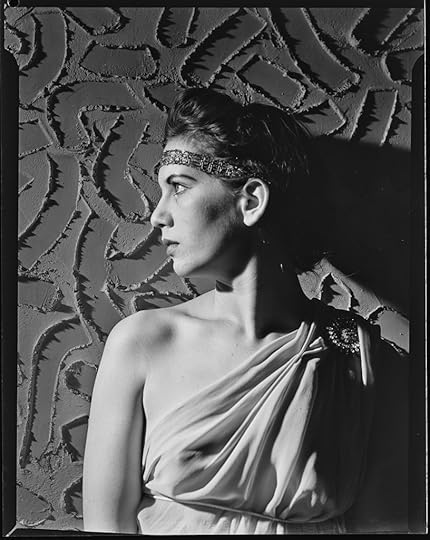
Charmian Clift (Wikipedia)

Studio Portrait of Charmian Clift, 23 June 1941.jpg
Profile Image for Louise.
3,196 reviews66 followers
March 11, 2020
I actually don't know what to say about this book.
There were times I got swept away in it and could feel the sun,the breeze,taste the alcohol... I felt I could have been there.
There were times I felt like it was a soap opera with a bit more sunshine than we get in our normal ones.
There were times I skipped a page because it just didn't hold my attention.

The positives were more frequent than the negatives.

I think that's probably all I've got to say about this book.
Profile Image for karen.
4,012 reviews172k followers
Want to read
July 18, 2020
WUT???? IS NOVEL ABOUT LEONARD COHEN?? WHY YOU KEEP SECRETS, WORLD??
Profile Image for Aoife Cassidy McM.
826 reviews378 followers
September 15, 2021
I DNF’d at 33%, which in itself was trying enough. A gang of posh kids go to Greece in 1960. Hollow, shallow, boring.
Profile Image for Ian "Marvin" Graye.
948 reviews2,783 followers
December 16, 2022
CRITIQUE:

Factual Fiction

This is a highly competent and enjoyable work of factual fiction.

The factual element concerns the life of Charmian Clift, George Johnston, Marianne Ihlen and Leonard Cohen on the Greek island of Hydra in 1960 (this is after the period about which Charmian wrote in "Peel Me a Lotus").

The fictional element involves, Erica, the young (18 year old) narrator, whose mother had been a friend of Charmian's when the Johnston family had lived in London, before travelling to Kalymnos.

Whisky and Figs

For some time, I resented the fact that Erica had insinuated/interposed herself into the story of these other people (but is this no different to what I as a reader do every time I read a novel?).

Erica, her boyfriend Jimmy (Charmian calls him "that very ordinary boy"), her brother Bobby and his girlfriend Trudy all struck me, at first, as talentless lower middle class wannabies, but gradually Erica emerged as a more engaging character, who seemed intent on replacing her recently deceased mother with Charmian's maternal, worldly and aesthetic instincts:

"I remembered how badly I had wanted to belong, how I'd tap-danced and sung my way through every audition for a role in her family..."

"In 1960, which in reality was almost half a decade before the sixties began, how was a rudderless, motherless girl to know lust from love - or, as Marianne once remarked, love from service..."

"Marianne may have been a poor role model but for a while Charmian really had been the mother I needed."

I loved the way Charmian comforts Erica with whisky and figs at a time of need. I must try this combination sometime.

Gardenias and Sandwiches

Under Charmian's influence, Erica grows from a naive girl who places a gardenia and a sandwich on Jimmy's writing desk every day, to a confident journalist and writer who "placed a gardenia and a little sandwich on a desk where I blackened pages of my own".

description
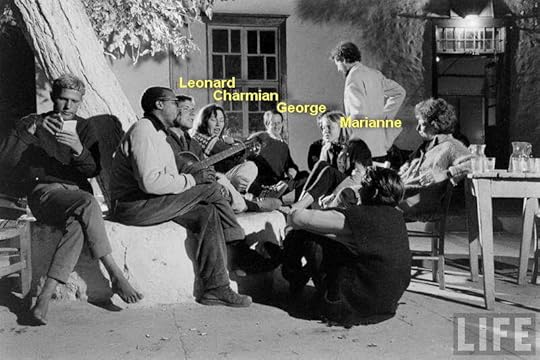
Evening at Dousko's Taverna - October 1960 (James Burke) Source

Dreams of Enchantment for Myself

There's no pretence or affectation in Erica's narration or the author's writing. She tells her story empathetically, simply and vividly, without the more overtly literary structure or tone of "The Broken Book".

Unfortunately, she couldn't resist telling us about a moment of intimacy the fictional Erica is supposed to have had with Leonard Cohen (although, presumably, there are or have been countless women who have shared a moment of intimacy with him):

"His hand slipped from my shoulder to my collarbone, slipped again and I let it. His breath was growing hot on my neck, and [a] guilty thrill...hatched inside me..."

This could be an expression of the jealousy she felt for Leonard's and Marianne's relationship (which would only last another ten years):

"It's what I dreamed of for myself."

Fortunately, life on Hydra would both foster and eliminate this dream.


VERSE:

Famous New Rugs and Walking Boots
[In the words of Polly Samson]
(Apologies to Leonard Cohen)


It's four in the morning;
The night has turned moonless.
They meet at the wells
With their duffels and flasks.
Leonard brings bread,
And some wine in straw casks.
Jimmy sits on a low wall
Peeling an orange he's taken
From a tree in the square,
I don't think he heard me call.
There's music from goat bells
Above the dark houses.
Charmian has a tartan rug
Thrown over one shoulder.
It can get chilly in the
Early hours on the summit.
She and Leonard both wear
Proper new walking boots.
They stop at a plateau,
And squat on their haunches,
Breaking and eating the bread.
They dunk it in retsina,
Which they sip together
In the first rays of the sun.


SOUNDTRACK:
Profile Image for Rebecca.
4,185 reviews3,448 followers
April 11, 2020
In the 1950s the Greek island of Hydra became a magnet for artists and writers, including Lawrence Durrell, Patrick Leigh Fermor and Henry Miller. Polly Samson’s fifth work of fiction, set in this makeshift artists’ colony in 1960, zeroes in on the married Australian authors Charmian Clift and George Johnston, Norwegian novelist Axel Jensen, his wife Marianne Ihlen, and an unknown young poet from Canada named Leonard Cohen.

We see all of these real-life characters from the perspective of our starry-eyed narrator, Erica, a seventeen-year-old outsider. In a framing story set c. late 2016, after she hears of Leonard’s death, Erica has returned to Hydra as an old woman. Yet that first gold summer is still intensely alive in her memory. She decided to decamp to Hydra just before Easter in 1960, with her boyfriend Jimmy and her brother Bobby, because Charmian was once their late mother’s closest friend back in London. Erica’s inheritance would go far here: “people like us … can live for a year in the sun on what it’d cost us for a month in a dingy bedsit at home.”

Love triangles abound and emotions run high on Hydra. Gradually Erica learns that just about everyone has slept with, or is currently sneaking around with, someone they aren’t married to. Meanwhile, Bobby and friends sleep late and paint, then party well into the night. While Erica is the responsible mother hen at their villa, seeing that everyone gets fed, she indulges her hedonistic side, too – going to every bash and spending half the day in bed with Jimmy.

Charmian becomes a kind of surrogate mother to Erica, but remains spiky due to her jealousy over George’s greater literary success while she has to care for the children and act as his amanuensis. “They’re the closest thing I have to a family,” Erica writes of Charmian and George and the wider expatriate circle. “I love them all: their banter and moods and tears and wild laughter, all of it, every chaotic bit of it.” But there’s a sense that the idyll can’t last.

This is a novel simply dripping with atmosphere. You can feel the Mediterranean heat soaking up through your sandals; see the piercing sunlight reflecting off white-washed buildings; smell the ripening fruit and herbs and fresh-caught fish. There are dozens of evocative passages I could quote from, but here is part of one of my favourites:
The port throbs with tourists and the street cats grow fat. The cicadas are busy breaking a hundred hearts with their songs. We pull our mattresses out to the terrace and sleep beneath the stars, wake with the sun … We pick over platters of fish at taverna tables, or drift from courtyard to courtyard with our records and poems, or take bottles of beer and eat bread and meatballs beneath the tumbling vines of the outdoor cinema … We have all become leaner, our legs muscled from the steps, Bobby and Jimmy’s shoulders almost amphibian from swimming. Sometimes we take a bag of peaches and a flask of coffee to the cave and grab a dip before the port is fully awake, other times we swim late at night and lie naked between the moon and the tide on the still-warm rocks.

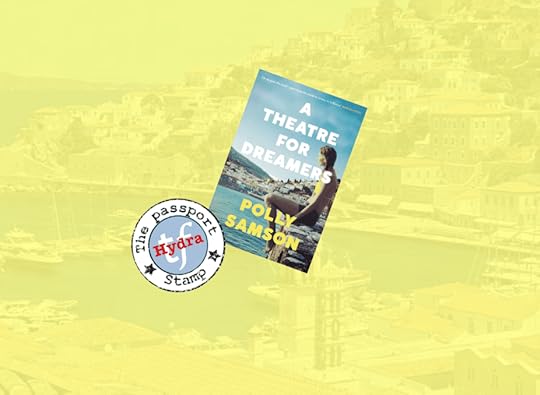
If you’re getting cabin fever and are hankering for some armchair travelling, I can’t recommend a trip to 1960 Hydra enough. There are two prizes that specifically recognize literature with a strong sense of place: The Royal Society of Literature’s Ondaatje Prize is “for a distinguished work of fiction, non-fiction or poetry, evoking the spirit of a place,” as is the Cicerone (fiction) prize, part of the Edward Stanford Travel Writing Awards. I’d be willing to bet that A Theatre for Dreamers will be shortlisted for one or both of those next year.

Originally published on my blog, Bookish Beck.
Profile Image for Emer  Tannam.
907 reviews22 followers
July 14, 2020
2.5
A lot of young, beautiful, talented people lounging around in the sun, on an idyllic Greek island in the 1960s. The descriptions of the island are very evocative, but heavy-handed at times. The narrator is irritating, there are too many characters, and not much happens. We don't get a strong sense of Marianne or Leonard either. It certainly seems like it was a fascinating time and place, but the book wasn't fascinating.
Profile Image for Jamie Klingler.
757 reviews66 followers
May 17, 2020
Try as I might, I just could not lose myself in the narrative. I actively didn't like Erica which made it difficult to feel much for her and it just felt like every character was underdeveloped and the women all so subservient although with streams of resistance. I wanted the book to help me travel back to Hydra and to feel the sun and the rocks and feed the cats again, but I just had to keep working to pick it up towards the conclusion.
Profile Image for Yiota K.
23 reviews2 followers
April 4, 2021
Disappointing if you are a faithful Cohen fan; or Greek. Bad, if you are both.

I bought the book because I am fascinated of that period of the 20th century where torn from WWII and amidst civil war, Greece was a haven for foreigner artists, poets, painters, writers and musicians, arriving and mingling with a generation of modern Greek art ambassadors, like Nikos Chadjikyriakos-Ghika, Seferis, etc. The inspirational scenery of Hydra and South Peloponnese of the 60s was a pole of attraction for the ever exploring spirits from all around the world, however the times were already changing and Greece was to enter an extremely profitable era of the mass tourism conquest of the world, which set an irreversible course, the finish line to the innocence that only poverty is able to provide.
Leonard Cohen’s connection with Hydra is well known, well recorded, abundantly saved in photographs, songs, films, biographies and of course, very well sold. A few months before buying the book, I happened to listen to a broadcast of a programme dedicated to the book of Kari Hesthamar, So Long, Marianne, (published June 2014) in the Greek radio, where the editor of the Greek edition, Ariadni Loukakou, provided a very deep insight of Cohen’s Hydra as well as Marianne and Leonard’s story. I got hooked on it, not because of the things that I knew, like the love story and the bohemian lifestyle and their coincidental deaths with few months apart, but because of the love and adoration that overflows the words of a true Cohen fan when engaged in a conversation about him. Which, along with the huge publication promotion of Polly Samson’s book in social media, led me buy her book.
It added nothing more to my knowledge about Hydra, Leonard and Marianne. I must admit I didn’t know about Charmian Clift or George Johnston, but had it been only their names in the reviews and not Cohen’s I wouldn’t have bought it. The writer places a young girl on the island who narrates the atmosphere and the esoteric quest for riding the trip of life to the reader. And by doing so, the writer uses the facts and the records of those days, written in existing books. For example, her boyfriend trying to put knowledge in her mind so as to be able to build her own intellectual, just like Axel was trying to do with Marianne, or when she realises she is prone to easily accepting the role of drudge, serving the talents of others. This is what Marianne was doing for both Axel and Cohen. Another similarity, caring for the cats, just like Marianne did, feeding the stray cats of the island. This makes the main character acquire an astonishing resemblance to Marianne, regarding her early self.
It’s disappointing for someone who knows and has read a lot about Cohen, but for those that is the first encounter with him or the island, yes, it must be thrilling.
Polly Samson said on the Telegraph Magazine (21/3/2020) that Cohen was her favourite songwriter, but until May 2014, half-term holidays, she didn’t know that he and Marianne had houses there, but in any case, their story is very tempting for a writer to get inspired from. However, all the things related to them had already been told. Sometimes I felt that the writer was looking at the photographs of James Burke and attributed long descriptions for people appearing in the photos, like for example, for Marianne: “wears a small smile and listens with her cheek pressed to her shoulder”. I know this photo!

I found a bit tiring the writer’s selection of words and descriptions with use of adjectives that I had to look up, some of which incomprehensive or just too much. For example, “shepherds, sponge-divers, fishermen all ranged together at the top of the mountain with their fistfuls of asphodel held aloft, all worshipping Apollo”. Or the impression of a runaway teenager of 18 years old upon seeing Cohen for the first time: “carapace of shyness”. Or the same girl’s impression an instant after meeting one of the main characters and before even telling him her name: “He might bite any hand that feeds him”.

Some phrases that the characters tell can be found intact if looked up (e.g. “…but also people like us who can live for a year in the sun on what it’d cost us for a month in a dingy bedsit at home”, “…and when you’ve lived on Hydra, you can’t live anywhere else, including Hydra”).

As others have observed, I found it hard sometimes to understand if the scene is located inside or outside the house, who is present etc. And just to remind that the winter Marianne and Axel arrived on the island, it was not a colony of foreigners, it was only 6 people in a population of 2000 local Greeks, which in that summer it extended to a few more but in no way was this a colony.

For a Greek reading this book, it really has some repetitive clichés, like the impression of the Greek dishes. The writer mentions the moussaka, the dolmades, description of how they eat fish as locals, the typical squeamishness the non-Greeks have for some very common and dear customs to the Orthodox Greeks, like the skewered lamps and turning over charcoal in Easter. In some cases I don’t understand what purpose it serves to write in greeklish words and phrases that the English readers cannot understand, like the Kioupi, the Nou-nou, ‘tha ertho kai ego’, ‘mazi sas’, meltemi, to bring this ‘filos a sketo’… What is the use of writing Maios for May…Of course, there is also the one about the Greek ‘Philoxenia’. Another one I spotted, was the mention of a wife’s name, Polymnia. I don’t know any woman in Greece with this name, however it is the name of the Muse of sacred poetry, sacred hymn, dance, and eloquence, so, this was not chosen randomly in the context of the book. Towards the end of the book, the writer must have been confused by the date of St Demetrius celebration, that is in the end of October, so nobody could have possibly been carrying “a watermelon as huge as a baby”. This conflicts also with Leonard's birthday that is in late September. However, the oddest of all was the reference to a woman “carted off to prison because her ex-husband scarpered without paying taxes”. This would be extremely rare to be mentioned in a conversation of two foreigners in Hydra of 1970, as this is a tactic adopted in much later years, but today it fills very conveniently some lines in the book.
The mention of Theodorakis is very much appreciated, I must admit.

I must be honest and say that the end of the book, these 2 last chapters make up for the other 28. The writer uses the change of the idyllic scenery that starts to fade away to reflect on the boredom, the lack of money, the waiting on letters that do not arrive, the tourists wandering listlessly, the insects bites, the cats with fleas, etc, to introduce the uneasy conditions people are now faced with. The shift from the idyllic location that they are to the repositioning of themselves to where they are needed to be.

I would have liked to have read this book more unwittingly and innocently, because the story of Leonard and Marianne is a very powerful one, but the coincidence of the airing of that radio programme prior to reading the book had such an effect on me that I wanted to dive deeply in it and explore more. But it just wasn’t enough. On the contrary, I was catching myself acknowledging all the time things I knew. One thing I didn’t know though, was the reinstated truth of the famous letter (email) Leonard wrote to Marianne. Here is the link for the real story: https://theconversation.com/mythmakin...
Profile Image for Andy Rendell.
23 reviews3 followers
December 27, 2020
"Tsk" (sic), and "Pfft" ( also sic) -sorry, but it's a dud, Desperately Tailgating Leonard...

If you want a light escapist holiday read about going to a nice island and mixing with inspiring, positive cultural heroes, forget it, or if you want to find out about Leonard, try Wiki and his own work.
Look beyond the local-colour fare about a then "unspoilt" Hydra,and almost every relationship is dysfunctional and destructive. Add an uneasy mix of a fictional coming-of-age life story, selected episodes from the real lives of Leonard, Marianne and other creatives, along with writing which is almost juvenile in tone and style, and the effect is unpleasant and unconvincing.

Digested Read: 'Ingenue finds trouble at t' idyllic port, everyone who can do gets their kit, themselves and their head off, most are emotional casualties before, during and/or afterwards, and most eventually die '.

Comments on the book by many reviewers and by some acquaintances who have been to Hydra at around the times described have been very positive. The setting and topic have inherent interest and topicality due to the fairly recent deaths of Cohen and Ihlen, so I am wondering whether some of this positivity is due to familiarity with the location, self-identification or a wish-fulfilment urge which are absent for me.

Much effort has clearly gone into the research and writing but I was disappointed to find it such a chore to read. There is a disconnect between some serious themes covered over the course of the book- women"s self-determination, the tension between the various liberties of action feeding creativity and the personal damage which can result, a good-enough plot overall, and the strangely stilted writing and two-dimensional characterisation. I could not agree with the dustjacket opinions of its literary merit, the author of one of which is thanked in the credits. Did they read it all?
The gaudily-festooned island greengrocer's boat of the prose wallows "like" (see below) it's overloaded with over-ripe fruit into the maw of the tiara-glistening solar furnace of Hydra Harbour, "like" it is responding to the cheeps of the ravening culture-hyena-cubs baying for forced metaphors from the jibe-scorched taverna tables.
There is excessive use of cringeworthy, am-dram stagey dialogue, to the extent of being what used to be called corny, although the credits indicate that some of it is verbatim. The csrtoonish exclamations 'Tsk' and 'Pfft' occur in dialogue in all seriousness, both twice in one chapter.
The text is reminiscent, in its queasy mix of banality, pretentiousness (pages are serially 'blackened'), trouble - in - Paradise clichés and sheer obviousness, of at best teen or airport literature, almost Five Go To A Greek Island, or Shirley Valentine Doesn't Quite Meet Anita Bruckner, the doyenne of female escapees from stuffy London mansion-blocks to parts more exotic. There is an almost melodramatic or gothic black-and-white quality to some of the characters, such as Erica's father.

Something has gone wrong with the narrator's voice, which I think attempts to speak as might have been spoken in 1960, but it grates stylistically, especially in the excessive use of unrealistic dialogue. This older British-raised literary narrator from that generation would surely avoid using 'Like' for 'As If' so frequently (three times within the last page of Chapter 24, to be nerdy) as just one issue. Overall, the tone adopted fails to convince.

Namedropping vies with nativist research bingo-- Paddy Leigh Fermor, tick, de Beauvoir, tick, local customs and characters, tick.There is a distasteful gossipy faux-prurience - shocked but not shocking. Who would guess? - early - 1960s wives and girlfriends burdened with men who take their home-and lovemaking for granted, the young fornicating, switching lovers and abusing substances, washed-out older expats, if past this, mouldering, bickering and backbiting - shock horror. To join in and name-drop too: Malcolm Lowry, Anthony Burgess, Somerset Maugham, Scott Fitzgerald, Sibylle Bedford (novellist a clef of her own neglected Riviera childhood and biographer of the Huxleys on the Riviera), Francoise Sagan, Waugh, Greene, Olivia Manning, Thomas Mann, either Durrell, even Peter Mayall or Frances Mayes (but please no romantic film spinoff) have done much of this better, largely without direct recourse to real people. Where I was most uneasy in this respect was in the jump from routine lightweight tourist brochure, and sun, sea and sex capers to the disastrous effects on at least one named, living former child of the island. The real-life facts speak for themselves I suppose, without moralising about them any further.

Writers writing faction about writers writing walk a line between adding inferred new insight and self-serving luvviness, not very successfully here, as some of the credits seem to illustrate. Almost Whicker Island syndrome.

Humour bypass? With all this alcohol, narcotics or just the odd aperitif, one might have expected a few (intentionally) amusing moments amongst the darker content, however ironic or waspish, but I experienced nary a Frankie Howerd titter. The anecdote where Leonard enacts a scene soliciting mock-solidarity with unwanted hair is I think flagged as humour, but misses the mark. I suppose you had to be there really.
Perseverance to the last chapters ties up threads which give a better idea of what it is all supposed to be about, and it could as easily
have stood by itself as a fully- fictional coming- of-age-novel, rather than having a cipher trailing around after a largely uninvolved Leonard and other, more tragic real-life people. The bathetic answer to the supposedly dire family secret is unveiled there too.
As for the relationships, John Mayall, a near contemporary, sang: " It's a mean ole scene... (when it comes to doublecrossin' time)".
Another reviewer has lamented "Where was the editor?" - indeed. Though as another reviewer has said, some people like some types of book, and some don't.
A pity overall, as the topic had interested me in principle, but the book has completely put me off now.
Tsk", he groaned, "More fool me for swallowing dustjacket puffquotes. But Pfft, at least it was Waterstones', and now is Oxfam's, gain."
5 reviews
July 17, 2020
Couldn't care less about any of the characters, not one of them is likeable. Especially the narrator. I can't really understand why or how you would write fiction about real people.

There seems to be little point to the story. I would have not bothered finishing the book but it was a gift from my father so I felt obliged to get to the end.

There were however some well written descriptions of the island which I enjoyed and kept me going.

A book written about pretentious people. I spent most of my time either thinking "who cares" or that the characters were so far removed from my life that I just didn't have any shred of care for any of them, which is unusual as I do normally enjoy the escapism that books bring.
Profile Image for Olive Fellows (abookolive).
800 reviews6,395 followers
August 13, 2023
A Theatre for Dreamers is a beautifully written fictionalized account of the time that the writers Charmian Clift and George Johnston (and a group of others) spent on the Greek island of Hydra. We see them through the eyes of a motherless teen, Erica, who gets clingy as she searches for a makeshift new family.

I'm a more plot-focused reader, so while the carefree, relaxing tone of the book was comforting, I was hoping for a bit more substance.

Click here to hear more of my thoughts on this book over on my Booktube channel, abookolive!

abookolive
Profile Image for Amy Imogene Reads.
1,215 reviews1,146 followers
July 3, 2022
3.5 nostalgic stars

The 1960s, Greek islands, a young girl on the cusp of artistic pursuits and adulthood, and a saturated look at men and women colliding together.

Sense of place: ★★★★★
Plot/Pacing: ★★★
Characters: ★★★

Erica's a fresh-faced young woman from London who's just arrived on Hydra, one of the picturesque Greek islands haunted by the rich, artistic, and beautiful. Its 1960, bohemia is all the rage, sexuality and the artistic are colliding together in various ways. It's heady days, and a heady setting.

A Theater for Dreamers follows Erica's journey into this rich tapestry of desires, art, lush settings, and mired interpersonal relationships. For us readers, it's an interesting blend of fact and fiction too—Leonard Cohen's real life persona meets a fictional group of folks in this window into the past. It's fantastically described, enviously set in a beautiful location, and classically portrayed through the eyes of our young and naïve protagonist.

I am, admittedly, a weird audience for this book. Every once in a while I like to step out of my reading comfort zone, if you will, and try things setting in different genres and settings. Historical fiction and destination locations/summer reads are not usually my cup of tea, so I think my rating reflects the fact that this isn't my usual read.

I found Erica to be an enjoyable main character to follow, if a bit annoyingly naïve. (I find this is often the case though with this kind of setup, so let's call it part of the territory.) Her fresh eyes experiencing this kind of sweltering landscape of sensual politics and artists in collision was extremely well done. Even though we've seen this story before, I thought it was done well.

I will say the novel lost me a bit with its sheer number of descriptions and meandering prose. I'm a "get to the point" type of reader unless it's a special case (usually in the fantasy realm) so I found myself getting frustrated with the paragraph to paragraph pacing. But do take that with the reviewer's grain of salt—I think this prose will work beautifully for those who love historical fiction/beach reads.

Thank you to Algonquin Books for my copy in exchange for an honest review.

Blog | Instagram
474 reviews25 followers
July 4, 2020
How could anyone write a bad novel about Hydra, Leonard Cohen, and the early ‘sixties? Polly Samson manages quite nicely taking real breathing characters and making them flat and unrealistic. But she does the same with her invented characters as well. Along the way she uses language she should not: “…I’ll never forget my first phosphorescence….” That’s the words of her British eighteen-year-old or so narrator, who also gives us, “I don’t know who I am.” On the positive side, some of the Hydra descriptions are good. But the nascent feminism Samson uses becomes forced and very awkward with very amateurish framing. The most interesting part of the work is the acknowledgements. She has good sources. (Samson does acknowledge the primary source for things Cohen.) She just doesn’t incorporate them. This does even qualify for a beach read, if we could still go to the beach.
Profile Image for Jessica.
498 reviews3 followers
November 5, 2020
This book needed more plot, less plodding in my opinion.

I wish I was one of those people that enjoy books just because of the lilting language but personally I find it hard to immerse myself where precedence is given to the beauty of the language used vs unfolding of the actual plot.

In addition to the flowery language I found the pacing of this book unbearably slow - a quarter way in I started skim reading heavily just so I could get to the end. The prose was pretty I guess but how many metaphors does one woman need in a paragraph? 'the night scented jasmine is soporific as a lullaby' ... just say 'the jasmine smelled good' please.

Leonard Cohen's wikipedia entry was more exciting to read than these 343 loooong laborious pages.

Profile Image for Lea.
1,110 reviews297 followers
August 18, 2023
I had two reasons for reading this: being curious about what kind of writer David Gilmour's wife is when she's not penning lyrics for horrible songs - and wanting to read fan fiction about Leonard Cohen and some young authors in the 60s on a Greek island. The writing is fine, but I found it rather detached and could not connect to the main characer - or the side characters floating by. Seminal plot points were done away with really quickly while unimportant things went on for pages. What I did like were the descriptions of the island. I've never really been interested in travelling to Greek islands, but now I suddenly am. But definitely not in the summer!
Profile Image for Anna.
2,115 reviews1,019 followers
June 13, 2021
I have no memory of where I came across 'A Theatre for Dreamers' or why exactly I decided to read it. Given that it only recently came out, I can only assume there was a review in the Guardian. Funnily enough, my experience of it was analogous to the previous novel I read, Nova, although the two were published 50 years apart in different genres. 'A Theatre for Dreamers' follows Erica, a girl of 17 who travels to the Greek island of Hydra in 1960 using an unexpected bequest from her mother. Her brother, boyfriend, and a group of friends accompany her. They settle into an expat community of artists on the island, which includes an old friend of Erica's mother. The plot of the novel is almost entirely interpersonal romantic drama, featuring constant adultery, frequent domestic abuse, unwanted pregnancies, and an exhausting amount of sexual jealousy. There is also a certain amount of artistic rivalry and jealousy. Like a fool, I only realised near the end that the character named Leonard was Leonard Cohen and the novel was fictionalising real events. I'm not sure it would have made a great difference had I noticed this earlier, though. While living on Hydra, Erica mourns her mother and contemplates what she wants from life. There is a strong theme of women's art being suppressed by the expectation that they'll support male artists, do all the cooking and housework, and raise children.

The similarity of reading experience with Nova was this: I liked the setting far more than the characters and plot. Samson's lush descriptions of Hydra transported me on a miniature holiday there, which was lovely. In reality I hate temperatures above 23°C and get easily sunburnt, thus prefer to appreciate such places vicariously. I think Samson strikes a pretty good balance between the idyllic and inconvenient aspects of living on Hydra in 1960. Being young, energetic, and somewhat naive, Erica is much less bothered by them than someone older would be. So 'A Theatre for Dreamers' is escapist to read in that respect. However, the romantic conflicts of the plot were much less to my taste and the ending exceedingly downbeat. Somehow all the extremes of emotion didn't move me greatly. Maybe this was due to Erica's limited perspective? Somehow the gossipy manner in which events were conveyed felt a bit tawdry, even voyeuristic. Perhaps the interpersonal intricacies would be more appealing to someone familiar with the group depicted, but I much preferred the place to the people.
Profile Image for Eylül Görmüş.
756 reviews4,680 followers
October 28, 2022
Hydra değil ama Midilli - bu kitabı bir Yunan adasında okumak istiyordum, mümkün oldu, çok mesudum. Öncelikle yazar Polly Samson, David Gilmour'un eşiymiş, ben de bu ismi nereden biliyorum diye düşünüyorum başından beri! Dahası, birkaç sene evvel izlerken zevkten delirdiğim David Gilmour'un Leonard Cohen'in Who By Fire'ını yorumlaması hadisesi de meğerse bu kitabın tanıtımı çerçevesinde gerçekleşmiş! Resmen tüm parçalar yerine oturdu ya.

Neyse, kitaba geleyim: kitabımız; Leonard Cohen ve Marianne Ihlen'in Hydra adasında tanıştıkları 1960 yazında geçiyor. Kitapta o dönem orada olan kimi gerçek kişilerin yanısıra bazı kurgu karakterler de var, anlatıcımız Erica da onlardan biri. Gerçek insanların hikayelerine eklediği kurgu öykülerle bir roman devşirmiş Polly Samson. Ben böyle şeyleri seviyorum, bence gayet de güzel harmanlamış yazar kurgu ile gerçeği. Anlatıcımız Erica'nın hem Cohen'in hem Marianne'in ölümlerinin ardından o yazı ve yaşadıklarını hatırlamasını ve aktarmasını dinliyoruz.

Cohen, Marianne ve Marianne'in eşi Axel başta olmak üzere adada o dönem bulunan sanatçılar topluluğunun dinamikleri üzerinden kadın-erkek arasındaki çatışmalar, toplumsal cinsiyet, monogami, sanatçının ilhamla ve ilham perisiyle çıkmazları gibi meselelere dair şeyler söylüyor Polly Samson. Fonda olanca sihriyle canım Hydra adası olduğu için elbette anlattığı şeyler çok büyülü oluveriyor.

Açıkçası bence bu nefis fikir daha iyi uygulamaya geçebilir ve ortaya daha edebi bir eser çıkarılabilirdi ama konusu ve karakterleri itibariyle beni vurup geçtiği için yine de sevdim.

Fakat: epeydir okuduğum en kötü çeviriydi maalesef, belki de ondan yeterince edebi bulamadım. Keşke İngilizce orijinalinden okusaydım dedim, eminim ki çok daha fazla keyif alırdım. Cümlenin ortasında değişen zaman kipleri, öznesi farklı yüklemler, garip kelime seçimleri... Çevirmen emeğini çok değerli buluyorum ve mümkün olduğunca eleştirmemeye gayret ediyorum ama bu artık susabileceğim gibi bir durum değil. Çeviri kötü, editör yok gibi, son okuma ise hiç yapılmamış besbelli. Umarım yayınevi kitabı yeniden elden geçirir, bu şekliyle gerçek bir keyif vermekten çok uzak, maalesef.
Profile Image for Jaclyn.
Author 56 books804 followers
May 9, 2020
Sick of your house? Want to travel? How does Hydra in the 60s sound hanging with Leonard Cohen, Charmian Clift and George Johnston? The sense of place in A Theatre for Dreamers is glorious and the bohemian partner swapping is exactly what you’d expect. It has a bit of a My Family and Other Animals vibe but with more adult content and a feminist bent. It didn’t capture my imagination as completely as I had hoped though, but perhaps that’s more the fault of the times than the book.
Profile Image for Alice Cunniffe.
135 reviews30 followers
May 21, 2021
snooooze fest

really gossipy book but didn’t care about a single character so just found it boring
Profile Image for Tripfiction.
2,045 reviews216 followers
April 5, 2020
Novel set on HYDRA 1960


A couple of years ago I read Beautiful Animals by Lawrence Osborne and found it be a quite stunning novel, also set on Hydra. Lawrence Osborne is an author who loves to delve into human interactions, always set against a well defined backdrop and always with a frisson of noir. And therefore I was anticipatory about reading another novel set on the island (and we have several more on the database, it clearly provides a wonderful backdrop for a good story).

Hydra is one of the Saronic Islands in Greece and in the 1960s and 1970s it was the adopted home of a community of artsy people, including the Norwegian novelist Axel Jensen, Australian writers Charmian Clift and George Johnston and the wonderful Leonard Cohen (he wrote Bird on the Wire and So Long, Marianne (dedicated to the wife of the aforementioned Axel) whilst he was on the island.

The author sets teenager Erica into this group and her ‘in’, as it were, is that her mother and Charmian were friends. Erica’s mother has recently passed away and a copy of Charmian’s book arrives. Spurred on by the behaviour of her abusive father, Erica sets off in a motor car that her mother had hidden from the family (and is now revealed in her legacy), taking with her brother Bobby and her boyfriend Jimmy. She is searching to somehow connect with her mother and arrives at Charmian’s house with a group of other young people in tow. Charmian has organised a house for them to rent and thus it is they soon settle into their new and colourful home on the island.

This is a story of relationships (chaotic and abusive), island life and Erica’s quest to find out more about her mother and her secrets. George and Charmian are in each other’s pockets one minute, as he writes a book that is going to cause shock waves through the society, then bickering like cat and dog the next. We know that Erica’s father humiliated and abused her mother and was controlling to the family members. Axel is a capricious husband who betrays his wife Marianne. She eventually consorts with Leonard.

The author is a skilled and lyrical writer and superbly and evocatively transports the reader to the island in the 1960s and then once again in the 1970s at the end, when Erica is trying to tie up some loose ends. By the 1970s, of course, much had changed because the Junta now governed Greece and the country had become a very different place. In the 1960s Greece offered a carefree existence, the sponge trade underpinned the economy, the sun shone, the sea was a vibrant blue and life was pretty OK.

The story is a meander through the lives of many people who come and go. It has a dreamy quality surely echoing the tenet of the title and the sonorous waves lapping the island. In one way this is a sublime read and in another I sense that the author, having chosen to set a group of real life, eccentric, larger-than-life and ebullient people at the heart of her story, somehow slightly lost her nerve. It’s terrifically full of colour and location but the setting, for me – and how can I even be even saying this as a TripFiction reviewer – almost overshadows the narrative. The locale is rendered in such vibrant and forceful terms that it demands an equally powerfully drafted narrative to balance it. That balance, for me, wasn’t quite achieved and the story couldn’t quite hold its own. But this is nevertheless a very readable and engrossing novel, it has received a huge amount of glowing reviews pre-publication, so do give it a go! You will immediately want to make a beeline for Hydra (when you can travel again!)
Profile Image for Raisa Beicu.
95 reviews376 followers
September 24, 2022
Sunt de-a dreptul fascinată de poveștile insulei Hydra, de care am aflat cu ceva timp în urmă într-un documentar despre Leonard Cohen. Acel loc în care artiștii se adunau, luau pauze luni sau ani, scriau, pictau, compuneau, râdeau, petreceau. Hydra pare din poveștile trecutului un soi de lung retreat al creativității, un tărâm unde artiștii își trăiau proiecțiile fără a fi întrerupți de realități inutile.

Am cumpărat și “Un teatru pentru visători”, știind că despre Hydra acelor ani este. Am citit-o și recunosc că m-a deranjat pe alocuri, mai ales în partea finală, când totul s-a abrutizat stilistic. Dar am găsit și regăsit povești despre Leonard Cohen și iubirea lui pentru Marianne, despre scriitoarea Charmian Clift și George Johnston
Despre dureri înecate în apele Greciei, despre părinți copleșiți, despre iubiri toxice, despre neînțelegeri pe care nici măcar o insulă idilică nu le poate rezolva.

Dacă vă decideți să o citiți, să o faceți fără mari așteptări. E mai degrabă o carte lejeră de vacanță, dar care mi-a întărit dorința de a vizita Hydra cât mai curând ☺️
Profile Image for Esmé.
124 reviews4 followers
June 30, 2023
This was wonderful to read everyday after getting out of the sea and drying off in the sun!

On one level, Samson produces an interesting take on the summer romance novel set on a Greek island surrounded by bohemian writers - rather than focussing on salacious detail, Samson portrays male egotistical (but nonetheless beautiful!) creatives demanding subservience from the equally-talented women around them. However, the book is very limited by the fist person narration from the point of view of the young protagonist... Rather than an intimate portrait of fraught artistic relationships, I felt that the point that Samson was constantly drumming home was how naive the narrator was, and consequently, I came away with the feeling that nothing had really happened.
Profile Image for Larry H.
3,069 reviews29.6k followers
May 14, 2021
3.5 stars.

In Polly Samson's upcoming book, A Theater for Dreamers , a young woman learns about life and herself when she spends time amidst writers and artists on a Greek island.

(First things first, I want to be where this book cover is. It’s the Greek island of Hydra, and I’m adding it to my post-COVID travel bucket list.)

It's 1960, and 18-year-old Erica is reeling from the death of her mother. When she reads a book by the Australian author Charmian Clift (who was friends with her mother) set on Hydra, Erica decides to escape the oppression of her abusive father and travel to Hydra with her boyfriend, an aspiring writer, and her older brother.

When they arrive on the island, Erica finds it an artists’ colony of sorts, led by Charmian and her writer husband, George. Erica tries to find inspiration for her own writing, she also grows closer to Charmian, as she tries to find out more about her mother and her secrets.

Meanwhile, the drama factor on the island rises with the advent of a love triangle which includes the young poet Leonard Cohen (later the singer of “Hallelujah,” among other things). The passions, pains, infidelities, and repercussions show Erica a side of relationships she hadn’t been aware of, and the events on the island will change her inexorably.

A Theater for Dreamers meshes real events and people with fictional ones. It’s an interesting story in a beautiful setting, but at times the imagery of the setting almost overpowers the narrative. There’s a lot going on here, with a lot of characters, so there was real power in the emotions of the story, but also it got a bit overwhelming.

Thanks to Algonquin Books for inviting me on the blog tour, and providing me with a complimentary advance copy of the book in exchange for an unbiased review!

A Theater for Dreamers publishes 5/11.

Check out my list of the best books I read in 2020 at https://itseithersadnessoreuphoria.blogspot.com/2021/01/the-best-books-i-read-in-2020.html.

See all of my reviews at itseithersadnessoreuphoria.blogspot.com.

Follow me on Instagram at https://www.instagram.com/the.bookishworld.of.yrralh/.
Displaying 1 - 30 of 748 reviews

Join the discussion

Can't find what you're looking for?

Get help and learn more about the design.