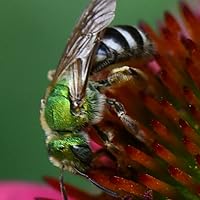
The birds, mammals, reptiles, and insects that inhabit our yards and gardens are overwhelmingly on our side—they are not our enemies, but instead our allies. They pollinate our flowers and vegetable crops, and they keep pests in check.
In Garden Allies, Frédérique Lavoipierre shares fascinating portraits of these creatures, describing their life cycles and showing how they keep the garden’s ecology in balance. Also included is helpful information on how to nurture and welcome these valuable creatures into your garden. With beautiful pen-and-ink drawings by Craig Latker, Garden Allies invites you to make friends with the creatures that fill your garden—the reward is a renewed sense of nature’s beauty and a garden humming with life.
Try to get a copy of this one for you personal library.
It is a good introduction to all of the living beings you can find in your garden and on the farm. It has good ideas on helping our beneficial friends.
The illustrations in the book are very amazing and detailed.
Hopefully it will inspire you to get to know our beneficial friends better.
A very thorough book about all manner of insects and animals that are beneficial to your garden. My only wish is that it had more photos included. What can I say? I am a visual reader. 🤷🏻♀️
This is an extremely thorough book about all manner of creatures that benefit your garden. Some may surprise you, as even moths, ants and slugs are presented as having some benefits in the garden (though there are ways given to control them as well). At over 300 pages, it's in depth and informative. Black and white illustrations depict each type of species, with blue highlights in the interior to add visual interest. It's rather text-heavy and science-heavy, which can be a good thing or a bad depending on how much information you want and how much you just want the facts. All in all, it's an excellent primer.
I read a temporary digital ARC of this book for review.
An excellent little guide to why it's better to get along with nature rather than to try to control it. All the little bugs and critters that you can find in your garden, if you just put away the pesticides/insecticides. The author aptly presents her information in a clearly and easily understandable manner. Cute illustrations. This one will go on my gardening shelf for referring to over and over again!
A wonderful book about why you should embrace and co-exist with nature. Charming illustrations and in depth info, this would make a lovely gift as well as reference material for anyone who understands that you really do reap what you sow.
Thanks to NetGalley, the author and publisher for my ARC.
From the gorgeous cover to the remarkable information and illustrations to the glossary, Garden Allies is a glorious book for gardeners of all abilities and non-gardeners alike who simply enjoy reading about it. It is bursting with details on biodiversity and how to attract pollinators and beneficial critters to your garden. Rather than immediately reaching for the pesticides, take a breath and remember that most garden predators have predators. Balance is necessary. Living things are symbiotic. When you kill "pests" you also kill beneficials. As the author says, make enemies your allies! I love that.
The author draws on her wealth of knowledge to discuss biological control, her case against pesticides unless absolutely necessary, fertile soil, mycorrhizal funi, pollinators, observing insects/birds/amphibians/reptiles and creating a happy oasis for yourself and nature. She reminds us that the world needs insects, especially herbivores, which are essential to life. And where would we be without flowers which form fruit? Each section contains useful information on distribution, appearance, popular names and so on.
My favourite sections are those about various bees and the benefits of honey (one of my favourites is lip balm!), differences between moths and butterflies, parasitoids, shellac origin, snails and the Lyme disease bacterium killer.
My sincere thank you to Timber Press and NetGalley for the privilege of reading this incredible book! I enjoyed learning more and re-visiting topics I hadn't thought of for ages.
Ideal audience is probably readers with an interest in studying entomology. The material isn't overly scientific but the author dedicates portions of each chapter ("essay" is how she labels them) to taxonomy (familiarity with Latin and Greek are a huge plus), appearance, popular names, scientific names, distribution and garden activities. I skipped through the technical portions and felt it didn't diminish the reading experience in any way.
My big picture takeaway is that there are many interesting creatures found in a garden under the right circumstances. And those circumstances include restraint: no pesticides, not disturbing the soil, not deadheading flowers, allowing some leaves and plant detritus to remain on the ground into Spring, not cutting perennials to the ground in the Fall and limited intervention when the creatures start to appear. It's very comforting to know that it's best not to maintain the tidiest garden spaces.
Beyond the message not to overdo things the author does offer thoughts on active measures we can take such as providing water sources and planting a variety of native plants (including perennials, grasses, bushes and trees). The suggestions all seem very reasonable and doable.
The author writes well and in a very pleasingly approachable style. What struck me as slightly strange was that while the author comes across as very cheerful and optimistic much of it stems from the message that when pests start to invade your garden there's no need to worry because something else will come along and kill them.
The book is filled with nice sketches of the living creatures the author writes about. They looked good on my kindle and probably look much better in a physical book.
A wonderful book that is a must read for gardeners in the United States. It’s just detailed enough to provide important information, while not so filled with scientific jargon to bore the average avid reader.
There is so much information in this book about the vast amount of allies we have in our gardens. It has given me plenty of ideas of what to add to my garden to create a more well rounded ecosystem where biodiversity can abound!!
Garden Allies is a beautifully written and illustrated holistic guide to the things which help maintain garden health and build soil, capably written and curated by Frédérique Lavoipierre. Due out 28th Sept 2021 from Workman on their Timber Press imprint, it's 320 pages and will be available in paperback and ebook formats.
This is such a peaceful and interesting book and quite inspiring. It's clearly and simply written by someone who knows what she's talking about and as a keen (and experienced) gardener, I learned more than I expected. The essays are grouped thematically into chapters: life beneath our feet (microbes, earthworms, micro-/macro-arthropods) fungi, winged insects, predators & parasites, beetles, common garden insects, ground insects & pathogens/galls, and birds & other vertebrates. The essays are full of interesting details of the appearance and characteristics of the subjects as well as how they interact with other species. The descriptions include appearance, common and scientific names, and garden roles they perform for us.
Although there's no photography in the volume, the illustrations by Craig Latker are beautifully wrought and enhance the text perfectly. Different organisms are easy to identify and the pointillist (dot sketched) drawings are really quite detailed.
Five stars. This would make a super choice for public library acquisition, gardening groups, home gardeners, and winter nonfiction reading.
Disclosure: I received an ARC at no cost from the author/publisher for review purposes.
With garden/crop planning front and center for most of us, picking the plants to grow this season and exactly where they are going in your garden is of the utmost importance. We also need to make sure that we choose some of the plants for our ‘Garden Allies,’ too.
Most of us plant for local pollinators; however, lots of beneficial insects, birds, mammals, and reptiles pollinate flowers, vegetable crops and handle pests, too. Recently, I finished, Garden Allies: The Insects, Birds, and Other Animals That Keep Your Garden Beautiful and Thriving by Frédérique Lavoipierre (@flavoipierre). Based on her series of the same name, which ran for ten years in Pacific Horticulture (@Pachort) magazine.
With the gorgeous pen-and-ink art by Craig Latker, Lavoipierre creates fascinating portraits of individual creatures, including life cycles and their contribution to the balance of a garden’s ecology – a perfect resource to use for planning!
4/5 overall, and worth the read! The author creates beautiful and intimate portraits of all the creatures, even ones you wouldn’t suspect, like ants and slugs. Be informed that, at over 300 pages, this book is very in-depth, text-heavy, with lots of science-related information and language. Not something most of us would read cover-to-cover in one sitting, but great to have in digestible chunks.
Resource tip: Use your local public library to sample books to know what you want to buy for your home library. Thanks, Vancouver Community Library, I’m buying this one!
"Garden Allies" talks about the different types of insects and animals that you might find in a garden. It's not really a practical, how-to gardening guide since the focus wasn't really on the garden but on the animals that you might find there (and elsewhere). The author talked about various categories of animals and wrote a few pages about each category (like worms, bees, wasps, flies, etc.). It covered things like nesting habits, what they eat, social behavior, and why gardeners might appreciate having them in the garden. Each section ended with profile-type information: their official names, what they look like, etc. Black and white drawings of the mentioned critters were sometimes included, but I didn't find them particularly helpful in terms of insect identification. Overall, I'd recommend this book to those interested in learning more about garden animals.
I received an ebook review copy of this book from the publisher through NetGalley.
A great introduction to the cast of characters, and how they interact with each other, that you will find in your garden/yard if you garden organically, especially if you garden with native plants. The book is written as a series of short essays that lend themselves to being read individually when you come across the animal in question while out in your yard. Very well done. Even after many, many years of photographing the various animals in my yard to be able to identify them and learn about them, I learned a few new things from this book. Gardeners who have any curiosity about the life they see in their gardens would do well to read this gem.
Fine. A pleasant little stroll through various taxa you might find in your garden. By covering so much, you get only a surface level look at anything. Ultimately the main message of this book can be described quite simply: if you foster a highly eco diverse garden, pests will be naturally controlled. Sure, makes total sense. My biggest gripe with this book was the pictures. Full color photographs would have been MUCH more helpful for identifying various critters. The black and white line drawings are lovely but not really helpful beyond that and without color, it seems like you are missing a huge element.
Very thorough reference guide that the author put a lot of thought and care into compiling! I wish there were more details on what specifically to plant (or not plant) to encourage more allies, but I am pleased with what was provided. The illustrations are great. Keep in mind that the author lives in Western USA, so there is a slight emphasis on what may be found there, but there is some information shared about other regions, too. Because of this book, I will be diving deeper into making my yard more habitable and attractive to dragonflies and bats. ^_^
Very nice, but more of a collection of essays on the crawling, flying, creeping things in your garden than gardening tool. Line drawings of the creatures make this seem like a fairy tale rather than if it had full color photos, which would always be my preference. As a very amateur gardener, I'd like to see the creepy crawly things and what they turn into in pictures, so that my initial reaction is not just "hulk smash."
Garden Allies is a good little book about identifying friends of the garden. This book handily describes different bugs and wildlife, what their benefits are, and if they transition from pest to partner, or back again. It's also illustrated, and was a good distraction from my war against the invasive spotted lanternfly.
It may come as a surprise to many (spoiler alert), but it turns out they're ALL allies. Ms Lavoipierre knows (and loves) her insects, birds, and other animals! I kinda wish I had sprung for the physical book (instead of the Kindle edition) so I could flip around in the pages and use it for reference.
This is a very beautiful book and is very useful to people who are into gardening and interesting insects. The book is full of information and lots of pictures that breaks the writing up.
Excellent gardening companion book that helps you get to know the bugs and animals that live in your garden. Comprehensive descriptions, tons of facts about their behavior and how to live alongside so many incredible little insects. You don't have to use pesticides to keep a good balance!
An awesome read. Wont look at our garden the same way again. Lots of helpful tips for providing a good ecosystem for the largest variety of life possible in your garden to control "pests" the natural way.
A descriptive and informative book on all the little insect friends found in the garden and a reminder that we should work with our garden allies, not against them. I loved casually reading a chapter or two over the last six months.
A perfect brief introduction to a wide variety of garden inhabitants that are not plants. The goal of this book is not to be an exhaustive resource, but rather a first step to becoming more aware of the impressive biodiversity found in our yards and gardens.
Nice reference, I learned quite a bit, unfortunately this book is mostly just an encyclopedia of animals, what they eat, and how they can benefit your garden. It lacks any real overarching glue