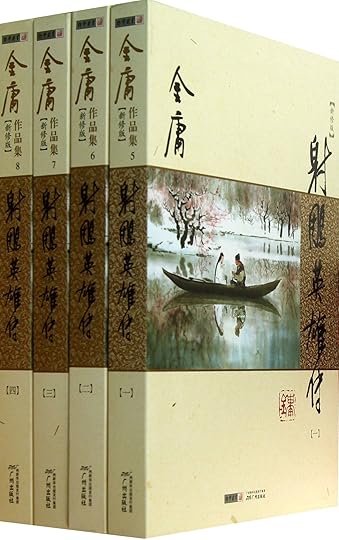
Captivating, lively, and epic (but not too much), definitely a 4-star from me.
One good thing about the story is that Jin Yong had compressed different subjects into his novel which made the story captivating and real. He combined Chinese philosophy (Confucianism, Buddhism, Laoism, Yi-King) and Chinese history (Mongolian too) to create a magical world where people with mastery in martial arts follow their own way of life. Of course, there are other factors used by the author, but those mentioned above are the most typical one in my opinion. For example, heroes in the wuxia world had been competed - killed and harmed - each other for year to obtain "Cuu Am Chan Kinh" (The True Book of the Nine Yin - or probably Jiu Yin Zhen Jing in English) which was believed to make the book owner invincible under the sun. After a long time, the book was acquired by Vuong Trung Duong - the founder of the Toan Chan Giao / Quanzhen school - after he defeated four other masters of martial arts during his time. After having the book, Vuong Trung Duong wanted to destroy it, as it had caused many hamrs and sufferings in the wuxia. However, he thought "water can carry the boat but it can also turn the boat over. So, the problem is not in the water but how we decide to use it." Therefore, he decided not to destroy but to keep the book. What he thought was kinda true. When "good", virtuous people like Guo Jing or Hong That Cong learned the knowledge in the book, they used it for good purposes like defending themselves from evil people like Ouyeng Feng. So, that kind of thinking is related to Taoism (and Yi King too), and the Quanzhen school was influenced majorly from Taoism. Therefore, all the details, events, characters in the book were lively and realistic, because they are backed up by a good system of philosophy and psychology.
The contrast between the brothers Guo Jing - Yang Kang is interesting as well. Guo Jing - stupid (I mean, literally low IQ and EQ) but brave, honest, loving, and a man of his promise. He is a person living to many virtures defined by Chinese philosophy or human moral in general, not to sacrifice his ideaology or other people even in hard times. Yang Kang, on the other hand, smart, sophisticated, but evil, did not hesitate to harm/kill or lie to other people just to achieve his aims. These brothers are tied together by the string of fate, and the high constrast between them highlights the virtures from the vices, in an epic and mythological way.
Love is another special topic in this story. It has many facets and tones, as people are traumatized or happy in different ways, even though all those ways have been caused by love. Many women in the story, though weak and dependent on the men (the influence of Confucianism and the context of a patriachal history, what else do you expect?), have their own virtures as well. For example, even though Mu Nianci loved Yang Kang deeply, she did not give in when his sexual desire was aroused (she did give in later though). Moreover, she was not blinded by love, as she always told Yang Kang to stop taking his enemy as his father, give up all the luxury of a prince of another country and go back to contribute to his own country. These stories highlight the virtures and therefore, the beauty of the female characters in the story.
I give it a 4-star because I think the story is still quite simple for me. I could not find a detaile reason why. Another thing that I do not like is because Jin Yong's ideology is about contributing to a Chinese dynasty at that time, in the context of the story. Of course, there is nothing wrong with that, especially when the story takes place a long time ago in the history. However, for me, I would prefer everyone to live happily and peacefully with each other, no matter which country they come from. This is just a blabbing from me, because it is really impossible to have this way of thinking when the neighbouring countries are trying to acquire that of your own. But anyway, it is fine. A very entertaining and enjoyable read.