

What do you think?
Thought in the Act
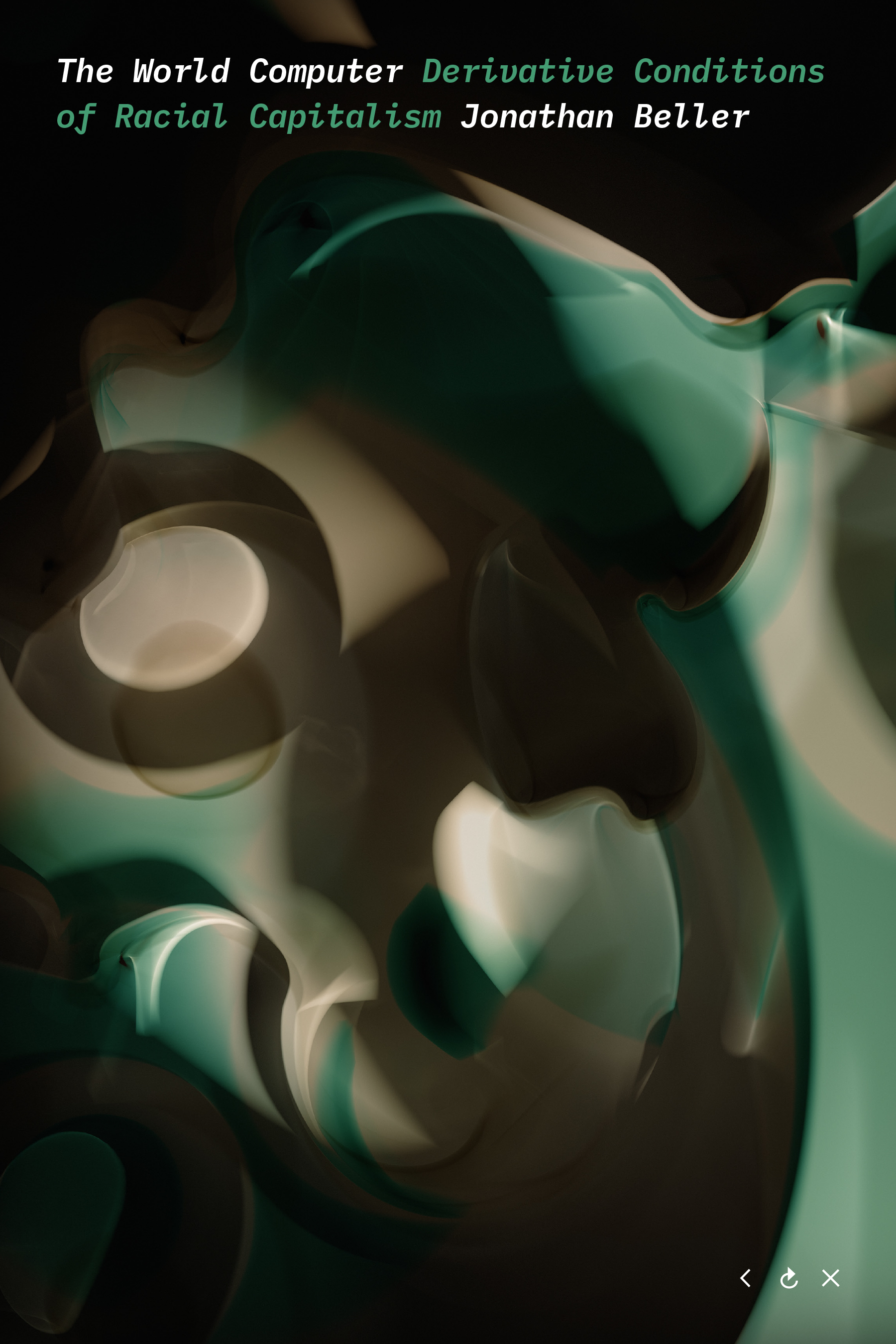
The World Computer: Derivative Conditions of Racial Capitalism
In The World Computer Jonathan Beller forcefully demonstrates that the history of commodification generates information itself. Out of the omnipresent calculus imposed by commodification, information emerges historically as a new money form. Investigating its subsequent financialization of daily life and colonization of semiotics, Beller situates the development of myriad systems for quantifying the value of people, objects, and affects as endemic to racial capitalism and computation. Built on oppression and genocide, capital and its technical result as computation manifest as racial formations, as do the machines and software of social mediation that feed racial capitalism and run on social difference. Algorithms, derived from for-profit management strategies, conscript all forms of expression—language, image, music, communication—into the calculus of capital such that even protest may turn a profit. Computational media function for the purpose of extraction rather than ameliorating global crises, and financialize every expressive act, converting each utterance into a wager. Repairing this ecology of exploitation, Beller contends, requires decolonizing information and money, and the scripting of futures wagered by the cultural legacies and claims of those in struggle.
352 pages, Hardcover
Published February 26, 2021
Ratings & Reviews
Friends & Following
Create a free account to discover what your friends think of this book!
Community Reviews
Displaying 1 - 5 of 5 reviews
July 10, 2022
I started this book as a high school debater looking for some new critical theory to whip out at a big tournament. I ended this book with an improved understanding of how racial capitalism has entrenched itself in our digital world. While Beller doesn't quite answer our questions about revolutionary organizing in semiocapitalism, his diagnosis of the problem is brilliantly clear. I'm glad debaters are reading this book.
May 10, 2022
Interesting and insightful, yet incredibly dense and complex. Some conclusions and connections are too totalizing and repetitive. I barely made it out; I would have to read it again for a comprehensive review.
April 2, 2026
This book won me a lot of debate rounds. I find the arguments about IBM computers being used to perpetuate the Holocaust compelling. I love a good information critique, and his analysis has only become more relevant with the advent of generative AI (and although the financial derivatives claim went over my head, I think it’s even more relevant today with the advent of prediction markets). However, I think Beller falls into the Marxist trap of: 1. Oversimplifying how the world works — chalking everything up to a vague notion of racial capitalism is just lazy. There are ways to align technology such that it is de-risked from preexisting biases, in the same way that econometricians can control for omitted variable bias. 2. I also believe that Beller doesn’t properly steelman the arguments against his thesis; he fails to engage with how financial institutions actually work in practice. Finally, the explanation of cybernetic communism was vague, and I honestly have no clue what it means, how it will come about, or why it matters. The idea that cryptocurrency will bring about a decentralized order of things is patently false — the best use case for crypto is stablecoins, which are backed by the very same centralized financial institutions Beller critiques.
Overall, the fancy Marxist prose makes you feel intellectual reading it, and some of the critiques are compelling. However, I think when you strip away the flowery language, Beller isn’t saying much and doesn’t provide a good alternative.
Overall, the fancy Marxist prose makes you feel intellectual reading it, and some of the critiques are compelling. However, I think when you strip away the flowery language, Beller isn’t saying much and doesn’t provide a good alternative.

April 14, 2022
Very good but loses steam after the monumental (92 page?) introduction ...kind of lost interest after the bit on the machinic unconscious. If it stopped after 120 pages or so it'd be 5 stars. So maybe worth picking up and reading just until there

September 22, 2025
Watch your language.
Displaying 1 - 5 of 5 reviews