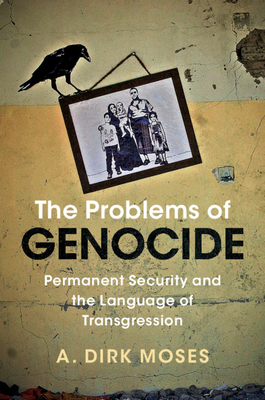
Genocide is not only a problem of mass death, but also of how, as a relatively new idea and law, it organizes and distorts thinking about civilian destruction. Taking the normative perspective of civilian immunity from military attack, A. Dirk Moses argues that the implicit hierarchy of international criminal law, atop which sits genocide as the 'crime of crimes', blinds us to other types of humanly caused civilian death, like bombing cities, and the 'collateral damage' of missile and drone strikes. Talk of genocide, then, can function ideologically to detract from systematic violence against civilians perpetrated by governments of all types. The Problems of Genocide contends that this violence is the consequence of 'permanent security' the striving of states, and armed groups seeking to found states, to make themselves invulnerable to threats.
A. Dirk Moses is Professor of Global and Colonial History at the European University Institute, Florence. He also taught (or still teaches) European History and comparative genocide Studies at the University of Sydney, Australia.
There is a tenuous cease-fire in Gaza but the quarreling among historians continues. At one end of the spectrum, some leftist and liberal historians argue the state of Israel is committing genocide. They point to statements by Israeli leaders that indicate intent to destroy, in whole or in part, Palestinians as such.
Other liberal historians condemn Israel’s destruction of Gaza in retaliation for the Hamas onslaught of Oct. 7, 2023, but they argue it does not meet the narrow definition of genocide. Further to the right along this spectrum, you will find Israel’s defenders who deny all wrongdoing and instead place the responsibility for Palestinian deaths on Hamas because it operates from civilian areas. Outside the lunatic fringes of the left, you won’t find many people who deny Hamas’ criminality on Oct. 7.
In Tuesday’s episode of History As It Happens, historian Dirk Moses and I didn’t bicker over who among the scholars possesses the truth. Some listeners may bristle that we didn’t take sides (as far as the genocide charge goes), but I would point them to my consistent critique of Israel’s war and the Biden administration’s unconditional military assistance. Genocide or not, there is no doubt in my mind that all sides – namely Hamas, Hezbollah, and Israel – have committed war crimes or crimes against humanity.
Dirk Moses is the Anne and Bernard Spitzer Professor of International Relations at the City College of New York. He is an expert in genocide studies and international relations, and his 2019 book The Problems of Genocide framed our conversation. His work is important because the concept of genocide is as contested today as it was in the immediate years after the Second World War. In his view, the entry of the genocide concept into law has been detrimental to the pursuit of justice.
Contested origins and legalisms
In the podcast, Moses delves into the conceptual origins of this “crime of crimes” that has rarely been successfully prosecuted in the 79 years since Nuremberg. You might be surprised to learn that none of the initial Nazi defendants before the international tribunal in 1945-46 were charged with genocide as an independent crime. How to define the concept was taken up by the United Nations, whose member states depoliticized it. Neither political groups nor political motives would be included. Rather, genocide would be narrowly defined as a crime against nations or races.
This was no accident. Nation-states large and small wanted freedom of action to violently suppress internal rebellions or wage war against external security threats. Therefore, if in the process a state annihilates a racial or ethnic group, it can be justified in terms of security, not as an act of racial or national extermination. This sinister notion was present at Nuremberg.
As Moses points out, the SS Einsatzgruppe commander Otto Ohlendorf told his Allied interrogators that he had done nothing wrong. Murdering Jews, including children, had not been racially motivated; it had been a matter of establishing permanent security in occupied Soviet territory. Ohlendorf’s defense for rounding up and killing civilians who posed no military threat whatsoever was not convincing. He was hanged in 1951 for crimes against humanity and war crimes.
“It’s been an ongoing debate for 100 years. The issues that are on the table with Ukraine and Gaza today were played out during the negotiations for the genocide convention in 1947-48, and then in subsequent armed conflicts, particularly in the wake of decolonization. This vexed relationship between war and genocide comes up,” Moses says.
“Why is it that genocide is so vehemently contested? Why, on the other side, is genocide so vehemently asserted? Let’s not forget that six days after the seventh of October, there were already two articles by Raz Segal and Martin Shaw alleging that genocide was taking place, or at least genocidal rhetoric was motivating it… These were accompanied by many other protestations by Palestinians in the immediate aftermath of the seventh of October. So, why this recourse to genocide?” Moses continues.
The CUNY historian contends that because genocide now occupies the sole position atop the list of evil human acts, other appalling international crimes somehow seem less severe.
“Here we are quibbling over whether it’s genocide or not, rather than talking about the facts that are staring us in the face. Gaza is being laid waste. It is being utterly destroyed. It is easy to infer the intention to make life uninhabitable there so that there can be a permanent security solution for Israel,” Moses says.
“So why is it that genocide is being alleged and then vehemently contested? It’s because genocide is related to the Holocaust in the sense that the Holocaust is genocide’s archetype or ideal type. When people think of what a genocide looks like, they think of the Holocaust. That may not be how the lawyers reason, but that’s how popular imagination works. These archetypes are sedimented into our consciousness. They are deep down in the DNA of how we imagine what the ultimate evil looks like. Once you make the Holocaust the absolute evil, with a capital A for absolute, then [the concept of] genocide incorporates or borrows its stigmatic aura. No state wants to be accused of that.”
Moses says this is only a partial explanation. We must also consider the emotional sting caused by accusing the world’s only Jewish state of the same category of crime committed by the Nazis, who sought to exterminate all Jews because they were Jews. There is also the modern problem of excessive analogizing: the politicized use of the genocide label can cheapen history. There’s also the suspicion that antisemitism influences the allegations against Israel. Historians are invested in these aspects of the debate because historians are human like everyone else.
And as Moses discusses in the podcast, Holocaust memory has been to some degree politicized. He mentioned the work of historian Shira Klein, who quoted major historians and cultural studies scholars saying that the point of Holocaust memory is to protect Israel’s diplomatic reputation.
Listen to my conversation with Dirk Moses here at Apple Podcasts.
Dirk Moses writes a compelling argument for the problematic design of current framework of genocide law and studies that normalizes the mass violence and the violation of human rights en masse. Starting from the origin of the language of human rights in the west, he traces the history of how human rights language framed Lemkins work and perspective when he first defined genocide. He also discusses the politics of the genocide convention and discusses cases throughout the rest of the book as to why it has failed to prevent mass atrocities and that the way we view crimes of atrocity may need substantial change to produce effective language that assists in the prevention of mass violence against peoples.