Jump to ratings and reviews
Rate this book

Magnolia, 木蘭

Rate this book
"This is a book of the body and the senses, whether the million tiny nerve endings of young love; the hunger that turns ‘your bones soft in the heat’; the painterly, edible, physical colour of flowers and the fabric lantern in the pattern of Maggie Cheung’s blue cheongsam; or ‘the soft scratchings of dusk’.

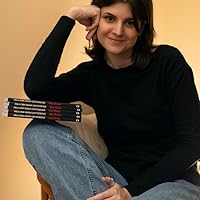
Nina Mingya Powles is a poet and zinemaker from Aotearoa New Zealand, currently living in London. She is the author of a food memoir, Tiny Moons: A Year of Eating in Shanghai (The Emma Press, 2020), and several poetry pamphlet collections including Luminescent (Seraph Press, 2017) and Girls of the Drift (Seraph Press, 2014). In 2018 she was one of three winners of the inaugural Women Poets' Prize, and in 2019 won the Nan Shepherd Prize for Nature Writing. She is the founding editor of Bitter Melon苦瓜, a risograph press that publishes limited-edition poetry pamphlets by Asian writers.

72 pages, Paperback

First published June 1, 2020

39 people are currently reading
2426 people want to read

About the author

Nina Mingya Powles

12 books222 followers

Ratings & Reviews

What do you think?
Rate this book

Friends & Following

Create a free account to discover what your friends think of this book!

Community Reviews

5 stars
300 (34%)
4 stars
352 (40%)
3 stars
167 (19%)
2 stars
38 (4%)
1 star
4 (<1%)
Displaying 1 - 30 of 174 reviews
Profile Image for emma.
2,561 reviews91.9k followers
April 14, 2023
judging books by their covers again...

unfortunately it appears i, a lifelong poetry doubter, am becoming a poetry girl one prose poem at a time.

some parts of this felt stronger to me than others, but maybe that's just part of my poetry enjoyer origin story? regardless, this had parts i really, really liked.

not only the cover.

but also that.

bottom line: pretty in more ways than one <3

3.5
Profile Image for Christmas Carol ꧁꧂ .
963 reviews835 followers
April 26, 2022
3.5★

The rising star of New Zealand poetry

I read Two Portraits of Home - [IMG_098] & [IMG_227] in the New Zealand Listener (Jan 23 2021) and I am intrigued. Very pretty use of words.

Let's call it 4★ & see what the rest of the collection looks like.

Sonnet with particles of gold

Lovely - Powles works so effectively with colour & taste 4★


Hmmm... shifting this review around to different shelves has changed the start date, so I have taken A Wild Guess & made it some time in March. I'll note Goodreads start times before shifting things in the future.

If anyone is interested, one poem from each shortlisted entry to the Ockham's

I'm puzzled why Maggie Cheung’s Blue Cheongsam was chosen to represent Powles work. It is a fragment of prose. I normally hate fragments, but this one is pretty. Ok so 2.5★

Field Notes from a Downpour Pretty & yet profound. Loved this one! 5★

Girl Warrior, or; Watching Mulan (1998) in Chinese with English Subtitles. Outstanding! Captures the feeling of displacement one gets when not completely from the place where you are living. 5★

Breakfast in Shanghai sigh. Fragments. But lovely descriptions that make me feel like I'm in Powles world - in particular for a pink morning in late spring another sigh for the lower case titles though. 3🍑💫

Maps Another fragment of prose. 2.5★

The Great Wall, 2016 This may be a fragment but watching the author read it made a big difference for me. 3⭐
https://www.youtube.com/watch?v=J-d60...


I have been given some Amazon gift vouchers & this is one of the books I have purchased. I'm probably not going to review every poem the way I have above, but let's see how I get on.

One thing I'm finding (& I don't think it's my kindle) is that the pages 'stick' a bit & are hard to turn. Haven't had this with a kindle book before.

Edit; & I have thrown in the towel & returned the kindle edition to Amazon. There is a note on the Amazon page warning that this is a large file (for 81 pages!) & it has proved impossible to read, as it sticks & jumps pages. I can't get hold of the author, but I have contacted her publicist to suggest this needs fixing.

Marking as a Can't Finish for now.


https://wordpress.com/view/carolshess...
Profile Image for luce (cry bebè's back from hiatus).
1,555 reviews5,836 followers
January 26, 2023
blogthestorygraphletterboxd tumblrko-fi

“I am full of nouns and verbs; I don’t know how to live any other way.”


Equal parts winsome and wistful Magnolia, 木蘭 makes for a dreamy yet insightful collection of poems that read like a meditation on the interplay between language, memory, and heritage. In some of these poems, Nina Mingya Powles examines how language has affected the way she interacts with her family members, her grasp of Mandarin, and writers like Eileen Chang and actors like Maggie Cheung. Some of these poems are light, ephemeral even, others appear more like snapshots, ones that capture in vibrant detail a certain mood.

“When reading her stories in translation it’s like trying to see her from a great distance. Or through a thick pane of glass. I am standing outside, peering into rooms where her ghost has been.”


Sometimes a certain memory or image leads Powles, and us, into unexpected places, so that we come to surprising realizations or observations. Many of these poems are suffused by a sense of longing, a nostalgia even. Powles yearns for connection, for clarity, for a more clear understanding of her own history. While the experiences and images within these poems are clearly very specific to Powles, there were many instances where I felt very in sync with the way Powles articulated her feelings and/or impressions. I liked the rhythm of her words, the imagery she creates, and the reflections she makes. The melancholic atmosphere permeating these poems adds to their introspective mood, and I even found myself revisiting my favorites once I’d finished the collection.

“Everything is in a haze, a sunken dreamworld seen through pink stained glass. Everything around me might collapse at the slightest touch. Light, sound, the air that separates you and me.”


Powles’ interrogation of language, its limitations, and its potential, brought to mind the work of Jhumpa Lahiri, Kim Thúy, and Victoria Chang. The comparative dimension Powles brings into her poems, as she refers to real-life people and art, brought to mind Olivia Laing. If you are looking for a melodic collection exploring language, memory, and identity you should definitely add this release to your tbr list.

“In Chinese one word can lead you out of the dark / then back into it / in a single breath”
Profile Image for el.
418 reviews2,390 followers
December 14, 2022
despite an abundance of average, there are a few moments of gorgeous lucidity in nina mingya powles’ magnolia:

Today scientists discovered the origins of gold: / the sound of egg noodles crisping in the wok, / the garden carpeted in kōwhai petals, / the way my phone corrects raumati (summer) to rainstorm. / The day after my grandmother died was white-gold in colour.
Profile Image for Aike.
93 reviews
January 24, 2021
While reading Tiny Moons I immediately ordered Nina Mingya Powles’ first poetry collection, which was also written during her time living & studying in Shanghai (and hence has a little overlap in the writing and content). Even more so than Tiny Moons, it offers an experience of the city evoked through flowers, taste, memory, history, language. Just like Nina writes that the burnt-up chemical sky of the city leaves a red taste in her mouth, these poems are a taste of Shanghai.

Magnolia travels between poetic forms, never too sure of itself. It is playful, this undefinability. The fragmentation fits with the themes explored, of a diaspora experience, of multitudes of language & culture. There is never any certainty, and I’m still not sure if the collection is strong because or despite of it.

The poems are soft, sensible, not scared to feel deeply and most of all ~ hungry. For the world, for all that there is to experience, and there is so much of it.
Profile Image for Areeb Ahmad (Bankrupt_Bookworm).
753 reviews262 followers
March 8, 2023
"and we asked what are you doing there, moon
our bodies neck-deep in salt and rain
each crater is a sea you said & dived under
the sun before I could speak water rushing
over your skin the place where chocolate
ice cream had melted and dried there like a
newly formed freckle on the surface of
us and the islands crumbling apart softly
over sea caves somewhere opening
my mouth into the waves to say you are
you are you are"

// Last summer we were underwater (for K.)


Let me first get this out of the way: contrary to what I expected, this collection didn't work for me and was not my thing. Nina Mingya Powles is a stunning poet. Both these statements can be simultaneously true. These poems have so many textures that layers after layers unpeel. It is fascinating to see language made palpable, brought down to the corporeal, to a movement of mouthparts. So words take shape, bridging dialectical gaps between Chinese and English.

Kamila Kunda aptly describes the experience of reading the book as "browsing through Polaroid photos in Technicolor". There's a vintage feel to the collection, a sepia tinge, and yet the poems themselves feel refreshing to read. Central to it all is Nina's poet persona, straddling two selves distinct from the other: "I am full of nouns and verbs; I don't know how to live any other way." Always there, a lineage of women going back and guiding the way forward, a legacy of light.


(I received an ARC from the publisher in exchange for an honest review.)
Profile Image for Sonia Arya.
10 reviews
August 16, 2020
I really wanted to like this book but I ended up feeling quite disappointed. There are few nice poems here and the references are quite fascinating but there are also so much that did not make an impact on me. I was mainly put off as I found Powles' writing very 'similar' to Sarah Howe and Ocean Vuong.
Profile Image for Nina.
Author 1 book54 followers
May 16, 2024
nova tamblr poezija, ukratko.

trudi se sa opisima hrane, spomene Mijazakijeve filmove tu i tamo, mnogo poetičnih opisa, ali sve to nekako nema svoje JA, vrlo generično i pseudo-intelektualno.
Profile Image for Maddie.
244 reviews32 followers
December 27, 2022
3.5 ⭐️
"Magnolia, 木蘭" is Nina Mingya Powles's debut poetry collection. The poems mainly explore the topic of Asian identity, and feel very personal and full of emotions.

My attention was drawn to this particular collection because of its gorgeous cover. As a disclaimer, I am not a big poetry reader. English is not my first language,and even though I am very proficient in the language, the feelings that poetry usually elicits with its readers come much easier to me when reading poetry in my native language. On the topic of language though, one of the things I loved about the poems was the way the writer incorporated Chinese words and played with the Chinese language. Language, of course, is a big part of one's identity, and this incorporation of words, that English-only speakers would not be able to read, speaks to that theme of identity. I also really liked the references to movies and creators.

The poems don't really have a structure. At times, they felt more like an outpouring of feelings and thoughts. For some readers that speaks more to their emotions, but for me, personally, it did not work as well. What I really liked though, was the imagery and vivid writing style.

Thank you to NetGalley and Tin House for the e-arc. All opinions are my own. "Magnolia, 木蘭", by Nina Mingya Powles has been available since August 2022.
Profile Image for Kendrick.
113 reviews10 followers
May 22, 2022
Magnolia appears as the type of book that I’m supposed to like: with poems exploring Asian identity and the boundaries of language while playing with different poetic forms. When a Eurasian friend pressed Powles’ poetry collection into my hands with a glowing review, I went in with high expectations.

On the thematic level, Magnolia is split into three parts, attempting to explore Asian identity through media, language and family. The writing style is sensorial -- filled with smell, sound, taste, and touch. Part of Powles' collection was written while she was on a writing sabbatical in Hong Kong, and she evokes landscapes of Hong Kong and China in poems like "Falling City" and "Train from Anyang". In an interview, Powles speaks of how most of her poems for Magnolias began as journal entries, and it is clear that the prose format is her style of choice. For me however, I felt that some Asian references in Magnolias “othered” the cultures they attempt to describe. In “Love letters in lotus leaves”, Powles' speaker describes women who make sticky rice dumplings:

In the stairwell outside my flat I pass the auntie next door carrying a blue bowl of zongzi, bundles of sticky rice wrapped in leaves, freshly steamed. I can feel their heat rising up between us. The scent of tea and rice and wet leaves fills the old house: gets inside cracks in the wooden floor, floats up under the door, the downstairs windows always coated in steam.

In the afternoons, aunties sit in the courtyard under the washing lines, cutting, mixing, folding, wrapping. Their laughter carries down the street in heavy, humid air.


If the women were viewing themselves, would they describe themselves in this manner? The “I” that vanishes after the first two sentences remains an invisible narrator, and most of Magnolia’s poems are built from this vantage point. At times, I felt like I was viewing parts of my culture through a looking glass, and while some poems aim for anger or sarcasm to subvert the presence of Whiteness, their turns can feel expected:

“I am the last of them – a woman with her own dreams, not salvaged from the cloud based data lake that I created.” (from “In the end we are humanlike: Blade Runner 2049”)

“99% of all this plastic comes from China / if we consume it all maybe we’ll never die / never break down / I’ll never be your low-carb paleo queen / I’ll spike your drink with MSG…” (from “Styrofoam love poem”)


I find myself more at ease when Magnolia’s speakers acknowledge their positions of estrangement. Magnolia’s second section, “Field notes on a downpour”, explores how Chinese characters are used by Sino diasporic writers to approach their culture/family (see: Natalie Wee, Chen Chen and Ang Shuang, among others). It is the collection’s best poem by a comfortable margin. I did wonder, given the focus on prose narrative, if there were opportunities to further push the structure of this form. Playing with a degree of uncertainty in voice may have also helped – most of the poems are narrated in plain declarative or imperative. TWhile this may not be noticeable for some readers, I wanted greater variety. Nevertheless, it is a good collection that will find its readers, but that reader was not me.
23 reviews3 followers
December 16, 2022
extremely mid,,, despite some moments of self-reflexivity, this book is q orientalizing in its treatment of asia as the wasian diasporic subject's dreamspace & thus projection screen. worse, this book is profoundly, &, with a shocking abundance that i have yet to behold in another book, guilty of what som-mai nguyen has called a "jazz-hands half-nelson device" in diasporic lit in which writers "extrapolate from orthographic coincidence and sprinkle in non-English words to assert unearned authority." the number of times i had to shout "that is NOT true!!!!" @ "explanations" of chinese etymology/definitions while reading this lol

https://astra-mag.com/articles/blunt-...
read this article instead of this book ... i'm sry...
Profile Image for Miya.
94 reviews2 followers
July 17, 2020
A beautiful collection of poems. Nina Mingya Powles meditates on her ancestry and mixed heritage through the exploration of food, language, color, flowers, and art. She brings us along as she travels the streets of Shanghai, contemplating the moon. As a mixed-race woman myself, I found her reckoning to be breathtaking. Finally, another human being trying to navigate the feeling of being born into multiple worlds. I'll be coming back to these poems again and again.

"I'll never be your low-carb paleo queen / I'll spike your drink with MSG"
Profile Image for Mick T.
7 reviews
April 28, 2021
2.5 stars. Following her collection, Luminescent, Powles' Magnolia 木蘭 illustrates poems where the speaker attempts to remember her heritage and learn language and what they mean to her. The way she describes things (i.e. script, food, etc.) is interesting at times, but sadly, some poems read like reports, a collection of ideas, and I did not connect with them emotionally.
Profile Image for Dessi Bocheva.
106 reviews1 follower
April 11, 2022
I quite enjoyed this overall but there were a few fillers. I wasn't a fan of the art descriptions but I did think the poems with the scattered structure which could be read in multiple ways were really interesting.
Profile Image for Always Becominging.
115 reviews22 followers
February 23, 2021
Nina is too good! With this collection she turns her gaze slightly away from historical women (though they still get their moments) and more onto herself. This is a book full of colour, taste, distance, memory, and Disney. These words glow.
Profile Image for Kamila Kunda.
430 reviews356 followers
July 9, 2022
Isn’t this cover just delightful? In her elusive, highly impressionistic poems in the collection “Magnolia”, New Zealand native of Malaysian Hakka origin Nina Mingya Powles explores various aspects of her identity. Reading her poems felt for me like browsing through Polaroid photos in Technicolor (and there are many poems here devoted to specific colours). A wonderful, immersive, sensorial experience.

Food and language are in the centre of her self-exploration and the observations of the world around her. Various dishes, fruit, even ways of preparing them are here Proustian madeleines, taking the author on a journey into her memories or the memories of women in her family. In a way “Magnolia” pays homage to a matriarchal structure of a family, in which women fill the treasure trove with everything close to people’s hearts.

“I am full of nouns and verbs; I don’t know how to live any other way”, writes Powles in one of her poem. Through language she tries to understand the world, observing with childlike fascination how language sometimes simplifies and in other times complicates it: “Some things make perfect sense, like the fact that 波 (wave) is made of skin (皮) and water (氵) but most things do not”. Inspired by learning Mandarin and not being able to communicate with her grandmother properly, with language, she expresses what could be described as saudadé in Portuguese (profound melancholic longing, often for something one has never had).

Films play another huge role in Powles’ poetry, from Ghibli productions to “Mulan” (hence the title of the collection: mùlán means ‘magnolia’ in Chinese) and “In the Mood for Love” (there is even a poem with the title of this latter film and one titled “Maggie Cheung’s Blue Cheongsam”).

I never felt I needed to understand these poems or all references, but I felt them with my heart. “Magnolia” is a deeply personal collection which made me smile a lot because of sheer beauty of the images Powles painted and sensitivity and attention to detail, whether culinary or linguistic.
Profile Image for Judy.
443 reviews117 followers
April 10, 2022
Anyone who enjoyed Tiny Moons: A Year of Eating in Shanghai, this author's short essays about food and moving between cultures, will probably enjoy this too. Although this collection is poetry and the other one poetic prose, they are quite similar in tone and cover some of the same topics. It's full of warmth and sensuous images and descriptions.
Profile Image for Ashley.
128 reviews5 followers
October 21, 2021
5 stars because I relate strongly to navigating the world with two birth tongues, the Malaysian Chinese references, the loneliness of being away from home, the evocation of nostalgia through food, and most of all the ties to a maternal grandmother who speaks Hakka.
Profile Image for Sarah Cavar.
Author 19 books359 followers
January 31, 2023
There are moments of beauty and insight here, but I fear this book is too bogged down by cliché, and particularly over reliance on language translation/dissection as its way of gathering meaning. I’ll definitely keep an eye out for more of Powles’s work, but this one is a solid “meh.”
Profile Image for Sahitya.
1,177 reviews248 followers
August 1, 2022
Probably more of a 3.5.

I’m not a poetry reader at all, so I frankly don’t even know the reason why I impulsively decided to pick this up. And I’m definitely not someone who can review a poetry/verse collection like this in any coherent manner.

Why I can’t really articulate to you what this whole collection was about, I could feel some of the emotions behind it, especially the ones related to belonging, not being able to understand a language that’s supposed to one’s mother tongue, that feeling of displacement from the place where one belongs to etc. And the the descriptions of food and rain in particular were very exquisite. But I can’t say the same about the complete book because there were many places where I felt lost and unable to understand what the author was trying to convey, but that’s probably just my shortcoming for being unfamiliar with the format.

However, the one thing I will remember about this is the way the author plays with the Chinese language, using homonyms as a metaphor for the various emotions the narrator is going through, the wordplay giving so many different meanings than what’s being conveyed in English, and the interplay between the two languages leads to so much more conversation and depth. I don’t know if I will read more poetry by this author but I definitely feel that I got to experience this collection.
Profile Image for ꧁ ꕥ James ꕥ ꧂.
522 reviews20 followers
July 22, 2022
This collection really focuses on themes about the natural world, food and also the authors own identity, and while there were a few filler poems which were nothing special, on the whole, this collection was beautifully poignant.
Profile Image for Jules KG.
51 reviews56 followers
July 28, 2022
Nina Mingya Powles has a colorful and distinctive voice in her poetry. This collection of poems was vivid in its imagery and imaginative in its storytelling. I think the writing was very beautiful and I would definitely recommend her work.
Profile Image for Szahra.
177 reviews4 followers
Read
February 5, 2023
DNF @ 38%
This poetry collection is just unfortunately not for me..
Profile Image for stefiereads.
389 reviews118 followers
June 24, 2025
3.5 stars.

This poetry collection made me feel homesick somehow. Intimate and quiet.
There are so many elements I love that are mentioned, like: rain, city at night, flowers, magnolias, food and more.
My first book of Nina and won't be the last.

P.s. Can we please talk about that beautiful cover?!
Profile Image for sara.
4 reviews2 followers
March 14, 2023
i love nina mingya powles and her beautiful writing and my bestie kari for always exposing me to brilliant literature and poetry and art
Profile Image for Shelley.
385 reviews9 followers
August 15, 2022
I feel like I’m in a mood at the moment — works about female Asian experiences I did my best to avoid growing up I suddenly find myself craving and curious about. This is another work in that vein.

This collection itself is satisfyingly cohesive. The idea of the mulan flower / magnolias winds it’s way throughout these poems. There’s also a lingering presence of rain (“Certain languages contain more kinds of rain than others, and I have eaten them all”) and repeated motifs. The voice is young, exploratory, uncertain.

Since reading Rose Lu’s book I’ve been thinking about the uniqueness of the Asian-New Zealand experience — the last stanza of City of forbidden shrines hits differently if you’re from NZ; there’s something very homesick in the mention of kōwhai. I didn’t enjoy all the poems, but the ones I did I connected with immensely. There’s a creativity to some of the lines that Nina Mingya Powles crafted which surprised me and felt wonderfully refreshing. I appreciated and enjoyed the thought that went into these poems.
Profile Image for To read these days.
9 reviews
June 1, 2021
Quite disappointed. Heavily 'infuenced' by other writers. I hear not only Sarah Howe but some lines read like lines from the author's contemporaries in the UK poetry scene. The poet who is part Chinese has travelled to China to learn the language, and to me some poems felt like they were written for the sake of being exoticised.
Displaying 1 - 30 of 174 reviews

Can't find what you're looking for?

Get help and learn more about the design.