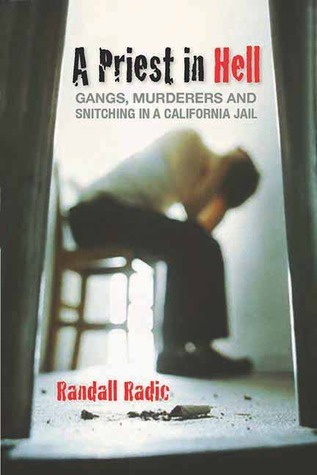
“Living in jail is like living in a foreign country. The customs and culture are different, almost alien, and so is the language.” A Priest in Hell is the compelling true story of life in the U.S. prison system. The book takes fodder for popular reality shows (like Cops) to a new level, giving the reader a frighteningly real sense of the tastes, sounds, smells, culture and lifestyle of jail. On November 5, 2005, Randall Radic was arrested and charged with ten felonies. Desperation for a monied lifestyle led Radic, a pastor in the northern California community of Ripon, to first mortgage the home provided to him by his church, before selling off the church itself. His crime is exposed when a large bank deposit catches the attention of the authorities. Radic is subsequently convicted of embezzlement, forgery, and fraud, and he spends six months in a California jail before a plea bargain facilitates his release. At 54, Radic is well above the average age of the prison population, and his background as a priest makes him both a target and a confidante within the prison walls. Through the book, Radic introduces the stories of several of his fellow inmates, detailing their crimes, cases, and struggles. He eventually earns his plea bargain by sharing confessions of a fellow inmate with the district attorney. Radic considers his time in jail Dante’s version of Hell. This is the gritty, painful reality of crime and consequence.
I read this book at the urging of an incarcerated friend. It is my first foray into the world of prison lit and I fully expected to dislike the book, or at least be bored with it. Neither was the case. I won't review the plot since the other reviews here do that nicely. I was far more interested in the personal perceptions and experiences that Randall Radic processed internally throughout the book and the very engaging manner in which he detailed them for the reader. That's a long-winded way of saying that I liked the writing.
While there is very little action over and above the shallow, repetitive, raw and crass dialogue one would expect to hear in a jail setting, there is such a descriptive richness in the vivid imagery that I felt as if I were viewing the environment through Radic's eyes with every chapter. I was surprised by how sucked into the scenes I became by the jail's "cancer green floors" and "ailing, infected white ceilings". "And life's raw guts is the perfect description of life in jail - like living in bleeding intestines."
Radic's skillful eye for detail captures not only the environmental surroundings but the very nuanced descriptions of the physical posturing, stances and gestures exhibited by many of the prisoners, what Radic terms: "primate dominance dynamics".
The myriad cell mates Radic endures in his short stay along with several other inmates come through as strong and distinctive personalities; bizarre, usually damaged ones at that. At times Radic's gentleness and kindness toward them is poignant and other times the riffs are laugh-out-loud funny: "'Look', I say, a little irritated that a Vespa-riding, solitaire-playing stalker is now advising me on the nuances of fraud, embezzlement and the distribution and allocation of derived funds." Radic's wry, dry, sardonic humor kept the narrative pace punchy for me: "My only concern is the abatement of boredom leading to lunacy."
This is not a tale of redemption or a conversional mea culpa of any sorts. Little mention is made of God or Radic's faith. There might be the tendency to get trapped in trying to make sense of a priest who, for God's sake, acts, thinks and speaks in this way, but if one has any familiarity at all with one's own shadow self, one gets over oneself quickly and moves along with less judgments.
Conceding that I would never have chosen to read this book of my own volition had it not come so highly recommended by my friend, I am glad that I did. The exposure to an environment that is totally foreign to me and the chance to glimpse into the tortured souls, customs and rituals of that world made for an interesting voyage that was rendered all the more rich by Radic's appealing writing style. I paused many times in the reading of "A Priest In Hell" to reread a sentence or passage that moved me, appreciating on deeper levels the author's intention in what he was expressing and the words he chose to use. This is a good example of one such place I paused: "This place has the potential to wound you, to make you something less than you are. As if by merely seeing a thing some part of yourself is taken away from you."
Discouraged and disillusioned, having to constantly make ends meet in a struggling parish, the author, a former pastor in northern California, is finally overcome by the temptation to experience the lifestyle of the wealthy, eat the finest foods, drive the most luxuriant cars, have the best of everything. A wild plan was hatched to sell the rectory provided by the church, and then sell the church itself ala the great Brooklyn Bridge scams of the 19th-century. The crime was eventually uncovered when the bank grew suspicious of the unusual deposits. Consequently the author found himself stripped of everything, staring at four empty walls of a jail cell charged with ten felonies. Describing his thoughts as he entered a cell for the first time Radic writes:
"I have nothing left. No energy, no thoughts, no possessions, no food, no personal items, no cup to drink from. No job, no house, no car, no money, no one I love. No book to read, no paper to write on, no pencil. All I have is the orange clothing I wear, and it is not even mine."
The author recounts his journey through the jail system while awaiting his hearing. Thrown into this alien environment he must learn quickly how to survive. He must discover some way to get along with his fellow inmates and find out who not to "hang-out" with, particularly the violent "gangbangers" and sex offenders. The jail-house lingo, with bizarre codenames such as "dog", "Surenos", "OG's", "chomos", "firebug", becomes his new mode of communication. A code of "etiquette" must be observed. Jailhouse currency becomes tobacco, soup packs, and candy bars. The author leaves nothing to the imagination when describing his day-to-day experiences. When he finds himself associating "Jail" with "Home", he realises the time has come to get out of this situation, but how?
An opportunity is presented when a violent sex offender, Roy Gerald Smith, brags about one of his crimes, the murder of his latest victim. Smith also reveals his determination to 'take care of' (eliminate!) a certain co-worker who is a witness to the crime, fully confident no one in jail would break the sacrosanct "Code of Silence"--snitches are not tolerated, snitches do not last long in jail. Armed with all the vital information concerning Smith, our author is faced with a choice, should he remain silent and ride out the last few months in jail, or snitch to make a plea bargain for an early release? If he snitched, he could also prevent the murder of Smith's co-worker, yet risk his own life in the process.
This biography of jail-life delivers as promised, giving the reader a true taste of an inmate's experience: jail is not a pretty place. This a gut-wrenching, realistic account of the sights, sounds, smells and environs of a California jail, complete with the favourite expletives used by the prisoners. If you wish to learn what a few months of incarceration is like and the calibre of people you can expect to encounter, this book is an eye-opener to a facet of life that most of us should hope to never experience.
Prison Break meets The Confessions of Saint Augustine?
Randall Radic will be the first to admit he requires some of the finer things in life. In fact, he needs them so much, he was willing to risk his career as a pastor in a brazen and outrageous 2005 embezzlement scheme that involved selling his congregation’s church property in Ripon, California, right out from under them. Busted and unable to do anything but plead guilty, Radic suddenly faced a life about as far away from those finer things as he could ever have imagined.
“A Priest in Hell” is Radic’s memoir of the six months he spent in jail on a term cut short by another act of brazen and outrageous conduct when the priest became a jailhouse Judas by snitching off a suspected killer who had confided his crime to him. Instead of collecting Judas’s 30 pieces of silver, Radic received early release on what was supposed to have been an 18-month sentence—violating the etiquette of the prison crowd as defiantly as he had violated his responsibilities to his parishioners in society. He seems sincerely repentant on both counts, and the conflicts that engulf him should lay the foundation for an interesting tale.
I expected this book to be better than it is. And it might well have been if Radic had spent more time in jail (hell) to develop additional story lines. But he probably wouldn’t trade his early release for additional research opportunities, so we have to accept his memoir for what it is. Radic is a gifted writer who approached this memoir with wit as well as insights. Beyond the strong writing, confession of the embezzlement and the anxiety over his decision to snitch, however, there is not a lot more going on.
What emerges, nevertheless, is still an intriguing travelogue of his trip behind bars, including profiles of cell mates and other jailhouse characters worthy of the brief introductions he provides. Radic is set to publish a follow-up about gangbangers called “Blood In, Blood Out.” And, he also has produced a longer memoir entitled “The Sound of Meat.” Perhaps “A Priest in Hell” will someday be described as the middle volume of the Radic trilogy.
I really didn't like the author, he never seemed to show any remorse for what he did – I know that his crime was nonviolent, but he often calls the people that are in the jail with him "animals" as if he didn't deserve to be there himself – when in reality he was an embezzler, and even worse, he embezzled from the church. But beyond that,I really did like the inside glimpse of what jail was like. While reading it, I had to keep in mind that this was probably the least dangerous unit that he could've been placed in – and it was pretty bad so you have to imagine many places are a lot worse – there was no rape or murder or anything really really horrific, and there were times when I thought that it really wasn't as bad as I thought prison would likely be. I was expecting much worse. Not that it was great – but I think he really didn't have all that much to complain about considering his crime. What especially ticked it off once he was in his arraignment and there were these two women from his church, and he mocks the fact that they expected him to get more punishment than just to be let off because he snitched on another prisoner – they really the right ones – he should've gotten more – and he's making fun of the people who basically he wronged in the first place. I also was kind of ticked off that his fiancée loved him unconditionally when I didn't think he deserved it – but that's her choice, not mine. I just thought this author was really more self-righteous than he had a right to be. He showed no remorse at all, and that bothered me. Of course, the book wasn't really about him – it was more at play-by-play description of everything that happened around him and the conversations he had. He never talks really about his own feelings in any depth, and there's no religious content of all of the book – he never discusses God or Jesus or religion or how he feels about anything. So it really isn't that type of book. So maybe he did feel remorse and just didn't express it – but I couldn't help thinking he got off easy for his crime