Teach Your Baby to Think Like a Scientist—Before They Can Even Talk
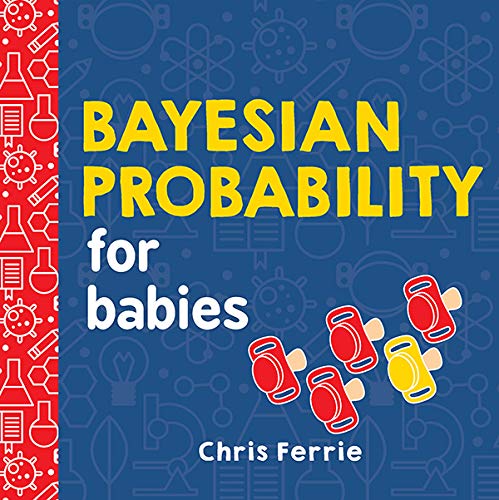
Unleash your toddler's natural curiosity with a board book that goes beyond ABCs and 123s. Bayesian Probability for Babies introduces the notion of Bayesian reasoning— a foundational concept in math and AI (Artificial Intelligence)—simplified for the tiniest thinkers.
From physicist and father Chris Ferrie, this engaging STEM board book uses vibrant illustrations and real-world logic to explain how we revise what we know as we gather new clues—an essential skill in science, decision-making, and even everyday life.
Why Families Call It "Brilliantly Simple" and "Surprisingly Fun":
Encourages your child's cognitive development through early logic and reasoningBond Over Discovery – Boosts connection and conversation through learning, helping little ones develop a love of logic early on.Introduces a big idea in a way that sparks joy, not confusionA conversation-starting gift that shows you believe in your child's potentialWhether you're a data scientist, a teacher, or simply a curious parent, this board book offers an inspiring way to introduce your child to probability, observation, and how we learn. It's perfect for bedtime read-alouds, classroom use, or your next baby shower gift.
I am Chris Ferrie, father of four and happy husband. My day job is academic research where I follow my curiosity through the word of quantum physics. My passion for communicating science has led from the most esoteric topics of mathematical physics to more recently writing children’s books.
No indeed, my one star rating for Chris Ferrie's 2019 Bayesian Probability for Babies does not really have anything to do with the book heading claiming that this is a board book supposedly meant for actual infants even though Ferrie's text and accompanying artwork combination for Bayesian Probability for Babies (and indeed for all of his Baby University series of board books) are at least in my humble opinion much more suitable for young children from about the age of two to five and maybe even beyond that (as while I do tend to find Chris Ferrie's Baby University titles a trifle annoying, misleading and also as such majorly gimmicky, this does not really ever affect my reviews/ratings per se, although I do increasingly wish that different and not baby-oriented book headings could be used, that the titles certainly do not equal the textual and illustrative contents Ferrie and his respective co-authors provide and demonstrate).
But indeed and also sadly, frustratingly, my one star ranking for Bayesian Probability for Babies totally and indeed pretty much ONLY has to do with the fact that I myself have been having major, have been having huge issues and problems even somewhat, even remotely understanding and figuring out Chris Ferrie's words and his probability, his mathematical explanations in Bayesian Probability for Babies (both textually and I must say visually as well, since the accompanying artwork is for my aesthetic tastes ugly, bland and neither successfully mirrors nor adequately explains the featured writing and in fact kind of makes Chris Ferrie's presented words even more potentially confusing to me). And yes, my frustration with the lack of comprehensibility regarding Bayesian Probability for Babies has been especially pronounced and problematic with the mathematical formulae Ferrie features and uses as part of Bayesian Probability for Babies (which are in my opinion NOT simple and actually kind of majorly and infuriatingly remind me of the kind of befuddling and insufficiently explained crap and garbage I got for mathematics and for probability/statistics during high school and which made me and continues to make me often totally and utterly despise and loathe anything even remotely mathematically based in scope). So I guess, I might perhaps even be the wrong type of person to review Bayesian Probability for Babies (totally not math inclined and also not at all at ease with the subject). But honestly and on the other hand, since Chris Ferrie has repeatedly stated that he believes STEM is taught the wrong way at the school (at all levels of school) and that we should be starting STEM thematics early and also with very young children (and which is why he supposedly created the Baby University board books in the first place), frankly, since it would generally be parents, early childhood educators etc. who would be using Bayesian Probability with the intended audience of two to five year olds, if I as an adult who has never been very good at maths have so much trouble with the probability themed contents of Bayesian Probability for Babies, then what is being featured by Ferrie and how this is being shown both verbally and equally visually by him is pretty much a huge failure and as such not to be recommended as suitable for young children.
For come on, most young children are not budding math geniuses (like TVs Sheldon Cooper), and I do certainly know that when I was a toddler, I would neither have understood nor in any way enjoyed Bayesian Probability for Babies, that Bayesian Probability for Babies is also one of the Baby University board books that would certainly benefit from having a section included explaining the basics of bayesian probability for parents/caregivers and maybe even how to approach this with very young children (in particular for those of us not adept and naturally talented regarding mathematics), and that I was actually hoping Chris Ferrie would be able to explain bayesian probability simply and in an easy to understand manner for and to me, but that pretty well everything with Bayesian Probability for Babies has left me hugely and sadly disappointed.
Again, who is the audience of this cynical, gag series of baby university books?! Not interesting for babies. Not funny enough for parents, beyond the first-impact "heh" when you see the title. Enough! I banish these from baby registries everywhere. These are like those "World's Okayest Boss" mugs, but even those are better, because (a) a mug is functional, and (b) those are funny.
catchy title. completely false. from the words "bayesian probability" to its conclusion this tiny book renders a complex and grand mathematical/statistical axiom to a bite from cookies!
no baby should be subjected to this. or most adults. including me.
Well I am getting gifts for a baby shower and I decided to look at this series. I must say as a scientist I was skeptical (yeah I know how that sounds but it is the only cool thing I can say about myself so give me a break 😆 ), I mean how can you simplify that for babies? This was pretty good I must say. Bayesian probability is probably the basis of all the analyses worth reading these days.
Want to learn about Bayesian probability as a baby well this book attempts to explain it but I was left still with some questions and no real understanding of this concept despite not being a baby. My baby listened to me read it but lost interest as the pictures were not very engaging and despite my enthusiastic voice the content was a bit boring and left me only with a desire to eat cookies.
Ok I still don't know what Bayesian P. is, compared to regular P. Or if that's even a thing to wonder. The book isn't cute or appealing. Maybe a mathematician parent could use it, somehow? But I doubt it. They'll teach the kid the concept irl when the opportunity arises, no?
how is it even possible for the final result to be 3/4? doesn’t make any sense you have NINE 𝐜𝐚𝐧𝐝𝐲 cookies (the ones with the balls) and ONE 𝐧𝐨-𝐜𝐚𝐧𝐝𝐲 cookie (without any balls), equaling TEN COOKIES. the probability of a no-candy bite on a candy cookie is 1/3. the probability of a no-candy bite on a no-candy cookie is 3/3 = 1. if you have TEN cookies (as described above [9 candy cookies; 1 no-candy cookie]), and take a bite of each, we’ll have: 4 no-candy bites (1 no candy bite from the no-candy cookie + 1/3 of the bites from the 9 candy cookies = 3 bites) and 6 candy bites (all from candy cookies). then it says: “1/3 of the candy cookies (9 in total) have a no candy bite”, which makes us with three candy cookies with no-candy bites. and then comes the conclusion that doesn’t make any sense: “the probability of a candy cookie with a no candy bite is 3/4”. and not only that, it illustrates the “4” 𝐜𝐚𝐧𝐝𝐲 cookies with an image of three candy cookies AND a 𝐧𝐨-𝐜𝐚𝐧𝐝𝐲 cookie. so that’s not 4 candy-cookies, but three candy cookies and one no-candy cookie. oh my god
Trying to get a decent conception of Bayesian Probability as I barely have any knowledge about it, this book makes it a bit more clear for those with barely any exposure to Bayesian Probability, by that I mean it lives up to its title. I will have to read it a couple more times and engage in actual lectures to get a grasp over the concept as a whole. Baby Steps !
4 stars instead of 3 because I read this book in 2 minutes, yet it pushed me to go down a rabbit hole of 1 hour trying to understand different examples and implications of Bayesian probability on Youtube. And I had no regret.
Obviously not to be taken seriously, but still makes a serious attempt (and sort of fails) at providing a simple explanation of Bayesian Probability. Not a great idea to use cookies as the example. Could have been either a lot funnier or a lot more useful.
This is an adult level explanation of probability with a food metaphor. This is for babies. I read it. I'm an adult. I didn't understand it. I don't think babies can.
Bayesian Probability for Babies is a pretty good illustrated overview for children. Once again, Chris Ferrie takes a surprisingly advanced mathematical concept and distills it into clean, colorful visuals and simple, everyday examples that young kids can follow along with. It is a playful, clever way to introduce the basic intuition behind updating beliefs based on new evidence—making it a fun board book for curious little ones and a great excuse for science- and math-loving parents to share their interests early on.