1923, the First World War has ended, the second has yet to begin, and Italy is torn between the Socialist and Fascist parties. A rend that would threaten to tear not only the country, but families apart This is the true story of one family in Maropati, Italy, during the Feast of the Epiphany. Beautifully illustrated, this embellished tale comes directly from Cavallaro's grandparents, in stories passed down from generations into a master storyteller's hands.
Politics is one of those things that just really makes no sense to me. Not political theory—I understand to some decent degree the ins and outs of various hypothetical governmental systems. I understand capitalism versus socialism versus communism. I understand monarchies versus oligarchies versus plutocracies versus democratic republics. I understand foreign and domestic policy and the reasons for supporting different perspectives within these spheres.
What I don’t understand is how things within the political realm come to matter so deeply to people. There doesn’t seem any reasonable excuse why reasonable men and women should find themselves demonizing left, right, or centrist. There doesn’t seem to be any real purpose to the vitriol with which voters who appreciate Candidate A will approach voters who appreciate Candidate B—and vice versa. There doesn’t seem to be any plausible reason that a person should hate another simply because the other holds to a variant political philosophy.
And yet, because our world is so often not a sane place to be, this kind of animosity does exist and from time to time feeds into brutal violence, taking ostensibly sensible people and turning them into monsters. Parade (With Fireworks) concerns itself with this very problem.
Cavallaro’s book is well crafted though slight. He relates a single story of political interest gone awry without exploring at all the depth that makes such a story believable. After digesting what Cavallaro offers, most readers will find the historical circumstance credible and the actions of its individuals plausible. Even though they are, from a modest standpoint, quite insane. Most readers won’t blanch at accepting events as the author lays them out because we all know how history has played out in the past and that wars have been perpetrated over such ideologies. Parade would have been much more fascinating had it sought to investigate the psychological framework of its cast rather than simply relate events as they happened. There is some treatment of those changes in political temperature that can be felt even across a single season of time. Cavallaro also broaches how deeply that alteration can abuse families and individuals caught in history’s maw, but on the whole Parade performs at a rather standard trot.
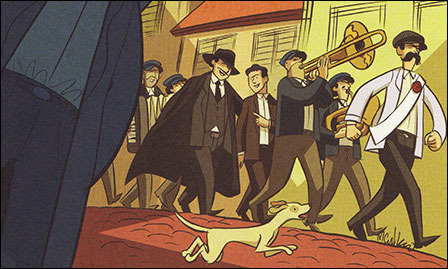
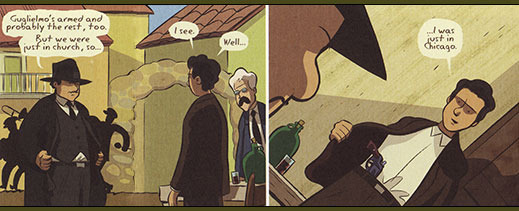
Parade chronicles moments during and surrounding its central event, the escort of a band from the center of town to its outskirts. It’s 1923: Italy—back when the fascists and the communists were vying for power in the wake of the Great War. Spain set a similar tableau at the time. Tempers heated and venom bubbled. And into this mess of passions steps Paolo, fresh from Chicago (and therefore armed).
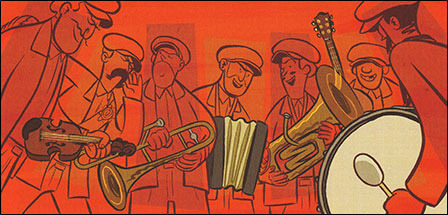
It’s Epiphany and Paolo’s brother Vincenzo is escorting the band he hired from the church to the edge of town to protect them from those who might do them harm. Vincenzo is an important man and, as a communist, someone with rivals. Gato has never gotten along with Vincenzo and he and his fascist friends follow along with the band as well, harassing them along the way and demanding they play some fascist anthem or other. When this small parade reaches Paolo, fuses light and the title-promised fireworks begin.
The story, for all its lack of introspection, is competently handled and the artwork accomplished. If I had to guess, I’d hazard that Cavallaro held some kind of background in animation. This may not be the case, but his characters have the grace and composition common to those familiar with breathing movement into their drawings. Parade is well-coloured and Cavallaro is able to evince mood and tone with his sometimes dramatic shifts in hue and saturation.
Parade (With Fireworks) may not hold a lasting place in the canon of historical graphic novels, but it does capture the spirit of a historical moment well enough. As a terse read, the book can be digested wholly over a very short amount of time. This may be a positive or a negative depending on who you are and why you read, but for my money, I would have preferred a more thought-provoking piece—one that asked questions of our nature, one that demanded a reason for our reasonlessness.
I used to be completely obsessed with this song called "The Strong Suit" by this guy called Cex because, while the beat was rudimentary and his flow was a little bit too nerd rap for my taste, the lyrics themselves were this dense, abstract surreal story about how we recreate our parents' issues in ourselves. I would tell anybody who would listen: "It's like what the best short fiction does, maaaaaaan." Because I was a pretentious college asshole.
So, Parade (With Fireworks) does the same thing. The actual story itself takes place over the course of, like, two hours, right? But the backstory, the... forestory, I guess? It implies so much about people and place and time in this simple story, filling in the details as needed until this tiny little thing is so three-dimensional and real that you kind of don't know what to do with it. And it's sad, mostly, which is good; and Mr. Cavallaro is associated with the Bouncing Souls and wrote the best song about drinking in the world- "St. Jude's Day," which I used to play on an acoustic guitar every time I played a show but which I semi-retired because I wasn't that good at it- and honestly, because it is very pretty.
Like, with graphic novels I'm usually like, 'the art is passable,' and then that's all I've got to say about the art. But the art in this is gorgeously nuanced, in a cartoony way, and the colors are gorgeous... I don't know, it surprised me a little. What a great book.
Summary: Loosely based in fact and family anecdote, "Parade (with fireworks)" gives us a tense and violent scene from post-WWI Italy and its shattering effect on one family. The parade is actually a group of Communist party musicians being escorted through town by the protagonist's brother and cousin, both of whom intend to protect them from a gang of Fascists. Of course, tempers flare and events spiral out of control with tragic consequences, leaving the hero in big trouble with the law.
Plot: The story is lightning-fast, perhaps a bit rushed in backstory and epilogue both. The rapid delivery works well for the parade and fight scenes, and makes the read a quick one.
Characters: Political tension ostensibly drives the plot, but the fiery tempers and hard heads of the characters are the true catalysts for action. Character development is not deep here. The men of the protagonist's family are hot-headed, and so are the members of the rival Fascist gang. After the conflict, the protagonist's strong-willed sister takes control of events, every bit as convinced of the superiority of her ideas as the male characters. Paolo (the hero) is never developed at all. He serves as an almost uninvolved narrator for much of the story.
Art: The vibrant artwork is terrific. Sun-washed and shadow-dappled by turns, the drawings pull the reader into the story. The mustaches alone are worth a glance.
Writing/Dialogue: The writing is terse and energetic, connecting the art and rolling the story forward. The author never indulges in musing or deep conversation between characters; this tale is meant to cut right to the quick.
Ending: The ending is likable enough, but like the characters, it isn't well-developed and feels pat and rushed.
What more did I want?: I didn't quite buy the ending, and I couldn't get attached to the protagonist since I didn't know much about him. Also, the cover of this book, while gorgeous, isn't related to the plot. If I pick up a book with a cover that shows an old man and his little grandson standing on a hill overlooking a green orchard, I do not expect the inside to contain a lot of violence and tragedy. I wish some foreboding symbolism had been worked into the picture.
It feels way too rushed to be emotionally impactful enough and the ending comes too quickly (and doesn't bring the story back around so it's quite unsatisfying as well). There's nothing egregiously wrong in it, it's just...bland.
I seem to share the opinion of many others who have read this before me. The point of this book escapes me. I didn't care much about the characters, I was completely lost with the plot, and when I found out at the end that this "true" tale was not actually all that accurate, I was pretty disappointed in the whole thing. On the good side, this book took me about 15 minutes to read, and the artwork was lovely and reminded me very much of animated film (which made sense when I learned that the author had some experience in that area).
Actually, I really hated this book. ...but the artwork was REALLY good, and the way it was drawn and coloured truly carried the story with it, so I can't say I hated EVERY aspect of it.
The main thing I hated, was how pointless it was. I mean, it's fact, and a historical record of sorts, but then it's followed up with the author's admission that he may or may not have even told those facts correctly, so... Why did I read this again?
It starts out with a long long prologue- about how bad bad things happened to him... and then he changed... or the world changed, or both... then even worse things happened, and that's what he is about to tell us.
Mostly, the story starts out very confusing- a rambling biography of sorts, which is aimless... and true to the first handful of pages, does in fact contain bad thing after bad thing, happening to the protagonist...
The problem is, at the end, there is... no ENDING. No real conclusion...
The prologue was richly done in artwork and story... but the epilogue is vague and in plain text and it also rambles... it tells us some 20 years later things are 'fixed' but it doesn't sound very convincing.
Especially when the author's note then says it's probably not true to facts anyway.
Whuuut? I would skip this one, personally. Really. Unless you have a specific interest in the exact topic.
Parade (with Fireworks) is an interesting tale about the clashes, in post-Great War Italy, of the ideologies of Fascist and Socialist Parties that are tearing the country apart, and how differences in thought tend to have an unintended consequence—great loss.
Although the conflicts of the story arise because of contradictory ideas, the characters seem to be affected in ways that are not directly tied to their parties, but with each other and their hate of Otherness. Another greatly moving/disturbing aspect of the story is the ignorance of the value of human life; while Gato and his men are trying to be judged as innocent, there is an overlooking of the loss that the protagonist has faced—telling us that justice does not prevail and that innocence can be bought with corruption.
As a teacher, a think this would be great to teach in tandem with a World or European History class as it ventures to display some of the problems that lead to the choices the Italian state made during WWII and greatly exhibits the malice and hate that accompanies differing views. More so, on a level for all students, the graphic novel displays the dangers of close-mindedness and the polarization of one’s views.
"Parade with Fireworks," a graphic novel based on a true story from Maropati, Italy, in 1923 is beautifully rendered. However, without an understanding of Post-WWI history - of Fascism and Socialism in Italy, specifically, the story is difficult to follow. However, the universality of the themes makes it worth a read - war separates not just countries and people within countries, it also separates families.
I really loved the idea of this book and it is beautiful. Family history, handed down to the author, delving into Italian WW II history, the struggle in Italy between the Fascists and the Socialists, based on the author's family stories handed down... and it looks beautiful, but I felt it was pretty confusing, too much left out for me to really fully get enough of a sense of it. The watercolors are the best thing about the book, capturing a time and place...
A bit difficult to follow. I didn't really begin to understand everything that was going on until the trial (very close to the end). Clearly I need to brush up on my Italian history.