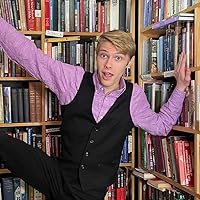
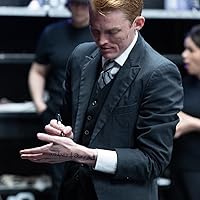
Jim Fingal is a fresh-out-of-Harvard fact-checker for a prominent but sinking New York magazine. John D’Agata is a talented writer with a transcendent essay about the suicide of a teenage boy — an essay that could save the magazine from collapse. When Jim is assigned to fact check D’Agata’s essay, the two come head to head in a comedic yet gripping battle over facts versus truth.
Bloody brilliant ... how this escaped major awards consideration, while the execrable GARY: A SEQUEL TO TITUS ANDRONICUS got 7 Tony nominations, is a travesty. In this age when the POT(Piece of Turd)US gets away with telling 15,413 lies in his first 1,055 days in office (and since the play is all ABOUT fact checking, here's the source: https://www.washingtonpost.com/politi...) ... it is also extraordinarily timely - and VERY funny to boot. And I'll bet the original cast of Daniel Radcliffe, Cherry Jones and Bobby Cannavale) sank their collective teeth into their roles with glee ... wish I'd seen it. Also made me want to read the non-fiction book by the principle characters upon which it was based, which is high praise indeed.
Whip smart, very funny, and timely as tomorrow's literary scandal: is it morally responsible for the modern essayist to play fast and loose with the facts in pursuit of the spiritual truth? Wish I could've seen it on Broadway; three plum roles any actor would kill for a chance at.
Yeah I finished this but I really just wanted to tell it to 'fuck off.'
What an uninteresting title for a play (it's based on a book) about real life essayist John D'Agata and fact-checker Jim Fingal.
What's interesting is that it's so short, it doesn't even feel like a play. It feels like the characters were plopped down in this stunning concise little story about what matters when it comes to facts and the truth. Interesting debate but by the time we get to our second set piece, we're tired of Jim sounding like an OCD critic talking about the number of strip clubs. It certainly gets moving in the 2nd half but I felt so detached reading this thing.
It just feels cyclical where John writes shit but keeps getting called out because of how inaccurate it is and Jim is so crazy that he consults a goddamn moon chart to prove that the moon wasn't half-full. The lines crackle and shoot back at each other with intensity and zip but I don't care about these stupid characters.
When Jim finally pulls out his climax twist card which is supposed to make everyone in the audience go 'whoaaaaa' it doesn't fucking matter because it makes no sense to his character. He only waited so long to do it in the play to make it seem like a climatic twist.
I’ve recently had the wonderful opportunity to be in this production and I am so grateful to have had the chance. My university is one of the few places to have put on the show apart from its run on Broadway. After reading the book, I wasn’t too sure if I wanted to audition, but I’m so glad I did. This is a funny but powerful story, and it is truly one of my favorite shows I’ve been in. I was cast as a swing for Emily and Jim, and chose to perform as Jim for the understudy show. Jim is such a fun and interesting character to play, and I love his monologues. This might seem like a “boring” play at first glance, but it’s so much more than it appears.
Some of my favorite lines include:
“A narrative of willful negligence.” -Emily (pg 44)
“You think YOU can help humanity understand why a teenager commits suicide. You think YOU can grapple more heroically with how to live.” -Jim (pg 51)
“People’s lives aren’t chord progressions you can rearrange at will.” -Jim (pg 56)
The Lifespan of a Fact was apparently performed in NYC just before the big pandemic shutdown of everything. I would have guessed from the read-through that it would have been done in about 30 minutes, but it apparently ran as a 90-minute performance at Studio 54 (once upon a time a nightclub, now a Broadway theater).
We’ve got at least two separate matters here: (1)the play itself, as theater; and (2)the issue of fact checking, apart from how it’s presented theatrically.
Theatrically, there seems to be a lot of crisp dialogue; but it’s hard for me to get a sense of just how crisp it would actually sound in a well-performed version. I honestly don’t know if I would have been drawn in by the drama of a live performance; but the dry-read of the printed word pointed to questions about “fake news” and “truth” and “facts” and “journalism,” rather than to questions about whether it was riveting entertainment for 90 minutes in the fifth row center.
The conversation is between a story-teller (who wrote an essay about a suicide) and a fact-checker, mediated by an editor who serves as a referee in the debate over just how much “poetic license” should be permitted in a “non-fiction” essay.
The topic should have resonance in today’s age of “fake news.” The younger generation may think that “fake news” originated with President Trump, but I’m always reminded how headlines screaming “Remember the Maine” ignited the Spanish American War; and that there was plenty of “fake news” planted by the Confederacy during the Civil War to convince plantation owners and slaves that the South was winning; the first recorded “fake news” goes back to biblical times.
The story-teller’s essay is chock-full of exaggerations and approximations crafted to enhance the poetics of the piece: the rhythm, the music, the beauty in language. And that’s because the essay is not just about a particular suicide, but puts itself out there as exploring the wider culture around suicide, by attaching to the reader’s emotional side.
The fact-checker objects to inaccuracies in names, dates, and non-essential details: was the moon half full or was it 12% full; were there 34 strip clubs or only 29; did it take 8 seconds or 9 for a body to fall 32 feet per second per second…
Since the play presented the two sides more or less evenly, I was at first wondering if this was going to be one of those theatrical gimmicks where the audience gets to be the jury and where different endings are played out depending on the jury’s vote; but they skipped the multiple ending gimmick.
“…facts have to be the final measure of the truth.” That sentence is hurled at us during the climactic scene. And we are encouraged to accept the truth of this statement about truth. And it does ring true, as “fact” and “truth” do have a certain relation to one another: fact does determine truth in the sense that most of us regard truth as a recognition of facts.
So, there’s the drama about the conflict over allowing poetic license for a work of non-fiction; and, there’s the intellectual debate over the details. We come to the end having considered some allowable discretions, like calling a 12% moon a half-moon; and we come to the end opposing outright fabrications, like calling it a hanging when a suicide is by jumping off a ledge.
In order for the reader (or, the audience) to take sides, the distinction would have to be made between “essential” and “non-essential” elements. And that would require a principled assessment; it would mean looking at the big picture before considering the import of any of the concrete examples which were brought into contention by the fact-checker. The script left that requirement entirely up to us, to the effect that some of us would see it this way, others not. What is the point, after all, of fact-checking a non-essential element?
The best part of the play for me was the story-teller’s character and soul. His character represents the conceptual approach to all the questions here; his thinking is not compartmentalized in the way the fact-checker’s is; his every fiber is integrated into the big picture. I would have enjoyed spending time visiting with John, the story-teller essayist.
The fact-checker, although common in our culture today, doesn’t have the appeal, doesn’t have the character I would be attracted to. He is constitutionally incapable of seeing the big picture in any of his objections to the liberties taken by essayist.
As drama, the play falls pretty flat for me. The characters representing each side in this battle over the role of poetic license are not put on stage showing us a conflict to be resolved; instead, the questions of poetic license are just bandied around without arriving at any verdict.
I would have loved it if each side in the conflict were part of a moral conflict, each struggling to have its own side prevail, with substantial consequences hanging in the balance. But the consequences we were presented with here were not substantial; and as a result the drama itself was less than energizing.
Aside from the drama, the questions of “fake news” and “misinformation” and “disinformation” are begging for a much better explication than they are being granted by today’s culture. Perhaps it is a metric of our cultural decline that these issues are so glaringly unresolved today.
My brother is the marketing director of the Unicorn Theatre. For the past several seasons, their creative has been handled by a local agency who, in the midst of the Coronavirus crisis, said they were barely hanging on and would have to pass on the upcoming season. My brother asked me if I was interested, and I said I was — this is a dream assignment that’s been on my wishlist for years. Of course, as part of the process, I have to read the plays, and so I have been. I love going to the theatre but I’ve never read a lot of plays (not unusual, I’m sure), so this has been a relatively novel experience for me. In any case, at the conclusion of reading each play, I’ve dashed off initial impressions via text to my brother. For these plays, unlike my more measured, more thoughtful book reviews, I’ll be using those slapdash messages.
“The Lifespan of a Fact” — Good, and yet, not as good as I’d hoped it would be. The premise is tantalizing — What is truth? What is fact? — and the dialog delivers, but the characters seemed too everyman somehow … the grizzled old-school writer who doesn’t give a damn about facts, the wide-eyed intern taking his fact-checking assignment to the literal extreme, the aging editor-in-chief willing to do just about anything to finally get some goddamn respect. I suppose, then, that it’s up to the actors to make the characters more than the sum of their parts, and, when done, I can see some real fireworks happening on stage. This one could be lots of fun.
To which my brother replied, “Totally. It definitely has that “Broadway shine” to the script. I wish I could have seen the show with Cherry Jones, Bobbie Cannavale, and Daniel Radcliffe.”
An interesting look into non-fiction writing, fact checking, judgement and what makes a piece interesting and true in journalism, all while calling into question those that write essays and articles and those that publish them. I think this piece would be fun to see done live for sure. It uses interesting choices like screens to bring emails to life and lighting to help tell the story (mixed with quirky, and witty writing) that I think when done live it would really whip by.
this was way better and funnier than i imagined. crazy plot twists, really fun character interactions, and just all around a really good time. and quick read.
kicking myself that i never got the chance to see this play when daniel radcilfee played jim fingal. new favorite silly little nerdy neurotic conspiracy theorist man.
Our theatre is producing this play in February. The play is fascinating, sometimes humorous, and reminds me of the saying, “never let facts get in the way of a good story.” I’m interested to read the non-fiction book that is the basis for the play to see what happened.
4 stars feels a bit generous but 3 is too little. 3.5 for me.
I really enjoy the idea of this play, this kind of argument between creativity and credibility, and how far white lies can go for the sake of art. But I think the execution fell somewhat flat for me. The beginning worked well, and the middle towards the end was good, I liked the banter of Jim and John (though I sometimes got their names confused…). The main problem I have is the ending. I feel like it just… ended too soon? There was more that could have been developed, in my opinion. Like what was going on with Emily and her photo? What was the photo? And the reading of the essay fell flat. I felt like I was SUPPOSED to be feeling something there, but I just thought it was kind of tedious. TLDR; the premise and ideas behind this were interesting enough to make it worth a read, it just falls flat in certain areas.
It's an interesting debate about what facts do and don't matter in life and what is a fact. It gets a little arduous at times but has a lot of good points that make you think. Does get kind of depressing at points, should definitely come with a trigger warning cause it talks about an article about a suicide so that is discussed often.
It's good but not great. Funny enough, but not profound. I've heard it described as "low-stakes ethics" which summarizes my reservations with the script. The essayist is so obviously correct in almost all cases that I'm a bit curious why this subject matter was taken on.
Again, it's a good, funny play, but its trivial subject matter stopped it from resonating deeply.