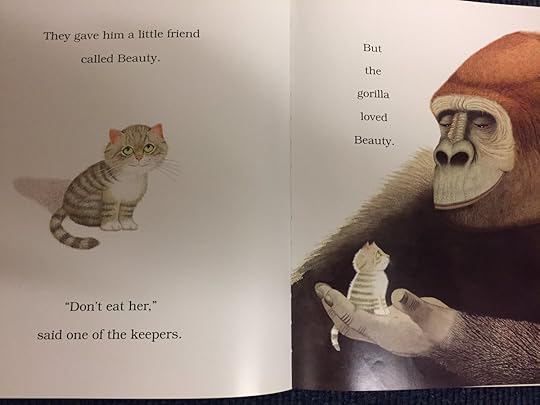
This is a story of a gorilla who learned sign language. He lives at the zoo and seemingly has everything, including a TV. However, he is sad and lonely. One day he signs to his keepers that he would like a friend, so they give him a kitten named Little Beauty. The two friends are very different in size and appearance, but they get along well and do everything together. One day, while watching a movie about King Kong, gorilla gets mad and smashes the TV. When the zookeepers come, they want to take away his friend. Suddenly (and surprisingly), Little Beauty uses sign language to tell them that she broke the TV. The two friends can stay together and it’s a happy ending.
This is a picture book because text and illustrations are interwoven. Simple text inspires beautiful illustrations. There is a narrative structure and a clear sequence of events in both text and pictures, enabling even non-readers to retell the book easily using just the pictures. Close-ups of the characters and details of illustrations convey a wide range of emotions and moods. Illustrations are oversized, making it easy for teachers to share them with the group.
This book can be used with K-2 students as a read-aloud or for shared reading. Some of the topics for discussion and instruction are the value of friendship, loyalty and sacrifice, using words to express anger, and sign language as a way to communicate. Educational concepts that can be taught in grade K are size and opposites (big gorilla and small Koko.) Children can try to predict what would happen after the gorilla breaks the TV. They can also practice retelling the story using picture clues and integrating text and pictures to discuss story elements and details. (ELA 0.1.2.2/1.1.2.2 and 0.1.7.7/1.1.7.7)
Little Beauty is based on a real-life story of gorilla Koko and her kitten All Ball. As an extension, children can be introduced to the non-fiction book Koko’s Kitten by Dr. Francine Patterson. (This one deals with the death of the first kitten, so teachers should carefully consider whether/how to use it with young children.) Another book students might enjoy is Unlikely Friendships (“for kids” version) by Jennifer Holland, with stories and photos of friendships among different animals.
Students can expand their discussion to their pets and special relationships with them. For example, how does your pet communicate with you? They can write short paragraphs about it. Alternately, the teacher can have the whole class come up with their own collaborative book about friendships with pets using Language Experience Approach, interactive or guided writing, depending on the level.