The Barnes & Noble Review A masterful blend of artistic skill, scientific prowess, and impassioned theatrics lay at the core of Waterhouse Hawkins. A man of pure determination, he created the first life-size models of dinosaurs! This brilliant book is a fantastic nod to the genius of one man, and a glimpse into the beginning of an important era.
As a boy in England, Benjamin Waterhouse Hawkins always wanted to be an artist. His passion led him to animals, and soon he was drawing and painting them with fervor. This eventually led to his true calling -- creating models of dinosaurs as they actually must have looked when they roamed the earth! With the help of scientist Richard Owen, he checked the fossil remains of dinosaurs against living animals and constructed a gigantic model. Among the first to witness his creation were Queen Victoria and Prince Albert, who reacted with pure amazement.
In order to impress England's leading scientists with his work, Waterhouse Hawkins staged a lavish New Year's Eve dinner party and hosted the gala inside the body of his model! He also wanted the public to learn about the dinosaurs and their history, so he built smaller models, illustrated books, and lectured on the subject. His fame spread to the United States, and he was invited to New York, where he began to create model dinosaurs for a proposed Paleozoic Museum in Central Park. However, a corrupt politician put an end to the project, and vandals later broke into Waterhouse Hawkins's workshop and destroyed his models. Though distraught, he moved on to Princeton, where he built skeletons and created paintings about life on earth in the age of the dinosaurs. Eventually, Waterhouse Hawkins returned to England and continued his work, some of which can still be seen in Crystal Palace Park.
Writer Barbara Kerley and illustrator Brian Selznick have weaved a spirited account of this largely forgotten man. Plenty of textual detail, research, and a good dose of wonderment make Kerley's narrative a delightful experience. And the awesome illustrations, which combine Waterhouse Hawkins's own grandeur with Selznick's talent for the bold and the beautiful, made the pages come to life. The fusion of scientific allure and sensational images is a stroke of brilliance. This phenomenal book stands as true testament to the devotion and power of an individual -- it would have made Waterhouse Hawkins proud. (Amy Barkat)
Barbara Kerley was born in Washington, D.C. and has lived in many places, including Nepal and the tropical island of Guam. She has written about almost everything: 19th C iguanodons, Teddy Roosevelt, world peace, Mark Twain's donkey, and the pleasure of following your curiosity.
In 1853 Waterhouse Hawkins was an English illustrator and sculptor who was commissioned by Queen Victoria to build life-sized sculptures of dinosaurs for the Crystal Palace, an art and science museum in England. This was to be the first time the average citizen would be able to see what a dinosaur looked like. Prior to this honor, Hawkins had illustrated the work of Charles Darwin, so he was eminently qualified in the fields of evolution and illustration to “create” the first dinosaurs.
This Caldecott Honor book brings to light a fascinating piece of history of which few people are aware. Brian Selznick’s illustrations capture the excitement of people seeing something of our planet’s past for the first time. After the success of the Crystal Palace, Waterhouse was asked to build dinosaurs for a museum proposed to be built in Central Park. The infamous Boss Tweed put a stop to the project, and after public backlash, had Waterhouse’s dinosaurs intended for the museum destroyed and buried in Central Park, where they remain. The illustrations for this segment of the book are particularly effective, highlighting both the callous disregard of Boss Tweed, and Waterhouse’s despair over the destruction of his project.
Despite the glut of books and other media available on the subject, dinosaurs continue to fascinate readers of all ages. The book showcases the root of this fascination, and unearths from obscurity a life of artistry and determination whose work was instrumental in providing the information we have now about dinosaurs.
This is illustrated by Brian Selznick and I didn’t know it existed. It’s a beautiful book of nonfiction about the man who wanted to educate the public on the existence of dinosaurs through visual reproduction back in the 1850s or so. Mr. Waterhouse was an artist of animals. He took the known dinosaur bones they had dug up and imagined what the creatures would look like and then he built them to scale with brick, metal, plaster and paint. Queen Victoria loved them. They were put on display for all to see and they are still at the crystal palace to this day to go and see.
And interesting side point here is that he came to NYC to build some for America. He spent 2 years doing so when a corrupt politician decided he didn’t want them and sent thugs to destroy all the work. How crazy is that? Otherwise, Central park would have our own historic dinosaurs.
I love Brian Selznick and I trust his story tellings abilities with his art. I love the story that they brought forward here. It’s a cool part of our history I didn’t know. This is how the world discovered dinosaurs thanks to this man, really. What a great story.
The niece thought this book was very interesting. She wants to go see the Crystal Palace to see these dinosaurs. The nephew loved this story about monsters and dinosaurs. He thought it would be fun to build something like that. They both gave this book 4 stars and they want more like it.
The Dinosaurs of Waterhouse Hawkins is an extraordinary book. It tells a tale which seems so fanciful that it does not seem credible, yet every word of this story is true. Moreover the presentation is so stylish, that the best word to describe this oversize children’s book is simply sumptuous. Even the lettering on the cover is raised, to give a padded feel, and printed in gold.
“Presentation” applies in another sense here … As we open the book it is like a theatrical event. The stage is set, and the deep red velvet tasselled curtain rises, held aloft by an unassuming little old man in evening dress, so that we can glimpse what lies beyond. His demeanour seems for all the world as if he is proudly demonstrating some spectacular feat, yet we cannot make sense of what we see. Is that the head of a reptile - or a statue perhaps? And other lumpish, unformed body parts too? We seem to be peering behind him into the depths of some sort of workshop.
Turning the page we have a double page spread, with dancing block capitals superimposed on the scene, proclaiming The Dinosaurs of Waterhouse Hawkins. The red curtains of the stage are fully open and tied back into swags at the top and sides. Yes! Now we can see that reptile’s head - but what sharp teeth - and it is HUGE! It is lurking just outside the spotlight, which arcs down on the same short funny-looking man with his big head. He is still gesticulating towards something we can’t quite make out in the gloom. Or can we … eyes … teeth … scales … we shudder and turn the page again.
The reverse of the title page has tiny print containing all the acknowledgements. We will look at that later, perhaps. But look at this, opposite. It is surely all the details of the book, but set out for all the world like a Victorian playbill, an advert of that time:
The Dinosaurs of Waterhouse Hawkins An Illuminating History of Mr Waterhouse Hawkins, Artist and Lecturer
by
Barbara Kerley
with drawings by
Brian Selznick
Many of which are based on the original sketches of Mr Hawkins _______________________________
A True Dinosaur Story -----In Three Ages-----
From a childhood LOVE OF ART, to the monumental DINOSAUR SCULPTURES at the Crystal Palace in England, to the THWARTED WORK in New York’s Central Park IT’S ALL HERE!
And so it is. This is such an inventive and creative way to provide a table of contents. (I have made an attempt to indicate the different typefaces, styles, sizes and positions, but line justifying on Goodreads is beyond me!)
Turning over, we begin the story proper.
We read how as a boy, Benjamin Waterhouse Hawkins always wanted to be an artist. Living in London in the 19th century, Benjamin would paint and draw the animals he loved, and particularly enjoyed making models of them. They almost seemed to come to life.
Soon he began to create models of dinosaurs as they actually must have looked when they roamed the earth. But this was just the beginning. When he was older the famous scientist Richard Owen helped him to check the fossil remains of dinosaurs against living animals and construct a gigantic model. Among the first to witness his creation were Queen Victoria and Prince Albert, who were amazed at what they saw.
The book explains the process he used to create his huge dinosaur sculptures. First came a drawing and then a small clay model. Then a life size one out of clay, and a mould from it. Then an iron skeleton to support the tons of dinosaur, and then the finished dinosaur, using “bricks, tiles and broken stones, held together with cement, covered with casts and painted.” (In the double spread illustration, the adult Waterhouse Hawkins is holding a placard with this sixth stage of the process printed on it, in front of a full scale sculpture.) He said it was like building a house on four columns.
But now he needed to impress England’s leading scientists with his work. And the next part of the story is perhaps the most incredible part. Waterhouse Hawkins decided to secretly prepare a unique grand event to entertain and surprise them; one which they would never forget. He invited the leading scientists and figures of the day, and staged a lavish New Year’s Eve dinner party on 31st December 1853. The gala was hosted by Richard Owen, but it was held inside the body of Waterhouse Hawkins’s model of an Iguanodon, by candlelight! The guests had to mount via wooden steps up to the platform. His dinner was an enormous success, and by the end they were singing:
“The jolly old beast is not deceased There’s life in hin again!“
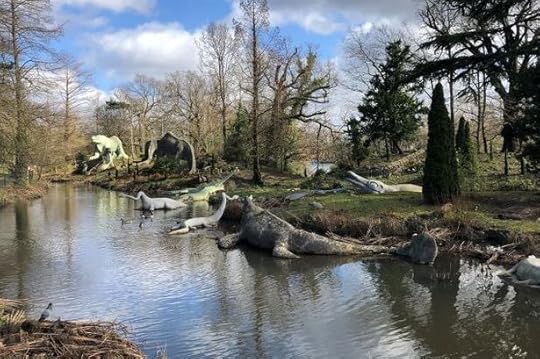
The dinner party not surprisingly got a lot of attention in the press. Hawkins was appointed assistant superintendent of the Great Exhibition of 1851 in London’s Crystal Palace, and the next year, he was asked to create 33 life-size concrete models of extinct dinosaurs. These would be placed in the park in South London where the great glass exhibition hall was to be relocated. Although the hall is no longer there, most of the sculptures are still on display in Crystal Palace Park.
Hawkins was keen that the public should learn about the dinosaurs and their history, so he built smaller models, illustrated books, and lectured on the subject. Over time his fame spread to the United States, and here the story takes a downward turn.
Eventually, Waterhouse Hawkins returned to England and continued his work, which we can still marvel at:
“And while his American dinosaurs no longer stand, somewhere, buried in Central Park, pieces of his dinosaurs remain.”
There is a diagram of the dinosaurs in this book on the last page, and overleaf is the “Bill of Fare” for the gala dinner.
This is a stunning book with both author and artist producing their best work. The only slight reservation I have is that the text is very small, and some of the language is quite difficult. It is usually children of 8 or 9 who become fascinated by prehistoric animals in the first instance, and the book appears to be targeted at young children, because of the size, amount of illustrations and the “cartoonish” feel. However the reading factor is more 9-12, and younger children may well need help to get the most out of this lovely book.
If you buy it, you may well be tempted to keep it for yourself!
This is a fabulous book; it’s completely engrossing. I’d never heard of Waterhouse Hawkins and I’m delighted his story is told in this book. He was such an impressive person: talented, dedicated, obviously with a sense of humor.
There is an author’s note and an illustrator’s note in the back of the book that are just superb. The author talks about the models, the spirit of the artist, the boss (you’ll see when you read the book), and the Palace (so cool and so sad it no longer exists.) The illustrator’s note focuses on his (interesting!) research and travels that gave him material to work with to create his illustrations.
There is also an illustration in the back with pictures of 4 dinosaurs as envisioned by Hawkins and what we know about what they look like today. The book makes a point of saying how Waterhouse got quite a bit wrong, but when you look at these dinosaur pictures side by side, he depicted them remarkably well, I think, especially given the paltry knowledge available at the time.
I love how the illustrator used real life sketches and models and an actual dinner party invitation when he created his unusual illustrations. That dinner party, held inside the model of a life size dinosaur is really something to behold.
The story, a mini biography of Hawkins and an informative piece on the history of how the general public came to know what dinosaurs look like, is inspiring, and funny, and sad in places too.
This book could easily inspire readers to study further the subjects covered. It works wonderfully as a history book, a biography, a book about natural history/dinosaurs. Older primary school students, boys and girls, are likely to enjoy this and learn from it.
I’ve been reading many non-fiction and historical fiction children’s picture books recently and one thing I’ve learned is how many huge gaps there are in my knowledge base. This is definitely one of those books. It’s marvelous.
4 STARS for the storytelling aspect, adding an extra star for the excellent author's and illustrator's notes.
First of all, this book was pretty much made for me! It has Victorian England (including the Crystal Palace which I wish so desperately was still standing today!), imaginative and fancy dinner parties, dinosaurs, and a thoughtful, creative and dedicated man who fought past the norm and those who tried to stop him to pursue his dream. Oh, and the fabulous drawings of Brian Selznick. What's not to love!?
I think this book is essential for anyone who is, or ever has been, interested in dinosaurs or natural history. I had never heard of Waterhouse Hawkins before, and turns out he was the first person to create "life size" models/statues of dinosaurs! He worked hand in hand with one of the leading scientists of the day and they tried to imagine what the whole dinosaur would look like, sometimes based on only one or two fossils. Fascinating to see how they did things, like the Iguanodon fossil looking like an iguana's skull so they modeled it after the iguana (including walking on all fours) and stuck the "horn" on the nose (it wasn't until more complete skeletons were found that they realized the horns are for thumbs and that that dino walked upright!) But, no matter that some of the dinosaurs Waterhouse built were a bit "off the mark"--the models inspired dino-fever in the masses and obviously the obsession is still going strong today. Oh, and if you hanker after stories with absolute jerk, corrupt politicians messing things up, look no farther than "The Boss"--wait until you see what happened to poor Waterhouse when he was asked to build the life-sized dino statues for Central Park (but, there are no life-size dino statues in Central Park, you might say--yes, unfortunately, you are right!) I love how (at around age seventy, by the way!) Waterhouse pulled himself up from the brink of despair and continued sharing his love of dinosaurs with the public. Truly inspiring! And if I needed any more reasons to like Prince Albert, some historians think he is the one who asked for the dinosaurs to be built for the Crystal Palace. What a guy! ;-) The author's and illustrator's notes at the end really enhance the story. Highly recommended!
And, for those of you whose library "due date" sleeve maddeningly covered up the "Invitation" on the front fly page which Waterhouse sent for his amazing dinner, here is what the original said (I had to look online!)
"Mr. B. Waterhouse Hawkins solicits the honor
of Professor————‘s company at dinner,
in the Iguanodon,
on the 31st of December, 1853, at 4 P.M."
Now, who wouldn't RSVP with a resounding "YES!" right away!? ;->
Before the The Invention of Hugo Cabret, Brian Selznick illustrated this nonfiction picture book epic. If you have the time (I would use two separate class periods), this makes a great read-aloud for all ages of elementary students; young and old.
It's hard to imagine, but not so long ago the general population didn't really have any idea what dinosaurs were all about - what kind of creatures they were, how and when they lived, what they looked like - and they certainly couldn't rattle their complicated names off in a glib list, as so many children today will happily do, at the drop of a hat. That began to change in the mid-nineteenth century however, as ignorance gave way to an enthusiastic thirst for knowledge, something that was owing, not just to scientists and their discoveries, but to the work of a man named Benjamin Waterhouse Hawkins, an artist who created the first three-dimensional, life-sized models of these prehistoric creatures. His dinosaur models were first made available to the public in 1854, at the opening of the Crystal Palace - the science museum founded by Victoria and Albert - something that made Hawkins something of a celebrity in his day. Commissioned to create similar models of the American dinosaurs, only to see his work vandalized and destroyed by corrupt New York City politician Boss Tweed (boo! hiss!), Hawkins worked well into his old age, and, when new discoveries demonstrated his models were incorrect, welcomed the additional information.
The third picture-book biography I have read by Barbara Kerley - the previous two are What To Do About Alice?: How Alice Roosevelt Broke the Rules, Charmed the World, and Drove Her Father Teddy Crazy! and The Extraordinary Mark Twain - this wonderful title accomplishes a great deal in its brief page-span (a hallmark of great picture-books). Not only does it tell an immensely engaging personal story, the story of Waterhouse Hawkins, it also highlights a number of important ideas that young readers may never have considered - such as the fact that we didn't always know what we know now, scientifically speaking, or that our ideas have to change, as new evidence emerges - without ever descending into any kind of overt didacticism. The accompanying artwork, which won Brian Selznick a Caldecott Honor (he won the medal itself for The Invention of Hugo Cabret), is just as appealing as the narrative, capturing the excitement of Hawkins' work, and the disappointment of his dashed American hopes. All in all, a superb biography for younger readers, one that is both educational and entertaining - it has a dinner party given inside a dinosaur model: what could be cooler than that?!? - as well as physically beautiful! A sure winner for dinosaur lovers young and old!
It is so hard for me to wrap my head around never having seen a full dinosaur skeleton, or even a rendering of the creatures! But, thanks to artist Waterhouse Hawkins (as well as other artists, researches, and Queen Victoria and Prince Albert) that was all changed for the reopening of the Crystal Palace!
Waterhouse was assigned with introducing the populace to models of what researchers and scientists inferred dinosaurs would look like (from the odds and ends bones already discovered).
But, Waterhouse's accomplishments didn't stop there, and he continued to create renderings throughout his life.
This book isn't so much about dinosaurs (though there is some fascinating information on the development of what people *thought* they looked like). Instead, this book highlights Hawkins' major achievements (and set backs) and left me wondering how I'd never known about this man before.
The illustrations are wonderfully vibrants, thanks again to the wonderful Brian Selznick!
Summary/A Thoughtful Review: This books tells the story of Benjamin Waterhouse Hawkins, artist, lecturer, and dinosaur extraordinaire! Divided into three sections: The First Age-London, The Second Age-America, and The Third Age-Home Again, author Barbara Kerley and illustrator Brian Selznick have collaborated to make this man's imagination and creations come alive for readers of all ages! Hawkins was born, grew up, and lived many years in London, passionately drawing and sculpting animals of every shape and size. His true passion, however, was dinosaurs. He used his knowledge of animals and a bit of imagination to build the first life-sized models using iron skeletons, bricks, tiles and broken stones, held together with cement and covered with casts, and finally painted. These monstrosities were unveiled in 1854 at the Crystal Palace of Queen Victoria and Prince Albert at Sydenham Park in England. News spread to the United States and Hawkins was soon travelled to America to build the first model of a complete dinosaur skeleton. He was contracted to build dinosaurs that would be put in New York City's first Paleozonic Museum, however, politics and financial difficulties stood in his way. Leaving New York, he still brought dinosaurs to the American people: painting and building dinosaurs at Princeton University and the Smithsonian Institute in Washington D.C. Late in life he returned to London to settle back into his cottage in Fossil Villa, however, he retired knowing, "his models wer the start of something wonderful: the world's first encounter with these ancient animals." Prior to reading this book, I sadly have never heard of Mr. Hawkins and his amazing contributions to the world of dinosaurs! This book, told in a narrative non-fiction form, tells a heart-warming story of a man with an amazing imagination and determination to make his dreams come alive! Although cartoon-like, the illustrations do capture the monumental size and percise detail of each of these animals. Readers will be drawn into Hawkin's dinosaur world, as they experience his triumphs and tribulations.
And I love the way the book is laid out - flipping through it, I love the variety of page layouts, whitespace, and giant dinosaur pix.
But reading it straight through, some of the magic disappears. I read it looking for books to promote to elementary-aged kids this month, and I don't think this will make the cut. There's something of seeing behind the curtain about it. I mean, yeah, this guy had a cool task and maybe made a BIG impact on history by bringing dinosaurs to life for the general public. But if most kids are like I was, I really don't think they'll fully understand the context of that significance. When I was in college, I did a major project on Abbie Hoffman. I was completely inspired by this guy. He blew me away. I've come to collect all of his books, and consider him one of my heroes. But I got marked down on the project because I was supposed to write about his "significance," and I didn't really get what that meant. It was like he was so significant to me, I couldn't see any further to the wider world.
Tangent, sorry. Suffice it to say, I'm not sure kids will get the ramifications of Waterhouse Hawkins not doing what he did. Besides, I'm not sure I do either, because the whole thing wasn't actually his idea in the first place. So someone else would probably have done what he did if he hadn't been there. Besides maybe the dinner party? Which is one scene, one night, and you get very little detail. I want menus! And guest lists! And reactions! And primary sources!
Yeah, maybe that's my issue here. The real hook isn't explored enough. And everything else is surface level. Maybe there's a reason you haven't heard of this before.
This is a wonderful biography of the man who first made life-size models of dinosaurs. I have to admit that I'd never heard of him and our girls were a bit apprehensive of reading this book.
But once we started reading, we were totally immersed into his world; we loved reading about his crazy dinner parties inside the dinosaur and we gasped in shock and horror at the idea of someone destroying work that took him two years to create.
We didn't read the entire author's note together, but I did explain to our girls that while we now realize that his models were a bit inaccurate, it triggered a period of interest in dinosaur fossils that continues today and helped us learn more about these creatures.
Overall, I was thrilled to discover this collaborative effort between Barbara Kerley and Brian Selznick. We really enjoyed reading this book together.
This lavishly illustrated and poetically written story of one man's determination amid adversity is inspiring. The story is divided into three time periods when a Victorian artist used his skills to create drawings, small models, clay models, molds, iron skeletons, and finished replicas of dinosaurs. In many respects, this man, Waterhouse Hawkins, can be credited with our continued fascination with these creatures that roamed the world long before humans arrived. The illustrator's attention to detail on every page makes this work outstanding and memorable. His work takes him from London to New York and then back home to London. There is even a storyline describing his struggles against Boss Tweed in New York, whose hired thugs destroyed all of Hawkins's work at one point. Young readers are bound to be intrigued at the notion of all those dinosaur remains buried beneath Central Park. This is one of those books that simply makes readers cry, "Wow!"
This is a great book for kids - especially those who looooove dinosaurs!! It's such a wonderful insight into the incredible imaginations and the visionary nature of the people who decided to see beyond the bones - to see the possibilities and the probabilities that these bones used to be something. Not just any 'something' either. Something really really big!
It just goes to show how someone can follow a passion in their lives and see it to fruition. That they can see others find the magic and believe. Powerful message for a book!
The illustrations are brilliant! I love Brian Selznick. His drawings are sensitive and imaginative and the colours are wonderful. I especially love the drawing of a young artist happily sketching in Central Park while beneath him lay the remnants of the destroyed dinosaurs. No doubt it's a truism!! And wouldn't it be cool to find them!
An interesting figure, with great potential for kid appeal.
There's something about Brian Selznick's illustrations that offends me. I think it's the size of them. He seems to find it necessary to occupy every last bit of available space. I wonder if he had restrained himself somewhat, whether the godawful 2-page spread of tiny text at the back could have been made more inviting and legible (over 3 or 4 pages?).
This true story is about Benjamin Waterhouse Hawkins' life. The story takes place in three different ages. The first age, London, shows how Waterhouse grew up drawing, painting and sculpting models of animals. He became fascinated with dinosaurs and wanted to make models of them. This is a big deal because even though fossils had been found years before, nobody really knew what dinosaurs looked like with muscles and skin. With some help from a scientist, Richard Owen, Waterhouse made life-size models of a number of dinosaurs. His models were displayed in the Crystal Palace at Sydenham Park so all people could see what dinnosaurs really looked like. In the second stage, waterhouse goes to America where he built the first model of a complete dinosaur skeleton. Plans were made to build a Paleozoic museum where he would house his new life-size models. A corrupt politician, Boss Tweed, thought this was a waste of money and stopped the project. After Waterhouse spoke out against Tweed, one night all of his dinosaurs were smashed to pieces and dumped in Central Park, where they still are today. Waterhous Hawkins was sad, but not defeated. He stayed in America and continued his work. The story ends in the third stage, home again in London. In his later years, new evidence showed that many of his dinosaurs he made were not completely accurate, but that didn't take away from the fact that Benjamin Waterhouse Hawkins' models are what truly got people interested in the study of dinosaurs to begin with. This picture book has a richness about it. From the thick, glossy pages to the romantic realism in the illustrations, The Dinosaurs of Waterhouse Hawkins is very inviting. While filled to the brim with scientific and historic information, Barbara Kerley's writing is not dull, but an exciting adventure. Brian Selznick's paintings come to life, filling every inch of each oversized page. The only page that lacks color and warmth is the one with a small portrait Boss Tweed, who almost looks like a zombie. As a reader you know, just by looking at the picture and the fact that there is no other illustration on this page, that this is a bad man. The mood changes after this page, and the colors become dark and foreboding. Only when the color becomes bright again, do we know that Waterhouse has let go of the past and is ready to move on. Grades 4-8.
THE DINOSAURS OF WATERHOUSE HAWKINS by Barbara Kerley, Illustrated by Brian Selznick, Scholastic Press, September 2001
THE DINOSAURS OF WATERHOUSE HAWKINS is a picture book which will certainly be adored by young dinosaur lovers--those little kids who throw around twenty-letter-long dinosaur names as casually as if they were mentioning "cat" or "dog." But to see this book as merely appropriate for younger ages would be a serious squandering of the scholarship and artistic talents invested in this rich and beautiful biography.
Waterhouse Hawkins was the mid-nineteenth century British sculptor who, from studying a few piles of dinosaur bones, created the life-sized models that gave the world its first look at the prehistoric creatures which are so familiar today to all those little kids. Assisted by Richard Owen, the scientist who coined the term "dinosaur," Waterhouse Hawkins became the toast of England through the creations he produced for Queen Victoria and exhibited at the Crystal Palace.
The tragedy of the Waterhouse Hawkins' story occurs later when dinosaur models he spends years building for Central Park are destroyed after he criticizes the infamous Boss Tweed who was determined to obstruct the project.
But the lesson of Waterhouse Hawkins, and the reason the book is so important for older readers, is that science and history are living disciplines which are always in flux, building layer upon layer. It is so fascinating how new discoveries, even during Hawkins' later years, make the picture a little clearer and make his models a little antiquated. The ongoing process of discovery and evaluation continues, of course, to this day.
Brian Selznick has outdone himself on this project. Working with a scrapbook of photographs and Hawkins' original drawings, and traveling to see the British models, he has created illustrations which give us a real sense of Waterhouse Hawkins the showman. Barbara Kerley ("Authoress of Thrilling Character") tells a fun and dramatic story and includes a detailed Author Note following the text.
In 1853, almost no one knew what a dinosaur looked like. No one had ever mounted a complete dinosaur skeleton, and who could be expected to imagine what these strange creatures would have looked like with muscles, skin, teeth, eyes, tails, and feet all in their proper places from just a heap of bones? This engaging children's book is the story of the Victorian artist who, with the help of renowned scientist Richard Owen, would bring dinosaurs to life for the people around him.
The story connects Benjamin Waterhouse Hawkins' early love of drawing and sculpting animals as a child with the career he built as an adult of designing, building, and lecturing about dinosaurs. In extremely readable prose, Barbara Kerley describes the process Owen and Hawkins used to decide what the dinosaurs probably looked like, as well as the method Hawkins used to translate those designs into his life-size statues.
Although this is a rather long story for a four-year-old, it is full of interesting anecdotes, such as the New Year's Eve party Waterhouse Hawkins held inside his model Iguanodon, the massive celebration that marked the début of the dinosaur models at the Crystal Palace in London in 1854, and the way Boss Tweed shut down Hawkins' attempt to build similar models to put on display in Central Park in New York. All beautifully illustrated by Brian Selznick, who based many of his illustrations on a rare scrapbook containing photographs and original drawings of the models that may have been created by Waterhouse Hawkins himself.
Perhaps the bit that I liked the most is the fact that the dinosaurs Waterhouse Hawkins created can still be seen today in Crystal Palace Park in Sydenham. Can anyone say road trip?
(Review originally published on my blog--Caterpickles: Scientific and Linguistic Engagement with a 4 Year Old Mind, caterpickles.com)
Main Characters: Waterhouse Hawkins Setting: 19th century England POV: From author's (Barbara Kerley) viewpoint discussing Waterhouse Hawkins’ life and works
Summary: The Dinosaurs of Waterhouse Hawkins is a biography authored by Barbara Kerley and illustrated by Brian Selznick, that describes the life and work of a famous paleontologist and artist, Waterhouse Hawkins. In 19th century England Waterhouse Hawkins worked with fossils from dinosaurs to construct lifelike models based off of information he learned from the fossils. He displayed his models for Queen Victoria and Prince Albert. Hawkins was becoming so famous for his work that he traveled to America to create more dinosaurs. He was soon faced with hardships when citizens broke into his workshop and ruined his work. But that did not stop Hawkins he continued to study dinosaurs and create models. To this day people can still see his work in museums. This book is filled with truly creative images done by the illustrator Brian Selznick which were interestingly enough based off of some of Waterhouse Hawkins original sketches and artwork. It is also interesting to note that this book received the Caldecott award in 2002.
Class Uses/Themes: I would use this book during a biography study in social studies. I would use this book along with other various famous individual’s in history and science biographies for students to independently choose and read for examples of a biography. After further biography study and modeling I would then ask students to write a biography on their own, on a famous individual who contributed something in science or history.
I really enjoyed both the text and illustrations in this introduction to Waterhouse Hawkins. I especially love both the illustration of and fact that he held a dinner party where guests sat inside a huge iguanadon sculpture! I love Waterhouse Hawkins' desire to use what was known at the time (which wasn't much...most of the dinosaur sculptures he created were based on just a few fossils!) to bring dinosaur to the masses. The wonderful author's and illustrator's notes explain that much of what Hawkins did was inaccurate (for example, he imagined iguanadon as walking on four legs rather than two and looking much like a large iguana), he consulted with the scientist Richard Owen who was considered the top comparative anatomist at the time. It seems to me this book shows a great example of how science works...scientists take what they know so far, formulate theories and then test their theories. Sometimes experiments or discoveries prove their theories correct and often their theories are proven incorrect...either way, refining what we know and leading to additional questions and hypotheses. So yes, it is true that Owen and Hawkins were often incorrect in their assumptions or hypotheses but they got many people interested in dinosaurs. In my mind, that enthusiasm and passion has almost certainly inspired many children to become paleontologists and likely helped fund additional exploration (my theories, not stated in the book). Without the informative author's note, this would be less valuable but the author's note was exceptional. I love the historical context and found Hawkins a fascinating person. The only thing missing is a bibliography so I could easily read more.
The best part about this picturebook biography is its subject, B. Waterhouse Hawkins, who built the first life-size models of dinosaurs in the 1850s. His original sculptures are still standing today in Crystal Palace Park:
Barbara Kerley's text in The Dinosaurs of Waterhouse Hawkins is detailed and quite lengthy (at times this picturebook resembles an illustrated book) but informative and well-researched, with even more information in the back matter.
Brian Selznick's detailed, colorful illustrations are based on or inspired by the original sketches of B. Waterhouse Hawkins. Though in some illustrations Brian Selznick's people are a bit stumpy.
I couldn't imagine that a book about someone's dinosaurs could be "informational," but after reading The Dinosaurs of Waterhouse Hawkins by Barbara Kerley, I am so floored by the illustrations and by the absolutely fascinating story of this Londoner and his ability to capture the minds of people all over the world with his creativity and vision for Dinosaurs.
Hawkins, who grew up drawing and creating models of the creatures around him, grew into a man fascinated by dinosaurs of all kinds.
After mastering his full scale models of these beasts, finding approval from the Queen and scientists alike, he was hired by the head of Central Park to create 'American Dinosaurs' for the parks attraction. After a change in political parties in NYC, his funding was discontinued and his models were destroyed and buried in central park. This story follows his obstacles and his overcomings of life's challenges and inspires everyone to dream big and stay the course for things you are truly passionate about.
[image error]
Boys and girls alike would love this book and has high literary value in my opinion because of its breathtaking illustrations, it's true to history accounts, and it's well written construction and syntax. Anything that can teach and entertain at the same time, holds a special place in my heart.
The story of the man who helped the world fall in love with his dinosaurs through his life-size sculptures. The story is told in three parts and begins with Hawkins's success in England and showcases his famous dinner party in which the brightest scientific minds of the day dined inside a mold of an iguanadon.
In the second part, Waterhouse is invited to America to build sculptures for Central Park in New York City. He's honored, but not everyone is supportive of this project and two years of Hawkins's work is destroyed by vandals acting under the orders of a corrupt politician.
In the last part, Hawkins returns home and enjoys the fruits of his life's work as he ages. Following the story are lengthy author's and illustrator's notes concerning each person's approach to research for this book.
The illustrations are visually stunning and are inspired by sketches found in one of Hawkins's scrapbooks. The last page showcases some of the changes to the dinosaurs as Waterhouse knew them and the way we now know they looked. The coolest thing I learned is that Hawkins got the world excited about dinosaurs and his creations can still be viewed today at the Crystal Palace Park in Sydenham.
This is a picture book format biographical account of Waterhouse Hawkins and his dinosaur sculptures. Hawkins partnered with Richard Owen, a renowned paleontologist, to make these large sculptures for the Crystal Palace. At the time, they only had fragments of a few species and one articulated skeleton of a scelidosaurus. Based off of that one, which was obviously a stocky quadruped, Hawkins built his models. Now, we know today that his models are not entirely accurate, but, some are closer than others. Iguanodon is way off. However, his dinosaurs caused such a stir that they really boosted paleontology. More people understood that the bones they found while digging their basement might be an important find. A Hadrosaur that had been found 20 years previously was finally dug up after Hawkins dinosaurs went on display.
Anyways, to me, he is a pretty important character in the history of paleontology. This picture book does a nice job with the illustrations; they help tell the story and entice the reader to continue. This is a wordy picture book, suitable for more like ages 5 and up, or younger if they are interested I suppose.
This book probably earned a few extra points just for having to do with dinosaurs. It's good to read that not all of the first designers of what dinosaurs may have looked like were the touring charletons that get time on the history channel. Hawkins really believed that his ideas of how dinosaurs may have appeared were accurate. Given the information he had, he did a fantastic job and it's awful that the U.S. didn't support him nearly as well as England. I'm also very impressed that the park where his dinosaurs live in England survived both world wars and is still open to visitors. Hawkins may not have gotten the look of dinosaurs right, but he tried and opened up new possibilities for bringing dinosaurs to the public. Also, despite the fancifal cover, the author and illustrator mention their most helpful sources in creating the book right above the copyright.
I really enjoyed this nonfiction work about Waterhouse Hawkins and the early days of dinosaur research. I especially liked that the text stressed that early dinosaur scientists used fossils and what they knew about modern reptiles to design models of dinosaurs. The final pages of the book discuss what Waterhouse learned about dinosaurs with more discoveries and compare Waterhouse's ideas with today's ideas. The illustrations are rich and match the feel of Waterhouse's time and interests.
Recommended for elementary school students. I believe that the text, though long, is clear and simple enough to use with 1st and 2nd grade students with plenty of teacher guidance and thoughtful passage selection.
Intriguing tale, with beautiful illustrations, that tells the story of Waterhouse Hawkins who created the first dinosaur models in the mid 1800s. The front cover immediately caught my eye and the text and illustrations included inside did not disappoint! While reading the story, I even stopped to search a little more about Hawkins to see how much was true in the book. The author includes a nice, detailed note at the end. Anyone with interest in paleontology or who enjoys non-fiction will enjoy this stunning picture book. Even young readers can enjoy this tale with some scaffolding. The text is not too scientific or complex to deter readers of all ages.
Wow. What a great story of a person who I had certainly not heard of but clearly have seen the impact of. I've been to quite a few museum's with dinosaur models and dioramas. And I still have my children's dinosaur book somewhere. But I never heard of Waterhouse Hawkins. This book brings his story to life. It's quite wordy for a picture book. But as a way for a child to see how science can be an inspiration for a life's work it was pretty amazing.
True story of Victorian artist Benjamin Waterhouse Hawkins who built the first life-size dinosaur models to teach the world about these ancient animals. Color illustrations by Brian Selznick won a Caldecott Honor award. Many were based on Hawkins' sketches. Kerley's lively storytelling voice and text organization make this a fun book for dinosaur fans.



 come to my blog!