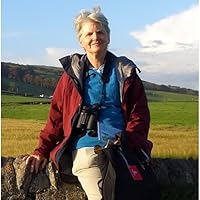
Rosemary Sutcliff, CBE (1920-1992) was a British novelist, best known as a writer of highly acclaimed historical fiction. Although primarily a children's author, the quality and depth of her writing also appeals to adults. She once commented that she wrote "for children of all ages, from nine to ninety."
Born in West Clandon, Surrey, Sutcliff spent her early youth in Malta and other naval bases where her father was stationed as a naval officer. She contracted Still's Disease when she was very young and was confined to a wheelchair for most of her life. Due to her chronic sickness, she spent the majority of her time with her mother, a tireless storyteller, from whom she learned many of the Celtic and Saxon legends that she would later expand into works of historical fiction. Her early schooling being continually interrupted by moving house and her disabling condition, Sutcliff didn't learn to read until she was nine, and left school at fourteen to enter the Bideford Art School, which she attended for three years, graduating from the General Art Course. She then worked as a painter of miniatures.
Rosemary Sutcliff began her career as a writer in 1950 with The Chronicles of Robin Hood. She found her voice when she wrote The Eagle of the Ninth in 1954. In 1959, she won the Carnegie Medal for The Lantern Bearers and was runner-up in 1972 with Tristan and Iseult. In 1974 she was highly commended for the Hans Christian Andersen Award. Her The Mark of the Horse Lord won the first Phoenix Award in 1985.
Sutcliff lived for many years in Walberton near Arundel, Sussex. In 1975 she was appointed OBE for services to Children's Literature and promoted to CBE in 1992. She wrote incessantly throughout her life, and was still writing on the morning of her death. She never married.
To my mind this is the archetypal Rosemary Sutcliff novel, in which her typical themes and interests are laid out in their purest form, although it was not her first novel, for me it is the rootstock of her writing.
Possibly though that is because it was one of the first of her books that I became familiar with.
It is a fantasia set in late bronze age Britain in a region of chalk downs, I would guess the South Downs because she spent part of her life there. The main character is a little boy with a withered arm. It is the custom of his people that for a boy to become a man he must as a teenager kill a wolf single handedly with a spear which as he has only the one arm and hand promises to be a tricky business. Failure to kill your wolf means exile from the people and going to live with 'the little dark people' who herd sheep up on the downs and are the remnants of the stone age inhabitants of the British Isles, as opposed to his people who like sensible bronze age folk everywhere; live in the valleys and grow barley, and other crops .
The main character, Drem, by name; is not a saint. When he talks to the little dark people, who he likes to visit he is rather superior, very much like the colonialist dealing with natives he is rather sharp and nasty at times to his adopted sister too. His relations with his family - demanding Grandfather , overbearing older brother, and over protective mother - are tricky at times too, however as per most (if not all) Sutcliff books there is over time a found family too.
Which brings me back to considering general themes in Sutcliff's stories, family first and foremost - generally in the form of the found family, but sometimes as here in the form of birth family plus elements of found family. Next, transition; here childhood to adulthood, but it can be also from one state to another free to slave and visa versa, or finding a different role for oneself as an adult. Disability and alienation, Sutcliff herself was a wheelchair user (or chariot rider maybe) for most of her life and she draws on her own experience here - her main characters are generally out on a limb or distanced from others maybe by a physical handicap, injury, disability, or by attitude and demeanour. Matriarchal leadership is common in many of her stories but does not occur here (iirc). The Little dark people crop up frequently, here she was drawing on the invasion thesis hypothesis for explaining British prehistory which was I guess still dominant at the time that she began writing - ie that populations were literally replaced and pushed out by waves of new comers, in her fictions the remnants of stone aged peoples still exist but are relegated to the margins, in this case herding sheep for the new comers. The other major theme of hers that I can think of is colonialism, post-colonialism and empire - typically appearing in her stories in the form of the Roman empire, here very mildly in the relation to the bronze age people and their predecessors in the downland landscape , this I guess is informed by the service of her male relatives in the British navy.
As you might guess from some of the themes, the story is an emotionally intense story, although I feel not quite as intensely dark as The Lantern Bearers, perhaps the bronze age setting imparts a curious warm brazen glow over her narrative in this case.
This is what I think of when I think of Sutcliff--epic transformative storytelling set in the past with great historicism and insight. She makes fascinating investigations into what life may have been like during the Bronze Age at the cusp of the Iron Age, while still grounding the reader in a very human tale of perseverance. Wonderful.
I don't get all the negative reviews! I looooved this book. Made me tear up more than once. All the characters were beautiful and wonderful and just...YES. The only thing I didn't like about it were the illustrations - they were horribly sixties/seventies and super unattractive.
This is the story of Drem, a boy of the Bronze Age, who wishes to take his Warrior Scarlet, the kilt that signifies that he is a full, adult member of the Tribe. Alas, he has a withered right arm, so the oddas are against him.
Warrior Scarlet is, like most of Rosemary Stucliff's books, beautifully written, particularly the descriptive passages that describe seasonal activities as the year wears on. Like always, when reading one of Sutcliff's books, I feel not only that I've been entertained by a story, but also that I've been living in another culture, another time, for a while--I feel like I know something about history when I read her books.
This is a coming-of-age story, of course, and follows Drem in his growing maturity. But it is also a story of his journey to compassion. At the beginning of the novel, he treats people thoughtlessly; but his suffering enables him to grow in his fellow-feeling for others, and the novel ends with his passage into not merely adulthood, but a kind of maturity of compassion.
The reason I give this book three stars instead of four is that the plot is really very predictable. I was about ten pages ahead all the way. Perhaps if I were reading Warrior Scarlet as a child, instead of an adult, I would not find it so. As it is, however, there were really no surprises. I kept reading because I enjoyed the Bronze Age world (about which I had known nothign previously), and because the characters were interesting--I almost never felt like I didn't know exactly what was going to happen next.
Back in grade school, I found Rosemary Sutcliff, and although I had only read one of her books, I had read it multiple times. It wasn't until years later that I found she had written many books. It may well be reading that one book set me on the road to studying history, and certainly still reading history
Drem, a young boy in bronze age Britain. To be a warrior in his tribe, he must slay a wolf. Unfortunately, Drem has a problem, he has the use of only one arm.
I really enjoyed this story, and I plan on continuing to work my way through Sutcliff's books.
I found the setting to be a difficulty with this book. It's set around 900 BCE, during the Bronze Age in Britain. I know almost nothing about this period, as with many of the periods Sutcliff wrote about, but Sutcliff herself knew less about this one too, because (I believe) there isn't any written record of the Bronze Age people, only information from archaeology. My impression is that Sutcliff learned about the artefacts attributed to these people, and then made up a culture around them, from personal names to gender and age roles to religion. As a result, I spent much of the book being skeptical about things instead of being absorbed in the story.
For example, although we might think of this time as the Bronze Age, especially characterized by the use of bronze because the British people of that time had learned to make things out of bronze (but not yet out of iron), and because metal artefacts are among the things that survived to teach us about their makers, does it follow that those people would identify themselves with bronze? There's a scene in which a trader displays an iron dagger brought from the continent, which can cut a notch out of a bronze dagger. Everyone's rather frightened by it and the priest makes a mystical speech about how, should iron weapons become widely used, it will be the end of the people. Someone else does sensibly point out that they could be the ones to use iron weapons, but there's very much a sense of the Bronze People beholding their future doom because they are Bronze. To me this seemed artificial, the indulgence of someone who has to think in terms of Flint and Bronze and Iron People because we don't know how these people really knew themselves.
Gender roles are very strict in this book's society. Women sit on that side of the hearth -- men sit on the other! Men mustn't ever help a woman with her work because it's women's work! It's women's job to anticipate when men will need to be fed and pack meals for them! Etc. The protagonist, Drem, is rather gruff and inconsiderate, and he's especially gruff and inconsiderate to girls and women. Sutcliff is completely aware that Drem is sexist and that this is a character flaw that he ought to get over as he gets over his gruff inconsiderateness, but that doesn't really make him any more pleasant to read about. I felt pretty sorry for the unhappy little Potential Love Interest in this story.
I would really have liked Sutcliff's brief Historical Note to explain who the Golden People and the Little Dark People of her story are. Drem is one of the Golden People, who are red-haired or blonde and taller than the Little Dark People, who were there first but now serve the Golden People as shepherds. I liked very much that the only explanation within the story of the two people comes from Doli, one of the Little Dark People, and that Drem does not get to hear all of the secrets of the Little Dark People. But I would have really appreciated knowing how these two peoples fit into today's knowledge of the Bronze Age. At the moment, I'm not even sure that Sutcliff didn't simply make them up.
(Also ... "Little Dark People"? ...)
This story also has the least compelling Intimate Male Friend of the protagonist of all the Sutcliff novels I've read so far. There's nothing objectionable about Vortrix (except his name, maybe), and the turning points of their friendship ought to be interesting, but I just didn't care very much.
My favorite part of Warrior Scarlet was Drem's relationship with his lovely dog (hooray) and the hunter who gave the dog to him, Talore. Drem has a disability -- his right arm doesn't work -- and Talore lost his right hand in battle. So Talore is the person who encourages Drem and shows him that he can become a warrior even without the use of one arm. This made a really nice change from other books I've read where a character with a disability is either the only person with a disability in the entire cast, or there are other characters with completely different disabilities, so that nobody can get any support from someone with the same needs.
Another book from my own primary school experience revisited - this story is even better than I remembered.
I think I’ve mentioned Mrs Barnes, the headteacher of my own little primary school, before - when I looked back on my own personal reading for pleasure story her influence flew out at me. She would read to each class once a week, the ‘infants’ all sitting on the floor in the hall for ‘Mrs Pepperpot’ and ‘Teddybear Robinson’ and the ‘junior’ classes in their classrooms. I know that when I was in what’s now Y5/6 she read ‘I am David’, ‘Stig of the Dump’ and this story ‘Warrior Scarlet’. She shared the best in children’s literature at the time (1970s) and she read aloud to us with skill - I loved these sessions. I bought ‘Warrior Scarlet’ for myself, with my pocket money, 55p. I will forever be grateful to her - these stories have stuck with me and have made a difference to how I see the world.
Warrior Scarlet is beautifully written. The settings and the big landscapes are as important to the story as the characters; the passing of the seasons and the Bronze Age rituals that mark this are woven through; the characters are distinct and Sutcliffe takes us into their thoughts and feelings with wonderful authenticity. As an adult reader I’m aware that my connection with the settings and the descriptions of nature is underpinned by my personal experiences - even as a ten year old I’d been taken on picnics on hilltops and walks down shady beck paths and knew what an Alder tree looked like and felt like (I climbed the one in our garden on a regular basis!) and those experiences gave me access to the text that other children might not have had. As a teacher and teacher-educator I know the importance of giving children these experiences first hand to enhance their comprehension of a story - to give them full access to what the author intended them to see and hear and smell and feel in their mind’s eye.
This story could be the gateway to a love of historical fiction for a ten year old... it could kindle a love of history that might become a lifelong passion.
I can see in Bronze Age Drem, and his people, bits and pieces of many of Sutcliff's other stories: the death of the old King and the making of the new (and a version of the Wolf-Slaying) is in Frontier Wolf; the New Spear ritual is in Eagle of the Ninth; there are cultural elements I recognize from Mark of the Horse Lord, too. This makes it a more familiar book, despite being set long before the others.
What I like about Sutcliff's work is that she does not shy away from having really bad things happen to her characters, or from forcing them to make difficult decisions between a bad choice and a worse choice. This gives her stories more depth than what they might have otherwise; this could have been a simple 'disabled boy proves he can be a warrior' story, but it's a bit more.
As in many of her stories, there is a shield-brother/loyalty thing going on, but here it is a more complex thing - the various permutations of friendship, rivalry, and loyalty among the boys are very interesting here, reaching an apex when Vortrix has to choose between two bad alternatives. And there is also a real feel of sadness about the ending, of how the characters relate to each other within the framework of their culture; it's not an unalloyed positive ending, and I appreciate that.
I've been wanting to read this novel for a long time so was very pleased to find it in this Puffin paperback edition complete with all the atmospheric Charles Keeping illustrations in the Oxfam Bookshop in Bedford this past weekend.
It has all Sutcliff's usual themes - coming of age, disability, animals, outsiders, with her wonderfully evocative language throughout. I can't think of any contemporary authors who write for children who command this level of beauty and magic in their writing. I wish I'd read more of her novels as a child.
Rosemary Sutcliff is probably best known for her historical novels for children about Roman Britain, but this novel about Drem, a Bronze age boy living with his tribe on the South Downs, was one of my favourites as a child.
The novel opens with 9 year old Drem talking with Doli, one of the Little Dark People who live on the hills with their sheep. Drem tells Doli that he intends to become a warrior and to wear the Warrior Scarlet that the rest of his tribe do. However, on returning home, he hears his grandfather and mother talking, discussing Drem's withered arm and how unlikely he is to pass the tests required to be a warrior and be initiated as a full male member of the tribe. Drem runs away, but meets the one-handed hunter Talore, who tells Drem that he must learn to do things so well with one arm that people forget about the other one.
Drem becomes an expert with the spear, and he joins the Boy's House with his peers, to train as a warrior and to kill a wolf, the initiation required to become a warrior. However, Drem has to be rescued from his wolf, and is exiled from his tribe. He joins the Little Dark People and becomes a shepherd. His concern for and care of the sheep and of Doli eventually proves to be his redemption and the means to rejoin the tribe.
This is an amazing book. Sutcliff's ability to evoke history and draw vivid, lifelike characters is astonishing, and Drem's disability is a pivotal point of the novel without it being issue-led. Recommended for confident readers 9+ or for a teacher to read to classes 8+.
Another of Sutcliff's historical novels set on the South Downs, Warrior Scarlet (1958) is set during the Bronze Age and heralds the dawning on the Iron Age. Drem dreams of being accepted into the warrior caste but his useless arm means that he is disadvantaged and ousted by his grandfather. Yet Drem shows determination and finds inspiration in Talore the hunter who suffers from a similar disability. One cannot help but wonder how influenced Sucliff was by living in Walberton and her walks on the Downs there. There is, as was the case with Sun Horse, Moon Horse, a real sense of a place but more so as a communal place rather than the landscape itself. A lovely end moment during the celebration of Beltane in which Drem and Blai leap over the fire.
[NB: This review originally appeared on The Warden's Walk on December 15, 2012.]
The wild landscape of Britain is more a character in Warrior Scarlet than in any other book I have read of Rosemary Sutcliff, and this for an author already famed for her lush and precise vocabulary of the natural world. Here more than ever she becomes a word-painter of every sort of tree and thicket, every spring flower and snow-covered moor, every sleeping valley and heather-banked brook, and all the other myriad wonders that God in His creative joy has adorned the earth. Bronze Age Britain is even less populated than Roman and post-Roman Britain, the eras of which she most frequently writes, and the connection between the native tribespeople and the land is stronger than ever. These are the Golden People, who have conquered the Dark Hill People on the island, and their way of life is the hunt, the bounding over earth in search of blood and food, and for this livelihood they learn all the sights, smells, touches, and even the tastes of nature.
Into this world is born Drem, a boy whose withered arm is the only thing that separates him from his ambition to become a great hunter. But this is a great divide, for if this one-armed boy cannot pass the test of manhood by slaying a wild wolf on his own, then he is driven from his tribe and forced to live as a shepherd among the servile Dark People of the hills. Despite the doubts of his family and tribe, Drem resolutely believes that he will slay the wolf and take his place as a man among men.
The plot is short, but full. It’s very satisfying if you are able to accept the novel’s slow pace; just don’t go in expecting rousing adventure of the sort Sutcliff offers in The Shining Company or Tristan and Iseult. There are many patient scenes of hunting and time spent among nature, where the story is not about accomplishing goals so much as realizing truths about oneself and finding one’s place in a vast, dangerous, and beautiful world. As ever, she avoids hysterics and forcibly shortened time spans, preferring to let her tale unfold naturally over many years. Dramatic crises are few for a novel of this length, but what unfold between them are clearly-seen moments of Drem’s life that reveal him as a proud and private boy, unworried by his disability except when his Grandfather refuses to believe he can overcome it, his mother tries to pamper him because of it, or his peers mock him for it. His family hut is also inhabited by his healthy big brother Drustic, who can be kind but does not quite understand him, the quiet, odd girl Blai, who was taken in by the family after being abandoned in the village by her traveling father, and the good dog Whitethroat, whom Drem wins by his own hunting prowess and raises from a pup.
Sutcliff herself suffered from Still’s Disease, which confined her to a wheelchair from early childhood to the end of her days, and she seems to write Drem with instinctive empathy. Warrior Scarlet is not about a disabled boy at all – it is a coming-of-age story and a tender study of a boy who happens to have but one arm. It is painful to him sometimes, and it is a big part of his life, but it does not define him, nor the book. When he makes friends, as with the venerable one-handed hunter Talore and the chieftain’s son Vortrix, it is because they realize this and do not address his lacking arm except when it is relevant, and even then they try not to give it more attention than Drem himself does. Part of the delight in this book comes from the emotional maturity and honorable friendship that Talore and Vortix offer Drem, and the true Manliness displayed therein. Drem himself struggles with the sort of gentleness his two friends display, as his instinctive reaction to fear is prideful anger. But he fights it, and begins to see that there is someone else in his life who needs the kindness and respect he himself desires. His realization carries through up until the very last page.
It is not all slow character-building and hunting scenes. There are some thrilling fights, some among prideful and cruel young boys, some between prideful and honor-bound young men, and some with animals. One such fight with a hungry wolf pack attacking in the middle of a blizzard is really harrowing stuff, as though the fierce brutality of Jack London’s stories were filtered through the lyricism of Robert Frost.
I admire Sutcliff’s willingness to take narrative risks and her ability to then handle them gracefully. We think we know what to expect from a plot like this, which we assume must be about overcoming a physical disability, preferably in a triumphantly public way. But in the final third of the book Sutcliff follows the road less taken, and allows a kind of failure where we expect victory. The key is that she doesn’t stop her story there, but explores the consequences of what happened and how Drem must deal with it. Life does not end merely because we do not accomplish our dreams and goals the way we expect. Disappointments are a part of life, and this book is the more powerful for showing how one may deal with them without succumbing to despair.
The story, I think, reflects some Christian values relating to this, though not explicitly and perhaps unintentionally; the idea that the timing we desire for our lives is not the same as God’s timing. Our lives have more anticlimaxes than dramatic this-is-it-once-and-for-all climaxes and do not follow easy formulas. But hope persists, and the good may come slowly but it will come, and the faithful are rewarded in the end. Drem’s reward, when it comes, is swift, and almost too sudden, filled with unexpected joy, and perfectly fitting.
Unlike most of Sutcliff's other works, this one is of bronze age Britain long before the first coming of the Romans. The only 'historical' thing is the initial introduction of iron to the tribe via a trader, otherwise, it is about what it was like to live at that time. The story is of a handicapped boy, who is one of the 'golden people' -- a Celt, born with one useless arm, who as is the tradition of his tribe, must single handedly kill a wolf. If he fails, he will either die in the effort, or be expelled from the tribe to live with the 'little dark people' the aboriginal tribe of Britain who were shorter and dark haired, that now live the life of a sheep herder subclass. If he succeeds, he will become a man, be tattooed, and allowed to wear the scarlet cloth that only warrior men are allowed to wear. This is the central story line of the book (won't spoil it for you).
While at first I really enjoyed the book, Sutcliff starts off with some very artistic prose, by the end I was loosing interest. It is your basic coming of age tale. It's not bad, its just not great. I didn't find the main character to be very well developed, or for that matter likable; he has too much external anger towards his plight. He is courageous, and tough, and is supposed to have a soft responsible heart... but in spite of that is kind of a jerk-- i.e., the sort of book that teaches young men that they are to be the beast to some girl's beauty, if that makes sense.
I recently re-read this for about the fourth time, but the last time I read it was probably thirty years ago. This is a mid-grade to young adult book, but obviously has something for adults too.
Warrior Scarlet is the story of a boy, Drem, growing up in bronze-age Britain. Drem has a paralyzed arm and this is really a problem in a society where a man has to be a hunter and a fighter. A boy must kill a wolf to become a man.
I had forgotten or maybe not noticed how poetic Sutcliff's writing is. And she is a master story-teller, knowing what to leave out as well as what to put in. She also paints a very complete picture of life back in these times. Her gift is combining historical detail with timeless matters of the heart.
I was amazed to find out the Rosemary Sutcliff was confined to a wheel chair most of her life.
This is one of my absolute favourite books. It is the only book by Rosemary Sutcliff I have read and came across it because I love Charles Keeping's illustration and the book is read by a character in another book I have enjoyed, 'Nordy Bank' by Sheena Porter. The bronze and iron ages are of great interest for me, so the book seemed to have a lot going for it. How right this proved to be. I can't remember a book that has had me more emotionally gripped, willing the boy Drem to succeed, for him to make it when all seems lost, when he is sometimes even hard to like. The twists and turns are so rewarding, so real, and the ending the one that I so wanted. I love this book and hope many enjoy it as I do, wonderful. Thank you Rosemary!
I admit to being a fan of Rosemary Sutcliffe, so please excuse me if I gush. As expected, Warrior Scarlet put the reader into the setting. I walked in the shoes of a boy in Bronze Age Britain as he sought to become a warrior even though he only had one useful arm. Realistic relationships with his mother, grandfather, and adopted "sister" continued the realistic experience. The life painted is tough, but not without beauty, joy and discovery. I guess I liked most the boy's realistic determination, disappointment, and reactions to the events around him. This story was much deeper than a quest tale, or a friendship tale. It was a transport in time to where people were recognizable, yet surprising.
Indémodable narration, les dessins glissés dans les pages permettent une immersion pour les jeunes lecteur.rices. Si la stricte repartition des taches homme / femme sent fort le vieux patriarcat, le reste de l'oeuvre a peu vieilli et c'était un plaisir de se replonger dans la vie de Drem !
Not my favorite of Sutcliff's books - it doesn't have the gripping, memorable characters that most of her other works boast - but still an enjoyable story for younger readers.
Powieść taka w starym stylu i raczej dla młodzieży, choć i ja chętnie przeczytałam.
O czym? O chłopcu, który dorasta w pewnym plemieniu, gdzieś na południu dzisiejszej Anglii, ale w kończącej się epoce brązu. Wśród zamieszkujących te tereny ludów, a także między poszczególnymi plemionami, panuje ścisła hierarchia. Jest męska i kobieca strona ogniska, a przekraczanie wyznaczonych granic jest niedozwolone. Mężczyźni walczą, kobiety gotują i tkają. Najważniejszą tkaniną w życiu każdego wojownika jest szkarłatne sukno, które symbolizuje przynależność do świata męskiego, do którego chłopiec może wejść tylko wtedy, kiedy uda mu się zabić wilka. Drem właśnie zakończył naukę i stoi przed tym zadaniem. Ale jest mu trudniej, niż wszystkim innym chłopcom, ponieważ ma niesprawną prawą rękę. Nikt nie wierzy w to, że mu się uda, nawet jego rodzina. Nikt, oprócz łowcy Talora i Wortriksa, z którym Drem zaprzyjaźnił się w Domu Chłopców. Jeśli nie zdoła wejść do grona wojowników, będzie musiał opuścić wieś, zamieszkać z Plemieniem Ludzi Uległych i zostać pasterzem owiec. Żadna dziewczyna nie zechce go na męża.
Piękna opowieść o męskiej inicjacji, o braterstwie, szacunku, poczuciu przynależności, o odwadze, przyjaźni, honorze, dążeniu do celu i troszeczkę o miłości... A wszystko to na tle codziennych czynności, mijających pór roku, starożytnych świąt i zwyczajów.
3.5 stars, rounded to 4. I think this is the second Rosemary Sutcliff book I've read. [Edited to add: Nope. I forgot I also read her Tristan and Iseult.] The first was The Eagle of the Ninth (set in Roman Britain) and Warrior Scarlet is set during the Bronze Age. We have recently been watching a LOT of Time Team, where they are digging up archeological sites from both these time periods - in many cases Roman sites built on previous Bronze Age sites. There were a few things mentioned in this story that were familiar to me because of the show, and reading this story with a fleshed-out depiction of a young boy's coming of age was really interesting. It makes me want to read up some more on this era, and also more on Rosemary Sutcliff's research process.
The only thing I didn't really like about it was how surly the main character got at times, snapping at those trying to help and support him, although he certainly had his difficulties to deal with and he could have been cranky and mean all the time.
I really liked the way she brought in the looming transition to the Iron Age and how it had such threatening potential to upset the balance of power.
I read an interview with Rosemary Sutcliff, from her later years. In it, she said that Drem, the protagonist of The Warrior Scarlet, was her favorite (or one of them.) I have to say that, having read now a handful of her books, The Warrior Scarlet is, so far, my least favorite. Robin Hood being my absolute favorite so far (love it!!!), and The Shining Company, my second favorite (so far.) This one takes place in Bronze Age Scotland, and is the gripping coming-of-age story of a boy who is handicapped (one arm doesn't work.) It was good, for sure, and when I finished it, I gave it 5 stars and 5 hearts, but, as time has gone by since reading it, I just don't have a 5-star place for it in my heart, long-term, I don't think. I'm still glad I read it, learned a ton about that time and place, and would recommend it, but it just has very stiff competition, when compared to Sutcliff's other works.
Rosemary Sutcliff writes the most heart-wrenching and yet beautiful stories about identity and belonging, and this tale is no different. I also loved getting to see a character who struggles with a disability and yet tries not to let it rule his life.
While slower, more bland, and pretty predictable compared to Sutcliff's other stories, I still enjoyed it. The descriptions were breathtaking, the themes very close to home, and also told a unique story about Bronze Age Britain and what the culture was probably like.
I docked one star only because some of the pagan practices or cultural elements bothered me to an extent. It was still a very good Sutcliff read.
Drem longs for the Warrior Scarlet, and he is shocked to overhear his grandfather and mother talking about how he will never be able to kill a wolf and become part of the tribe, as he only has one working arm. His only option will be to live among the sheepherders, alone, away from his people.
But he is befriended by a man who has only one hand, Talore, and Drem goes with those of his age group to learn to be a man and to kill a wolf.
And then it all goes wrong…
What a fantastic story. It’s a story of overcoming, a story of friendship, a story of suffering the consequences of a hasty action, a story of second chances, a story of finding one’s way in a difficult world.
A life-time favourite. If he is ever to wear the warrior scarlet, Drem One-arm must win the respect of his able-bodied peers, and find a way to kill his wolf. Sutcliff paints a vivid, in-depth picture of a world in transition from the Bronze Age to the Iron Age. It's a hierarchical world where rank must be set aside as warriors and shepherds work together to protect the sheep from hungry wolves during the lambing season. Unforgettable characters such as Talore the Hunter and Doli the Shepherd guide Drem as he learns courage, skill, patience, and resilience when things don't go his way.
I have been meaning to read some books by Rosemary Sutcliff for years - for some reason I never did as a child, even though she visited my school to give a talk back in the early eighties. I needed a small book to read on the train, so I chose this one, and I was delighted. Her writing is exactly the sort I enjoy, careful, thoughtful and beautiful. If you like Ursula le Guin's children's books I think you'd like Sutcliff too.
Of het aan de gedateerde vertaling, of aan de gedateerde vertelstijl ligt weet ik niet goed, maar het duurde even voor ik in het verhaal mee was. Een beetje te veel, wellicht goed bedoelde elementen die mee in het verhaal moesten opgenomen worden naar mijn idee. Maar in verschijningsjaar 1958 (!!) wellicht een goede manier om de samenleving in de bronstijd tot leven te wekken voor de toenmalige jeugd. Wellicht zijn we te verwend met onze huidige beeldcultuur.
Liked this story, perhaps more than some others, because the hero had to deal with a handicap. He did. His friendships and adventures were great stuff for me when I was a child. Liked the setting in a different time period (Bronze Age) then the one I lived in. Helped me work on developing my imagination, hence discovering a world I was unfamiliar with.