

What do you think?

To explore the Tarot is to explore ourselves, to be reminded of the universality of our longing for meaning, for purpose and for a connection to the divine. This 600-year-old tradition reflects not only a history of seekers, but our journey of artistic expression and the ways we communicate our collective human story.
For many in the West, Tarot exists in the shadow place of our cultural consciousness, a metaphysical tradition assigned to the dusty glass cabinets of the arcane. Its history, long and obscure, has been passed down through secret writing, oral tradition, and the scholarly tomes of philosophers and sages. Hundreds of years and hundreds of creative hands--mystics and artists often working in collaboration--have transformed what was essentially a parlor game into a source of divination and system of self-exploration, as each new generation has sought to evolve the form and reinterpret the medium.
Author Jessica Hundley traces this fascinating history in Tarot, the debut volume in TASCHEN's Library of Esoterica series. The book explores the symbolic meaning behind more than 600 cards and works of original art, two thirds of which have never been published outside of the decks themselves. It's the first ever visual compendium of its kind, spanning from Medieval to modern, and artfully arranged according to the sequencing of the 78 cards of the Major and Minor Arcana. It explores the powerful influence of Tarot as muse to artists like Salvador Dali and Niki de Saint Phalle and includes the decks of nearly 100 diverse contemporary artists from around the world, all of whom have embraced the medium for its capacity to push cultural identity forward. Rounding out the volume are excerpts from thinkers such as Eliphas Levi, Carl Jung, and Joseph Campbell; a foreword by artist Penny Slinger; a guide to reading the cards by Johannes Fiebig; and an essay on oracle decks by Marcella Kroll.
For many in the West, Tarot exists in the shadow place of our cultural consciousness, a metaphysical tradition assigned to the dusty glass cabinets of the arcane. Its history, long and obscure, has been passed down through secret writing, oral tradition, and the scholarly tomes of philosophers and sages. Hundreds of years and hundreds of creative hands--mystics and artists often working in collaboration--have transformed what was essentially a parlor game into a source of divination and system of self-exploration, as each new generation has sought to evolve the form and reinterpret the medium.
Author Jessica Hundley traces this fascinating history in Tarot, the debut volume in TASCHEN's Library of Esoterica series. The book explores the symbolic meaning behind more than 600 cards and works of original art, two thirds of which have never been published outside of the decks themselves. It's the first ever visual compendium of its kind, spanning from Medieval to modern, and artfully arranged according to the sequencing of the 78 cards of the Major and Minor Arcana. It explores the powerful influence of Tarot as muse to artists like Salvador Dali and Niki de Saint Phalle and includes the decks of nearly 100 diverse contemporary artists from around the world, all of whom have embraced the medium for its capacity to push cultural identity forward. Rounding out the volume are excerpts from thinkers such as Eliphas Levi, Carl Jung, and Joseph Campbell; a foreword by artist Penny Slinger; a guide to reading the cards by Johannes Fiebig; and an essay on oracle decks by Marcella Kroll.
520 pages, Hardcover
First published January 1, 2020
Ratings & Reviews
Friends & Following
Create a free account to discover what your friends think of this book!
Community Reviews
Displaying 1 - 30 of 86 reviews
![Profile Image for s.penkevich [hiatus-will return-miss you all].](https://i.gr-assets.com/images/S/compressed.photo.goodreads.com/users/1735525095i/6431467._UX200_CR0,11,200,200_.jpg)
March 26, 2025
Tarot reading time! Pick a card:
Pick Me
Pick Me
Pick Me
Pick Me
Pick Me
Pick Me
Pick Me
Pick Me
Pick Me
Pick Me
Pick Me
Pick Me
Pick Me
Pick Me
Pick Me
Pick Me
Pick Me
Pick Me
Pick Me
Pick Me
Pick Me
Pick Me
Pick Me
Pick Me
Pick Me
Now that you have your tarot reading for today it is time for the review:
Tarot have long been used for games or cartomancy and are known for their gorgeous and interpretive artwork. Primarily originating in 15th century Italy as trionifi and later tarocchi, they are still widely known and used today. Maybe you want to do a bit of divination, maybe you want to ask the cards about your job or love life, or maybe you don’t believe in that but you like the art or have fun playing with the tarot. Either way, tarot are pretty fun to look at and collect. I have a few decks myself. Tarot: The Library of Esoterica from Taschen—known for their great art coffee table type books at a reasonable price—is such a delightful book packed with history and art of the tarot. It is more intended to be an overview of the art throughout history and about the artists behind the decks than a book about card meanings, though there is a bit of information about the symbolism and interpretations of the major arcana and the general idea of the suits. I really love this as a great resource to look at and think of the various artistic interpretations and I mayyyyyy have ordered a new deck that I found in it. I mean, this is just packed full of cool art:
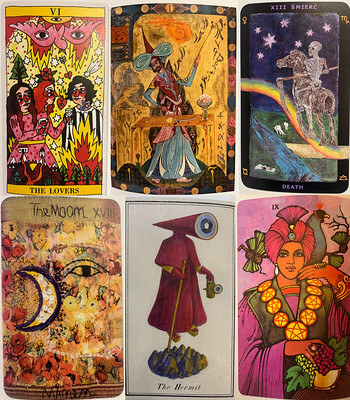
Tarot cards were usually hand painted until the invention of the printing press allowed for wider production and distribution of tarot cards. The earliest references to tarot are around the 1440s and 1450s and the cards painted by Visconti-Sforza Tarot in the mid-15th century, and Philippe Vachier of Marseilles 1639 deck are the earliest surviving cards. To design a deck is a huge undertaking and many artists have had wildy different interpretations of the card to help direct the symbolism. There are three primary types of tarot cards and symbolism:
— The Tarot of Marseilles , likely originating in 15th century Italy before spreading to France when the French conquered Milan. It was the Marseilles decks that went from being used for card game purposes to occult readings and divination.
— The Rider-Waite , originating in 1909 when it was published by William Rider & Son, based on the instructions of mystic A. E. Waite and with the well-known illustrations by Pamela Colman Smith (both members of the Hermetic Order of the Golden Dawn). Many modern tarot are based on the Rider-Waite symbolism and art, which was inspired by the Hermetic Order of the Golden Dawn as well as 19th-century magician & occultist Éliphas Lévi.
— The Thoth Tarot , designed by Aleister Crowley along with Lady Frieda Harris. Crowley had previously been a member of the Hermetic Order of the Golden Dawn but fell out in 1902 & went on to create an esoteric order of his own. The imagery & symbolism of the Thoth deck draws from science, philosophy, astrology & various occult systems, all detailed in his companion book, The Book of Thoth. ‘The origin of this pack of cards is very obscure,’ Crowley said of Tarot, ‘Some authorities seek to put it back as far as the ancient Egyptian Mysteries; others try to bring it forward as late as the fifteenth or even the sixteenth century ... [but] The only theory of ultimate interest about the tarot is that it is an admirable symbolic picture of the Universe, based on the data of the Holy Qabalah.’
The deck is structured not that unlike a deck of cards, with the major arcana added in.The terms major/minor arcana originated with Jean-Baptiste Pitois, a French author know for his The History & Practice of Magic. But if you look at each “suit” you can see how they correspond to a normal deck of cards & each suit has its own set of symbolism & meaning with it.
Pentacles corresponds with diamonds & sometimes called Coins. ‘Pentacles are the suit of material possession, career, & bodily health.’ Associated with the element of earth, they often make us aware of our generosity or greed.
Swords corresponds with Spades ‘Swords are the suit of higher consciousness, of intellect, of decisive change & focused power.’ Swords are associated with the air element & symbolic of action, change, & force.
Wands corresponds with Clubs ‘Wands are the suit of desire & yearning, dreams, & manifestation.’ Associated with the element of fire, Wands symbolize sexuality, willpower, primal energy & is the suit of the ego.
Cups correspond with Hearts. ‘Cups explore the complexities of the heart, the push & pull of relationship to others, the catharsis that comes with deeply felt emotions.’ Associated with water, Cups are symbolic of intuition & nurturing.
Doing a reading involves looking at the symbolism & constructing a story from them. Its about mindful perception, making an intuitive narrative from the cards. I quite like how it becomes a sort of storytelling with prompts, like creative writing that allows you to reflect on yourself & your actions. ‘After you have found how to tell a simple story, put in more details,’ wrote Pamela Colman Smith, arist of the Rider-Waite, ‘Learn from everything, see everything, & above all feel everything! Fine eyes within, look for the door into the unknown country.’ This book doesn’t give much in the way of looking at how to do readings, though it does provide some basic reading methods.
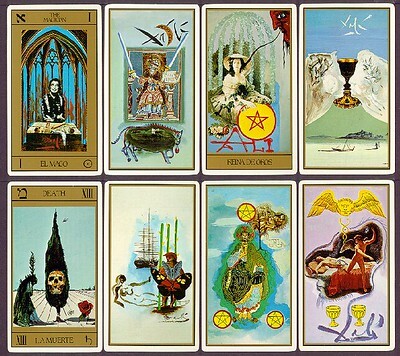
I also enjoyed the history on artists and modern uses of tarot. I was fascinated to learn that Salvador Dali was contracted for the James Bond movie Live and Let Die to make a set. Unfortunately they did not use his cards but Dali finished them.
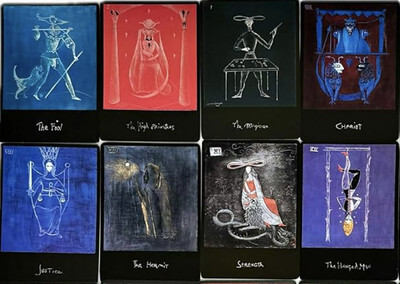
Another favorite artist, Leonora Carrington, also created a deck of the Major Arcana.
Tarot: The Library of Esoterica is a great little resource and so much fun to look at. There is a great variety of cards and artists represented here and it is fun for frequent users of the tarot or those just interested in art and symbolism.
Pick Me
Pick Me
Pick Me
Pick Me
Pick Me
Pick Me
Pick Me
Pick Me
Pick Me
Pick Me
Pick Me
Pick Me
Pick Me
Pick Me
Pick Me
Pick Me
Pick Me
Pick Me
Pick Me
Pick Me
Pick Me
Pick Me
Pick Me
Pick Me
Pick Me
Now that you have your tarot reading for today it is time for the review:
Tarot have long been used for games or cartomancy and are known for their gorgeous and interpretive artwork. Primarily originating in 15th century Italy as trionifi and later tarocchi, they are still widely known and used today. Maybe you want to do a bit of divination, maybe you want to ask the cards about your job or love life, or maybe you don’t believe in that but you like the art or have fun playing with the tarot. Either way, tarot are pretty fun to look at and collect. I have a few decks myself. Tarot: The Library of Esoterica from Taschen—known for their great art coffee table type books at a reasonable price—is such a delightful book packed with history and art of the tarot. It is more intended to be an overview of the art throughout history and about the artists behind the decks than a book about card meanings, though there is a bit of information about the symbolism and interpretations of the major arcana and the general idea of the suits. I really love this as a great resource to look at and think of the various artistic interpretations and I mayyyyyy have ordered a new deck that I found in it. I mean, this is just packed full of cool art:
Tarot cards were usually hand painted until the invention of the printing press allowed for wider production and distribution of tarot cards. The earliest references to tarot are around the 1440s and 1450s and the cards painted by Visconti-Sforza Tarot in the mid-15th century, and Philippe Vachier of Marseilles 1639 deck are the earliest surviving cards. To design a deck is a huge undertaking and many artists have had wildy different interpretations of the card to help direct the symbolism. There are three primary types of tarot cards and symbolism:
— The Tarot of Marseilles , likely originating in 15th century Italy before spreading to France when the French conquered Milan. It was the Marseilles decks that went from being used for card game purposes to occult readings and divination.
— The Rider-Waite , originating in 1909 when it was published by William Rider & Son, based on the instructions of mystic A. E. Waite and with the well-known illustrations by Pamela Colman Smith (both members of the Hermetic Order of the Golden Dawn). Many modern tarot are based on the Rider-Waite symbolism and art, which was inspired by the Hermetic Order of the Golden Dawn as well as 19th-century magician & occultist Éliphas Lévi.
— The Thoth Tarot , designed by Aleister Crowley along with Lady Frieda Harris. Crowley had previously been a member of the Hermetic Order of the Golden Dawn but fell out in 1902 & went on to create an esoteric order of his own. The imagery & symbolism of the Thoth deck draws from science, philosophy, astrology & various occult systems, all detailed in his companion book, The Book of Thoth. ‘The origin of this pack of cards is very obscure,’ Crowley said of Tarot, ‘Some authorities seek to put it back as far as the ancient Egyptian Mysteries; others try to bring it forward as late as the fifteenth or even the sixteenth century ... [but] The only theory of ultimate interest about the tarot is that it is an admirable symbolic picture of the Universe, based on the data of the Holy Qabalah.’
The deck is structured not that unlike a deck of cards, with the major arcana added in.The terms major/minor arcana originated with Jean-Baptiste Pitois, a French author know for his The History & Practice of Magic. But if you look at each “suit” you can see how they correspond to a normal deck of cards & each suit has its own set of symbolism & meaning with it.
Pentacles corresponds with diamonds & sometimes called Coins. ‘Pentacles are the suit of material possession, career, & bodily health.’ Associated with the element of earth, they often make us aware of our generosity or greed.
Swords corresponds with Spades ‘Swords are the suit of higher consciousness, of intellect, of decisive change & focused power.’ Swords are associated with the air element & symbolic of action, change, & force.
Wands corresponds with Clubs ‘Wands are the suit of desire & yearning, dreams, & manifestation.’ Associated with the element of fire, Wands symbolize sexuality, willpower, primal energy & is the suit of the ego.
Cups correspond with Hearts. ‘Cups explore the complexities of the heart, the push & pull of relationship to others, the catharsis that comes with deeply felt emotions.’ Associated with water, Cups are symbolic of intuition & nurturing.
Doing a reading involves looking at the symbolism & constructing a story from them. Its about mindful perception, making an intuitive narrative from the cards. I quite like how it becomes a sort of storytelling with prompts, like creative writing that allows you to reflect on yourself & your actions. ‘After you have found how to tell a simple story, put in more details,’ wrote Pamela Colman Smith, arist of the Rider-Waite, ‘Learn from everything, see everything, & above all feel everything! Fine eyes within, look for the door into the unknown country.’ This book doesn’t give much in the way of looking at how to do readings, though it does provide some basic reading methods.
I also enjoyed the history on artists and modern uses of tarot. I was fascinated to learn that Salvador Dali was contracted for the James Bond movie Live and Let Die to make a set. Unfortunately they did not use his cards but Dali finished them.
Another favorite artist, Leonora Carrington, also created a deck of the Major Arcana.
Tarot: The Library of Esoterica is a great little resource and so much fun to look at. There is a great variety of cards and artists represented here and it is fun for frequent users of the tarot or those just interested in art and symbolism.

March 20, 2021
The Library of Esoterica brings out the bibliophile in me! I received so much pleasure flipping through its pages. The font is neatly set, the pages are thick, and the book has that perfect book smell - it was very pleasing to take my time with this one!
Tarot has a few essays and tarot chronologies that are straightforward, including the history of tarot and oracle decks that does a good job of delineating where some of its legendary claims (Egyptian roots) come from (white man making shit up), and an exquisite showcase to some of the earliest historical decks in existence, think medieval Italian art paintings with gold foil.
Tarot shows tarot decks as well as tarot-influenced artwork for all the cards of the Major and Minor Arcana. There is a short discussion on each card, a quote here and there from major tarot figures -generally a long-dead member of some hermetic order, but others are more contemporary- its correspondences including astrological sign and element, and general interpretation. This is then followed by cards from different tarot decks interspersed with artworks.
Because this is Taschen, it was high-brow. Many of the decks had captions that said it was rare, limited print and hard to find. For those that didn't say so, when I Googled them, I found that they were. There were also quite a few decks that were created to promote a band, a magazine, a fashion label, or an ad for a company. There were also quite a few decks that were starting to become familiar because it seemed Jessica Hundley was obsessed with the cards and had to have them for each section. Familiar names included The Star Tarot, UUSI's Pagan Underworlds, Margarete Peterson, Tarot Balbo, Medieval Scampi, the OG version of the Brotherhood of the Light tarot and a few more that I have not remembered its names.
The decks leaned towards European art history aesthetic - Renaissance or minimalistic and abstract. There were some shamanistic decks that were great to see, and there were some popular decks by BIPOC creators like Manzel's Tarot, Neo Tarot, Mystic Mondays, as well as some other unique decks that featured archetypes that pulled from Mexican or Japanese culture. I saw Tarot Nefertari in there, one of my favourite decks with Egyptian iconography.
What could have been improved? An essay on the major tarot card publishing companies would have been a fascinating look at the business of tarot. The popularity of tarot. Cultural appropriation of decks that depict BIPOC and cultural ceremonies that are created by white people. I'm split on whether I would have liked to see more newer decks in the book; I liked that many of them were older and that I didn't know about them but I don't think I needed to see more than 1 card created by a fashion label house or an American band for promotional purposes. I would have swapped those out for influential decks that are popular now like Spirit Speaks or something.
Overall, I really enjoyed this, and I also found some new decks to add my collection! I have the Astrology book next from the Library of Esoterica and I can't wait to get into it!
Tarot has a few essays and tarot chronologies that are straightforward, including the history of tarot and oracle decks that does a good job of delineating where some of its legendary claims (Egyptian roots) come from (white man making shit up), and an exquisite showcase to some of the earliest historical decks in existence, think medieval Italian art paintings with gold foil.
Tarot shows tarot decks as well as tarot-influenced artwork for all the cards of the Major and Minor Arcana. There is a short discussion on each card, a quote here and there from major tarot figures -generally a long-dead member of some hermetic order, but others are more contemporary- its correspondences including astrological sign and element, and general interpretation. This is then followed by cards from different tarot decks interspersed with artworks.
Because this is Taschen, it was high-brow. Many of the decks had captions that said it was rare, limited print and hard to find. For those that didn't say so, when I Googled them, I found that they were. There were also quite a few decks that were created to promote a band, a magazine, a fashion label, or an ad for a company. There were also quite a few decks that were starting to become familiar because it seemed Jessica Hundley was obsessed with the cards and had to have them for each section. Familiar names included The Star Tarot, UUSI's Pagan Underworlds, Margarete Peterson, Tarot Balbo, Medieval Scampi, the OG version of the Brotherhood of the Light tarot and a few more that I have not remembered its names.
The decks leaned towards European art history aesthetic - Renaissance or minimalistic and abstract. There were some shamanistic decks that were great to see, and there were some popular decks by BIPOC creators like Manzel's Tarot, Neo Tarot, Mystic Mondays, as well as some other unique decks that featured archetypes that pulled from Mexican or Japanese culture. I saw Tarot Nefertari in there, one of my favourite decks with Egyptian iconography.
What could have been improved? An essay on the major tarot card publishing companies would have been a fascinating look at the business of tarot. The popularity of tarot. Cultural appropriation of decks that depict BIPOC and cultural ceremonies that are created by white people. I'm split on whether I would have liked to see more newer decks in the book; I liked that many of them were older and that I didn't know about them but I don't think I needed to see more than 1 card created by a fashion label house or an American band for promotional purposes. I would have swapped those out for influential decks that are popular now like Spirit Speaks or something.
Overall, I really enjoyed this, and I also found some new decks to add my collection! I have the Astrology book next from the Library of Esoterica and I can't wait to get into it!

March 15, 2024
Образи, архетипи і пафос) по-перше, було цікаво зануритись в абсолютно незнайому мені тему. По-друге, тема ця виявилась не такою вже незнайомою - Таро тісно переплітається…з усім. З Юнгом, Джозеффом Кемпбелом, християнством, ісламом, Кабалою, нумерологією, астрологією, філософією, містицизмом. Така собі смислова еклектика на максималках, приправлена то пафосним то втаємниченим тоном.
Якщо відкинути упередження і скептицизм, то Таро виявиться в першу чергу цікавим «генератором сюжетів» на котрий вже кожен додумує свої сенси.
Ну, і головне - неймовірний віжуал притаманний всім альбомам Ташин.
Якщо відкинути упередження і скептицизм, то Таро виявиться в першу чергу цікавим «генератором сюжетів» на котрий вже кожен додумує свої сенси.
Ну, і головне - неймовірний віжуал притаманний всім альбомам Ташин.

January 15, 2021
Man patiko. Šiek tiek Taro kortų istorijos nuo pat XV a. iki šių dienų, šiek tiek kiekvienos kortos apibūdinimo ir daug daug daug iliustracijų.
Taro dažnai mistifikuojamos, tačiau prasidėjo jos kaip kortų žaidimas, ir netgi pirmieji būrimo vadovėliai vadinosi "How to entertain yourself with Tarot cards", o dalis reikšmių ir simbolių jose atsirado tik XiX a. pab - XX a. pr., ir buvo sugalvoti pačių kortų kūrėjų. Iš kitos pusės, atrodo, kad kas kūrė, darė tai tikrai atsidavę, nes kortas piešdavo ir jų paaiškinimus rašydavo po kelis metus, stengdamiesi į vieną vietą susieti daugybę simbolių. Tai kaip ir lieka iki galo neaišku, kiek rimtas visas šis reikalas, bet turbūt kaip ir visi kiti reikalai šiam gyvenime - kiek rimtumo pridėsi, tiek ir turėsi :)
Taro dažnai mistifikuojamos, tačiau prasidėjo jos kaip kortų žaidimas, ir netgi pirmieji būrimo vadovėliai vadinosi "How to entertain yourself with Tarot cards", o dalis reikšmių ir simbolių jose atsirado tik XiX a. pab - XX a. pr., ir buvo sugalvoti pačių kortų kūrėjų. Iš kitos pusės, atrodo, kad kas kūrė, darė tai tikrai atsidavę, nes kortas piešdavo ir jų paaiškinimus rašydavo po kelis metus, stengdamiesi į vieną vietą susieti daugybę simbolių. Tai kaip ir lieka iki galo neaišku, kiek rimtas visas šis reikalas, bet turbūt kaip ir visi kiti reikalai šiam gyvenime - kiek rimtumo pridėsi, tiek ir turėsi :)

June 20, 2022
Simply exquisite.
The information it provides is very basic but everything else is a luxury, a delight for the eyes.
Impeccable binding and a wonderful selection of images.
A marvel.
The information it provides is very basic but everything else is a luxury, a delight for the eyes.
Impeccable binding and a wonderful selection of images.
A marvel.

August 19, 2025
Неймовірна книга. Якщо це страва - то дуже смачна, візуально насичена і залишає відбиток у снах. Не знав, що таро так багато ілюстровані. Дуже вдячний студентам, які мені подарували цю книгу - поки живу і маю пам'ять, грітимуся від цього спогаду.

March 7, 2024
Taschen keep up their top-shelf output in content and quality yet again. Putting it simply, this is a crucial visual bridge for studying The Tarot. In tandem with a tarot deck, a tarot guide (mine is Rachel Pollack's 'Seventy-Eight Degrees of Wisdom'), a trustworthy notebook & pen, one can move through the timeless study of the introspective and surreal inner landscapes of the 78 cards. This fat doorstopper of a book contains so many vibrant images from lost, ancient, modern, kitsch and pop art that it should be digested slowly as part of a study both rigorous and inclusive. Of course, smoking some stick and flipping through is all fine fun, but for me at least, it's a corner stone to visualizing the aesthetics of this great esoteric art. Talk shop with your Hanged Man, explore the ruined floors of The Tower, go shopping with The Seven of Cups, and while you're at, have tea with The Devil and explore the difference between lust and codependency. Ask The Moon why you're having the same dream again and again and again.
While not for everyone, I can't recommend this book enough. In the high pantheon of coffee table books, and then much more. It's a magical, colorful grimoire, both meditative and therapeutic, if you allow it to be. We're all glorious messes, so you may as well open some doors and simply have fun with it.
While not for everyone, I can't recommend this book enough. In the high pantheon of coffee table books, and then much more. It's a magical, colorful grimoire, both meditative and therapeutic, if you allow it to be. We're all glorious messes, so you may as well open some doors and simply have fun with it.

November 6, 2020
Hay libros que son una joya, no solamente por su contenido sino por su forma, por su calidad editorial, por su significado y su arte. Este libro es precisamente eso, una joya. Un compendio maravilloso de cartas de Tarot provenientes de una inmensa variedad de mazos diferentes y un recorrido fascinante por su simbología y belleza artística. Una obra imprescindible para todo amante del Tarot, el arte y la belleza.
December 20, 2020
Intro to Tarot cards meaning/history. A visual book, mainly compromised of gorgeous art from a wide array of cultures and artists. Sought to get the reader interested in deeper research into tarot symbology, and it accomplished that goal.
September 14, 2026
Good intro to tarot but fairly surface level and picture heavy. The book neglects many of the Rider- Waite cards, prioritising a display of a wide range of mainly modern decks most of which I wasn’t a fan of and took the magic away.

October 27, 2024
Plenty of typos throughout and scant examination of the archetypes and suits except for limited description of how they came to be in tarot despite a number of sections outlining the history and historical figures of the various decks.
We are told that the archetypes represent each of us in various stages of our journey, for example, yet we have little to no reference to their origins or just how they are representative.
Nor is there any discussion of how the many artists integrated these archetypes and suits into their work on the tarot. Many readers will be left to interpret the artists’ work based solely on visual cues. The more versed reader may pick up on historical cues from the dates provided and general style of the work, but we are still left to work out the contexts or lenses through which the decks were created.
All of which may be fine, but this reader expected more depth and care from a Taschen tome.
We are told that the archetypes represent each of us in various stages of our journey, for example, yet we have little to no reference to their origins or just how they are representative.
Nor is there any discussion of how the many artists integrated these archetypes and suits into their work on the tarot. Many readers will be left to interpret the artists’ work based solely on visual cues. The more versed reader may pick up on historical cues from the dates provided and general style of the work, but we are still left to work out the contexts or lenses through which the decks were created.
All of which may be fine, but this reader expected more depth and care from a Taschen tome.

March 9, 2021
This is a handsome book, lavishly illustrated. The text is aimed at the Tarot novice (such as myself), with an emphasis more on the artistic merits of the cards than on their properties of divination. Tarot presents examples from decks from across the centuries and around the globe. The only thing that prevents me from awarding five stars is some sloppy editing—more typos than one would expect from such a high quality physical package.

January 4, 2026
Hace dos días no sabía qué era un Arcano y me cagué cuando me salió la Torre en mi 1° tirada 🏰⚡. PERO me he enamorado del tarot.
En origen era un juego de mesa italiano en el s. XV (Visconti-Sforza) y no se usó para la adivinación hasta el s. XVIII (Etteilla). De hecho, el mazo más famoso (Waite) es del s. XX.
Pero ¿y qué? Estamos conectando con simbolismo de hace 600 años. Para mí es una herramienta de introspección, como diría Leonora Carrington: "un espejo que refleja tu interior" 🪞. Todos vivimos nuestro propio viaje de héroe y los arquetipos de Jung son los "iconos" de un inconsciente colectivo que nos sirven de guía. 🧭
Sus imágenes son "puertas a habitaciones inesperadas de nuestra mente" 🚪 y muchos mazos son una galería de arte portátil increíble 🎨.
[[Ilustraciones para ver mil veces, profundiza en los arcanos mayores y describe los menores. Válido como libro de consulta 👁️]]
En origen era un juego de mesa italiano en el s. XV (Visconti-Sforza) y no se usó para la adivinación hasta el s. XVIII (Etteilla). De hecho, el mazo más famoso (Waite) es del s. XX.
Pero ¿y qué? Estamos conectando con simbolismo de hace 600 años. Para mí es una herramienta de introspección, como diría Leonora Carrington: "un espejo que refleja tu interior" 🪞. Todos vivimos nuestro propio viaje de héroe y los arquetipos de Jung son los "iconos" de un inconsciente colectivo que nos sirven de guía. 🧭
Sus imágenes son "puertas a habitaciones inesperadas de nuestra mente" 🚪 y muchos mazos son una galería de arte portátil increíble 🎨.
[[Ilustraciones para ver mil veces, profundiza en los arcanos mayores y describe los menores. Válido como libro de consulta 👁️]]

August 24, 2026
dizainas keliantis adikciją vartyti ir neturint laiko kada. Susumavimai glausti, taiklūs, tarnaus puikiai kaip atmintinė greitam žvilgsniui užmesti kai reikia. Patrauklios iliustracijos, įdomi selekcija, atverianti akis, kad neegzistuoja vienas kanonas vienos tiesos apie Taro skaitymą - viskas gyvenime atsiveria subjektyvia prizme. O dar įdomiau patirti ne per istorikų, raganų, o menininkų vaizduotę! tačiau renkantis autorės šiek tiek patingėta, nes daug kurių kaladžių variacijos kartojasi ir tampa nebeįdomu tyrinėti vizualiai vienodus pavyzdžius.
Kadangi tai yra tik viso plataus ezoterinio, mistikos, filosofijos, psichoanalizės, paties pasaulio narpliojimo pradžios vadovas, jo siekis yra sužadinti norą mokytis apie save, visatos paslaptis ne per taisykles ir “tiesas”, o sapnus, abstraktų simbolizmą, numerologiją, antikinius mitus ir renesansinę menotyrą. Smagu, kad yra kaladžių įkvėptų feministinio žvilgsnio, pagonybės, pasakų, muzikos, popso, Jungo, siurrealistų, psichodelikos, egipto, 80’s ir t.t. Ir t.t.
Pasijutau įkvėpta, kad viskas yra verta.
Kadangi tai yra tik viso plataus ezoterinio, mistikos, filosofijos, psichoanalizės, paties pasaulio narpliojimo pradžios vadovas, jo siekis yra sužadinti norą mokytis apie save, visatos paslaptis ne per taisykles ir “tiesas”, o sapnus, abstraktų simbolizmą, numerologiją, antikinius mitus ir renesansinę menotyrą. Smagu, kad yra kaladžių įkvėptų feministinio žvilgsnio, pagonybės, pasakų, muzikos, popso, Jungo, siurrealistų, psichodelikos, egipto, 80’s ir t.t. Ir t.t.
Pasijutau įkvėpta, kad viskas yra verta.

August 20, 2024
A great introduction to Tarot with focus on the art of the different card decks crafted throughout the centuries.
This volume does delve into the symbolism and meanings of the cards and their archetypes (which was the most interesting part for me) and the history of Tarot, but it is mainly a literary art gallery, showcasing hundreds of illustrations and paintings with short information about the artists and their unique decks. Although I enjoyed taking in all these beautiful cards, for me it lacked some more insight into how differently the artists interpreted each card, which symbols could be found in them and thoughts on how to 'read' them.
But as a visual guide to the art of Tarot and an overview of the archetypes, this works perfectly.
This volume does delve into the symbolism and meanings of the cards and their archetypes (which was the most interesting part for me) and the history of Tarot, but it is mainly a literary art gallery, showcasing hundreds of illustrations and paintings with short information about the artists and their unique decks. Although I enjoyed taking in all these beautiful cards, for me it lacked some more insight into how differently the artists interpreted each card, which symbols could be found in them and thoughts on how to 'read' them.
But as a visual guide to the art of Tarot and an overview of the archetypes, this works perfectly.

May 6, 2023
Beautiful and while the analyses and info are brief they are genuinely insightful, written in a more poetic way than many tarot books. I also loved the quotes.
And of course the images are incredible and inspiring…I only wish it went into as much detail about the minor arcana as it does the major. It would have to be two volumes probably but I think it would be worth it.
And of course the images are incredible and inspiring…I only wish it went into as much detail about the minor arcana as it does the major. It would have to be two volumes probably but I think it would be worth it.

August 5, 2022
Absolutely stunning artworks of Tarot cards from all over the world.

April 5, 2025
Inspiring & insightful

December 13, 2022
This book is a beautiful collection of tarot illustrations, as well as a comprehensive history of tarot. This is a keeper, and I'm buying a copy for my coffee table.

June 29, 2024
This book is excellent. There was so much good information that some expanded areas would have been awesome.
Read
August 13, 2026avid tarot user and reader here but sometimes i get freaked out by my own readings lol. ikr so spooky.

Read
April 5, 2021Gorgeous and useful
September 16, 2022
An absolute Must Have for any serious tarot lover. This book is well written, easy to understand and filled with wonderful cards from a series of decks, some OOP and others that are easily available for purchase. The deck that started me on the path of deck collecting is included in this book- The Pop Rock Tarot by Julia Noonan and Julia Remine Piggin. This was a punch-out tarot deck published by Scholastic in 1972. I bought my copy at a Scholastic Book Fair at my elementary school and fell instantly in love with the deck and artwork. Now, 50 years later, I'm still in love and still collecting tarot decks. If you love tarot, get this book. It's worth the price and will send you down the rabbit hole searching new and old decks for fun, and collecting.

April 10, 2021
This is now one of my favorite books ever. After slowly reading it over the past year so that I could savor each chapter, I'm sure I will return to it for reference again and again. It's an amazing survey of the tarot, with some text and many beautiful images from various tarot decks past and present. I found the heavy visual focus rich with meaning and inspiration, and a refreshing change.

June 16, 2022
Visualmente hermoso, intelectualmente no está a la altura.
Revisión muy superficial de las cartas y sus significados, recomiendo comprar más por la estética del libro, o si se busca saber un poco del Tarot.
Revisión muy superficial de las cartas y sus significados, recomiendo comprar más por la estética del libro, o si se busca saber un poco del Tarot.
September 12, 2026
This is a gorgeous book, obviously, but it is more than a coffee-table object with gold stamped on the cover. Jessica Hundley brings together tarot art from centuries of decks and gives you the sense that these cards have never belonged to one fixed look, one spiritual school, or one kind of reader. I loved seeing how wildly the imagery shifts across time and culture, especially after spending so many years looking at variations of the same handful of Rider-Waite-Smith images. The essays are engaging and the book does a good job of treating tarot as an artistic, historical, occult, and psychological phenomenon all at once. My criticism is that the sheer amount of beautiful material sometimes means individual decks, artists, and historical periods get only a brief introduction before the book has to move on. I finished it with a longer reading list, which is good, but I also wanted more sustained depth in a few places. And despite the “sourcebook” label, I would not call this a practical guide to learning readings. Still, it is the kind of book that makes you want to pull every deck you own off the shelf and look at it again. For tarot lovers, art people, and anyone who wants to understand just how vast this tradition is, it is a real pleasure.

January 5, 2024
One of four Taschen volumes in the collection The Library of Esoterica (the others being Witchcraft, Astrology and Plant Magick) it's a beautiful artifact and full of great reproductions of Tarot cards from its beginnings in Renaissance Italy to very recent pieces and also artworks inspired by the imagery and symbolism of the Tarot.
The text that accompanies the image is very much standard stuff that can easily be found in popular books on the subject, there is little attempt to do an in depth academic study of the subject, but it is also not too fanciful. There is a clear focus on the images and art of the tarot, although there are also attempts to explain the symbolic meaning of the most common images in the several versions of the deck presented here.
A beautiful volume that can be found at pretty accessible prices (I bought this for under 30 euros), it is definitely worth having although if you are any kind of expert or even have read just a couple of books on the subject, you shouldn't expect to find anything groundbreaking within. It's about the pretty pictures and there's nothing wrong with that, if you go in with that in mind.
The text that accompanies the image is very much standard stuff that can easily be found in popular books on the subject, there is little attempt to do an in depth academic study of the subject, but it is also not too fanciful. There is a clear focus on the images and art of the tarot, although there are also attempts to explain the symbolic meaning of the most common images in the several versions of the deck presented here.
A beautiful volume that can be found at pretty accessible prices (I bought this for under 30 euros), it is definitely worth having although if you are any kind of expert or even have read just a couple of books on the subject, you shouldn't expect to find anything groundbreaking within. It's about the pretty pictures and there's nothing wrong with that, if you go in with that in mind.

August 31, 2022
Libro consigliatissimo per chi vuole conoscere la storia e l'arte dei tarocchi. Si colloca tra i testi recenti che affrontano sia la storia scientifica e filologica - che individua la nascita dei tarocchi in Italia intorno al XIV secolo -, sia la storia leggendaria raccontata dagli esoteristi dell'Ottocento, che hanno aggiunto alle carte significati dall'Antico Egitto e dalla Cabala. È poi un testo aggiornato anche sugli studi più recenti, infatti dà la giusta importanza storica all'illustratrice Pamela Colman Smith.
Ma il grosso del libro è un compendio che rappresenta ogni carta interpretata da artisti diversi. I mazzi scelti sono tantissimi e molto vari nello stile, nella cultura, nei significati. Hanno rappresentazione sia mazzi antichi che moderni, inclusivi e non, di grandi case editrici e indipendenti.
(Preciso che però non è un libro per chi vuole imparare a leggere i tarocchi, perché non approfondisce le tecniche e i modi di trarre significati dalle carte durante una consultazione.)
Ma il grosso del libro è un compendio che rappresenta ogni carta interpretata da artisti diversi. I mazzi scelti sono tantissimi e molto vari nello stile, nella cultura, nei significati. Hanno rappresentazione sia mazzi antichi che moderni, inclusivi e non, di grandi case editrici e indipendenti.
(Preciso che però non è un libro per chi vuole imparare a leggere i tarocchi, perché non approfondisce le tecniche e i modi di trarre significati dalle carte durante una consultazione.)
January 5, 2023
For those who have a more difficult time passively learning (learning only by reading, etc), this is a great book to consider having. Each card is given its own section with a short, simple, yet effective “blurb” on the imagery generally given to the card and the significance. I find the way it’s described in this book a lot more helpful to developing the skills to read tarot on your own, other than just being directly “told” what it is like in other beginner’s tarot books. If you are a creative or nerd type, you will appreciate the beautiful artistic cards chosen from different decks to represent each card in the book. It is also helpful that you can get used to seeing different decks and training your brain to analyse them or see the symbolic similarities/patterns for each card. Best part is that it makes an absolutely stunning “coffee table” book, inside and outside. A collector’s item for sure and very reasonably priced for what it was (I purchased for 40$).

March 21, 2024
I must be missing something, but there is nothing in this book but a bunch of nice decks. I think most from Taschen, which makes sense as they are publishing. Pity with that, almost all are out of print. An example: Knight of Wands, — Fleeting desires. The Knight of Wands points to our restlessness and desire to be loved, and asks us to confront our tendencies to be impetuous and impatient. For the suit of Cups: qualities are feelings, emotions, intuition and creativity and astrologically associated with Pisces, Cancer and Scorpio. All true but 528 pages? They associate the cups to hearts (pg 423). Fiebig has done better books (though not the redone Tarot Way of Mindfulness) with a lot of the same meanings and better depth. There are only 2 spreads, the basic daily and the Celtic Cross and little to tell you how to use them. I guess this is a picture book highlighting the publishers work much like Stuart Kaplan's US Games Encyclopedia of Tarot.
Displaying 1 - 30 of 86 reviews