Snoopy atop his doghouse, Lucy's five-cent psychiatric booth, the Great Pumpkin, Miss Othmar, and Sally all debut. All this, and "Happiness is a warm puppy." Nearly 200 rare or unseen strips! Introduction by Whoopi Goldberg.
As the first decade of Peanuts closes, it seems only fitting to bid farewell to that halcyon decade with a cover starring Patty, one of the original three Peanuts. Major new additions to classic Peanuts lore come fast and furious here. Snoopy begins to take up residence atop his doghouse, and his repertoire of impressions increases exponentially. Lucy sets up her booth and offers her first five-cent psychiatric counsel. (Her advice to a forlorn Charlie Brown: "Get over it.") For the very first time, Linus spends all night in the pumpkin patch on his lonely vigil for the Great Pumpkin (although he laments that he was a victim of "false doctrine," he's back 12 months later). Linus also gets into repeated, and visually explosive, scuffles with a blanket-stealing Snoopy, suffers the first depredations of his blanket-hating grandmother, and falls in love with his new teacher Miss Othmar. Even more importantly, several years after the last addition to the cast ("Pig-Pen"), Charlie Brown's sister Sally makes her appearance—first as an (off-panel) brand new baby for Charlie to gush over, then as a toddler and eventually a real, talking, thinking cast member. (By the end of this volume, she'll already start developing her crush on Linus.) All this, and one of the most famous Peanuts strips ever: "Happiness is a warm puppy." Almost one hundred of the 731 strips collected in this volume (including many Sundays) have never been collected in any book since their original release, with one hundred more having been collected only once in relatively obscure and now impossible-to-find books; in other words, close to one quarter of the strips have never been seen by anyone but the most avid Peanuts completists.
The introduction is by comedienne extraordinaire Whoopi Goldberg, who reveals which Peanuts character she has tattooed on her body (and where)—as well as telling of her meeting with "Sparky" Schulz, and her fascinating theory on Snoopy's brother Spike. As always, this volume is gorgeously designed by award-winning cartoonist Seth. The Complete Peanuts continues to receive national and international media attention for its sophisticated treatment of one of the 20th Century's defining American classics.
A 2007 Eisner Award winner: Best Archival Collection/Project: Strips; a 2007 Harvey Award winner: Best Domestic Reprint Project.
Charles Monroe Schulz was an American cartoonist, whose comic strip Peanuts proved one of the most popular and influential in the history of the medium, and is still widely reprinted on a daily basis. Schulz's first regular cartoons, Li'l Folks, were published from 1947 to 1950 by the St. Paul Pioneer Press; he first used the name Charlie Brown for a character there, although he applied the name in four gags to three different boys and one buried in sand. The series also had a dog that looked much like Snoopy. In 1948, Schulz sold a cartoon to The Saturday Evening Post; the first of 17 single-panel cartoons by Schulz that would be published there. In 1948, Schulz tried to have Li'l Folks syndicated through the Newspaper Enterprise Association. Schulz would have been an independent contractor for the syndicate, unheard of in the 1940s, but the deal fell through. Li'l Folks was dropped from the Pioneer Press in January, 1950. Later that year, Schulz approached the United Feature Syndicate with his best strips from Li'l Folks, and Peanuts made its first appearance on October 2, 1950. The strip became one of the most popular comic strips of all time. He also had a short-lived sports-oriented comic strip called It's Only a Game (1957–1959), but he abandoned it due to the demands of the successful Peanuts. From 1956 to 1965 he contributed a single-panel strip ("Young Pillars") featuring teenagers to Youth, a publication associated with the Church of God. Peanuts ran for nearly 50 years, almost without interruption; during the life of the strip, Schulz took only one vacation, a five-week break in late 1997. At its peak, Peanuts appeared in more than 2,600 newspapers in 75 countries. Schulz stated that his routine every morning consisted of eating a jelly donut and sitting down to write the day's strip. After coming up with an idea (which he said could take anywhere from a few minutes to a few hours), he began drawing it, which took about an hour for dailies and three hours for Sunday strips. He stubbornly refused to hire an inker or letterer, saying that "it would be equivalent to a golfer hiring a man to make his putts for him." In November 1999 Schulz suffered a stroke, and later it was discovered that he had colon cancer that had metastasized. Because of the chemotherapy and the fact he could not read or see clearly, he announced his retirement on December 14, 1999. Schulz often touched on religious themes in his work, including the classic television cartoon, A Charlie Brown Christmas (1965), which features the character Linus van Pelt quoting the King James Version of the Bible Luke 2:8-14 to explain "what Christmas is all about." In personal interviews Schulz mentioned that Linus represented his spiritual side. Schulz, reared in the Lutheran faith, had been active in the Church of God as a young adult and then later taught Sunday school at a United Methodist Church. In the 1960s, Robert L. Short interpreted certain themes and conversations in Peanuts as being consistent with parts of Christian theology, and used them as illustrations during his lectures about the gospel, as he explained in his bestselling paperback book, The Gospel According to Peanuts, the first of several books he wrote on religion and Peanuts, and other popular culture items. From the late 1980s, however, Schulz described himself in interviews as a "secular humanist": “I do not go to church anymore... I guess you might say I've come around to secular humanism, an obligation I believe all humans have to others and the world we live in.”
It is impressive to create a new comic strip every day for a decade, let alone half a century like Schulz did. That’s over eighteen-thousand consecutive days of output. They’re not all going to be brilliant, but so far, the charm is not waning much.
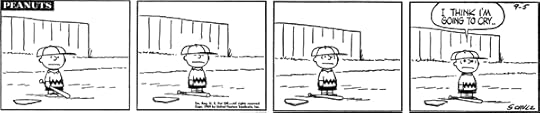
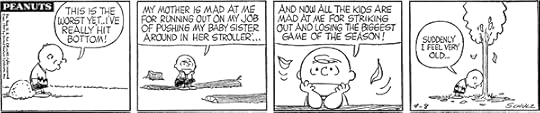
In these years, Charlie Brown’s sister Sally is born, and in one of the most heartbreaking sequences yet—a storyline spanning fifteen daily strips—Charlie Brown is tasked with pushing his baby sister around the block in her stroller at the expense of participating in his baseball game. He is determined to carry out his brotherly duties. After his team beckons and harasses him sufficiently, he abandons his sister in their front yard, rushing to the field, determined now to be the hero in the final play of the game. Over three consecutive strips, he strikes out, one, two, three. In the following strip, he stands alone, forlorn, and taciturn on home plate before finally muttering to himself, “I think I’m going to cry.” In a subsequent strip, after being lambasted by his teammates, he laments that he not only failed as a teammate, but as a brother and caregiver for his sister, resting his dejected head against a tree and declaring, “I suddenly feel very old.” The prescient, mature, and devastating implication of this line is one of fatherhood. In sacrificing time with his family to attend to matters of providing, he may fail in that endeavor as well, thus ultimately letting down everyone who was depending on him. Life really can just be too much, even for a child with such a heightened sense of responsibility that in attempting to please everyone, fails everyone, including himself.
Has it been a decade already? Book five of The Complete Peanuts, which includes every strip from 1959 and 1960, marks the franchise's tenth anniversary. It's hard to believe that by the time Bill Watterson's Calvin and Hobbes notched ten years, it was at its end; Peanuts still had another forty to go. January 2, 1959 gets the year off to a fast start as Lucy presents her friends with lists of character faults they should eliminate in the coming year. Lucy has "high ideals," she explains to Charlie Brown. "I want to make this a better world for me to live in!" It always feels more gratifying to dissect and condemn other people's flaws than our own. January 12 (page six) is a nice strip: Violet says something insulting about dogs, and when Charlie Brown speaks up on their behalf, Snoopy's gratitude is heartfelt...if a bit clingy, as we observe the rest of the week. By 1959 Patty was less integral to Peanuts than she used to be, but on January 24 (page ten) she and Charlie Brown have an enlightening philosophical conversation. She assures him that everyone has good and bad days, but Charlie Brown counters that "Last year I was the only person I know who had three hundred and sixty-five bad days!" Negative experiences stand out in the mind more than good ones, so we tend to forget the good happened at all. A lot of Charlie Brown's depression stems from this.
January 26 (page twelve), Charlie Brown writes to his penpal, a strip that ends with a witty punchline about spelling. Charles Schulz is a master of pithy comedy. On February 9 (page eighteen), Lucy uses her watch to count aloud as Charlie Brown ages, second by second. It's disconcerting to think about time ticking by, rather than focus on filling it with worthwhile activity. Charlie Brown engages in another smart discussion with Patty on February 25 (page twenty-four), telling her that arithmetic is a bad subject for him in school. "I'm at my best in something where the answers are mostly a matter of opinion!" The artist in each of us empathizes with that statement; trying to create beauty is very different from having to arrive at objectively correct answers. March 13 (page thirty-one) caps off a week of Charlie Brown fretting about a library book he lost. Plagued by anxiety over how the library will react, Charlie Brown goes wildly giddy with relief when he locates the book before the day of reckoning. Linus's comment: "In all this world there is nothing more inspiring than the sight of someone who has just been taken off the hook!" Aye, being "shot at and missed" is an unrivaled euphoria. Sunday, March 22 (page thirty-five), Linus builds a fantastically elaborate sandcastle, but heavy rain washes it away. Linus puzzles over the moral to his story, but I think it's this: before you pour your heart and soul into creation, be sure the investment is in something likely to last. Castles of sand inevitably disintegrate.
Here we go! March 27 (page thirty-seven) is the beginning of an era as Lucy sets up her "Psychiatric Help 5¢" booth and delivers her first pitiless advice to Charlie Brown. The bit would remain a Peanuts mainstay for decades. On March 30 (page thirty-nine) Snoopy reminisces about a time when a girl walked by and shared her ice-cream cone with him. When Lucy happens by the same spot in the present day, she's less charitable, and a disappointed Snoopy thinks, "You can't go home again." The places where we had our greatest days feel almost magical, as though good things are waiting to come our way again in that exact spot, but rarely is fate so kind. Charlie Brown and Lucy talk social politics on April 10 (page forty-three). He mentions an article that says today's young people don't believe in any causes, and Lucy loudly objects: "I'm my own cause!" Her stance seems a silly one to take, but it's quite prevalent. Societies decline when we get so wrapped up in our own identities that we lose the vision and verve to promote causes beyond ourselves. May 15 (page fifty-eight) is a return to pure humor, as Charlie Brown reads a scary story to Linus. Snoopy's impression of a vampire bat when a nervous Linus turns to look at him is excellent visual comedy. A story arc that changes Peanuts forever commences May 25 (page sixty-three) when Charlie Brown remarks that his mother will be at the hospital for "about five days." Could it be...? Yes! May 26 confirms that Charlie Brown has a baby sister, and June 2 (page sixty-six), her name is given for the first time: Sally. Peanuts will never be the same.
One of the funniest Sundays in this collection is June 14 (page seventy-one). Lucy attaches a bell to Snoopy's collar, but he's not used to the way it jingles when he trots around. Snoopy delivers the perfect punchline, in a single word. June 28 (page seventy-seven) is another good Sunday. Linus offers to share his ice cream with Snoopy, and Lucy throws a fit. Doesn't he know dogs have filthy mouths? Snoopy walks off feeling downcast and degraded. "I'm less than human!" Even people can feel that way, when others dehumanize us for personal traits they object to. It's a lonely, helpless feeling, and most of us can identify with Snoopy's dejection. July 1 (page seventy-eight), it dawns on Charlie Brown that his new sister isn't the life-changer he expected her to be. He adores Sally, but depression still overtakes him at times, and he doesn't feel that most people like him. Punctuated by Linus's poignant final line, this is one of the most famous strips Charles Schulz wrote, finding its way into A Charlie Brown Christmas, the classic 1965 television special. July 30 (page ninety-one) is a spiffy little insight into the human condition. Linus tells Charlie Brown he wants to develop concern for others; those more fortunate than himself, not less. "I want to bring them down to my level!" Such is the politics of envy, an outgrowth of warped human nature. We'd rather have no one do well than see anybody prosper more than ourselves. August 1 is an expansion on this point; Linus declares he wants to be a great philanthropist, but when Charlie Brown points out that it requires wealth, Linus amends his statement. "I want to be a great philanthropist with someone else's money!" Isn't that always the way? Distributing somebody else's cash is fun, but it's another thing entirely when the money represents your own blood, sweat, and tears. If generosity were easy, everyone would take part.
August 23 (page one hundred one) is a historic day: the first appearance of Sally Brown, being pushed in a stroller by her brother. September 9 (page one hundred eight), Charlie Brown is discouraged that everyone is mad at him. He feels ill-equipped to deal with life: "I think the whole trouble is that we're thrown into life too fast...we're not really prepared." We only get one shot at life, so what hope is there of doing it right? Our time on earth is at least as defined by our mistakes as our triumphs, and we have to make peace with that or we'll never be happy. October 5 (page one hundred twenty) introduces Miss Othmar, the teacher Linus has fallen in love with. The next two weeks revolve around his crush on her, providing much of the material for the 1975 television special, Be My Valentine, Charlie Brown. October 22 (page one hundred twenty-seven) is a cute, wordless strip involving Snoopy, Sally, and a game of "Spin the Bottle." If this one doesn't coax a smile, I don't know what will. Snoopy wrestles with existential dread on October 24, alone in his doghouse at night. What is life's purpose? The last panel is an honest, earnest admission by our favorite beagle: "I haven't got the slightest idea!" Confident as we may be in our worldview, no one is certain what lies over the final horizon. Another storyline that finds its way into a television special begins October 26 (page one hundred twenty-nine), with Linus writing a letter to the "Great Pumpkin." Oh, what fun this time of year is in the world of Peanuts. Debuting in 1966, It's the Great Pumpkin, Charlie Brown is arguably the most charming television special Charles Schulz wrote. Some of its memorable lines derive from this week of October 26, 1959, particularly the October 30 and 31 strips.
Though it's not Christmas themed, November 26 (page one hundred forty-two) is quoted in A Charlie Brown Christmas. Charlie Brown suggests "Pig-Pen" might have on him the dirt and dust of ancient civilizations; maybe he's not just a slob. Christmas is in full gear by December 20 (page one hundred fifty-two), as Linus finishes dressing for the pageant and rehearses his lines. The climactic scene from A Charlie Brown Christmas is based on this storyline. December 24 (page one hundred fifty-four) is a cheerful holiday strip, Linus watching the snowfall through a window and announcing "It's pitch white outside!" I love his way with words. The Christmas special again finds source material January 5, 1960 (page one hundred fifty-nine), Linus catching snowflakes on his tongue and Lucy saying they're not ready to eat at this time of year. The timeline Lucy gives differs from that in the special, but Linus's punchline is the same: "They sure look ripe to me!" Charlie Brown talks at length on January 20 (page one hundred sixty-five) about people not liking him, explaining why he feels uncomfortable no matter what size group he's in. When your commentary is drenched in negativity, you don't present yourself as pleasant company, Charlie Brown discovers. March 20 (page one hundred ninety-one) is pure cuteness, the first time Linus spends quality time with baby Sally. Charlie Brown might not approve of him coaching her on how to suck her thumb and cling to a security blanket, but the strip is as charming as Peanuts ever gets. We see perhaps the most famous comic of Charles Schulz's career on April 25 (page two hundred seven). All that needs to be said: "Happiness is a warm puppy." May 30 (page two hundred twenty-two) is a smart insight, as Lucy tells Linus not to throw away her birthday card from Charlie Brown. She's a sentimental person, she informs her brother. "I'll save it for a little while, and throw it away tomorrow!" That's worth a chuckle, but also reveals how most of us truly feel about these things. After a short time we forget why we valued our sentimental keepsakes and then toss them out without another thought. We're more like Lucy here than we care to admit.
Winsome humor is a Charles Schulz specialty, and June 5 (page two hundred twenty-four) is a prime example. How could Linus and Snoopy resist breaking into a song and dance number when they start connecting the bones of a dinosaur skeleton model? "Oh, the ankle bone connects to the leg bone..." Lucy isn't amused, but I love it. In early July, Lucy benignly picks on Charlie Brown for having a "failure face." Her closeup examination and explanation of its features to Linus on July 1 (page two hundred thirty-five) is hilarious. August 10 (page two hundred fifty-two) sees Charlie Brown under pressure on the pitcher's mound. If he can notch one more out, his team will somehow win this baseball game, and every player on his squad has advice regarding pitch selection. In life, everyone seems to have an opinion on how you should comport yourself, but as the saying goes, "too many cooks spoil the broth." You have to tune out the noise and make your own decisions, for better or worse. Sunday, August 21 (page two hundred fifty-seven) is vintage Peanuts comedy, Linus shouting at the rain to leave so the team can play baseball. When the downpour abruptly stops, he's spooked by his own power. August 22 (page two hundred fifty-eight) kicks off a major storyline. It's the first time Sally walks, and the first indication she's enamored of Linus. As her feelings deepen, so does his discomfiture; the narrative is two weeks of emotional ups and downs. September 1 (page two hundred sixty-two) may be the pinnacle of the arc, perfectly portraying the emotional extremes of love.
Lucy scolds Snoopy for following her around on September 18 (page two hundred sixty-nine). His confidence is shaken—do all the kids view him as a pest?—but some timely affection from Violet remedies this. A friendly face and a few kind words are often all that's needed to heal a wounded heart. An extended story about the freeway commission planning to bulldoze Snoopy's doghouse to build a road ends September 26 (page two hundred seventy-three)...for now. The work is postponed until 1967, but will the issue resurface at that point in Peanuts history? I'm curious to find out in book nine of this series. Halloween of 1959 laid a firm foundation for It's the Great Pumpkin, Charlie Brown, but Sunday, October 30 (page two hundred eighty-seven) of 1960 provides the climax for the special, as Linus and Charlie Brown wait in the pumpkin patch for the "Great Pumpkin." Is that truly him rising among the gourds under the full moon? November 18 (page two hundred ninety-five), Lucy and Linus marvel over what appears to be a butterfly migrated up from South America. Or...is it a potato chip? Lucy's punchline is terrific. November 21 (page two hundred ninety-seven), Snoopy wistfully ponders the birds, gone south for winter. They're usually an annoyance, but the scene feels unnaturally silent without them. When it comes to family, friends, or even people we don't much like, we fail to realize what they mean to us until they're gone. The quiet is unsettling without them to fill it. It's another quirk of human (or beagle) behavior that Charles Schulz captures as deftly as any cartoonist who ever lived.
Reading the fifty-year Peanuts series from start to finish is a joy. I love the effervescence and moodiness of the strip; the television specials, too, all written by Charles Schulz himself through 1994. His devotion to Charlie Brown and the gang bleeds through in every stroke of artistic design, in every wise, emotional, or sweet saying uttered by his characters. The 1960s is said to be Peanuts in its prime, and book five indicates things are headed that way. I'd say it's the best two years from the first decade of the strip. If better is yet to come, I'm excited for it.
So I scored a big pile of these on Shopgoodwill a couple weeks ago. It's hard to come up with new things to say about these Peanuts collections. This one is noteable for Sally Brown being born, walking, and latching on to Linus. Everything else is pretty much the same. It strikes me that Charlie Brown himself is the least interesting character in the strip. Linus and Lucy could easily be the leads and there wouldn't be some much sad sack moping around. Anyway, I'm continually impressed at how much mileage Schulz gets out of his characters. Four out of five stars.
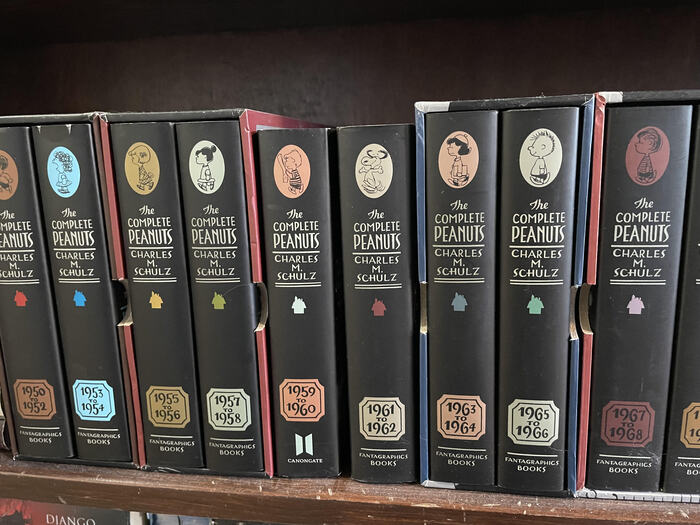
I was confused when I pulled up the Goodreads book page to add this: introduction by Whoopi Goldberg? No! It's by Russell T. Davies, of Doctor Who showrunning fame! I realize now it may be a US versus UK edition issue. I have the rest of the series in the original 2-volume Fantagraphics box sets, but when I was buying this one, scrambling a bit after the fact to catch up as they flew off the shelves before I caught wind of this particular greatness, as I recall I thought to save a bit of dough and purchased 1959-1960 and 1961-1962 separately. This was unwise, not just because the publisher imprint on the spine turned out different, but most because I was then without a slipcase for these two volumes. Seeing them all arranged on a bookshelf, it's a glaring flaw. I suppose I shall have to check the current going price for a matching replacement.
I wouldn't mind reading Whoopi Goldberg's introduction, but my impression of Russell Davies' is that it was the best one yet! As much as the ones before were from notable personages, this was the first that comes evidently from a genuine lifelong fan of the strip.
During these years, Schulz's longer-running topics took hold, those ideas that played out for several weeks interrupted only by Sundays. There are some truly excellent baseball losses, the saga of the Mad Punter, the introduction of Linus' obsession with the Great Pumpkin, and a new character added to the family: Charlie Brown's little sister Sally. For this latter, she was an off-screen topic for weeks before finally appearing on the page. Later, her crush on Linus makes its first appearance, but she hasn't spoken aloud yet.
Each of these volumes is a weighty piece of work and takes much longer to read with any absorption than, for comparison, the For Better of For Worse collections I'm also reading. For the latter, you can get through a year of strips with significant ease, while Peanuts requires more blockish attention to properly absorb, despite that the panels and dialogue are more sparse. There's simply more unspoken context at work that deserves firm attention.
(а ще в коміксах 1959 року лайнус вирішує, що вірить у великого гарбуза, який на геловін встає з грядки і приносить дітлахам подарунки. і, здається, великий гарбуз із нами залишиться надовго, що дуже втішно).
I read these Peanuts books with my two oldest girls (11 and 8) because I have such fond memories of reading them when I was their age. I also think it's good for them to read these books because I want them to develop a sense of humor. I am convinced that a sense of humor, like anything else, is rarely natural but rather must be developed by hearing good story telling, reading intelligent humor and experiencing those who understand and enjoy the art of banter, wit and retortion.
It is interesting to observe the impression Peanuts has made on my oldest girls. One has naturally incorporated the anachronistic "rats" into her vocabulary. They both equate the concept of cool with Snoopy. On a more complex note, while they have been taught by their prudent mother not to use the word "stupid," they can separate reality from a comic enough to understand why its so darn funny when Lucy uses it constantly.
Seinfeld, the Grail and Caddyshack are years away, but thank God for Schulz, the conduit for generations into developing a sense of humor.
Some great pieces in this collection. My favorites include Snoopy being the mad punter and Linus' belief in the Great Pumpkin. Of course, the big moment in this collection is the arrival of Sally Brown. She starts unseen but eventually she is being pushed in a stroller by her big brother. Towards the end of the collection, she has discovered her great love, Linus. I can't wait to start the next Peanut collection.
This entire review has been hidden because of spoilers.
I admit. I am biased having been a fan of Peanuts since first becoming aware of the cartoon strips in the late 60s and it was, arguably, the 60s when they really hit top form. Snoopy is more human than the kids and I had forgotten about his boxing exploits. This volume sees the introduction of Sally Brown who is walking by the end of the book, very much smitten with Linus. Great stuff.
As this is coming to us from the last of the 1950s, it is no surprise that it has a definite feel of being a blast from the past. At the same time, and what is truly surprising, is how similar so much of their concerns feel to today's. Boiled down, their concerns are about the uncertainty of the future, of how events, near or far, will shape their lives. I think that is what makes Peanuts so great.
It's funny when Schulz is clearly pressed for ideas and so there's like 10 consecutive strips where snoopy punts a football and thinks to himself some variation of 'the mad punter strikes again'. But hey, you can't expect someone to be funny 365 times a year. Even at it's weakest, Peanuts still has its incredibly charming art to fall back on.
I think this volume has the first instance of a character lifting their head up and doing the signature peanuts cry.
Continuing my read through the complete Peanuts. This volume features Charlie Brown's little sister Sally's arrival at toddlerhood, Snoopy embarking on his career as the Mad Punter, the non-appearance of the Great Pumpkin, and another series of existential reflections beneath the nightstars.
The first decade of PEANUTS, the most famous comic strip ever created, finishes off with the same ol' cast of Charlie Brown, Snoopy, Lucy & Linus, Schroeder, Violet, Patty, Shermy, and "Pig-Pen," with a brief introduction of a brand new member: SALLY BROWN!
I loved seeing Charlie Brown update everyone on the birth of his little sister, Sally. This was the first time we readers got to actually experience a character right from birth. I look forward to seeing Sally grow up!
All in all, I absolutely LOVED the 50s version of the PEANUTS. And it only gets better from here--the 60s is known to be their best decade!
One complaint, though. With this collection's design, not the comics themselves. These volumes are beautifully designed, and so well-cared-for; such an excellent collection to finally bring together every PEANUTS strip Charles Schulz ever created. BUT--WHY IS IT ALL IN BLACK AND WHITE?!? They chose to print the Sunday comics, not in their original color, but in black and white... how could they call this "THE COMPLETE PEANUTS" and still do that? And now they are publishing 12 volumes of just the Sunday strips IN COLOR... WTF is wrong with you? Ugh.
Just really enjoying these volumes. This is my first encounter with the early Peanuts years. Definitely darker. I can see the influence the strip had on things like the Simpsons. On the surface, it's a cartoon, but the issues and humor are quite sophisticated and adult. Truly ahead of its time.
We see more comical strips on the Peanuts kids as they head into the 1960s, while we see Sally make her debut and see her grow and her unrequited love for Linus, his Great Pumpkin obsession and good ole Charlie Brown’s baseball escapades. A (100%/Outstanding)
Charlie Brown: “Do you ever think much about the future, Linus?” Linus: “Oh, yes... all the time.” Charlie Brown: “What do you think you’d like to be when you grow up?” Linus: “Outrageously happy!”
Peanuts plugging along. This is the period in which Sally was born, with much dramatics from Charlie Brown, Lucy taking the occasion to wish Linus had never been born, and other complications. The baseball team. Snoppy branches out, once as Dracula, and once as "whirlydog." Miss Othmar appears to Linus's delight -- twice (with no explanation how she regained favor). Also, Linus gets a library card, Charlie Brown flies kites (or fails to), and Snoopy's home is threatened with demolition
A lovely collection of the Peanuts comic strips from 1959 to 1960. The introduction by Whoopi Goldberg was interesting.
Even though these comics hail from the 60s, most of the panels shown felt contemporary and at times relatable. Sally is born during this time and seeing her as a baby was adorable.
There’s a good mix of panels from different character POVs, including Snoopy. This was fun to read—I’ll have to try and find the other collections!
A New Bombshell Enters The Villa: Charlie Brown has a baby sister! I can't wait to see her personality develop. I loved how excited he is about her, it really puts Lucy's reaction to her brother's birth a couple volumes ago into perspective.
What is there not to like of Peanuts? I remember endless days when I sat around on my parent's couch reading all kinds of comic books. Snoopy's (as we called it) was one of our favorite and we never tired of reading them. We took it at face value, with no ability as a child to read in between the lines, or label the characters in particular spots. Peanuts worked because they were all different and they all somehow managed to live or survive each other, much like kids did in real life.
Last year for Christmas, my husband's brother Michael sent three of these volumes for our kids, and they have all spent endless hours on the couch reading them. I was the only one who did not get around to it. Recently my husband Malcolm asked us all one morning during breakfast to chose one of the characters with whom each of us identified the most. I had to go back and re-read Peanuts to try and see. Sasha said he was Lucy, Leo said he was pigpen, Berend said he was Snoopy and Malcolm said he was Snoopy too but we vetoed his decision and said he is Schroeder, except instead of the piano, he has a computer. I decided I am Linus. I think we all agreed our personalities match these characters.
I never realized that the Peanuts comics were so conservative. I've read snippets here and there, but had never actually read them at length. I picked up this collection because I found it at the thrift store for $1.89. I wouldn't have splurged on how expensive it is full price to read it.
I can't really say too much bad about it. It's the beloved Peanuts. But there's also nothing I'm dying to rant or rave over. Snoopy's still my favorite, though. He's a great character. Overall, I enjoyed the stories, but didn't find it compelling enough to feel anything more than a 3.5 star rating. I might have even been a little generous. I've always loved the cartoons, so it was weird for me not to love the actual comics.
They were still enjoyable, but nothing I'm dying to read more of.