

What do you think?

The Complete Peanuts #8
The Complete Peanuts, 1965-1966
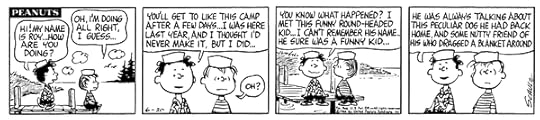
In The Complete Peanuts 1965-66 : We are now in the mid-1960s, one of Schulz's peak periods of creativity (and one third of the way through the strip's life!). Snoopy has become the strip's dominant personality, and this volume marks two milestones for the the first of many "dogfights" with the nefarious Red Baron, and the launch of his writing career ("It was a dark and stormy night..."). Two new characters-the first two from outside the strip's regular little neighborhood-make their bows. Roy (who befriends Charlie Brown and then Linus at summer camp) won't have a lasting impact, but upon his return from camp he regales a friend of his with tales of the strange kids he met, and she has to go check them out for herself. Her name? Peppermint Patty.
The Complete Peanuts 1965-66 features a new introduction by Hal Hartley, writer/director of acclaimed independent films Trust, Henry Fool, Kimono, Simple Men, The Unbelievable Truth , and Fay Grim .
The Complete Peanuts 1965-66 features a new introduction by Hal Hartley, writer/director of acclaimed independent films Trust, Henry Fool, Kimono, Simple Men, The Unbelievable Truth , and Fay Grim .
323 pages, Hardcover
First published September 17, 2007
About the author
Charles M. Schulz
3,040 books1,671 followersCharles Monroe Schulz was an American cartoonist, whose comic strip Peanuts proved one of the most popular and influential in the history of the medium, and is still widely reprinted on a daily basis.
Schulz's first regular cartoons, Li'l Folks, were published from 1947 to 1950 by the St. Paul Pioneer Press; he first used the name Charlie Brown for a character there, although he applied the name in four gags to three different boys and one buried in sand. The series also had a dog that looked much like Snoopy. In 1948, Schulz sold a cartoon to The Saturday Evening Post; the first of 17 single-panel cartoons by Schulz that would be published there. In 1948, Schulz tried to have Li'l Folks syndicated through the Newspaper Enterprise Association. Schulz would have been an independent contractor for the syndicate, unheard of in the 1940s, but the deal fell through. Li'l Folks was dropped from the Pioneer Press in January, 1950.
Later that year, Schulz approached the United Feature Syndicate with his best strips from Li'l Folks, and Peanuts made its first appearance on October 2, 1950. The strip became one of the most popular comic strips of all time. He also had a short-lived sports-oriented comic strip called It's Only a Game (1957–1959), but he abandoned it due to the demands of the successful Peanuts. From 1956 to 1965 he contributed a single-panel strip ("Young Pillars") featuring teenagers to Youth, a publication associated with the Church of God.
Peanuts ran for nearly 50 years, almost without interruption; during the life of the strip, Schulz took only one vacation, a five-week break in late 1997. At its peak, Peanuts appeared in more than 2,600 newspapers in 75 countries. Schulz stated that his routine every morning consisted of eating a jelly donut and sitting down to write the day's strip. After coming up with an idea (which he said could take anywhere from a few minutes to a few hours), he began drawing it, which took about an hour for dailies and three hours for Sunday strips. He stubbornly refused to hire an inker or letterer, saying that "it would be equivalent to a golfer hiring a man to make his putts for him." In November 1999 Schulz suffered a stroke, and later it was discovered that he had colon cancer that had metastasized. Because of the chemotherapy and the fact he could not read or see clearly, he announced his retirement on December 14, 1999.
Schulz often touched on religious themes in his work, including the classic television cartoon, A Charlie Brown Christmas (1965), which features the character Linus van Pelt quoting the King James Version of the Bible Luke 2:8-14 to explain "what Christmas is all about." In personal interviews Schulz mentioned that Linus represented his spiritual side. Schulz, reared in the Lutheran faith, had been active in the Church of God as a young adult and then later taught Sunday school at a United Methodist Church. In the 1960s, Robert L. Short interpreted certain themes and conversations in Peanuts as being consistent with parts of Christian theology, and used them as illustrations during his lectures about the gospel, as he explained in his bestselling paperback book, The Gospel According to Peanuts, the first of several books he wrote on religion and Peanuts, and other popular culture items. From the late 1980s, however, Schulz described himself in interviews as a "secular humanist": “I do not go to church anymore... I guess you might say I've come around to secular humanism, an obligation I believe all humans have to others and the world we live in.”
Schulz's first regular cartoons, Li'l Folks, were published from 1947 to 1950 by the St. Paul Pioneer Press; he first used the name Charlie Brown for a character there, although he applied the name in four gags to three different boys and one buried in sand. The series also had a dog that looked much like Snoopy. In 1948, Schulz sold a cartoon to The Saturday Evening Post; the first of 17 single-panel cartoons by Schulz that would be published there. In 1948, Schulz tried to have Li'l Folks syndicated through the Newspaper Enterprise Association. Schulz would have been an independent contractor for the syndicate, unheard of in the 1940s, but the deal fell through. Li'l Folks was dropped from the Pioneer Press in January, 1950.
Later that year, Schulz approached the United Feature Syndicate with his best strips from Li'l Folks, and Peanuts made its first appearance on October 2, 1950. The strip became one of the most popular comic strips of all time. He also had a short-lived sports-oriented comic strip called It's Only a Game (1957–1959), but he abandoned it due to the demands of the successful Peanuts. From 1956 to 1965 he contributed a single-panel strip ("Young Pillars") featuring teenagers to Youth, a publication associated with the Church of God.
Peanuts ran for nearly 50 years, almost without interruption; during the life of the strip, Schulz took only one vacation, a five-week break in late 1997. At its peak, Peanuts appeared in more than 2,600 newspapers in 75 countries. Schulz stated that his routine every morning consisted of eating a jelly donut and sitting down to write the day's strip. After coming up with an idea (which he said could take anywhere from a few minutes to a few hours), he began drawing it, which took about an hour for dailies and three hours for Sunday strips. He stubbornly refused to hire an inker or letterer, saying that "it would be equivalent to a golfer hiring a man to make his putts for him." In November 1999 Schulz suffered a stroke, and later it was discovered that he had colon cancer that had metastasized. Because of the chemotherapy and the fact he could not read or see clearly, he announced his retirement on December 14, 1999.
Schulz often touched on religious themes in his work, including the classic television cartoon, A Charlie Brown Christmas (1965), which features the character Linus van Pelt quoting the King James Version of the Bible Luke 2:8-14 to explain "what Christmas is all about." In personal interviews Schulz mentioned that Linus represented his spiritual side. Schulz, reared in the Lutheran faith, had been active in the Church of God as a young adult and then later taught Sunday school at a United Methodist Church. In the 1960s, Robert L. Short interpreted certain themes and conversations in Peanuts as being consistent with parts of Christian theology, and used them as illustrations during his lectures about the gospel, as he explained in his bestselling paperback book, The Gospel According to Peanuts, the first of several books he wrote on religion and Peanuts, and other popular culture items. From the late 1980s, however, Schulz described himself in interviews as a "secular humanist": “I do not go to church anymore... I guess you might say I've come around to secular humanism, an obligation I believe all humans have to others and the world we live in.”
Ratings & Reviews
Friends & Following
Create a free account to discover what your friends think of this book!
Community Reviews
Displaying 1 - 30 of 109 reviews

January 8, 2020
1965 is probably the year that Peanuts took its place in the cultural pantheon, especially with the surprising success of A Charlie Brown Christmas that December. I admit that I didn't start at the beginning like I did with Calvin & Hobbes, just because the sheer amount of material in the Peanuts canon makes it daunting.
That said, this is a good place to start. The main cast - Charlie Brown, Lucy, Linus, Sally, Schroeder, and Snoopy - have pretty much settled into their consistent forms. Peppermint Patty has been introduced, although she lives at the other end of town from the others, which might as well be the other side of the globe from their perspective. In the next few years, Franklin and Marcie will join.
Charles Schulz' outlook on life, as portrayed in this strip, was a unique perspective in pop culture. He takes all the touchstones of a nostalgic idyll - kids playing baseball, going to camp, staging a Christmas pageant - but approaches them in the most pessimistic way possible. Obviously Charlie Brown suffers most, but all the kids endure frustration and failure. They deal with their problems with a weird mix of adult cynicism, adolescent awkwardness, childish irresponsibility...and childlike perseverance and hope. They shout "AAAAUUUUGGGHHHH" to the heavens and storm away from their problems, but none of them ever gives up entirely. It's a mature, balanced worldview that I wish was more common.
There are a lot of other endearing qualities in this comic, but one that stands out for me is how simple and low-key the whole thing is. Schulz is one of those great American creators of the twentieth century - up there with Walt Disney, Dr. Seuss, Gene Rodenberry, Jim Henson, Steven Spielberg, and George Lucas. They all came up with characters and stories that took an indelible place in the world's imagination. But while the others on the list concocted bombastic, colorful characters and places, Schulz's cast and plots were deliberately mundane. It's just a bunch of elementary-school kids hanging out in their Anytown, USA neighborhood. Granted, there's a beagle who likes to don a WWI pilot helmet, and the kite-eating tree and Linus' blanket may be sentient sometimes, but that's as magical or exciting as anything gets around here.
And, in an era where every film, book, and TV show is in a fierce competition to see which can be the most explosive, shocking, and heartbreaking, Peanuts is balm for the soul.
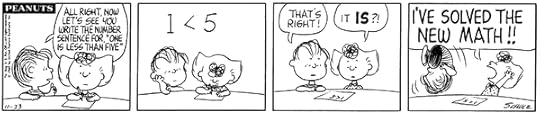
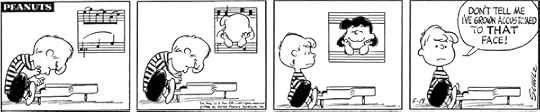
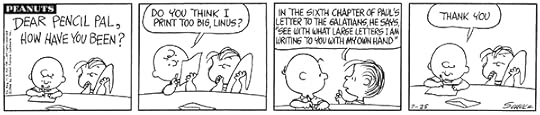
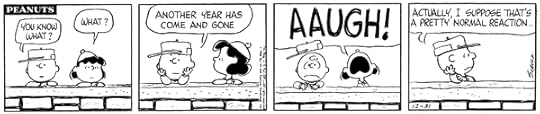
There's really not much more I can add to that, so here are some of my favorites from this particular tome:

November 23, 2017
Fun to read :)

December 24, 2023
This collects Peanuts strips from 1965 and 1966. This is at or near the strip's prime. I hesitate to say Prime because Marcie hasn't been introduced yet but it contains the first Snoopy as a WWI ace, first Peppermint Pattie, and last appearance of Violet before her parents join the Cult of Cthulhu. I may have made that last one up.
Linus, Lucy, and Sally get a lot of time. Sally wears an eyepatch for a good portion of the book. She is just starting to see Linus as her future husband but isn't calling him her Sweet Babboo yet. Lucy is Lucy and Linus is still spreading the gospel of the Great Pumpkin. Charlie Brown is still a loser but has more agency than he does in later books.
I'd say this would be a great read for anyone who wants a look at the Peanuts before they started selling insurance. 4 out of 5 stars.
Linus, Lucy, and Sally get a lot of time. Sally wears an eyepatch for a good portion of the book. She is just starting to see Linus as her future husband but isn't calling him her Sweet Babboo yet. Lucy is Lucy and Linus is still spreading the gospel of the Great Pumpkin. Charlie Brown is still a loser but has more agency than he does in later books.
I'd say this would be a great read for anyone who wants a look at the Peanuts before they started selling insurance. 4 out of 5 stars.

February 26, 2010
(Reprinted from the Chicago Center for Literature and Photography [cclapcenter.com:]. I am the original author of this essay, as well as the owner of CCLaP; it is not being reprinted illegally.)
I recently received a hundred-dollar gift certificate to Borders from my brother and sister-in-law for Christmas; but that ironically created a problem for me, in that I've thoroughly trained myself over the last three years to think of books only in terms of library rentals, making it difficult to picture what kinds of books I might want to actually own permanently. So I bought a hundred bucks in comics! J-sus Chr-st, I suck! And one of these purchases was a volume in Fantagraphics' new hardcover reissuing of all 18,000 Peanuts strips that Charles Schulz ever wrote, each massive over-designed tome covering two years in the strip's history; the one I picked up covers the 730 strips published in 1965 and '66, a seminal time for Peanuts that cemented the strip's lasting popularity for good. See, it seems anymore that less and less people understand this, but it was during the '60s that Schulz first started infusing his deceptively simple strip with all kinds of heady Modernist references to theology, philosophy, the "New Math" and more, turning it from the simple children's diversion it used to be into a suddenly hip Silver Age cultural touchstone; and this of course was before the '70s, when Schulz first started running out of ideas, deciding to devote the strip more and more to being the unchanging daily core of a TV-friendly merchandising empire.
So on the one hand, the book is a real treat, a reminder of the exquisite minimalist humor that Schulz was so perfect at when he was at his creative height, during the exact period of work I myself was raised on (mostly through an endless series of cheap tattered paperbacks bought for a dime at garage sales) that so heavily influenced my own sense of humor; but on the other hand, I'm also kind of disgusted at myself for buying a $40 over-designed hardback doorstop full of freaking comic strips, and acknowledge that that now officially makes me one of those academically trained stuffy white males who are as we speak sucking away what little fun still remains in the world of comics, just like stuffy academic white males ruined jazz, and ruined baseball, and ruined the blues. (In fact, if you want a good look at all the formerly fun things that stuffy academic white males have ruined over the years, simply make a list of all the documentaries Ken Burns has ever made.) As nice as it's been to sit and re-read all these classic strips from the series' height, it's hard to look at all those artsy detail blowups and that dark-on-dark design scheme and not think, "You know, I've now officially become one of those creative-class douchebags who everyone complains about, and there's a part of me who hates myself for it." Good grief.
Out of 10: 9.0...no, wait, I mean 6.2...no, wait, I don't know what I mean
I recently received a hundred-dollar gift certificate to Borders from my brother and sister-in-law for Christmas; but that ironically created a problem for me, in that I've thoroughly trained myself over the last three years to think of books only in terms of library rentals, making it difficult to picture what kinds of books I might want to actually own permanently. So I bought a hundred bucks in comics! J-sus Chr-st, I suck! And one of these purchases was a volume in Fantagraphics' new hardcover reissuing of all 18,000 Peanuts strips that Charles Schulz ever wrote, each massive over-designed tome covering two years in the strip's history; the one I picked up covers the 730 strips published in 1965 and '66, a seminal time for Peanuts that cemented the strip's lasting popularity for good. See, it seems anymore that less and less people understand this, but it was during the '60s that Schulz first started infusing his deceptively simple strip with all kinds of heady Modernist references to theology, philosophy, the "New Math" and more, turning it from the simple children's diversion it used to be into a suddenly hip Silver Age cultural touchstone; and this of course was before the '70s, when Schulz first started running out of ideas, deciding to devote the strip more and more to being the unchanging daily core of a TV-friendly merchandising empire.
So on the one hand, the book is a real treat, a reminder of the exquisite minimalist humor that Schulz was so perfect at when he was at his creative height, during the exact period of work I myself was raised on (mostly through an endless series of cheap tattered paperbacks bought for a dime at garage sales) that so heavily influenced my own sense of humor; but on the other hand, I'm also kind of disgusted at myself for buying a $40 over-designed hardback doorstop full of freaking comic strips, and acknowledge that that now officially makes me one of those academically trained stuffy white males who are as we speak sucking away what little fun still remains in the world of comics, just like stuffy academic white males ruined jazz, and ruined baseball, and ruined the blues. (In fact, if you want a good look at all the formerly fun things that stuffy academic white males have ruined over the years, simply make a list of all the documentaries Ken Burns has ever made.) As nice as it's been to sit and re-read all these classic strips from the series' height, it's hard to look at all those artsy detail blowups and that dark-on-dark design scheme and not think, "You know, I've now officially become one of those creative-class douchebags who everyone complains about, and there's a part of me who hates myself for it." Good grief.
Out of 10: 9.0...no, wait, I mean 6.2...no, wait, I don't know what I mean

January 10, 2021
It's great to go back and read more Peanuts comics as we see Snoopy find and lose his first love, him doing his signature happy dance and see the debut of Peppermint Patty who loves to call Charlie Brown "Chuck". A (100%/Outstanding)

April 28, 2026
Peppermint Patty shows up. An adult isn't shown but speaks. Snoopy branches out into Piracy and the Foreign Legion. More Henry James is cited than you would expect. The phrase "Featuring 'Good Ol' Charlie Brown' sneaks into the Sunday title card. I took shots of at least 45 different panels for later posting and sharing. All together, another classic volume.

August 25, 2007
The one, the only. This volume of the Fantagraphics releases has a lot of dailies and Sundays that will probably be among series fans' favorites (some of mine: "Sydney or the Bush"; Snoopy gains weight trying to forget his latest beautiful beagle girlfriend; Sally has to wear an eye patch; Charlie Brown goes to summer camp).
It's hard to overstate Schulz's genius in Peanuts, at least up until the 1960s. Unlike a lot of latter-day strips, which are composed basically of broad gags, not characters (cough Dilbert cough; cough Garfield cough), Schulz's comics have a subtlety to them, and the characters come to be real people who we know and like (at least in most cases -- I'm not so sure I like Violet). Most of the comics in this collection are either laugh-out-loud funny, touching, visually hilarious, or all three together.
It's hard to overstate Schulz's genius in Peanuts, at least up until the 1960s. Unlike a lot of latter-day strips, which are composed basically of broad gags, not characters (cough Dilbert cough; cough Garfield cough), Schulz's comics have a subtlety to them, and the characters come to be real people who we know and like (at least in most cases -- I'm not so sure I like Violet). Most of the comics in this collection are either laugh-out-loud funny, touching, visually hilarious, or all three together.

December 28, 2019
My annual tradition of ending the year with a book from the Complete Peanuts collection continued with another great one. In this edition Snoopy has his first battle with the Red Baron, Woodstock is born (on Snoopy's stomach!), and we are introduced to Peppermint Patty.
I found a place online (https://en.wikibooks.org/wiki/Annotat...) that has annotations for each of these books. This was really helpful, as otherwise I would have missed the references to the Avis Rent-a-Car and Hathaway shirt commercials.
Also, this was the book where I realized I married Lucy Van Pelt.
I found a place online (https://en.wikibooks.org/wiki/Annotat...) that has annotations for each of these books. This was really helpful, as otherwise I would have missed the references to the Avis Rent-a-Car and Hathaway shirt commercials.
Also, this was the book where I realized I married Lucy Van Pelt.
July 10, 2025
Ahhh, time spent with good ol' Charlie Brown and the gang is good for what ails ya. 💛

September 27, 2024
What innovations did Charles Schulz introduce into his Peanuts comic strip after a decade and a half? A couple big ones are showcased in The Complete Peanuts, Vol. 8: 1965-1966. January 6, 1965 (page three) is a normal confrontation between Frieda and Snoopy, but Snoopy makes an interesting point. He may be only a lazy beagle to her, but his place in Peanuts canon is legendary. January 10 (page five) glimpses Linus's personal evolution. He's no longer a toddler raging against big sister Lucy; he uses gentle words to dissuade her from destroying his snowman. February 12 (page nineteen), as Snoopy copes with losing his chance with the girl beagle he loves, he gorges on food to block his feelings. He asks what you get from life's pain, and answers himself: "A few memories and a fat stomach." In our darkest days, isn't that exactly how life seems? February 15 (page twenty-one), Linus and Lucy observe a bug on the ground. Lucy scorns its ignorance of the world's ills, but Linus asks, "Who's better off?" Perhaps higher intelligence is a curse. February 21 (page twenty-three) is a verbatim Lucy reaction from the It's the Great Pumpkin, Charlie Brown to Snoopy kissing her. Classic.
April 13 (page forty-five) is a nice moment, Lucy worrying about a worldwide flood and Linus quelling her anxiety by quoting the Bible. It makes a fond point regarding doctrine. April 24 (page forty-nine), Lucy rails against Linus as willing to settle for average. His rebuttal is interesting; maybe it's people who "settle" for average who do the societal heavy lifting that dreamers cannot. We skip most of summer to August 29 (page one hundred four), where Linus uses his wit and insight to show Lucy he must be a prophet. This strip is funny because adults really respond this way when asked the question Linus poses. September 12 (page one hundred ten), Charlie Brown agonizes in class for the bell to ring and bail him out from not finishing his homework. He silently bemoans why these things always happen to him...but when he gets a lucky break, his reaction after school reveals why these things "always" happen to some people. October 10 (page one hundred twenty-two) is a seminal moment for Peanuts: Snoopy's first appearance as the World War I flying ace. The storyline dominates much of what's left in this book.
We get a classic line from the Halloween television special October 26 (page one hundred twenty-nine), and a purely funny episode November 17 (page one hundred thirty-eight), showing Linus's reaction to a hidden Snoopy snoring up in a tree. November 27 (page one hundred forty-two) is comedy-philosophy, Charlie Brown speaking to Linus as they buy movie tickets. The humdrum of doing this every Saturday adds to Charlie Brown's sense that his life is whipping by. It's played for comedy yet makes a thoughtful point. December 21 (page one hundred fifty-three), Snoopy skates alone at the ice rink where he met the girl beagle who broke his heart. He yearns to obliterate the memories, but of course forgetting is impossible. January 10, 1966 (page one hundred sixty-two), Snoopy lazes atop his doghouse musing on his lack of direction in life, and asks an astute question: "What am I doing right?" Most would ask the opposite, but Snoopy is mildly pleased to have no ambition yet feel contented. I like the subtle sentiment of March 22 (page one hundred ninety-two) as Charlie Brown and Shermy eat lunch at school. Charlie Brown says a peanut butter sandwich is just the right one to be eating as you realize you wouldn't have gathered the courage anyway to talk to the girl you love who's sitting just across the way. I hear you, Charlie Brown.
Snoopy's World War I flying ace playacting has grown more elaborate by April 12 (page two hundred one), and Charlie Brown decries his own lack of a normal pet dog. But how many canine owners are lucky enough to have Snoopy? If you're ever tempted to wish an oddball loved one were normal, remember what a privilege it can be that they're in your camp. Amidst a storyline that sees Linus and Lucy move away from town with their parents, we get a genuine reaction from Schroeder on May 16 (page two hundred sixteen) to Lucy's leaving, and another May 18. The subtlety renders it all the stronger. Lighter fare lifts the mood May 26 (page two hundred twenty) as Lucy and Frieda try to raise Charlie Brown's spirits on the pitcher's mound...but their unintentionally hilarious antics do the opposite. July 26 (page two hundred forty-six) seems to have provided fodder for the 1972 Snoopy Come Home special. NO DOGS ALLOWED ON THIS BEACH! is a running gag from it.
August 22 (page two hundred fifty-eight) is a big day: the introduction of "Peppermint" Patty. Her baseball prowess takes centerstage already. August 24, she rings Charlie Brown on the phone and calls him "Chuck" for the first time! October 7 (page two hundred seventy-seven) is a comforting gag for the fall season, Linus remarking how soothing it is to have warm socks straight out of the clothes dryer. It is a pleasure as the first cold snap lays in. October 8 is an effective play on the necessity for visual representation of action sounds in a comic strip. It's a sly, funny bit. December 22 (page three hundred ten), Sally, perplexed by stories of her grandmother's stocking stuffed with fancy fruit on Christmases of yore, grabs a sock from her own drawer and laments the pitiful amount Santa could shove in there. The book concludes with Christmas and the easygoing days after, before parting ways prior to January 1, 1967.
To me, 1965 and '66 in Peanuts fell below the usual standard. There were fewer laugh-out-loud moments, ingenious sight gags, and stories that caused me to deeply ponder. A lot of the strips focused on Snoopy as World War I flying ace; most of these weren't very funny, and because the action takes place in Snoopy's imagination, the stakes are low. Some fans love the World War I flying ace motif, and others don't. I fall into the latter camp. Still, I rate this eighth volume of The Complete Peanuts two and a half stars and it wouldn't have taken much for me to round that upward. Spending time with the gang on page or screen is one of my favorite parts of the holiday season; I'll never not have fun with a Peanuts book across my lap.
April 13 (page forty-five) is a nice moment, Lucy worrying about a worldwide flood and Linus quelling her anxiety by quoting the Bible. It makes a fond point regarding doctrine. April 24 (page forty-nine), Lucy rails against Linus as willing to settle for average. His rebuttal is interesting; maybe it's people who "settle" for average who do the societal heavy lifting that dreamers cannot. We skip most of summer to August 29 (page one hundred four), where Linus uses his wit and insight to show Lucy he must be a prophet. This strip is funny because adults really respond this way when asked the question Linus poses. September 12 (page one hundred ten), Charlie Brown agonizes in class for the bell to ring and bail him out from not finishing his homework. He silently bemoans why these things always happen to him...but when he gets a lucky break, his reaction after school reveals why these things "always" happen to some people. October 10 (page one hundred twenty-two) is a seminal moment for Peanuts: Snoopy's first appearance as the World War I flying ace. The storyline dominates much of what's left in this book.
We get a classic line from the Halloween television special October 26 (page one hundred twenty-nine), and a purely funny episode November 17 (page one hundred thirty-eight), showing Linus's reaction to a hidden Snoopy snoring up in a tree. November 27 (page one hundred forty-two) is comedy-philosophy, Charlie Brown speaking to Linus as they buy movie tickets. The humdrum of doing this every Saturday adds to Charlie Brown's sense that his life is whipping by. It's played for comedy yet makes a thoughtful point. December 21 (page one hundred fifty-three), Snoopy skates alone at the ice rink where he met the girl beagle who broke his heart. He yearns to obliterate the memories, but of course forgetting is impossible. January 10, 1966 (page one hundred sixty-two), Snoopy lazes atop his doghouse musing on his lack of direction in life, and asks an astute question: "What am I doing right?" Most would ask the opposite, but Snoopy is mildly pleased to have no ambition yet feel contented. I like the subtle sentiment of March 22 (page one hundred ninety-two) as Charlie Brown and Shermy eat lunch at school. Charlie Brown says a peanut butter sandwich is just the right one to be eating as you realize you wouldn't have gathered the courage anyway to talk to the girl you love who's sitting just across the way. I hear you, Charlie Brown.
Snoopy's World War I flying ace playacting has grown more elaborate by April 12 (page two hundred one), and Charlie Brown decries his own lack of a normal pet dog. But how many canine owners are lucky enough to have Snoopy? If you're ever tempted to wish an oddball loved one were normal, remember what a privilege it can be that they're in your camp. Amidst a storyline that sees Linus and Lucy move away from town with their parents, we get a genuine reaction from Schroeder on May 16 (page two hundred sixteen) to Lucy's leaving, and another May 18. The subtlety renders it all the stronger. Lighter fare lifts the mood May 26 (page two hundred twenty) as Lucy and Frieda try to raise Charlie Brown's spirits on the pitcher's mound...but their unintentionally hilarious antics do the opposite. July 26 (page two hundred forty-six) seems to have provided fodder for the 1972 Snoopy Come Home special. NO DOGS ALLOWED ON THIS BEACH! is a running gag from it.
August 22 (page two hundred fifty-eight) is a big day: the introduction of "Peppermint" Patty. Her baseball prowess takes centerstage already. August 24, she rings Charlie Brown on the phone and calls him "Chuck" for the first time! October 7 (page two hundred seventy-seven) is a comforting gag for the fall season, Linus remarking how soothing it is to have warm socks straight out of the clothes dryer. It is a pleasure as the first cold snap lays in. October 8 is an effective play on the necessity for visual representation of action sounds in a comic strip. It's a sly, funny bit. December 22 (page three hundred ten), Sally, perplexed by stories of her grandmother's stocking stuffed with fancy fruit on Christmases of yore, grabs a sock from her own drawer and laments the pitiful amount Santa could shove in there. The book concludes with Christmas and the easygoing days after, before parting ways prior to January 1, 1967.
To me, 1965 and '66 in Peanuts fell below the usual standard. There were fewer laugh-out-loud moments, ingenious sight gags, and stories that caused me to deeply ponder. A lot of the strips focused on Snoopy as World War I flying ace; most of these weren't very funny, and because the action takes place in Snoopy's imagination, the stakes are low. Some fans love the World War I flying ace motif, and others don't. I fall into the latter camp. Still, I rate this eighth volume of The Complete Peanuts two and a half stars and it wouldn't have taken much for me to round that upward. Spending time with the gang on page or screen is one of my favorite parts of the holiday season; I'll never not have fun with a Peanuts book across my lap.

January 31, 2022
The newest collection of Peanuts I read has classic moments. This is the first mention of Snoopys World War 1 flying ace. He has begun his never-ending battle with the Red Baron. There was also a great romance between Snoopy and a female beagle he met while ice skating.
The rest of the gang are wonderful, as always, especially Lucy. In this collection, she and Linus move away when their father is transferred to another city. Both Sally and Schroeder react to their absence.
Sally had to handle wearing an eye patch because of a weak eye.
In August of 1966, Peppermint Patty makes her debut.
Of course, the great tragedy is that Snoppy's dog house burns down.
I am continuing on my journey through the Peanuts collections.
The rest of the gang are wonderful, as always, especially Lucy. In this collection, she and Linus move away when their father is transferred to another city. Both Sally and Schroeder react to their absence.
Sally had to handle wearing an eye patch because of a weak eye.
In August of 1966, Peppermint Patty makes her debut.
Of course, the great tragedy is that Snoppy's dog house burns down.
I am continuing on my journey through the Peanuts collections.
December 14, 2016
Here we are getting into classic Peanuts territory.
This book has Snoopy's first dogfight against The Red Baron, the first appearance of Peppermint Patty, and so on. Charlie Brown goes to camp, then Linus goes the next year. Charlie Brown gets hit by a car. Sally Brown versus amblyopia. Snoopy's doghouse burns down and he loses his Van Gogh.
Linus lights a candle, and Lucy curses the darkness.
This book has Snoopy's first dogfight against The Red Baron, the first appearance of Peppermint Patty, and so on. Charlie Brown goes to camp, then Linus goes the next year. Charlie Brown gets hit by a car. Sally Brown versus amblyopia. Snoopy's doghouse burns down and he loses his Van Gogh.
Linus lights a candle, and Lucy curses the darkness.

January 2, 2008
Ok! So it's just comic strips. But outside of comics aficionados, Peanuts is criminally under appreciated. This particular batch has a bunch of sequences that were far more surreal than I recalled: Lucy makes a slideshow of Charlie Brown's faults, Lucy enters Linus and his blanket as a science fair exhibit, Linus paints a mural inside Snoopy's doghouse. It's funny stuff!

December 24, 2013
My favorite of the first eight volumes. The introduction of Snoopy's Red Baron obsession and Peppermint Patty helped give the strip its modern identity.

June 12, 2021
Charlie Brown: "You know what?"
Shermy: "What?"
Charlie Brown: "A peanut butter sandwich is just the sandwich to be eating when you're looking across the playground at a little red-haired girl you admire, but you know you haven't a chance of ever meeting..."
Shermy: "Why is that?"
Charlie Brown: "If you have to ask, you'll never understand!"
Shermy: "What?"
Charlie Brown: "A peanut butter sandwich is just the sandwich to be eating when you're looking across the playground at a little red-haired girl you admire, but you know you haven't a chance of ever meeting..."
Shermy: "Why is that?"
Charlie Brown: "If you have to ask, you'll never understand!"

May 1, 2022
Peanuts, always good for a laugh and to make one feel good 👍

March 10, 2019
Peanuts rolling along. Charlie Brown goes to camp for the first time; later, so does Linus. Snoopy becomes a WWI flying ace -- and "A dark and stormy night" makes its first appearance, for a sequence of about a week, after which he, having dragged his typewriter to the doghouse in the opening, gets rid of it. Peppermint Patty is introduced taking over the baseball team. Linus evades his blanket-hating grandmother by mailing his blanket to himself, and it goes wrong.
Read
April 19, 2026read in 2023
LUCY JUST LET CHARLIE BROWN KICK THE FOOTBALL
LUCY JUST LET CHARLIE BROWN KICK THE FOOTBALL


May 30, 2019
The cover of this volume features Charlie Brown, but it's clear that these were the character's last years as the main protagonist of the comic strip. In these years Snoopy became more and more prominent, and by 1968 the imaginative pup had taken over the comic strip as its leading character. Snoopy clearly goes beyond being a dog in this volume: he skates at a pond and falls in love with a girl beagle (January '65), he writes and even publishes short stories (July '65), he surfs (August '65), and most importantly, he imagines himself as a First World War ace pilot for the first time, with his house figuring as a 'Sopwith Camel' (10 October '65). This idea leads to many story panels, especially Sunday pages devoted to Snoopy's vivid imagination.
Charlie Brown suffers the usual frustrations with homework, at baseball, and with his secret love for the little red-haired girl. His best story is when he enters a spelling bee (this idea from February '66 would be expanded in the first Peanuts feature film, 'A Boy Named Charlie Brown').
Sally, too, has some fine moments, trying to grasp the new math (October '65) and having to wear an eye patch to fight a lazy eye (November '65). Apart from the regular gang, quite some new characters are introduced in these years: Charlie Brown meets Roy at Summer camp (June '65), who meets Linus the following year. Roy in turn introduces Peppermint Patty to the gang (August '66), and she immediately shows to be a character to stay. Meanwhile, March '66 sees an embryonic version of Woodstock.
Charlie Brown's mishaps are less moving than in earlier volumes, but Schulz is still in top form. His only mistakes are the misguided gags on Linus' blanket being alive (March '65), and a gag appearing twice (January 24 & December 20, 1966).
Charlie Brown suffers the usual frustrations with homework, at baseball, and with his secret love for the little red-haired girl. His best story is when he enters a spelling bee (this idea from February '66 would be expanded in the first Peanuts feature film, 'A Boy Named Charlie Brown').
Sally, too, has some fine moments, trying to grasp the new math (October '65) and having to wear an eye patch to fight a lazy eye (November '65). Apart from the regular gang, quite some new characters are introduced in these years: Charlie Brown meets Roy at Summer camp (June '65), who meets Linus the following year. Roy in turn introduces Peppermint Patty to the gang (August '66), and she immediately shows to be a character to stay. Meanwhile, March '66 sees an embryonic version of Woodstock.
Charlie Brown's mishaps are less moving than in earlier volumes, but Schulz is still in top form. His only mistakes are the misguided gags on Linus' blanket being alive (March '65), and a gag appearing twice (January 24 & December 20, 1966).

June 2, 2015
15 years into PEANUTS, and the cast has grown considerably! The usual gang is here: Charlie Brown, Snoopy, Lucy & Linus van Pelt, Schroeder, Sally Brown, Patty, Violet, Shermy, Frieda, "Pig-Pen," even 5 shows up every now and again. Then Charlie Brown & Linus meet a kid at camp named Roy, and through him they are introduced to... "Peppermint" Patty! Yup, that's right, one of the most well-known PEANUTS characters took 15 years to join the gang.
Another character took a bit longer: Woodstock. Woodstock--or at least a bird that looks and acts a lot like Woodstock--is born in this volume, and Snoopy takes care of him, but it won't be until the beginning of the '70s that he is actually given the name "Woodstock."
This is a great volume. We are treated to a lot more story arcs instead of single-strip gags. Lucy and Linus move away, and Linus gives Charlie Brown his blanket in a touching arc where we learn Sally and Schroeder's true feelings regarding the van Pelts. It's also interesting to see Schulz incorporate technology into the strip, having the kids listen to hand-held radios and use electric toothbrushes.
What makes this volume a rare collector's item is the introduction of Peppermint Patty. But what makes it special to me is Snoopy's very first use of a typewriter ("It was a dark and stormy night!") and his first obsessions with the Red Baron ("Here's the World War I Flying Ace...").
1965 also marks the year of PEANUTS's first foray into film, with the special "A Charlie Brown Christmas." During my reading of this volume, I watched that and the two specials that aired in 1966, "Charlie Brown's All-Stars" and "It's the Great Pumpkin, Charlie Brown."
Another character took a bit longer: Woodstock. Woodstock--or at least a bird that looks and acts a lot like Woodstock--is born in this volume, and Snoopy takes care of him, but it won't be until the beginning of the '70s that he is actually given the name "Woodstock."
This is a great volume. We are treated to a lot more story arcs instead of single-strip gags. Lucy and Linus move away, and Linus gives Charlie Brown his blanket in a touching arc where we learn Sally and Schroeder's true feelings regarding the van Pelts. It's also interesting to see Schulz incorporate technology into the strip, having the kids listen to hand-held radios and use electric toothbrushes.
What makes this volume a rare collector's item is the introduction of Peppermint Patty. But what makes it special to me is Snoopy's very first use of a typewriter ("It was a dark and stormy night!") and his first obsessions with the Red Baron ("Here's the World War I Flying Ace...").
1965 also marks the year of PEANUTS's first foray into film, with the special "A Charlie Brown Christmas." During my reading of this volume, I watched that and the two specials that aired in 1966, "Charlie Brown's All-Stars" and "It's the Great Pumpkin, Charlie Brown."

April 6, 2018
4 stars because this collection has a LOT of Red Baron and Baseball plot lines, which aren't my favorite. I will never get tired of the Linus as Child Prodigy schtick. Lucy's spitfire confidence especially shines in these strips, which is a joy.
P L U S the end of this collection introduces "Peppermint" Patty (gotta respect Schulz's peculiar use of quotation marks), which is a Peanuts game changer and also just a joy unto the world. In one of my favorite Peanuts strips of all time, "Peppermint" Patty sits waiting for the Great Pumpkin, reflecting on superstition and beliefs. In the last frame, she leans against a pumpkin and says, "Let's face it... I'm also a little bit stupid." That's what I come to Peanuts for: this masterful juxtaposition of childhood innocence and deep, sometimes dark introspection.
Will I continue my secret goal to read every Peanuts strip this year? Seems likely!
P L U S the end of this collection introduces "Peppermint" Patty (gotta respect Schulz's peculiar use of quotation marks), which is a Peanuts game changer and also just a joy unto the world. In one of my favorite Peanuts strips of all time, "Peppermint" Patty sits waiting for the Great Pumpkin, reflecting on superstition and beliefs. In the last frame, she leans against a pumpkin and says, "Let's face it... I'm also a little bit stupid." That's what I come to Peanuts for: this masterful juxtaposition of childhood innocence and deep, sometimes dark introspection.
Will I continue my secret goal to read every Peanuts strip this year? Seems likely!

October 4, 2016
It's funny how as you get older you start identifying with different characters and for different reasons. I would love to sit down someday and see which character I am most like and who most people see me as.

October 26, 2022
It's at this point in time -- about 15 years after Charles Schulz first began his comic strip about "that round-headed kid" -- that he begins to get a little more crazy with things. Snoopy climbs into his Sopwith Camel to do battle with the Red Baron, Linus' annual patch-sitting to wait for the Great Pumpkin, and December 16th is finally made a famous date to the masses. (Shame on you if you don't know why. )
It was about this time in my life that Peanuts became part of my life. December 9, 1965, was the premiere of A Charlie Brown Christmas, which was recreated in part in the December 18, 1966, Sunday strip (Linus reading from Luke 2:8, the verse quoted in the TV version). From here through his death on February 12, 2000 -- two days before the vast majority of modern cartoonists drew Sunday/Valentine's Day love notes to him -- Schulz and his legendary cast of cartoon kids were part and parcel of my life and the lives of many millions worldwide. This book is like a re connection to those days of my now remote youth. Feels good. Gonna get cereal and watch Saturday morning cartoons.
It was about this time in my life that Peanuts became part of my life. December 9, 1965, was the premiere of A Charlie Brown Christmas, which was recreated in part in the December 18, 1966, Sunday strip (Linus reading from Luke 2:8, the verse quoted in the TV version). From here through his death on February 12, 2000 -- two days before the vast majority of modern cartoonists drew Sunday/Valentine's Day love notes to him -- Schulz and his legendary cast of cartoon kids were part and parcel of my life and the lives of many millions worldwide. This book is like a re connection to those days of my now remote youth. Feels good. Gonna get cereal and watch Saturday morning cartoons.
July 24, 2026
More like 4.5 stars. Great plotlines include Charlie Brown on safety patrol, Linus's blanket coming alive and attacking Lucy, and Snoopy's house burning down. I love that the joke of Snoopy having a Van Gogh just carries on (and that he acquires an Andrew Wyeth for the new home).
What's startling is to see similarities with Calvin and Hobbes. The living blanket plot especially but Linus building a snowman army and multiple snowball strips seem to have influenced Watterson 25 years later.
There's something really amazing about the lunch notes that Linus gets from his mother. The one where she says "I suppose in many ways our generation has failed yours, but we did try...Please judge us with mercy." It's a universal plea of the adult to the child. So incredible that Schulz is writing that in 1966 and it's relevant 60 years later. (Also "study hard...but do not neglect your peer-group rating" is something I need to start saying to my kids every morning before school.)
What's startling is to see similarities with Calvin and Hobbes. The living blanket plot especially but Linus building a snowman army and multiple snowball strips seem to have influenced Watterson 25 years later.
There's something really amazing about the lunch notes that Linus gets from his mother. The one where she says "I suppose in many ways our generation has failed yours, but we did try...Please judge us with mercy." It's a universal plea of the adult to the child. So incredible that Schulz is writing that in 1966 and it's relevant 60 years later. (Also "study hard...but do not neglect your peer-group rating" is something I need to start saying to my kids every morning before school.)

June 8, 2025
Book 109 of 350 ~ 2025
🌟🌟🌟🌟🌟
Lucy is extra crabby in this one - if that's even possible.
Welcome to Peppermint Patty, who makes her first appearance.
It's the PEANUTS. It's an instant five-star review.
#book109of350 #amreading #peanuts #tbrpile #instareads #readstagram #reading #bookreview #bookreviewer #booklover #booksAreLife #booksForTheWin #thisbookfairyisreading #bookstagram #bookstagrammer #bookstagramfeature #bookshelf #booksofinstagram #bookish #bookworm #goodreads #booklovers #theSGbookfairyReads #theSGtrekkiereads #bookaholic #bookaddict #bookchallenge2025 #reviews #lovebooks #booknerds
🌟🌟🌟🌟🌟
Lucy is extra crabby in this one - if that's even possible.
Welcome to Peppermint Patty, who makes her first appearance.
It's the PEANUTS. It's an instant five-star review.
#book109of350 #amreading #peanuts #tbrpile #instareads #readstagram #reading #bookreview #bookreviewer #booklover #booksAreLife #booksForTheWin #thisbookfairyisreading #bookstagram #bookstagrammer #bookstagramfeature #bookshelf #booksofinstagram #bookish #bookworm #goodreads #booklovers #theSGbookfairyReads #theSGtrekkiereads #bookaholic #bookaddict #bookchallenge2025 #reviews #lovebooks #booknerds

September 23, 2025
Classic collection of middle period Peanuts. Peppermint Patty first appears, much earlier than I realized. Her appearance ties into the perennial summer camp and terrible baseball team storylines. There are a lot of WWI flying ace strips, and the sheer number of Sopwith Camels he loses becomes a running gag. The luxurious hidden part of the doghouse gets a lot of play, although it seems Schulz backed away from that angle in later years. Lots of Lucy crabbiness and Charlie Brown wishy-washyness and neuroses. According to Michaelis's Schulz bio, this mirrors what was going on in Schulz's marriage and (perhaps) his inner life at the time.

Read
July 17, 2022En este libro el protagonismo de Snoopy es cada vez mayor: destacable el comienzo de sus aventuras en su Sopwich Camel combatiendo al maldito Barón Rojo desde el techo de su caseta y sus vagabundeos por las trincheras después de ser derribado. También, su caseta se quema (según Lucy por fumar en la cama) y pierde todas sus posesiones, incluido su Van Gogh. Notable es también la aparición de Pecas Patty, que dirige en una ocasión el equipo de baseball y cree todo lo que Linus cuenta sobre la Gran Calabaza. Obra maestra. Imprescindible

February 16, 2024
It was a good run, Charlie Brown.
This volume, which introduces so many iconic Peanuts tropes, also signals a marked decline in the quality of Schulz’s humour. Snoopy is too present and the flying ace gag hardly deserved weeks upon weeks of repetition. Lucy is too crabby, one longs for the fussbudget of the 1950s. Charlie Brown has been ground down to a nub by relentless mockery and self doubt; he was more interesting when he sometimes fought back or even gave others grief, than as a human punching bag.
This volume, which introduces so many iconic Peanuts tropes, also signals a marked decline in the quality of Schulz’s humour. Snoopy is too present and the flying ace gag hardly deserved weeks upon weeks of repetition. Lucy is too crabby, one longs for the fussbudget of the 1950s. Charlie Brown has been ground down to a nub by relentless mockery and self doubt; he was more interesting when he sometimes fought back or even gave others grief, than as a human punching bag.

October 13, 2024
what's really funny to me is that we had a peppermint patty in the earliest volume, but she was like violet, she wasn't the tomboy sporty gal calling everyone with other names like chuck and lucille. but in this volume she's reintroduced as that character who will stick with us.
also snoopy's imagination finally "takes flight", shroeder reveals a hint of liking lucy? linus and charlie brown reveal to be truly good friends as they go through the same camp arc (and they even make friends with the same boy there, at different times!)
also snoopy's imagination finally "takes flight", shroeder reveals a hint of liking lucy? linus and charlie brown reveal to be truly good friends as they go through the same camp arc (and they even make friends with the same boy there, at different times!)
Displaying 1 - 30 of 109 reviews