

What do you think?

The Complete Peanuts #4
The Complete Peanuts, 1957-1958
Peanuts definitively enters its golden age. Linus becomes more eloquent, and more neurotic; Charlie Brown cascades further down the hill to loserdom; but the rising star is master mimic and blanket thief Snoopy.
As the 1950s close down, Peanuts definitively enters its golden age. Linus, who had just learned to speak in the previous volume, becomes downright eloquent and even begins to fend off Lucy's bullying; even so, his security neurosis becomes more pronounced, including a harrowing two-week "Lost Weekend" sequence of blanketlessness. Charlie Brown cascades further down the hill to loserdom, with spectacularly lost kites, humiliating baseball losses (including one where he becomes "the Goat" and is driven from the field in a chorus of BAAAAHs); at least his newly acquired "pencil pal" affords him some comfort. Pig-Pen, Shermy, Violet, and Patty are also around, as is an increasingly Beethoven-fixated Schroeder. But the rising star is undoubtedly Snoopy. He's at the center of the most graphically dynamic and action-packed episodes (the ones in which he attempts to grab Linus's blanket at a dead run). He even tentatively tries to sleep on the crest of his doghouse roof once or twice, with mixed results. And his imitations continue apace, including penguins, anteaters, sea monsters, vultures and (much to her chagrin) Lucy. No wonder the beagle is the cover star of this volume. 730 b/w comic strips
As the 1950s close down, Peanuts definitively enters its golden age. Linus, who had just learned to speak in the previous volume, becomes downright eloquent and even begins to fend off Lucy's bullying; even so, his security neurosis becomes more pronounced, including a harrowing two-week "Lost Weekend" sequence of blanketlessness. Charlie Brown cascades further down the hill to loserdom, with spectacularly lost kites, humiliating baseball losses (including one where he becomes "the Goat" and is driven from the field in a chorus of BAAAAHs); at least his newly acquired "pencil pal" affords him some comfort. Pig-Pen, Shermy, Violet, and Patty are also around, as is an increasingly Beethoven-fixated Schroeder. But the rising star is undoubtedly Snoopy. He's at the center of the most graphically dynamic and action-packed episodes (the ones in which he attempts to grab Linus's blanket at a dead run). He even tentatively tries to sleep on the crest of his doghouse roof once or twice, with mixed results. And his imitations continue apace, including penguins, anteaters, sea monsters, vultures and (much to her chagrin) Lucy. No wonder the beagle is the cover star of this volume. 730 b/w comic strips
325 pages, Hardcover
First published January 1, 2005
About the author
Charles M. Schulz
3,041 books1,671 followersCharles Monroe Schulz was an American cartoonist, whose comic strip Peanuts proved one of the most popular and influential in the history of the medium, and is still widely reprinted on a daily basis.
Schulz's first regular cartoons, Li'l Folks, were published from 1947 to 1950 by the St. Paul Pioneer Press; he first used the name Charlie Brown for a character there, although he applied the name in four gags to three different boys and one buried in sand. The series also had a dog that looked much like Snoopy. In 1948, Schulz sold a cartoon to The Saturday Evening Post; the first of 17 single-panel cartoons by Schulz that would be published there. In 1948, Schulz tried to have Li'l Folks syndicated through the Newspaper Enterprise Association. Schulz would have been an independent contractor for the syndicate, unheard of in the 1940s, but the deal fell through. Li'l Folks was dropped from the Pioneer Press in January, 1950.
Later that year, Schulz approached the United Feature Syndicate with his best strips from Li'l Folks, and Peanuts made its first appearance on October 2, 1950. The strip became one of the most popular comic strips of all time. He also had a short-lived sports-oriented comic strip called It's Only a Game (1957–1959), but he abandoned it due to the demands of the successful Peanuts. From 1956 to 1965 he contributed a single-panel strip ("Young Pillars") featuring teenagers to Youth, a publication associated with the Church of God.
Peanuts ran for nearly 50 years, almost without interruption; during the life of the strip, Schulz took only one vacation, a five-week break in late 1997. At its peak, Peanuts appeared in more than 2,600 newspapers in 75 countries. Schulz stated that his routine every morning consisted of eating a jelly donut and sitting down to write the day's strip. After coming up with an idea (which he said could take anywhere from a few minutes to a few hours), he began drawing it, which took about an hour for dailies and three hours for Sunday strips. He stubbornly refused to hire an inker or letterer, saying that "it would be equivalent to a golfer hiring a man to make his putts for him." In November 1999 Schulz suffered a stroke, and later it was discovered that he had colon cancer that had metastasized. Because of the chemotherapy and the fact he could not read or see clearly, he announced his retirement on December 14, 1999.
Schulz often touched on religious themes in his work, including the classic television cartoon, A Charlie Brown Christmas (1965), which features the character Linus van Pelt quoting the King James Version of the Bible Luke 2:8-14 to explain "what Christmas is all about." In personal interviews Schulz mentioned that Linus represented his spiritual side. Schulz, reared in the Lutheran faith, had been active in the Church of God as a young adult and then later taught Sunday school at a United Methodist Church. In the 1960s, Robert L. Short interpreted certain themes and conversations in Peanuts as being consistent with parts of Christian theology, and used them as illustrations during his lectures about the gospel, as he explained in his bestselling paperback book, The Gospel According to Peanuts, the first of several books he wrote on religion and Peanuts, and other popular culture items. From the late 1980s, however, Schulz described himself in interviews as a "secular humanist": “I do not go to church anymore... I guess you might say I've come around to secular humanism, an obligation I believe all humans have to others and the world we live in.”
Schulz's first regular cartoons, Li'l Folks, were published from 1947 to 1950 by the St. Paul Pioneer Press; he first used the name Charlie Brown for a character there, although he applied the name in four gags to three different boys and one buried in sand. The series also had a dog that looked much like Snoopy. In 1948, Schulz sold a cartoon to The Saturday Evening Post; the first of 17 single-panel cartoons by Schulz that would be published there. In 1948, Schulz tried to have Li'l Folks syndicated through the Newspaper Enterprise Association. Schulz would have been an independent contractor for the syndicate, unheard of in the 1940s, but the deal fell through. Li'l Folks was dropped from the Pioneer Press in January, 1950.
Later that year, Schulz approached the United Feature Syndicate with his best strips from Li'l Folks, and Peanuts made its first appearance on October 2, 1950. The strip became one of the most popular comic strips of all time. He also had a short-lived sports-oriented comic strip called It's Only a Game (1957–1959), but he abandoned it due to the demands of the successful Peanuts. From 1956 to 1965 he contributed a single-panel strip ("Young Pillars") featuring teenagers to Youth, a publication associated with the Church of God.
Peanuts ran for nearly 50 years, almost without interruption; during the life of the strip, Schulz took only one vacation, a five-week break in late 1997. At its peak, Peanuts appeared in more than 2,600 newspapers in 75 countries. Schulz stated that his routine every morning consisted of eating a jelly donut and sitting down to write the day's strip. After coming up with an idea (which he said could take anywhere from a few minutes to a few hours), he began drawing it, which took about an hour for dailies and three hours for Sunday strips. He stubbornly refused to hire an inker or letterer, saying that "it would be equivalent to a golfer hiring a man to make his putts for him." In November 1999 Schulz suffered a stroke, and later it was discovered that he had colon cancer that had metastasized. Because of the chemotherapy and the fact he could not read or see clearly, he announced his retirement on December 14, 1999.
Schulz often touched on religious themes in his work, including the classic television cartoon, A Charlie Brown Christmas (1965), which features the character Linus van Pelt quoting the King James Version of the Bible Luke 2:8-14 to explain "what Christmas is all about." In personal interviews Schulz mentioned that Linus represented his spiritual side. Schulz, reared in the Lutheran faith, had been active in the Church of God as a young adult and then later taught Sunday school at a United Methodist Church. In the 1960s, Robert L. Short interpreted certain themes and conversations in Peanuts as being consistent with parts of Christian theology, and used them as illustrations during his lectures about the gospel, as he explained in his bestselling paperback book, The Gospel According to Peanuts, the first of several books he wrote on religion and Peanuts, and other popular culture items. From the late 1980s, however, Schulz described himself in interviews as a "secular humanist": “I do not go to church anymore... I guess you might say I've come around to secular humanism, an obligation I believe all humans have to others and the world we live in.”
Ratings & Reviews
Friends & Following
Create a free account to discover what your friends think of this book!
Community Reviews
Displaying 1 - 30 of 116 reviews

December 26, 2018
The natural order is established!
PEANUTS AS YOU WANT THEM!
It took like 3 years, but finally you get The Peanuts as most people may remember them from the TV Specials and TV series. Of course, it was cool to read the roots of the iconic comic strip, but it's better to read them and enjoy them as you remember them...
Lucy grew up and now is an equal to Charlie Brown in the area of discussions and conflicts, and while Linus is still in kindergarten, he already became the pal for good ol' Charlie Brown when our conflicted hero needs to make some trascendental reflections.
Linus' blanket is already a staple, and of course Snoopy is already trying to get it from Linus.
The character of Shermy still around, but he's definitely scarse in his participations, so I wouldn't be surprised if in the next volume, he wouldn't be around anymore, since Linus already took the role that Shermy was doing.
In the area of sports...
...Baseball is here big time, and good ol' Charlie Browm is the manager of course, and his charming bad luck is established. Not to mention that in Football, Lucy keeps taking out the football from the path of Charlie Brown!
Snoopy isn't "talking" anymore and he's thinking finally his comments...
...and he already kissed Lucy!
The war between Violet and Charlie Brown is getting stronger!
Charlie Brown began his pencil-pal letters (since he's not good with pens).
I didn't know that Charlie Brown's dad works as a barber. That's a cool trivia fact.
And Shroeder is crazy about Beethoven's birthday celebration!
Peanuts... only them!
PEANUTS AS YOU WANT THEM!
It took like 3 years, but finally you get The Peanuts as most people may remember them from the TV Specials and TV series. Of course, it was cool to read the roots of the iconic comic strip, but it's better to read them and enjoy them as you remember them...
Lucy grew up and now is an equal to Charlie Brown in the area of discussions and conflicts, and while Linus is still in kindergarten, he already became the pal for good ol' Charlie Brown when our conflicted hero needs to make some trascendental reflections.
Linus' blanket is already a staple, and of course Snoopy is already trying to get it from Linus.
The character of Shermy still around, but he's definitely scarse in his participations, so I wouldn't be surprised if in the next volume, he wouldn't be around anymore, since Linus already took the role that Shermy was doing.
In the area of sports...
...Baseball is here big time, and good ol' Charlie Browm is the manager of course, and his charming bad luck is established. Not to mention that in Football, Lucy keeps taking out the football from the path of Charlie Brown!
Snoopy isn't "talking" anymore and he's thinking finally his comments...
...and he already kissed Lucy!
The war between Violet and Charlie Brown is getting stronger!
Charlie Brown began his pencil-pal letters (since he's not good with pens).
I didn't know that Charlie Brown's dad works as a barber. That's a cool trivia fact.
And Shroeder is crazy about Beethoven's birthday celebration!
Peanuts... only them!

June 18, 2020
These strips are closer to what I'm used to from Peanuts: Charlie Brown getting into one mishap after another, Lucy bossing everyone around, Linus' attachment to his blanket, reading Snoopy's thoughts, etc. Still, some elements that later became hallmarks of the franchise--e.g., Sally, Snoopy's typewriter, and Woodstock--are nowhere to be found here; I'm sure they'll appear in later volumes. Peanuts is such a pop culture icon, it's hard to say something about it that hasn't already been said; you probably already know whether or not this is for you.

August 12, 2021
The Complete Peanuts, Vol. 4 collects all the Peanuts strips from 1957 and 1958.
This is my fourth dip into the Peanuts pool. There wasn't a whole lot of innovation in these two years beyond some of the focus switching over to Snoopy, who finally achieved his final metamorphosis, and Linus.
I'm finding these aren't my favorite strips to read in big whacks. Charlie Brown manages to be the sad Milhouse of his own strip. Lucy continues to remind me of my cousin Teena when we were kids and is lucky Schroeder hasn't broken her fingers in that piano of his. Linus is easily my favorite character, an optimistic philosopher in Charlie Brown's pessimistic world.
If I didn't know Charles Schluz was an only child, I'd think he had an overbearing sister. Maybe he had an overbearing neighbor girl? Anyway, it seems like Patty only exists to torment Charlie Brown. Lucie torments Charlie Brown, Schroeder, and Linus, but seems to actually like them on some level.
This won't be my last Complete Peanuts volume, since I do find the strip amusing, but maybe I'll ration the next one.
This is my fourth dip into the Peanuts pool. There wasn't a whole lot of innovation in these two years beyond some of the focus switching over to Snoopy, who finally achieved his final metamorphosis, and Linus.
I'm finding these aren't my favorite strips to read in big whacks. Charlie Brown manages to be the sad Milhouse of his own strip. Lucy continues to remind me of my cousin Teena when we were kids and is lucky Schroeder hasn't broken her fingers in that piano of his. Linus is easily my favorite character, an optimistic philosopher in Charlie Brown's pessimistic world.
If I didn't know Charles Schluz was an only child, I'd think he had an overbearing sister. Maybe he had an overbearing neighbor girl? Anyway, it seems like Patty only exists to torment Charlie Brown. Lucie torments Charlie Brown, Schroeder, and Linus, but seems to actually like them on some level.
This won't be my last Complete Peanuts volume, since I do find the strip amusing, but maybe I'll ration the next one.

February 5, 2026
One of many quintessential Peanuts strips:
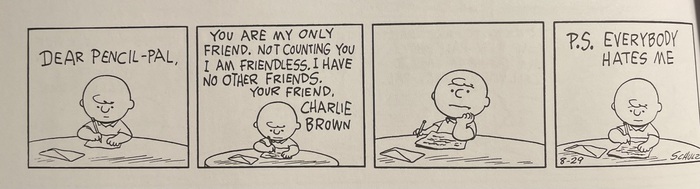
These years see more development of the classics: Charlie Brown's abortive kite-flying attempts, the highs and extreme lows of baseball, Snoopy's interpretations, so much more. Snoopy grows into his adult form with a fatter nose and increasingly detailed internal life.
I'm eagerly awaiting the arrival of Sally Brown and even more so Peppermint Patty and Marcie, whenever those are to come.
This volume's introduction is by Jonathan Franzen, in which he counters the common perspective of Schulz as a victim of his self-esteem and other insecurities; rather, it is his strength in dealing with these that allows him to be the artist that he is.
These years see more development of the classics: Charlie Brown's abortive kite-flying attempts, the highs and extreme lows of baseball, Snoopy's interpretations, so much more. Snoopy grows into his adult form with a fatter nose and increasingly detailed internal life.
I'm eagerly awaiting the arrival of Sally Brown and even more so Peppermint Patty and Marcie, whenever those are to come.
This volume's introduction is by Jonathan Franzen, in which he counters the common perspective of Schulz as a victim of his self-esteem and other insecurities; rather, it is his strength in dealing with these that allows him to be the artist that he is.

March 16, 2020
Spending time in the company of Charles Schulz and his Peanuts gang is a treat, and this book provides another three hundred thirteen pages to do so, as the strip moves out of its formative years and establishes a firm identity. 1957 starts well with a philosophical episode on January 2 (page one), Charlie Brown admitting to Patty that "I'd like to be able to feel that I'm needed." People who are truly needed bear a heavy social burden, she reminds him, so Charlie Brown amends his stance: "Well, I'd like to feel needed, and yet not have to do anything." Most of us crave the feeling of being indispensable, but we don't consider the responsibility it entails. Charlie Brown's words reflect our own human flaws. Winter of '57-58 sees Charlie Brown spend a lot of time flat on his back on the ice, unable to get back up because of his bulky winter coat. January 22 (page ten) is the best of these strips, Charlie Brown and Lucy comically commiserating about the inconveniences of dying; freezing to death or drowning can be irritating. January 27 (page twelve), Charlie Brown watches Lucy carefully build mini snowmen and then violently massacre them. "I feel torn between the desire to create and the desire to destroy", she says. Many of us struggle with those competing impulses, with no less absurd results than Lucy's.
March 15 (page thirty-two) is one of many storylines in which Snoopy reacts to Charlie Brown calling him "Fuzzy-face." We feel for Snoopy in his hurt, but this particular day is humorous. What kind of face does one expect from a dog? Linus delves into the subtext of Goldilocks and the Three Bears on May 18 (page fifty-nine), getting more out of the story than most kids. It's funny, but he has a point; there is nuance to the old fairy tales if one takes the time to look for it. Patty pleads with Lucy not to get upset and cry on July 10 (page eighty-two), and Lucy suspends her tears long enough for an interesting response. "Why should I deprive myself of an emotional outlet?" Fear of upset and turmoil spurs us to stop ourselves or others from expressing angst, but a good cry is emotionally and physically beneficial. Sometimes we need it to wash away the residue of bad things that happen so we can start fresh once our tears have dried. A classic Linus gag highlights July 16 (page eighty-five), as he blows a balloon up "half-way"...in his own unique style. How does one not love Linus van Pelt? A classic bit recreated in the Peanuts television specials appears August 4 (page ninety-three), Lucy questioning Beethoven's greatness because "he didn't get to be king, did he?" Schroeder's patience is sorely tried by that girl. Weathering a period of recent depression, Charlie Brown remarks to Lucy on September 2 (page one hundred six) that he isn't sure why he's a naturally downbeat person. "Sometimes I think my soul is full of weeds!" Every jaded optimist will deeply feel Charlie Brown's declaration, lamenting their own weeds that sprout where others seem to have no problem cultivating colorful, fragrant flowers. It's just part of being a Charlie Brown in a disappointing world.
The philosophy continues on October 8 (page one hundred twenty-one), Schroeder telling Charlie Brown that "early defeats help to build character for later on in life." For what, Charlie Brown asks? "For more defeats!" We don't often think through our platitudes to their logical conclusions, but Schroeder is right. At least our experiences of defeat help dull the sting of subsequent failures. November 15 (page one hundred thirty-seven) is a Peanuts classic, worded almost exactly the same as a gag from the 1966 It's the Great Pumpkin, Charlie Brown television special. "Never jump into a pile of leaves holding a wet sucker!" We learn on November 17 (page one hundred thirty-eight) that Charlie Brown is six years old; he was four when the strip started in 1950. January 7, 1958 (page one hundred sixty) is an amusing jab at the evolution of Snoopy's design; the dog behaves more like a human than he did in the early days, and when Charlie Brown's teacher assigns the students to draw a dog they know, he dismisses the thought of rendering Snoopy. "I'll just have to tell her I don't know any real dogs." Ha! Good one, Mr. Schulz. January 23 (page one hundred sixty-seven) is one of the funnier strips in this book; if you've never seen a dog scream, here's your chance. January 25 offers a feel-good rebuttal, courtesy of Violet, to Charlie Brown frequently calling Snoopy "Fuzzy-face." February 23 (page one hundred eighty) exposes the foolishness of adults who assume children live in a wonderland of fun and good humor; kids can be cruel, and no one knows that better than Charlie Brown. This brand of astute observation is what made Charles Schulz a comic legend.
Snoopy wrestles with his aggressive side on March 22 (page one hundred ninety-one). Sanguine as he usually is, Snoopy is in a sour mood here and feels like biting someone, but knows the backlash would be traumatic for him. "I guess I'd be better off just learning to live with my inner tensions", he thinks. We all have to curb our worst impulses in order to avoid life-changing consequences. Human and canine nature have their dark sides, and indulging them carries a steep cost. Swallowing these impulses feels wrong, but is ultimately good for us. May 2 (page two hundred nine) offers a sharp bit of timeless social commentary, Linus playing a game with friends where they pretend to fire guns at each other. Is this "cowboys and Indians"? Nope...it's "liberals and conservatives!!" The truth in this strip is uncomfortable; when politics degenerates to the point of violence or even violent rhetoric, it isn't lost on kids. If society wants healthy discourse, adults need to adjust their behavior before it poisons the next generation. June 23 (page two hundred thirty-two) is the genesis of a famous joke from the 1965 A Charlie Brown Christmas television special, Lucy challenging Linus on what he'll do with his security blanket when he grows up. "Maybe I'll have it made into a sport-coat!" is a quintessential Linus response. His banter with Lucy was always a fun part of Peanuts.
Charles Schulz doesn't rely predominantly on sight gags, but July 11 (page two hundred thirty-nine) is a good one. It's among the funniest moments in this collection, Linus finding an unlikely hiding spot for his blanket so Snoopy can't swipe it. September 1 (page two hundred sixty-two) we find out that Charlie Brown's father is a barber, as Schulz's was, and September 7 (page two hundred sixty-four) is a strip that helped inspire a memorable scene in It's the Great Pumpkin, Charlie Brown. All I need to say is, "My lips touched dog lips!" September 17 (page two hundred sixty-eight) revisits Linus's "sport coat" quip, and November 27 (page two hundred ninety-nine) is an introspective piece where Snoopy reflects on his days as a callow youth. He was a wild pup, mostly ignorant of the world, but enjoyed himself to the utmost. "Now I don't have any fun and I'm still ignorant!" he thinks, wistfully. Experience may lead to wisdom, but the progress is hard to measure. Often you'll feel as though you've lost the fun without gaining maturity, but hang in there, Snoopy; we love you even in your melancholy moments.
Peanuts had an exemplary beginning in the early and mid-1950s. The comedy is fresh, the philosophy substantial, and Charlie Brown's innate sadness is poignant for anyone who has grown up questioning whether people beyond their own family care about them. Volume 4 of The Complete Peanuts is less potent than the three that preceded it, however; laugh-out-loud strips are fewer, topical humor plays an outsized role, and the wisdom isn't as pervasive. Peanuts isn't considered to have reached its peak until the late 1960s, though, so I'm sure this is a blip in the timeline. The quality of material in this book is still better than most comic strips, and tagging along with Charlie Brown and company is fun. I'd rate this volume of The Complete Peanuts two and a half stars, and I'm eager to resume the story with the next book, which covers 1959 and '60.
March 15 (page thirty-two) is one of many storylines in which Snoopy reacts to Charlie Brown calling him "Fuzzy-face." We feel for Snoopy in his hurt, but this particular day is humorous. What kind of face does one expect from a dog? Linus delves into the subtext of Goldilocks and the Three Bears on May 18 (page fifty-nine), getting more out of the story than most kids. It's funny, but he has a point; there is nuance to the old fairy tales if one takes the time to look for it. Patty pleads with Lucy not to get upset and cry on July 10 (page eighty-two), and Lucy suspends her tears long enough for an interesting response. "Why should I deprive myself of an emotional outlet?" Fear of upset and turmoil spurs us to stop ourselves or others from expressing angst, but a good cry is emotionally and physically beneficial. Sometimes we need it to wash away the residue of bad things that happen so we can start fresh once our tears have dried. A classic Linus gag highlights July 16 (page eighty-five), as he blows a balloon up "half-way"...in his own unique style. How does one not love Linus van Pelt? A classic bit recreated in the Peanuts television specials appears August 4 (page ninety-three), Lucy questioning Beethoven's greatness because "he didn't get to be king, did he?" Schroeder's patience is sorely tried by that girl. Weathering a period of recent depression, Charlie Brown remarks to Lucy on September 2 (page one hundred six) that he isn't sure why he's a naturally downbeat person. "Sometimes I think my soul is full of weeds!" Every jaded optimist will deeply feel Charlie Brown's declaration, lamenting their own weeds that sprout where others seem to have no problem cultivating colorful, fragrant flowers. It's just part of being a Charlie Brown in a disappointing world.
The philosophy continues on October 8 (page one hundred twenty-one), Schroeder telling Charlie Brown that "early defeats help to build character for later on in life." For what, Charlie Brown asks? "For more defeats!" We don't often think through our platitudes to their logical conclusions, but Schroeder is right. At least our experiences of defeat help dull the sting of subsequent failures. November 15 (page one hundred thirty-seven) is a Peanuts classic, worded almost exactly the same as a gag from the 1966 It's the Great Pumpkin, Charlie Brown television special. "Never jump into a pile of leaves holding a wet sucker!" We learn on November 17 (page one hundred thirty-eight) that Charlie Brown is six years old; he was four when the strip started in 1950. January 7, 1958 (page one hundred sixty) is an amusing jab at the evolution of Snoopy's design; the dog behaves more like a human than he did in the early days, and when Charlie Brown's teacher assigns the students to draw a dog they know, he dismisses the thought of rendering Snoopy. "I'll just have to tell her I don't know any real dogs." Ha! Good one, Mr. Schulz. January 23 (page one hundred sixty-seven) is one of the funnier strips in this book; if you've never seen a dog scream, here's your chance. January 25 offers a feel-good rebuttal, courtesy of Violet, to Charlie Brown frequently calling Snoopy "Fuzzy-face." February 23 (page one hundred eighty) exposes the foolishness of adults who assume children live in a wonderland of fun and good humor; kids can be cruel, and no one knows that better than Charlie Brown. This brand of astute observation is what made Charles Schulz a comic legend.
Snoopy wrestles with his aggressive side on March 22 (page one hundred ninety-one). Sanguine as he usually is, Snoopy is in a sour mood here and feels like biting someone, but knows the backlash would be traumatic for him. "I guess I'd be better off just learning to live with my inner tensions", he thinks. We all have to curb our worst impulses in order to avoid life-changing consequences. Human and canine nature have their dark sides, and indulging them carries a steep cost. Swallowing these impulses feels wrong, but is ultimately good for us. May 2 (page two hundred nine) offers a sharp bit of timeless social commentary, Linus playing a game with friends where they pretend to fire guns at each other. Is this "cowboys and Indians"? Nope...it's "liberals and conservatives!!" The truth in this strip is uncomfortable; when politics degenerates to the point of violence or even violent rhetoric, it isn't lost on kids. If society wants healthy discourse, adults need to adjust their behavior before it poisons the next generation. June 23 (page two hundred thirty-two) is the genesis of a famous joke from the 1965 A Charlie Brown Christmas television special, Lucy challenging Linus on what he'll do with his security blanket when he grows up. "Maybe I'll have it made into a sport-coat!" is a quintessential Linus response. His banter with Lucy was always a fun part of Peanuts.
Charles Schulz doesn't rely predominantly on sight gags, but July 11 (page two hundred thirty-nine) is a good one. It's among the funniest moments in this collection, Linus finding an unlikely hiding spot for his blanket so Snoopy can't swipe it. September 1 (page two hundred sixty-two) we find out that Charlie Brown's father is a barber, as Schulz's was, and September 7 (page two hundred sixty-four) is a strip that helped inspire a memorable scene in It's the Great Pumpkin, Charlie Brown. All I need to say is, "My lips touched dog lips!" September 17 (page two hundred sixty-eight) revisits Linus's "sport coat" quip, and November 27 (page two hundred ninety-nine) is an introspective piece where Snoopy reflects on his days as a callow youth. He was a wild pup, mostly ignorant of the world, but enjoyed himself to the utmost. "Now I don't have any fun and I'm still ignorant!" he thinks, wistfully. Experience may lead to wisdom, but the progress is hard to measure. Often you'll feel as though you've lost the fun without gaining maturity, but hang in there, Snoopy; we love you even in your melancholy moments.
Peanuts had an exemplary beginning in the early and mid-1950s. The comedy is fresh, the philosophy substantial, and Charlie Brown's innate sadness is poignant for anyone who has grown up questioning whether people beyond their own family care about them. Volume 4 of The Complete Peanuts is less potent than the three that preceded it, however; laugh-out-loud strips are fewer, topical humor plays an outsized role, and the wisdom isn't as pervasive. Peanuts isn't considered to have reached its peak until the late 1960s, though, so I'm sure this is a blip in the timeline. The quality of material in this book is still better than most comic strips, and tagging along with Charlie Brown and company is fun. I'd rate this volume of The Complete Peanuts two and a half stars, and I'm eager to resume the story with the next book, which covers 1959 and '60.

September 3, 2014
Another glorious compendium of Peanuts-y goodness!
I may be biased, but Snoopy seems well on his way to becoming the breakout star of the strip. Many animals are imitated. Many dances are performed. Snoopy plays a violin/piano duet with Schroeder. Both the “weed claustrophobia” and “fuzzy face” sequences–both childhood favorites–are in here. There's definitely a reason he was selected for the cover portrait for this volume.
I notice that this book also contains the first mention of the name, “Joseph Schlabotnik,” an “incomparable” pianist, according to Schroeder. I can't help but wonder if he's related to Charlie Brown's favorite ballplayer? Clearly Schulz liked the name.
These collections can certainly be read in any order, though it can be fun to watch Schulz’ style slowly shift over the years. Longer sequences of strips become more common as his confidence and comfort with doing a daily strip grows. Some of them can be a bit 50's-centric, but Schulz quickly learned the value of more timeless humor.
At the end of the day, it's Peanuts. Love it or hate it, its influence and longevity are undeniable. Recommended!
I may be biased, but Snoopy seems well on his way to becoming the breakout star of the strip. Many animals are imitated. Many dances are performed. Snoopy plays a violin/piano duet with Schroeder. Both the “weed claustrophobia” and “fuzzy face” sequences–both childhood favorites–are in here. There's definitely a reason he was selected for the cover portrait for this volume.
I notice that this book also contains the first mention of the name, “Joseph Schlabotnik,” an “incomparable” pianist, according to Schroeder. I can't help but wonder if he's related to Charlie Brown's favorite ballplayer? Clearly Schulz liked the name.
These collections can certainly be read in any order, though it can be fun to watch Schulz’ style slowly shift over the years. Longer sequences of strips become more common as his confidence and comfort with doing a daily strip grows. Some of them can be a bit 50's-centric, but Schulz quickly learned the value of more timeless humor.
At the end of the day, it's Peanuts. Love it or hate it, its influence and longevity are undeniable. Recommended!

July 4, 2020
A more energetic volume in the Peanuts series as we see Charlie Brown’s kite-flying fails and Snoopy messing around with Linus and his blanket, and his funny vulture impression. A (100%/Outstanding)

July 23, 2021
1 of 26 volumes of collected work. Staggering. Review will be appended to all volumes when I've completed them all.

January 27, 2019
Peanuts as we all know it, nearly perfectly in form. Snoopy's imagination is only turning him into animals of other kinds -- like vultures -- but Linus with his security blanket, the baseball team getting going (and somehow managing to get within one catch of the championship in spite of never doing anything right on panel), Pig-Pen, the kite albeit without the kite-eating tree, and more

November 27, 2022
I've read three of the first four now and, despite enjoying much within, I now so passionately hate Lucy and Beethoven (Why did he think that a boy's obsession was so funny as to relentlessly repeat the same lame joke?) that it's hard to desire continuing...
His "line economy", with it's general lack of background, is not appreciated by me -I call it lazy- but he does well with what he does render.
His "line economy", with it's general lack of background, is not appreciated by me -I call it lazy- but he does well with what he does render.

February 23, 2021
Charlie Brown: "Have you ever felt lonely when you were in a crowd?"
Lucy: "Oh yes, lots of times... In fact, I always seem to feel lonely when I'm in a crowd..."
Charlie Brown: "You do?"
Lucy: "Uh, huh... The only time I'm not lonely is when I'm by myself!"
Lucy: "Oh yes, lots of times... In fact, I always seem to feel lonely when I'm in a crowd..."
Charlie Brown: "You do?"
Lucy: "Uh, huh... The only time I'm not lonely is when I'm by myself!"

February 28, 2025
I'm slowly but surely becoming a Snoopy lover, which is something I've been resisting for some time: his personality jumps through the pages, even with the rare insight into his thoughts.
He's affectionate, he's curious, he's particular in his tastes and, when it matters, he is a hater. Love that for him.
He's affectionate, he's curious, he's particular in his tastes and, when it matters, he is a hater. Love that for him.

September 8, 2022
Good Ole' Charlie Brown and Gang
The interview in this collection is by large so far my favorite. Instead of trying to make Schulz out as a rebel or hopelessly depressed it so very well described him as a human being struggling to make it, only as a cartoonist who more often than others has to face his humanity and is therefore all the stronger.
The rest of the book is of course pure Peanuts magic that brought back so many wonderful memories, and as my son says, "put so many thoughts in my head".
The interview in this collection is by large so far my favorite. Instead of trying to make Schulz out as a rebel or hopelessly depressed it so very well described him as a human being struggling to make it, only as a cartoonist who more often than others has to face his humanity and is therefore all the stronger.
The rest of the book is of course pure Peanuts magic that brought back so many wonderful memories, and as my son says, "put so many thoughts in my head".

September 9, 2015
The blossoming of Snoopy. Great stuff.

October 24, 2024
snoooopyyyy!!!!!!
é muito gostoso ler o começo do que virou o peanuts. tanto no quesito desenho, que ainda é um pouco mais tortinho e achatado do que o que ficamos acostumados hoje em dia, quanto no quesito história e personagens. o snoopy ainda é um cachorrinho de fato, mas já começa a apresentar traços mais "humanos", é a primeira vez que ele vira abutre (!!!!!) e ele já tem pensamentos, mas ainda não se comunica com ninguém.
dá mt dó de como o charlie brown é odiado, o bullying nos eua lá no alto desde sempre né. mas é mt gostoso que são todos crianças mesmo. é muito bobo, é um pouco malvado, é bem engraçado.
eu AMEI a construção das relações entre os personagens. minhas preferidas foram a lucy e o linus, que são extremamente irmã mais velha e irmão mais novo, é perfeito. também curti muito a evolução da lucy achando o snoopy meio bobo, mas eles ficando amigos com ela fazendo coceira nele e depois se encontrando pra dançar!!! são as minhas tirinhas preferidas!!!! e o snoopy tentando pegar o cobertor do linus também é delicioso.
é obviamente um quadrinho bem estadunidense. o tanto que eles ligam pra baseball, um esporte que nem existe, é meio fascinante. e tem umas coisas meio curiosas da cultura estadunidense do fim dos anos 50, que inclusive dá pra sentir como desafio na tradução. mas tudo bem também, né, os eua infelizmente são um país que existe...
enfim, a lucy é absolutamente perfeita, eu a amo. queria continuar lendo na ordem pra acompanhar o desenrolar das personalidades e relações. também fico me perguntando se a lucy perderia seu posto de primeira humana no meu coração pra patty pimentinha, mas daí teria que pular uns 15 anos. de qualquer forma, a família van pelt brilha nessas tirinhas. mas o astro é e sempre será o snoopy.
tl;dr: SNOOOOOOOOOPPYYYYYYY
é muito gostoso ler o começo do que virou o peanuts. tanto no quesito desenho, que ainda é um pouco mais tortinho e achatado do que o que ficamos acostumados hoje em dia, quanto no quesito história e personagens. o snoopy ainda é um cachorrinho de fato, mas já começa a apresentar traços mais "humanos", é a primeira vez que ele vira abutre (!!!!!) e ele já tem pensamentos, mas ainda não se comunica com ninguém.
dá mt dó de como o charlie brown é odiado, o bullying nos eua lá no alto desde sempre né. mas é mt gostoso que são todos crianças mesmo. é muito bobo, é um pouco malvado, é bem engraçado.
eu AMEI a construção das relações entre os personagens. minhas preferidas foram a lucy e o linus, que são extremamente irmã mais velha e irmão mais novo, é perfeito. também curti muito a evolução da lucy achando o snoopy meio bobo, mas eles ficando amigos com ela fazendo coceira nele e depois se encontrando pra dançar!!! são as minhas tirinhas preferidas!!!! e o snoopy tentando pegar o cobertor do linus também é delicioso.
é obviamente um quadrinho bem estadunidense. o tanto que eles ligam pra baseball, um esporte que nem existe, é meio fascinante. e tem umas coisas meio curiosas da cultura estadunidense do fim dos anos 50, que inclusive dá pra sentir como desafio na tradução. mas tudo bem também, né, os eua infelizmente são um país que existe...
enfim, a lucy é absolutamente perfeita, eu a amo. queria continuar lendo na ordem pra acompanhar o desenrolar das personalidades e relações. também fico me perguntando se a lucy perderia seu posto de primeira humana no meu coração pra patty pimentinha, mas daí teria que pular uns 15 anos. de qualquer forma, a família van pelt brilha nessas tirinhas. mas o astro é e sempre será o snoopy.
tl;dr: SNOOOOOOOOOPPYYYYYYY

November 12, 2023
It's around this time that you can tell Snoopy will one day eclipse the rest of the cast.

September 2, 2026
A great couple years. I find myself snapping pictures of so many panels. So deep and timeless.

January 28, 2022
Ah, the memories. Charlie Brown, Snoopy and the Peanuts gang. Happy, sad, philosophical but always entertaining.

February 18, 2025
Ik ben oprecht gefascineerd door Charles M. Schulz. Hij is de tekenaar van Peanuts, dat bij ons in België vooral bekend is door het personage Snoopy. In bijna 50 jaar schreef hij iets van een 18000 cartoons bij elkaar. Een enorme prestatie en zijn cartoons werden over de hele wereld gepubliceerd. Maar het meest bizarre in heel dit gegeven is dat Charles M. Schulz heel consistent was qua niveau. Elke cartoon die ik ondertussen van Peanuts heb gelezen in de eerste drie delen van deze prachtige verzameling ‘The Complete Peanuts’ is raak. We zien hoe Peanuts worstelt met zichzelf, we zien hoe Snoopy meer en meer de hond wordt waar hij later bekend door zou worden en ondertussen passeren er nog een hoop andere iconische personages de revue zoals Lucy, Linus, Pig-Pen, Violet en Schroeder. Samen beleven ze de simpelste dingen des levens maar kijken ze naar alles vanuit een heel volwassen perspectief waarin ze niet bang zijn om hun gevoelens te tonen. Dit vierde boek dat 1957 tot en met 1958 beslaat is een erg knap werkje waarvan Jonathan Franzen het voorwoord heeft geschreven. Het mooie is ook dat als je de reeks van het begin leest, je ook echt de wereld van Peanuts ziet veranderen, net zoals ook de echte wereld op de achtergrond. En daarnaast is het ook erg mooi hoe Peanuts mentale problemen bespreekbaar maakte want iemand als Peanuts worstelde dikwijls met zichzelf, zijn innerlijke eenzaamheid en zijn omgeving. En ook hoe hard de wereld en kinderen tegen elkaar kunnen zijn. The Complete Peanuts is een geweldig stukje geschiedenis voor elke stripfanaat. Want Peanuts en Charles M. Schulz heeft een enorme invloed gehad op tekenaars als Jim Davis, Bill Watterson, Matt Groening en Dav Pilkey.

December 2, 2018
снупі намагається украсти в лайнуса психотерапевтичного пледика, шродер пропустив один день народження бетховена і зробив усе, щоб не пропустити наступного, а чарлі браун перебуває в перманентній екзистенційній кризі, поглиблювати яку йому люб'язно допомагають люсі і вайолет (дівчатка в чарльза шульца таки нестерпні).
ці збірки починаються і закінчуються взимку, тому в мені від них розростається різдвяний настрій.
ці збірки починаються і закінчуються взимку, тому в мені від них розростається різдвяний настрій.

July 29, 2024
- charlie brown is really self-concious of his shortcomings, but he doesn't give himself a break either
- lucy is vicious
- we're starting to see the progress of snopppy from a normal dog who had no inner thoughts and dialogue, to the dog who likes doing impressions and isn't satisfied with just being a dog, and i like it!
- lucy is vicious
- we're starting to see the progress of snopppy from a normal dog who had no inner thoughts and dialogue, to the dog who likes doing impressions and isn't satisfied with just being a dog, and i like it!

January 9, 2026
Charlie Brown:
“This is a beautiful trophy Lucy..
‘Awarded to Lucille Van Pelt.. 1954, 1955, 1956.. The world’s number-one fussbudget’”
Lucy:
“You see, after I won it three years in a row, they let me keep it..”
“As one newspaper editor put it, ‘This girl was BORN TO FUSS!’”
“This is a beautiful trophy Lucy..
‘Awarded to Lucille Van Pelt.. 1954, 1955, 1956.. The world’s number-one fussbudget’”
Lucy:
“You see, after I won it three years in a row, they let me keep it..”
“As one newspaper editor put it, ‘This girl was BORN TO FUSS!’”

April 6, 2023
Started skipping some of the ones where Lucy yells the whole time.

September 19, 2024
Great book

December 2, 2024
A fantastic series of comics that made me smile more than once, and even hooked my daughter. I normally save these, but it was just the right homey feel and I had to put the next on hold right away.
May 26, 2022
Good grief

April 30, 2023
So it turns out that I absolutely adore baby!Linus ♥ I will definitely be reading this collection again before I return it to the library!

December 30, 2024
loved seeing the evolution of snoopy and more of schroeder and lucy together !

June 2, 2015
The same cast as the last 5 years: Charlie Brown, Lucy van Pelt, Linus van Pelt, Snoopy, Schroeder, Violet, Patty, "Pig-Pen," and Shermy.
This book is my favorite of the '50s. The humor has hit its stride, and Schulz is shining with these characters' pain, anger, depression, philosophy, and witticisms.
Snoopy and Linus are the only characters still growing at this point. Linus is learning about the world, and it seems he's torn between intellectual and toddler. The genius with the blanket. Snoopy has just begun testing the whole "walking-on-two-legs" thing, and at the very end of 1958 he starts to try (and fail) sleeping on TOP of his dog house. Interestingly, this is also the first volume in which Schulz finally hints toward Charlie Brown being the owner of Snoopy. The first 7 years of PEANUTS just saw Snoopy as the "neighborhood puppy" who played with all the kids. But now, we know that when he's hungry, he goes to Good Ol' Charlie Brown.
Another nice touch to this volume: the publishers added an end-note with a copy of the "lost strip" of 1953. They couldn't find it in time to print it in The Complete Peanuts, Vol. 2, but they finally found it and included it in Vol. 4. Now it has been printed for the first time in over 50 years!
This book is my favorite of the '50s. The humor has hit its stride, and Schulz is shining with these characters' pain, anger, depression, philosophy, and witticisms.
Snoopy and Linus are the only characters still growing at this point. Linus is learning about the world, and it seems he's torn between intellectual and toddler. The genius with the blanket. Snoopy has just begun testing the whole "walking-on-two-legs" thing, and at the very end of 1958 he starts to try (and fail) sleeping on TOP of his dog house. Interestingly, this is also the first volume in which Schulz finally hints toward Charlie Brown being the owner of Snoopy. The first 7 years of PEANUTS just saw Snoopy as the "neighborhood puppy" who played with all the kids. But now, we know that when he's hungry, he goes to Good Ol' Charlie Brown.
Another nice touch to this volume: the publishers added an end-note with a copy of the "lost strip" of 1953. They couldn't find it in time to print it in The Complete Peanuts, Vol. 2, but they finally found it and included it in Vol. 4. Now it has been printed for the first time in over 50 years!

September 22, 2010
A dynamite two years for the Peanuts gang - Schulz has really come into his own, and this collection is not just "promising": it's very very good. At the heart of the work, Charlie Brown has become a fascinating, multi-layered character whose resigned reactions to life and its concerns are as relevant to anyone of any age today, as they were to the boy and his creator in the 1950s.
Beyond this, all of the supporting characters prove their worth. Lucy and Linus, obviously, stand out, with the rest of the cast - Schroeder, Pig-Pen, Violet, Patty and Shermy - contributing well. Snoopy finally steps up to become more than a one-joke character, impersonating all kinds of animals, and developing trademark quirks and personality.
Schulz also further matures his style, using entire weeks to play out running gags or mini-storylines. These first 8 years of the "Peanuts" cycle have already had me chortling to myself many a night; I look forward to the remaining 42...
Beyond this, all of the supporting characters prove their worth. Lucy and Linus, obviously, stand out, with the rest of the cast - Schroeder, Pig-Pen, Violet, Patty and Shermy - contributing well. Snoopy finally steps up to become more than a one-joke character, impersonating all kinds of animals, and developing trademark quirks and personality.
Schulz also further matures his style, using entire weeks to play out running gags or mini-storylines. These first 8 years of the "Peanuts" cycle have already had me chortling to myself many a night; I look forward to the remaining 42...
Displaying 1 - 30 of 116 reviews