

What do you think?

And Now I Spill the Family Secrets: An Illustrated Memoir
Goodreads Choice Award
Nominee for Readers' Favorite Graphic Novels & Comics (2021)In 1988, when Kimball is only four years old, her mother attempts suicide on Mother's Day—and this becomes one of many things Kimball's family never speaks about. As she searches for answers nearly thirty years later, Kimball embarks on a journey into the secrets her family has kept for decades.
Using old diary entries, hospital records, home videos, and other archives, Margaret pieces together a narrative map of her childhood—her mother's bipolar disorder, her grandmother's institutionalization, and her brother's increasing struggles—in an attempt to understand what no one likes to talk about: the fractures in her family.
Using old diary entries, hospital records, home videos, and other archives, Margaret pieces together a narrative map of her childhood—her mother's bipolar disorder, her grandmother's institutionalization, and her brother's increasing struggles—in an attempt to understand what no one likes to talk about: the fractures in her family.
288 pages, Paperback
First published April 20, 2021
About the author
Margaret Kimball
7 books82 followersMargaret Kimball is the author of the illustrated memoir, And Now I Spill the Family Secrets (HarperCollins, 2021). She lives with her family in Indianapolis.
Ratings & Reviews
Friends & Following
Create a free account to discover what your friends think of this book!
Community Reviews
Displaying 1 - 30 of 508 reviews

August 8, 2021
The book opens with a suicide attempt by the author's mother in the 1980s then ranges back and forth through the decades exploring the history of mental illness and divorce in her family tree. While I felt sort of bad for everyone involved, I didn't really connect with the material due to the format and the author's failure to really land a reason for sharing all these family secrets.
First, I really don't get the point of an illustrated memoir where the pictures and the text only intersect tangentially. Set up sort of like a scrapbook or a Richard Scarry picture book, the pages were filled with street maps, cross-sections, room layouts, diary pages and legal documents, broken up with a very infrequent recreation of a family snapshot or frame from a home movie. The number of still life studies of furniture and fixtures was positively numbing.
Over these obviously photo-referenced drawings were strings of captions and giant boxes of text that could have been basically lifted out and printed as a straight prose memoir with very little editing to mark the absence of the images. There are little margin notes explaining some of the images, but most of those are pretty useless and easily discarded. For example: "Cedarcrest Regional Hospital in Newington, Connecticut, was originally built for tuberculosis patients in 1910 and in 1976 became part of the Department of Mental Health. Nine years after my mom's admission, the hospital closed." To which I can only say, "Oh, so?"
In the river of text, the author is almost as removed as her illustrations, acting like the director of a documentary, touching on her own trauma and grief but keeping the focus on the family events. In the midst of all the microscopic details about her mother, father, stepmother and brother, she almost fails to mention that at some point she got married to some guy and struggled with alcohol abuse. And she raises but doesn't really settle the questions regarding telling the stories of other people in her family when their agreement and maybe even ability to enter into an agreement about the matter is dubious (and even involves some dishonesty on her part). She got her book deal and spills the family secrets as the title promises, but I felt so detached from her and her family by the end that I'm not sure I see the value in doing so.
First, I really don't get the point of an illustrated memoir where the pictures and the text only intersect tangentially. Set up sort of like a scrapbook or a Richard Scarry picture book, the pages were filled with street maps, cross-sections, room layouts, diary pages and legal documents, broken up with a very infrequent recreation of a family snapshot or frame from a home movie. The number of still life studies of furniture and fixtures was positively numbing.
Over these obviously photo-referenced drawings were strings of captions and giant boxes of text that could have been basically lifted out and printed as a straight prose memoir with very little editing to mark the absence of the images. There are little margin notes explaining some of the images, but most of those are pretty useless and easily discarded. For example: "Cedarcrest Regional Hospital in Newington, Connecticut, was originally built for tuberculosis patients in 1910 and in 1976 became part of the Department of Mental Health. Nine years after my mom's admission, the hospital closed." To which I can only say, "Oh, so?"
In the river of text, the author is almost as removed as her illustrations, acting like the director of a documentary, touching on her own trauma and grief but keeping the focus on the family events. In the midst of all the microscopic details about her mother, father, stepmother and brother, she almost fails to mention that at some point she got married to some guy and struggled with alcohol abuse. And she raises but doesn't really settle the questions regarding telling the stories of other people in her family when their agreement and maybe even ability to enter into an agreement about the matter is dubious (and even involves some dishonesty on her part). She got her book deal and spills the family secrets as the title promises, but I felt so detached from her and her family by the end that I'm not sure I see the value in doing so.

April 11, 2021
[I receive a newsletter from HarperOne from which I can select books I would like to read that they then mail to me at no cost. I am not otherwise paid. I have no obligation to post or leave a review.]
...
This book is spectacular. I have been on GoodReads for years now and really think this memoir will be a top contender for best memoir of 2021. I didn't realize it was a graphic novel until I received it in the mail. The images add so much detail and set the mood of the story in a subtle, but powerful way.
I couldn't put the book down, reading it over the course of 24 hours. I was drawn in not only by the author's honesty but also the fairness with which she tells the complicated history of her family. As a psychologist, I can tell Kimball has done a lot of work to recover from her difficult childhood so that she can see the humanity in each of her family members. She honors their strengths while also naming the ways they hurt and were hurt by each other. She speaks about serious mental illness with a compassionate voice.
Some books are meant to be championed. This is one of them.
...
This book is spectacular. I have been on GoodReads for years now and really think this memoir will be a top contender for best memoir of 2021. I didn't realize it was a graphic novel until I received it in the mail. The images add so much detail and set the mood of the story in a subtle, but powerful way.
I couldn't put the book down, reading it over the course of 24 hours. I was drawn in not only by the author's honesty but also the fairness with which she tells the complicated history of her family. As a psychologist, I can tell Kimball has done a lot of work to recover from her difficult childhood so that she can see the humanity in each of her family members. She honors their strengths while also naming the ways they hurt and were hurt by each other. She speaks about serious mental illness with a compassionate voice.
Some books are meant to be championed. This is one of them.

August 20, 2021
Only at the end do we learn that one of the people with psychosis at the center of this story specifically said that she did not want her private medical information published. That person's most personal sorrow is now published -- with her name attached to it! -- for all the world to see. I thought that the despicable David Sedaris's self-aggrandizing misuse of the story of his sister after her death by suicide was the lowest of the low, but now this is at least as bad. Words cannot express my disgust that the author chose to elevate herself at the expense of people with psychiatric disabilities. She excuses it by saying that writers are vampires, as if she had no choice. There are, in fact, ways to write memoirs about growing up with family members with psychiatric disabilities that do not entail literally reproducing the records of their hospitalizations. But this writer chose, quite deliberately, to expose a person more vulnerable than herself to the most sadistic exposure I can imagine. We get it. You're mad at your mom for being crazy. That's still no excuse for harming her in this way.
This entire review has been hidden because of spoilers.
May 29, 2021
3.5 Stars!
“My mom was thirty-one when she decided to take her own life. It was Mother’s Day, 1988.”
So go the opening lines of this graphic memoir. Kimball uses an interesting technique that I’ve rarely if ever come across before, she draws scenes about people but without people in them and what this does is add a ghostly, dislocated feel to the narrative, which I found very clever and effective. It takes until page 18 before we see a person.
This soon turns into an almost forensic examination of the mental illness plaguing generations of her family, which is compelling as it is haunting. There is no doubt about Kimball’s artistic talents, or the overall quality of this memoir. As a personal journey and family project it must be invaluable.
Clearly this is a deeply personal and painful account to write about, but I just don’t think this story is as interesting to read for an outsider as it would have been for the author to write about. Ultimately I believe the problem with this is in the editing, it was just too long, I think this version is the one she could have kept for her and her family and there could have been a shorter, sharper version for the wider audience.

January 2, 2022
DNF at 254
I have been at it for 2 weeks now and decided to finally return this back to the library on the last day of the year because I know I won’t be finishing it. When I picked it up I thought it would be on the lines of Bechdel’s Are You My Mother - which focuses on the psychological effects an aloof parent can have on a child’s personality. It’s a deeply personal memoir with a lot of incidents that rely heavily on memory, but Bechdel explains them with the help of quotes from child psychologist. The illustrated memoir paints a beautiful arc of childhood trauma and recurring patterns, ending with adulthood acceptance. I would highly recommend that one if you haven’t already checked it out.
However, this book was nothing like it. For one And Now I Spill the Family Secrets is exactly what it sounds like, the author discusses the family secrets - multiple depressive episodes of her mom, inherited mental illness, her childhood with divorced parents, second marriages - that should remain secrets as many family members didn’t want her dissecting their life in extreme detail. And yet there is no depth in the whole book. It is just surface level. It feels like she’s just discussing in detail her life and the ups and downs she faced due to her mother’s illness. There is no learning curve, there is no psychological linking to what we are reading. Only a detailed year to year, without any food for thought. Yes, the author discusses mental illness and how hiding it can have grave repercussions on generations to come but that statement is repeated over and over without any psychological backing or research.
Margaret Kimball is very unknown to me. And so reading her memoir I would expect her to build some character study for herself so that the reader can relate. The whole memoir is from her perspective and yet she feels aloof and weirdly unknowable even by the end of it, and a major reason for that is the way she writes. The author constructed the memoir by relying on her diary entries as a child, and she writes the whole book in a similar tone. Writing in a diary for only your eyes is very different from wiring a memoir. Most passages are so generic and mundane: I did this and then this happened and my dad did this and then this. It’s a word by word of what her everyday looked like. I don’t want to say it but I felt extremely bored. By the mid-way point I was really wondering when the character arc would begin, not just for her but also for her mother’s illness. The book is just too long, there are passages describing parties and speeding tickets and bitchy school nurses which add absolutely nothing to the theme of the memoir.
I could go on and go about the things that felt off to me, but more than anything I felt it was a profound waste of time. It’s not a discussion or a dialogue into changing how we view mental illness, it’s more like a detailed essay on how she felt and adjusted while her mother suffered manic and suicidal episodes.
I have been at it for 2 weeks now and decided to finally return this back to the library on the last day of the year because I know I won’t be finishing it. When I picked it up I thought it would be on the lines of Bechdel’s Are You My Mother - which focuses on the psychological effects an aloof parent can have on a child’s personality. It’s a deeply personal memoir with a lot of incidents that rely heavily on memory, but Bechdel explains them with the help of quotes from child psychologist. The illustrated memoir paints a beautiful arc of childhood trauma and recurring patterns, ending with adulthood acceptance. I would highly recommend that one if you haven’t already checked it out.
However, this book was nothing like it. For one And Now I Spill the Family Secrets is exactly what it sounds like, the author discusses the family secrets - multiple depressive episodes of her mom, inherited mental illness, her childhood with divorced parents, second marriages - that should remain secrets as many family members didn’t want her dissecting their life in extreme detail. And yet there is no depth in the whole book. It is just surface level. It feels like she’s just discussing in detail her life and the ups and downs she faced due to her mother’s illness. There is no learning curve, there is no psychological linking to what we are reading. Only a detailed year to year, without any food for thought. Yes, the author discusses mental illness and how hiding it can have grave repercussions on generations to come but that statement is repeated over and over without any psychological backing or research.
Margaret Kimball is very unknown to me. And so reading her memoir I would expect her to build some character study for herself so that the reader can relate. The whole memoir is from her perspective and yet she feels aloof and weirdly unknowable even by the end of it, and a major reason for that is the way she writes. The author constructed the memoir by relying on her diary entries as a child, and she writes the whole book in a similar tone. Writing in a diary for only your eyes is very different from wiring a memoir. Most passages are so generic and mundane: I did this and then this happened and my dad did this and then this. It’s a word by word of what her everyday looked like. I don’t want to say it but I felt extremely bored. By the mid-way point I was really wondering when the character arc would begin, not just for her but also for her mother’s illness. The book is just too long, there are passages describing parties and speeding tickets and bitchy school nurses which add absolutely nothing to the theme of the memoir.
I could go on and go about the things that felt off to me, but more than anything I felt it was a profound waste of time. It’s not a discussion or a dialogue into changing how we view mental illness, it’s more like a detailed essay on how she felt and adjusted while her mother suffered manic and suicidal episodes.

August 12, 2021
The book lost its grip on me about halfway through, and by the end I felt pretty "meh" about the whole thing. I feel like the book lost its intended purpose, of which I'm still confused about. The choice of illustrations was interesting at first, but made the book kind of dry. The lack of conclusion also had me confused.
I also read some other reviews that stated they think the author exploited her family's mental illnesses for her book, and I'm tempted to agree. The ending didn't provide a satisfactory reason for "spilling" her family's secrets. There was no thoughtful and respectful discussion of mental illness and its effects on loved ones. We barely see any emotional response from the author or how her childhood affected her adult life. It was all very clinical and factual, which is a strange way to portray a history of your family's hardships and illnesses. The only questions asked of her family members were self-serving. I don't remember their own words about how their diagnoses affected them or their own experiences of living with one. All we get is some discomfort at having their personal experiences being displayed so publicly. So again I ask: why was this book written? (Sorry for rambling on there. I just finished the book and I feel so dissatisfied).
I also read some other reviews that stated they think the author exploited her family's mental illnesses for her book, and I'm tempted to agree. The ending didn't provide a satisfactory reason for "spilling" her family's secrets. There was no thoughtful and respectful discussion of mental illness and its effects on loved ones. We barely see any emotional response from the author or how her childhood affected her adult life. It was all very clinical and factual, which is a strange way to portray a history of your family's hardships and illnesses. The only questions asked of her family members were self-serving. I don't remember their own words about how their diagnoses affected them or their own experiences of living with one. All we get is some discomfort at having their personal experiences being displayed so publicly. So again I ask: why was this book written? (Sorry for rambling on there. I just finished the book and I feel so dissatisfied).

April 28, 2021
Memoir writing is such an interesting and personal thing. It is both a story for the reader to consume, and also a way for the narrator to work out the complexities of their own life's story. I was drawn to this story due to the mental health and family matters that permeate Kimball's life story. My own version of bibliotherapy so to speak. In that way the story doesn't disappoint and I felt the narration was a raw and real portrayal of the authors life, feelings, and experiences. However, as a reader, the format of static scene pictures accompanied by clustered and frenetic text was halting for me and left me disconnected from the overall journey. I do understand the thought process, as it more closely resembles the montage of pictures, missives, and notes that often make up a personal history. But from a storytelling standpoint it wasn't a good gel for me as a reader. However, for those who really get behind scrapbooking and family history this would be a good read for them.

July 15, 2021
This is one of the only memoirs, illustrated or not, that I have ever read in which the memoirist really tries to understand a sibling's thoughts and motivations. To me, the standout chapter is "The Interview," even though it's the least interesting chapter visually. In most of the book, Kimball is hyperfocused on herself—something that most memoirists do. But in the interview chapter, she talks to her older brother and tries to understand his worldview. This is partly because she wants to understand mental illness, which has emerged in several family members, and partly because she is so close to this brother that it's hard for her to comprehend where she ends and he begins.

read-in-2021
June 10, 2021I was uncomfortable with this book. It felt ableist which is pretty typical of mental health memoirs by family members but the interview of her schizophrenic brother towards the end made my heart sink since I recognized that rhythm, that tone, that shame. & the fact her family wasn't entirely okay with her book but she puts in an interview to expose that soft underbelly, the rambling speech everyone imagines when they think of people with 'scary' mental illnesses.

November 13, 2025
Please for the love of god do not spill the family secrets! Keep the secrets.

April 28, 2021
The cover alone grabbed me. This graphic novel memoir was twisty and compelling from the get go. Told through the eyes of the middle daughter, Margaret tries to uncover the family secrets and history that was hidden intentionally and unintentionally. The mental illness and suicide attempts didn't have to be shameful, they just needed to be understood and unearthed. Going back in forth from childhood to adulthood and back again - this non linear memoir is breathtakingly illustrated. Each frame, map, and character is laid bare. At times viewed through a youthful lens and later more mature. No family is perfect and Margi looks to chronicle her family's history rather than hide it. Compelling and wonderfully illustrated.

November 6, 2024
I am mystified by why this memoir was written. What was the goal here? The author seems to have wanted to write about her family members’ struggles with acute mental illnesses, spilling THEIR secrets, but also conveniently omitting any of her own (her experiences with drinking, drugs and being a stepmother were vaguely brought up and brushed off). It’s clear that some of the members of her family expressly forbade her from writing about them because they existed in the narrative as giant black holes (the younger two siblings) and I think some of the scenes involving her sick family members were also gone. Very odd.
Plus, the graphic novel format was a bad fit. The constant focus on house interiors was distracting, and reading the text was hard.
Plus, the graphic novel format was a bad fit. The constant focus on house interiors was distracting, and reading the text was hard.

October 8, 2021
I have listened to the audiobook of this three times so far and I don’t think I will ever get enough of it. The way the author has been so open about the hardships in her life is so moving and interesting to listen to. I will forever recommend this book, but I would check trigger warnings.
These are some that come to my mind but I’m sure there are more:
Addiction
Suicide
Self-Harm
Mental Health discussions (psychosis, psych wards ext)
These are some that come to my mind but I’m sure there are more:
Addiction
Suicide
Self-Harm
Mental Health discussions (psychosis, psych wards ext)

June 14, 2021
This is really compelling and really well-written but oooof it’s all the tough parts of a memoir with very little of the warmth. The complicated decision to write about people who pretty clearly seemed to not want to be written about made me feel unsettled. I liked this! It was good! I’m also unsettled.

August 7, 2021
Some books get better as you read further, some get more tedious. Margaret Kimball's graphic memoir, And Now I Spill the Family Secrets, is an example of the former. Her story follows the role of mental illness in her family. Her great-grandmother was hospitalized with schizophrenia, her grandmother apparently had postpartum depression, her mother bipolar disorder. Her brother is a paranoid conspiracy theorist who had been given at least one crisis evaluation, according to the police officer, because "you stopped and asked me about internet stalking and all kinds of crazy stuff that makes no sense" (p. 260). The author briefly referred to her problems with alcohol.
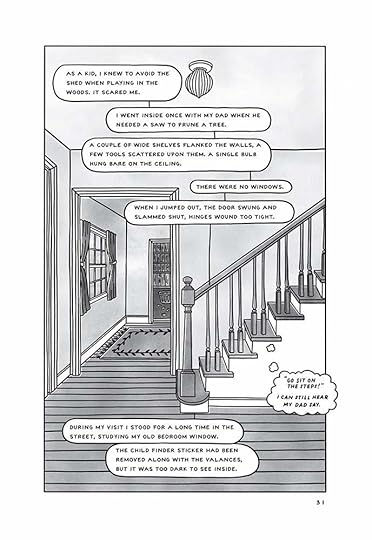
In the beginning of Family Secrets, Kimball describes rather than reflects. She is a lost child amidst chaos – loving parents who divorce, as one is warm and chaotic, while the other is silent, yet stable. Her illustrations are attractive, but decorative and thus distancing. She identifies the colors of the living room couch and chair in asides for no apparent reason. The only times that people show up are in her redrawn photographs.
I missed the greater immediacy of Alison Bechdel's graphic memoir, Fun Home, and the layering of images and ideas that she included. Kimball's drawings felt flat in comparison.
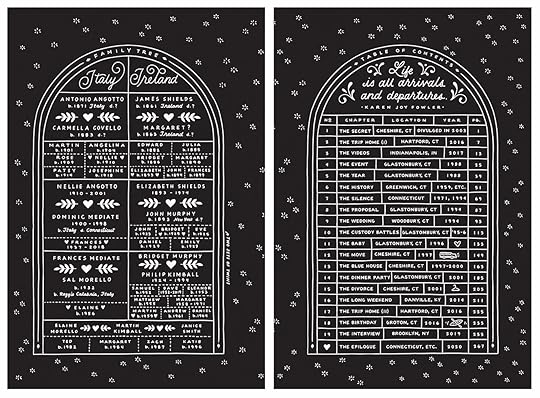
Family tree and table of Contents, pp. 9-10
As a description of the damage that having a mentally-ill parent can cause, the beginning of Family Secrets is good, although slow. She watches her mother's manic episodes and hospitalizations helplessly from the sidelines, while her father attempts to protect her by removing her from her mother's home. Her stepmom blows up at her stepchildren for no apparent reasons, although maybe hers are the garden variety reasons that challenge all blended families.
I found the ending more interesting, as here there was some arc to her story. As Kimball and her siblings attempted to reconnect, she both recognized the degree to which her brother Ted was struggling and challenged her strategies for responding to his craziness:
How could I help my brother without alienating him?// I thought of three options:
First, I could believe Ted wholeheartedly and agree with every description, from government chips to gang stalking. // Second, I could disagree and tell him he was delusional. // This second option meant losing my relationship with my brother forever. // Third, I could listen and remain neutral and nonjudgmental. // I could agree with the things I actually agreed with (governments do spy) and disagree with the things I thought were incorrect (the guy sipping his coffee is not following us (p. 231, paragraphing deleted for this context)
Many of us – whether we are talking to crazy relatives or conspiracy-focused acquaintances on social media – only think about the Truth and winning the argument. When we attempt to win, everyone loses. When active listening, there's an opportunity for something more.
In the beginning of Family Secrets, Kimball describes rather than reflects. She is a lost child amidst chaos – loving parents who divorce, as one is warm and chaotic, while the other is silent, yet stable. Her illustrations are attractive, but decorative and thus distancing. She identifies the colors of the living room couch and chair in asides for no apparent reason. The only times that people show up are in her redrawn photographs.
I missed the greater immediacy of Alison Bechdel's graphic memoir, Fun Home, and the layering of images and ideas that she included. Kimball's drawings felt flat in comparison.
Family tree and table of Contents, pp. 9-10
As a description of the damage that having a mentally-ill parent can cause, the beginning of Family Secrets is good, although slow. She watches her mother's manic episodes and hospitalizations helplessly from the sidelines, while her father attempts to protect her by removing her from her mother's home. Her stepmom blows up at her stepchildren for no apparent reasons, although maybe hers are the garden variety reasons that challenge all blended families.
I found the ending more interesting, as here there was some arc to her story. As Kimball and her siblings attempted to reconnect, she both recognized the degree to which her brother Ted was struggling and challenged her strategies for responding to his craziness:
How could I help my brother without alienating him?// I thought of three options:
First, I could believe Ted wholeheartedly and agree with every description, from government chips to gang stalking. // Second, I could disagree and tell him he was delusional. // This second option meant losing my relationship with my brother forever. // Third, I could listen and remain neutral and nonjudgmental. // I could agree with the things I actually agreed with (governments do spy) and disagree with the things I thought were incorrect (the guy sipping his coffee is not following us (p. 231, paragraphing deleted for this context)
Many of us – whether we are talking to crazy relatives or conspiracy-focused acquaintances on social media – only think about the Truth and winning the argument. When we attempt to win, everyone loses. When active listening, there's an opportunity for something more.

December 16, 2021
I don't think you can get to be an adult human without grieving something.
Personally, I'm grieving the loss of a relationship with my parents due to their homophobia.
I posted a quote from page 200 of this book about grief that resonated with me.
Kimball is grieving what she lost from life due to her mother's mental health struggles. She describes events from her childhood, and how each member of her family coped with the trauma.
The art choices of this book really stood out to me. There are no "live" scenes with human figures in them. All of the images are stills of empty rooms, objects, outdoor places. If human figures do appear, they're in illustrated recreations of photos, or stills from recorded video. That haunting approach affected me, as a reader, in a few different ways.
Kimball's illustrations are stark black and white with some grayscale. When I read that she's illustrated coloring books that fact made perfect sense to me.
Personally, I'm grieving the loss of a relationship with my parents due to their homophobia.
I posted a quote from page 200 of this book about grief that resonated with me.
Kimball is grieving what she lost from life due to her mother's mental health struggles. She describes events from her childhood, and how each member of her family coped with the trauma.
The art choices of this book really stood out to me. There are no "live" scenes with human figures in them. All of the images are stills of empty rooms, objects, outdoor places. If human figures do appear, they're in illustrated recreations of photos, or stills from recorded video. That haunting approach affected me, as a reader, in a few different ways.
Kimball's illustrations are stark black and white with some grayscale. When I read that she's illustrated coloring books that fact made perfect sense to me.

December 8, 2022
This is going to be one of the strangest two stars I've ever given. I can't deny that it was the title that drew me in, and I feel like many people would agree—even as I dragged this book with me around my school, I caught many wandering gazes and questions that were usually absent from the rest of my reading.
But how could you not be intrigued? Right away, a title that says And Now I Spill the Family Secrets promises divulgence. It waves a tantalizing slice of meat in front of the nosy, curious parts of ourselves that are enticed by drama and secrecy; the exciting revelation of all things taboo. It acts on the same part of our brain as true crime and secret documents, and at the sight of such a secret, we are seized with the desire to know, what are these family secrets?
Well, I read the book. Now I know her family secrets, and all I can say is that these secrets probably should have stayed secret.
This book is a graphic memoir written by Kimball, telling in drawings of old documents and walls of thought-out prose the story of her childhood in central Connecticut. The blurb at the back promises a full divulgence of every fracture in her family, but every "fracture" given is either obviously average or immorally private.
The other problem Kimball tackles is the mental illness tracing her mother's side, such as her grandmother's and brother's schizophrenia. However, the main subject for mental illness is her mother, who struggles with bipolar disorder and shapes a large portion of Kimball's childhood. In this way, Kimball's mother plays a titular role in the story, which makes the way Kimball treats her right to privacy deeply troubling.
The general sense of disrespect permeates the book, but there are a few specific instances. At one point, Kimball is looking into her grandmother's stay at a mental hospital, and she realizes her mother has access to her files. However, when she asks her mother to access them for her, she declines, out of respect for her grandmother's privacy. Kimball immediately treats this with disdain, saying that her mother is ashamed of her family and that there's no reason for her to keep them secret, as if not wanting to divulge your mother's private information out of respect is something terrible.
But for me, the worst part was that towards the end, Kimball reveals that her mother wasn't comfortable with a lot of the things she put in the book. Kimball defends herself and tries to dance around this, framing it as an irrational feeling on her mother's part and calling even claiming that as a writer, she is "a vampire, always capable of betrayal" as if that somehow makes it better
I will argue that as a full adult and a member of her family, Kimball has a right to a lot of the information that is withheld from her: her mother's suicide attempt during her childhood, the reason for her parents' divorce, her grandmother's institutionalization. But the problem comes from the fact that some people in the book didn't want a lot of things published.
There was no reason for Kimball to divulge all of this information to the public. Her family's mental illness seems to be a private, intimate topic to everyone but her, and throughout the book Kimball makes it clear that she has little understanding of mental illness. She's unsympathetic to her mother after her mental breakdowns, suicide attempts, and hospitalization, and takes a lot of information from research rather than actual understanding. And even after all this research, she admits that she's still placing her mother's mental illness into a logical box and is frustrated with her for everything bipolar. Kimball judges mental illness from a level that simply doesn't understand it, and it's clear throughout the entire novel.
And on top of all of that, the book wasn't very interesting. I'm sure it was very significant for Kimball to be writing herself, but as an outside observer, I found myself bored for most the time I was reading. She follows her parents' divorce and her father's remarriage and all the quiet, run-of-the-mill family drama, and I found that I just didn't care about most of it.
Ultimately, I really don't think this book should have been written. It's invasive and boring and completely unnecessary, and Kimball probably could have learned more about her family without turning around and writing a tell-all memoir.
But how could you not be intrigued? Right away, a title that says And Now I Spill the Family Secrets promises divulgence. It waves a tantalizing slice of meat in front of the nosy, curious parts of ourselves that are enticed by drama and secrecy; the exciting revelation of all things taboo. It acts on the same part of our brain as true crime and secret documents, and at the sight of such a secret, we are seized with the desire to know, what are these family secrets?
Well, I read the book. Now I know her family secrets, and all I can say is that these secrets probably should have stayed secret.
This book is a graphic memoir written by Kimball, telling in drawings of old documents and walls of thought-out prose the story of her childhood in central Connecticut. The blurb at the back promises a full divulgence of every fracture in her family, but every "fracture" given is either obviously average or immorally private.
The other problem Kimball tackles is the mental illness tracing her mother's side, such as her grandmother's and brother's schizophrenia. However, the main subject for mental illness is her mother, who struggles with bipolar disorder and shapes a large portion of Kimball's childhood. In this way, Kimball's mother plays a titular role in the story, which makes the way Kimball treats her right to privacy deeply troubling.
The general sense of disrespect permeates the book, but there are a few specific instances. At one point, Kimball is looking into her grandmother's stay at a mental hospital, and she realizes her mother has access to her files. However, when she asks her mother to access them for her, she declines, out of respect for her grandmother's privacy. Kimball immediately treats this with disdain, saying that her mother is ashamed of her family and that there's no reason for her to keep them secret, as if not wanting to divulge your mother's private information out of respect is something terrible.
But for me, the worst part was that towards the end, Kimball reveals that her mother wasn't comfortable with a lot of the things she put in the book. Kimball defends herself and tries to dance around this, framing it as an irrational feeling on her mother's part and calling even claiming that as a writer, she is "a vampire, always capable of betrayal" as if that somehow makes it better
I will argue that as a full adult and a member of her family, Kimball has a right to a lot of the information that is withheld from her: her mother's suicide attempt during her childhood, the reason for her parents' divorce, her grandmother's institutionalization. But the problem comes from the fact that some people in the book didn't want a lot of things published.
There was no reason for Kimball to divulge all of this information to the public. Her family's mental illness seems to be a private, intimate topic to everyone but her, and throughout the book Kimball makes it clear that she has little understanding of mental illness. She's unsympathetic to her mother after her mental breakdowns, suicide attempts, and hospitalization, and takes a lot of information from research rather than actual understanding. And even after all this research, she admits that she's still placing her mother's mental illness into a logical box and is frustrated with her for everything bipolar. Kimball judges mental illness from a level that simply doesn't understand it, and it's clear throughout the entire novel.
And on top of all of that, the book wasn't very interesting. I'm sure it was very significant for Kimball to be writing herself, but as an outside observer, I found myself bored for most the time I was reading. She follows her parents' divorce and her father's remarriage and all the quiet, run-of-the-mill family drama, and I found that I just didn't care about most of it.
Ultimately, I really don't think this book should have been written. It's invasive and boring and completely unnecessary, and Kimball probably could have learned more about her family without turning around and writing a tell-all memoir.

January 16, 2022
I don’t understand how the author published this and her family members are still alive and speaking to her. Maybe they’ve stopped. Suicide and mental illness are difficult and important subjects. I’m just not sure this was the right way to do it.

October 14, 2024
This was incredible!!

March 13, 2022
3.5 stars. This was really interesting, but the pure black and white illustrations, depicting spaces, diary entries, and photographs, without featuring scenes of people, made for some heavier reading without much to balance out the darkness of the struggles portrayed. I also felt like the story wasn’t quite complete, and it left me wondering where Janice ended up, and what Katie’s thoughts on her mom are. The situation with her brother couldn’t be fully ‘resolved’ since it’s still going on and is much more recent, so not everything was fully wrapped up. Maybe there will be a sequel someday?

April 13, 2022
This wasn’t badly written by any means but I genuinely don’t get the point of this book. The author doesn’t so much spill family secrets- she just spills the beans on her mother and brother’s mental illnesses and her step-mother’s bitchiness. None of which seem to be kept very secret. Though the author claims to struggle with guilt about using her family’s stories in the book, I can’t help but feel that this entire book was just an attempt to eke money out of the mental illness in her family.

August 28, 2021
Another graphic memoir that falls into the "exhausting, uncomfortable, and impossible to look away" category. And Now I Spill the Family Secrets is perhaps better than some of its contemporaries in its dedication to detail and full exposure. Margi Kimball offers a welcome amount of both-sides-ness, which feels incredibly necessary as she explores the history of mental illness in her family. Particularly as all of the participants are still alive. Nonetheless, it all feels deeply, deeply awkward.
But you can't look away! Kimball crafts an absorbing tale that's not so much a mystery (though it seems to be sold as one) as a pure unloading of family history. It's annotated Ancestry.com. With the simplistic art, dedication to detail, and sharp, pointed chapters, it would feel right at home as a deep dive podcast. Reading the streams of dialogue, you can't help but hear the voice from Serial.
I should note that And Now I Spill the Family Secrets is probably a deeply uncomfortable read if there's any mental illness or divorce in your family. Kimball digs into the painful details of both topics - it hits home as you recognize the commonalities, even if your life (or a friend's life) isn't quite so dramatic as Kimballs.
I liked the book. I didn't love the book. I'm glad I read it. I don't know that I'd read it again. Kimball could have cut more wheat from the chaff, but this is a good stiff drink of a read. Recommended for memoir fans who are wary of the graphic format.
But you can't look away! Kimball crafts an absorbing tale that's not so much a mystery (though it seems to be sold as one) as a pure unloading of family history. It's annotated Ancestry.com. With the simplistic art, dedication to detail, and sharp, pointed chapters, it would feel right at home as a deep dive podcast. Reading the streams of dialogue, you can't help but hear the voice from Serial.
I should note that And Now I Spill the Family Secrets is probably a deeply uncomfortable read if there's any mental illness or divorce in your family. Kimball digs into the painful details of both topics - it hits home as you recognize the commonalities, even if your life (or a friend's life) isn't quite so dramatic as Kimballs.
I liked the book. I didn't love the book. I'm glad I read it. I don't know that I'd read it again. Kimball could have cut more wheat from the chaff, but this is a good stiff drink of a read. Recommended for memoir fans who are wary of the graphic format.

July 18, 2021
I won this as my first ever book won from the Goodreads giveaways. Not only was it the first one I’ve ever won, but it was a print book!
This is a memoir unlike any other I’ve ever read. The artist chose to turn this memoir into a graphic novel (which is not something I’ve ever read or been interested in, however this one was really good. ) The art work adds so much to the story she tells.
Everyone has something about or in their family that people just don’t talk about. Events that happen. People that drift in and out and in and out, or just disappear. Everyone has that family member they try to hide away, or is estranged for whatever reason. This novel take on those deep family secrets found in the life of the author.
Sometimes it’s nice to slip away and see that all people and families are the same. We all struggle. We all fight. We all hate. We all cry. We all mourn. We all lose and we all win. But most of all, We all love.
Thank you so much to #Goodreads and the Goodreads Giveaway program, along with the publisher and author for the opportunity to read something I would not have picked up otherwise. This beautiful print book was sent to me in exchange for my honest and unbiased opinion.
This is a memoir unlike any other I’ve ever read. The artist chose to turn this memoir into a graphic novel (which is not something I’ve ever read or been interested in, however this one was really good. ) The art work adds so much to the story she tells.
Everyone has something about or in their family that people just don’t talk about. Events that happen. People that drift in and out and in and out, or just disappear. Everyone has that family member they try to hide away, or is estranged for whatever reason. This novel take on those deep family secrets found in the life of the author.
Sometimes it’s nice to slip away and see that all people and families are the same. We all struggle. We all fight. We all hate. We all cry. We all mourn. We all lose and we all win. But most of all, We all love.
Thank you so much to #Goodreads and the Goodreads Giveaway program, along with the publisher and author for the opportunity to read something I would not have picked up otherwise. This beautiful print book was sent to me in exchange for my honest and unbiased opinion.

August 30, 2021
A super-personal memoir that seem to strip out all the personal parts out of it based on the format. I'm not sure why Kimball chose to use the graphic novel format but then decided to cut out all the people except for when referencing photos or videos. It was obviously a very conscious decisions but one that really took me out of it.
Ultimately I'm not sure what drawings of front of houses and living rooms divorced of people in them helped to move the story along when compared to a text-only approach even with some photo reproductions included. Ultimately what we get are a bunch of static images with text on top. There is even some dialogue but it's basically presented in a back and forth way that isn't enhanced by the "graphic" nature of this memoir.
The story itself is a challenging one focused on dealing with multi-generational mental illness in a family. I appreciate the honest exploration of how Kimball has dealt with the various members of the family even if they don't paint them in the best light in retrospect. Definitely a tough read at times.
Ultimately I'm not sure what drawings of front of houses and living rooms divorced of people in them helped to move the story along when compared to a text-only approach even with some photo reproductions included. Ultimately what we get are a bunch of static images with text on top. There is even some dialogue but it's basically presented in a back and forth way that isn't enhanced by the "graphic" nature of this memoir.
The story itself is a challenging one focused on dealing with multi-generational mental illness in a family. I appreciate the honest exploration of how Kimball has dealt with the various members of the family even if they don't paint them in the best light in retrospect. Definitely a tough read at times.
September 16, 2021
This graphic memoir held my attention. The author describes the mental illness and trauma extending through the generations in her family. The catalyst for her research into her family's secrets was the revelation that her mother had attempted suicide when Kimball was a child. She researches her mother and maternal grandmother's mental health histories, and then recounts the story of her own childhood and the dissolution of her parents' marriage. The story is told with detailed illustrations and straightforward prose. It's a sad, complicated story, but one that many of us will be able to relate to. The author is startlingly honest. Sometimes I wondered what the purpose of all this airing of dirty laundry accomplishes other than schadenfreude. Kimball is a compelling storyteller and fine illustrator. But memoir should be a starting point for art, and this one seemed to get bogged down in the story, and it did not achieve that next level.

May 2, 2021
I savored this illustrated memoir over the last few days.
Margaret Kimball recounts her childhood memories beginning with her mother's attempted suicide. Kimball's memories show how family secrets and mental health affected her throughout her youth. This book successfully shows the impact of mental health on a child and their entire family. Even trickling down through the generations.
I don't read many graphic novels, so I can't really give a proper review regarding the illustrations. I just know it worked for me.
CW for suicide, schizophrenia, and post partum depression
Margaret Kimball recounts her childhood memories beginning with her mother's attempted suicide. Kimball's memories show how family secrets and mental health affected her throughout her youth. This book successfully shows the impact of mental health on a child and their entire family. Even trickling down through the generations.
I don't read many graphic novels, so I can't really give a proper review regarding the illustrations. I just know it worked for me.
CW for suicide, schizophrenia, and post partum depression

January 19, 2022
"Are you there Margaret? It's me, God."
"Hi God. You know, I'm not Catholic anymore. We stopped going to church when I was 4, when my room was in one corner of the first floor in our house. My brothers' room was next to it, next to which was my parents room. But yes, I'm here."
"Good. Please don't write that book."
"Hi God. You know, I'm not Catholic anymore. We stopped going to church when I was 4, when my room was in one corner of the first floor in our house. My brothers' room was next to it, next to which was my parents room. But yes, I'm here."
"Good. Please don't write that book."

June 7, 2021
The art in this book is stunning and so is Kimball’s ability to reflect on her family’s story. She’s so honest and raw and open about her experiences with her family. I’m struck by her sections about Ted and how she talks about him and talks about how she works to understand him.
October 16, 2021
literally NO secrets were spilled???? what tf do you mean “and now i spill the family secrets” ??? you said…. nothing? anything of curiosity, the author NEVER learns about irl so like…. no answers. i sincerely am having a hard time understanding the point?

July 30, 2021
I haven’t been this engrossed in a graphic novel in a long time! The illustration style is beautiful and the story is a tender gift to us as readers. Read this book.
Displaying 1 - 30 of 508 reviews