

What do you think?

Diese goldenen Jahre: Roman
In 1922, Paul Beckermann arrives at the Bauhaus art school and is immediately seduced by both the charismatic teaching and his fellow students. Eccentric and alluring, the more time Paul spends with his new friends the closer they become, and the deeper he falls in love with the mesmerising Charlotte. But Paul is not the only one vying for her affections, and soon an insidious rivalry takes root.
As political tensions escalate in Germany, the Bauhaus finds itself under threat, and the group begins to disintegrate under the pressure of its own betrayals and love affairs. Decades later, in the wake of an unthinkable tragedy, Paul is haunted by a secret. When an old friend from the Bauhaus resurfaces, he must finally break his silence.
Beautifully written, powerful and suspenseful, Naomi Wood's The Hiding Game is a novel about the dangerously fine line between love and obsession, set against the most turbulent era of our recent past.
342 pages, Kindle Edition
First published January 1, 2019
About the author
Naomi Wood
38 books223 followersNaomi Wood was born in 1983 and lives in London. She studied at Cambridge and at UEA for her MA in Creative Writing. Originally from York, she has gone on to live in Hong Kong, Paris and Washington DC. She is the author of The Godless Boys, Mrs. Hemingway and The Hiding Game. This is Why We Can't Have Nice Things is her first short story collection, and is coming out in April 2024.
Ratings & Reviews
Friends & Following
Create a free account to discover what your friends think of this book!
Community Reviews
Displaying 1 - 30 of 158 reviews

January 17, 2021
Naomi Wood's novel is a blend of fact and fiction, unsettling and disturbing historical fiction informed by art, specifically the influential Bauhaus art movement in Germany that began post WW1, with Walter Gropius's minimalist take on architecture. In 1934, Paul Beckermann fled Germany and the Third Reich that had taken over the country for England, only for his haunted past with secrets to raise its head when an old friend invites him to the funeral of Walter Konig, a man for whom he harbours resentment and blamed him for the tragic death of his adored Charlotte. This triggers his reflections back to when he was a young man n 1922, when he was part of a group of 6 idealistic art students at the Bauhaus Art School, urged to look beyond the normal and ordinary, to see the other more radical possibilities in the expression of their art and creativity under the Weimar Republic.
The background of the tensions and turbulence of the rise of the Nazis influences and finds echoes within the lives and relationships between the group of friends, as relationships reconfigure and shift through the years. Their lives that take in love affairs, betrayal, obsessions, deception, guilt, drugs and drink, and the threats, horrors and dangers posed by the Nazi regime to the group and to the Bauhaus Art School itself, which moved to Dessau and then Berlin. In this beautifully written, character driven narrative, it is the intimate portrait of the lives of the six friends that dominate as Paul's self deceptions and secrets are revealed. Wood evokes the historical period brilliantly with her rich descriptions and details, I particularly appreciated the information on the Bauhaus movement. This is likely to appeal to those interested in Germany at this time and/or the Bauhaus Art Movement. Many thanks to Pan Macmillan.
The background of the tensions and turbulence of the rise of the Nazis influences and finds echoes within the lives and relationships between the group of friends, as relationships reconfigure and shift through the years. Their lives that take in love affairs, betrayal, obsessions, deception, guilt, drugs and drink, and the threats, horrors and dangers posed by the Nazi regime to the group and to the Bauhaus Art School itself, which moved to Dessau and then Berlin. In this beautifully written, character driven narrative, it is the intimate portrait of the lives of the six friends that dominate as Paul's self deceptions and secrets are revealed. Wood evokes the historical period brilliantly with her rich descriptions and details, I particularly appreciated the information on the Bauhaus movement. This is likely to appeal to those interested in Germany at this time and/or the Bauhaus Art Movement. Many thanks to Pan Macmillan.

July 12, 2019
While this is framed as some kind of suspenseful interrogation into a dark personal past, the secret that 'haunts' our narrator, Paul Beckermann, is nothing more than a reflection of his self-serving character. Not a surprise to anyone but himself. The whole book is a sequence of people acting through petty selfishness in a time when such choices have greater than usual consequences. Focused through a group of six students who attend the celebrated Bauhaus at its height, their destruction is effectively achieved by their own hands long before the outside world intervenes. Yet even with all this supposed love and obsession, there's no feeling. Any emotional response from the reader is surely in our understanding of the period, the reflected horror of the rising Nazi threat, not in the ways the characters have to deal with these new realities. Or in their well-deserved guilt years later. At times the writing is superbly evocative, a turn of phrase that's just right. But it's only this that stops the book from proving firmly mediocre.
ARC via Netgalley
ARC via Netgalley

March 30, 2021
The Hiding Game is about a group of students at the Bauhaus, the famous German art school, in the 1920s and 30s. There are romantic obsessions, jealous squabbles, secrets and lies, and political tensions bubbling away in the background. Paul, the narrator, is recounting this story some years later: we know from the beginning that half the group are gone; some dead, some missing. It’s very promising at first, seeming to possess all the ingredients for the type of smart-but-juicy novel I love to get stuck into. But... god, it drags. It’s far too long, and honestly, not much actually happens. There’s very little plot, but not much character development either.
Paul is an infuriatingly passive man; that passivity is, admittedly, key to the plot, but it affects every aspect of his character, most damagingly his passion for fellow Bauhausler Charlotte. Theirs is a romance with all the chemistry and ardour of two used teabags on the side of a sink. Paul seems more stirred by a brief moment of eye contact with a man in a pub than he ever is by Charlotte, the supposed love of his life (who is also given little in the way of a personality of her own). I got the feeling the author was more comfortable writing desire between men and perhaps struggled with portraying lust from a straight man’s viewpoint; I understand this totally, but it leaves a hole at the heart of the love story that anchors the plot and motivates Paul’s narrative.
A well-written and stylish story with a fascinating historical backdrop, but ultimately I got so frustrated and bored that I can’t truly recommend it.
TinyLetter | Linktree
Paul is an infuriatingly passive man; that passivity is, admittedly, key to the plot, but it affects every aspect of his character, most damagingly his passion for fellow Bauhausler Charlotte. Theirs is a romance with all the chemistry and ardour of two used teabags on the side of a sink. Paul seems more stirred by a brief moment of eye contact with a man in a pub than he ever is by Charlotte, the supposed love of his life (who is also given little in the way of a personality of her own). I got the feeling the author was more comfortable writing desire between men and perhaps struggled with portraying lust from a straight man’s viewpoint; I understand this totally, but it leaves a hole at the heart of the love story that anchors the plot and motivates Paul’s narrative.
A well-written and stylish story with a fascinating historical backdrop, but ultimately I got so frustrated and bored that I can’t truly recommend it.
TinyLetter | Linktree

July 10, 2019
Set mostly in pre-war Germany, this historical novel, is set at the famous, Bauhaus art school. As such, it has appeal in terms of both the setting and the story. It begins with six friends, together in the golden years, at the beginning of the Bauhaus movement; starting in 1922 and winding through the pre-war years and, indeed, into the present.
The story is told mainly from the point of view of Paul Beckermann, who moved to London. The news that one of their group had died, leads him to think back and remember his youth, his love of the beautiful, unconventional, Charlotte, and recall his regrets.
This is a novel about friendship, love, betrayal, secrets and the shadow of history. For the excess of the Weimar Republic gives way to the rising National Socialist Party and a new, political regime. I really enjoyed the historical background, the writing was excellent and this would be a good choice for book groups, with lots to discuss. I received a copy of this book from the publisher, via NetGalley, for review.
The story is told mainly from the point of view of Paul Beckermann, who moved to London. The news that one of their group had died, leads him to think back and remember his youth, his love of the beautiful, unconventional, Charlotte, and recall his regrets.
This is a novel about friendship, love, betrayal, secrets and the shadow of history. For the excess of the Weimar Republic gives way to the rising National Socialist Party and a new, political regime. I really enjoyed the historical background, the writing was excellent and this would be a good choice for book groups, with lots to discuss. I received a copy of this book from the publisher, via NetGalley, for review.

August 15, 2019
This is an academic love affair set in the tense political climate of 1920s Germany and written in the vein of The Secret History and If We Were Villains. The isolated setting, academic focus, and creative aptitude of the characters soon become sinister inclusions in this dark and foreboding narrative that unveiled as many secrets as mysteries it created. There is an unsettling tension that is maintained throughout and the rocky political time period, that becomes part of the background, only helps to heighten and disturb the events that occur.
I received a copy of this book in exchange for an honest review. Thank you to the author, Naomi Wood, and the publisher, Picador, for this opportunity.
I received a copy of this book in exchange for an honest review. Thank you to the author, Naomi Wood, and the publisher, Picador, for this opportunity.

August 14, 2019
(3.75) Cross The Secret History with The Age of Light and you’ll get an idea of what this is like. Set mostly in Germany in the 1920s–30s, it’s about a group of six friends who meet at the Bauhaus, a bohemian art school founded 100 years ago this year. They seem to fall into three natural pairs – with the narrator, Paul Beckermann, swiftly falling in love with Charlotte – but romances spark up in unexpected places and their allegiances shift over time. They experiment with fasting at an instructor’s behest, but also hop beds and fall into cocaine use: veering from asceticism to hedonism and back. In their art, too, they vacillate between the extremes of innovation and safe romanticism. Wood describes the Bauhaus mentality as: “Play. Risk. Experimentation. … Study. Observation. Licenza.”
It makes for a satisfying hothouse atmosphere where the tensions between people who mostly love but sometimes hate each other are bound to flare up. As Paul puts it, the Bauhaus was “something of worship to all of us and yet sometimes not so much a school as a cage wherein our madnesses multiplied.” All along, it’s impossible to forget what’s happening in Germany: surveys and raids exposing foreigners, Jews and Communists threaten the long-term survival of this group of friends. Glimpses from decades into the future, when Paul is setting down these reminiscences in England, add in a dose of foreboding.
Wood writes gorgeous prose. Compared to Mrs. Hemingway, this is too long (almost without exception, every book I’ve read recently that’s nearly 400 pages could stand to be much closer to 300), and I had trouble keeping the secondary characters straight, but it’s a delicious slice of historical fiction that should appeal to most readers of character-driven fiction. The title comes from a game Paul and Charlotte play, in which one person hides an object in their hand and tries to get the other to guess what it is via a three-word description. But, of course, it also ties in with the themes of truth vs. deception and taking responsibility.
A favorite line: “The trees were struck yellow in the hectic blaze, and the grass beyond was as vivid as a painted field”
It makes for a satisfying hothouse atmosphere where the tensions between people who mostly love but sometimes hate each other are bound to flare up. As Paul puts it, the Bauhaus was “something of worship to all of us and yet sometimes not so much a school as a cage wherein our madnesses multiplied.” All along, it’s impossible to forget what’s happening in Germany: surveys and raids exposing foreigners, Jews and Communists threaten the long-term survival of this group of friends. Glimpses from decades into the future, when Paul is setting down these reminiscences in England, add in a dose of foreboding.
Wood writes gorgeous prose. Compared to Mrs. Hemingway, this is too long (almost without exception, every book I’ve read recently that’s nearly 400 pages could stand to be much closer to 300), and I had trouble keeping the secondary characters straight, but it’s a delicious slice of historical fiction that should appeal to most readers of character-driven fiction. The title comes from a game Paul and Charlotte play, in which one person hides an object in their hand and tries to get the other to guess what it is via a three-word description. But, of course, it also ties in with the themes of truth vs. deception and taking responsibility.
A favorite line: “The trees were struck yellow in the hectic blaze, and the grass beyond was as vivid as a painted field”

September 21, 2019
2.5* roundedup because I really liked the parts about art/Bauhaus.
May 22, 2019
This is a mesmerising book. Anyone who loved Mrs Hemingway, Naomi Wood’s previous novel, will recognise the elegance with which she captures a place and a time, and her gift for setting relationships spinning against the backdrop of a transforming world. Here, she has gone further, to the extent you can feel the world shifting around the drama.
The story has stayed with me - not just because of the powerfully realised world, but because of how human the relationships feel. This book is set during the Weimar Republic, and it’s decline, in Germany. The far right is on the rise, and yet, the relationships, the focus on different kinds of love - friendship, lust, inspiration, obsession and beyond - show a side to that world we don’t get to hear about.
You can hear the jack boots, but you are focused on the art. You can feel the darkness rising, but you must look first at love.
The story has stayed with me - not just because of the powerfully realised world, but because of how human the relationships feel. This book is set during the Weimar Republic, and it’s decline, in Germany. The far right is on the rise, and yet, the relationships, the focus on different kinds of love - friendship, lust, inspiration, obsession and beyond - show a side to that world we don’t get to hear about.
You can hear the jack boots, but you are focused on the art. You can feel the darkness rising, but you must look first at love.

July 15, 2019
Novel set primarily in Germany (Weimar, Dessau, Berlin)
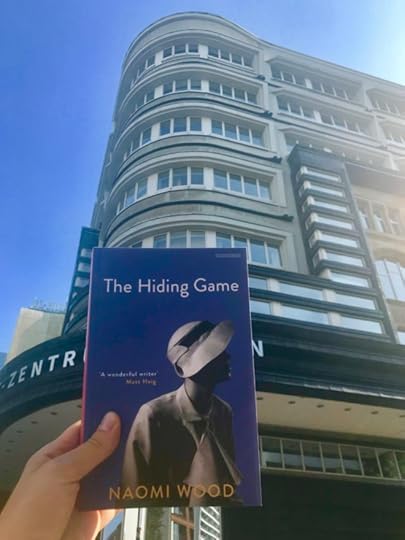
1920s Weimar. An era of avant-garde art. Paul Klee and Wassily Kandinsky are in the city where previous great writers, thinkers and philosophers are still casting their intellectual and creative spell over the citizens. There is something eminently imaginative in the water of this city.
The Bauhaus movement was founded in Weimar in 1919 but with the rise of the National Socialists and their dismissal of its creative direction, it eventually moved to Dessau and then on to Berlin. It couldn’t be saved in Germany from the destructive political forces but by the time the school closed in 1933, its influence was represented all over the world. The novel The Hiding Game is set against the backdrop of the extraordinary times of the Weimar Republic. The Bauhaus School of Art encapsulated the period and became famous for its approach to design.
The novel opens in the 1920s when inflation is starting to be rampant in Germany. A group of six young people – “the Bauhaus Babies” – is studying at the Bauhaus school in Weimar, acolytes of their teacher Master Itten (who, the author stresses is fictional and combines into one single person all three Bauhaus directors – Walter Gropius / Hannes Meyer / Mies van der Rohe). He encourages them to experience, not merely visualise, their environment in order to truly understand the world and their place in it – their experience has to be thoroughly immersive; and thus they have their hair shorn, they fast until one of them falls over. And then they move on to sexual liaisons and to cocaine and alcohol. The National Socialists, however, are starting to gain a very strong foothold…..
Move forward several years post WW2 – to somewhere on the British coast – where Paul is now living. Irmi, still in Germany and one of the six, advises Paul (through whose eyes the story is recounted) that one of their group, Walter, has died. She would like Paul to return to Berlin for the service. But Paul has too much latent resentment. Walter was, he feels, culpable in the death of Charlotte whom Paul adored.
Charlotte initially had a relationship with group member Jenö. Paul struggles to shake off his insecurities about this charming, wilful woman, even once they are together. The lingering fear that Jenö and Charlotte still have a lover’s legacy preys destructively on his mind. The group dynamics are played out through the subsequent years, as the art school changes location for political reasons. The story of the six culminates as WW2 plays out its tragic course.
I read the author’s novel Mrs Hemingway and I found it engrossing and so well written. I remember it fondly. In The Hiding Game the author once again brings to life her chosen setting and era in colourful and well researched prose. In this novel the exquisite detail and swathes of a beautifully penned narrative make for a rich and rewarding read. However, the characters just left me surprisingly cold, I felt disconnected. They were almost like ghosts parading through the narrative, the mists of time almost obscuring their flesh and blood personas – I guess they somehow mirrored the nebulous figures of Schiller, Goethe, Liszt and Cranach whose presence from the past held dynamic sway over the 6 students at the Bauhaus School of Art in the Weimar days…..
1920s Weimar. An era of avant-garde art. Paul Klee and Wassily Kandinsky are in the city where previous great writers, thinkers and philosophers are still casting their intellectual and creative spell over the citizens. There is something eminently imaginative in the water of this city.
The Bauhaus movement was founded in Weimar in 1919 but with the rise of the National Socialists and their dismissal of its creative direction, it eventually moved to Dessau and then on to Berlin. It couldn’t be saved in Germany from the destructive political forces but by the time the school closed in 1933, its influence was represented all over the world. The novel The Hiding Game is set against the backdrop of the extraordinary times of the Weimar Republic. The Bauhaus School of Art encapsulated the period and became famous for its approach to design.
The novel opens in the 1920s when inflation is starting to be rampant in Germany. A group of six young people – “the Bauhaus Babies” – is studying at the Bauhaus school in Weimar, acolytes of their teacher Master Itten (who, the author stresses is fictional and combines into one single person all three Bauhaus directors – Walter Gropius / Hannes Meyer / Mies van der Rohe). He encourages them to experience, not merely visualise, their environment in order to truly understand the world and their place in it – their experience has to be thoroughly immersive; and thus they have their hair shorn, they fast until one of them falls over. And then they move on to sexual liaisons and to cocaine and alcohol. The National Socialists, however, are starting to gain a very strong foothold…..
Move forward several years post WW2 – to somewhere on the British coast – where Paul is now living. Irmi, still in Germany and one of the six, advises Paul (through whose eyes the story is recounted) that one of their group, Walter, has died. She would like Paul to return to Berlin for the service. But Paul has too much latent resentment. Walter was, he feels, culpable in the death of Charlotte whom Paul adored.
Charlotte initially had a relationship with group member Jenö. Paul struggles to shake off his insecurities about this charming, wilful woman, even once they are together. The lingering fear that Jenö and Charlotte still have a lover’s legacy preys destructively on his mind. The group dynamics are played out through the subsequent years, as the art school changes location for political reasons. The story of the six culminates as WW2 plays out its tragic course.
I read the author’s novel Mrs Hemingway and I found it engrossing and so well written. I remember it fondly. In The Hiding Game the author once again brings to life her chosen setting and era in colourful and well researched prose. In this novel the exquisite detail and swathes of a beautifully penned narrative make for a rich and rewarding read. However, the characters just left me surprisingly cold, I felt disconnected. They were almost like ghosts parading through the narrative, the mists of time almost obscuring their flesh and blood personas – I guess they somehow mirrored the nebulous figures of Schiller, Goethe, Liszt and Cranach whose presence from the past held dynamic sway over the 6 students at the Bauhaus School of Art in the Weimar days…..

July 22, 2019
I thought this was going to be a psychological thriller based on some historical events around the Bauhaus art school which was based in cities in the east Germany in the 20s and 30s. I found it not so interesting as it was basically an introspective by Paul Beckermann, one of a group of six students who meet in their first year of study at Bauhaus. The group are two girls, Irmi and Charlotte and four boys Paul, Walter, Jeno and Kaspar. Initially Paul and Charlotte are an item as are Walter and Jeno but that latter relationship is more circumspect as this is not an age of enlightenment about same sex relationships. But then things take a turn as the relationships change and the rest of the books is full of the angst that this creates for decades to come. It is mostly looking back to their time at the Bauhaus, both as students and later as staff, but then jumps to more recent times when Paul is in England having escaped there from the Nazi uprising.
The writing is good but I just found the storyline quite dull. There were a lot of extreme emotions being portrayed for events that didn’t seem to warrant it.
I did enjoy learning at little more about the Bauhaus but am no more a fan of their style than I was before reading this book.
With thanks to NetGalley and Pan Macmillan for a free copy of this book in exchange for an honest review.
The writing is good but I just found the storyline quite dull. There were a lot of extreme emotions being portrayed for events that didn’t seem to warrant it.
I did enjoy learning at little more about the Bauhaus but am no more a fan of their style than I was before reading this book.
With thanks to NetGalley and Pan Macmillan for a free copy of this book in exchange for an honest review.
August 18, 2019
A little disappointing, this. Six students at the legendary Bauhaus modern art school act as guides to the heady times they had as students there, when it moved first from the title city of the Weimar Republic, to somewhere else, and then to Berlin itself, just before Hitler gets power. It was a chequered past, for it was never really loved by the "citizens" living alongside the students – and these pages prove why, for none of the characters are likeable. In fact they almost drove me to skimread – almost, mind – so I could find the Germany outside their stuck-up mindsets. It's evoked rather well, from the times of hyperinflation to the almost flapper world of the capital, but I felt rather cheated that such a unique time in European history was presented through the lens of boring, up themselves, druggy art students. The core of the book is supposed to be a mental flashback, a confession, from one of them now living in England in the 1960s, but even at that age he seems ignorant of how yawnsome his unrequited love, and everything else, might be. If he'd been less reluctant to get us all to the more interesting big reveals, which circle back to Weimar, and even more unique (sic) times, I'd have thought more highly of this novel. But as it is I really think those that lived through it all in real life deserved better.

August 7, 2022
Wood really effectively combined fact and fiction to take us through Weimar Germany to the rise of Hitler. As is perhaps Wood's intention, I found the character development more intriguing than the plot - I most appreciated the facts that all the characters were very distinct, and that their actions and motivations were constantly questioned.

July 31, 2019
Naomi Wood is a very skilled writer - her prose flows like a river, beautiful sentences with wonderful word choices. Her words are lyrical, beats pulsing through the page, all playing in harmony to make the reading a joy. I suspect I'd get pleasure reading her to-do list.
When I finished The Hiding Game, I put it down and decided I enjoyed it. I read it fast, 'cover' to 'cover' (doesn't work with e-books) in a couple of days, which is very quick for me (certainly helped by being on holiday!). The problem is that when I considered why I enjoyed it, it was all entirely down to the writing. When I reflected on the story, my main thought was, "Is that it? Not much happened there."
The basic story is six friends meet at the Bauhaus during the rise of the Nazis. I knew it was abolished by the Nazis as the contemporary, degenerate, style conflicted with their preference for the neoclassical. However, this didn't come across strongly - the thrust of the book was on the friendships - and as things turned sour, it seemed Naomi hardened on those friendships instead of pursuing what it must have been like living in fear of those days; I never got the sense of being in that period, the tensions and distrust. My main complaint was when that fear was ratcheted up, the book ended abruptly - the conclusion seemed rushed, the betrayals insignificant.
I did enjoy the art descriptions, that was very nicely done, even the story was well executed, but I felt the plot needed more tension, stronger betrayals, and more sense of time&place. I'll definitely look out for future books from Naomi, she's got a strong future ahead of her.
3 for the plot, 5 for writing - 4 overall - a very enjoyable read with a few flaws.
Book supplied by Netgalley for an honest review.
When I finished The Hiding Game, I put it down and decided I enjoyed it. I read it fast, 'cover' to 'cover' (doesn't work with e-books) in a couple of days, which is very quick for me (certainly helped by being on holiday!). The problem is that when I considered why I enjoyed it, it was all entirely down to the writing. When I reflected on the story, my main thought was, "Is that it? Not much happened there."
The basic story is six friends meet at the Bauhaus during the rise of the Nazis. I knew it was abolished by the Nazis as the contemporary, degenerate, style conflicted with their preference for the neoclassical. However, this didn't come across strongly - the thrust of the book was on the friendships - and as things turned sour, it seemed Naomi hardened on those friendships instead of pursuing what it must have been like living in fear of those days; I never got the sense of being in that period, the tensions and distrust. My main complaint was when that fear was ratcheted up, the book ended abruptly - the conclusion seemed rushed, the betrayals insignificant.
I did enjoy the art descriptions, that was very nicely done, even the story was well executed, but I felt the plot needed more tension, stronger betrayals, and more sense of time&place. I'll definitely look out for future books from Naomi, she's got a strong future ahead of her.
3 for the plot, 5 for writing - 4 overall - a very enjoyable read with a few flaws.
Book supplied by Netgalley for an honest review.

May 24, 2021
trigger warning
When Paul joins the Bauhaus, a prestigious art school, he expects to learn about art. What he doesn't expect is to fall in love, with a person so many others seem to love, and that they're all nearing their doom.
Setting ist 1922 Germany, first in Weimar, then Dessau, then Berlin. At first, times are tough in a country trying to find it's own feet again after a devastating war, and through their youth, the students are able to forget everything.
Then, a guy called Hitler rises, and the reader knows what's up.
This was not what I expected, at all. I wanted dark academia, because I enjoyed The Secret History and If We Were Villains, but I did not enjoy this at all.
We're told from the beginning that one character won't make it out of a concentration camp, because this book is made up of Paul's recollections. He sits there, at the end of his life, and tries to paint his own portrait, a realistic portrait, despite being an abstract artist.
I did not enjoy being in Paul's head. He's insecure, constantly worrying but trying to ignore his own thoughts. It's exhausting.
I did not enjoy the plot of people trying to get together, through intrigue if necessary.
But: This all boils down to personal taste. As much as I don't like it, somebody else might love it.
The arc was provided by the publisher.
When Paul joins the Bauhaus, a prestigious art school, he expects to learn about art. What he doesn't expect is to fall in love, with a person so many others seem to love, and that they're all nearing their doom.
Setting ist 1922 Germany, first in Weimar, then Dessau, then Berlin. At first, times are tough in a country trying to find it's own feet again after a devastating war, and through their youth, the students are able to forget everything.
Then, a guy called Hitler rises, and the reader knows what's up.
This was not what I expected, at all. I wanted dark academia, because I enjoyed The Secret History and If We Were Villains, but I did not enjoy this at all.
We're told from the beginning that one character won't make it out of a concentration camp, because this book is made up of Paul's recollections. He sits there, at the end of his life, and tries to paint his own portrait, a realistic portrait, despite being an abstract artist.
I did not enjoy being in Paul's head. He's insecure, constantly worrying but trying to ignore his own thoughts. It's exhausting.
I did not enjoy the plot of people trying to get together, through intrigue if necessary.
But: This all boils down to personal taste. As much as I don't like it, somebody else might love it.
The arc was provided by the publisher.

January 17, 2021
Bauhaus art school, the dying days of the Weimar Republic and the rise of Nazism... and six friends tangled in a morass of love, art, passion and jealousy.
I suspect this is one of those books where the less we know about art and the dark history of 1930s Germany, the more we might like this. Wood chooses to tell us the fate of one of the characters from the start so that it hangs over the flash-back narrative but, really, it's hardly surprising given the time and place.
I really liked the first half of the book and the gradual drip-feed of information about the relationships between the six friends. But the second half feels like it lost its way: some of the characters drop by the wayside, and the emotional level gets very fevered.
I suspect this is one of those books where the less we know about art and the dark history of 1930s Germany, the more we might like this. Wood chooses to tell us the fate of one of the characters from the start so that it hangs over the flash-back narrative but, really, it's hardly surprising given the time and place.
I really liked the first half of the book and the gradual drip-feed of information about the relationships between the six friends. But the second half feels like it lost its way: some of the characters drop by the wayside, and the emotional level gets very fevered.

May 27, 2022
Loved this. Complex, layered, subtle, moving. A really haunting read. Ignore the reviews that say it’s ‘dull’ and that nothing happens. They are missing the point and the beauty, entirely.

June 27, 2019
'Set at the Bauhaus art school in pre-war Germany…
An intoxicating story of young friendships and fledgling loves in a heady and enticing world set against the backdrop of a precarious Europe.'
The Hiding Game is the latest wonderful piece of literary fiction from the author of the equally fabulous Mrs Hemingway, Naomi Wood. Due for publication on July 11th with Picador Books, The Hiding Game is an exceptional, yet very complex and intense, novel recreating the glory days of the Bauhaus Art School. Under the sponsorship of The Literary Encyclopedia, Naomi Wood travelled to where it all began in 1919 in Weimar, to where it ended fourteen years later in Berlin, via Dessau.
The Bauhaus Art School was the brainchild of Prussian architect Walter Gropius, whose minimalist approach to architecture is still very evident today in many cities and homes across the globe. The Bauhaus was intended to encourage it’s students to see beyond the everyday, to use their minds and hands differently and to see the extraordinary possibilities that exist when something is stripped back to it’s raw state revealing it’s nakedness, it’s truth. The teaching methods used at the Bauhaus were considered alternative and, for many, it’s teachers and it’s students went too far. Way ahead of it’s time, the residents of Weimar were not prepared to embrace the bizarre ethos of the school and in 1926 it relocated to Dessau. Here the now infamous Bauhaus school settled into new accommodation, a building unlike any that had been seen before.
Naomi Wood takes the incredible history of this influential school and remarkably recreates that transient period through the combination of factual and fictional characters. Described as ‘beautifully written, powerful and suspenseful…a novel about the dangerously fine line between love and obsession, set against the most turbulent era of our recent past’ The Hiding Game’s publication will coincide with the 100 year celebrations of the founding of the Bauhaus Art School.
Naomi Wood introduces the reader to six students who remain linked to the school in some fashion up to it’s demise in 1933, as the Nazi regime’s influence took hold. These students live a hedonistic lifestyle, trapped in the bubble of this avant garde world that they now reside. As they express their artistic styles through the use of metal, weave, art and more, they develop a very close, but also quite a paranoid, relationship. Naomi Wood was inspired by an old photograph of this time where the students were caught up in what appeared to be ‘a blissful utopia‘. It set her to thinking about what would happen if events transpired to upset this Utopian existence.
The characters in the book are very progressive in their thinking but also different, peculiar and very profound. All have a heightened emotional quality to their personality and, after awhile, little fissures appear in their friendships, in their relationships, as their radical lifestyle intensifies.
As the Nazi regime strengthens a palpable fear starts to take root in the minds of the Bauhaus thinkers, masters and students. Their radical ideas strike fear into the minds of many and it’s not long before the Bauhaus is again moved from Dessau to a new, and final, home in Berlin.
The Hiding Game is a window into the legacy of the Bauhaus, providing the reader with a very fascinating, yet also very authentic view of life for many during that horrifying period of our history. Naomi Wood, using fictional characters, provides the reader with an astonishing and tragic tale, a story that is completely engrossing, capturing the reader’s full attention from the opening pages. The Hiding Game is not a book that can be read at any speed. Due to the nature of it’s content I found myself putting the book down and carrying out my own research online, reading some very insightful posts about this era.
The Hiding Game is an enthralling read, with an amazing attention to detail, that I found completely fascinating and so incredibly commanding. It is a very poignant tale of love, obsession, tragedy and betrayal….a literary gem.
‘During the writing of The Hiding Game, I also discovered the ethos of the Bauhaus workshop : that creativity is in the making of things, not the production. The idea, in the words of Josef Albers, that beauty is a kind of skillfulness. And so I tried to write this book as a student would have experimented and played in their workshop. That quintessentially Bauhaus approach made writing this book deeply pleasurable.’
– Naomi Wood
An intoxicating story of young friendships and fledgling loves in a heady and enticing world set against the backdrop of a precarious Europe.'
The Hiding Game is the latest wonderful piece of literary fiction from the author of the equally fabulous Mrs Hemingway, Naomi Wood. Due for publication on July 11th with Picador Books, The Hiding Game is an exceptional, yet very complex and intense, novel recreating the glory days of the Bauhaus Art School. Under the sponsorship of The Literary Encyclopedia, Naomi Wood travelled to where it all began in 1919 in Weimar, to where it ended fourteen years later in Berlin, via Dessau.
The Bauhaus Art School was the brainchild of Prussian architect Walter Gropius, whose minimalist approach to architecture is still very evident today in many cities and homes across the globe. The Bauhaus was intended to encourage it’s students to see beyond the everyday, to use their minds and hands differently and to see the extraordinary possibilities that exist when something is stripped back to it’s raw state revealing it’s nakedness, it’s truth. The teaching methods used at the Bauhaus were considered alternative and, for many, it’s teachers and it’s students went too far. Way ahead of it’s time, the residents of Weimar were not prepared to embrace the bizarre ethos of the school and in 1926 it relocated to Dessau. Here the now infamous Bauhaus school settled into new accommodation, a building unlike any that had been seen before.
Naomi Wood takes the incredible history of this influential school and remarkably recreates that transient period through the combination of factual and fictional characters. Described as ‘beautifully written, powerful and suspenseful…a novel about the dangerously fine line between love and obsession, set against the most turbulent era of our recent past’ The Hiding Game’s publication will coincide with the 100 year celebrations of the founding of the Bauhaus Art School.
Naomi Wood introduces the reader to six students who remain linked to the school in some fashion up to it’s demise in 1933, as the Nazi regime’s influence took hold. These students live a hedonistic lifestyle, trapped in the bubble of this avant garde world that they now reside. As they express their artistic styles through the use of metal, weave, art and more, they develop a very close, but also quite a paranoid, relationship. Naomi Wood was inspired by an old photograph of this time where the students were caught up in what appeared to be ‘a blissful utopia‘. It set her to thinking about what would happen if events transpired to upset this Utopian existence.
The characters in the book are very progressive in their thinking but also different, peculiar and very profound. All have a heightened emotional quality to their personality and, after awhile, little fissures appear in their friendships, in their relationships, as their radical lifestyle intensifies.
As the Nazi regime strengthens a palpable fear starts to take root in the minds of the Bauhaus thinkers, masters and students. Their radical ideas strike fear into the minds of many and it’s not long before the Bauhaus is again moved from Dessau to a new, and final, home in Berlin.
The Hiding Game is a window into the legacy of the Bauhaus, providing the reader with a very fascinating, yet also very authentic view of life for many during that horrifying period of our history. Naomi Wood, using fictional characters, provides the reader with an astonishing and tragic tale, a story that is completely engrossing, capturing the reader’s full attention from the opening pages. The Hiding Game is not a book that can be read at any speed. Due to the nature of it’s content I found myself putting the book down and carrying out my own research online, reading some very insightful posts about this era.
The Hiding Game is an enthralling read, with an amazing attention to detail, that I found completely fascinating and so incredibly commanding. It is a very poignant tale of love, obsession, tragedy and betrayal….a literary gem.
‘During the writing of The Hiding Game, I also discovered the ethos of the Bauhaus workshop : that creativity is in the making of things, not the production. The idea, in the words of Josef Albers, that beauty is a kind of skillfulness. And so I tried to write this book as a student would have experimented and played in their workshop. That quintessentially Bauhaus approach made writing this book deeply pleasurable.’
– Naomi Wood

August 15, 2019
Review copy kindly supplied by the publishers via NetGalley
Narrated in the 1960s in flashback by Paul Brickman (formerly Beckermann), a German artist living on the south coast of England, this novel charts the rise of the Third Reich from the early 1920s through the eyes of a group of Bauhaus students, and indeed through the fortunes of the Bauhaus itself.
The death of Walter Konig, one of the group, and an invitation to his funeral, prompts a journey of self-reflection, a confession, which Paul freely recognises will be only one of several possible versions of events.
Having said that, however, he then goes on to narrate events in what is on the surface a very factual manner - but it is only as the layers build up that we start to see what he has chosen to include and what he has left out, what he has glossed over, what he can only face up to as he strips away the layers of his own self-deception. His narrative hinges on his guilt about the death of one of the group, his erstwhile girlfriend Charlotte, in the Dachau camp. The tale opens with the group arriving as new students at the newly opened Bauhaus in Weimar in 1922 - there are Walter and Jeno, Kaspar and Irma, Paul and the androgynous Charlotte - Bauhaus babies. Charlotte is Czechoslovakian and Jeno is Hungarian. Paul is immediately attracted to Charlotte and they become close but the relationship remains platonic - Paul is inclined to favour a slow build.
Walter is in love with Jeno, Paul with Charlotte, and in the background, Irma with Paul although this has less bearing on the unfolding of events. While Paul waits for love to blossom between himself and Charlotte, and after Jeno makes advances to Walter in the Turkish baths, Charlotte and Jeno embark upon a relationship. And so the stage is set for a Greek tragedy driven by jealousy and doubt.
Over the years, the group fragments and reconfigures while in the wider world, the Bauhaus is condemned for harbouring undesirable foreigners, communists and Jews, and is raided, shut down, attacked, but manages to keep resurfacing in different locations, resisting. In contrast to the work coming out of this avant-garde setting is the jobbing work that Paul and Walter do for Ernst Steiner’s studio, churning out sentimental pastoral scenes by the yard on commission for wealthy Americans. Is this indicative of their moral relativism, which will have such an impact on Charlotte’s fate in later years? Relentlessly, in the background, revealed almost incidentally in Paul’s much more intimate narrative, is the rise of the Brown Shirts, the increasing food shortages, the spiralling inflation which renders their earnings valueless, the increasingly open hostility to Communists, Jews, foreigners on the streets.
Naomi Wood from the start evokes the atmosphere of Brideshead Revisited and Donna Tartt’s The Secret History, with her tight-knit group of students in their own little rarefied world where all rules are made to be broken. For my money though, she doesn’t quite pull it off. The narrative remains too intimate to properly reflect wider events, so the novel is never entirely sure whether it wants to be a slow reveal of the events that led to Charlotte’s death, or a reflection of the rise of the Third Reich, and it doesn’t achieve either in an entirely satisfactory manner. Paul is a narrator blinded by his obsessive love for Charlotte, his suspicion of Jeno’s motives, his immature selfishness. His blinkered vision gets in the way of our perception of the historical events happening - or is it a reflection of how easy it was for people to fail to notice what was happening around them?
This is definitely a novel worth reading, but for those who are expecting another Secret History, my advice would be to take it on its own terms.
Narrated in the 1960s in flashback by Paul Brickman (formerly Beckermann), a German artist living on the south coast of England, this novel charts the rise of the Third Reich from the early 1920s through the eyes of a group of Bauhaus students, and indeed through the fortunes of the Bauhaus itself.
The death of Walter Konig, one of the group, and an invitation to his funeral, prompts a journey of self-reflection, a confession, which Paul freely recognises will be only one of several possible versions of events.
Having said that, however, he then goes on to narrate events in what is on the surface a very factual manner - but it is only as the layers build up that we start to see what he has chosen to include and what he has left out, what he has glossed over, what he can only face up to as he strips away the layers of his own self-deception. His narrative hinges on his guilt about the death of one of the group, his erstwhile girlfriend Charlotte, in the Dachau camp. The tale opens with the group arriving as new students at the newly opened Bauhaus in Weimar in 1922 - there are Walter and Jeno, Kaspar and Irma, Paul and the androgynous Charlotte - Bauhaus babies. Charlotte is Czechoslovakian and Jeno is Hungarian. Paul is immediately attracted to Charlotte and they become close but the relationship remains platonic - Paul is inclined to favour a slow build.
Walter is in love with Jeno, Paul with Charlotte, and in the background, Irma with Paul although this has less bearing on the unfolding of events. While Paul waits for love to blossom between himself and Charlotte, and after Jeno makes advances to Walter in the Turkish baths, Charlotte and Jeno embark upon a relationship. And so the stage is set for a Greek tragedy driven by jealousy and doubt.
Over the years, the group fragments and reconfigures while in the wider world, the Bauhaus is condemned for harbouring undesirable foreigners, communists and Jews, and is raided, shut down, attacked, but manages to keep resurfacing in different locations, resisting. In contrast to the work coming out of this avant-garde setting is the jobbing work that Paul and Walter do for Ernst Steiner’s studio, churning out sentimental pastoral scenes by the yard on commission for wealthy Americans. Is this indicative of their moral relativism, which will have such an impact on Charlotte’s fate in later years? Relentlessly, in the background, revealed almost incidentally in Paul’s much more intimate narrative, is the rise of the Brown Shirts, the increasing food shortages, the spiralling inflation which renders their earnings valueless, the increasingly open hostility to Communists, Jews, foreigners on the streets.
Naomi Wood from the start evokes the atmosphere of Brideshead Revisited and Donna Tartt’s The Secret History, with her tight-knit group of students in their own little rarefied world where all rules are made to be broken. For my money though, she doesn’t quite pull it off. The narrative remains too intimate to properly reflect wider events, so the novel is never entirely sure whether it wants to be a slow reveal of the events that led to Charlotte’s death, or a reflection of the rise of the Third Reich, and it doesn’t achieve either in an entirely satisfactory manner. Paul is a narrator blinded by his obsessive love for Charlotte, his suspicion of Jeno’s motives, his immature selfishness. His blinkered vision gets in the way of our perception of the historical events happening - or is it a reflection of how easy it was for people to fail to notice what was happening around them?
This is definitely a novel worth reading, but for those who are expecting another Secret History, my advice would be to take it on its own terms.

October 2, 2019
Six students at an art school in 1920s Weimar play a little game where they hide something in their hand. They leave three-word clues, and the others try to guess what they are hiding. Of course, there are many other things to hide as well, and the story collects the clues to uncover what everyone is hiding.
Being in this time and place, we know there will be some Nazi connections, religious, sexual and political leanings that require secrecy. Mostly this is the story of young people and their relationships with each other, shifting as they mature and discover themselves and changing due to external factors that affect Germany as well as the rest of Europe. Trying times in both senses.
The story is told mainly from 1960s London as one of the six looks back on his life. A couple of the friends have died by this time and the cause of death is revealed slowly. In a similar fashion, there is a fight in the shower rooms with potential legal consequences and the truth of what happens comes out, again, slowly. The art school is the famous Bauhaus, which originated in Weimar but had to relocate, and the layout of the buildings, the artistic challenges and events bring this school to life. The backdrop to the events between the two wars slides in details of the economy and upcoming depression, general public attitudes and rising dissatisfaction.
This period of European history continues to fascinate and it is refreshing to read about it from such an unusual angle. Creative people always make good characters even if they are quite unlikable, as in this book. I was looking forward to reading about the the avant garde artists from the Bauhaus, some of the character being actual people from history, although their parts are very fleeting, some just being mentioned.
It is written well, with some beautiful phrases, ('My meanness that April shocked my September self') although the telling of the story dominates the showing and the time jumps are mildly confusing at times, as the age of the characters is not clear. Most of the book 'passed in church like slowness' as the weather and fickleness of the friendships were the central features, while the wait is on for the secrets to reveal themselves.
The last part of the novel corresponds with the Nazis coming into power and the tensions rises, as it would for those living in Germany at that time. Some do not see the threat, some escape it. Here the narrator, looking back, faces his guilt: 'I already know my obsessions well.' The secret he is hiding, as with all of the characters, is that they are selfish, despite what they all tell themselves. This is not a love story.
Wood is a talented writer and her research is sound. However, this story is about young friends and the place in history seems like a passing feature. Disappointing if that is what draws you to this book. An original read nonetheless.
#NetGalley #TheHidingGame
Being in this time and place, we know there will be some Nazi connections, religious, sexual and political leanings that require secrecy. Mostly this is the story of young people and their relationships with each other, shifting as they mature and discover themselves and changing due to external factors that affect Germany as well as the rest of Europe. Trying times in both senses.
The story is told mainly from 1960s London as one of the six looks back on his life. A couple of the friends have died by this time and the cause of death is revealed slowly. In a similar fashion, there is a fight in the shower rooms with potential legal consequences and the truth of what happens comes out, again, slowly. The art school is the famous Bauhaus, which originated in Weimar but had to relocate, and the layout of the buildings, the artistic challenges and events bring this school to life. The backdrop to the events between the two wars slides in details of the economy and upcoming depression, general public attitudes and rising dissatisfaction.
This period of European history continues to fascinate and it is refreshing to read about it from such an unusual angle. Creative people always make good characters even if they are quite unlikable, as in this book. I was looking forward to reading about the the avant garde artists from the Bauhaus, some of the character being actual people from history, although their parts are very fleeting, some just being mentioned.
It is written well, with some beautiful phrases, ('My meanness that April shocked my September self') although the telling of the story dominates the showing and the time jumps are mildly confusing at times, as the age of the characters is not clear. Most of the book 'passed in church like slowness' as the weather and fickleness of the friendships were the central features, while the wait is on for the secrets to reveal themselves.
The last part of the novel corresponds with the Nazis coming into power and the tensions rises, as it would for those living in Germany at that time. Some do not see the threat, some escape it. Here the narrator, looking back, faces his guilt: 'I already know my obsessions well.' The secret he is hiding, as with all of the characters, is that they are selfish, despite what they all tell themselves. This is not a love story.
Wood is a talented writer and her research is sound. However, this story is about young friends and the place in history seems like a passing feature. Disappointing if that is what draws you to this book. An original read nonetheless.
#NetGalley #TheHidingGame
March 17, 2020
Loved this one.It's been some years since the second world war and painter Paul Beckermann is living in England after escaping from Germany in 1934. After hearing about the death of a friend he finds himself remembering his days at the German art Bauhaus and the friends and loves he had there. 1922 Paul along with other idealistic students begins his time at the Bauhaus. Over the course of the next few years loves and friendships are formed,but when the Nazi's come to power secrets and betrayals force the once close Bauhaus group apart leading to denial and tragedy. Really enjoyed this one.
June 26, 2024
Konst! Bauhaus! Kreativitet! Hemska värld men fina konst. Nånstans däremellan hamnar denna bok i nazisttysklands upptåg och Bauhaus nederlag. Just nu känns det som 5 stjärnor. Blir arg på Paul men han känns ändå mänskligt. Irrationellt kär och gillar ändå ett slut där allt inte går bra. Gillar man konst och design är denna ett måste. En släng av komplicerade relationer och vi är hemma.
July 24, 2019
Another 3.5 read - interesting novel based on the Bauhaus movement so I now need to go read some more about that as I realised it was something I didn't know much about. I liked the style of writing - the characters are German and there seems to be a hint of German about the language, I don't know if it was deliberate but there are places when I thought the writer's first language was possibly German or it had been translated but it added to the authenticity and wasn't annoying - interesting to see if anyone else thinks that.
August 19, 2019
Brilliantly creates the hot-house frenzy of the Bauhaus. Moving and absorbing, I've read little better written this year.

January 24, 2021
If you are a fan of Bauhaus, I think it might be of interest to you, but it disappointed me.
English: https://elifthereader.com/books/the-h...
Türkçe: https://kitaplikkedisi.com/kitaplar/t...
English: https://elifthereader.com/books/the-h...
Türkçe: https://kitaplikkedisi.com/kitaplar/t...


September 1, 2022
Powerful

September 5, 2024
The single most dysfunctional friendship group
August 17, 2019
An interesting and well written book looking at a dark historical period from a different perspective. However, in the end I didn't feel it quite managed to capture the historical or the group tensions well enough to maintain my interest.
Thank you to netgalley and Pan Macmillan for a copy if this book
Thank you to netgalley and Pan Macmillan for a copy if this book

December 21, 2019
Thank you to NetGalley and Pan MacMillan Picador for the ARC
In post-war England Paul Brickman, formerly Beckermann, looks back on his years in the Bauhaus in the 20's and 30's with his group of 6 friends. Prompted by the invitation to the funeral of one of the gang. In the background there are the artist community with familiar names such as Paul Klee and Kandinsky, but also the rise of the Nazi's which makes the lives of the friends increasingly difficult. The rising intolerance towards anyone different, being Jewish, artist, foreign or homosexual threatens the friends not just as individuals, but also as a group. Some riding the waves of the changing tides, others struggling and drowning. However, the danger does not just come from the outside, but also from within. Peer pressure, secrets and lies, jealousy, and love all lead to destruction. We learn about the fate of some of the friends early on, but the changing dynamics within the group still make for a very interesting read.
In post-war England Paul Brickman, formerly Beckermann, looks back on his years in the Bauhaus in the 20's and 30's with his group of 6 friends. Prompted by the invitation to the funeral of one of the gang. In the background there are the artist community with familiar names such as Paul Klee and Kandinsky, but also the rise of the Nazi's which makes the lives of the friends increasingly difficult. The rising intolerance towards anyone different, being Jewish, artist, foreign or homosexual threatens the friends not just as individuals, but also as a group. Some riding the waves of the changing tides, others struggling and drowning. However, the danger does not just come from the outside, but also from within. Peer pressure, secrets and lies, jealousy, and love all lead to destruction. We learn about the fate of some of the friends early on, but the changing dynamics within the group still make for a very interesting read.

July 13, 2019
I have to confess to being a little disappointed in this novel and yet it held my attention all the way through. I hugely enjoyed Mrs Hemingway and while I wasn't expecting the same book somehow this one doesn't have the depth of characterisation or the same emotional clout despite a good ending.
The writing is as good as ever. The historical context of pre-war Germany is well researched and feels authentic. I'm fascinated by the Bauhaus. So all the ingredients are there. Yet sadly the characters, including the main one in first person are a little flat on the page so while I'm able to read this without pain - I'm certainly not forcing myself - I'm not fully engaged at all with what's going on. It's like watching indistinct shadows on a wall. It's possible this is the effect the author is going for because she's talented and clever but not the great read I was hoping for. The best of this book is in the last 50 pages where you almost begin to care but really it's too late since there's been so much banality before then.
Torn between giving it 3 stars and 4 because while it was interesting it didn't draw me in. Really 3.5 stars.
The writing is as good as ever. The historical context of pre-war Germany is well researched and feels authentic. I'm fascinated by the Bauhaus. So all the ingredients are there. Yet sadly the characters, including the main one in first person are a little flat on the page so while I'm able to read this without pain - I'm certainly not forcing myself - I'm not fully engaged at all with what's going on. It's like watching indistinct shadows on a wall. It's possible this is the effect the author is going for because she's talented and clever but not the great read I was hoping for. The best of this book is in the last 50 pages where you almost begin to care but really it's too late since there's been so much banality before then.
Torn between giving it 3 stars and 4 because while it was interesting it didn't draw me in. Really 3.5 stars.
Displaying 1 - 30 of 158 reviews