Jump to ratings and reviews
Rate this book

နေဝန်းနီ ကာရန်များ

Rate this book
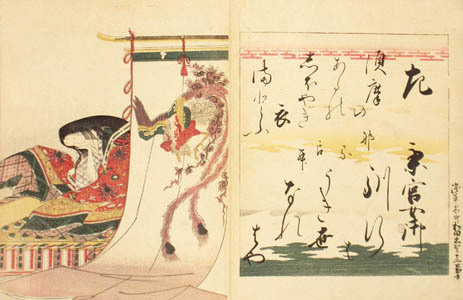
Reproduces an album with the poems and imaginary portraits of the great writers that flourished in the imperial court of Japan from the ninth to thirteenth centuries.

Paperback

First published January 1, 1991

3 people are currently reading
62 people want to read

About the author

Ratings & Reviews

What do you think?
Rate this book

Friends & Following

Create a free account to discover what your friends think of this book!

Community Reviews

5 stars
12 (52%)
4 stars
2 (8%)
3 stars
8 (34%)
2 stars
1 (4%)
1 star
0 (0%)
Displaying 1 - 6 of 6 reviews
Profile Image for Mir.
4,976 reviews5,330 followers
July 9, 2018
This is how you present translated poetry. Excellent.

This volume reproduces an album with the poems and imaginary portraits of the great women writers that flourished in the imperial court of Japan from the ninth to thirteenth centuries. For every poem (yes, every single one) there is not only a translation, with extensive notes explaining the meaning(s) and symbolism, but also a phonetic text showing how it sounded, notes on the author's autobiography with emphasis on elements that related* to the poem, and translations of the poems to which the poet was responding or was influenced by.

It is all presented in such a way as to be accessible to non-experts. There is minimal technical terminology and where something like a custom or item of apparel is significant, it is explained.


*Often the poems were noted at the time as being written for specific people, such as "X wrote this in response to Y's poem asking if her feelings had changed." Others were written for less personal reasons, such as poetry competition with a set theme.
Profile Image for Ingrid.
473 reviews7 followers
October 30, 2022
This is a really excellent way to translate haikus: each poem is transliterated and translated on one page, and the entire facing page provides the historical, linguistic, or cultural context that's necessary to truly appreciate how complex and masterful these short works are. Beautiful, full page reproductions of the original album pages allow the reader to appreciate not only Chōbunsai Eishi's art, but also the calligraphy.
Author 10 books2 followers
August 9, 2019
An interesting book, I wish it had more poetry. Sometimes the descriptions felt like the guy was dragging them out when he was talking about the calligraphy because that’s not why I was reading the book. The calligraphy isn’t even by the women who wrote the poetry, just some random kids. Who cares?

Anyway, loved reading up on more female poets of like the 9th-13th century. Great stuff there.
Profile Image for Brian Coltin.
73 reviews
October 19, 2023
I got a bit too into Tale of Genji. Lovely selection of poetry, great explanations. I do wish it had included printed versions of the poems in kanji rather than romaji because it is very difficult to read the calligraphy for the uninitiated.
Profile Image for Paul H..
874 reviews462 followers
September 26, 2017
The book itself is beautiful (color illustrations) and the explanatory material is impressive. Unfortunately Japanese poetry from the Heian period is generally mannered, repetitive, and dull. Poetry written by women in this era is, tragically, even more unimpressive, as they were basically restricted to writing love poetry, which relies on a handful of tropes.

For world-class poetry written by a woman at roughly the same time and in a similar tradition, check out Li Ch'ing-Chao (1084-1155), who is ridiculously talented.
Profile Image for Scott Berzon.
38 reviews7 followers
March 7, 2010
I enjoyed the headnotes/history of these Japanese women poets more than most of the poems themselves.
Displaying 1 - 6 of 6 reviews

Can't find what you're looking for?

Get help and learn more about the design.