

What do you think?

You Are Eating an Orange. You Are Naked.
A young translator living in Toronto frequently travels abroad—to Hong Kong, Macau, Prague, Tokyo—often with his unnamed lover. In restaurants and hotel rooms, the couple begin telling folk tales to each other, perhaps as a way to fill the undefined space between them. Theirs is a comic and enigmatic relationship in which emotions are often muted and sometimes masked by verbal play and philosophical questions, and further complicated by the woman’s frequent unexplained disappearances.
You Are Eating an Orange. You Are Naked. is an intimate novel of memory and longing that challenges Western tropes and Orientalism. Embracing the playful surrealism of Haruki Murakami and the atmospheric narratives of filmmaker Wong Kar-wai, Sheung-King’s debut is at once lyrical and punctuated, and wholly unique, and marks the arrival of a bold new voice in Asian-Canadian literature.
Praise for You Are Eating an Orange. You Are Naked.:
Longlisted for CBC's Canada Reads 2021
“One of the best book debuts of 2020” — The Globe and Mail
“Sheung-King has written a wonderfully unexpected and maverick love story but also a novel of ideas that hopscotches between Toronto, Macau, Hong Kong, Tokyo, and Prague. It is enchanting, funny, and a joy to read.”
—Kyo Maclear, author of Birds Art Life
“A tale of two rich and rootless people that oozes the horror and confusion of love, while staying somehow still desperately romantic, and so gloriously sad. This novel is also about something else: it gives the cold shoulder to the dominant gaze and its demands to control the Asian body, carving out a thrilling space beyond whiteness. I didn’t want it to end.” —Thea Lim, author of An Ocean of Minutes, a finalist for the Scotiabank Giller Prize
“In a cruel paradox for writers who are just trying to recount their lives, the tropes of diasporic lit have made it nearly impossible to write about belonging without also placing whiteness at the center of attention—the tropes exist because stories that do this are regularly rewarded with publication. But You Are Eating an Orange. You Are Naked. sidesteps this trap all together: It is bored by Western approval.”
— Thea Lim, The Nation.
“He practically sets the page on fire." —Brett Josef Grubisic, Toronto Star
You Are Eating an Orange. You Are Naked. is an intimate novel of memory and longing that challenges Western tropes and Orientalism. Embracing the playful surrealism of Haruki Murakami and the atmospheric narratives of filmmaker Wong Kar-wai, Sheung-King’s debut is at once lyrical and punctuated, and wholly unique, and marks the arrival of a bold new voice in Asian-Canadian literature.
Praise for You Are Eating an Orange. You Are Naked.:
Longlisted for CBC's Canada Reads 2021
“One of the best book debuts of 2020” — The Globe and Mail
“Sheung-King has written a wonderfully unexpected and maverick love story but also a novel of ideas that hopscotches between Toronto, Macau, Hong Kong, Tokyo, and Prague. It is enchanting, funny, and a joy to read.”
—Kyo Maclear, author of Birds Art Life
“A tale of two rich and rootless people that oozes the horror and confusion of love, while staying somehow still desperately romantic, and so gloriously sad. This novel is also about something else: it gives the cold shoulder to the dominant gaze and its demands to control the Asian body, carving out a thrilling space beyond whiteness. I didn’t want it to end.” —Thea Lim, author of An Ocean of Minutes, a finalist for the Scotiabank Giller Prize
“In a cruel paradox for writers who are just trying to recount their lives, the tropes of diasporic lit have made it nearly impossible to write about belonging without also placing whiteness at the center of attention—the tropes exist because stories that do this are regularly rewarded with publication. But You Are Eating an Orange. You Are Naked. sidesteps this trap all together: It is bored by Western approval.”
— Thea Lim, The Nation.
“He practically sets the page on fire." —Brett Josef Grubisic, Toronto Star
190 pages, Paperback
First published October 27, 2020
About the author
Sheung-King
4 books119 followersSheung-King, Aaron Tang is an author and educator. His debut novel, You Are Eating an Orange. You Are Naked is a finalist for the 2021 Governor General's Award, a finalist for the 2021 Amazon Canada First Novel Award, longlisted for CBC’s Canada Reads 2021, and named one of the best book debuts of 2020 by the Globe and Mail. Born in Vancouver, Sheung-King grew up in Hong Kong. His work examines “the interior lives of the transnational Asian diaspora” (Thea Lim, The Nation). He taught creative writing at the University of Guelph. His next second novel, BATSHIT SEVEN, is published by Penguin Random House Canada. Sheung-King holds a Master of Fine Arts in creative writing from the University of Guelph.
Ratings & Reviews
Friends & Following
Create a free account to discover what your friends think of this book!
Community Reviews
Displaying 1 - 30 of 391 reviews

May 12, 2022
This book is odd.
Not just because of that title (although, sheesh), but because the most interesting parts of it are actually from other stories and books. The original content here: Meh. The analyses of other works and summaries of folktales: Cool, fun, I love em.
I mean, it's not that crazy, and actually I am forced to find it very Relatable, because I too am most interesting for my commentaries (in that the coolest / most unique thing about me is that I write reviews that people read).
So I don't know how much credit to give either the book or myself.
I do like the footnotes and I usually do not, so that's a win, and while often even when I am paying a book the highest compliment I can (writing down quotes from it), I also wrote thoughts I had while reading this one.
That was also cool and new.
Bottom line: A book that makes you think!
------------------------
pre-review
a thinker.
review to come / 3.5 stars
------------------------
currently-reading updates
weird brag but ok
------------
reading books by asian authors for aapi month!
book 1: kim jiyoung, born 1982
book 2: siren queen
book 3: the heart principle
book 4: n.p.
book 5: the hole
book 6: set on you
book 7: disorientation
book 8: parade
book 9: if i had your face
book 10: joan is okay
book 11: strange weather in tokyo
book 12: sarong party girls
book 13: the wind-up bird chronicle
book 14: portrait of a thief
book 15: sophie go's lonely hearts club
book 16: chemistry
book 17: heaven
book 18: the atlas six
book 19: the remains of the day
book 20: is everyone hanging out without me? and other concerns
book 21: why not me?
book 22: when the tiger came down the mountain
book 23: the lies we tell
book 24: to paradise
book 25: pachinko
book 26: you are eating an orange. you are naked.
Not just because of that title (although, sheesh), but because the most interesting parts of it are actually from other stories and books. The original content here: Meh. The analyses of other works and summaries of folktales: Cool, fun, I love em.
I mean, it's not that crazy, and actually I am forced to find it very Relatable, because I too am most interesting for my commentaries (in that the coolest / most unique thing about me is that I write reviews that people read).
So I don't know how much credit to give either the book or myself.
I do like the footnotes and I usually do not, so that's a win, and while often even when I am paying a book the highest compliment I can (writing down quotes from it), I also wrote thoughts I had while reading this one.
That was also cool and new.
Bottom line: A book that makes you think!
------------------------
pre-review
a thinker.
review to come / 3.5 stars
------------------------
currently-reading updates
weird brag but ok
------------
reading books by asian authors for aapi month!
book 1: kim jiyoung, born 1982
book 2: siren queen
book 3: the heart principle
book 4: n.p.
book 5: the hole
book 6: set on you
book 7: disorientation
book 8: parade
book 9: if i had your face
book 10: joan is okay
book 11: strange weather in tokyo
book 12: sarong party girls
book 13: the wind-up bird chronicle
book 14: portrait of a thief
book 15: sophie go's lonely hearts club
book 16: chemistry
book 17: heaven
book 18: the atlas six
book 19: the remains of the day
book 20: is everyone hanging out without me? and other concerns
book 21: why not me?
book 22: when the tiger came down the mountain
book 23: the lies we tell
book 24: to paradise
book 25: pachinko
book 26: you are eating an orange. you are naked.

May 20, 2021
It's a confident debut that namedrops Goethe, Nietzsche, Judith Butler, Ai WeiWei and Mo Yen. It was inspired by the films of Wong Kar-wai and written as part of Sheung King's Masters thesis - and despite all this, avoids coming across as insufferably pretentious. That doesn't make it any less challenging a read though.
"In the Meiji Era, Natsume Soseki translated the English phrase I love you as The moon is beautiful, isn’t it? He believed that feelings should be expressed indirectly rather than directly. And to him, that question—the moon is beautiful, isn’t it?—perfectly captured the state of affection known as love.”
That is how the book reads to me. My normal galloping pace of reading renders the text inscrutable and opaque. (I know I said it wasn't pretentious, but I love this paragraph and how it fits into the larger story) If only you'd sit with it a bit it could bloom in understanding and significance, but I'm already 2 pages past that. The fault lies with me and my inability to slow down, reread and consider what is being hinted at here. In that sense it's closer to poetry and its need to be more closely considered. Right book at the wrong time for me.
"In the Meiji Era, Natsume Soseki translated the English phrase I love you as The moon is beautiful, isn’t it? He believed that feelings should be expressed indirectly rather than directly. And to him, that question—the moon is beautiful, isn’t it?—perfectly captured the state of affection known as love.”
That is how the book reads to me. My normal galloping pace of reading renders the text inscrutable and opaque. (I know I said it wasn't pretentious, but I love this paragraph and how it fits into the larger story) If only you'd sit with it a bit it could bloom in understanding and significance, but I'm already 2 pages past that. The fault lies with me and my inability to slow down, reread and consider what is being hinted at here. In that sense it's closer to poetry and its need to be more closely considered. Right book at the wrong time for me.

May 15, 2021
I loved this book. It made me miss my girlfriend so much. Not because she's anything like you, but because love feels like buying groceries and taking walks and having conversations in the bathtub.
I loved this book. Every story, every chapter, felt like the few times I have managed to eat ice cream slowly and actually enjoy the flavours.
I loved this book. It made me sad because I always felt like you and me were on borrowed time, and you would take the envelope, drink the elixir, become a celestial fox. And that's what our young relationship feels like to me. Like something beautiful I'm trying to enjoy without thinking too much about how it's going to end one day. Like a book.
I loved this book. Every story, every chapter, felt like the few times I have managed to eat ice cream slowly and actually enjoy the flavours.
I loved this book. It made me sad because I always felt like you and me were on borrowed time, and you would take the envelope, drink the elixir, become a celestial fox. And that's what our young relationship feels like to me. Like something beautiful I'm trying to enjoy without thinking too much about how it's going to end one day. Like a book.

May 26, 2021
One part love story, one part folk tale, one part dream like reverie, one part meditation on having multiple cultures, and one part art/literary critique. That's a lot to pack in a slim novel, but it works. All the threads are balanced carefully and come together for a satisfying story that also makes you think. I was most struck by how my feelings for the protagonists changed from the first story to the last. They aren't perfect people, and they are pretty opaque (especially to each other) but they were both very interesting to learn about and spend time with. The narrator mentions several times his love for Murakami, and this novel owes a lot to his dreamy aimless intelligent characters. And when you add in the element of cross cultural exploration and (mis)understanding, you get a book that is really enjoyable!
**Thanks to the author, publisher, and NetGalley for a free copy in exchange for an honest review.
**Thanks to the author, publisher, and NetGalley for a free copy in exchange for an honest review.

February 2, 2021
I did not know what to expect when I picked up this book. Initially, I found it slow going, but it wasn't long before I became fascinated and interested in the stories and folktales the young translator tells his girlfriend.
They travel from his apartment in Toronto to Hong Kong, Macau, Tokyo and Prague. My nephew worked in Macau several years ago, so I was exceptionally curious and pleased to read the descriptions of casinos, restaurants, the ferry to Hong Kong, and learn interesting 'tidbits' about this rich little country.
I appreciate the few times that Sheung-King uses footnotes to give recipes or explain unfamiliar food names or words.
Sheung -King's writing is lyrical and unique. I have never before read anything like it and am glad that this book was longlisted for Canada Reads 2021.
I agree with Thea Lim, author of An Ocean of Minutes, "I didn't want it to end."
4 stars
They travel from his apartment in Toronto to Hong Kong, Macau, Tokyo and Prague. My nephew worked in Macau several years ago, so I was exceptionally curious and pleased to read the descriptions of casinos, restaurants, the ferry to Hong Kong, and learn interesting 'tidbits' about this rich little country.
I appreciate the few times that Sheung-King uses footnotes to give recipes or explain unfamiliar food names or words.
Sheung -King's writing is lyrical and unique. I have never before read anything like it and am glad that this book was longlisted for Canada Reads 2021.
I agree with Thea Lim, author of An Ocean of Minutes, "I didn't want it to end."
4 stars
December 28, 2022
When you read the book's title, you can tell right away that it's not an average book; it's something different, something melancholy, and when you read the first line, which mentions one of your all-time favourite movies, you are immediately drawn in. This book might be good or bad. Either too little or none at all feelings will be evoked by it. You could also fall into the third type, which includes those who can relate to some areas but struggle to connect or relate to others. The prose is incredibly ethereal, and I can tell that the author is a fan of Wong kar wai from the sentences ( which he has also mentioned).
Being a fan of Wong Kar Wai, I ought to have enjoyed this book, but I came to the realisation that I would have felt the same if wong kar wai's movie was presented in a book format.
Being a fan of Wong Kar Wai, I ought to have enjoyed this book, but I came to the realisation that I would have felt the same if wong kar wai's movie was presented in a book format.

January 19, 2021
Wow. This is not at all what I was expecting. I wasn't in the mood for a book like this. I was tired on a Friday evening. And I started reading and the book totally changed my mood. It was perfect. I read most of it in one sitting. So, so good. And different. I feel as though more people should be talking about this.

March 7, 2021
i feel like this novel was written specifically for me as it is perfect in ways that are entirely too personal to share <3
August 3, 2025
Derivative or Not? 🍁
A review of the Book*hug Press paperback (October 27, 2020).
I took a chance on this one when I was at the Lakefield Literary Festival this year. I usually like to support the local indie bookstore, the authors and their current books, but the readings and the subject matter of the recent Batshit Seven (2024) did not make it sound very impressive. I saw that this earlier book was nominated for some Canadian literary awards such as the Governor General so it seemed the better bet.
The opening was a brief (but uncredited) synopsis of director Wong Kar-Wai's film Chungking Express and the book goes on to quote other film plots and various Chinese folktales and/or Buddhist Monk parables (I can't vouch for the authenticity of those, some might be the author's original work). These are told as stories by the narrator to his girlfriend. They are perhaps meant to be metaphors about their relationship, but the tie-ins were often lost on me.
References to Mo Yen (sic) and Metis Atahs (sic) were either intentionally misspelled or hinted at a lack of due diligence by the author and/or copy editor. Presumably novelist Mo Yan and artist Metis Atash were the actual intended references.
On the upside, the on again/off again relationship between the Chinese translator and his Japanese girlfriend does make for some comedic meet-cute moments and banter, as does the translator's encounters with a romantic rival. Some of those you can read in my status updates below (here if you are reading outside of GR).
There was somewhat of a unrealistic element with the lead characters doing piece/gig work but living in the high-priced downtown Toronto Waterfront area and also travelling worldwide to cities such as Macau, Hong Kong, Tokyo, and Prague.
With that and the suspicion that much of it was quoting from other plots and literature the overall impression was only so-so. A GR 3-star "Liked It" is the most I can give.
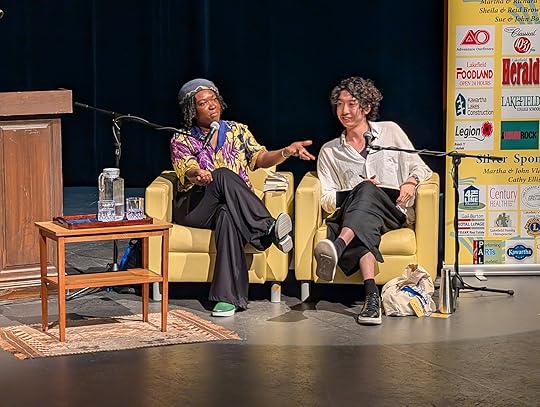
Authors Canisia Lubrin (Code Noir) and Sheung-King (Batshit Seven) at the 2025 Lakefield Literary Festival. Image sourced from Facebook.
A review of the Book*hug Press paperback (October 27, 2020).
I took a chance on this one when I was at the Lakefield Literary Festival this year. I usually like to support the local indie bookstore, the authors and their current books, but the readings and the subject matter of the recent Batshit Seven (2024) did not make it sound very impressive. I saw that this earlier book was nominated for some Canadian literary awards such as the Governor General so it seemed the better bet.
The opening was a brief (but uncredited) synopsis of director Wong Kar-Wai's film Chungking Express and the book goes on to quote other film plots and various Chinese folktales and/or Buddhist Monk parables (I can't vouch for the authenticity of those, some might be the author's original work). These are told as stories by the narrator to his girlfriend. They are perhaps meant to be metaphors about their relationship, but the tie-ins were often lost on me.
References to Mo Yen (sic) and Metis Atahs (sic) were either intentionally misspelled or hinted at a lack of due diligence by the author and/or copy editor. Presumably novelist Mo Yan and artist Metis Atash were the actual intended references.
On the upside, the on again/off again relationship between the Chinese translator and his Japanese girlfriend does make for some comedic meet-cute moments and banter, as does the translator's encounters with a romantic rival. Some of those you can read in my status updates below (here if you are reading outside of GR).
There was somewhat of a unrealistic element with the lead characters doing piece/gig work but living in the high-priced downtown Toronto Waterfront area and also travelling worldwide to cities such as Macau, Hong Kong, Tokyo, and Prague.
With that and the suspicion that much of it was quoting from other plots and literature the overall impression was only so-so. A GR 3-star "Liked It" is the most I can give.
Authors Canisia Lubrin (Code Noir) and Sheung-King (Batshit Seven) at the 2025 Lakefield Literary Festival. Image sourced from Facebook.

May 3, 2022
A strange book that found me sitting between a man, his mind, his girlfriend, their walks, talks, travel, and cigarette smoke. It was strange in the way that I like, but also a little miserable in a way that I found annoying, yet bearable.
I loved the commentary surrounding Lost In Translation, I laughed and Sheung-King made me see that movie completely differently. The first thematic read of Asian/Asian-American/Pacific Islander Month and it was iight.
I loved the commentary surrounding Lost In Translation, I laughed and Sheung-King made me see that movie completely differently. The first thematic read of Asian/Asian-American/Pacific Islander Month and it was iight.

January 18, 2021
Great, really great. Loved the second person POV. Any book that starts out with a recount of the plot of Chungking Express has my heart.

June 12, 2021
05/17/2023 reread: I can't say I actually understood any more of this book the second time around but there's something about it that is just able to transport me across time and space and I love that about it. Reread this on audio and I think I prefer this book as a physical read, for what it's worth. Also, I am begging more authors to please write in second person 🥲
Original review: A lot of the metaphors went over my head, but overall, this was a really great book. I loved the writing, and I'm a sucker for stories within a story. It is written completely in second person, so if that's not your thing, I'd maybe avoid this one. That being said, I personally felt like the narrative choice worked really well, especially later on in the book. I felt a lot of nostalgia for the MC's experiences, both on his travels and his life in Toronto and Hong Kong, which probably makes me a bit biased. I also think there are some interesting conversations here about orientalism and the western gaze, and I definitely think this is a book I will reread in the future.
Original review: A lot of the metaphors went over my head, but overall, this was a really great book. I loved the writing, and I'm a sucker for stories within a story. It is written completely in second person, so if that's not your thing, I'd maybe avoid this one. That being said, I personally felt like the narrative choice worked really well, especially later on in the book. I felt a lot of nostalgia for the MC's experiences, both on his travels and his life in Toronto and Hong Kong, which probably makes me a bit biased. I also think there are some interesting conversations here about orientalism and the western gaze, and I definitely think this is a book I will reread in the future.
July 31, 2021
This is a poor man's Murakami, and Murakami was already mediocre to begin with. Rambling, meaningless, namedrops better authors trying to coast off their ideas and impact to trick the reader into thinking this is deeper than a shallow rain puddle. The book reads like throwing rice against a wall trying to see what sticks. Insufferable. The humor of "lmao SPORK so randumb xddd".
I don't know how or why this trash was published. I assume the author knew someone.
I don't know how or why this trash was published. I assume the author knew someone.

Read
January 30, 2023some of this book went over my head which is not the worst thing, I do think it's clever how it decenters whiteness and explores orientalism. the joke about kazuo ishirugo being his favourite white writer, funny! It definitely explores the idea of media and representation and a portrayal of an Asian identity well and that part was interesting
but ... it kind of reminded me of Murakami, but in the sense of it reminded me of the worst of murakami. I don't know, I find the pining male main character whose kind of pathetic like the most boring protagonist to follow ever, always, and so much of the monologue made me roll my eyes. I didn't like the portrayal of the female love interest and I also found the writing style kinda... meh.
anyways, not rating as I'm not sure what I would rate it
but ... it kind of reminded me of Murakami, but in the sense of it reminded me of the worst of murakami. I don't know, I find the pining male main character whose kind of pathetic like the most boring protagonist to follow ever, always, and so much of the monologue made me roll my eyes. I didn't like the portrayal of the female love interest and I also found the writing style kinda... meh.
anyways, not rating as I'm not sure what I would rate it

May 31, 2023
2.5 stars. This was... odd? I know it is playing on Japanese surrealism but it really did feel quite disjointed and hard to settle in to at times. A couple are basically telling each other different stories and the stories get weirder and weirder. I felt quite invested in a story only then to be taken out of it and told about fruit. It was just strange. I appreciated it more than I enjoyed the actual reading experience as it's great to read a Canadian novel grappling with eastern surrealism as I've never seen that done in a book before.

March 13, 2023
I'm not sure whether I liked this or not... Might come back for a better and more thought out review but let's be honest, I'll probably forget.

October 17, 2021
I couldn't enjoy the book because the girlfriend was awful. Don't know why the narrator put up with that toxicity.
Yikes.
Yikes.
Read
December 20, 2022Was exactly how I imagine a dude from film twitter will tweet after watching the popular movies.

March 31, 2022
I picked this up for the entertaining title (You are Eating an Orange. You are Naked.), but I definitely stayed for the yearning. Marupok ako. Bye.
Final impressions to follow.
Recommended!
🌻🍃 More bookish content on Shut up, Shealea 🍃🌻
instagram • pinterest • twitter • ko-fi
Final impressions to follow.
Recommended!
🌻🍃 More bookish content on Shut up, Shealea 🍃🌻
instagram • pinterest • twitter • ko-fi

March 18, 2021
I love this book on a spiritual level.

November 20, 2025
Mixed feelings about this one. The narrator talks about "you" — in this case his elusive girlfriend.
In my review of Open Water I observed that the 2nd person narrative can be off-putting — judgmental, awkward, isolating, accusatory. At least in "Orange / Naked" the "you" is confined to one person, that is — until the last 30 pages, when the "you" shifts to the narrator himself.
Is this auto fiction, or a version of the Japanese "I novel" (or perhaps a Hong Kong "You novel")?
Many quotes from Goethe, Barthes, and other writers, and references to movies, artists. Does one thing lead to another, or do things just happen? — that question is subject to eternal recurrence; another concept handled and examined.
The result is an interesting novel, readable but not that engaging. The last section foists a complicating twist on the whole thing — is it memoir, or indeed auto fiction, as the author suggests in the last section (which reeks of meta-fiction, or perhaps, to be more accurate, emits gentle persistent whiffs of meta-fiction with an laboured undercurrent of literary pretension).
What to rate this? I read it, but didn't enjoy it. So many restaurant visited. So many movies, and glasses of wine, and designer labels. So much judgement and insecurity. So much compare and despair. So much self-hatred and self-awareness. So much eternal recurrence— and then some more.
Here are 3 genuine paragraphs: I open the fridge again. I stare into the fridge. I stare into the fridge—
Heck 3 stars, why not?
In my review of Open Water I observed that the 2nd person narrative can be off-putting — judgmental, awkward, isolating, accusatory. At least in "Orange / Naked" the "you" is confined to one person, that is — until the last 30 pages, when the "you" shifts to the narrator himself.
Is this auto fiction, or a version of the Japanese "I novel" (or perhaps a Hong Kong "You novel")?
Many quotes from Goethe, Barthes, and other writers, and references to movies, artists. Does one thing lead to another, or do things just happen? — that question is subject to eternal recurrence; another concept handled and examined.
The result is an interesting novel, readable but not that engaging. The last section foists a complicating twist on the whole thing — is it memoir, or indeed auto fiction, as the author suggests in the last section (which reeks of meta-fiction, or perhaps, to be more accurate, emits gentle persistent whiffs of meta-fiction with an laboured undercurrent of literary pretension).
What to rate this? I read it, but didn't enjoy it. So many restaurant visited. So many movies, and glasses of wine, and designer labels. So much judgement and insecurity. So much compare and despair. So much self-hatred and self-awareness. So much eternal recurrence— and then some more.
Here are 3 genuine paragraphs: I open the fridge again. I stare into the fridge. I stare into the fridge—
Heck 3 stars, why not?

April 5, 2021
2 stars *may change
This book is hilarious. Like, genuinely funny in a bad way, I had no idea what I was going into at first, but man, that was something. The book manages to be written in both first and second tense, with a narrator describing the female companion as "you" (me? I would never). It was so...something?
The best way I can describe this book is using a quote from it (Note that I listened to the audiobook so this is me writing it down based on what I hear): "Out of nowhere, I realize that I don't mind you flicking my dick when you're drunk. In contrast, maybe a part of me likes that you flip my dick and walk away. I imagine you walking into the restaurant, flicking my penis, and just walking away without saying a word."
Ahahaha, what? Okay.
I mean, yeah, I don't know what else to say. This book wasn't for me. Go figure.
This book is hilarious. Like, genuinely funny in a bad way, I had no idea what I was going into at first, but man, that was something. The book manages to be written in both first and second tense, with a narrator describing the female companion as "you" (me? I would never). It was so...something?
The best way I can describe this book is using a quote from it (Note that I listened to the audiobook so this is me writing it down based on what I hear): "Out of nowhere, I realize that I don't mind you flicking my dick when you're drunk. In contrast, maybe a part of me likes that you flip my dick and walk away. I imagine you walking into the restaurant, flicking my penis, and just walking away without saying a word."
Ahahaha, what? Okay.
I mean, yeah, I don't know what else to say. This book wasn't for me. Go figure.

Want to Read
September 5, 2020I have no idea what this is about but I see that title and it looks so meta and I just finished watching that new Kaufman film and you know what? I'm in. And I am naked.

Read
October 31, 2020I need time. I didn't really like it. But I liked some it. I dunno.
January 25, 2024
very apparent that it was written by a man; folk stories: 5 stars, plot: 3 stars

March 13, 2024
Would you care to stab me?

June 14, 2021
I really really loved this. For fans of Hiromi Kawakami.
November 17, 2020
The stories follow the unnamed first person protagonist ("I") and his unnamed girlfriend, who is always referred to in second person ("you"). The couple travels to various locations all over the world--they are rootless, transnational subjects--and talk about stories and books, this and that. The dialogue between the pair and the exploratory freedom with which the book is written reminded me a little bit of Diderot's Jacques the Fatalist and His Master.
The book begins with the anxiety of separation; there is the reference of the thirty cans of pineapple in Chungking Express: "I am a can of pineapple. Cop 223 is as well. We're watching Chungking Express. On April 1, Cop 223's girlfriend, May, leaves him" (p.9). This is one of the only consistent themes throughout. It serves as a weak connection for all of the stories and adds a latent tension. This theme is returned to in the concluding story, "Kafka's Guide to Love," as a way of wrapping up the book. Some of the stories lacked connective tissue to such an extent that I wondered if this was deliberate. The story "Snow in June" ends with "I wake up the next morning and you are not next to me. You don't leave a note, nor do you answer the phone... Maybe you'll be gone for a while" (p. 83). The next story, "Grocery Shopping in the Desert," begins with "We are naked" (p.85): an ellipsis... Perhaps Aaron is attempting to subvert Western novelistic narrative conventions?
The writing is quite experimental. Different writing conventions are used: some stories are sub-divided using numbers (a la Milan Kundera in Aaron's own admission, although it was used differently than Kundera; Kundera modeled his novels after the structure of musical compositions, and used numbers to control the "tempo" of his sections); some stories use screenwriting conventions to mark dialogue (e.g. "You: Your eyes are brown"); in the chapter the "Kitchen God," Aaron experiments with a summative triplet at the end of the sub-sections.
Various texts are referenced in all of the stories. These texts modulate and actively shape the stories by providing a new frame of reference with which to understand the story, (e.g references to Goethe and Barthes in "I Am the One Who Waits") and by seeping into the writing itself (the first chapter, "Do You Like Pineapples?" is a good example).
Whether as homage or play, Aaron subtly references images, characters, and scenes from other writers in the book. "I notice a little mole on your lower back" (p. 12) (Murakami), man in a baseball hat in Macao (felt like some of Murakami's male characters), "you" smokes Virginia Slims (Wind-Up Bird Chronicles), "Is it you?" (p. 113) (Yoko Tawada's "The Bath"), the lunch meeting serving as an interpreter for a rich Asian couple (Yoko Tawada's "The Bath"). I noticed mostly references to Murakami and Yoko Tawada, although I am sure there are others.
I thought that the best story is "I Am Writing about a Hole," which was nominated for the 2018 Pushcart Prize for nonfiction. Aaron writes that "When the hole is present, the part of you that wants to speak vanishes and you lose the desire to say anything..." (p. 134). The hole is tangentially connected to racism and Orientalist discourses. Aaron uses the films of Clint Eastwood, an essay by Salman Rushdie, Lost in Translation, and more to try to better understand the hole. He decides "to look for ways to deal with such issues without getting angry" (p. 143). Through Mo Yan, Haruki Murakami, and Yoko Tawada (all non-Western writers), he learns how to deal with the hole. And as he writes about the hole, the hole disappears--a Nietzschean move of overcoming through art.
The book begins with the anxiety of separation; there is the reference of the thirty cans of pineapple in Chungking Express: "I am a can of pineapple. Cop 223 is as well. We're watching Chungking Express. On April 1, Cop 223's girlfriend, May, leaves him" (p.9). This is one of the only consistent themes throughout. It serves as a weak connection for all of the stories and adds a latent tension. This theme is returned to in the concluding story, "Kafka's Guide to Love," as a way of wrapping up the book. Some of the stories lacked connective tissue to such an extent that I wondered if this was deliberate. The story "Snow in June" ends with "I wake up the next morning and you are not next to me. You don't leave a note, nor do you answer the phone... Maybe you'll be gone for a while" (p. 83). The next story, "Grocery Shopping in the Desert," begins with "We are naked" (p.85): an ellipsis... Perhaps Aaron is attempting to subvert Western novelistic narrative conventions?
The writing is quite experimental. Different writing conventions are used: some stories are sub-divided using numbers (a la Milan Kundera in Aaron's own admission, although it was used differently than Kundera; Kundera modeled his novels after the structure of musical compositions, and used numbers to control the "tempo" of his sections); some stories use screenwriting conventions to mark dialogue (e.g. "You: Your eyes are brown"); in the chapter the "Kitchen God," Aaron experiments with a summative triplet at the end of the sub-sections.
Various texts are referenced in all of the stories. These texts modulate and actively shape the stories by providing a new frame of reference with which to understand the story, (e.g references to Goethe and Barthes in "I Am the One Who Waits") and by seeping into the writing itself (the first chapter, "Do You Like Pineapples?" is a good example).
Whether as homage or play, Aaron subtly references images, characters, and scenes from other writers in the book. "I notice a little mole on your lower back" (p. 12) (Murakami), man in a baseball hat in Macao (felt like some of Murakami's male characters), "you" smokes Virginia Slims (Wind-Up Bird Chronicles), "Is it you?" (p. 113) (Yoko Tawada's "The Bath"), the lunch meeting serving as an interpreter for a rich Asian couple (Yoko Tawada's "The Bath"). I noticed mostly references to Murakami and Yoko Tawada, although I am sure there are others.
I thought that the best story is "I Am Writing about a Hole," which was nominated for the 2018 Pushcart Prize for nonfiction. Aaron writes that "When the hole is present, the part of you that wants to speak vanishes and you lose the desire to say anything..." (p. 134). The hole is tangentially connected to racism and Orientalist discourses. Aaron uses the films of Clint Eastwood, an essay by Salman Rushdie, Lost in Translation, and more to try to better understand the hole. He decides "to look for ways to deal with such issues without getting angry" (p. 143). Through Mo Yan, Haruki Murakami, and Yoko Tawada (all non-Western writers), he learns how to deal with the hole. And as he writes about the hole, the hole disappears--a Nietzschean move of overcoming through art.
This entire review has been hidden because of spoilers.

April 7, 2021
4 stars
A couple hang out in cities around the world & tell each other stories: some from childhood, some fables or folktales, some they heard from a friend of a friend. This is the kind of slow moving, character-focused slice-of-life story I enjoy. Nothing rushed, plenty of time to contemplate ducks & capitalism & childhood & racism as the couple talk. The woman MC is a bit of a clichéd “quirky just because” character, but the writing is good otherwise.
[What I liked:]
•This book has a very similar style to an early Murakami novel, like Pinball or Norwegian Wood. A young man narrates, 1st person present tense. We never learn the couples’ names, but their characters are fleshed out with random details from childhood memories & the sometimes unexpected reactions or responses they have to situations & conversations. I really like slice-of-life stories when the characters are interesting & the prose is good.
•In addition to quirky tales, the book does explore some more weighty topics such the consequences of actions, finding purpose in work, & if anything means anything, etc. I like that the narration style feels like I’m almost a third person hanging out at the table drinking whiskey with the couple, considering death by falling pig & if gambling is problematic as they chat. The weightiness isn’t forced upon the reader, but you’re invited to sit & ponder.
•The character development isn’t linear, but I still enjoyed the moments of learning more about the MC’s as they popped up. For example, I enjoyed hearing about the guy’s grandfather & how he looked in his Sunday suit, how he liked to smoke a pipe & lived in Burma.
•Harold Lee is a great character—every discomfort he raises in the narrator, & how the narrator is jealous of him but doesn’t want to be, then likes Harold but doesn’t want to. It’s a very relatable sequence.
[What I didn’t like as much:]
•I enjoy this style of book, but if you are looking for action or a linear narrative you won’t find it here. I think the pace suits the style well, but this is definitely a “slow moving” story.
•I like the woman MC, more or less, but I do feel like some of her characterization may be overdone, as if she’s weird & quirky just because the writer wanted a weird & quirky woman character. She’s kinda flaky & does what she wants when she wants, but there’s not a clear motivation behind it—is she self centered? Does she have trust issues? Is she just very independent & also socially unaware of how her behavior affects others? I’ve no clue. She just seems to do odd things because it gives her mystique, which isn’t good character development in my opinion.
•I didn’t get a strong sense of how the narrator feels about his girlfriend & her oddities—or actually why they’re together at all. He says the way she smokes makes him want to kiss her, & there is some chemistry, but what does he think of her personality? Are they only together out of habit, or because there’s no one better to date? It’s not portrayed clearly.
•There is lots of...how to call it...name dropping? The MC’s discuss & quote writers & directors like Murakami & Salman Rushdie & Wong Kar-wai. It felt pretentious & didn’t fit very smoothly with the rest of the narrative.
CW: mentions of death & violence, discussions of racism including slurs
[I received an ARC ebook copy from NetGalley in exchange for my honest review. Thank you for the book!]
A couple hang out in cities around the world & tell each other stories: some from childhood, some fables or folktales, some they heard from a friend of a friend. This is the kind of slow moving, character-focused slice-of-life story I enjoy. Nothing rushed, plenty of time to contemplate ducks & capitalism & childhood & racism as the couple talk. The woman MC is a bit of a clichéd “quirky just because” character, but the writing is good otherwise.
[What I liked:]
•This book has a very similar style to an early Murakami novel, like Pinball or Norwegian Wood. A young man narrates, 1st person present tense. We never learn the couples’ names, but their characters are fleshed out with random details from childhood memories & the sometimes unexpected reactions or responses they have to situations & conversations. I really like slice-of-life stories when the characters are interesting & the prose is good.
•In addition to quirky tales, the book does explore some more weighty topics such the consequences of actions, finding purpose in work, & if anything means anything, etc. I like that the narration style feels like I’m almost a third person hanging out at the table drinking whiskey with the couple, considering death by falling pig & if gambling is problematic as they chat. The weightiness isn’t forced upon the reader, but you’re invited to sit & ponder.
•The character development isn’t linear, but I still enjoyed the moments of learning more about the MC’s as they popped up. For example, I enjoyed hearing about the guy’s grandfather & how he looked in his Sunday suit, how he liked to smoke a pipe & lived in Burma.
•Harold Lee is a great character—every discomfort he raises in the narrator, & how the narrator is jealous of him but doesn’t want to be, then likes Harold but doesn’t want to. It’s a very relatable sequence.
[What I didn’t like as much:]
•I enjoy this style of book, but if you are looking for action or a linear narrative you won’t find it here. I think the pace suits the style well, but this is definitely a “slow moving” story.
•I like the woman MC, more or less, but I do feel like some of her characterization may be overdone, as if she’s weird & quirky just because the writer wanted a weird & quirky woman character. She’s kinda flaky & does what she wants when she wants, but there’s not a clear motivation behind it—is she self centered? Does she have trust issues? Is she just very independent & also socially unaware of how her behavior affects others? I’ve no clue. She just seems to do odd things because it gives her mystique, which isn’t good character development in my opinion.
•I didn’t get a strong sense of how the narrator feels about his girlfriend & her oddities—or actually why they’re together at all. He says the way she smokes makes him want to kiss her, & there is some chemistry, but what does he think of her personality? Are they only together out of habit, or because there’s no one better to date? It’s not portrayed clearly.
•There is lots of...how to call it...name dropping? The MC’s discuss & quote writers & directors like Murakami & Salman Rushdie & Wong Kar-wai. It felt pretentious & didn’t fit very smoothly with the rest of the narrative.
CW: mentions of death & violence, discussions of racism including slurs
[I received an ARC ebook copy from NetGalley in exchange for my honest review. Thank you for the book!]
September 28, 2022
lol. not a single subject presented in this book has been tackled in any meaningful way, the characters were so poorly written that i can only compare the reading experience to the feeling of sandpaper on bare skin, perhaps the only redeemable features of this book were the stories from eastern folklore woven into the main plot and the prose. the narrator's lover is even more insufferable than he himself is, the author of this book somehow managed to write an even worse version of the typical manic pixie dream girl seen in popular media today lol. this book also heavily relies on its referencing of other artists who actually wrote or otherwise created profound pieces of art (such as wong kar-wai, osamu dazai, etc.) – all in an attempt to trick the reader into thinking that the piece of literature they're reading has anything deep to say. every topic the characters discussed has only been explored skin deep, if even that. some of them didn't even penetrate the epidermis. the way the pair sucks each other off, both metaphorically & physically, is also quite difficult to swallow, especially when we are meant to believe that their very ordinary and mundane critiques of certain topics/societal issues are somehow very profound and interesting and unique. all in all i'm incredibly saddened that i didn't enjoy this work. i seriously went in expecting to adore it - it had everything typically needed to win me over, from a narrator who's a translator to my favourite cities (hong kong, prague, taipei, etc), not to mention the refrences and discussions of wong kar-wai's works and other people who i deeply respect and appreciate, as well as fucking folktales!!!, it Seriously had ALL the things i like, it checked all the boxes required for me to love it and yet the execution was so very poor that i simply cannot give it more than a single star. this is probably the longest review i've ever written on this app and that's purely because of that fact lol! i'm literally just upset now, that i didn't enjoy this book even remotely as much as i initially thought i would. that's always a special kind of a heartbreak i think. anyways that's all. bai bai!
Displaying 1 - 30 of 391 reviews