Moto Hagio (萩尾望都 Hagio Moto) is a manga artist born in Ōmuta, Fukuoka Prefecture, Japan, though she currently lives in Saitama Prefecture. She is considered a "founding mother" of modern shōjo manga, and a member of the Year 24 Group (24-Gumi). She helped pioneer modern shōjo manga, modern science fiction manga, and BL manga. In addition to being an "industry pioneer", her body of work "shows a maturity, depth and personal vision found only in the finest of creative artists". She has been described as "the most beloved shōjo manga artist of all time."
Moto Hagio made her professional debut in 1969 at the age of 20 with her short story Lulu to Mimi on Kodansha's magazine Nakayoshi. Later she produced a series of short stories for various magazines for Shogakukan. Two years after her debut, she published Juichigatsu no Gimunajiumu (The November Gymnasium), a short story which dealt openly with love between two boys at a boarding school. The story was part of a larger movement by female manga artists at the time which pioneered a genre of girls' comics about love between young men. In 1974, Hagio developed this story into the longer Toma no shinzo (The Heart of Thomas). She was awarded the Shogakukan Manga Award in 1976 for her science fiction classic Juichinin iru! (They Were Eleven) and her epic tale Poe no ichizoku (The Poe Family).
31/8/20 My first classic shoujo! I'm so happy I read this one, it had so many interesting themes that were explored and the art was absolutely stellar. I think it's really cool to read pieces that have had such a huge influence on the manga that is currently being made. I'm most certainly looking forward to reading more of Hagio's work :) Also will be doing a review of this one soon on my Youtube channel :)
26/8/20 I have recently been getting into some older shoujo and shounen manga and this seemed right up my alley! :)
There is something dreamlike about both the art and the vignettes of this shifting cast of beautiful vampires. Hunters lost in the woods... lovely and fragile girls who look like other girls who died long ago... people who disintegrate, who drown or perhaps simple fall beneath the waves... abandoned children being fed on roses...
This will appeal to fans of atmosphere and art rather than strictly plotted story. Unless some installments are missing (which could be? They don't seem to be in chronological order, and I don't know if this is all the stories or a selection) there are a lot of disconnects and tales left unfinished. This is partly because they are connected only by Edgar, so when he leaves a scene we don't find out what happens to the rest of the characters.
Hagio is fantastic and an important artist in the development of modern manga, so I'm thrilled that she is being made more widely available to Anglophone audiences.
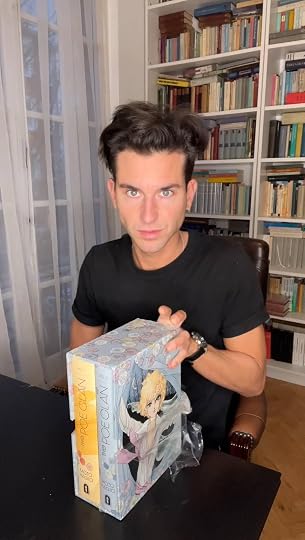
The physical book itself is massive and beautiful, pale gold and covered in roses. The art is so pretty and so 70's and VAMPIRES. Maybe the melodrama is a lot, but I love it. I never thought I'd see this released in English and am so happy.
I keep trying Moto Hagio books every so often, when I really shouldn't. Her stories are vague gothic melodrama, and the characters are sometimes hard to tell apart in the art.
This one is a vampire story about children who will not age anymore, but who can't stop swooning and fainting all over the place, short of the blood they need for energy. The chapters jump around the centuries, skipping forward and back, so we see characters in the 1750s in the middle of the book, for instance, who we already know died in the late 1800s, and then follow a couple of survivors into the 1950s.
I was on the fence about whether I might read the end despite being lukewarm on the start, having made it halfway through the storyline after all, but my local library made the decision for me since they don't have that volume in their collection. Oops.
FOR REFERENCE:
Contents: Chapter 1. Limpid Locks of Silver -- Chapter 2. The Village of Poe -- Chapter 3. Glensmith's Diary -- Chapter 4. The Poe Clan -- Chapter 5. Marybelle and the Silver Rose -- Chapter 6. The Birds' Nest
The Poe Clan is a classic shoujo series about the lives of a family of vampires. There are six chapters in this first volume, ranging from 20 pages greater than 100, skipping through time and location. Although two characters grace the cover, the devilish Edgar is the lead, and is the only character who appears throughout the book.
Although people will draw comparisons from the Poe Clan to Twilight series, as both are geared to teenage girls, this saga has much more in common with Anne Rice's Vampire Chronicles. So much so I have to wonder whether Moto Hagio read Interview With A Vampire before beginning this series. Both sagas brim with male homosexuality, vampires trapped in existential despair, eternal children, and are interested in warped family relationships and loss.
The reader is slowly introduced to the Poe Clan, through the eyes young men who are drawn the beautiful and eternally youthful Marybelle, and by the journals of wayfarers who stumble upon the Village of Poe surrounded by fields of roses. It isn't until Chapter 4 that the vampires take center stage, and it's more more than half way through before the reader gets an origin story for the main character. But these slow reveals and jumps in time give a depth and mystery to this story that I deeply appreciate. I even enjoy the slightly episodic nature of the chapters, giving Moto Hagio a chance to showcase different scenarios and eras for her characters.
The 'Vampirenella' of the Poe Clan drink the essences of both roses and humans, and seem to be able to draw energy from humans by the tips of their undead fingers as well as the occasional neck bite. I am unclear as to the exact nature of this Clan. Edgar can appear as a young man, a winged demon, or a satyr. Does he need blood, or can he survive on roses? No matter. He's too busy seducing young men. Eternity is "too much to bear alone."
The artwork here is definitely of the 70's manga, which will be dated to some viewers. I mind it less, although the last chapter felt rushed. Sequentially I was lost across a few pages and it was easy to confuse characters. The translation flows well and these edition is heavy and beautiful. I'm so glad Rachel Thorn has found Fantagraphics to publish Hagio's work, and I look forward to Volume Two.
La primera lectura del año no ha podido ser mejor. Hasta ahora lo que he leído de esta autora me ha gustado, así que no podía dejar escapar la que muchos consideran su mejor obra, y no decepciona. Me he llevado varias sorpresas mientras leía. La primera, que antes de llegar a la mitad del volumen, ya se había acabado la historia, a ver, es evidente que no porque queda más de medio tocho por leer, pero era un final, tan bueno que por un momento no supe que me encontraría a continuación.
La segunda sorpresa es esa continuación. Son diferentes historias que van adelante y atrás en el tiempo, desde el siglo XVIII a la guerra mundial, y ocurren en diferentes países. A pesar de parecer que esté todo mezclado en realidad tiene mucho sentido y he disfrutado mucho la lectura de esos capítulos. Está claro que esta autora siempre me sorprende y logra conquistarme con su narrativa. Qué ganas de que salga el segundo volumen!
The art definitely felt like it was from a different time. Graceful and full of significant looks. The page layouts are highly varied, with a lot of intricate detail that might make it a bit harder to follow if you are still nervous about reading manga. The book itself is oversized however, so it was really a very luscious and beautifully intricate experience that I felt a bit rushed through due to my library loan timeline.
An older story it is not surprising that the presentation of gender is not hugely progressive. That said, you could certainly tell how this aligned with Moto's credentials as the mother of shōnen-ai.
Race was the most uncomfortable thing for me when it came to this particular book. Not unique to this book, the way that "whiteness" is presented in most manga compared to how "blackness" is presented is not great. And while I certainly have heard other people talk about this, if any of y'all can direct me to more full some articles or books about race in manga I will love you forever. That said, I will keep trying to find these conversations and report back if I find anything. The chapter that coincided with the Holocaust was just weird too in my opinion.
Not very central, but there's at least one chapter in the book where one of the character is kind of wasting away. A very olden times and fairy tail sort of understanding of disability, much like everything else in this book.
Class is never really explored in the book. This is a typical vampire story where long life has lead to a generally high level of wealth.
A harder book for me to get through due to its length (512 pages!) it's a very strong book. Beautiful, it's easy to see the kind of influence that Moto Hagio has had in Manga. I'll be rating this volume three out of five stars.
The current goodreads blurb is pretty accurate. The one I read originally made this sound a lot smuttier and more gender-bent than it actually is. That's not a criticism of this book, which is very good; it was just different from what I expected. Beautiful and dreamy and sad -- kind of emo-historical fantasy, I guess?
3.5 rounded down. I LOVE the ending of the first chapter and enjoyed a couple of the other short stories, but needed some time to like actually realize they're standalone stories and not part of a continuous narrative lmao also while I love the art, I felt that the story beats didn't so much glide but jerk forward, which also took me some time to get used to.
Moto Hagio es de las pocas autoras de manga clásico que sigo de forma constante, desde que leí "¿quién es el pasajero número 11?" intento hacerme con todo el material material suyo que sale (normalmente editado por tomodomo como en esta ocasión). En este caso hablamos del que posiblemente sea su trabajo más popular, una historia de vampiros contada mediante episodios individuales de la vida de los protagonistas que se corresponden con distintos momentos de la historia europea.
Los vampiros de Moto Hagio (que ella llama Vampirnellas) tienen sus propias reglas que no siempre se asemejan a las de los vampiros tradicionales, de hecho a veces resultan un poco contradictorias, porque aunque se supone que los vampirnellas no beben sangre sino que la absorven de alguna manera con las manos, si se hace referencia a la sangre en algunos pasajes. En todo caso la autora prefiere dejar este tipo de cosas para la imaginación de cada uno y se centra en la relación entre los personajes principales (Edgar, Merribelle y Allan) y la de estos con otros personajes, en su mayoría humanos, en los que suelen dejar una huella imborrable para luego desaparecer de sus vidas envueltos en un halo de misterio y frecuentemente dejando consecuencias trágicas.
Aunque en el manga aparecen más vampirnellas con mayor o menor importancia en la trama, los personajes principales son los anteriormente mencionados Edgar, Merribelle y Allan, los dos primeros son hermanos y el tercero es incluido en el clan de los Poe posteriormente. Los tres coinciden en ser personajes en transición a la edad adulta, pero que conservan gran parte de la ingenuidad e inocencia de la niñez, esto contrasta con su condición de vampiros y su necesidad de extraer su sustento de las víctimas. Si hay un protagonista que destaque sobre los otros es Edgar, de hecho gran parte de las historias y sucesos giran en torno a sus necesidades y deseos... él es el que propicia la incorporación de Allan y Merribelle al clan, el que hace que se muevan las tramas por su amor a su hermana o por su deseo de vivir nuevas experiencias y en general el que lleva la voz cantante, hecho que se explica no sólo por su personalidad sino porque ha sido transformado en vampirnella por el líder del clan de los Poe y es el que transforma a su vez a los otros dos.
El arte de Hagio es muy especial y ha sido imitado por muchos autores posteriores, consigue una gran belleza en los personajes y los ambientes con unos trazos simples y claros, sin excesos estilísticos. En general el cómic es una maravilla visual, Moto Hagio es una maestra de la composición de página y consigue no sólo páginas y viñetas de gran belleza, sino que hace la lectura muy fluída y sencilla.
Why you should read this: It's one of the earliest but definetely the most influential vampire manga of the 1970s. It's also a shojo masterpiece, with beautiful eternal children who are cold and traumatized and so lonely ...
It's a stunning piece because it's so emotional: if you really let yourself feel with these characters, their situation is heartbreaking, beautifully rendered into images that only appear simple at first galnce.
Very interesting and novel take on child vampires - Vampanella in this one.
For vampire and gothic lovers. These stories are episodic in nature and not chronological, but the character development is stellar and it's well worth a read.
Moto Hagio always offers a very psychological approach to all her characters, and Poe is no exception. Every time a layer of their personality is pulled back, something new is revealed.
no one actually conveyed how good this is like the existential and poetical yearning is on par with that of anne rice's vampire saga???
and the stereotypical shōjo roses being plot relevant and obviously very much iconic and actually original in here???
at first the old fashioned art made me cringe a bit because i had never read a classic manga but i quickly changed my mind because it's so gorgeous??? and the composition in every page is stunning and unlike any other manga I've read???? the FLOW!!! hagio really understands how to distribute the vignettes and even the dialogue bubbles to suit the narration best in a way you rarely see in comics or mangas from anywhere, art spiegelmam wishes he had what hagio has!!!
En cuanto he podido tener un rato para poder leer con tranquilidad me he ventilado este primer volumen de El clan de los Poe. Me ha gustado, aunque no lo he disfrutado del todo como me ha pasado con otros mangas que me he leído. Este tomo consta de más de 470 páginas, pero se lee fácil y rápido. Pero también tengo que decir que, en las tramas de los distintos capítulos, que son como pequeños relatos, hay algunos saltos en la trama (o eso me ha parecido a mi) en los que me ha resultado un poco difícil seguir la historia. No sé si he terminado de entender la historia de este clan. Igualmente me ha gustado y lo he disfrutado sin saber que había vampiros que ha sido una sorpresa cuando lo he empezado a leer.
One of the early 70’s very first works by the woman considered to be one of the mothers of modern shojo manga.
The Poe Clan is, in my opinion, typical of those years when shojo manga authors became predominantly women who used this form of expression to convey their ideas in line with the feminist and sexual revolution and to offer stories with new themes — science fiction, fantasy, historical manga, etc. Love stories—but not only—with deep and often tortured characters.
The Poe Clan is the story of Edgar, Marybelle, and Allan, trapped in the bodies of young teenagers. Edgar, the main protagonist, suffers from profound loneliness and is consumed by remorse—spoiler stuff—in an evanescent and ethereal Gothic atmosphere between fields of roses and violent storms. Hagio also develops a homoerotic subtext which, along with The Heart of Thomas, will also make her a pioneer of the Boys' Love genre.
In short, we are dealing with pioneering work, created in a specific context, with historical/patrimonial value. The graphic style is typical of the 1970s, which I really appreciate. It is certainly very different from contemporary standards, but it is worth discovering.
Super contente d'avoir découvert l'oeuvre de Moto Hagio, enfin. Je savais pas trop dans quoi je m'aventurais, mis à part que j'allais suivre une famille de Vampanellas et que cela allait être incroyable visuellement parlant. C'était magnifique en effet mais c'était finalement bien plus que ça. J'ai adoré suivre le Clan des Poe, particulièrement Edgar et Marybelle sur des décennies. Je trouve que la mangaka fait un travail fabuleux pour retranscrire la solitude et la nostalgie du personnage principal, qui voyage de village en village en quête de compagnie. L'oeuvre est parsemée de passages lyriques (que je vois comme des chants) avec des dessins qui nous plonge dans un univers enchanteur et parallèle. J'ai bien aimé le fait qu'il n'y ai pas vraiment de temporalité précise, les histoires s'entremêlent toutes.
J'ai envie d'acheter des roses et d'en mettre partout dans ma chambre. Maintenant je regrette de ne pas avoir vu sa masterclass au festival d'Angoulême cette année. Gros coeur sur la traductrice aussi <3 (Je sens que cette lecture va me remettre dans ma folie manga)
El dibujo es precioso y se hace súper fácil de leer, aunque es un pelín largo (lo subestimé). Un poco caótico a veces e increíblemente dramático, menuDO CHISMAZO. Se nota que es antiguo por los detalles circenses que tiene, pero la verdad es que lo disfruté mucho. Also, la nota final de la traductora me encantó y me ayudo a entender muchas cosas, menuda reina. Vuelvo a recalcar, QUÉ BONITO DE LEER.
Kiedy Anne Rice myślała o Wywiadzie z wampirem, Moto Hagio stworzyła Klan Poe. Momentami chaotyczne, ale trafne i piękne są historie Hagio. Must read dla wszystkich fanów gotyckich wampirów. 🖤
Un des mangas les plus somptueux qu'il m'ait été donné de lire, ce n'est pas étonnant qu'il est considéré comme ayant influencé le genre du shōjo pour les décennies à suivre.
À travers plusieurs histoires dessinées tournant autour du personnage d'Edgar (et parfois, de Marybelle sa sœur et du clan des Poe, sa famille adoptive) présentée dans un désordre chronologique (ce qui n'est pas mauvais ici) et dans une Europe un peu romantisée, on découvre peu à peu l'univers des familles de vampanella (des vampires) qui doivent constamment changer de lieu et se retrouvent souvent isolés et seuls dans leurs incessants déplacement et désir de survie. Plusieurs des personnages sont très queer, sans jamais être nommée comme tel, mais c'est vraiment pas du sous-texte, c'est assez explicite et on ne peut pas s'empêcher de penser que Le Clan des Poe est un héritier spirituel à Carmilla et explore beaucoup plus l'idée des passions, du désir, des incessants voyages, etc. que sont prédécesseurs. Ce qui fait le charme de ce manga, ce sont les dessins absolument époustouflant souvent remplis de fleurs, de chevelure, qui tombe parfois dans l'onirisme quand les scènes le demande avec juste un petit soupçon d'horreur (avec de nombreux clair obscur) quand le scénario demande d'être un peu plus sombre.
J'apprécie aussi les récits de durée très varié et dont les sujets le sont tout autant, cela permet de multiplier les points de vue narratifs, donner de la place à différents personnages pour qu'ils soient beaucoup plus sujets que personnages secondaires et comprendre un peu mieux l'articulation des liens et leurs psychologie.
Il existe peu de manga parfait, mais celui-là en est un, aucune fausse note, dessin et narration incroyable, j'attends avec impatience la suite de ces histoires.
Debo empezar esta reseña admitiendo que me quise comprar este manga por la portada, me parece una maravilla y la edición es preciosa. Sin embargo cuando leía la sipnosis me llamó aún más la atención porque se trata de vampiros en el siglo 18/19.
El dibujo de Moto Hagio, si ya me parecía precioso en ¨Catarsis.¨ o en ¨¿Quién es el 11 pasajero?¨ ahora me resulta MARAVILLOSO. Es clásico y hay personajes que son iguales pero la forma de narrar que tiene la autora te hace saber diferenciarlos.
En cuanto la trama...cuando acabé la primera historia, El clan de los Poe, pensé que lo demás serían historias cortas y me decepcioné pues pensé que todo el tomo tenía que ver con los personajes. En efecto, así es. Todas las historias están conectadas, presentándonos el pasado de los Poe y por último la continuación de la primera historia. La forma en la que todo está conectado me ha gustado muchísimo.
Está claro que este es sin lugar a dudas mi manga favorito y estoy impaciente porque salga el segundo, y último tomo, de este manga.
The Poe family saga has developed over the centuries, placing the always fascinating figure of the vampire in a romantic perspective full of human drama.
The Poe clan doesn't age. However, the world around them continues to change, to progress and to offer continuous opportunities for meetings and exchanging relationships with human beings.
Hagio's narrative is engaging and dynamic and she alternates relaxed and peaceful moments with others that are more disturbing and full of tension. From my point of view the narrative capacity of Moto Hagio is tremendous, and the involvement of the reader in the events is inevitable.
The Poe clan tells the story of loneliness and sadness; of fleeting moments of love and of constant struggles to affirm their existence despite everything. The gift of immortality is actually a condemnation that brings pain and suffering without ever being able to stop.
Beautiful release — but the melodrama is so thick that it strangles a lot of the suspense out of the story. Edgar’s existence is the most tragic to me out of these characters’ eventual paths. Hagio is obviously a forerunner to the Vampire Knights and Twilights of the world; it is a shame she doesn’t seem to have have the same notoriety in the world as a whole as she does in Japan. Classics are classics for a reason!
Intento no pensar mucho en la sexualización de la infancia (que sí, que las niñas se casaban a tal edad, que muy bien) porque amo el clan de los Poe con todo mi corazón. Aquí me quedo, esperando el segundo tomo con muchas ganas.
Moto Hagio regina assoluta del fumetto, del disegno e della narrazione, capace di passare dal romantico struggente al frivolo drama settecentesco e poi di ripiombare nel tragico, nel decadente e sognante romantico, tutto con naturalezza, e poi che vampiri strepitosi, che inquietudini e sentimenti riesce a mettere in scena, intere vite intrecciate con la storia, le speranze, i sogni…