Jump to ratings and reviews
Rate this book

De boot in de avond

Rate this book
In zijn laatste, meest persoonlijke roman weet Tarjei Vesaas proza en poëzie te verenigen. Alledaagse scènes, dromen en visioenen wisselen elkaar af en vormen samen een indringend levensverhaal. De betovering van de dans van de kraanvogels, de eendrachtige samenwerking tussen vader, zoon en paard in een besneeuwd bos, de oude, zwijgzame vriendschap met een steen: Vesaas neemt je mee in zijn wereld en geeft je toegang tot zijn intiemste gevoelens en gedachten.

176 pages, Paperback

First published January 1, 1968

45 people are currently reading
916 people want to read

About the author

Tarjei Vesaas

82 books407 followers
Tarjei Vesaas was a Norwegian poet and novelist. Written in Nynorsk, his work is characterized by simple, terse, and symbolic prose. His stories often cover simple rural people that undergo a severe psychological drama and who according to critics are described with immense psychological insight. Commonly dealing with themes such as death, guilt, angst, and other deep and intractable human emotions, the Norwegian natural landscape is a prevalent feature in his works. His debut was in 1923 with Children of Humans (Menneskebonn), but he had his breakthrough in 1934 with The Great Cycle (Det store spelet). His mastery of the nynorsk language, landsmål (see Norwegian language), has contributed to its acceptance as a medium of world class literature.

Ratings & Reviews

What do you think?
Rate this book

Friends & Following

Create a free account to discover what your friends think of this book!

Community Reviews

5 stars
94 (27%)
4 stars
105 (31%)
3 stars
96 (28%)
2 stars
36 (10%)
1 star
7 (2%)
Displaying 1 - 30 of 65 reviews
Profile Image for Jim Fonseca.
1,157 reviews8,438 followers
February 9, 2022
[Edited 2/9/22]

This Norwegian author (1897-1970) is best known for his novel The Ice Palace. The book I am reviewing was his last work, written a couple of years before his death when he was 71. It’s a series of vignettes - memoirs really, more than short stories - of a young boy growing up. We aren’t told if these were real events that happened to the author but it’s likely they are true stores of his youth. They run the gamut from the mundane to the traumatic. Here's an idea of some of the stories:

description

The first story sets the tone: a young boy, maybe ten years old, experiences the ‘endless drudgery’ of working with his father -- “He of the few and sharp words.” -- to shovel snow from dawn to dusk to clear a logging road that will likely fill with snow again during the night.

Another story has this same theme of drudgery: even as a boy, he feels it is ‘not right’ that his mother and father fall into bed every night from exhaustion.

He falls, injured, into a river and drifts downstream clinging to a log for miles before he is rescued. Had it been winter rather than summer, he would have died of hypothermia.

description

After World War II he finds the bodies of five German soldiers dead in the woods.

A young boy sits up with his mother in the evening waiting for his father to come home – hopefully not drunk.

Other stories are of him watching cranes dance as he lies hidden in a marsh and of puppy love. standing and talking with a girl in the snow.

There is good writing and occasional poetry. I liked this passage:

“Words can cause trouble like large rocks in one’s path.
Wrong: Words can clear the largest rocks out of the way.
Wrong again: Words can turn into dark chasms unbridgeable for a whole lifetime.
We know very little about the power and destructiveness of words.”

description

Good stories and an easy read.

Norway woods from norwegianwoodseries.com
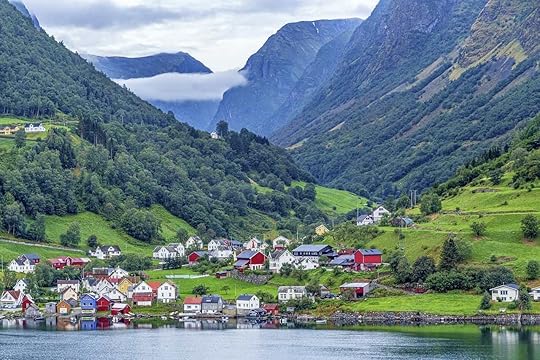
Norwegian village from breathintravel.com
Photo of the author from snl.no/
Profile Image for Dolors.
604 reviews2,797 followers
October 15, 2018
Sketches of lyrical introspection where man and nature fuse to become one entity. The prose is apparently simple, smooth and flowing, but a closer appraisal will reveal a symbology akin to the most complex philosophical treatise.
Identity, memory, loss and angst are perceived through the severity of the Norwegian landscape, which is revealed as the real protagonist of this meditative narrative. With a kind of overwhelming sensitivity and a bare lyricism that recalls the Japanese haiku, Vesaas immerses the reader in a series of visual progressions where man is witness to his own emotions like he is to the impassivity of the natural world that imposes the rhythm and repose of his existential ruminations.

A child hidden behind the marshes observes a crane colony perform a dance, a drifter avoids the river in order not to see his reflection, a man battles against his heart to express its true feelings because he doesn’t want to get hurt, a boat is silently waiting on the shore for the right person to guide its way down to the open sea.
Fleeting images more than words distinguish the elusive nature of Vesaas’ chant to nature, to the icy lakes and the endless horizon where water kisses the molten sky.

As I slowly went through the pages of this contemplative novel, taking my time to savor the texture of Vesaas’ imagistic pilgrimage through the essence of mankind’s soul, I had the feeling to be in limbo, somewhere between the recollection of a hazy dream and a vision of life from the clarity of an all-seeing afterworld.
I seldom remember having felt so serene and full of anticipation at once, eager to see what awaits in the dark, without being afraid of the unknown, just trusting my arms to be strong enough to embrace my fate with every fiber of my being.
Ultimately, that must be what it feels like to be alive, and Vesaas’ words overflow with the miracle of life, of creation, of natural wonder. What else can a reader expect? Poetry in prose. Wisdom distilled in beauty. You’ll find yourself in the pages of this tiny book. What are you waiting for?
Profile Image for Algernon (Darth Anyan).
1,829 reviews1,155 followers
February 9, 2022
I exist for the sake of the rivers beneath the earth.
To listen and to understand.
Not to understand, but to be close to where it is happening.


I may scare some readers away, but the only way I can describe this book is as a long introspective poem told in prose fragments or cantos. There is no plot, there is precious little in the way of characters and action. What we have here is a consciousness asking unanswerable questions, a contemplative look at existence, a stream of emotions settling one over the other like falling snow - amazement, fear, curiosity, love, tranquillity, turmoil, grace. Tarjei Vesaas turns himself into a mirror reflecting the natural wonders of him homeland, offering us the gift of wonder that makes the particular into the universal. The overall tonality is a melancholic one, a silent sigh at the end of a long trip. Instead of a continuous narrative, we have elegant and spare brushstrokes of china ink, dancing across the page in a pulsing rhythm of light and darkness, we have the beating heart of a consciousness larger than the individual, an awakening / attuning to the long lifespan of stone, to the the migratory habits of cranes, to the tidal waves of the ocean.

Vesaas is the boatman guiding his craft through the meanders and rapids of innocent years, passionate years, toiling years, searching years, tired years, searching through this - his last published novel - to gain the shores of peaceful river:

The shining, tranquil river glides out with its burdens.
It comes as if from far away in the interior,
and delivers its innermost secrets.
On its way towards the distant ocean.
what accompanies it on the journey?
Intense desires that have subsided.
Nothing more.


It is the evening of a long journey, and the poet shares with us the richness and the wisdom of his experience, in almost transparent, sparkling words that have been polished like gemstones over the grindstone of memory. My own words feel heavy footed and stumbling in trying to convey how much the prose of the Norwegian has moved and inspired me. As usual, I have to borrow from his own talent in order to better express these feelings:

The things one says usually seem to be left lying about on the floor like a pair of lop-sided shoes - while the things one wanted to say feel like birds in flight. [...]
Words can cause trouble like large rocks in one's path.
Wrong: words can clear the largest rocks out of the way.
Wrong again: Words can turn into dark chasms unbridgeable for a whole lifetime.
We know very little about the power and destructiveness of words.

yet "words is all I have, to take your heart away" as the Bee Gees told me so many years ago, and my heart beats this time to the rhythm of the long-legged dance and beating wings of blue cranes, majestic creatures who come visiting from far away countries, to teach a young boy about the beauty and the danger and the fleeting nature of happiness.

They are not birds,
they are ourselves when we have passed between the millstones,
crossed the thorny wastes,
gone through the fire,
undertaken wondrous journeys
and given away our heart to things unworthy of it -
with the resulting humiliation unto death.
then it happens.
then we must dance like this.
Then we clothe ourselves in the proud guise of the crane
and sail through the world, away from the fleshpots,
to find a familiar marsh,
utter wild shrieks and invent frenzied gestures.


A morning of adventure in early childhood, a young boy hiding silent and scared among the grass, can give meaning and strength to a whole lifetime. The most famous sequence in the book reminds me of Dyonisian mysteries in ancient Greece, explains my fascination for Vesaas through the vital connection he maintains with the mineral and natural world, his Zen like capacity to extract energy and contentment from sunrise and snow and flowing water, a connection that has been alienated in me through long years among cement towers, my eyes glued to an electronic screen. I have become suspicious even of my tendency to over analyse the texts in my reviews, to reach for far-fetched connections in order to impress my friends with my sophistication and my knowledge of trivia. (I went to wikipedia to get some research done after reading about the dancing cranes from "In the Marshes and on the Earth", looking up Bacchus : 'Dionysus is represented by city religions as the protector of those who do not belong to conventional society and thus symbolizes everything which is chaotic, dangerous and unexpected, everything which escapes human reason and which can only be attributed to the unforeseeable action of the gods. He is also called Eleutherios ("the liberator"), whose wine, music and ecstatic dance frees his followers from self-conscious fear and care, and subverts the oppressive restraints of the powerful.'

But Vesaas has no need of clever connections or academic explanations, he is a vessel, a boat sailing between the bones of the earth and the distant, unreachable stars. He is the burning conscience that is inside the world, not the dry, cold intelligence that places itself outside in order to observe and analyse.

For with one's eyes one may mirror the shy, pure crane.
I am on the crane's own territory;
I seem to have entered a sacred place where one has no right to be.
The ritual will be played out in the guise of a bird.


He is searching for anchoring points, for the safe shores that will reconcile him with the imminent darkness. Wisdom seems forever out of his grasp, night unavoidable and loneliness the only certainty.

Liberation is a big word. It doesn't suit me; what am I to be liberated from? On the contrary, I must be able to receive. To fill a void.

The poet is wise, the poet is sad, the poet is terrorized by the night and the loneliness. If the cries of the cranes could be translated into human language, they could probably say something like this (sung to the tune of Jacques Brel - "Ne me quite pas"):

Please. Don't go.
Don't go for a long time.
I must see it all. Don't go.
Do something that will frighten me, if you like,
but don't go.


I will stop now, before I drown this gem of a book with unnecessary explanations. I cherished every page of it, some full of light, others disturbingly dark and morbid. I put on more Jacques Brel on my music player, added some Don McLean ("Starry, Starry Night". "Seasons in the Sun") and forgot for a few hours that I am between four walls. I walked with Vesaas among high mountain meadows full of spring flowers and sailed on tranquil rivers towards wooded shore. The following quotes are just a few 'haiku-like' fragments of a bigger picture that is revealed patiently with each of the sketches included in the book.
(the line breaks are my own, the novel is presented in prose, but I believe that Vesaas makes no distinction between the two forms when he builds his prose. The translator of his work did a great job capturing the rhythm and the tonality of his phrasing, and I envy his compatriots first for being able to walk in the poet's footsteps, and secondly for being able to read his novels in the language they were written). So let me fade away and follow the spell of Vesaas words:

"Snowbound, snowed under, and trapped in the snow.
This is my song and thus is my song,
the day is long and this is my song,
let me simply get snowbound and trapped in the snow.
The day is long, and the day is long.
It is good to sleep, snowbound and trapped in the snow."


- - -

Nothing is nothing, the day is past,
it is evening and the wind is rising.
Outside are moonshine and wind.


- - -

The heart is split in two,
irresolute between its desires.
Yet the boat has to advance ...
night or day are merely shifting veils to be traversed.
Advance with fierce courage.
Not for the sake of men.
For the sake of insoluble riddles.
It utter secrecy
the heart is split in two.


- - -

The world is large.
The world contains such infinite variety -
and we need not know more about it than that.


- - -

A solitary, thick grove of leafy trees.
And the loveliest weather.
Warm rain that has a quality of great gentleness,
a quality of deep peace.


- - -

It is a young girl
sitting in the sunshine.
A girl, of course.


- - -

One sees only oneself in the stone.
There everything is sealed,
yet one sees oneself in the stone
exactly as created,
and walks quickly past oneself
with beating heart.
The walls in the rock are smooth yet deeply troubled.


- - -

A breathing space between iron hands.
Soon they will be here.
One must cling to ordinary things.


- - -

If there is a heart here, it is lonely.
The heart grows lonely; that is how it was created.
It grows finally into its true self.
Lonely. It is far to its neighbour,
and there it is a stranger.
So it has even further to go.


- - -

The air may be charged with bitter questions,
useless questions.
They will not be asked.
They merely rest above the carrying water,
rest while on the move like everything else.
No current halts because it is difficult to understand
that intense desires are quenched.


- - -

Scent of the first rain on a light dress,
over warm flesh
What of it?
Or on my own light shirt.
Fleeting, precious moments.


- - -

It seems so trivial, but it doesn't take much.
Just walking up to fetch the milk churn early one morning can be a miracle.


- - -

The hour of becoming before full daylight.
He who sleeps
sins when he sleeps away this.


- - -


No more words now.
Here is my thirsting hand.
Profile Image for Edita.
1,579 reviews590 followers
January 8, 2023
If there is a heart here, it is lonely. The heart grows lonely; that is how it was created. It grows finally into its true self.
[...]
But the wind has blown forward twisted memories too—while it tosses the boat, while the thwarts blacken. Memories fly in frightened flocks.
[...]
If only the heart could shut itself off. It may not do so, and becomes crammed with memories, heavy with images, saving itself by clinging to straws, like the mooring rope and the slight, familiar smell of the mooring rope in rain. The reassuring smell of the commonplace.
[...]
One must cling to the most ordinary things. Nothing is going to happen,
[...]
My heart expands, but receives nothing. It is large and shocked by memories.
Profile Image for S̶e̶a̶n̶.
978 reviews580 followers
April 16, 2023
The Boat in the Evening was Tarjei Vesaas’ final novel, published in 1968, two years before his death. This is significant, as the book feels very much like the work of a writer at the end of his life. It is also hard not to read this through an autobiographical lens, though to be truthful I do not know enough of the details of Vesaas’ life to speculate about the likelihood of that. But it reads as if written by someone looking back over a lifetime, having accepted and internalized the futility in searching for meaning in life, and in so doing, having been freed from the burden of this search and subsequently enabled to simply live and observe.

The book is divided into discrete ‘chapters’, most of which connect only through thematic explorations of resignation and acceptance of life’s transience/impermanence. That said, one could read into this the faint structure of a graduated life, beginning and closing with the perspective of a child. As in his other novels, though, Vesaas is often evasive and opaque—and in this one most of all—so much of what could be called ‘structure’ is unsteadily traced in the reader’s mind. Here he allows his inner poet to take full reins at times, even occasionally splicing in lined poetry within his prose. This serves to enhance the way he conjures otherworldly visions of the commonplace. Much of the text reads almost but not quite like prose poetry—it hovers in a gauzy space between fiction and poetry, retaining just enough narrative slivers within each chapter to stay within the realm of fiction.

Outside of his poetry, which I’ve not delved into much so cannot comment on, this novel represents perhaps the purest form of Vesaas’ unique blend of a mystical appreciation of nature with the complexity of interpersonal dynamics, particularly within families and between young people experiencing early stirrings of attraction to each other. And that purity is also what makes the book read like a writer’s closing comments on the concerns he has focused on throughout his writing career. It is a distillation, even approaching later Beckett in its thematic concision at times (particularly in the chapter ‘The Drifter’, which brings to mind The Unnamable—the third novel in Beckett’s Molloy trilogy). Though not likely the best choice for readers new to Vesaas, this book is an important work to read later on after exploring some of his other novels.
Some of the countless eyes in the marsh seem to focus and look at me. The thought is not unwelcome; it is as if a link has been made, a tiny floating link between myself and what is here. It is important. One must gradually learn the truth about the boundaries between what is great and what is small.
Profile Image for BJ Lillis.
326 reviews272 followers
February 16, 2023
Tarjei Vesaas and I are alike. We see things similarly—and in a way that I hadn’t understood until I read him; that I perhaps couldn’t have understood without reference to his stories.

This book—which is both and neither novel and story collection—is a small wonder: small because it is modest in aim and style and because it is short, wonder because it is a wonder. Not because it is so special; perhaps it is not so special, perhaps it is even ordinary—but because it feels like a wonder. Because wonder bubbles up within you as you turn the pages. Because to read it is to inhabit a world of memory, your own and Vesaas’s superimposed. Because to read it is to live and walk and wonder.

To say that Vesaas accomplishes the same wonderworking in Spring Night, The Ice Palace, or The Bridges as in The Boat in the Evening—and with greater precision, and that those novels are novels proper, with a current of story to carry them downstream, is only to say that there are different kinds of books in the world, and that that is as it should be, and that you should read all four of them.
Profile Image for Nate D.
1,652 reviews1,249 followers
April 30, 2012
Fragile humanity alone in the undying magnitude of nature. Instants of crystalline clarity of word and deep psychic significance. Simple eloquence and beauty shaped into thought-series like drops of water rapidly following one another down a leaf, each in graceful expression of subtle design. Quiet resonance.

More series of prose poems than the novel I had taken it for originally, but there's a certain thematic arc holding things together. Not for nothing the vignettes are numbered in a specific order. Some are rather abstract (your heart lies by the roadside while the ocean has crept up to the house and a boat taps the wall), some extremely concrete (clearing the way through snow and fog on a winter morning, observing the return of the cranes to a hidden pond, awaiting a meeting in snowfall), all are wise and deftly expressive.

Each of Vesaas' books, starting with The Ice Palace, earned him a nobel prize nomination, but he never got one, and died just after this last work was published. It feels like an elegy, the best elegy.
Profile Image for Moira Macfarlane.
855 reviews102 followers
November 13, 2020
3 1/2*
1968. Herinneringen aan een leven wat achter hem ligt, een bijna voltooid leven en van een bepaalde tijdloosheid, gevangen in zijn woorden. Vaak erg mooi, maar ook erg melancholisch en hoewel ik daarvan hou en ik die kant ook zeker in me heb was het me soms ook te veel. Ik voelde me gaandeweg vertragen en erin verdrinken, alsof ik erdoor onderwater getrokken werd. Wat ook wel weer bijzonder is, dat een boek dat met me kan doen.
Als ik het opnieuw oppak dan lees ik het in stukken en beetjes, lees ik het als poëzie, dat past beter. Deze woorden en zinnen klinken mooier bij herhaling denk ik.
'De geur van de eerste regen op een dunne jurk, over warme huid.
Ja en?
Of op mijn eigen dunne overhemd.
Snelle, kostbare ogenblikken.
Een geur die verdwijnt als je je omdraait en zwijgt. Zo ruikt dat wat niet kan blijven, dat wat zelf niet weet dat het bestaat. Stilletjes verborgen op je tong achter een liefdeswoord.
Ongrijpbaar - zoals dat wat je dichtbij je zou willen hebben als je niets meer zou moeten wensen.'
Profile Image for Jeroen Decuyper.
192 reviews44 followers
February 12, 2021
Het proza van Tarjei Vesaas heb ik leren kennen via de strak en mooi uitgegeven ontwerpen van de hand van Bas Van Vuurde, van zowel “Het IJspaleis” als “De Vogels”, bij Lebowski Publishers. Ik herinner me dat de uitgever besloten had de boeken van Vesaas opnieuw uit te geven door een tip van Karl Ove Knausgård, die hem als de “beste Noorse schrijver ooit” bestempelde. Na zowel “Het IJspaleis” als “De Vogels”, allebei verhalen die beklijven, volgde onvermijdelijk “De boot in de avond” op het leeslijstje.

Na de twee prologen weet je dat het raak is. Onmiddellijk herken je de spaarzame schrijfstijl van Vesaas: de korte zinnen, de accurate beschrijvingen van de natuur en de omgeving waarin de personages zich voortbewegen. Maar tegelijk is het o zo anders dan de twee vorige boeken. In eerste instantie is zijn proza veel poëtischer. Soms neemt het ook de vorm van een gedicht aan, met een kantlijn die inspringt en stukjes die zich visueel onderscheiden van de rest van de tekst. In “De verspilde dag verdwijnt kruipend op zijn buik” bijvoorbeeld, het zesde hoofdstuk uit de bundel, is dat het geval en krijgt de tekst een zekere musicaliteit.

In tweede instantie kan je bezwaarlijk van een roman spreken, ook al vermeldt de achterflap dat het zijn meest persoonlijke 'roman' is. Het is m.i. eerder een verzameling van korte en iets langere impressies en sfeerbeelden. Het deed mij vaaglijk denken aan “Le Spleen de Paris - Petits poèmes en prose” van Baudelaire, zeker qua sfeer en taalgebruik, zonder de personages uit de zelfkant van de maatschappij dan. Ingetogen en poëtisch, met een licht melancholische ondertoon. Proza dat gerijpt is tot poëzie.

Mens en natuur vloeien in elkaar over in zowat elk verhaaltje. Ontregelend, tot op het punt dat je bijna fysiek ongemakkelijk wordt door hetgeen Vesaas beschrijft en zijn lezer mee laat en doet ondergaan. Want ook al wil je je niet identificeren met het personage en de gebeurtenissen, toch zuigt en trekt en sleurt het proza van Vesaas je letterlijk in het verhaal. Zoals dat bij het eerder vermelde “De verspilde dag verdwijnt kruipend op zijn buik” en “Brand diep vanbinnen” het geval is.

Bloedmooi zijn “Ongrijpbaar” en “Alleen al naar boven lopen en de emmer halen”. Uit het eerstgenoemde:

“De geur van de eerste regen op een dunne jurk, over warme huid. (...)
Een geur die verdwijnt als je je omdraait en zwijgt. Zo ruikt dat wat niet kan blijven, dat wat zelf niet weet dat het bestaat. Stilletjes verborgen op je tong achter een liefdeswoord. Ongrijpbaar - zoals dat wat je dicht bij je zou willen hebben als je niets meer zou moeten wensen. (...) Verwondering moet je hebben - zoals het verlangen dat op warme dagen tussen ons opkomt, in de eerste druppels van een regenbui.”


Het laatstgenoemde verwijst, als is het slechts zijdelings, in één woord, naar de Noorse variante van het “Tristan en Isolde” verhaal, waar aan het einde de liefde sterker blijkt dan de dood, en die gedachte veruitwendigd wordt in de klimplanten die van het ene graf in het andere naar elkaar toe groeien.

En Vesaas spaart één van zijn beste verhaaltjes - mijn absolute favoriet - voor op het laatst, zoals het een groot artiest betaamt, of het nu in boeken of op een podium is. In het voorlaatste bisnummer “De melodie” brengt hij een ode aan (zijn?) ouders, en tegelijk aan de ouders van iedereen: het archetype van de ouders en een gezin met kinderen. Hoe die ouders in dat verhaal door kinderogen verbeeld worden, is weergaloos en onevenaarbaar. Alleen omwille van dat verhaal is deze bundel - geen 'roman' - het aanraden waard.
Profile Image for Kasa Cotugno.
2,747 reviews584 followers
August 31, 2019
Impressionistic and yet naturalistic, this release from Archipelago publishing house presents a work of Tarjei Vesaas, one of Norway's most honored authors, as yet unavailable in translation. Semi biographical scenes present Norwegian rural life, but it is unclear as to the era. Versaas was born in 1897, so the coming of age sequences are more identifiable. I was particularly taken by an evening in which the narrator sits motionless as a "tussock" (even more so because tussocks to respond to breezes) in order to watch the dance of the cranes. A phenomenon described beautifully by Richard Powers in The Echo Maker. Here, Versaas presents man and nature, giving personality not only to the marshes, animals, and a horse, but also to the rocks. The river. Almost shockingly, there is a chapter recounting an episode of war, so haunting and clear, a reader feels as if they're present despite the poetry of the execution.
Profile Image for Wendy.
Author 21 books87 followers
January 3, 2015
This is the only book by Vesaas I had to give up on, Uncharacteristically self-indulgent, and entirely lacking in his usual excellent pacing.
Profile Image for Lucia Jane.
439 reviews10 followers
February 28, 2024
Ik heb gemengde gevoelens. Ik heb het als luisterboek geluisterd, en ik denk dat ik het iets beter gevonden zou hebben als boek. Ik twijfelde tussen 2 of 2,5 sterren.

Het poëtische vond ik wel mooi, maar soms net iets te vaag en gekunsteld. Het neigde dan voor mij meer naar poëzie, wat ik ook mooi vind, maar ik kon soms echt niet volgen waar hij het nou weer over had. Maar er zitten zeker mooie stukken in.
Een groot nadeel voor mij: ik vind het in fictie bijna altijd ontzettend storend als een auteur ineens overschakelt naar de tweede persoon. Dat trekt me helemaal uit het verhaal.

Desondanks zat er ook een bepaalde verstillende schoonheid in dit boek. En ik ben zeker benieuwd naar zijn andere boeken!
Profile Image for Andy.
1,166 reviews220 followers
August 29, 2023
Poetic, fluid and disjointed, abstract and intense. A series of thought/emotion memoirs, impressions. Strangely reminded me of Caradog Pritchard’s One Moonlit Night.
Profile Image for Myriam.
496 reviews68 followers
September 22, 2020
‘Altijd iets wat je moet vinden, en je weet niet waar. Als het nu nog een gewone naam had gehad, dat vreemde verlangen waar je mee rondloopt.’
Profile Image for Steven R. Kraaijeveld.
555 reviews1,924 followers
December 3, 2022
"One must gradually learn the truth about the boundaries between what is great and what is small." (46)
After The Birds and The Ice Palace, I thought I'd read Tarjei Vesaas's final novel, The Hills Reply (first published in English in 1971 as The Boat in the Evening). 'Novel' is probably a bit of a misnomer; The Hills is more like a collection of only loosely connected stories, which are tied together not by a narrative but by setting—by the land and landscapes, by water and animals, by emotions and strivings, by sounds and smells, by people and life.
Profile Image for Judy.
1,954 reviews452 followers
February 24, 2020
I loved this author's The Ice Palace and looked forward to this, his final novel. I had some difficulty reading The Hills Reply though. It is more a collection of ruminations on the author's life with both short and longer pieces that range through various incidents.

The writing, even in translation, is beautiful. The style is stream of consciousness and sometimes I struggled to understand what he was saying. In fact, reading this book had similarities to reading poetry for me.

I did enjoy how he made me slow down to savor the sentences and images. In recalling times of deep emotional turmoil as well as moments of transcendence, his connection with the natural world was strong. He reminded me to be more present and observant as I move through my days. I live in a beautiful setting of trees, mountain tops in the distance, birds and animals, wind and clouds. If he is right, that answers to human troubles can be gleaned from such surroundings, then the understandings about life that I search for could be found in my very yard and neighborhood.
Profile Image for Stella Starlight.
343 reviews20 followers
December 14, 2021
I loved Vesaas' 'The Birds' and appreciated 'The Ice Palace' but couldn't really be bothered with this vague and plotless poetry-prose experiment. The final 2 stories where nice but I didn't really get the rest of this book. The sense of intellectually knowing this book is good and special but just not feeling it left me behind unsatisfied.
Profile Image for Peter.
Author 4 books32 followers
July 16, 2021
A beautiful but difficult book. The writing is often gorgeous, poetic and full of lonely longing, but some passages are very abstract and almost devoid of narrative or characterization. A fascinating work of modernist fiction that requires very careful reading. I've read three Vesaas books so far, and he hasn't disappointed me yet. It's a wonder he isn't more widely known.

Update: I read this a second time, but only accidentally: this time it had the title The Hills Reply (the U.S. edition), which I didn’t realize is the exact same book as The Boat in the Evening (the U.K. edition) which I read five years ago. This time I’m knocking the rating down from 4 stars to 3 stars, because the vagueness of the prose and nearly non-existent story left me cold. The lower rating is also a knock on the U.S. publisher, Archipelago, for burying the disclosure that this is a reissue (with a new title) only on the copyright page.
Profile Image for Felix Hayman.
58 reviews21 followers
May 18, 2011
I have read this book so many times and have searched and searched for faults, but there are none.This is as sparse a series of sketches you will ever read and you will not for one second be disappointed, because writers have too much of a tendency to over extend and over exaggerate the written word.Not so, Tarjei Vesaas. Few realise that he was nominated for the Nobel prize 8 times! and this book proves a reason why.
Profile Image for Mandy.
3,605 reviews330 followers
January 25, 2020
This is really not my sort of book and I found it disjointed and at time impenetrable. It’s an episodic series of vignettes, evoking scenes from the author’s childhood, poetic and lyrical, with evocative descriptions of the Norwegian countryside but too introspective and contemplative to engage me. There are 12 “chapters”, mostly inconsequential, with lots of water, rivers, rocks and mysterious figures in the landscape. One or two of the sketches had more of an impact on me – the first about a boy, his father and a horse was very poignant. If you enjoy nature writing then this might be for you, but it wasn’t for me. A couple of quotes sum it up for me. “Questions are in the air. But no answers” and “There will never be any answers”. I’m just too pragmatic not to demand a few answers now and again.
Profile Image for mwr.
304 reviews10 followers
January 1, 2020
I'm beginning to realize that a lot of the things that charm me about Scandinavian literature are more broadly a part of Scandinavian culture than traits of the specific authors.

Categorizing this work is difficult. Vignettes, plausibly hovering around a single person's life, interspersed with not just poetic prose but actual verse sometimes.
Profile Image for Jógvan Helge.
190 reviews2 followers
June 26, 2024
Er det roman? Er det noveller? Kva fugl er det der? Impresjonistiske, skisserande prosadikt om barndom, natur og relasjonar. Mykje er kjent vesaask, og då noko av det sterkaste han har i den symbolistiske stilen han er elska for, men til tider her går han heilt av skaftet, inn i eit assosiativt lynne der få ting heng i hop på eit konkret plan, der metafor og minne kvervlar saman i svært krevande stykke. Gjev ein dei tid, får ein mykje att, men det er nok ikkje utan grunn at det er ein del av dei andre romanane som er meir populære. Mine favorittar var kap. 1, 3, 6, 8 og 16.
Profile Image for Paula.
655 reviews135 followers
November 11, 2024
Paula Leest Europees: Noorwegen. Dit was het niet echt voor mij. Geen slecht boek, maar niet mijn ding.
Profile Image for Jonathan yates.
239 reviews5 followers
January 18, 2020
This book was amazing, less a novel and more a series of landscape paintings that when read together make every picture more than they would be on their own.
Profile Image for Alisa.
611 reviews
August 14, 2014
I really wish I had known this was a collection of short stories before starting it. I spent the first several "chapters" attempting to make connections between the characters. Finally, by the fifth story, I could experience each as a stand-alone. As with many short story collections, this isn't cover-to-cover perfection. Several are too formless for my taste, either completely lacking characters (such as The Wasted Day Creeps Away on Its Belly and The Tranquil River Glides Out of the Landscape) or are nothing but surreal dreams or hallucinations (like Daybreak with Shining Horses and The Dream of Stone). Reading about a dream, even if well-written, is just as uninteresting as having someone tell you about the dream they had last night. Despite these few I did not enjoy, I am still so glad I read this for those that stand out as excellent. Truly excellent. The Drifter and the Mirrors, like the novels by Vesaas I have read, uses a fascinating mix of reality and surrealism. It describes a man drifting in a river, near death, disorientated by the reflections. It reads like a fable, and yet can also be interpreted as realistically capturing the feeling of drifting in a river near death. In the Marshes and on the Earth was also lovely, describing the powerful mystery of having a close encounter with nature. And the penultimate story was, for me, the ultimate. It is the least surreal, and shows that Vesaas can describe simple life (a boy's changing thoughts and observations of his mother) with profound insight and beauty.
Profile Image for Madelon.
187 reviews10 followers
May 24, 2022
De Noor Tarjei Vesaas schreef proza en poëzie en zijn De Boot in de Avond laveert ergens tussen die twee. Zijn werken De Vogels en Het IJksasteel zijn misschien het bekendst, maar dit werk schijnt dan weer zeer ingewikkeld te zijn in tegenstelling tot die twee andere verhalen, en een beetje uitdaging kan nooit kwaad. In 2020 kwam bij uitgeverij Lebowski voor het eerst een Nederlandse vertaling van De Boot in de Avond uit. De vertaling is van de hand van Marin Mars. Zowel Lebowski als Mars verdienen alle lof, want dit werk is uitermate bijzonder en het lezen ervan is een verrijkende ervaring.

In veertien verhalen (of zijn het hoofdstukken?), sommige van slechts enkele pagina’s lang, andere wat langer, staat telkens een personage en zijn verhouding tot zijn omgeving centraal. Of het hier telkens hetzelfde personage betreft, is onduidelijk. Soms zijn de personages tegen hun wil speelbal van hun omgeving, maar vaker onderwerpen ze zich vrijwillig aan een omgeving of natuur die zich niet laat beteugelen. Soms wordt het personage één met die omgeving, andere momenten is er sprake van een zekere strijd om zijn omgeving te (om)vatten. Sommige verhalen zijn zeer abstract, andere kennen een wat gangbaarder verloop.

Lees verder
12 reviews11 followers
December 5, 2020
Ontregelend boek, waar je als lezer lastig grip op krijgt, maar anderzijds je wel in de greep neemt. De natuur, het weer, de mens - ze zijn verweven met elkaar, maar toch ook vreemden. Vesaas is een groot stilist. Een boek om te lezen en te herlezen.
Displaying 1 - 30 of 65 reviews

Can't find what you're looking for?

Get help and learn more about the design.