

What do you think?

Norse Mythology: The Graphic Novels #1
Norse Mythology, Vol. 1
Il racconto a fumetti della Mitologia Norrena; dalla creazione dei Nove regni, alla perdita dell'occhio di Odino. Dalla fabbricazione del martello di Thor, al ruolo di Loki nella fine del tutto, Ragnarök. La penna di Gaiman e il tratto di Russell sono capaci di restituirci una rappresentazione tanto fedele quanto divertente del pantheon norreno, con divinità che hanno sia pregi che difetti.
160 pages, Hardcover
First published March 23, 2021
Ratings & Reviews
Friends & Following
Create a free account to discover what your friends think of this book!
Community Reviews
Displaying 1 - 30 of 200 reviews

November 18, 2020
As most people will know, I LOVE mythology. The Norse mythology being one of my favourites. Also, I'm a huge fan of Neil Gaiman's. Therefore, I've read his Norse Mythology back when it came out in audio but I also have (and have read) the hardcover and paperback versions and even listened to a radio dramatisation (yes, they all bring something different to the table, for more info, check out the reviews I linked to).
Naturally, when I heard that he had collaborated with old colleagues/friends to also make this a comicbook, I had to have it.
In this 1st volume, we are shown the creation of all things, learn of the nine worlds and then dive into the following four different stories:
1) The Gifts of the Gods, in which Loki steals Sif's golden hair and in order so save his own skin from Thor, he tricks dwarf craftsmen into creating a number of treasures.
2) The Master Builder, in which the gods trick a mysterious builder into building a wall around Asgard for them for free.
3) The Children of Loki, in which we are introduced not only to Loki's two "legitimate" sons but also to his three children with the giantess Angrboda: Jormungundr, Fenrir and Hel. And we are told the stories of how they became what they are known for.
4) Freya's Unusual Wedding, in which Thor's hammer gets stolen by the ogre Thrym so Thor and Loki have to become crafty to get it back.
I must say that the art disappointed me a little bit. It's not bad, not by a long shot. However, it's not as brilliant as what I know from other Gaiman comics (though also better than most found in the Sandman volumes).
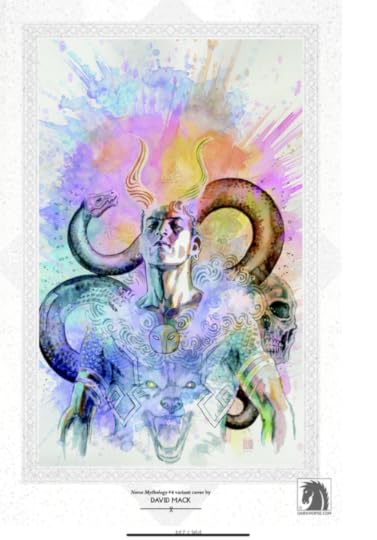
The best art, in my opinion, was by David Mack - sadly, he only created some cover art for the comic. These are my three favourite character works of his:


No, volume 1 is not out yet (as of today, only issues #1 and #2 are available), will only be published in 2021 in fact (March, I think), but thanks to Edelweiss, I received an ARC and am very happy about that.
Despite the art not sweeping me off my feet, I loved seeing this old world come to life in the colourful panels so I will definitely be waiting (im-)patiently for the other volumes.
Naturally, when I heard that he had collaborated with old colleagues/friends to also make this a comicbook, I had to have it.
In this 1st volume, we are shown the creation of all things, learn of the nine worlds and then dive into the following four different stories:
1) The Gifts of the Gods, in which Loki steals Sif's golden hair and in order so save his own skin from Thor, he tricks dwarf craftsmen into creating a number of treasures.
2) The Master Builder, in which the gods trick a mysterious builder into building a wall around Asgard for them for free.
3) The Children of Loki, in which we are introduced not only to Loki's two "legitimate" sons but also to his three children with the giantess Angrboda: Jormungundr, Fenrir and Hel. And we are told the stories of how they became what they are known for.
4) Freya's Unusual Wedding, in which Thor's hammer gets stolen by the ogre Thrym so Thor and Loki have to become crafty to get it back.
I must say that the art disappointed me a little bit. It's not bad, not by a long shot. However, it's not as brilliant as what I know from other Gaiman comics (though also better than most found in the Sandman volumes).
The best art, in my opinion, was by David Mack - sadly, he only created some cover art for the comic. These are my three favourite character works of his:
No, volume 1 is not out yet (as of today, only issues #1 and #2 are available), will only be published in 2021 in fact (March, I think), but thanks to Edelweiss, I received an ARC and am very happy about that.
Despite the art not sweeping me off my feet, I loved seeing this old world come to life in the colourful panels so I will definitely be waiting (im-)patiently for the other volumes.

December 15, 2020
I actually may have liked this better than the original book these were pulled from. Long time Neil Gaiman collaborator, P. Craig Russell, has brought in a murder's row of fantastic artists to breathe life into Gaiman's retelling of Norse mythology.


August 3, 2021
Neil Gaiman's "Norse Mythology" is a superb book and one that ought to be read by all lovers of Norse lore. This is the comic adaptation of that book. In comparison to the book the details, naturally, are sadly lacking. The stories have a more abbreviated feel and are leaning towards the children's side, rather than the inherent darkness endemic in Norse lore.
That might sound like a negative review. It is not. I merely point out that one ought to read the book first. This is also a good introduction to anyone seeking to get a rough idea of the main Norse myths. The structure is the same as the book and the artists change depending on the story. The art is good and the story is as well. I enjoyed it.
Will I be getting volume two? Perhaps. Just to finish my collection, but I shall be in no rush. But for those who liked the book or wanted a good introduction to Norse myths, then this comic is one you'd like.
That might sound like a negative review. It is not. I merely point out that one ought to read the book first. This is also a good introduction to anyone seeking to get a rough idea of the main Norse myths. The structure is the same as the book and the artists change depending on the story. The art is good and the story is as well. I enjoyed it.
Will I be getting volume two? Perhaps. Just to finish my collection, but I shall be in no rush. But for those who liked the book or wanted a good introduction to Norse myths, then this comic is one you'd like.

April 17, 2021
As is usually the case, I love Neil Gaiman's original work and just sort of like the Dark Horse graphic novel adaptation.
The scripting for my favorite scene from the book was bungled with this:
There were things Thor did when something went wrong. The first thing he did was ask himself if what had happened was Loki’s fault. Thor pondered. He did not believe that even Loki would have dared to steal his hammer. So he did the next thing he did when something went wrong, and he went to ask Loki for advice.
becoming this:
Thor's hammer was gone.
"Loki?
"Hmm . . . Loki.
"No. He wouldn't dare.
"But Loki's crafty. I'll ask him what to do."
Really? That's the best way to adapt that scene?
The art was consistently good despite having so many different artists, with the contributions from David Rubín and Jill Thompson really standing out.
The scripting for my favorite scene from the book was bungled with this:
There were things Thor did when something went wrong. The first thing he did was ask himself if what had happened was Loki’s fault. Thor pondered. He did not believe that even Loki would have dared to steal his hammer. So he did the next thing he did when something went wrong, and he went to ask Loki for advice.
becoming this:
Thor's hammer was gone.
"Loki?
"Hmm . . . Loki.
"No. He wouldn't dare.
"But Loki's crafty. I'll ask him what to do."
Really? That's the best way to adapt that scene?
The art was consistently good despite having so many different artists, with the contributions from David Rubín and Jill Thompson really standing out.

April 17, 2023
I just love it <3

January 23, 2023
This was incredibly funny and entertaining, and I really enjoyed the visual art. I highly recommend it.

October 4, 2024
A well-detailed Norse saga with bits and such normally not covered. The artwork was the best part for me as I'm already familiar with 98% of the mythology.
MY GRADE: B plus.
MY GRADE: B plus.

March 29, 2021
I have been a fan of stories of myth and legend since I first started to be able to select my own books and stories at the age of 8 or 9. That may have been related to my growing love of the world of "Four Color" comics. Marvel was blowing up at that time and one of my favorite comics was JOURNEY INTO MYSTERY with stories of The Mighty Thor and the smaller continuing Tales of Asgard in the back of each. That lead me to the Eddas and the original tales of the Norse Gods.
Over the intervening years there have been a tremendous amount of material reimagining the stories but they, for the most part wandered - or rebooted entirely - the stories giving them a new twist or a new mythology of their own.
Having said that, every once in while, someone would go back to the roots of the myths and reshare those tales that have been told and retold over a thousand years. That was definitely the case with Neil Gaiman's NORSE MYTHOLOGY. It became an immediate best seller - perhaps a function of the author's name as much as the material - and soon lead to the standard adaption and visualization in graphic form with the creation and publication by Dark Horse comics. Wonderful artists such as P. Craig Russell...Mike Mignola...Jerry Ordway...and others produced an amazing and beautiful publication.
Tales directly from the Eddas with the adventure...the battles...and the humor...are here in glorious color.
This is the first volume of the proposed collections and it is...A...M...Azing!!! The P. Craig Russell cover is worth the price of admission alone!!!
Over the intervening years there have been a tremendous amount of material reimagining the stories but they, for the most part wandered - or rebooted entirely - the stories giving them a new twist or a new mythology of their own.
Having said that, every once in while, someone would go back to the roots of the myths and reshare those tales that have been told and retold over a thousand years. That was definitely the case with Neil Gaiman's NORSE MYTHOLOGY. It became an immediate best seller - perhaps a function of the author's name as much as the material - and soon lead to the standard adaption and visualization in graphic form with the creation and publication by Dark Horse comics. Wonderful artists such as P. Craig Russell...Mike Mignola...Jerry Ordway...and others produced an amazing and beautiful publication.
Tales directly from the Eddas with the adventure...the battles...and the humor...are here in glorious color.
This is the first volume of the proposed collections and it is...A...M...Azing!!! The P. Craig Russell cover is worth the price of admission alone!!!

November 23, 2023
women <33333

March 24, 2022
It's always good to return to these Norse myths, and Gaiman has done a fine job retelling them here in graphic novel format, as well as in the larger book he published a few years ago. You'll find a lot of the favorites collected here: creation, Sif's hair, Freya's wedding, Loki's children, the binding of Fafnir. My favorite is probably the story of the Jotun master builder and his horse. However, the art is fairly pedestrian throughout, and even though it features some big names, it seems like most of these artists are just phoning it in. I don't really know what I want here, something groovier, more Kirbyesque, more Frank Frazetta? Colleen Doran did some remarkable work on Gaiman's twisted fairy tale "Snow, Glass, Apples," but there is nothing so striking to be found here. Kirby was the king at bringing the wonders of Asgard to life, and even your average Marvel comic today can do Loki and the Aesir better, so I was hoping this special Gaiman collection drawn by a handful of well-regarded artists would be a lot more visually compelling.

October 23, 2021
I typically am fond of Gaiman's writing and P Craig Russell's artwork, but this volume did not capture the feel of the Norse myths to me. In addition, while Russell's art is always lovely, he did not draw all the stories so the quality of the presentation is inconsistent, and some of the design work is uninspired and overly Marvel-influenced (why does Loki wear horns on his helmet? why does Thor wear a blue outfit and a red cape?).
They also skipped the story of Loki's birth and adoption (and for that matter, why is the beautiful, blond or flame-haired Loki depicted as an ugly gothling?), which left me feeling that a lot of these stories were out of sequence.
Perhaps it was simply that it was directed too much for younger readers, as the violence, sexuality, and rough humor are all softened. I'd first recommend the classic D'Aulaires book for a young reader.
They also skipped the story of Loki's birth and adoption (and for that matter, why is the beautiful, blond or flame-haired Loki depicted as an ugly gothling?), which left me feeling that a lot of these stories were out of sequence.
Perhaps it was simply that it was directed too much for younger readers, as the violence, sexuality, and rough humor are all softened. I'd first recommend the classic D'Aulaires book for a young reader.

November 30, 2022
This graphic novel is a collection of classical Norse mythology tales with Loki, Odin, Thor, Freya and all the rest. The text is very brief and straight to the point like a classical children's fairy tale or a retelling of a myth. I wonder if Gaiman's original text has a bit more flare, because in the graphical form it didn't really come out in any aspect.
Part of the still ongoing Neil Gaiman by Dark Horse HumbleBundle. Seems there are some pretty nice graphic novels there!
Part of the still ongoing Neil Gaiman by Dark Horse HumbleBundle. Seems there are some pretty nice graphic novels there!
June 12, 2022
i LOVEEEE p craig russell’s art style it’s so pretty!!!!!! the variety of illustrators and different interpretations of norse gods & goddesses & other creatures r sooo fantastic! and i just love neil gaiman’s writing yet Again he is so brilliant and i will eat every single comic book he writes UP. the only criticism i have is that, in comparison to the novel form of ‘norse mythology’, the comic doesn’t have as much context or background info, so it’s not as accessible. but i totally recommend it to anyone who’s read + enjoyed the novel form!!! :)
July 26, 2022
This man... DOES NOT MISS. Such a wonderful retelling of Norse Mythology. Humorous and witty. The art in every story is phenomenal. Neil needs to calm down.. I am spending way too much money on his books and comics. Makes me want to throw up... in a good way.

April 15, 2021
Virtually anything Gaiman writes or helps create is something I have enjoyed. Norse Mythology, Volume 1 is no different. The art and stories are beautiful. I especially recommend for those looking to explore Norse mythology and found other resources to be tedious.

January 9, 2026
הספר נשלח לסקירה!
כמו הכרך השני, הראשון נהדר.
אבל באמת אהבתי יותר את השני כי הראשון טיפונת מבלבל?
לפחות לאנשים שלא קראו את הספר המקורי…
ככה או ככה, האיורים נהדרים ומוסיפים ואין דבר יותר כיף מאשר לקרוא את סיפורי המיתולוגיה הנורדית ולראות אותם מול העיניים שלי.
כמו הכרך השני, הראשון נהדר.
אבל באמת אהבתי יותר את השני כי הראשון טיפונת מבלבל?
לפחות לאנשים שלא קראו את הספר המקורי…
ככה או ככה, האיורים נהדרים ומוסיפים ואין דבר יותר כיף מאשר לקרוא את סיפורי המיתולוגיה הנורדית ולראות אותם מול העיניים שלי.

September 29, 2021
If there was a way to give 6 stars I would. Gaiman is brilliant at weaving Norse stories, and every artist contributing to this was gifted. Best graphic novel I've enjoyed in a while.

July 26, 2021
I enjoyed the text-only version of this book, and it works just as well in graphic novel form. Children of Loki was especially intense. Well done.


May 12, 2022
Not So Thrilled
I love Neil Gaiman but haven’t so thrilled with his Norse Mythology books. Read the non graphic version too and I thought I’d like this better. Alas. I didn’t.
I love Neil Gaiman but haven’t so thrilled with his Norse Mythology books. Read the non graphic version too and I thought I’d like this better. Alas. I didn’t.

March 2, 2024
Gonna start this review by indulging myself on a few points. I grew up reading the usual versions of classical, meaning Mediterranean mythologies with only the briefest nod to the Norse legends. The stories were so sanitized and regimented as to leave me to wonder why the ancients would have stayed awake during the fireside recitations. Edith Hamilton, may have been safe, but hardly lively.My versions rarely had illustration and never color. Besides whatever we believed was sacred scripture and could only be addressed in terms of hushed respect and whatever they believed was merely pagan or worse tales.
In this light, the combination of a great story teller like Neil Gaimen et al has to be near irresistible. This is volume 1 of 3 retelling of the myths of the mighty Norse. By reputation a hearty, hard drinking , fighting and traveling people. Gaiman clearly plays on this reputation and insures that the doing of their god are in keeping with their believers.
This being volume one, it is a mythological origins story. How existence came into existence and the generations of giants and beings that in turn gave us the gods and later the humans. For the rest we have the doing of the gods of Asgard. First the mighty and wise and one eyed Oden and later the party man Thor and his impious trickster brother Loki.
Gods and goddesses do not seem to need much time for whatever tasks of areas of interest each has charge of, over<?> so there is time for trickery and who better for trickery than Loki. And so there are tricks and counter tricks and a gambit that has Loki something of the butt of his own craftiness. This volume ends with a major male player in drag. So as much fun as Norse Mythology Volume 1 is, it may not be allowed in certain of our book banning states.
In this light, the combination of a great story teller like Neil Gaimen et al has to be near irresistible. This is volume 1 of 3 retelling of the myths of the mighty Norse. By reputation a hearty, hard drinking , fighting and traveling people. Gaiman clearly plays on this reputation and insures that the doing of their god are in keeping with their believers.
This being volume one, it is a mythological origins story. How existence came into existence and the generations of giants and beings that in turn gave us the gods and later the humans. For the rest we have the doing of the gods of Asgard. First the mighty and wise and one eyed Oden and later the party man Thor and his impious trickster brother Loki.
Gods and goddesses do not seem to need much time for whatever tasks of areas of interest each has charge of, over<?> so there is time for trickery and who better for trickery than Loki. And so there are tricks and counter tricks and a gambit that has Loki something of the butt of his own craftiness. This volume ends with a major male player in drag. So as much fun as Norse Mythology Volume 1 is, it may not be allowed in certain of our book banning states.

April 29, 2023
3.5
This was a mixed bag, which makes a lot of sense when we take into consideration that it features art from a whole array of different artists, and it also is a collection of stories, not all of them equally interesting or compelling.
So I felt some of the pure genesis-myth stories were pretty heavy in text and quite boring, with the art being just there in the background and easy to skip, while the witty and fun tales were much more entertaining over all.
Not rushing to get the next volumes...
This was a mixed bag, which makes a lot of sense when we take into consideration that it features art from a whole array of different artists, and it also is a collection of stories, not all of them equally interesting or compelling.
So I felt some of the pure genesis-myth stories were pretty heavy in text and quite boring, with the art being just there in the background and easy to skip, while the witty and fun tales were much more entertaining over all.
Not rushing to get the next volumes...

July 8, 2022
Eh. The art wasn't terrible, but it wasn't anything to get excited about either. This was fine, but so surface-y that there was . . . well, again, nothing to get excited about. Fine for a library borrow. Made me want to read the Gaiman book upon which this is based.

February 27, 2021
4.5/5 stars
Thanks to Edelweiss and Dark Horse Comics for providing an ARC in exchange for a fair review. All thoughts are my own.
Characters from Norse mythology remain a popular facet of modern pop culture. These days, most people are probably familiar with the Marvel comics/film versions of deities like Thor, Loki, and Odin, but elements of Norse mythology frequently pop up all over the place. Famously, Neil Gaiman borrowed heavily from Norse mythology for his 2001 novel, American Gods (which got adapted by Dark Horse Comics as a comic series in 2017, so it’s only appropriate that he published his own retellings of Norse tales in 2017’s Norse Mythology. And now, Dark Horse is bringing these closer-to-authentic Norse tales to the world of comics—where the Marvel versions of these characters got their start. The first volume of this series—adapted by P. Craig Russell and illustrated by Russell, Mike Mignola, Jerry Ordway, Piotr Kowalski, David Rubín, and Jill Thompson—is a very faithful adaptation of Gaiman’s source material. Like Dark Horse’s American Gods adaptation, very little is changed here—but it works very, very well.
The first volume of Dark Horse’s Norse Mythology collects the first six issues of the series. Within those issues are adaptations of the first several stories of Gaiman’s book. Unlike most modern comics, Norse Mythology is episodic, with each story standing more-or-less on its own. The seven stories collected here are also split between the six issues—there isn’t a lot of consistency to the length of each story, but regular issues of a monthly comic tend to be around 22 pages long, so some stories end up being split across two issues of the series. Contrary to what the volume’s synopsis suggests, there isn’t really an arc that’s being collected here—not in the traditional sense, at least. This isn’t a bad thing, though. The book doesn’t feature an overarching plotline that connects the stories together; it’s just a collection of tales about the Norse gods, spanning from the beginning of time to (eventually) Ragnarok. So, it only makes sense that the comic adaptation would feel the same. The episodic nature works very well, allowing each story to feel like a complete experience. Though, I wonder what it’s like reading this title month-to-month given the varied lengths of the stories.
As I said, there are seven stories collected in this volume. The first two, "Prologue" and "Yggdrasil and the Nine Worlds" (art by P. Craig Russell), tell the Norse creation story—how the Gods, giants, dwarves, humans, etc came into existence and how the Nine Realms were formed. The third story, "Mimir's Head and Odin's Eye" (art by Mike Mignola), explains how Odin traded his eye to Mimir in exchange for knowledge. The fourth story, "The Treasures of the Gods" (art by Jerry Ordway), shows how a prank played by Loki resulted in the Gods being given some of their iconic tools—including Mjolnir. The fifth story, "The Master Builder" (art by Piotr Kowalski), is a fun story about how the wall surrounding Asgard was built. The sixth story, "The Children of Loki" (art by David Rubín), introduces readers to Loki's children, Jormungundr, Hel, and Fenrir, and explains how Tyr lost his hand. The final story, "Freya's Unusual Wedding" (art by Jill Thompson), sees Loki and Thor (disguised as Freya) traveling to an Ogre kingdom to foil an attempted marriage between Thrym and Freya in exchange for the return of Thor's missing hammer. All of these stories are delightful, each of them expanding upon some of the most popular Norse concepts that have crept into modern pop culture. My favorites, though, are "The Treasures of the Gods," "The Children of Loki," and "Freya's Unusual Wedding." These three stories rank among the longest in the collection, and they're the ones I had the most fun with. The artwork from each story's respective artist fits perfectly with each tale, and these three tales are just a lot of fun to read. All of the stories are great, but those are the ones that have stuck with me.
Like the American Gods adaptation, Norse Mythology is incredibly faithful to Gaiman’s text. All of the words are sourced directly from the book, with Russell abridging some of the prose. Unlike with his American Gods adaptation, I think this approach suits Norse Mythology very nicely. The whole idea of Gaiman’s book was to remain as faithful to the original stories as possible, with Gaiman simply updating the language to something modern readers would have an easier time understanding. So, the comic following the same formula both makes sense and makes for an enjoyable read. It helps that Russell also seems less reliant on copying large swathes of Gaiman’s prose for use as linking narration as he did in American Gods. Here, he allows the dialogue to speak for itself and only uses narration in stories where there’s little-to-no dialogue or in situations where a scene needs some kind of linking narration. It’s a nice balance that results in a more fluid and enjoyable reading experience. Basically, he took what worked about his American Gods adaptation and improved upon it.
The real highlight of this adaptation, of course, is the artwork. In Norse Mythology, every story (aside from the first two) is illustrated by a different artist. You might think this would result in a series that lacks a consistent visual identity, but you’d be wrong. Russell provides the series with a great starting point, illustrating the first two stories and establishing a general look and feel for the series. Every artist that follows him takes that established style and melds it with their own. The designs of the characters remain consistent between artists, with each artist interpreting the designs through their eyes. What results is a series that has both a unified and an endlessly varied visual identity—and it works brilliantly. I love that each story looks a little different; it only furthers the idea that these are stories being told and retold. Plus, the artwork is all fantastic. All of it is super solid, but I especially love Mike Mignola’s artwork in “Mimir’s Head and Odin’s Eye,” David Rubín’s artwork in “The Children of Loki,” and Jill Thompson’s artwork in “Freya’s Unusual Wedding.” I hope future installments of the series continue bringing in such a wide variety of artists because the ever-changing visuals contribute greatly to the uniqueness and enjoyability of the series.
All in all, Norse Mythology is a great adaptation of Gaiman’s retellings of these Nordic myths. P. Craig Russell takes what worked from his adaptation of Gaiman’s American Gods and improves upon it, delivering a tightly-written, well-paced, and extremely faithful work. His scripts are buoyed by some truly impressive artwork from a collection of some of the comic industry’s best artists. If you’ve read the book, you’ll enjoy seeing these myths (and Gaiman’s versions of them) brought to life by such a talented group of artists. If you’re wholly unfamiliar with Norse mythology as a whole, this is a great place to start becoming acquainted with this widely-utilized mythology. Overall, it’s a quick, enjoyable read that’s well worth your time.
Thanks to Edelweiss and Dark Horse Comics for providing an ARC in exchange for a fair review. All thoughts are my own.
Characters from Norse mythology remain a popular facet of modern pop culture. These days, most people are probably familiar with the Marvel comics/film versions of deities like Thor, Loki, and Odin, but elements of Norse mythology frequently pop up all over the place. Famously, Neil Gaiman borrowed heavily from Norse mythology for his 2001 novel, American Gods (which got adapted by Dark Horse Comics as a comic series in 2017, so it’s only appropriate that he published his own retellings of Norse tales in 2017’s Norse Mythology. And now, Dark Horse is bringing these closer-to-authentic Norse tales to the world of comics—where the Marvel versions of these characters got their start. The first volume of this series—adapted by P. Craig Russell and illustrated by Russell, Mike Mignola, Jerry Ordway, Piotr Kowalski, David Rubín, and Jill Thompson—is a very faithful adaptation of Gaiman’s source material. Like Dark Horse’s American Gods adaptation, very little is changed here—but it works very, very well.
The first volume of Dark Horse’s Norse Mythology collects the first six issues of the series. Within those issues are adaptations of the first several stories of Gaiman’s book. Unlike most modern comics, Norse Mythology is episodic, with each story standing more-or-less on its own. The seven stories collected here are also split between the six issues—there isn’t a lot of consistency to the length of each story, but regular issues of a monthly comic tend to be around 22 pages long, so some stories end up being split across two issues of the series. Contrary to what the volume’s synopsis suggests, there isn’t really an arc that’s being collected here—not in the traditional sense, at least. This isn’t a bad thing, though. The book doesn’t feature an overarching plotline that connects the stories together; it’s just a collection of tales about the Norse gods, spanning from the beginning of time to (eventually) Ragnarok. So, it only makes sense that the comic adaptation would feel the same. The episodic nature works very well, allowing each story to feel like a complete experience. Though, I wonder what it’s like reading this title month-to-month given the varied lengths of the stories.
As I said, there are seven stories collected in this volume. The first two, "Prologue" and "Yggdrasil and the Nine Worlds" (art by P. Craig Russell), tell the Norse creation story—how the Gods, giants, dwarves, humans, etc came into existence and how the Nine Realms were formed. The third story, "Mimir's Head and Odin's Eye" (art by Mike Mignola), explains how Odin traded his eye to Mimir in exchange for knowledge. The fourth story, "The Treasures of the Gods" (art by Jerry Ordway), shows how a prank played by Loki resulted in the Gods being given some of their iconic tools—including Mjolnir. The fifth story, "The Master Builder" (art by Piotr Kowalski), is a fun story about how the wall surrounding Asgard was built. The sixth story, "The Children of Loki" (art by David Rubín), introduces readers to Loki's children, Jormungundr, Hel, and Fenrir, and explains how Tyr lost his hand. The final story, "Freya's Unusual Wedding" (art by Jill Thompson), sees Loki and Thor (disguised as Freya) traveling to an Ogre kingdom to foil an attempted marriage between Thrym and Freya in exchange for the return of Thor's missing hammer. All of these stories are delightful, each of them expanding upon some of the most popular Norse concepts that have crept into modern pop culture. My favorites, though, are "The Treasures of the Gods," "The Children of Loki," and "Freya's Unusual Wedding." These three stories rank among the longest in the collection, and they're the ones I had the most fun with. The artwork from each story's respective artist fits perfectly with each tale, and these three tales are just a lot of fun to read. All of the stories are great, but those are the ones that have stuck with me.
Like the American Gods adaptation, Norse Mythology is incredibly faithful to Gaiman’s text. All of the words are sourced directly from the book, with Russell abridging some of the prose. Unlike with his American Gods adaptation, I think this approach suits Norse Mythology very nicely. The whole idea of Gaiman’s book was to remain as faithful to the original stories as possible, with Gaiman simply updating the language to something modern readers would have an easier time understanding. So, the comic following the same formula both makes sense and makes for an enjoyable read. It helps that Russell also seems less reliant on copying large swathes of Gaiman’s prose for use as linking narration as he did in American Gods. Here, he allows the dialogue to speak for itself and only uses narration in stories where there’s little-to-no dialogue or in situations where a scene needs some kind of linking narration. It’s a nice balance that results in a more fluid and enjoyable reading experience. Basically, he took what worked about his American Gods adaptation and improved upon it.
The real highlight of this adaptation, of course, is the artwork. In Norse Mythology, every story (aside from the first two) is illustrated by a different artist. You might think this would result in a series that lacks a consistent visual identity, but you’d be wrong. Russell provides the series with a great starting point, illustrating the first two stories and establishing a general look and feel for the series. Every artist that follows him takes that established style and melds it with their own. The designs of the characters remain consistent between artists, with each artist interpreting the designs through their eyes. What results is a series that has both a unified and an endlessly varied visual identity—and it works brilliantly. I love that each story looks a little different; it only furthers the idea that these are stories being told and retold. Plus, the artwork is all fantastic. All of it is super solid, but I especially love Mike Mignola’s artwork in “Mimir’s Head and Odin’s Eye,” David Rubín’s artwork in “The Children of Loki,” and Jill Thompson’s artwork in “Freya’s Unusual Wedding.” I hope future installments of the series continue bringing in such a wide variety of artists because the ever-changing visuals contribute greatly to the uniqueness and enjoyability of the series.
All in all, Norse Mythology is a great adaptation of Gaiman’s retellings of these Nordic myths. P. Craig Russell takes what worked from his adaptation of Gaiman’s American Gods and improves upon it, delivering a tightly-written, well-paced, and extremely faithful work. His scripts are buoyed by some truly impressive artwork from a collection of some of the comic industry’s best artists. If you’ve read the book, you’ll enjoy seeing these myths (and Gaiman’s versions of them) brought to life by such a talented group of artists. If you’re wholly unfamiliar with Norse mythology as a whole, this is a great place to start becoming acquainted with this widely-utilized mythology. Overall, it’s a quick, enjoyable read that’s well worth your time.

March 23, 2026
***Some material may not be appropriate for young readers or those sensitive to graphic violence***
Neil Gaiman's Norse Mythology Vol... is a collection of anthologies exploring the realm of Nordic lore in small graphic formar. As a result the author is less of an author and more a compiler, which I was disappointed about.
The first volume basically explores the worlds of the Nordic mythoi, its creation stories and also setting up the stage for events to come. Some stories have more of a narrative vibe to them and others are more driven by ongoing conversations with very little action. And as a result the writing doesn't fit the style I normally relate with this author. And there are no pronunciation guides for those who may not be similar to these names.
Secondly each "episode" is illustrated by different artists and with very much different styles so some of the elements and/or characters are very different. For instance one version of Freya has her a pretty much dark golden appearance, with more primal hair while later on she appears as the baby Nordic version of Aphrodite. Another interesting aspect was the headpiece for Loki throughout.
The book ends with a glance into a gallery of the various covers followed by a behinds-the-desk look into the various methods of each illustrator.
All in all it was a decent starter look into Norse lore - not fully detailed, providing questionable choices and also a rare human undertone - for those who don't mind a graphic version.
Neil Gaiman's Norse Mythology Vol... is a collection of anthologies exploring the realm of Nordic lore in small graphic formar. As a result the author is less of an author and more a compiler, which I was disappointed about.
The first volume basically explores the worlds of the Nordic mythoi, its creation stories and also setting up the stage for events to come. Some stories have more of a narrative vibe to them and others are more driven by ongoing conversations with very little action. And as a result the writing doesn't fit the style I normally relate with this author. And there are no pronunciation guides for those who may not be similar to these names.
Secondly each "episode" is illustrated by different artists and with very much different styles so some of the elements and/or characters are very different. For instance one version of Freya has her a pretty much dark golden appearance, with more primal hair while later on she appears as the baby Nordic version of Aphrodite. Another interesting aspect was the headpiece for Loki throughout.
The book ends with a glance into a gallery of the various covers followed by a behinds-the-desk look into the various methods of each illustrator.
All in all it was a decent starter look into Norse lore - not fully detailed, providing questionable choices and also a rare human undertone - for those who don't mind a graphic version.

May 31, 2024
I was pleasantly surprised by this one! Probably because the saturation of the Thor and Loki stories that seem to be on continuously in the movie theatre, I was feeling a little jaded about what this book was going to offer me. I mean - we've seem to have seen it all, am I right?
But the book is guided by the words of Neil Gaiman - and that made all the difference! Plus, he kept true to the intrinsic nature of the characters without over dramatizing, whilst keeping their godlike status intact, but with the serious flaws that they have. And!- the graphic element is well done! Well laid out and flows nicely with beautiful colouring. Plus the book included a table of contents (or chapter/story divisions, if you want to call it that instead) with an actual page number, so you don't have to count your pages to figure out how to update your progress on Goodreads(Lore Olympics - my love/hate example)! That was most appreciated!! I love to take my time with graphic novels - so I rarely finish a book in a night. There's usually too much to take in and enjoy - the subtleties of the drawings, the colouring and the storyline.
This edition has the beginnings of norse mythology, so we get the stories of how they began and the world they came from. Not an easy feat for the graphic side, but they did a good job of it and it lays the groundwork of the rest of the stories.
Very glad that there is a volume 2 to follow up on!
But the book is guided by the words of Neil Gaiman - and that made all the difference! Plus, he kept true to the intrinsic nature of the characters without over dramatizing, whilst keeping their godlike status intact, but with the serious flaws that they have. And!- the graphic element is well done! Well laid out and flows nicely with beautiful colouring. Plus the book included a table of contents (or chapter/story divisions, if you want to call it that instead) with an actual page number, so you don't have to count your pages to figure out how to update your progress on Goodreads(Lore Olympics - my love/hate example)! That was most appreciated!! I love to take my time with graphic novels - so I rarely finish a book in a night. There's usually too much to take in and enjoy - the subtleties of the drawings, the colouring and the storyline.
This edition has the beginnings of norse mythology, so we get the stories of how they began and the world they came from. Not an easy feat for the graphic side, but they did a good job of it and it lays the groundwork of the rest of the stories.
Very glad that there is a volume 2 to follow up on!

April 26, 2023

“It was the fact that the world and the story ends, and the way that it ends and is reborn, that made the gods and the frost giants and the rest of them tragic heroes, tragic villains. Ragnarok made the Norse world linger for me, seem strangely present and current, while other, better-documented systems of belief felt as if they were part of the past, old things.”
I'm enjoying my time diving into Norse mythology through a number of different facets - through Rick Riordan's Magnus Chase series, through Norse Mythology (graphic novels and novel), and even through Red Rising (some Norse mythology references).
In this 1st volume, we are shown the creation of all things, learn of the nine worlds and then dive into the following four different stories:
1) The Gifts of the Gods, in which Loki steals Sif's golden hair and in order so save his own skin from Thor, he tricks dwarf craftsmen into creating a number of treasures.
2) The Master Builder, in which the gods trick a mysterious builder into building a wall around Asgard for them for free.
3) The Children of Loki, in which we are introduced not only to Loki's two "legitimate" sons but also to his three children with the giantess Angrboda: Jormungundr, Fenrir and Hel. And we are told the stories of how they became what they are known for.
4) Freya's Unusual Wedding, in which Thor's hammer gets stolen by the ogre Thrym so Thor and Loki have to become crafty to get it back.
December 23, 2021
There is not much to tell, really: these are some of the most compelling myths bequeathed to us, they are retold by a man who has truly mastered the craft, and drawn by some of the best artists in the industry and genre. Add to that P. Craig Russell's covers, and it became one of the extremely few series I buy in single issue form anymore.

November 11, 2021
I've read Neil Gaiman's Norse Mythology which I loved and I was glad to see there's a graphic novel adaptation. So, I got my hands on it obviously!
I loved the art. Especially the last story's art, which is really good! Onto the second volume, now!
I loved the art. Especially the last story's art, which is really good! Onto the second volume, now!

May 27, 2022
"Four stags graze on the huge branches of the world tree, devouring the foliage and bark, while uncountable snakes bite at it's roots".
The art is quite stunning, bringing a new beauty to familiar mythology. I reserve a star because the visual of Loki is rather drab.
The art is quite stunning, bringing a new beauty to familiar mythology. I reserve a star because the visual of Loki is rather drab.
Displaying 1 - 30 of 200 reviews