

What do you think?

Cardiff Studies in Archaeology
Dunadd: An Early Dalriadic Capital
The kingdom of Dál Riata emerged in Argyll in the early centuries AD, after the Romans had abandoned Scotland. Unlike the Picts to the north and the British Celtic tribes to the south, the rulers of Argyll were Gaelic speakers who had crossed the sea from Ireland.
This book describes the results of new excavations at Dunadd, the rocky hill on which these early Scots built a citadel. The authors also review previous research at the site, and discuss what we know of Dalriadic society and culture.
From the Iron Age onwards, Dunadd was one of the most important regional centres, and the extensive early medieval remains have been interpreted in the past as the site where the first kings of Scotland were crowned. The elegant metal artefacts, metallurgical workshop and elaborate masonry uncovered in these new excavations support this claim and also shed new light on the development of insular art.
While this volume is at heart a detailed excavation report, the wider contextual discussions (which are a hallmark of the Cardiff Studies in Archaeology series) will be of interest to anybody interested in the early, unwritten history of Scotland.
This book describes the results of new excavations at Dunadd, the rocky hill on which these early Scots built a citadel. The authors also review previous research at the site, and discuss what we know of Dalriadic society and culture.
From the Iron Age onwards, Dunadd was one of the most important regional centres, and the extensive early medieval remains have been interpreted in the past as the site where the first kings of Scotland were crowned. The elegant metal artefacts, metallurgical workshop and elaborate masonry uncovered in these new excavations support this claim and also shed new light on the development of insular art.
While this volume is at heart a detailed excavation report, the wider contextual discussions (which are a hallmark of the Cardiff Studies in Archaeology series) will be of interest to anybody interested in the early, unwritten history of Scotland.
- GenresScotlandArchaeology
270 pages, Hardcover
First published December 15, 2000
Ratings & Reviews
Friends & Following
Create a free account to discover what your friends think of this book!
Community Reviews
Displaying 1 - 1 of 1 review

September 30, 2025
Dunadd is an ancient ruined fort in mid-Argyll in Scotland, located on a rocky outcrop that rises 54m (177ft) from a surrounding area of flat peat bog. You can see the location on the cover photo of the book. The ruins of various dry stone walls are visible, extending in concentric rings from the summit.
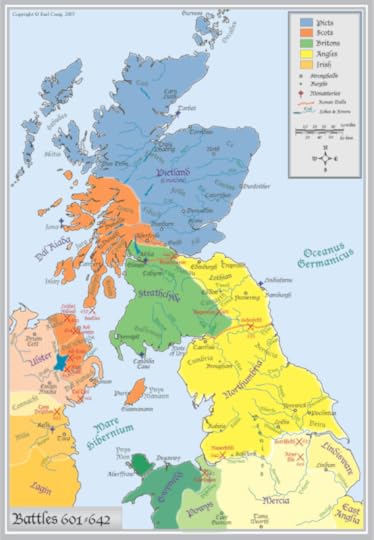
Dunadd has the reputation for being the inauguration site for the kings of Dàl Riata, the homeland of the Scottish Gaels, on the western seaboard of Scotland. The map below shows Dàl Riata in relation to its neighbours in the 7th century AD.
At the very top of the site, the shape of a human footprint has been carved deeply into the rock, and it is said that a new king would place his right foot on this carving, symbolically laying claim to the land. Dunadd is open to the public and is free to visit, so you can go along and place your own foot there, and proclaim yourself King of Dàl Riata!
Somehow or other the kings of Dàl Riata managed to establish themselves as the rulers of a joint Scottish/Pictish Kingdom, uniting Scotland north of the Forth-Clyde line, into the Kingdom of Alba. This happened in about the mid-ninth century, and the Pictish language seems to have then disappeared with remarkable rapidity, being replaced by the Scottish version of Gaelic. However the political centre of the new kingdom was in the east, around Scone and Dunkeld. Dunadd became a forgotten backwater.
The book itself is the report of an archaeological excavation carried out at the site in 1980-81. It opens with an expanded version of the background, before going into detailed descriptions of the numerous objects found at the site, as well as analyses of pollen samples, examinations of animal bones etc. It was all very informative although too detailed and specialised for the general reader, of which I am one.
The site was first inhabited in the 4th/3rd centuries BC, but the most substantial activity came from the 4th/5th centuries AD onwards. It’s possible that the site was uninhabited for the period in-between.
The finds included a fair collection of weapons, amongst them a sword fragment, (swords were rare and valuable items and would not have been casually discarded) spear blades, arrowheads, and crossbow bolts, all of which suggest the past presence of high-status warriors. The excavation team also found the remains of glass beakers imported from the Continent, and quality jewellery items worked with gold, garnet and jet. Ceramics showed evidence of contents like honey and dyer’s madder. Again, all this evidence, taken together, is supportive of the suggestion that the site was at the top of the local hierarchy, and most likely was a place of royal inauguration.
This book is on a specialised subject and is unlikely to appeal to anyone except people in Scotland with an interest in history. A good read for me though!
Dunadd has the reputation for being the inauguration site for the kings of Dàl Riata, the homeland of the Scottish Gaels, on the western seaboard of Scotland. The map below shows Dàl Riata in relation to its neighbours in the 7th century AD.
At the very top of the site, the shape of a human footprint has been carved deeply into the rock, and it is said that a new king would place his right foot on this carving, symbolically laying claim to the land. Dunadd is open to the public and is free to visit, so you can go along and place your own foot there, and proclaim yourself King of Dàl Riata!
Somehow or other the kings of Dàl Riata managed to establish themselves as the rulers of a joint Scottish/Pictish Kingdom, uniting Scotland north of the Forth-Clyde line, into the Kingdom of Alba. This happened in about the mid-ninth century, and the Pictish language seems to have then disappeared with remarkable rapidity, being replaced by the Scottish version of Gaelic. However the political centre of the new kingdom was in the east, around Scone and Dunkeld. Dunadd became a forgotten backwater.
The book itself is the report of an archaeological excavation carried out at the site in 1980-81. It opens with an expanded version of the background, before going into detailed descriptions of the numerous objects found at the site, as well as analyses of pollen samples, examinations of animal bones etc. It was all very informative although too detailed and specialised for the general reader, of which I am one.
The site was first inhabited in the 4th/3rd centuries BC, but the most substantial activity came from the 4th/5th centuries AD onwards. It’s possible that the site was uninhabited for the period in-between.
The finds included a fair collection of weapons, amongst them a sword fragment, (swords were rare and valuable items and would not have been casually discarded) spear blades, arrowheads, and crossbow bolts, all of which suggest the past presence of high-status warriors. The excavation team also found the remains of glass beakers imported from the Continent, and quality jewellery items worked with gold, garnet and jet. Ceramics showed evidence of contents like honey and dyer’s madder. Again, all this evidence, taken together, is supportive of the suggestion that the site was at the top of the local hierarchy, and most likely was a place of royal inauguration.
This book is on a specialised subject and is unlikely to appeal to anyone except people in Scotland with an interest in history. A good read for me though!
Displaying 1 - 1 of 1 review