This Is How the Bone Sings is a book about silence. These poems are about Minidoka, the concentration camp built in Idaho for Japanese Americans during World War II, drawing from myth and folk tale to talk about the legacy of trauma across multiple generations in America.
He holds degrees from Arizona State University (MFA, Creative Writing) and the University of Washington (BA, English). A recipient of fellowships from Kundiman and the Kenyon Review Writers Workshop, his work has been nominated for Best of the Net and the Pushcart Prize. He is currently an Assistant Professor in the Department of Writing at Grand Valley State University in Grand Rapids, Michigan.
Japanese internment camps were established during World War II by President Franklin D. Roosevelt through his Executive Order 9066. From 1942 to 1945, this policy made possible the relocation and incarceration of approximately 112,000 people of Japanese ancestry.
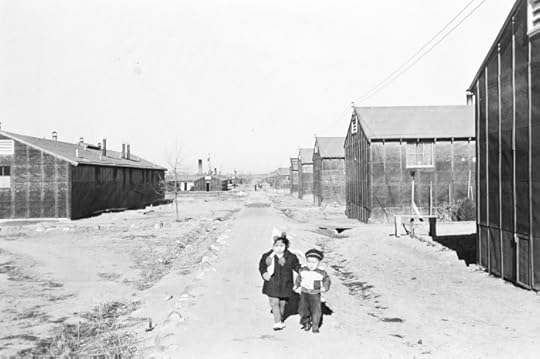
Minidoka Internment camp, Idaho
There is a place along the border where children sleep in the dark like there was once a prairie in Idaho where my father learned what Minidoka means--- a concentration camp under that scar spangled sky, all our ancestors bound in razor wire and splintered wood, the moon's careless gaze over us all.
The author's grandparents, and his father were among the American citizens unfairly imprisoned at Minidoka.
I was not at Minidoka, but I was bequeathed a piece at birth.
The scars still linger . . .
My grandparents are not ghosts--- but that place where they were broken still lives inside me. There are no ghosts, only Minidoka, land of woe, a blight in my body, hereditary decay.
And the tragic memories trickle down through the generations.
In my dream, my son is learning to talk but all he says is Minidoka. He is learning to walk but he just walks in circles.
These poems are filled with tremendous sadness, many dowsed in fairy tale imagery.
Minidoka. I never say your name aloud except when measuring my family's ghosts against the razor wire still wrapped around all our tongues.
A sorrowful commentary on a shameful past deed.
I say your name but it doesn't mean anything to people whose families were not left wrecked out on the prairie. So I call you America and let that name sit on my tongue like dust.
Todd Kaneko is the son and grandson of Japanese Americans interred in the Minidoka Concentration camp in Minidoka, Idaho. Each poem in this collection reads like a haunting, a ghostly presence of the past bleeding into the future. These poems teach history. They teach historical truths. They’re personal and tragic and hopeful. Some favorite lines:
from “all of this will be yours one day”:
“My son: I wonder what you will think about where we come from—that barbed wire
stretching over your head for decades, those guard towers standing between us”
In rich, sweeping language, poet W. Todd Kaneko explores the psychological effects over generations of American internment camps during World War II. These poems use place to express both beauty and horror, pulling the reader into the mind of the narrator, the narrator's interned parents, and the narrator's child who knew of the camps only by stories, as in these lines from "all the things that make heaven and earth":
" There are no such things
as ghosts--I tell my son this every evening as he gazes up the dark stairwell towards his room.
What will be waiting for us when my boy is old enough to ask where he comes from?
What will we find when our memories of camp finally molder back into the ground?"
Every word is concise and every sentence compelling. This is a profound book that will leave the reader meditating on the possible meanings of history. The collection strikes hard like a fist, but leaves room for tenderness.
This is a stunning collection of poems, blending history with myth and folklore to explore how the scars of the past carry through generations — from grandparents through to their grandchildren. The wounds caused by racism and hate are continue on through memory and story. These poems are evocative and beautiful, providing an important memorial for an aspect of American history that should never be forgotten.
Kaneko’s blending of poetic artistry and astonishing family legacy is inimitable. He plays with form, with language and imagery, all while paying homage to the generations who came before him, imprisoned at the internment camp Minidoka, and looking forward too, to the future and the birthright that will be left to his own son. A gorgeous collection - definitely will be reread and hopefully I’ll get to teach this in the future!
a beautiful, much needed collection full of generational trauma and the question of telling a story that isn’t necessarily one’s own. these poems explore the implications of silence through kaneko’s japanese-american identity, threading folklore and cultural references throughout while using visceral and sometimes violent images. themes of loss, parenthood, and truth seeking are very present and thoroughly explored.
This is a beautiful book that traces the generational effects of a shameful chapter of American history. The past survives as ghost and bone and dirt and love and care and connection. My favorites are the reading comprehension poems, a form that Kaneko has repurposed to an effect that makes use of both the familiar and the surprising.
Kaneko's first collection, The Dead Wrestler Elegies, is my husband's favorite poetry book, and he revisits it often. Kaneko's second, This Is How the Bone Sings, proves how insane his range is. Whether he's writing about pro wrestling or concentration camps, he's exploring history, our roots, the deepest questions about where we come from and who we are.