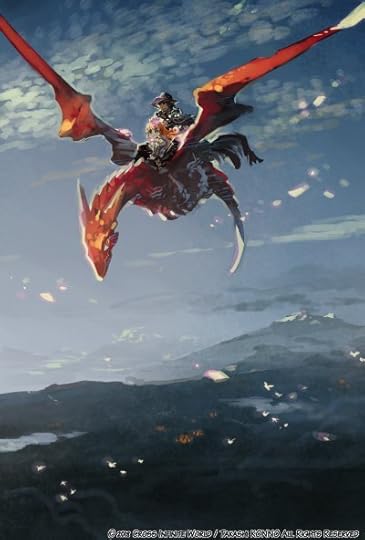
Little Princess in Fairy Forest is a breathtaking saga of a young princess, Lala, who must fight for her very existence with the last of her royal knights, Gideon Thorn. Her pursuer, the tyrannical Lord Designs Siegfried, will stop at nothing to wed Princess Lala and legitimize his reign—he’s already massacred the rest of the royal family.Princess Lala and Gideon are doggedly pursued even as they flee into the Forbidden Forest, a land relegated to myth and legend because of dragons—the mortal enemies of knights. Join Lala and Gideon as they flee for their lives in an attempt to survive the traitor’s deadly machinations. Gideon is willing to do anything to protect his princess, even if it means engaging the mighty dragons in combat.
If I could, I'd give it a 3.5, but as 4 feels a little too generous... 3 stars.
It's cute, but I wish the writing was a little less juvenile so it didn't clash so much with some of the darker themes. It reads like a middle grade book, but the plot points are a little more for older audiences. I liked both independently of each other (for the most part), but together, it's a bit debatable how well it works.
The writing has some weird translation issues. It uses titles in place of names in the narrative. "Witch did this" or "Knight did that" or "This is all for Princess." What made it more frustrating was that it was inconsistent. Sometimes, the translator would include "the" to say "the witch" or "the dragon." I'm not sure why they made this creative choice in the English version, but it kept bothering me the whole time.
Story-wise, it's a bit disjointed at the start, but once the time-skip occurs a few chapters in, the pacing evens out and the story's timeline becomes less "events that happen" and become more linearly cohesive.
The characters are simple and fit the fairy tale feel. They don't need to be deep because this really feels like an extended fairy tale, and in that it works.
I'd also like to add that I really liked the art. It's a little rough, but it felt intentional and worked pretty well for this one.
It's worth a read, especially if you like fairy tales. Just be prepared for monsters and pretty cruel deaths on top of your friendly dragons and fairy godmothers.
What is it? The author's take on their own classic fairy tale, Little Princess is the story of Princess Lala Lalia who kingdom has suffered a rebellion at the hands of the evil Lord Designs. She escaped with The Thorn Knight Gideon and the pair eventually find themselves face to face with a fearsome dragon. The dragon, a knight's worst enemy agrees to help Gideon protect his young charge and the two reluctantly work together to keep the princess safe.
What are the characters like? There is literally no one in this book I disliked. Or...I suppose I should say, disliked reading about. The villains obviously did horrible things and I wasn't rooting for them but it was that fairy tale over the top where you don't really hate them you just wonder what bad thing they are going to do next.
Anyone particularly cool? Picking one person is hard because I think what made these characters shine was really their interactions between. In the beginning, interactions between Lady Megan and her father were very interesting and made you wonder what was to come. The small family Gideon, Lala and Spike made together was adorable and I would have loved to spend the entire book with just their happy family adventures. Then the Witch towards the end how she changed and grew. Oh, I love them all!
What's the bad news? Written to be a classic fairy tale I feel like it had a few classic fairy tale issues. It has the odd convenient miracle and the odd bits of unexplained magic that is just there. I was a little disappointed as in the story that followed Lady Megan. She was really cool, I loved the idea behind her character but...can't go into detail without spoiling but I would have taken it in a different direction I guess.
And the good news? It's good! Like really good. Character dialogue and interaction makes the story. Spike and Gideon's butting relationship and their struggle to be dads to this brave little seven-year-old who takes as little shit as her small body can fight off. The spiralling madness of Lord Designs, the beautiful mystery that was Lady Megan. I want a movie of this book and then I want a spin-off series of Spike and Gideon adventures. Preferably animated with the books amazing art style. Overall the story is well paced, cliche enough to fit into that classic dark fairy tale bracket the author aimed for but brakes a couple of cliches in the right places to make perfect for a modern audience.
When I first looked at the cover, I was reminded of the artist of Final Fantasy XII and Bravely Default. It fits considering Little Princess in Fairy Forest contains a very common video game storyline: save the kingdom from a coup.
In many ways, Siegfried’s attempt is a rousing success. He has killed the current monarchs and has control of the castle. Unfortunately, his plan hits a major roadblock: only one who has been blessed by the spirit realm can actually reign. Since six-year-old Princess Lala is the only one left who fits the bill, Siegfried has only one option:
Marry the princess!
And no, he’s not waiting.
Eeeesh. Good thing Lala has managed to escape thanks to Gideon, the kingdom’s last knight.
Now, with a setup like this, you may expect Gideon and Lala to lead a bunch of ragtag loyalists to quell Siegfried’s army. Instead, the pair gain one major ally: a dragon named Spike. (No, he’s not small and purple.) The three end up living in the woods, biding time until the fated moment when they must confront Siegfried.
Yes, despite the “fairy forest” part of the title, the light novel doesn’t spend the bulk of the story on having the young, sheltered heir meeting a bunch of spirits. This isn’t The Ancient Magus’ Bride, which is ironic considering Gideon’s title is the Thorn Knight — very similar to the Elias’ title of Thorn Mage. However, like that series, Little Princess in Fairy Forest is inspired by classical English fairy tales and mythos.
The illustrations are old-fashioned sketches, and the story makes several references to rules like knights and dragons being mortal enemies and assisting damsels-in-distress. Everything is so much like a medieval fantasy story that I might not have pegged this as a Japanese light novel. Even the fact that the novel is a complete adventure covering Lala’s escape, the group’s life in the forest, and the return to the castle gives it a Western feel, and it’s paced very well.
Plus, it isn’t often that a Japanese light novel focuses on a young girl and a middle-aged man instead of teenagers. Oh, and one dragon. Spike and Gideon are the best part of the story, a couple of de facto Musketeers who like to squabble and reaffirm their devotion to Lala. Spike is learned in the ways of the world (and strong to boot), and Gideon is neither an anti-hero who was forced into his role nor a infallible warrior. Both have regrets, and this makes their oaths all the more meaningful. Their dialogue also contrasts with Lala’s, as her sections are written in short, childish phrases. It is more realistic, but it’s also not the most engaging read. Fortunately, even at her young age, she has the noblesse oblige of a royal, but I’d still rather have the story kept in third person point-of-view with an omniscient narrator.
The final developments also rely on a particular individual who is not loyal to Siegfried. In fact, the heroes luck out a couple of times because he doesn’t have any loyalists to his cause. His only ally is his daughter, Megan, whose soul he sold to the devil. If that sounds disturbing, there is an even more horrifying event in the novel that will likely grip readers. The confrontation with Siegfried is a textual spectacle, but I didn’t like how one of the mercenaries gave a critical assist. At least the small cast means that the light novel can tightly tie everything together, leaving room for a spin-off. (More Gideon and Spike, please!)
I really do hope we can visit these characters again, as Little Princess in Fairy Forest proves that all fairy tales involving princesses don’t need to be solved with true love’s kiss. Sometimes, all a princess needs is a knight past his prime and one oversized flying lizard.
As a huge fan of stories that incorporate fairy tale elements, I was pretty happy to see Cross Infinite World pick up a light novel that does just that. From Princess Lala fleeing her castle because of the traitor Lord Designs to Lady Megan with her black magic mirror to black knights, witches, and dragons, this story is full of fun fantasy and fairy tale elements. The first half of the novel does a good job with introducing the different characters and establishing their distinctly different personalities. The clash between Dragon and Knight over how to raise Lala was a lot of fun to read.
The second half is where all the action really kicks in with fighting the undead and air battles from the back of the dragon. I would say this is Cross Infinite World's most action-packed light novel to date. And the action is handled really well too. My only gripe is that this is a standalone novel and we won't be able to see what adventures lie in wait for the characters next. Overall, this is a fun read and I can recommend it to anyone looking for an action-oriented dark fantasy/fairy tale story with dragons. The dragon has a much bigger role than I was expecting, which was a very pleasant surprise! Too many stories toss out that they have dragons and barely do anything with them. If you like the Dragonheart movies, I'm pretty sure you'll like this too! I'm huge fan of the first movie, and I kept hearing the dragon from this speaking in Sean Connery's voice because of it!
It took me a bit to get into this book... I found it hard to read, partly because of the odd cadence to the grammar that most Light Novels have on account of being translations, and partly because it's written in present tense.
Once I got used to that though the book is good! Very dark in places... I mean goodness it gets mega Grimm sometimes. One section goes straight up Dark Souls. But it's also got a lot of sweetness to it and it ends nicely. Also there's a good dragon in this and I adore him <3 and the fact that he's a main character from practically the start.
Nicely crafted single volume fantasy that covers a very age-old trope of the knight protecting his princess. What makes it interesting is the addition of the Dragon, usually the major antagonist, is on the side of the heroes this time and forges a very strong bond with the knight to protect the princess.
The worldbuilding is great, but limited and the author leaves just enough loose threads hanging for a potential addition to the world, yet still manages to wrap up the book very nicely.
A great read over the weekend that evokes a nostalgia for fairy tales.
This is a story about redemption, clothed in a fairytale. Visually, it is a stunning read. There are many passages in this story that I wish to see animated on screen. I loved the lore and the world building. There was care taken with the finer details of the Black Forest, and the guardians of the little princess, the Black Night and the Dragon, were wonderful characters.
Unfortunately, the story seems to have craftsmanship errors. The first problem I had with the story was that it was unclear who the main character was. The story began in the first person point of view of the princess, but soon it became evident that she was mostly a passenger in this tale. The point of view often fluctuated between Gideon's first person point of view and a third person narrative about Gideon. At one point, a passage was related about Gideon in the third person, switched to the 3rd person POV of the villain, then became Gideon's first person POV. The overall affect was jarring. There were also passages that began in the princess's first person POV, then became a third person POV by the next paragraph, complete with adult language, unless seven-year-olds use words like "coalesce" in this fairy world. In fact, one might be confused that this is a children's tale because of the first chapter told from the point of view of a seven year-old, but soon salty language, sexual innuendo, and graphic violence reveal this story to be geared towards young adults.
The narrative also fluctuated between fluffy sections with anime comedy dialogue to thoughtful passages with depth and pathos to nightmarish scenes of grisly horror. There was a decided lack of narrative continuity throughout the entire book. At first, I thought perhaps these were translation errors, but I ended up feeling that this was a problem with the source material. I appreciated the afterword where the author explained his reasoning behind pitting the middle-aged black knight versus the middle-age tyrant. Unfortunately, the tyrant came across as a pointless character, lacking any depth whatsoever. There was an effort to explain his delusions, as well as an effort to reveal who the real villain of the story was, but I found the true villain wanting in depth as well.
So, it was a terrible book? No. It was a lovely tale. Despite the narrative flaws, and the flat villains, the story was rich, and the main characters were interesting. I felt compelled to continue reading. Isn't that what we want from a book?
This was Tsubaki Tokino's first work, and although it is rough in places, his visionary talent shines brightly. I loved the ideas presented as well as the Japanese take on European fairytales. The gruesome monster at the end was also chilling and vividly described. Often, I find the epilogue anticlimactic, but this epilogue hit all the right notes, including a heart-breaking scene were the reader found closure along with the main characters for the most horrific event in the story. I look forward to Tokino's future stories. Fans of anime fantasy should feel right at home here.
I think this is a lesson in how to write fairy tales; there’s a distance, to be sure, but this one felt it was too distant from the ongoings of the story. On the other hand, the more I read the story, the more the narrative almost naturally falls closer to what’s going on, it feels that something (be it the translation, editing, or something else) would reach in and yank it back to its initial distance and it happened quite a bit to where there were times that I’ve nearly wanted to DNF. I can understand the desire to yank it away from it because it’s meant to be read as a storybook and at times, it works well but it works well because I’m close enough to discern the story itself.
There were a lot of times where it wanted to be an adult fairy tale so badly but it doesn’t because the princess character is a young child. Rather, it’s easier to say that it wants to go darker but then remembers there’s a child or two in the story and it makes me question: who is this aimed for? Because it’s certainly too “young” to be an adult fairy tale but it doesn’t feel like it’s edgy enough, not really, to be for young adults or higher. There’s a lot of content that I’m not sure would fit appropriately for younger kids either, especially near the end. When you write a fairy tale, I think it’s important to consider who you want the story to be aimed at and more importantly, why. Don’t get me wrong, you don’t need to know these things at the beginning, the end, or if at all, but it might help to condense the themes more if you, the author, know who you’re writing for.
I think, at least for me, there are quite a bit of unique ideas that I wish were explored more in the scope of the story. Again, I understand the nature of light novels in general tend to leave stuff like that hanging. Not only that, and again I reiterate, that I do think there should have more to it than what I got.
There’s quite a bit of POV switches which normally wouldn’t bother me but for something as short as this, it can be a bit jarring. I think what makes it worse is that there’s also time skips involved which doesn't help with its confusing setting on whose POV the moment is in or especially when. I think there’s a desire from the author to explore some of these ideas/themes more which is why I’m wondering what happened and why it felt there’s clear and forceful reigning in of the prose and narrative. Still, this was enjoyable.
I did get very worried about the villain and how he’s to be shown along with his motives, especially. Granted, it’s not terrible and I wasn’t expecting too much, but I just don’t want him to be weird to be weird. There’s some anime bullshit, as always, and because of that constant worry, it’s likely I’m harsher to this light novel than need to be. I do love the sketchy images in the book and that adds to it.
There are a lot of things to love about this book, honestly, for as harsh as I’ve been. Truthfully, the strongest things are the bonds between Gideon, the princess, and the dragon. If it was just the book with all three of them vibing in the forest, I would have been okay with it but I understand there's a plot to be had.
At the end of the day, this book thankfully is a simple and sweet fairy tale that could have been more for me. I think if you’re the type of reader who wants something short, fast, to the point and maybe some fun ideas, you’ll enjoy this more than me. It’s just me being picky as usual; I guess the way I feel about it is – if you’re going to be a light novel, give me a reason to care about the characters and give me time to care about them. Fairy tales are one of my most favorite genres to read and explore, so this was disappointing for me in that aspect.
Interesante novela ligera, con notable influencia de los cuentos folklóricos medievales, como se podría imaginar con tan sólo ver el título. Más que de la princesa (que por cierto, ES pequeña: tiene tan solo 7 años), la historia corre por cuenta de sus dos protectores: un dragón y un caballero de mediana edad. Tal vez no sea la combinación con la que estemos más familiarizados, pero funciona. En lo personal el caballero (Gideon Thorn) ha sido mi favorito, dadas las ínfulas de sofisticación con las que cuenta el dragón (Spike). Sin embargo, como bien dije, la química de la dupla es impecable, tanto en las escenas de acción como en las de humor en las que participan ambos. Otro punto alto son los villanos. Son horribles y no tienen escrúpulos en hacer lo que sea, pero a fin de cuentas hay una razón para que lo hagan, aunque la manera en la que se explayan sobre el tema pueda ser algo superficial. De nuevo, tal vez los crímenes que cometen sean algo fuertes, por lo que no recomendaría este títulos a niños pequeños o personas de sensibilidad extrema. Lo que me lleva a una de las críticas, que son ciertas escenas en tono de picaresca que me parecieron totalmente innecesarias y fuera de lugar. No me voy a extender en esto (quien lo lea, sabrá a lo que me refiero), aunque a su favor debo decir que solo se dieron en un par de oportunidades y casi no van en detrimento de la historia en general. Salvo ese par de inconsistencias, me ha parecido un libro bastante entretenido. Recomendado tanto para los lectores de fantasía medieval como a los de literatura japonesa contemporánea.